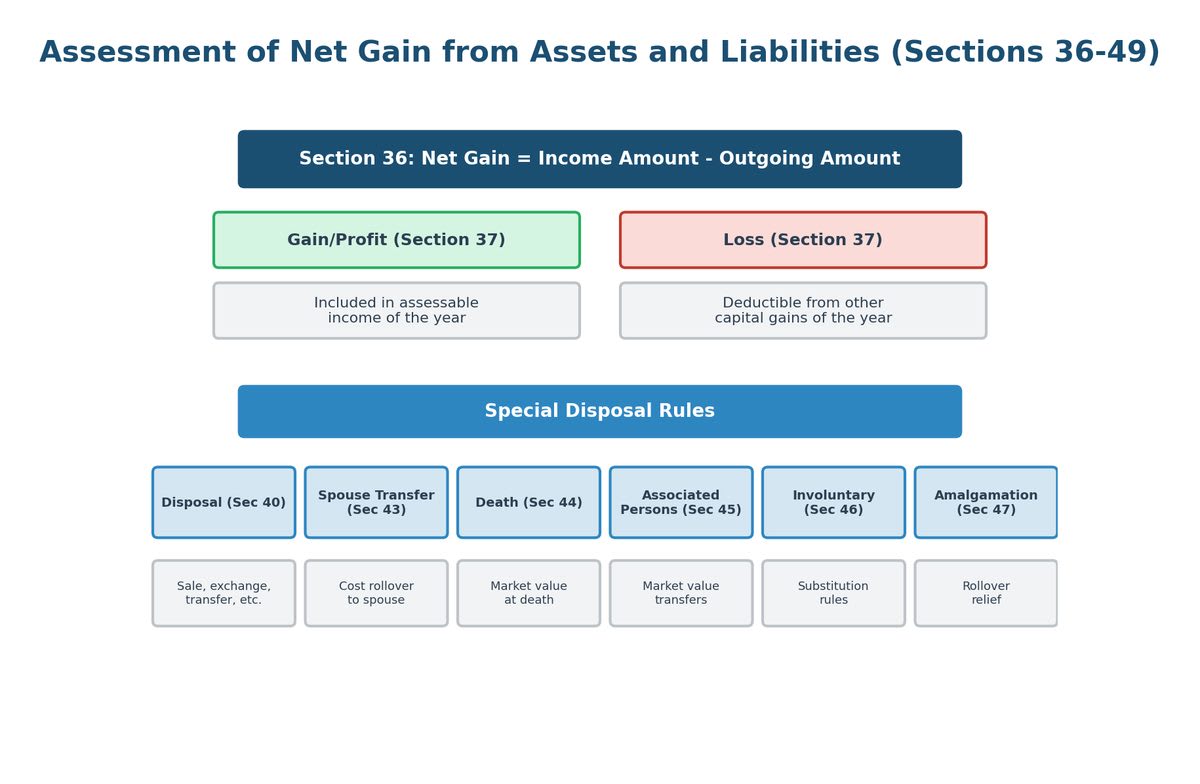
Figure: Assessment of Net Gain from Assets and Liabilities (Sections 36-49)
36. Net profits from asset and liability
(1) The net profits derived from the disposal of business assets or liability of a business of any person for any income year shall be computed by deducting the following losses from the sum of all profits derived from the disposal of business assets or liability of that business in that income year:-
(a) The sum of all losses suffered in that year from the disposal of business assets or liability of that business,
(b) The loss that could not be deducted elsewhere out of the net loss suffered from any other business of that person in that year, and
(c) The loss that could not be deducted out of the net loss suffered from that business or from any other business of that person in any past income year.
Particulars | Amount (Rs.) |
A. Total gains from disposal of business assets/liabilities | XXX |
Less: Deduction of losses | |
(a) Losses from disposal of business assets in the same year | (XXX) |
(b) Unadjusted loss from other business of the same year | (XXX) |
(c) Brought forward unabsorbed business losses | (XXX) |
Net profit from disposal of business assets (Taxable) | XXX |
The net gain from disposal of business assets or liabilities in the business is included when determining the income of the business pursuant to Section 7(2)(c) of the Act.
Example 22.3.1: Suppose Suleman is a natural person. Among his businesses, Suleman Grocery is one. That business had a net loss of Rs. 2 lakhs in income year 2065/66. His other business is Suleman Furniture Trade. That furniture trade had a loss of Rs. 3 lakhs in that year (unrelieved). His furniture trade had a loss of Rs. 2 lakhs in income year 2064/65. Land used for business purposes in that trade was sold in that income year for Rs. 50 lakhs. He had purchased that land four years earlier for Rs. 20 lakhs. Calculation of net gain from disposal of business assets:
Example 22.3.1 - Net Gain from Business Asset Disposal (Suleman) | |
Item | Amount (Rs.) |
1. Incomings: Land sale | Rs. 50 lakhs |
2. Outgoings: Cost value of land | Rs. 20 lakhs |
3. Gain (1 - 2) | Rs. 30 lakhs |
4. Business loss for this income year (Grocery Rs. 2L + Furniture Rs. 3L) | Rs. 5 lakhs |
5. Business loss in previous income year (Furniture FY 2064/65) | Rs. 2 lakhs |
6. Unrelieved business loss due to time expiry | Rs. 0 |
Net Gain (3 - 4 - 5 - 6) | Rs. 23 lakhs |
(2) The net profits derived from the disposal of taxable non-business assets of investment of any person for any income year shall be computed by deducting the following losses from the sum of all profits derived from the disposal of taxable non-business assets of that investment in that income year:-
(a) The sum of all losses suffered in that year from the disposal of non-business taxable assets of that investment,
(b) The loss that could not be deducted elsewhere out of the net loss suffered from any other business or investment of that person in that year, and
(c) The loss that could not be deducted out of the net loss suffered from that investment, any business or any other investment of that person in any past income year.
Particulars | Amount |
A. Total gains from disposal of taxable non-business investment assets | XXX |
Less: Deduction of losses | |
(a) Losses from disposal of taxable non-business assets of same investment (same year) | (XXX) |
(b) Unadjusted loss from other business or investment of same year | (XXX) |
(c) Brought forward unabsorbed losses (business/same or other investment) | (XXX) |
Net profit from disposal of taxable non-business investment assets (Taxable) | XXX |
The net gain from non-business taxable assets used in investment is calculated as the amount to be included when determining investment income pursuant to Section 9(2)(b) of the Act.
Example 22.3.2: Suppose Suleman is a natural person. He had a loss of Rs. 2 lakhs from share sales in income year 2065/66. He also has a furniture trade. That furniture trade had a loss of Rs. 3 lakhs in that year (unrelieved). His furniture trade had a loss of Rs. 2 lakhs in income year 2064/65. He sold his private land (non-business taxable asset) in his own name in that income year for Rs. 60 lakhs. He had purchased that land four years earlier for Rs. 20 lakhs. Calculation of gain on the asset:
Item | Amount |
1. Land sale (disposal of non-business taxable asset) | 60 lakhs |
2. Cost value of land | 20 lakhs |
3. Gain (1-2) | 40 lakhs |
4. Loss this year from disposal of investment taxable non-business assets (shares) | 2 lakhs |
5. Loss in other business in same income year (furniture trade) | 3 lakhs |
6. Loss in other business in previous income year | 2 lakhs |
Net Gain (3-4-5-6) | 33 lakhs |
(3) Any person may make a claim for deduction pursuant to sub-section (1) or (2) in respect of a loss suffered from the disposal of property or liability of foreign source only to the extent of the profit derived from the disposal of any property or liability of foreign source.
Type of Loss | Allowed Set-off Against | Restriction |
Loss from disposal of foreign source business assets or liabilities | (i) Gain from disposal of foreign source business assets or liabilities | Can be set off only within foreign source income; cannot be set off against domestic gains |
Loss from disposal of foreign source investment taxable non-business assets | Gain from disposal of foreign source investment taxable non-business assets | Can be set off only within same foreign source investment gains; no cross-set-off with domestic or business gains |
An example explaining the above provision is presented below.
Example 22.3.3: (Incorrect in Directive)
Suppose Suleman is a resident natural person. He had a loss of Rs. 5 lakhs from sale of shares in India in income year 2065/66. He had a loss of Rs. 2 lakhs from his Nepal business in that income year. He also has a furniture industry in India. That furniture industry had a loss of Rs. 3 lakhs in that year. His industry sold land (business asset) used in India in income year 2064/65 at a loss of Rs. 20 lakhs. That loss could not be set off in the previous income year. In this income year, he sold another piece of land of that same industry in India for Rs. 60 lakhs. He had purchased that land four years earlier for Rs. 20 lakhs. The calculation of gain from disposal of business assets in India is as follows (Rs. in lakhs):
Particulars | Amount (Rs.) |
1. Land sale in India (disposal of business asset) | 60 lakhs |
Deduct: Cost value of land | 20 lakhs |
Gain (1-2) | 40 lakhs |
Less: Loss in Indian furniture industry | 3 lakhs |
Less: Loss from disposal of business assets in India in previous year | 20 lakhs |
Less: Loss from disposal of Indian shares (Investment Loss not claimable) | 0 |
Less: Nepal source business loss | 2 lakhs |
Net Gain | 15 lakhs |
Losses from disposal of foreign source assets and liabilities may only be claimed up to the extent of the gain from disposal of assets and liabilities of the same foreign source. They may not be set off against gains from disposal of Nepal source assets. An example explaining the choice of deduction provision is presented below.
Example 22.3.4: Suppose the income position of any person is as follows:
(1) Gain of Rs. 50,000/- from disposal of business assets;
(2) Loss of Rs. 30,000/- from disposal of business assets in a previous year; (3) Loss of Rs. 10,000/- from foreign source assets.
That person can deduct the loss from disposal of business assets of Rs. 30,000/- in the previous year from the gain of Rs. 50,000/- from the above disposal of business assets, but the loss from foreign source assets of Rs. 10,000/- cannot be deducted from the gain from disposal of Nepal source assets. That is, when calculating foreign source assets/liabilities and gain and loss, separate calculations must be made for each foreign country on a Per Country Basis.
(4) If any person is entitled under sub-section (1) or (2) to deduct the net loss suffered from a business or investment in more than one computation pursuant to sub-section (1) or (2), that person may select computations for the purpose of deducting that loss or portion thereof.
Explanation: For the purposes of this Section,-
(1) "Net loss" means,-
(a) In respect of any business, the amount to the extent that the loss suffered from the disposal of the business assets or liability of that business in any income year exceeds the profit derived from the disposal of business assets or liability of that business in that year, and
(b) In respect of any investment, the amount to the extent that the loss suffered from the disposal of the taxable non-business assets of that investment in any income year exceeds the profit derived from the disposal of taxable non-business assets of that investment in that year.
(2) "Net loss that could not be deducted" means, with respect to any business or investment:-
(a) The loss in any income year that could not be deducted pursuant to clause (b) or (c) of sub-section (1) or clause (b) or (c) of sub-section (2), out of the net loss suffered by that business or investment in that income year, and
(b) Any loss of that business or investment referred to in sub-section (7) of Section 20 that could not be deducted and is not qualified for remission by virtue of the time-limit referred to in sub-section (1) or (2) of Section 20.
Net gain on disposal of assets/liabilities (Sec 36): (1) business assets/liabilities → net gain = total gains − (current-year losses on business assets/liabilities + unrelieved losses of other businesses, current & prior); included u/s 7(2)(c). (2) investment non-business taxable assets (NBTA) → net gain = total gains − (current losses on NBTA + unrelieved business/investment losses, current & prior); included u/s 9(2)(b). (3) Foreign-source loss is ring-fenced: deductible only against gains of the same foreign source
37. Profit and loss made from asset and liability
(1) The profit derived by any person from the disposal of any asset or liability shall be computed, considering it to be the extent that the sum of the incomes derived from that asset or liability exceeds the sum of the outgoings for that asset or liability at the time of disposal.
(2) The loss suffered by any person from the disposal of any asset or liability shall be computed, considering it to be the extent that the sum of the outgoings for that asset or liability exceeds the sum of the incomes earned from that asset or liability at the time of disposal.
Example 22.4.1: Suppose any natural person sold a house built one year earlier. The total cost of purchasing land and building that house up to the time of sale was Rs. 1,20,00,000. At the time of sale, a cost of Rs. 20,000/- was incurred for selling, so the total outgoings (Outgoings) for that house at the time of disposal were Rs. 1,20,20,000.
If Rs. 1,25,00,000/- was received from the sale (Incomings), the outgoings (Outgoings) for that asset were Rs. 1,20,20,000, resulting in a gain of Rs. 4,80,000.
If Rs. 1,19,00,000/- was received from the sale (Incomings), the outgoings (Outgoings) for that asset were Rs. 1,20,20,000, resulting in a loss of Rs. 1,20,000/-.
38. Expenses and net expenses for asset and liability
(1) The following expenses shall be included in the expenses for the asset or liability of any person, subject to this Act:-
(a) In respect of any asset, the expenses made by that person in acquiring that asset, inclusive of the following amounts:-
(1) The related expenses made in the construction and production of that asset, and
(2) Any amount required to be included in the computation of the income of that person as a result of acquisition of such asset.
(b) The expenses made by that person in obtaining the ownership of that asset or liability, inclusive of the expenses incurred in the alteration, improvement and repair and maintenance of the asset or liability, and the expenses in the repair and maintenance of the asset,
(c) The expenses made by that person in the disposal of the asset or liability, and
(d) Casual expenses made by that person in acquiring the asset or bearing liability and in disposing such asset or liability.
Provided that the expenses referred to in clauses (a), (b), (c), (d) and (e) of sub-section (1) of Section 21 and the expenses that are allowed to be deducted in the assessment of income shall not be required to be included in such expenses.
(2) The net expenses for any asset or liability at any particular time shall be so computed as to consider the amounts to the extent of excess of the sum of all expenses for that asset or liability over the sum of all incomes for that asset or liability at that time.
(3) The amount of expenses to be deducted in computing the income as referred to in Chapters-6 and 7 shall be deemed as if they were made in respect of the expenses for any asset or liability and shall be applicable in respect of the expenses referred to in sub-section (1).
Provided that Section 26 shall not apply to the above-mentioned provision.
Example Explaining Section 37(3) Business Asset
A machine is purchased for Rs. 1,000,000.
During use:
Repairs = Rs. 100,000
The Rs. 100,000 is deducted as a business. Later, the machine is sold.
Without sub-section (3), one might argue that the repair cost should again be included in the asset's outgoings when computing gain/loss on disposal.
Outgoings are divided into 4 main categories:
Category | Meaning |
(a) Amount paid at inception | Cost of acquiring asset/liability |
(b) Amount paid during holding | Improvement, repair, maintenance |
(c) Amount paid at disposal | Selling/transfer expenses |
(d) Tax-related payment | Tax paid on receiving asset/liability |
The following are excluded from Outgoings:
Expenses already deducted in business income calculation
Personal expenses
Expenses not related to that asset or liability
Expenses referred to in clauses (a), (b), (c), (d) and (e) of sub-section (1) of Section 21
Example 22.5.1: Suppose Gopal Sapkota purchased land for Rs. 40 lakhs in income year 2060/61. He paid a broker commission of Rs. 2 lakhs when purchasing that land. The expenses for documentation and registration of that land were Rs. 1 lakh 75 thousand. He incurred Rs. 3 lakhs for constructing a boundary wall on that land. He took a loan from a bank to purchase that land. By income year 2066/67, he sold that land for Rs. 1 crore. By that date, interest of Rs. 7 lakhs had been paid. He paid a broker commission of Rs. 3 lakhs when selling the land. He spent Rs. 50 thousand on a feast for his well-wishers at a celebration of purchasing the land. In this situation, the calculation of outgoings (Outgoings) for that land is as follows:
Particulars | Amount |
Purchase price of land | Rs. 40 lakhs |
Broker commission for land purchase | Rs. 2 lakhs |
Documentation and registration | Rs. 1.75 lakhs |
Boundary wall | Rs. 3 lakhs |
Interest expense | Rs. 7 lakhs |
Feast expense (not allowed) | - |
Broker commission for land sale | Rs. 3 lakhs |
Cost of land (outgoing) | Rs. 56.75 lakhs |
Accordingly, Rs. 56 lakhs 75 thousand is considered the outgoing for that land for the purpose of calculating the gain from disposal of that asset.
When the asset was received without paying the cost, or when the person had to pay tax due to the appreciation of the asset, the amount included in the tax accounting for that asset or appreciation is considered the outgoing (Outgoings) for that asset. An example explaining that situation is presented below.
Example 22.5.2: Suppose a foreign government gave employment to Michel, a citizen of that country, at that country's embassy in Nepal. In addition to cash salary, that foreign government also gave him some Bonds issued by that foreign government. The current market value of those Bonds is assumed to be Rs. 1 lakh. For him, the cash and Bonds received as salary are tax-exempt amounts under Section 10 of the Act. Suppose in the following year he sold those Bonds in Nepal for Rs. 1,05,000/-. In this situation, when calculating the gain from disposal of that asset, it must be calculated taking expenses as Rs. 1,00,000/- and income as Rs. 1,05,000/-.
Example 22.5.3: Suppose Gopesh and Company Pvt. Ltd. paid Rs. 40 lakhs for purchasing land. In the following year, the expense for maintaining that land was Rs. 1 lakh. In the third year, it received Rs. 2 lakhs for resolving some unresolved boundary disputes with neighbors. In such a situation, the net outgoings (Outgoings) for that land are calculated as follows:
Year | Transaction | Amount |
First year | Outgoings for land | Rs. 40 lakhs |
Second year | Outgoings for land maintenance | Rs. 1 lakh |
Second year | Outgoings for land (cumulative) | Rs. 41 lakhs |
Third year | Disposal of land (incomings) | Rs. 2 lakhs |
Third year | Outgoings for land (net) | Rs. 39 lakhs |
39. Income and net income for asset and liability
(1) The following amounts shall be included in the income for the asset or liability of any person, subject to this Act:-
(a) The amounts received by that person, in respect of the liability, in bearing the liability,
(b) The amounts to be received by that person in acquiring the asset or in respect of bearing the liability, including the amounts acquired by altering or lessening the value of the asset or increasing the liability, and
(c) The amounts received or to be received by that person in respect of the disposal of that asset or liability.
Provided that the amounts exempted from tax, amounts subject to tax deduction finally, or amounts to be included in the income in assessing the income of that person shall not be included in such income.
Income (Incomings) from an asset or liability is divided into 3 main categories:
Category | Meaning |
(a) Amount received at inception | Amount received in connection with acquiring an asset or assuming a liability |
(b) Amount received during holding period | Amount received due to changes in the value of the asset or increase in the liability |
(c) Amount received at disposal | Amount received or receivable upon disposal of the asset or liability, or upon discharge/settlement of the liability |
Other Incomings Included
Category | Meaning |
Amount received when assuming a liability | Consideration received for taking on an obligation or liability |
Amount received from value changes | Amounts arising from appreciation, revaluation, forgiveness, or other increases in economic benefit related to the asset or liability |
The Following Are excluded from Incomings:
Amounts exempt from tax under Section 10
Amounts subject to final withholding taxation under Section 92
Amounts already included in the calculation of taxable income under another provision of the Act
(2) The net incomes for any asset or liability at any time shall include the amounts to the extent of excess of the incomes for that asset or liability over the sum of all expenses for that asset or liability at that time.
(3) The amount to be included in the income in computing the income as referred to in Chapters-6 and 7 shall be deemed as if they were made in respect of the incomes for any asset or liability and shall be dealt with pursuant to sub-section (1).
Provided that Section 26 shall not apply to the above-mentioned provision.
40. Disposal of asset or liability
(1) If the ownership of any person over any asset ceases, that person shall be deemed to have disposed of that asset. The disposal of asset shall include acts such as distribution of the asset by the owner of the asset, amalgamation of the asset in other asset or liability, sale of the asset by installments or lease of the asset to any other person under a financial lease, cancellation, destruction, loss, expiration or surrender of the same.
(2) If the burden of liability of any person ceases, that person shall be deemed to have disposed of that liability. The disposal of liability shall include acts such as settlement, cancellation, release, completion of the liability or amalgamation of liability in other liability or asset.
Example 22.7.1: Suppose Medico Nepal Pvt. Ltd. is a pharmaceutical manufacturing company. Another pharmaceutical manufacturing company named Global Lab Nepal Limited conducted a Takeover (acquisition) of it effective from date 2065.10.1. In such an acquisition, Medico Nepal Pvt. Ltd. is deemed to have disposed of its assets and liabilities.
(3) Notwithstanding anything contained in sub-sections (1) and (2), any person shall be deemed to have disposed of any asset or liability in the following circumstances:-
(a) In respect of an natural person, immediately before the death of that person,
Any asset in the ownership of a natural person is deemed to have been disposed of immediately before the death of that person. The incomings from this type of disposal are necessary not only for the purpose of calculating the gain for tax purposes but also for the purpose of determining the outgoings for the recipient. An example explaining that situation is presented below.
Example 22.7.2: Suppose Mahendra Malla had a house and land in Nepalgunj purchased on date 2064.3.15 for Rs. 1 crore. He died on date 2066.5.6. At that time, the value of the house and land was Rs. 1 crore 20 lakhs. Immediately before Mahendra Malla's death, i.e., on date 2066.5.6, disposal of his assets at Rs. 1 crore 20 lakhs is deemed to have occurred. So, Rs. 1 crore 20 lakhs is cost for the heir for calculation of outgoing.
(b) In respect of any asset, if the sum of the incomings for that asset exceeds the sum of the outgoings for that asset,
For income tax purposes, depreciable assets are accounted for on a pool basis, and when assets of that pool are disposed of and the amount received (income) exceeds the pool's depreciation base (i.e., outgoings), the excess amount must be included in income pursuant to Section 7(2)(d) of the Act, and the remaining value of that asset pool becomes zero and that asset is deemed to have been disposed of. An example explaining that situation is presented below.
Example 22.7.3: Suppose Sagesh and Company Pvt. Ltd. has the following assets under Group 'B' at the beginning of income year 2065/66:
Furniture | Rs. 50,000 |
Computer | Rs. 1,00,000 |
Total Depreciation Base | Rs. 1,50,000. |
In income year 2065/66, the company did not purchase any additional assets in that pool. However, the company sold furniture for Rs. 2 lakhs in that year. In this situation, the depreciation base of the pool, i.e., Rs. 1 lakh 50 thousand, constitutes the outgoings for disposal purposes, and the received amount, i.e., Rs. 2 lakhs, is the incomings.
Since the received amount (Incomings) from the disposal exceeds the outgoings (depreciation base), the excess amount, i.e., Rs. 50 thousand, must be included in income pursuant to Section 7(2)(d) of the Act, the remaining value of that asset pool becomes zero, and that asset (pool) is deemed to have been disposed of. If the furniture had been sold for an amount less than Rs. 1 lakh 50 thousand, the remaining value would have represented that Group 'B' pool.
(c) In respect of any asset subject to debt claim,-
(1) If it has become a bad debt as per the standards as prescribed in respect of a debt claim of a bank or financial institution, and
(2) If, in any other circumstance, that person has reasonably believed the debt claim as non-recoverable.
Provided that the person shall have already pursued all proper measures to recover that debt claim.
Rule 9: For purposes of Clause (a) of Sub-section (2) of Section 25 and Sub-clause (1) of Clause (c) of Sub-section (3) of Section 40 of the Act, the standards determined by the Nepal Rastra Bank shall apply in respect of a debt of a bank or financial institution becoming unrecoverable or its conversion into a bad debt.
(d) If any person has started using business assets, non-business taxable assets, depreciable asset or stock-in-trade in a manner to alter the type thereof, immediately before the use of the altered form of that asset,
If any person converts a business asset, depreciable asset, non-business taxable asset, or trading stock into another type and uses it, disposal of that asset is also deemed to have occurred immediately before it is used in the converted form. Asset disposal is deemed to have occurred when converted from one type of asset to another type as shown below:
Before Disposal | After Disposal |
Trading Stock | Depreciable Asset, Non-Business Taxable Asset, Business Asset |
Depreciable Asset | Trading Stock, Non-Business Taxable Asset, Business Asset |
Non-Business Taxable Asset | Trading Stock, Depreciable Asset, Business Asset |
Business Asset | Trading Stock, Depreciable Asset, Non-Business Taxable Asset |
An example explaining that situation is presented below.
Example 22.7.4: Suppose Suntali and Company Pvt. Ltd. is a Real Estate company. That company had been conducting house and land business while renting houses. One house in its Trading Stock began being used by that person on date 2066.6.7. Because the Trading Stock in that form was converted to Fixed Assets in its balance sheet, that house (trading stock) is deemed to have been disposed of on that date, and at the same time that asset is counted as a depreciable asset.
(e) In the circumstances referred to in Section 57 in respect of any entity, and
(f) Immediately before that person becomes a non-resident person, except in the case of land or building situated in Nepal.
Other than land, land with building, or buildings situated in Nepal owned by a resident person, disposal of other assets is deemed to have occurred immediately before that person becomes a non-resident (Non-resident). An example explaining that situation is presented below.
Example 22.7.5: Suppose Shailesh was a resident person of Nepal up to income year 2064/65. He has a house and land in Kathmandu. He has shares of a listed company purchased for Rs. 3 lakhs in his name. He left Nepal in income year 2065/66 to go to Australia and has been residing there permanently, and he did not return to Nepal in that income year. In such a situation, those shares in his name are deemed to have been disposed of at the end of Ashadh 2065. However, the house and land in his name are not deemed to have been disposed of.
(4) If any person disposes of any asset by leasing it under a financial lease pursuant to sub-section (1), the lessee of that asset shall be deemed to have acquired the ownership of that asset at the time of disposal.
(5) The following provisions shall apply for the purposes of computing the profits derived by any person from the disposal of the asset or liability:-
(a) The amounts of net expenses for any asset under the ownership of any person at the time of commencement of this Act shall be deemed to be equal to the market value of the asset prevailing at that time,
(b) The amounts of net incomes for liability of any person at the time of commencement of this Act shall be deemed to be equal to the amount as per the market value of the liability prevailing at that time.
Example
Suppose, You bought land in 2050 for Rs. 1,000,000.
On the date the Act commenced, its market value was Rs. 3,000,000.
Later you sold it for Rs. 4,000,000.
Without this rule, Gain = 4,000,000 − 1,000,000= Rs. 3,000,000
This would tax gains that arose before the Act.
With this rule, Deemed cost base = Market value at commencement= Rs. 3,000,000
Gain = 4,000,000 − 3,000,000= Rs. 1,000,000
Only the increase from Rs. 3,000,000 to Rs. 4,000,000 is taxed.
41. Disposal along with retention of asset or liability
If any person disposes of any asset or liability in any manner referred to in clauses (c), (d), (e) and (f) of sub-section (3) of Section 40, the following provisions shall apply:-
(a) In respect of asset,-
(1) That person shall be deemed to have received the amount equal to the market value of that asset at the time of disposal for the disposal, and
(2) When that asset is re-disposed, the net outgoings made for that asset until the time of disposal pursuant to this Section shall be deemed to be equal to the amount receivable.
Regarding Assets: The person retaining the asset is deemed to have received (income) an amount equal to the market value of that asset at the time of deemed disposal. Also, when that asset is subsequently actually disposed of, the market value deemed as income at the time of the earlier deemed disposal is considered the outgoing for that asset for the purpose of determining expenses. An example explaining that situation is presented below.
Example 22.8.1: Suppose Shailesh was a resident person of Nepal up to income year 2063/64. He has shares of a listed company purchased for Rs. 3 lakhs in his name. He left Nepal on Poush 10, 2064 to go to Australia and has been residing there permanently, and he was not a resident of Nepal in that income year. The market value of the shares of that company at that date was Rs. 5 lakhs. He sold those shares on date 2066.4.20 for Rs. 6 lakhs and paid Rs. 1,200/- as Broker Commission. Those shares in his name are deemed to have been disposed of on Poush 10, 2064, and the market value of Rs. 5 lakhs at that date is deemed the income (receipt) from that disposal. The calculation of gain at the time the asset is deemed disposed of and at the time of actual disposal is done as follows:
Calculation of gain at the time deemed disposed of at end of Ashadh 2064:
Particulars | Amount |
Market value of shares at time deemed disposed of (deemed income) | Rs. 5,00,000/- |
Cost value of shares (expense) | Rs. 3,00,000/- |
Gain at time deemed disposed of | Rs. 2,00,000/- |
Calculation of gain at actual re-disposal on 2066.4.20:
Particulars | Amount |
Market value of shares at time of disposal (income) | Rs. 6,00,000/- |
Market value at time deemed disposed of | Rs. 5,00,000/- |
Broker commission paid | Rs. 1,200/- |
Net outgoings on shares | Rs. 5,01,200/- |
Gain at time of share disposal | Rs. 98,800/- |
Thus, the income (Incomings) from the actual disposal, i.e., Rs. 6 lakhs, minus the net outgoings, i.e., Rs. 5,01,200/-, leaves Rs. 98,800/- as the gain at the time of disposal, while at the time deemed disposed of (Poush 10, 2064), a gain of Rs. 2 lakhs is deemed to have occurred.
(b) In respect of liability,-
(1) That person shall be deemed to have incurred expenses in a sum equal to the market value of that liability at the time of disposal for the disposal, and
(2) When that liability is re-disposed, the net incomes derived for that liability pursuant to this Section until that time shall be deemed to be equal to the amount of expenses.
The circumstances of disposal with retention (Retention) of assets or liabilities are explained below.
Regarding Liabilities: The person is deemed to have incurred outgoings (Outgoings) equal to the market value of that liability at the time deemed disposed of. Just as with asset disposal, calculation is made based on market value in liability disposal too. However, while market value is the incomings (Incomings) in asset disposal, market value is the outgoing (Outgoing) in liability disposal. An example explaining that situation is presented below.
Example 22.8.2: Suppose Karma Limited issued 15 percent debentures and raised Rs. 2 crore in debt. Due to the change of new shareholders in the company on date 2065.8.11, Section 57 circumstances arose. The attractive interest rate on those debentures made the market value of the debentures Rs. 2 crores 10 lakhs. The debentures matured at the end of Ashadh 2068 and the principal was repaid. On date 2065.8.11, the company is deemed to have disposed of all its assets and liabilities at market value. Calculation of gain at time deemed disposed of in the 'old' deemed company on date 2065.8.11:
Particulars | Amount |
Amount for liability (deemed income) | Rs. 2,00,00,000/- |
Market value of liability at time deemed disposed of (expense) | Rs. 2,10,00,000/- |
Loss at time liability deemed disposed of | Rs. 10,00,000/- |
Calculation of gain when 'new' deemed company repays (re-disposal) the liability on date 2068.3.32:
Particulars | Amount |
Market value of liability on 2065.8.11 (income) | Rs. 2,10,00,000/- |
Amount of liability repaid at time of disposal (expense) | Rs. 2,00,00,000/- |
Gain at time of liability disposal | Rs. 10,00,000/- |
Thus, at the time of actual disposal, the 'new' company is deemed to have a gain of Rs. 10 lakhs, while at the time deemed disposed of pursuant to Section 57 (date 2065.8.11), the 'old' company is deemed to have a loss of Rs. 10 lakhs.
Disposal with retention (Sec 41): where disposal is DEEMED under Sec 40(3)(c)-(f) (bad debt, asset-type conversion, Sec 57 ownership change, becoming non-resident) but the person keeps the asset/liability:
(a) ASSET - deemed to receive its market value at that time (gain taxed now); on later actual disposal, that market value becomes the outgoing/cost base.
(b) LIABILITY - deemed to incur outgoings equal to market value; that becomes the income figure on later disposal. Net effect: the gain is split between the deemed-disposal date and the actual-disposal date
42. Disposal through installment sale or financial lease
If any person disposes of any asset by way of installment sale or lease under a financial lease to any other person, the following provisions shall apply:-
(a) The person who has disposed of the asset shall be deemed to have received the amount equal to the market value of that asset at the time of disposal for the disposal, and
(b) The person who has acquired the asset through disposal shall be deemed to have incurred cost in a sum equal to clause (a).
Provided that this provision shall not be applicable where the provision of Section 45 applies.
If any person disposes of any asset by giving it on installment sale (Installment Sale) or by leasing under a finance lease (Financial lease) to another person, the person who disposed of the asset is deemed to have realized (Realised) an amount equal to the market value of the asset at the time of disposal. Similarly, for the person who received the asset from the disposal, the same amount is deemed to be the cost incurred. However, this does not apply to transfers between associated persons and other non-market transfers. An example explaining that situation is presented below.
Example 22.9.1: Suppose Air Gurans Ltd. provided one helicopter to AB Nepal Pvt. Ltd. on date 2066.10.15 under Finance Lease arrangements. At that time, the market value of that helicopter was Rs. 9 crores. Under the Finance Lease arrangement, AB Nepal Pvt. Ltd. was to pay Air Gurans Ltd. at an annual rate of Rs. 2 crores over 5 years, and ownership transfer would occur only after that payment was fully received. The company had purchased that helicopter for Rs. 8 crores 75 lakhs. On date 2066.10.15, Air Gurans Ltd. is deemed to have disposed of that helicopter, and the gain or loss from that disposal must be calculated as follows:
Particulars | Amount |
Incomings | Rs. 9 crores |
Outgoings for that asset | Rs. 8 crores 75 lakhs |
Gain | Rs. 25 lakhs |
The cost incurred by AB Nepal Pvt. Ltd. for the helicopter transferred by finance lease is Rs. 9 crores. However, Air Gurans Ltd. must calculate each annual installment of Rs. 2 crores, including principal repayment and interest, as principal repayment and interest income pursuant to Section 32 of the Act.
Disposal by instalment sale or finance lease (Sec 42): the transferor is deemed to receive the asset's market value; the transferee's cost = that same value (unless Sec 45 applies).
43. Transfer of asset to husband, wife or former husband, wife
If any natural person who is a divorcee or lives apart upon having partition share disposes of a asset by transferring it to his or her husband, wife or former husband or wife, and that husband, wife or former husband or wife makes a choice in writing to have this Section enforced, the following provisions shall apply:-
(a) That person shall be deemed to have obtained, for disposal, the amount equal to the net expenses incurred immediately before the disposal, and
(b) The person who has acquired the asset through transfer shall be deemed to have incurred cost in a sum equal to clause (a).
If any natural person transfers an asset to their spouse or former spouse with whom the relationship has been severed or who is living separately without taking a share, and that spouse or former spouse chooses to apply this provision, that person is deemed to have received an amount equal to the net outgoings on that asset immediately before the disposal. Since the incomings and outgoings for the person who transferred the asset are equal, no tax burden falls on them. When the person who received the asset subsequently disposes of it, they treat the previously received cost (net outgoings) as their own outgoings (cost). This section applies only to non-business taxable assets and business assets and liabilities of a sole firm.
An example explaining that situation is presented below.
Example 22.10.1: Suppose Rasendra purchased a piece of land on date 2063.10.1 for Rs. 1 crore. He and his wife Sarala separated on date 2066.5.6. He transferred that land to his former wife Sarala on date 2066.5.10 without any consideration. The market value of that land at the time of transfer was Rs. 1 crore 40 lakhs. At the time of such transfer, Sarala incurred expenses of Rs. 10 thousand for documentation and registration. Rasendra transferred that land to his former wife without any consideration and gave information to the relevant office that Section 43 of this Act is chosen to apply. On date 2066.10.5, she sold that land for Rs. 1 crore 50 lakhs. The gain from disposal of that asset for Rasendra and Sarala must be calculated as follows:
Particulars | Amount |
Incomings (Incoming) | Rs. 1 crore |
Outgoings for that asset (Outgoing) | Rs. 1 crore |
No gain | |
Particulars | Amount |
Amount received from disposal (income) | Rs. 1,50,00,000/- |
Cost deemed for asset received by transfer | Rs. 1,00,00,000/- |
Documentation and registration expenses | Rs. 10,000/- |
Total outgoings for asset | Rs. 1,00,10,000/- |
Gain at time of disposal | Rs. 49,90,000/- |
Thus, Rasendra has no gain from the disposal of that land, whereas Sarala has a gain of Rs. 49 lakhs 90 thousand. That is, when an asset is transferred to a spouse or former spouse with severed relationship or living separately without taking a share, the cost base (Cost Base) is also transferred. If Rasendra had not given written information to the relevant office that Section 43 of the Act is chosen to apply, income and outgoings would need to be calculated pursuant to Section 45 of the Act.
Transfer to spouse/former spouse (Sec 43): on transfer to a (former) spouse who is separated or divorced without taking a partition share, if the recipient elects in writing, the transferor is deemed to receive an amount equal to net outgoings (so No gain arises) and the recipient's cost = that amount (cost rollover). Applies only to NBTA and a sole firm's business assets/liabilities
44. Transfer of asset after death
If the ownership of any asset is disposed through transfer to any other person because of the death of any natural person, the following provisions shall apply:-
(a) That person shall be deemed to have obtained, for disposal, the amount equal to the market value of that asset prevailing at the time of disposal, and
(b) The person who has acquired the asset through transfer shall be deemed to have incurred cost in a sum equal to clause (a).
At the time of death, the asset is deemed to have been disposed of at market value in order to calculate the increase in wealth (wealth creation), and that same amount is carried forward as the cost base for the person inheriting the asset.
Since there is no tax burden on personal assets, this provision applies only to:
Non-business taxable assets, and
Assets and liabilities of a sole proprietorship
According to the definition of non-business taxable assets, if such assets are transferred within three generations, they are not considered non-business taxable assets under Section 2(r) of the Act. In such cases, this provision does not apply. An example explaining that situation is presented below.
Example 22.11.1: Suppose Rasendra purchased a piece of land on date 2065.5.1 for Rs. 1 crore. He had borrowed Rs. 80 lakhs from Upendra to purchase that land and had given that same land as collateral mortgage. He died on date 2066.1.6. Per the loan terms, Upendra's ownership of that land was established. At that time, the market value of that land was Rs. 1 crore 10 lakhs.
Thus, there is a gain of Rs. 10 lakhs from the disposal of that land, and the tax liability on that gain belongs to the recipient of that asset, i.e., Upendra.
Example 22.11.2: Suppose Rasendra purchased a piece of land on date 2065.5.1 for Rs. 1 crore. He died on date 2066.1.6 and after death that asset was transferred to his son Ravindra. At that time, the market value of that land was Rs. 1 crore 10 lakhs. Since the land deemed disposed of by Rasendra was transferred within three generations by other means other than purchase and sale, it is not considered a non-business taxable asset, so this section is not triggered and no gain calculation is made. However, if that same asset is subsequently disposed of by son Ravindra, and at the time of disposal that asset falls within the definition of non-business taxable asset, Ravindra can only claim outgoings up to the extent that his father Rasendra could have claimed on date 2066.1.6.
Particulars | Amount |
Incomings (Incoming) - Market value of house and land at the time of his death | Rs. 1,10,00,000/- |
Outgoings for that asset (Outgoing) | Rs. 1,00,00,000/- |
Gain | Rs. 10,00,000/- |
Transfer of asset on death (Sec 44): the deceased is deemed to dispose at market value, and the recipient's cost = that market value (applies to NBTA and a sole firm's assets/liabilities). EXCEPTION: within 3 generations, an asset transferred other than by purchase/sale is not an NBTA (Sec 2(r)), so no gain arises on death - the heir simply inherits the deceased's cost base and is taxed only on a later actual disposal
45. Transfer between associated persons and other non-market transfers
(1) If any person disposes of any asset by transferring it to an associated person or any other person for no consideration, the following provisions shall apply:-
(a) The person who has disposed of the asset shall be deemed to have received, for the disposal, the amount equal to the greater of the market value of that asset or the net expenses for that asset immediately before the disposal, and
(b) The person who has acquired the asset through disposal shall be deemed to have incurred cost in a sum equal to clause (a).
(c) In the case of asset transferred pursuant to sub-clause (5) of clause (r) of Section 2, the costs incurred by the person transferring such asset shall be deemed to be the costs incurred by the person acquiring such asset.
(2) Notwithstanding anything contained in sub-section (1), if any person disposes of any business assets, non-business taxable assets or asset remaining as stock-in-trade by transferring ownership over such asset to any associated person and the matters contained in sub-section (6) are fulfilled, the following provisions shall apply:-
(a) That person shall be deemed to have received, for the disposal, the amount equal to the net expenses for that asset immediately before the disposal, and
(b) The person who has acquired the asset through transfer shall be deemed to have incurred cost in a sum equal to clause (a).
(3) Notwithstanding anything contained in sub-section (1), if any person disposes of any depreciable asset by transferring ownership over such asset to any associated person by fulfilling the matters contained in sub-section (6), the following provisions shall apply:-
(a) That person shall be deemed to have received, for the disposal, the amount equal to the remaining value of the group of the descending system pursuant to Section 4 of Schedule-2 at the time of disposal, and
(b) The person who has acquired the asset through transfer shall be deemed to have incurred cost in a sum equal to clause (a).
Example 22.12.2: Suppose Yes Nepal Pvt. Ltd. purchased a flat (building) on date 2070.5.1 for Rs. 1 crore 50 lakhs. That building was transferred to its subsidiary company Ramro Nepal Pvt. Ltd. on date 2071.6.5. At the time of transfer (disposal), the declining balance written down value of that pool pursuant to Schedule-2, Section 4, was Rs. 1,42,50,000, and the market value of that building at that time was Rs. 1 crore 60 lakhs. In this situation (assuming Section 45(3) election is made), the incomings (Incoming) for that building transferred to the associated person, i.e., Rs. 1,42,50,000 (Written Down Value), are deemed received by Yes Nepal Pvt. Ltd., and for the subsidiary company Ramro Nepal Pvt. Ltd., that amount is deemed the cost (Outgoing) for that asset.
(4) If any person disposes of any liability by transferring it to an associated person pursuant to this Section or by transferring it to any other person without giving any value, the following provisions shall apply:-
(a) That person shall be deemed to have incurred cost for the disposal in a sum equal to the lesser of the market value or the net income earned for the liability immediately before the disposal, and
(b) The transferee of the liability shall be deemed to have received an amount equal to that liability in respect of assumption of the liability.
Provided that this provision shall not be applicable where the provisions of Sections 43 and 44 apply.
Example 22.12.1: Suppose Rasendra purchased a piece of land on date 2069.5.1 for Rs. 1 crore. In that same year, Rs. 5 lakhs were spent building a wall on that land. He gave that land by gift deed to a person named Dinesh on date 2070.6.5. The market value of that land at that time was Rs. 1 crore 10 lakhs. The calculation of gain on the land deemed disposed of by Rasendra:
Particulars | Amount |
Incomings (Incoming) - Market value of house and land given by gift deed | Rs. 1,10,00,000/- |
Outgoings for that asset (Outgoing) | Rs. 1,05,00,000/- |
Gain | Rs. 5,00,000/- |
Thus, there is a gain of Rs. 5 lakhs from the disposal of that land, and the tax liability on that gain belongs to Rasendra who disposed of the asset. For Dinesh, the person who received the asset, the cost of that asset is deemed to be Rs. 1 crore 10 lakhs.
If the market value of that asset at the time of transfer had been Rs. 1 crore 2 lakhs, then since net outgoings of Rs. 1 crore 5 lakhs exceed the market value of Rs. 1 crore 2 lakhs, the higher amount (net outgoings) would be the deemed incomings:
Particulars | Amount |
Incomings (Incoming) - (Higher of market value Rs. 1,02,00,000 vs net outgoings Rs. 1,05,00,000) | Rs. 1,05,00,000 |
Outgoings for that asset (Outgoing) | Rs. 1,05,00,000 |
Gain | 0 |
Thus, there is no gain from the disposal of that land. Similarly, the cost for Dinesh who received the asset is deemed to be Rs. 1 crore 5 lakhs.
(5) If any person disposes of any liability assumed in earning income from any of that person's businesses by transferring it to an associated person, by fulfilling the matters mentioned in sub-section (6), the following provisions shall apply:-
(a) That person shall be deemed to have incurred cost for the disposal in a sum equal to the net income earned for the liability immediately before the disposal, and
(b) The associated person shall be deemed to have received an amount equal to that amount in respect of assumption of the liability.
(6) For the purposes of sub-sections (2), (3) and (5), the following matters shall have been fulfilled:-
(a) The disposed business assets, stock-in-trade or depreciable assets of the business shall be the business assets, stock-in-trade or depreciable assets of the business of the associated person immediately after the transfer by the person making such disposal.
(b) The disposed non-business taxable assets or depreciable asset of any investment shall be the business assets, non-business taxable assets, depreciable asset or stock-in-trade of the associated person immediately after the transfer by the person making such disposal.
(c) In the case of any liability, the liability shall have been transferred to the associated person for the earning of income from any business or investment of the associated person.
(d) The transferor and the associated person shall have been residents at the time of transfer, and the associated person shall not be a person enjoying tax exemption.
(e) The vested ownership in that asset or vested burden in that liability shall continue to exist at least fifty percent, as the case may be.
(f) Both that person and the associated person shall have made request in writing in order to enforce an option under sub-section (2), (3) or (5), as the case may be.
Transfer between associated persons / non-market transfer (Sec 45): a no-consideration or non-arm's-length transfer (e.g. gift) → transferor deemed to receive the HIGHER of market value or net outgoings (so a gain can arise); recipient's cost = that amount. GROUP ROLLOVER exception (45(2)/(3)/(5)): business assets & stock transferred at net outgoings, depreciable assets at pool written-down value (no immediate gain)
IF the 45(6) conditions are met = both parties resident + associated person not tax-exempt + asset stays a business/investment asset of the recipient + 50% or more ownership continues + both elect in writing. Does not apply where Sec 43 (spouse) or 44 (death) applies
46. Involuntary disposal of asset or liability with substitution
(1) If any person, no later than one year of the involuntary disposal of any asset in any mode out of the modes mentioned in sub-section (1) of Section 40, acquires ownership over other asset of similar type in lieu of that asset and makes request in writing to have this Section applied, the following provisions shall apply:-
(a) That person shall be deemed to have received, for the disposal, an amount equal to the sum of the following amounts:-
(1) Net expenses for that asset immediately before the disposal, and
(2) If the amount derived from the disposal exceeds the expenses incurred in acquiring the substituted asset, the amount of such excess, and
(b) That person shall be deemed to have incurred expenses in a sum equal to the sum of the following amounts, in acquiring the substituted asset:-
(1) Net expenses for the disposed asset immediately before the disposal, and
(2) If the expenses incurred in acquiring the substituted asset exceed the amount derived from the disposal, the amount of such excess.
Example 22.13.1: Suppose Khagendra Gopama purchased one ropani of land in Bhaktapur on date 2062.5.1 for Rs. 50 lakhs. In the course of road expansion, the Nepal Government acquired that land on date 2066.5.7 with compensation of Rs. 80 lakhs. He purchased one ropani of land approximately two kilometres away on date 2067.4.5 (within one year) as replacement land and gave written information choosing Section 46. The gain calculation for the three possible purchase values of replacement land (in Rs. Lakhs):
Example 22.13.1 - Involuntary Disposal with Replacement Land | |||
Particulars | Situation a (Rs. 60L) | Situation b (Rs. 80L) | Situation c (Rs. 85L) |
Net outgoings of disposed asset (1) | 50 | 50 | 50 |
Amount received from disposal (2) | 80 | 80 | 80 |
Value of replacement land (3) | 60 | 80 | 85 |
Amount deemed received from disposal (4)=(1+2-3) | 70 | 50 | 50 |
Outgoings when acquiring replacement asset (5)=(1+3-2) | 50 | 50 | 55 |
Gain (Loss) (6)=(4-1) | 20 | 0 | (5) |
Value allocated to new replacement asset (7)=(1-6) | 30 | 50 | 55 |
Example 22.13.2: Suppose Gopama Limited's depreciable asset building was destroyed by fire. The depreciation base of the building at the beginning of the year was Rs. 50 lakhs. The company had insured the building for its market value of Rs. 80 lakhs and claimed Rs. 80 lakhs from the insurance company. The company constructed another new building at the same location and applied choosing the benefit of Section 46. The new construction was completed within one year. The new building costs are: (a) Rs. 60 lakhs; (b) Rs. 80 lakhs; (c) Rs. 85 lakhs. The tax treatment for the building involuntarily disposed of by Gopama Company is as follows (Rs. in lakhs):
If the company had not chosen the Section 46 benefit, in the year of damage, depreciation would be calculated pursuant to Schedule-2 of the Act, and in the year the insurance compensation was received, that compensation amount must be included in income pursuant to Section 31 and Section 62 of the Act.
Particulars | Case (a) | Case (b) | Case (c) |
Cost of new building (Pool D) | 60 | 80 | 85 |
First Year
Particulars | a | b | c |
Opening WDV | 50 | 50 | 50 |
Addition during year | 0 | 0 | 0 |
Compensation received (Sec. 46 opted) | 0 | 0 | 0 |
Closing WDV | 50 | 50 | 50 |
Depreciation expense | 0 | 0 | 0 |
Second Year
Particulars | a | b | c |
Opening WDV | 50 | 50 | 50 |
Addition (new building) | 60 | 80 | 85 |
Compensation received | 80 | 80 | 80 |
Deemed amount received | 70 | 50 | 50 |
Cost of disposed asset | 50 | 50 | 55 |
Gain/(excess or shortfall) | 20 | 0 | (5) |
Adjusted WDV | 30 | 50 | 55 |
If the company had not chosen the Section 46 benefit, in the year of damage, depreciation would be calculated pursuant to Schedule-2 of the Act, and in the year the insurance compensation was received, that compensation amount must be included in income pursuant to Section 31 and Section 62 of the Act.
(2) If any person, no later than one year of the involuntary disposal of any liability in any mode out of the modes mentioned in sub-section (2) of Section 40, bears other liability of similar type in lieu of that liability and makes request in writing to have this Section applied, the following provisions shall apply:-
(a) That person shall be deemed to have incurred expenses, for the disposal, in a sum to be set by subtracting the amount mentioned in clause (2) from the amount mentioned in clause (1):-
(1) Amount for net incomes for that liability immediately before the disposal, and
(2) If the expenses incurred in making that disposal exceed the amount in assuming the substituted liability, the amount of such excess expenses.
(b) That person shall be deemed to have received a sum equal to the sum of the following amounts, in assuming the substituted liability:-
(1) Net incomes for the disposed liability immediately before the disposal, and
(2) If the amount derived in assuming the substituted liability exceeds the expenses incurred in making the disposal, the amount of such excess.
(3) The circumstances where involuntary disposal is created after substitution of one security of any entity for another security as a result of a change in the security of the interest in the entity or restructuring of the entity shall be as prescribed.
Rule 16(1): In cases where, by virtue of the unification or restructuring of any entity, the interest of any person in any entity is replaced by another interest of that entity or by the interest of any other entity, an involuntary disposal shall be deemed to have been created.
Rule 16(2): In cases where an involuntary disposal is created pursuant to Sub-rule (1), the entity or person shall submit an application to the Department for an approval.
Rule 16(3): The Department may provide approval on the application submitted pursuant to Sub-rule (2).
Example 22.13.3: Assume that Nepal Rastra Bank has directed N. N.D. L. Finance Ltd. to merge into Nepal Laxmi Bank Ltd. Accordingly, the said finance company has merged into that bank. In this context, the shareholders of the finance company have received shares of Nepal Laxmi Bank Ltd.If the transfer and replacement of shares received by the shareholders of the finance company occur in this manner, it shall be regarded as an involuntary disposal. For such an involuntary disposal to be recognized, approval must be obtained from the Department (tax authority).
Involuntary disposal with substitution (Sec 46): where an asset is compulsorily disposed of (government acquisition, court order or similar) AND a same-type replacement asset is acquired within 1 year AND the person elects in writing → rollover relief. Deemed incomings = net outgoings of the disposed asset + (disposal proceeds − replacement cost, only where proceeds exceed replacement cost); the replacement asset's cost is adjusted so the unrecognised gain carries over. If the replacement is not acquired within 1 year, the first year's return must be amended (Sec 101)
47. Disposal upon amalgamation of asset and liability
(1) If, as a result of acquisition of any asset or bearing of any liability by any person, any other asset under ownership of, or any other liability borne by, that person ceases or is amalgamated and thus disposal takes place, the following provisions shall apply:-
(a) Where net expenses were incurred for the amalgamated asset or liability immediately before disposal, that person:-
(1) Shall be deemed to have received an amount equal to the net expenses in respect of the disposal of the amalgamated asset or liability.
Provided that such amount shall not exceed the amount received by that person for the amalgamated liability.
(2) Shall be deemed to have incurred expenses in a sum equal to that amount in holding ownership or bearing liability of the amalgamated asset.
(b) Where net incomes were earned for the amalgamated liability in respect of the amalgamated liability immediately before the disposal of the liability, that person:-
(1) Shall be deemed to have incurred expenses in a sum equal to net incomes for the disposal of the amalgamated liability.
Provided that in the case of the amalgamated asset, that amount shall not exceed the amount spent by that person in acquiring that asset.
(2) Shall be deemed to have received an amount equal to that amount in holding ownership of or bearing liability of the amalgamated asset.
(2) Without prejudice to the matters contained in sub-section (1), that sub-section shall also apply to the following circumstances:-
(a) If that person carries out an act of acquisition or sale of any asset,
(b) If that person acquires the asset leased, and
(c) If the guaranteed liability is transferred by the transferee.
Example 22.14.1: Suppose Khop Ltd. issued a promissory note (bill of exchange) of Rs. 70 lakhs in the name of Nep Pvt. Ltd. Nep Pvt. Ltd. issued a promissory note of Rs. 60 lakhs in the name of Gan Ltd. Gan Ltd. submitted that promissory note to Khop Ltd. Thus, Khop Ltd. has a liability to pay Rs. 70 lakhs and an asset to receive Rs. 60 lakhs in the form of promissory notes. In such a case, Khop Ltd. can net the payable liability and receivable asset and issue a new promissory note. However, the merged liability shall not be deemed to exceed the merged assets. The value and disposal circumstances of the promissory note are as follows:
Particulars | Amount |
Promissory note to be paid | Rs. 70 lakhs |
Promissory note to be received | Rs. 60 lakhs |
Asset merged | Rs. 10 lakhs |
Disposal on amalgamation of asset/liability (Sec 47): where acquiring an asset or assuming a liability causes the person's own existing asset/liability to cease or merge (e.g. netting mutual promissory notes), the merging asset/liability is deemed disposed of at its net outgoings / net incomings, and the same amount becomes the cost/income of the merged item - so no gain or loss arises on the merger itself (capped so the merged liability does not exceed the merged asset)
47A. Disposal upon Merger of BFI and Insurance
Removed
48. Disposal of asset and liability through division
If the rights related with any asset owned by or the burdens related with any liability borne by any person devolve on any other person also by way of lease of any asset or any part thereof, the following provisions shall apply:-
(a) Where the rights or burdens are permanent, that first person shall be deemed to have disposed of any part of that asset or liability but not to have acquired any new asset or liability, and
(b) Where the rights or burdens are temporary or contingent, that first person shall be deemed not to have disposed of any part of that asset or liability.
Provided that such person shall be deemed to have acquired a new asset or assumed a new liability, as the case may be.
For example, if part of a piece of land is divided and transferred to another person, since the rights to that land are permanently transferred to another person through that transfer, the land is considered to have been disposed of through division.
Similarly, if rights related to any asset acquired by ownership by any person or burdens related to any liability assumed by that person are temporarily rather than permanently transferred to another person, such transfer is not considered disposal of the asset or liability, such as transfer of an asset under an operating lease (Operating lease).
Disposal through division (Sec 48): a PERMANENT transfer of rights/burdens in part of an asset/liability (e.g. dividing and selling part of a plot) = disposal of that part; a TEMPORARY transfer (e.g. an operating lease) = NOT a disposal. Allocation of cost/income
49. Disposal through allocation of incomes and expenses
(1) Any person shall, in the following circumstances, allocate the expenses or incomes made in acquiring, bearing or disposing of any asset or liability between properties and liabilities, on the basis of the market value at the time of acquisition, bearing or disposal, as the case may be:-
(a) Where one or more properties are acquired or one or more liabilities assumed at the same time, or
(b) Where one or more properties or liabilities are disposed of at the same time.
(2) If any person who holds ownership of any asset or bears any liability disposes of any part of that asset or liability, the net expenses or net incomes of that asset or liability immediately before the disposal shall be allocated in the portion of the disposed asset or liability and in the remaining portion, as the case may be, on the basis of the market value thereof immediately after the disposal.
Example 22.17.1: Suppose Laxmi Financial Institution Ltd. Pokhara purchased two pieces of land worth Rs. 1 crore and Rs. 50 lakhs respectively. In the process of purchasing that land, Rs. 3 lakhs were paid to V.V. Associates for surveying that land and examining other legal conditions. Such paid expenses must be apportioned among the lands according to their market value. When apportioned accordingly, they must be apportioned as Rs. 2 lakhs (for the Rs. 1 crore land - 2/3 share) and Rs. 1 lakh (for the Rs. 50 lakh land - 1/3 share) respectively.
Example 22.17.2: Suppose Laxmi Financial Institution Ltd. Pokhara purchased two ropani of land for Rs. 1 crore. Rs. 5 lakhs were paid to V.V. Associates for surveying that land, studying market value, and examining other legal conditions. The current market value of that land is Rs. 2 crores. The institution sold one ropani of that two ropani land for Rs. 1 crore 20 lakhs, and the value of the remaining one ropani is Rs. 80 lakhs. The net outgoings for that land are apportioned as follows:
Item | Amount (Rs.) |
1. Cost of land | Rs. 1,00,00,000 |
2. Consulting expense | Rs. 5,00,000 |
3. Total cost of land (Outgoings) (1+2) | Rs. 1,05,00,000 |
4.1 Market value of remaining asset (Rs. 80 lakhs = 40% of Rs. 2 crores) | Rs. 42,00,000 |
4.2 Value of sold asset (Rs. 1,20 lakhs = 60% of Rs. 2 crores) | Rs. 63,00,000 |
5. Cost of remaining land (40% of Rs. 1,05,00,000) | Rs. 42,00,000 |
(Sec 49): where assets/liabilities are acquired or disposed of together, shared expenses & income are apportioned among them by market value; on a part-disposal, the net outgoings/incomings are split between the disposed and the retained portions by their market values immediately after disposal.