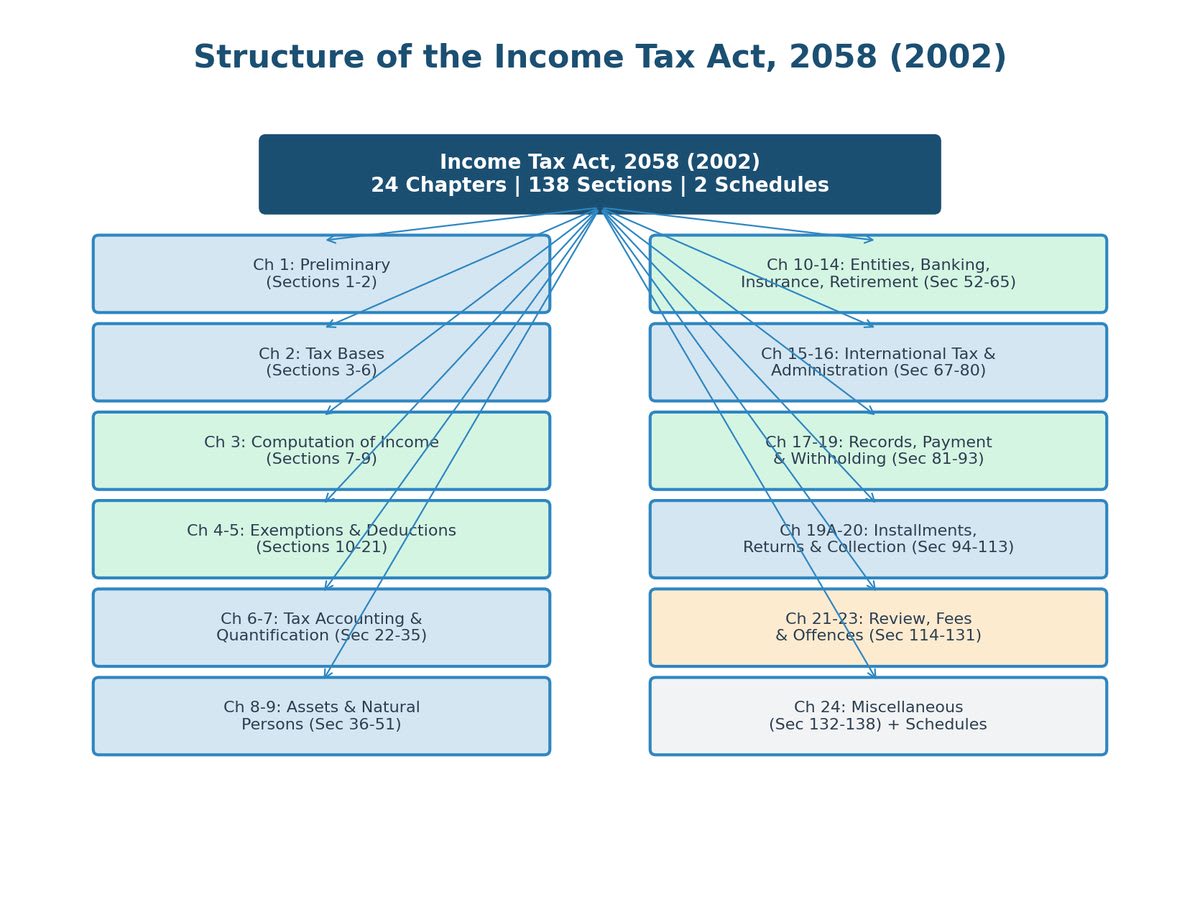
Figure: Structure of the Income Tax Act, 2058
1. Short title, extent and commencement
(1) This Act may be cited as the "Income Tax Act, 2058 (2002)".
(2) This Act shall come into force throughout Nepal and shall also apply to residents residing wherever outside Nepal.
(3) This Act shall come into force immediately.
2. Definitions
Unless the subject or the context otherwise requires in this Act
(a) "Person withholding advance tax" means a person with a duty to withhold advance tax pursuant to Chapter-17 in making payments for employment, investment return, service charge and contract or agreement, as well.
When making a payment that requires advance tax to be withheld, the amount of tax at the rate prescribed in the Act must be deducted from the payment, and only the remaining balance may be paid. A Withholding Agent is therefore a person who has the obligation to withhold advance tax before making payment. For example, when an entity pays remuneration to its employees and is required to distribute remuneration with tax applied, such entity is a Withholding Agent. When a company pays a service fee to a consultant, such company has the obligation to withhold advance tax on the service fee payment and is therefore a Withholding Agent.
(b) "Officer" means the Director General, Deputy Director General, Chief Tax Administrator, Director, Chief Tax Officer, Tax Officer and other Officers in the Department, as referred to in Section 72.
Section 72 of the Act establishes that the Inland Revenue Department is responsible for implementation and administration of this Act. The Department includes the Inland Revenue Department as well as Inland Revenue Offices, Large Taxpayer Offices, Medium Taxpayer Offices, and Taxpayer Service Offices. Section 72(4)(c) also provides that the Director General may designate certain powers to be exercised by any civil service officer or employee.
(b1) "International Transaction" means any transaction relating to goods, services, finance, or intangible assets conducted by any person with at least one non-resident person. The term also includes any other transaction that affects income, expenditure, assets, or liabilities.
(c) "Payment from which tax is withheld finally" means any dividend, rent, profit, interest and payment from which tax has to be withheld made to the non-resident person, as referred to in Section 92.
The Act treats withheld advance tax amounts in two ways: as creditable withholding tax and as final withholding tax. Creditable withholding tax is the amount of advance tax deducted that a taxpayer may credit against the annual tax payable. Final withholding tax is the amount deducted from the payment at the prescribed rate at the time of payment, which constitutes the final tax payment. A taxpayer subject to creditable withholding is required to file an income return and must include such income received with withholding in the aggregate income in that return, then deduct the withheld tax from the annual tax liability. A taxpayer subject to final withholding is not required to include the amount received with such withholding as income in the income return, nor may such withheld tax be credited against other tax liabilities.
(d) "Retirement fund" means an entity established with the sole objective to accept retirement contribution fund for making retirement payments from the fund to the entity's beneficiary natural persons or their dependents, and invest such funds.
An entity operated solely for the purpose of managing a retirement fund is called a Retirement Fund. Such a retirement fund performs only the following functions:
(1) to accept contributions brought by natural persons to be deposited in their names in the fund;
(2) to make retirement payments to such contributing persons (i.e., beneficiaries), or their dependents, after the beneficiary's retirement or death; and
(3) to invest the accumulated retirement contributions.
For tax purposes, retirement funds have two structural types: Approved Retirement Fund and Unapproved Retirement Fund. Examples of retirement funds include the Employees Provident Fund (Karmachari Sanchayakosh), Citizen Investment Trust (Nagrik Lagani Kosh), Social Security Fund (Samajik Suraksha Kosh), retirement fund operated by the Civil Servants' Retirement Gratuity Fund (Nivritti Bharan Kosh), and entities approved by the Department to operate retirement funds.
(e) "Retirement payment" means any payment made to the following person:-
(1) Payment made to an natural person where such person has got retirement, or
(2) Payment to the dependent of an natural person where such person has died.
Retirement payment refers to payment made after a natural person has in principle reached a state of being unable to perform any employment, profession, or business and has retired. Similarly, where a natural person dies, the amount payable to that person, if paid to that person's dependent, is also called a retirement payment. Examples of retirement payments include payments from a retirement fund for retirement contributions made, gratuity, provident fund, encashment of accumulated leave, medical expenses, long service gratuity, and payment from a welfare fund. Such retirement payments may come from the Government of Nepal, an approved retirement fund, an unapproved retirement fund, an employer, or any other fund. Payments from an approved retirement fund may only be made in the following three circumstances:
(1) when an employee or worker retires from service;
(2) when the beneficiary reaches the age of fifty-eight years; or
(3) when the beneficiary dies or becomes permanently disabled.
Payments received before meeting these conditions, such as Long Service Gratuity, Leave Encashment, or Medical Expenses received during the period of service before actual retirement, do not fall under retirement payments; such payments must be included in income from employment.
(f) "Retirement contribution fund" means any payment made to a retirement fund for provisions of retirement payment or for future provisions thereof.
The retirement contribution amount includes the contribution deposited by the natural person themselves or, in the case of an associated person (i.e., an employer), by the employer on behalf of the natural person.
Example 2.1: Suppose Sujit Singh is employed at Kamal and Co. Pvt. Ltd. at a monthly salary of Rs. 20,000. If the company deposits Rs. 2,000 per month in a retirement fund in his name, and he also contributes Rs. 2,000 from his own side, then the total of Rs. 4,000 contributed by both sides shall be considered the retirement contribution amount for Sujit.
(g) "Incapacitated person" means a person who is not capable of making his or her dealings because of physical or mental illness.
The Act makes special provision so that the legal representatives or guardians of such persons may fulfil tax obligations on their behalf.
(h) "Income" means an income earned by any person from employment, business, investment or windfall gain and the term also includes the total amount of that income calculated in accordance with this Act.
The total amount of such income, calculated in accordance with the Act, is the taxable income on which tax is assessed. Income is classified into four heads: employment, business, investment, and windfall gain.
(h1) "Windfall gain" means a gain obtained by means of lottery, gift, prize, tips, share of earning in a game (Jitauri) or any other gain acquired incidentally.
A lottery, gift, prize, bonus, winnings, or other amount received without certainty of receipt and without the use of the recipient's labor or capital is considered windfall gains. Such amounts are subject to a separate final withholding tax and need not be included in the income return.
(i) "Income year" means a period from the first day of Shrawan of any year to the last day of Ashad of the next year.
The income year runs from the first of Shrawan to the end of Ashad of the following year. However, for a person established or who begins earning income during this period, the income year is from the date of establishment or commencement of income earning to the end of Ashad immediately following. Similarly, where a person's business has been or is deemed to have been closed, that person's income year shall be from the first of Shrawan to the date of closure or deemed closure of the business.
Example 2.2: Suppose Dhruv Company Pvt. Ltd. was liquidated on 2080/07/05. In that case, the final income year of that company shall be from 2080/04/01 to 2080/07/05. If at that date, 50% or more of the ownership of that company changed, then under Section 57 of the Act, in fiscal year 2080/81, the period from 2080/04/01 to 2080/07/05 shall be one income year and the period from 2080/07/06 to 2081/03/31 shall be another income year.
(j) "Gift" means any payment made without any consideration or in the case of any payment with consideration, where the market value of payment exceeds the market value of consideration, payment to the extent of such excess.
Example 2.3: Suppose a person named Vishwabandhu purchased a TV worth Rs. 25,000. The TV seller provided him a DVD player worth Rs. 5,000 at no charge. Such a player received without payment is considered a gift. Where a payment is made with consideration but the payment exceeds the market value of the consideration, the excess is also treated as a gift.
(k) "Debt liability" means the liability equivalent to the debt claim.
Where a person has an obligation to make a payment to another person for an arrangement, and such obligation is to be paid after a specified period or condition, such obligation is considered a debt liability. For example, if a person has taken a loan from a bank, the amount payable under the loan agreement is a debt liability. Such amount includes not only the principal but also the return on that principal, i.e., interest.
(l) "Debt claim" means the right of any person to receive payment from another person, and the term also includes the right of any person to have repaid a loan lent by such person to another person, the right to receive deposits made in a bank and financial institution, to receive sums to which such person is entitled and to receive money from the sale of debentures, bills of exchange, bonds, rights under annuities, financial lease and installments.
A debt claim is the corresponding right held by the lender to receive repayment of a debt liability. Examples of debt claims include deposits held in banks and financial institutions, receivable amounts, debentures, bills of exchange, bonds, rights under annuities, rights to receive amounts from financial leases, and instalment sales.
(m) "Company" means any company incorporated under the prevailing company law, and for the purpose of tax the following institutions shall also be treated as if they were companies:-
(1) Any corporate body established under the laws in force;
(2) Any unincorporated association, committee, institution, or society, or any group of persons other than a registered or unregistered sole proprietorship and partnership, or a trust;
(3) A partnership firm with twenty or more partners, whether registered or not under the prevailing law, a retirement fund, a cooperative institution, a unit trust, or a joint venture;
(4) Any foreign company;
(5) Any other foreign institution as specified by the Director General.
For income tax purposes, organizations duly registered under prevailing law, such as private limited companies, public companies, corporations, associations, non-governmental organizations (NGOs), and international non-governmental organizations (INGOs), are considered companies. All organized entities except sole proprietorships and partnership firms with fewer than twenty partners are considered companies.
(n) "Tax" means the tax chargeable under this Act, and this term includes the following payments:-
(1) The expenditures referred to in clause (a) of sub-section (8) of Section 104 as incurred by the Department for any claim in respect of, and auction sale of, the property in which the tax is due and outstanding,
(2) The amount payable by the person withholding advance tax or the person subject to tax withholding under Section 90 or the amount payable by the person making payment in installment under Section 94 or the amount payable by the person withholding advance tax under Section 95A. or the amount payable after the tax assessment under Sections 99, 100 and 101,
(3) The amount payable to the Department in respect of tax liability of the third party under sub-section (2) of Section 107, sub-section (3) or (4) of Section 108, sub-section (1) of Section 109, sub-section (1) of Section 110,
(4) The amount referred to in Chapter-22 payable for a fee and interest, and
(5) The amount of fine referred to in Section 129 required to be paid as per the order of the Department.
Under Section 104 of the Act, the Government of Nepal has a claim over the property of a person having tax arrears, and Sub-section (8)(a) provides that costs incurred by the Department in claiming and auctioning such property may be recovered from the person with tax arrears; therefore such costs are also considered tax. Under Section 90, a withholding agent is required to deposit the withheld advance tax amount within 25 days of the end of that month. Under Section 94, a person who has assessable income or will have assessable income from business or investment is required to file tax on an instalment basis. The amount to be paid at self-assessment under Section 99, jeopardy assessment under Section 100, and amended assessment under Section 101 are also considered tax. Amounts payable by managers of entities under Section 107(2), by receivers under Sections 108(3) and (4), by debtors of taxpayer under Section 109(1), and by agents of non-residents under Section 110(1) are also considered tax.
Example 2.4: Suppose Yuga Prasad has been appointed as liquidator of a limited liability company. As of the time of liquidation, there is Rs. 10,00,000 in withheld advance tax and Rs. 30,00,000 in other tax arrears. After selling the assets and deducting liquidation expenses, Rs. 1,00,00,000 remains. There is a secured loan of Rs. 30,00,000 that has priority over the tax, and Rs. 50,00,000 in unsecured liabilities. In that case, the liquidator must first set aside Rs. 10,00,000 in advance withheld tax from the sale proceeds, even before deducting liquidation expenses. Thereafter, after deducting liquidation expenses and the Rs. 30,00,000 secured loan, from the remaining amount, Rs. 30,00,000 in other tax arrears must first be settled, and the remaining Rs. 30,00,000 distributed pro-rata to settle unsecured liabilities.
(o) "Person subject to tax withholding" means any person who receives payment or has the right to receive payment by withholding tax under Chapter-17 in making payment for employment, investment return, service charge or contract or agreement.
A person subject to tax withholding is a person who receives payment after tax has been deducted at source.
(p) "Tax assessment" means the assessment of tax to be made under this Act and this term includes the assessment of a fee and interest under Section 122.
Provided that this term does not mean the previous tax assessment substituted by the amended tax assessment under Section 101.
The Act provides for three types of tax assessment:
(1) Self-assessment under Section 99, i.e., the system where a person with a tax liability assesses their own tax;
(2) Jeopardy Assessment under Section 100 for an income year or a portion thereof before the taxpayer's time to file an income return has expired; and
(3) Amended tax assessment made by the Department under Section 101 to adjust a person's tax liability on a fair and equitable basis.
Since an amended tax assessment replaces the original tax, in the event of an amended assessment, the prior self-assessment (Section 99) or jeopardy assessment (Section 100) shall not be considered a tax assessment(An amended assessment supersedes and replaces the previous assessment, making the amended assessment the only valid tax assessment). Additionally, Section 99(2) provides that for a taxpayer who does not file a self-assessment income return within the prescribed time, a self-assessment shall be deemed to have occurred automatically on the last day for filing the income return. The fees and interest calculated by the Department under Section 122 are also considered a tax assessment, covering fees under Sections 117, 119A, 120, and 121, and interest under Sections 118 and 119.
(p1) "Transaction" means a transaction equal to the total amount included pursuant to Section 7, 8 or 9 for the purpose of calculation of income of employment, business or investment in any income year.
Transaction means the total amount included in computing income under Sections 7, 8, or 9 for an income year. It represents the gross level of activity in employment, business, or investment income computation and is used as the basis for determining whether the presumptive tax provisions of Section 4(4) apply.
(q) "Non-resident person" means any person other than the resident person.
(r) "Non-business taxable assets" means any land, building and interest or security in any entity except the following properties:-
(1) Business assets, depreciable assets or stocks-in-trade,
Business assets include shares, land, receivables, advance accounts, cash and bank balances, and other assets other than stock-in-trade or depreciable assets of the business. Depreciable assets means assets used to earn income in any business or investment that lose value through wear and tear, obsolescence, or the passage of time. Stock-in-trade refers to assets held for sale in the ordinary course of a business operated by a person, assets in work-in-progress, and stocks of materials to be incorporated into such assets.
Example 6.4.1: Suppose Hada Furniture Pvt. Ltd. buys and sells furniture. In income year 2080/81, it purchased 10 chairs for Rs. 1,00,000 and sold 6 of them for Rs. 70,000. In that income year, the 10 chairs held for sale constitute the stock-in-trade of that company.
(2) A private building owned by an natural person in the following situation:-
(a) Being under ownership for a continuous period of ten years or more, and
(b) Where that person has resided for a total period of ten years or more continuously or at several times,
Explanation: For the purpose of this clause, "private building" means building, land occupied by the building and additional land of equal area occupied by the building or one Ropani of land whichever is lesser.
(3) Any interest of any beneficiary in retirement fund,
Every person who contributes to a retirement fund is a beneficiary with respect to the investment in that retirement fund. Such a beneficiary's interest in that retirement fund is not treated as a non-business taxable asset. Their investment in any entity other than the retirement fund is treated as a non-business taxable asset.
Example 6.4.2: Suppose Ramprasad contributes Rs. 4,000 every month to a retirement fund. He has also purchased shares worth Rs. 1 lakh in a financial institution. The amount accumulated through contributions to the retirement fund is not treated as a non-business taxable asset. However, his investment in the shares of the financial institution is treated as a non-business taxable asset.
(4) A land, land with building and private building belonging to and disposed of by any natural person for a value less than ten lakh rupees, or
If a natural person disposes of land and a personal building for a value of less than Rs. 10 lakhs, such asset is not treated as a non-business taxable asset. If disposed of for a value exceeding that, such an asset is treated as a non-business taxable asset.
Example 6.4.3: Suppose Suresh purchased a house on date 2069.03.31 for Rs. 20 lakhs and sold that house on date 2081.10.05 for Rs. 80 lakhs. Since the disposal value exceeds Rs. 10 lakhs, that house is treated as his non-business taxable asset, and the amount received from the disposal of that house is treated as non-business taxable asset income. The net gain computed from such income in accordance with Chapter 8 of the Act is treated as non-business taxable asset income and must be included in computing investment income. If he had purchased that house 10 years ago or earlier and had resided in it continuously or intermittently for a total of 10 years or more, that house would not be treated as a non-business taxable asset and the gain from the disposal of such an asset would not be included in his investment income.
(5) Any asset disposed of by way of transfer in any manner other than the purchase and sale within three generations.
Ordinarily, property transfers within three generations are made through partition, gift and similar means rather than purchase and sale. However, sometimes property is bought and sold within three generations. Accordingly, the sale amount of property sold within three generations is treated as non-business taxable asset income, while transfer by means other than purchase and sale within three generations is not treated as non-business taxable asset income or investment for tax purposes. However, even where property is sold within three generations, if the value is less than Rs. 10 lakhs, such property is still not treated as a non-business taxable asset.
Example 2.5: Suppose Prem Prasad Acharya purchased a building in Kathmandu on 23rd Kartik 2070 for Rs. 2,00,00,000. He sold that building on 26th Push 2080 for Rs. 3,00,00,000. He was abroad for a cumulative total of 120 days from 23rd Kartik 2070 to 26th Push 2080. Even though he was the owner of that building for more than ten years, because he resided in it for less than ten years cumulatively, the above building is considered a non-business chargeable asset. However, if he had sold the building two months later, the condition of having resided therein for more than ten years would also have been met, and the building would not have been considered a non-business chargeable asset.
Example 2.5.1: In the example above, had it been a building only, the building and in the case of a building with land, land up to one ropani or the area covered by the building (whichever is less), that portion of property would not have been considered a non-business chargeable asset.
Example 2.5.2: Even if the building in the above example had been sold for less than Rs. 10,00,000, it would not have been considered a non-business chargeable asset.
Example 2.5.3: The building in the above example became a non-business chargeable asset when sold. Had that building been transferred free of charge within three generations, it would not have been considered a non-business chargeable asset.
Example 2.6: Suppose a person named Laxmi Rimal purchased land in Kathmandu worth Rs. 20,00,000 on 3rd Falgun 2075. She sold that land on 6th Aswin 2080 for Rs. 45,00,000. Since the sale value of the above land exceeds Rs. 10,00,000, the above land is a non-business chargeable asset.
Example 2.7: Suppose Yubaraj Basnet transferred land worth Rs. 5,00,00,000 registered in his name, purchased one year ago, to his grandson by a gift deed. Even if the market value of that property at the time of transfer was Rs. 6,00,00,000, that property shall not be considered a non-business chargeable asset.
Securities (shares, bonds, debentures) in the ownership of a natural person, except for free-of-charge transfer of rights within three generations, shall be considered non-business chargeable assets when disposed of through purchase and sale or other transfer of rights.
(s) "Organization entitled to enjoy exemption" means the following entity:-
(1) The following entities registered in the Department as organizations entitled to enjoy exemption:-
(a) A social, religious, educational or benevolent organization of public nature established with non-profit motive,
(b) An amateur sports organization so formed with a view to promoting social or sports related facilities that the organization or its members does not derive profits,
(2) A political party registered in the Election Commission,
Provided that if any person has derived any benefit from the property of that organization and the monies obtained from that organization except in making payment for the property or the service provided by any person to that organization or in discharging functions in consonance with the objective of the organization entitled to exemption, tax exemption shall not be granted.
Rule 3(1): Any organization entitled to enjoy tax exemption pursuant to Section 2(s) of the Act shall submit an application, accompanied by the following details, to the Department for the exemption of tax:
(a) in the case of an organization required to be registered pursuant to the prevailing law, a duplicate copy of the registration certificate;
(b) a copy of the statute of the organization;
(c) where the permanent account number has been obtained, a copy of such certificate; and
(d) a duplicate copy of an audit report, if any.
Rule 3(2): Upon conducting necessary examination as to the application for tax exemption submitted pursuant to Sub-rule (1), the Department shall register such organization as an organization entitled to enjoy tax exemption and issue a certificate.
Rule 3(3): Notwithstanding anything contained in Sub-rules (1) and (2), the Department may specify any entity falling within the organization entitled to enjoy tax exemption so as they may not be required to be registered.
Rule 5A(1): Any tax-exempt organization that has obtained a certificate of tax exemption pursuant to Rule 3 shall renew such certificate within one year from the date of expiry of the income year.
Rule 5A(2): In renewing pursuant to Sub-rule (1), the application shall be accompanied by the income return of the preceding income year, the details showing that advance tax has been withheld and deposited, and other supporting evidence, and shall be submitted to the Department in the format prescribed by the Department.
Rule 5A(3): On the basis of the application received pursuant to Sub-rule (2), if upon examination the applicant appears to be entitled to enjoy tax exemption, the certificate shall be renewed.
Rule 5A(4): Where the format of the certificate of tax exemption received for renewal pursuant to this Rule does not match the format specified by the Department, a new certificate shall be issued in place of the previous certificate of tax exemption.
Rule 5A(5): Unless the certificate of tax exemption is renewed pursuant to Sub-rule (1), the organization that has obtained a certificate of tax exemption shall not be entitled to avail of the benefit of tax exemption.
Rule 27(1): Any person entitled to enjoy tax exemption may submit an application to the Department for the tax exemption certificate.
Rule 27(2): Upon receiving an application pursuant to Sub-rule (1), if it appears that the person is entitled to enjoy tax exemption, the Department shall provide the tax exemption certificate to such person.
(t) "Trust" means an arrangement whereby a trustee holds any property.
Provided that this term does not include a partnership, corporate body or organization referred to in sub-clause (3) of clause (m).
A trust is an arrangement whereby a trustee holds and manages property for the benefit of another person (the beneficiary). For income tax purposes, trusts are treated as entities. A trust that is established in Nepal, whose trustee is a resident person in the relevant income year, or a trust controlled directly or through one or more interposed entities by a resident person or a group of associated persons, shall be considered a resident of Nepal.
(u) "Trustee" means an natural person, trust (Guthi) or other body corporate who, natural personly or jointly with other natural person, trust (Guthi) or corporate body, holds a property in trust, and the term also includes the following person:-
(1) The operator or administrator of the assets of a deceased,
(2) A liquidator, recipient or trustee,
(3) Any person who protects, directs, controls or manages the assets of an incapacitated person in personal or official capacity,
(4) Any person who manages the assets under a private enterprise or similar other enterprise, and
(5) Any other person in a position similar to that of the person as referred to in clauses (1), (2), (3) and (4).
A trustee holds property on behalf of a beneficiary and is responsible for managing such property in accordance with the terms of the trust. For tax purposes, the trustee is responsible for fulfilling the tax obligations of the trust. Trustees include the operator or administrator of assets of a deceased person, a liquidator, a receiver or trustee, any person who protects or manages the assets of an incapacitated person, any person managing assets under a private enterprise, and any other person in a similar position.
(v) "Long-term contract" means a contract referred to in Section 26 of which validity period is more than twelve months.
A long-term contract is a contract for production, construction or installation, or a contract on the fulfillment of services related thereto, where the contract is estimated to span more than one income year at the time of conclusion. The special provisions for computing income from long-term contracts are provided in Section 26 of the Act and Rule 12 of the Income Tax Regulations, 2059. The key characteristic is that the contract value exceeds what is ordinary for a single income year, requiring special methods for recognizing income across periods.
(w) "Relative" means an natural person's husband, wife, son, daughter (adopted son, daughter as well), father, mother, grand-father, grand-mother, elder brother, younger brother, sister-in-law, daughter-in-law, elder sister, younger sister, father-in-law, mother-in-law, brother-in-law, elder brother-in-law, wife's sister, uncle, aunt, nephew, niece, grand-son and grand-daughter.
Relatives of a natural person are associated persons of that natural person. This is significant for tax purposes because transactions between associated persons may be subject to arm's-length pricing requirements under Section 33 of the Act, and payments to associated persons may require special treatment.
(x) "Entity" means the following organization or body:-
(1) A partnership, trust or company,
(2) District Coordination Committee,
(3) Government of Nepal, Provincial Government or Local Level,
(4) Any foreign government or provincial or local government under that government or a public international organization established by any treaty, or
(5) A permanent establishment of the organization or body referred to in clauses (1), (2), (3) and (4), which is not situated in a country of which it is a resident.
(y) "Interest in entity" means and includes the contingent right to receive income or capital of any entity.
Interest in an entity means the right, including a contingent right, to receive the income or capital of the entity. For example, interest in entity refers to a partner's share in a partnership firm, a shareholder's share in a limited liability company, an investor's contribution in a retirement fund, a partner's interest in a joint venture, and a person's ownership in a permanent establishment.
(z) "Disposal" means a disposal inclusive of the sale or transfer of any property or liability as mentioned in Section 40.
Disposal includes the sale or transfer of any property or liability, and also any event that is deemed to be a disposal under the Act. The significance of disposal in the Income Tax Act is that it triggers recognition of income or loss on the property or liability disposed of. Deemed disposals include situations such as the death of a natural person, a property becoming subject to a bad debt, a change in use of a business asset to personal use, and a change in residence status from resident to non-resident.
(aa) "Vested ownership" means the following ownership:-
(1) In the case of any entity, ownership created on the basis of the interest which any natural person or any entity in which an natural person has no interest has in that entity directly or indirectly through one or more interposed entities, or
(2) In the case of the assets owned by any entity, ownership of the assets as determined in proportion to the ownership of the persons who have vested ownership in that entity.
Vested ownership refers to full and absolute ownership of an asset or interest, as opposed to contingent or future ownership rights. For an entity, vested ownership is determined by the interest which a person holds in that entity. For assets owned by an entity, vested ownership is determined by the proportionate interest of each holder in the entity's assets.
(ab) "Lease" means the provisional right of any person to enjoy or use any property except movable property belonging to another person, and the term also includes a license, rent agreement, trenches, royalty agreement or right of a lessee/tenant.
For income tax purposes, a distinction is made between operating leases and financial leases. Payments under an operating lease are treated as rental income and expense. Financial leases, where ownership risk and rewards are substantially transferred, are treated differently, with the lessee treating the asset as owned and the payment broken into principal and interest components.
(ac) "Natural person" means an natural person, and, for the purposes of this Act this term also includes a sole proprietorship owned by an natural person, whether registered or not, and a spouse so selected under Section 50 as to be considered as the single natural person.
An natural person means a human being. For income tax purposes, the tax treatment of a natural person differs from that of an entity. Natural persons have graduated tax rates, personal exemptions, and specific deductions available to them (such as medical tax credits and retirement contribution deductions) that are not available to entities. A natural person may be a resident or a non-resident for income tax purposes.
(ad) "Payment for natural resources" means an amount of any of the following payments:-
(1) Amounts received for having right to extract water, minerals or other living and non-living resources from the earth, or
(2) Amounts calculated on the basis of the quantity or value of living or non-living resources of the natural resources and minerals extracted from the earth, in full or in part.
Natural resource payments are amounts received for the right to extract water, minerals, or other living or non-living resources from natural sources, or amounts calculated on the basis of the quantity or value of such resources extracted or to be extracted. Such payments are treated as investment income under Section 9 of the Act.
(ae) "Market value" means ordinary transaction value of any property or service in the ordinary course of trade between unrelated persons in respect of such property or service.
Market value means the ordinary transaction value of any property or service in an arm's-length transaction between unrelated parties. For tax purposes, where transactions are not conducted at market value (particularly between associated persons), the Department may re-characterize or re-allocate amounts to reflect arm's-length market values under Section 33 of the Act.
(af) "Rent" means a premium/sum received for the house rent as well as for the lease of a tangible property and all payments including premium made under the lease.
Provided that this term does not include any payment made for natural resources or amount received by the natural person as a rent of house except for private/sole firm.
Rent includes both house rent and amounts received for the lease of land. Rent received from the lease of property is investment income under Section 9 of the Act. Natural resource payments are separately defined and treated; they do not constitute rent.
(ag) "Payment" means the following activities:-
(1) If the money or property owned by any one person is transferred to another person and the liability of any other person is transferred to that person,
(2) If the ownership over any property created by any person devolves on another person after the creation of that property or if any person bears the onus of liability of another person,
(3) If any person delivers service to another person,
(4) If any person uses any property owned by another person or such property is available for such use.
Payment is a broad concept under the Act that covers not only cash transfers but also property transfers, creation of ownership rights, delivery of services, and provision of the use of property. This broad definition ensures that non-cash transactions are also captured within the tax system.
(ah) "Distribution of profit" means the distribution of profits of any entity made pursuant to Section 53, including the capitalization of profits.
A distribution of profit by an entity reduces the value of the entity's assets and liabilities and represents a transfer of value to the interest holders. Capitalization of profit (bonus shares) is also treated as a distribution. Payments made to interest holders on arm's-length terms for services or property provided are not distributions.
(ai) "Unit trust" means a trust in which a trustee holds property for the benefit of at least twenty persons, and in which the rights of the persons to participate in income or capital are arranged to be divided on the basis determined by the number of units held.
A unit trust is a trust divided on the basis of a fixed number of units, where each unit represents an equal proportionate share in the trust property. Unit trusts are treated as entities for income tax purposes. Income distributed by a unit trust to unit holders is generally treated as dividend income.
(ai1) "Contribution-based retirement payment" means a payment consisting of an amount included in the income of a natural person and deposited into an approved retirement fund out of that income, together with the amount increased on that sum.
A contribution-based retirement payment comprises: (1) the amount deducted monthly from an employee's or worker's remuneration that is deposited in an approved retirement fund; (2) the employer's additional retirement contribution deposited in an approved retirement fund on behalf of the employee; and (3) the amount by which both of the above have increased (i.e., investment returns on contributions). Such payments are subject to special tax treatment under Chapter 12 of the Act.
(aj) "Employment" means any kind of past, present or future employment.
For tax purposes, a natural person must account for income from employment on a cash basis under Section 22(2) of the Act, meaning employment income is included in income in the year it is actually received in cash.
Example 2.15 (Past employment): Suppose Lalit has been employed at a company since 2070. From 2075, only 50% of salary was being paid due to financial difficulties. In fiscal year 2080/81, the remaining 50% salary arrears were paid to Lalit in Magh 2080. Even though the company may expense the accrued salary in the relevant income year on an accrual basis, Lalit received the payment in cash in Magh 2080 and must include it in income for fiscal year 2080/81 on a cash basis.
Example 2.16 (Future employment): Suppose Suvarna works at a company. Needing money, and on the condition of not receiving salary for the next year, he received one year's salary in advance from the company. Since he received this amount on the condition of future employment, it must be counted in income from employment for the income year in which the amount was received.
(ak) "Royalty" means any payment made under the lease of any intangible property, and the term also includes any payment made for the following purpose:-
(1) To use or have the right to use a copyright, patent, design, model, plan, secret formula or process or trademark,
(2) To render technical know-how,
(3) To provide the right to use any motion picture film, video tape, sound recording or similar other means and to use or render industrial, business or scientific experience,
(4) To render any assistance in a manner to be ancillary to the matters referred to in clauses (1), (2), or (3), or
(5) To have full or partial restrictions on the matters referred to in (1), (2), (3) or (4).
Provided that the term does not mean any payment made for natural resources.
Royalty refers to payments under a lease of intangible property or for the use of intangible property. Examples include payments for the right to use a trade name, payments to a singer, lyricist, or composer for playing their songs on a radio station, or fees paid for the right to use a patent. Natural resource payments are separately defined and do not constitute royalty.
(al) "Investment" means the act of holding one or more properties or investing such properties, except the following:-
(1) Holding any property used by the owner in personal use, or
(2) Employment or occupation.
Provided that the act of holding any non-business taxable assets is considered as investment.
The act of holding property to earn income is called an investment. In earning investment income, the person earning the income generally does not have continuous active engagement. Income such as dividends, interest, natural resource payments, rent, royalties, gains from investment insurance, gains from an interest in an unapproved retirement fund, retirement payments from an approved retirement fund, or net gains from disposal of non-business chargeable assets are investment income. To determine whether something qualifies as an investment, attention must be paid to the nature of holding the assets. Generally, assets held for investment purposes are held for a long period. In investment, income arises from the same asset, whereas in business, income is earned by buying, selling, or otherwise using the asset.
(am) "Investment insurance" means any of the following insurance:-
(1) An insurance against the death of the insured or of the associated person of the insured,
(2) An insurance against personal injuries of the insured or his associated person or against any event leading to incapacity in any particular manner,
Provided that the validity period of the insurance contract shall be at least five years or the contract shall be without any validity period and the contract is so made that it cannot be terminated by the insurer prior to expiration of a period of five years except in exceptional circumstances.
(3) An insurance so made that any money or series of moneys are paid to the insured in the future,
(4) Reinsurance of the insurance referred to in clause (1), (2) or (3), or
(5) Reinsurance of the reinsurance referred to in clause (4).
Examples of investment insurance include Life Insurance, Superannuation, and Endowment Policy. Even if it is insurance related to a life risk, if the period of an accidental insurance contract expires in less than five years, such contract does not fall under investment insurance.
(an) "Dividend" means the distribution to be made by an entity.
Dividend refers to the share of profit distributed by an entity to its interest holders (shareholders). Such term also refers to the capitalization of profit, i.e., bonus shares. Dividends are subject to final withholding tax under Section 88 of the Act.
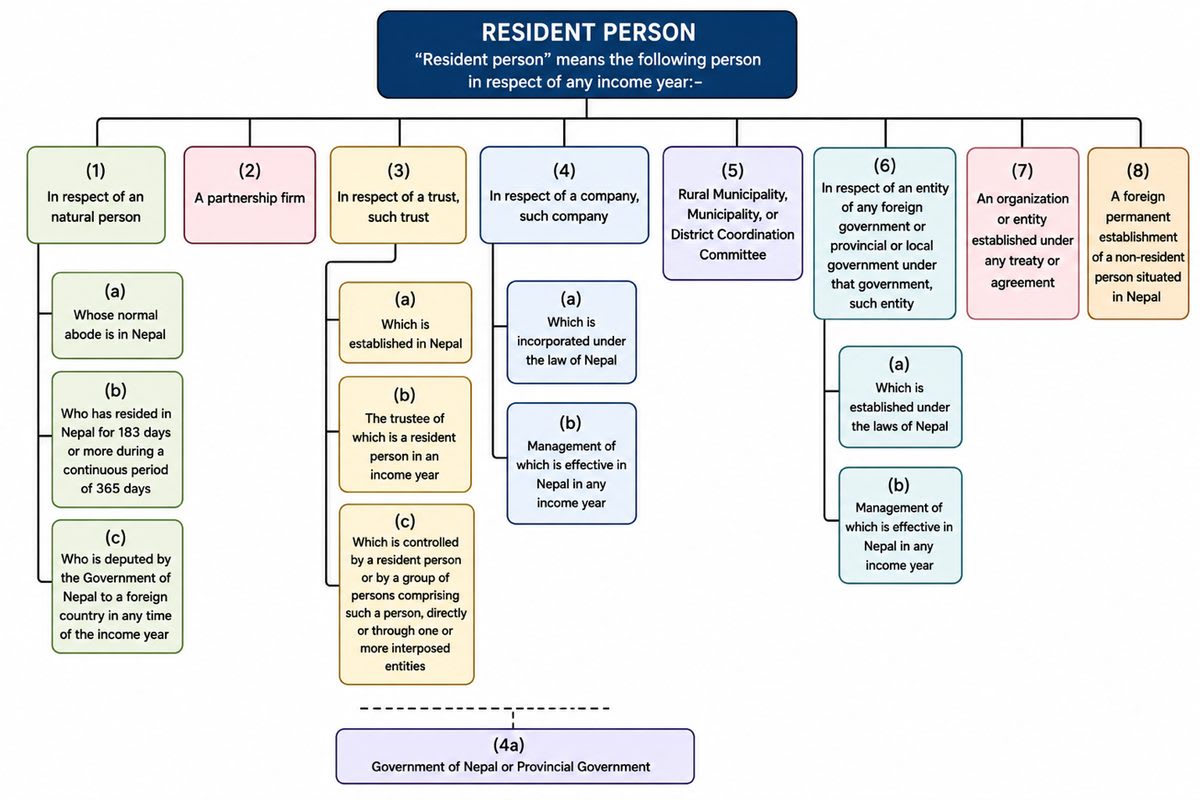
(ao) "Resident person" means the following person in respect of any income year:-
(1) In respect of an natural person,-
(a) Whose normal abode is in Nepal,
(b) Who has resided in Nepal for 183 days or more during a continuous period of 365 days, or
(c) Who is deputed by the Government of Nepal to a foreign country in any time of the income year.
(2) A partnership firm,
(3) In respect of a trust, such trust,-
(a) Which is established in Nepal,
(b) The trustee of which is a resident person in an income year, or
(c) Which is controlled by a resident person or by a group of persons comprising such a person, directly or through one or more interposed entities,
(4) In respect of a company, such company,-
(a) Which is incorporated under the law of Nepal, or
(b) Management of which is effective in Nepal in any income year.
(4a) Government of Nepal or Provincial Government,
(5) Rural Municipality, Municipality, or District Coordination Committee,
(6) In respect of an entity of any foreign government or provincial or local government under that government, such entity,-
(a) Which is established under the laws of Nepal, or
(b) Management of which is effective in Nepal in any income year.
(7) An organization or entity established under any treaty or agreement, and
(8) A foreign permanent establishment of a non-resident person situated in Nepal.
Habitual place of abode in Nepal refers to the place where the concerned person's main economic activity takes place; having a permanent address or house in Nepal alone does not make Nepal the habitual place of abode.
Example 2.17: Suppose Om Bahadur Thapa, who has a permanent home in Chitwan, went to Malaysia three years ago for foreign employment. He returns to Nepal once a year to visit his family. In this case, even though his permanent home is in Nepal, since his continuous residence and primary economic activity are not in Nepal, his habitual place of abode shall not be considered to be in Nepal.
Example 2.18: In Example 2.17 above, if Om Bahadur Thapa's business is in Nepal and he traveled to various countries outside Nepal for more than 183 days that year due to business or personal reasons, then since his major economic activities are in Nepal, his habitual place of abode shall be considered to be in Nepal.
Example 2.19: If Om Bahadur Thapa went to Malaysia on 6th Bhadra 2078 for foreign employment and returned to Nepal on 5th Bhadra 2080, after which he permanently resided in Nepal: since he left Nepal on 6th Bhadra 2078, he was present in Nepal for fewer than 183 days in a continuous 365-day period for income years 2078/79 and 2079/80, making him a non-resident for those income years. For income year 2080/81, since he was present in Nepal for 330 days, he is a resident of Nepal for that fiscal year.
Example 2.20: If Om Bahadur Thapa was posted on deputation by the Government of Nepal to the Nepali embassy abroad and has been working there for the past four years, then in such a case he shall be considered a resident of Nepal.
Example 2.21: Suppose a trust is in operation in Kolkata, India. If that trust is controlled by residents of Nepal, such trust shall also be considered a resident of Nepal. A foreign permanent establishment of a non-resident person located in Nepal shall also be considered a resident of Nepal.
(ap) "Person" means an natural person or entity.
The word person refers to both a natural person (such as Ram, John, Rahim) and a legal person (artificial person) such as a company, trust, institution, etc.
(aq) "Manager" means any person involved in making managerial decisions of any entity, and the term also includes a trustee of any trust and a person having ownership in a foreign permanent establishment.
For tax purposes, managers are jointly and severally liable for the tax obligations of the entity under Section 107 of the Act if the entity fails to pay tax by the due date.
(ar) "Occupation" means any kind of industry, business, profession or business transactions of similar other nature, and the term also includes past, present or future occupations of similar type.
Provided that this term does not include employment.
In employment, generally labor is consumed. In business and investment, both labor and capital are consumed. In investment, there is generally no active engagement of the person earning income in holding assets and earning income. In business, however, there is active engagement of the person in income-earning activities. Holding assets without active participation and earning only rent is considered investment, whereas if the person actively manages the property and rental income, it is considered business. Business includes industry (producing and selling goods), trading (buying and selling goods), profession, or similar commercial transactions.
(as) "Interest" means the following payment or profit:-
(1) Payment under debt liability except the principal,
(2) Profit made from concession, concession under debt liability, premium, alteration payment or from similar payment, and
(3) The amounts referred to in Section 32 receivable as an interest out of the payment to be made by a person who acquires any property under annuities or installment sale or of the payment made to any person for the use of any property under a financial lease.
Interest generally refers to the return on capital or investment. When an investment is returned with an amount greater than the capital invested, such excess is called interest. Discounts, premiums, or swap payments under a debt liability are also considered interest.
Example 2.22: Suppose a bank purchased a Treasury Bill issued by Nepal Rastra Bank with a face value of Rs. 1,00,00,000, payable in 90 days, for Rs. 98,50,000. Although the bank invested Rs. 98,50,000, since the bank shall receive Rs. 1,00,00,000 at the time of payment, the excess amount of Rs. 1,50,000 is considered interest.
Example 2.23: Suppose a financial institution provided a loan of Rs. 50,00,000 to a customer with an Annual Fixed Instalment of Rs. 11,48,037. If the interest rate on that loan is 10 percent, the principal repayment and interest income on such received instalments must be calculated as follows:
Outstanding Principal (Rs.) | Instalment Amount (Rs.) | Principal Repaid (Rs.) | Interest Amount (Rs.) |
50,00,000 | 11,48,037 | 6,48,037 | 5,00,000 |
43,51,963 | 11,48,037 | 7,12,841 | 4,35,196 |
36,39,122 | 11,48,037 | 7,84,125 | 3,63,912 |
28,54,997 | 11,48,037 | 8,62,537 | 2,85,500 |
19,92,460 | 11,48,037 | 9,48,791 | 1,99,246 |
10,43,669 | 11,48,037 | 10,43,670 | 1,04,367 |
68,88,222 | - | 50,00,000 | 18,88,222 |
(at) "Stock-in-trade" means the property owned by any person and to be sold in the course of regular business carried on by such person, the property in work-in-progress and the inventory of materials to be incorporated in the property.
Provided that this term does not include a property held in foreign currency.
Assets held directly or indirectly for sale in a business are called trading stock. Examples may differ depending on the nature of the person's business. Furniture is trading stock for a person who buys and sells furniture, but for other persons it would be a depreciable asset. Assets in progress (work-in-progress) in the course of production are also included in trading stock. Foreign currency and traveler's cheques held by a bank are not trading stock but are foreign currency assets.
(au) "Business asset" means any property used in any occupation.
Provided that this term does not mean stock-in-trade or depreciable assets of the occupation.
Business assets include all assets other than trading stock or depreciable assets of a business, such as shares, land, receivables, advance accounts, cash, and bank balances. All assets owned by a business other than trading stock and depreciable assets are business assets.
(av) "Distribution" means a distribution to be made by any entity as referred to in Section 53.
Generally, transactions conducted on arm's-length terms between an interest holder and an entity, and payments related thereto, are not distributions; all other payments by an entity are considered a distribution. Section 53 of the Act clarifies the distribution of profit and return of capital by an entity. Only when a distribution by an entity reduces the value of the assets and liabilities of that entity shall such distribution be considered a distribution of profit or return of capital.
(av1) "Electronic means" means computer, fax, email, internet, electronic cash machine and fiscal printer, and this term also includes other approved means as specified by the Department.
The Department may designate additional electronic mediums beyond those listed. Electronic mediums are used for filing returns, making payments, and conducting other tax-related transactions. The use of electronic mediums is encouraged by the Department and is mandatory for certain categories of taxpayers.
(aw) "Income sent abroad" means an income required to be sent abroad by a foreign permanent establishment of a non-resident person situated in Nepal as referred to in Section 68, which has been sent abroad through a bank or paid in any other manner.
For business or investment purposes, a non-resident person may have permanent establishments in Nepal. The obligation to file and pay tax on income of a foreign permanent establishment of a non-resident person located in Nepal rests with that establishment itself. Even though such establishments may be independent entities under the prevailing law of Nepal, they cannot independently distribute their profits and must remit their earned profits to the related parent company (non-resident). Such an amount is called income sent abroad. Income sent abroad in any income year equals the dividend amount distributed by the foreign permanent establishment in that year.
Example 2.24: Suppose the branch office of Global Life Insurance Company is a foreign permanent establishment of a non-resident person operating a business in Nepal. If the profit earned by that entity from conducting investment insurance business in Nepal is remitted to the parent company, such amount shall be considered income sent abroad, and only the balance after withholding tax at 5 percent shall be paid.
(ax) "Foreign income tax" means a foreign income tax referred to in sub-section (8) of Section 69 levied by any foreign country, and the term also includes any finally withheld tax levied by any foreign country.
Foreign income tax paid or payable by a resident person on foreign-source income may be credited against the Nepal income tax liability on such foreign income under Section 71 of the Act, subject to the limitations set out in that section.
(ay) "Foreign permanent establishment" means an entity referred to in sub-clause (5) of clause (x).
A foreign permanent establishment means an entity that is not located in its country of residence. For example, the branch office of American Life Insurance Company, USA located in Nepal is a foreign permanent establishment.
(az) "Department" means the Inland Revenue Department.
Under Section 72 of the Act, Large Taxpayer Offices, Medium Taxpayer Offices, Inland Revenue Offices, and Taxpayer Service Offices are all treated as components of the Department. Accordingly, the term Department refers to those offices as well. Actions taken by any subordinate office are deemed to be actions of the Department.
(aaa) "Property held in foreign currency" means any property held in a foreign currency other than Nepalese rupees.
Assets held in any foreign currency other than Nepali rupees are assets in foreign currency. For a bank, foreign currency held in its stock is treated as a foreign currency asset rather than as trading stock. The value of foreign currency assets must be converted to Nepali rupees at the applicable exchange rate for tax purposes.
(aab) "Permanent establishment" means a place where any person carries on a business fully or partly, and the term includes the following place:-
(1) A place where any person carries on a business fully or partly, through any agent except a general agent who acts independently in the ordinary course of carrying on business,
(2) A place where any person's main equipment or main machinery is situated or used or installed,
(3) One or more than one place in any country where any person has delivered technical, professional or consultancy service through an employee or in any other manner for more than ninety days at one or several times in a period of any twelve months, or
(4) A place where any person is involved in a construction, installation or establishment project and has carried out supervisory works of that project for a period of ninety days or more.
Fixed place + Dependent agent + Services (90 days rolling 12 months) + Construction (90 days) = PE
A fixed place (Fixed Place) where a person conducts their business is called a permanent establishment. For tax purposes, a foreign permanent establishment must be treated as an independent entity. For a non-resident person, a place of business falls under a foreign permanent establishment in the following circumstances:
Fixed Place Permanent Establishment: Any structure established in any manner by a non-resident to conduct business in Nepal is a permanent establishment. Such structures include branches, factories, workshops, management offices, oil wells, mines, gas wells, etc. For a non-resident's fixed place of business in Nepal, the duration of stay need not be counted to determine if it is a permanent establishment.
Example 2.25: Suppose American Sport Inc. opened a branch office on New Road to sell and distribute its goods in Nepal. Even if it is only a branch of a non-resident, it constitutes a permanent establishment under the Income Tax Act, 2058.
Agency Permanent Establishment: Where a person fully or partially carries on business through an agent in Nepal, other than an ordinary independent agent, the place of work of such agent is a permanent establishment. Where a local agent has been given authority by a foreign entity to enter into contracts and uses that authority in the normal course of business to enter into contracts in the name of that entity, such agency is considered a dependent agent, and the agent's place of business is a permanent establishment.
Example 2.26: Suppose American Sport Inc. appointed Amco Sports Pvt. Ltd. as its distributor in Nepal. If Amco Sports Pvt. Ltd. imports goods at its own risk and sets prices independently, it is not a Nepali permanent establishment of the American company. However, if Amco Sports Pvt. Ltd. operates as a dependent agent through which the American company sets the selling price and bears the profit and loss, it is considered a permanent establishment.
Service Permanent Establishment: Where a non-resident provides services in Nepal by sending employees or through other representatives, and the cumulative stay of such employees or representatives reaches 90 days in the preceding 12 months (90 days in a rolling 365-day period), the non-resident shall have a service permanent establishment.
Example 2.27: Suppose American Sport Inc. received work to conduct research in Nepal. It sent 2 employees for 35 days from January 1, then 2 employees for 30 days in July and 60 days in December. Since the employees stayed in Nepal for 90 days in the preceding 12 months, American Sport Inc. shall be considered to have a permanent establishment.
Construction and Installation Permanent Establishment: Where a non-resident carries out construction, installation, or assembly work in Nepal, and the presence continuously reaches 90 days or more, such site itself is a permanent establishment.
Example 2.28: Suppose Singapore Construction Company received an order of 100 days to drain mud from the Melamchi project tunnel. It sent 5 employees who completed the work within 95 days. Since Singapore Construction Company was continuously engaged in work in Nepal for more than 90 days, it shall be considered to have a permanent establishment.
(aac) "Property" means a tangible or intangible property of any kind, and the term also includes currency, good-will, technological knowledge, assets, any person's ownership or interest in a foreign branch, a right to make income or acquire income in the future and any part of such property.
Property includes any type of tangible or intangible property, currency, goodwill, technical knowledge, estate, ownership or interest in a foreign branch, the right to earn or receive income in the future, and any part of such property.
(aad) "Associated person" means any one or more than one person or group of persons who act as per the intention of each other, and the term also includes the following persons:-
(1) An natural person and relative of that person or any person or a partner of that person,
(2) A foreign permanent establishment and a person having ownership in that establishment, and
(3) Any entity which by itself or jointly with any other person related with it or with an assisting entity or any other person or entity related with such assisting entity controls fifty percent or more of the income, capital or voting right of any entity or derives benefits therefrom.
Provided that the following person shall not be an associated person:-
(1) An employee,
(2) A person specified by the Department as a non-associated person.
(4) For the purposes of Sections 33, 33A and 33B:
(a) An entity that, either by itself or together with its related persons, associated entities, or other persons/entities related to such associated entities, controls 30 percent or more of the income, capital, or voting rights of another entity, or derives benefit therefrom;
(b) An entity that receives a loan amount equal to 50 percent or more of its total assets from any person providing the loan;
(c) An entity whose income-generating activities are substantially or wholly dependent on the intellectual property rights, technical knowledge, or commercial rights of another person;
(d) An entity that supplies 90 percent or more of the raw materials or consumable goods required by another person.
Where an arrangement exists in which one person conducts transactions on behalf of or in the manner of another person, such a person is called an Associated Person. For income tax purposes, where a payment required to be made to a person is made to that person's associated person, such payment is deemed to have been made to that person.
Example 2.29: Suppose Ram and Binod are partners in Ram-Binod Partnership Firm. In that case, Ram and Binod are associated persons for that partnership. Even as partners, they are also associated persons with each other.
Example 2.30: Suppose Ram and Binod are partners in Ram-Binod Partnership Firm, and apart from that partnership, Ram and Binod each hold 35% shares in Nepal Company Limited. In that case, Ram and Binod are associated persons for Nepal Company Limited.
Example 2.31: Suppose Ram, Ram's wife, Ram's nephew, Binod, and Binod's grandson each hold 15% shares in Nepal Company, and Ram and Binod are partners in one firm. Due to family and partnership relationships, since 75% of Nepal Company's shares are held by associated persons, each person is an associated person.
Example 2.32: Suppose Kathmandu Company holds 60% and Bhaktapur Company holds 40% of the shares in Purva Upatyaka Company. Kathmandu Company and Purva Upatyaka Company are associated persons. If Upatyaka Company's shares are 40% from Purva Upatyaka, 40% from Lalitpur Company, and 20% from Kathmandu Company, then Upatyaka Company, Purva Upatyaka Company, and Kathmandu Company are mutually associated persons.
Example 2.33: Suppose (Ka) Limited has two subsidiary companies: (Kha) Ltd. (52% ownership) and (Ga) Ltd. (60% ownership). (Ga) Ltd. purchased 52% of the shares in (Ta) Ltd. (Kha) Ltd., (Ga) Ltd., and (Ta) Ltd. each purchased 18% of the shares in (Pa) Ltd. In such circumstances, each of the companies is considered an associated person.
(aad1) "Adjusted taxable income" means the taxable income of any person for any income year calculated without reducing any amount under Sections 12, 12A, 12B, 12C and 12D or without any deduction under sub-section (2) of Section 14, Section 17 or 18.
Adjusted taxable income is calculated without reducing any amount under Sections 12, 12A, 12B, 12C (charitable donations) and 12D (corporate social responsibility), without claiming deductions for interest under Section 14(2) (thin capitalisation), pollution control expenses under Section 17, or research and development expenses under Section 18. The concept is used to calculate the maximum deductible limit for each of these expense categories.
Type of Limit | What is NOT Deducted | What is Deducted (Without limitation) | Basis of Calculation |
Donation Limit | Donation amount | Sec 14(2), Sec 17, Sec 18 expenses | Taxable income after deducting Sec 14(2), 17, 18 but before donation |
Interest Limit | Donation, Sec 14(2) | Sec 17, Sec 18 expenses | Taxable income after deducting Sec 17, 18 but before donation and Sec 14(2) |
Pollution Control Expense Limit | Donation, Sec 17(2) | Sec 14(2), Sec 18 expenses | Taxable income after deducting Sec 14(2), 18 but before donation and Sec 17(2) |
R&D Expense Limit | Donation, Sec 18(2) | Sec 14(2), Sec 17 expenses | Taxable income after deducting Sec 14(2), 17 but before donation and Sec 18(2) |
(aae) "Partnership" means a firm consisting of less than twenty partners, whether registered under the law in force or not.
Provided that this term does not include a sole proprietorship or joint venture, whether registered or not.
A partnership firm with fewer than twenty partners, whether registered or not, is treated as a partnership for income tax purposes. If a partnership has twenty or more partners, it is treated as a company. A sole proprietorship or joint venture is not a partnership regardless of structure.
(aaf) "General insurance" means an insurance other than investment insurance.
General insurance is all insurance other than investment insurance. Examples include motor vehicle insurance, fire insurance, health insurance, and travel insurance. Premiums paid for general insurance may be deductible as a business expense, and claim amounts received may be includible in income depending on the circumstances. General insurance premiums for health and medical treatment purposes may qualify for the medical tax credit under Section 51 of the Act.
(aag) "General interest rate" means the rate of interest of fifteen percent per annum.
The ordinary (general) interest rate of fifteen percent per annum is the benchmark rate used throughout the Act for calculating interest on late payments of tax under Section 119, interest paid on tax refunds under Section 113(6), and for computing the interest component of financial lease and instalment payments under Section 32.
(aah) "Approved retirement fund" means a retirement fund having obtained approval from the Department pursuant to sub-section (1) of Section 63.
Retirement funds that have obtained approval from the Department to operate a retirement fund, the Employees Provident Fund, the Citizen Investment Trust, the Social Security Fund, and retirement funds operated by the Civil Servants' Retirement Gratuity Fund are called Approved Retirement Funds. Entities operating retirement funds without obtaining approval from the Department are called unapproved or disapproved retirement funds.
(aah1) "Safe Harbour Rule" means the conditions specified in Section 33A under which the transfer price shall be accepted as the arm’s length market value.
(aai) "Service charge" means any charge paid to any person, according to the market value, for the service rendered by such a person, and the term also includes any meeting allowance, management fee or technical service charge.
Service fee is a charge paid at market value to any person for services provided by that person. Examples include a fee paid to a consultant for services provided (Consultancy Fee), or remuneration paid to an auditor for providing audit services. However, the salary paid to an internal auditor who is an employee is included under remuneration (employment income), not service fee. Service fees are subject to advance tax withholding under Chapter 17 of the Act.
(aaj) "Shareholder" means a beneficiary of any company.
A shareholder is a person who has an interest in a company. In the context of income tax, shareholders receive dividends from companies. Dividends distributed to shareholders are subject to final withholding tax under Section 88 of the Act. A shareholder's interest in a company is a non-business chargeable asset or a business asset depending on the circumstances.
(aak) "Depreciable property" means a property, which is used in any business or investment for earning income, and declines in value because of wear and tear, being old or passage of time.
Provided that the term does not mean stock-in-trade.
The depreciation deduction is calculated on a pooling basis under Section 19 and Schedule 2 of the Act.
(aal) "Beneficiary" means a person who has an interest referred to in clause (y) in any entity.
Interest holder (beneficiary) refers to a partner in a partnership firm, a shareholder in a limited liability company, an investor (natural person making retirement contributions) in a retirement fund, a partner in a joint venture, and a person who holds ownership in a permanent establishment. The interest held by a beneficiary in a retirement fund is specifically excluded from the definition of non-business chargeable assets under Section 2(r)(3).
(aam) "Prescribed" or "as prescribed" means prescribed or as prescribed in the Rules framed under this Act.
Where the Act uses the words 'prescribed' or 'as prescribed,' the Government of Nepal must prescribe them by making regulations. Accordingly, the Government of Nepal has issued the Income Tax Regulations, 2059 and prescribed therein matters that need to be prescribed. Such matters prescribed in the regulations are treated as part of the Act. The Department may also issue directives (such as the Income Tax Directive, 2066) prescribing operational details within the authority granted by the Act and Regulations.