85. Time, place and mode of payment of tax
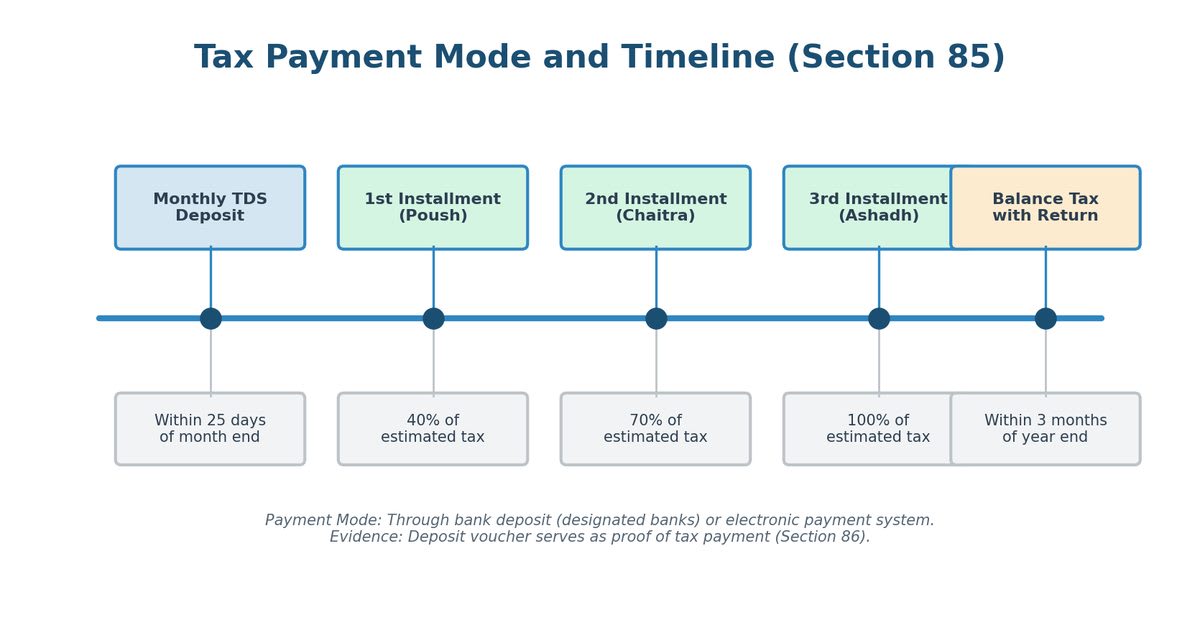
Figure: Tax Payment Mode and Timeline (Section 85)
(1) Tax required to be paid under this Act shall be paid in the place and mode as prescribed, and the Department may so prescribe that tax to be paid shall also be paid through electronic means.
Rule 29(1): A person must pay tax payable under the Act at the following places in the following manner:
(a) Where the Department has notified any person of the place for paying tax, at that same place;
(b) In other cases not covered by Clause (a), at a government-authorised bank or at the Department.
Rule 29(2): Where any person has paid tax at a government-authorised bank under Sub-rule (1), information thereof must be provided to the Department.
Rule 29(3): When paying tax under Sub-rule (1), payment may be made as follows:
(a) When making payment at the Department, by cash up to the limit prescribed by the Department, and by cheque or draft for amounts exceeding such limit; or
(b) When making payment at a government-authorised bank, by cash, cheque, draft, or electronic means.
Rule 29(4): If a cheque used to pay tax under Sub-rule (3) is dishonoured for any reason, the person who submitted such cheque must pay the Department an amount prescribed by the Department for all expenses incurred up to the payment date. When the Department prescribes such expense amount, it must include interest, fees, and fine amounts applicable on the tax up to the payment date.
Under the provisions of the Income Tax Act, the 'tax to be paid' includes the following amounts:
1. Amount to be paid per tax assessment under Section 99 by a person who has filed an income return under Section 96 of the Act: Among taxpayers required to file income returns under Section 96, if any taxpayer files an income return stating the total tax they owe for that year and the remaining tax balance to be paid for that year, such taxpayer must be deemed to have assessed their own tax for that year. The remaining tax to be paid by the person who filed the income return means the amount remaining after deducting from the total tax payable under the income return any instalment tax deposited for that year and any tax withheld when receiving payment from any other person. However, if any person does not file an income return for any income year, they must be deemed to have assessed their tax under Section 99 of the Act and to have paid the tax as per such assessment, and no tax balance is deemed outstanding for that year per their self-assessment.
2. Instalment Tax to be Paid by a Person Required to Pay Tax in Instalments: Under Section 94 of the Act, a person who earns income from business or investment in any income year must pay their estimated tax for that year in three instalments. Of the total estimated tax to be paid, 40 percent must be paid by the first instalment, 70 percent by the second instalment, and 100 percent by the third instalment. The instalment tax to be paid means the estimated tax for the instalment period minus any instalment tax already deposited for that income year in any earlier instalment before the current instalment deadline, and minus any tax withheld from payments included in computing that person's income for that year before the current instalment deadline. However, a taxpayer whose total amount for all 3 instalments is less than Rs. 7,500/- need not pay instalment tax.
3. Amount to be Paid per Revised or Deemed Tax Assessment Made by the Department or Office: Under Section 99 of the Act, the Department may revise the tax assessment made or deemed to have been made by a person within four years from the deadline for filing the income return. For taxpayers mentioned in Section 96(5) who fail to file an income return as per the Department's order, the office may conduct a deemed tax assessment. For a taxpayer who has been subjected to a revised or deemed tax assessment, an amount required to be paid as per the notice given under Section 102 of the Act is called the tax to be paid under this Act.
4. Tax Withheld from Payments or Amount Deemed to Have Been Withheld: A person or entity required to withhold tax on payments must deposit the withheld tax amount at the relevant office under Section 90. Where such amounts are paid without tax withholding by the payer or person or entity required to withhold tax, the tax is deemed to have been withheld at the time when it should have been withheld. The obligation to pay the unwithheld tax amount rests jointly with both the withholding agent and the person subject to tax withholding.
5. Amount of Advance Tax Collected or Deemed Collected: Under Section 95A of the Act, advance tax must be collected by the operator of a commodity market from persons who have earned profits and gains by trading in such market, by the entity that receives tax withholding on gains from disposal of securities of a resident entity, by the relevant Land Revenue Office that receives tax withholding on gains from disposal of house-land, house, or land, and by the relevant Customs Office on import of agricultural goods specified in the Act. Where advance tax has been collected but not deposited, the responsibility to deposit such amount rests with the person who collected it. The obligation to pay the uncollected advance tax amount rests jointly with both the person collecting and the person who should have received the tax.
6. Fees/Penalties Payable under the Act: These include:
(i) Fee under Section 117(1)(c) for not filing income return on time;
(ii) Fee under Section 117(1)(a) for not filing estimated tax return under Section 95;
(iii) Fee under Section 117(1)(b) for not filing the statement under Section 95A(9);
(iv) Fee under Section 117(3) for not filing the statement under Section 90(1);
(v) Fee under Section 117(2) for not maintaining documents required under Section 81;
(vi) Fees under Section 119A for violations related to electronic invoicing;
(vii) Fee under Section 120 for false or misleading statements;
(viii) Fee under Section 121 for encouraging tax offenses.
The fee amount to be paid as above is called the tax to be paid under this Act.
7. Interest Payable under the Act: If any person fails to pay the tax they owe within the prescribed time, interest accrues on such outstanding amount at the rate of 15 percent per year for the period between when the tax was required to be deposited and when it was actually deposited, as provided in Section 119 of the Act. Where instalment payment of arrear tax collection has been approved under Section 110A of the Act and payment is not made within the approved period, additional interest at the annual rate of 5 percent on the outstanding tax accrues under Section 119(4). Such interest is called the tax to be paid under this Act.
8. Claim and Auction Expenses: If the Department or office incurs any expense in seizing or conducting auction sale of any property of a person with tax arrears for the purpose of collecting outstanding tax, the office or Department may recover such expense from the person with tax arrears, and such amount is called the tax to be paid under this Act.
9. Fine Amount Payable under Section 129: If any person who has not paid tax, given false or misleading statements, obstructed tax administration, or failed to comply with the Act, or was an accomplice in such offenses, admits in writing to any of the offenses they have committed before the Department or office initiates court proceedings, the Department may order such person to deposit a fine amount not exceeding the total fine applicable for all offenses they admitted. The fine amount to be paid per such order is called the tax to be paid under this Act.
10. Amount to be Paid by Second or Third Parties per the Department's Order: A manager of an entity with tax arrears is responsible for paying the outstanding tax of that entity. Similarly, the Department may order a person required to pay any amount to a person with tax arrears, or an agent of a non-resident person with tax arrears, to pay the outstanding tax of the person with tax arrears up to that amount, and it becomes the duty of such person to pay the amount specified in the order. The amount that any such person mentioned above must pay under the Act or Department's order is called the tax to be paid under this Act.
(2) Tax required to be paid under this Act shall be paid at the following times, subject to sub-section (1):-
(a) In the case of one who has to withhold and pay advance tax, at the time mentioned in sub-section (4) of Section 90,
A person required to withhold and deposit tax on payments must deposit the tax amount within twenty-five days of the end of the month in which the tax is required to be withheld.
(b) In the case of one who has to pay tax in installments, at the time mentioned in sub-section (1) of Section 94,
A person required to pay in instalments must pay the first instalment of estimated tax by the end of Poush (mid-January), the second instalment by the end of Chaitra (mid-April), and the third and final instalment by the end of Ashadh (mid-July) of that income year.
(c) In the case of one who has to pay assessed tax,-
(1) On the date when the income return is to be submitted in respect of the tax assessment referred to in Section 99,
A person who self-assesses their tax must deposit the remaining unpaid tax balance after deducting the instalment tax and advance tax deposits from the total tax per the income return, along with the income return, i.e., within three months of the end of the income year.
(2) Within the time limit as specified in the tax assessment notice delivered pursuant to Section 102 in respect of tax assessed pursuant to sub-section (2) of Section 100,
Where the Department conducts a jeopardy tax assessment, the person subjected to jeopardy tax assessment must pay the outstanding tax within the deadline specified in the tax assessment notice sent under Section 102 of the Act.
(3) Within the time limit as specified in the tax assessment notice delivered pursuant to Section 102 in respect of the amended tax assessment made pursuant to Section 101,
Where the Department conducts an amended tax assessment, the person subjected to amended tax assessment must pay the outstanding tax within the deadline specified in the tax assessment notice sent under Section 102 of the Act.
(d) In respect of the amounts required to be paid to the Department as per any notice issued pursuant to sub-section (8) of Section 104, sub-section (1) of Section 109, or sub-section (1) of Section 110, on the date mentioned in the notice,
A person with tax arrears must pay the demanded amount by the date specified in the notice given under Section 104(8) of the Act regarding expenses incurred when the Department seizes or conducts auction sale of any property of that person to collect the outstanding tax. Persons required to pay amounts to persons with tax arrears under Section 109(1) and agents of non-resident persons with tax arrears under Section 110(1) must pay the required amount by the date specified in the notice issued by the Department.
(e) In respect of a liability fixed upon failure of any entity to pay tax pursuant to sub-section (2) of Section 107, at the same time when the entity is required to pay the tax,
Responsible authorised officers or managers of an entity who are responsible under Section 107(2) of the Act to pay the outstanding tax liability not paid by such entity must pay it at the same time the entity was required to pay it.
(f) In respect of the amounts required pursuant to sub-section (3) or (4) of Section 108, within seven days of the date on which the amounts are adjusted by auction sale or on which the amounts cannot be so adjusted, and
A receiver who, per the notice given by the Department under Section 108(2), sets aside an amount from the proceeds of the sale of any property of the person with tax arrears must deposit such amount within seven days of the date the receiver set aside such amount from the sale proceeds. Even if such person did not set aside any amount from the sale proceeds, the amount must be paid within seven days of the date by when it should have been set aside.
(g) In respect of the fees and interest assessed pursuant to Section 122, on the date as mentioned in the assessment notice.
Fees and interest assessed by the Department or office under Section 122 that are required to be paid must be paid within the deadline specified in the tax assessment notice sent under Section 102 of the Act or other notice.
(3) The date on which tax has to be paid shall not be affected in the following circumstances:-
(a) An action taken by the Department pursuant to Chapter-20 to recover tax, or
(b) Other action has been commenced pursuant to this Act.
Rule 30: In cases where any person is to pay due tax, interest and fee in various income years or of various sources but does not pay all amounts, the Department shall decide the matter of which income year or which source that amount is considered to belong to or is related with.
The tax to be paid under the Act and the time for payment are as summarised in the following table:
S.No. | Description of Tax or Amount | Time for Payment |
1. | Tax withheld from payments by a withholding agent, or the advance tax or the amount deemed withheld or collected even if not actually withheld or collected | Within twenty-five days of the end of the month in which tax withholding or advance tax collection is required. |
2(a) | Estimated instalment tax to be paid (first instalment / second instalment / third instalment) | By end of Poush / Chaitra / Ashadh of the income year in which instalment is due. |
2(b) | For taxpayers filing turnover-based income statement (first instalment / second instalment) | By end of Poush / Ashadh of the income year in which instalment is due. |
3. | Outstanding tax balance per income return filed under Section 96 and tax assessed under Section 99 | By the deadline for filing the income return, i.e., within three months of the end of the income year. |
4. | Tax payable per jeopardy tax assessment under Section 100(2) | Within the deadline specified in the tax assessment notice sent under Section 102 of the Act to the person subjected to jeopardy tax assessment. |
5. | Tax payable per amended tax assessment under Section 101 | Within the deadline specified in the tax assessment notice sent under Section 102 of the Act to the person subjected to amended tax assessment. |
6. | Expenses incurred when the Department seizes or conducts auction sale of property of a person with tax arrears | By the date specified in the notice given to the person with tax arrears under Section 104(8) of the Act. |
7. | Amount to be paid by a person required to pay amounts to a person with tax arrears under Section 109(1) and an agent of a non-resident person with tax arrears under Section 110(1) per the notice issued by the Department | By the date specified in the notice issued by the Department to those persons for payment. |
8. | Outstanding tax liability not paid by an entity for which one or more responsible authorised officers or managers of that entity under Section 107(2) of the Act are responsible to pay | At the same time the entity was required to pay it. |
9. | Amount set aside by a receiver from proceeds of sale of property of the person with tax arrears under Section 108(3) | Within seven days from the date the amount was set aside from the sale proceeds. |
10. | Where a receiver personally becomes responsible to pay the amount under Section 108(4) because no amount was set aside from the sale proceeds for tax | Within seven days from the date by when the amount should have been set aside from the sale proceeds. |
11. | Fees and interest assessed by the Department as per Section 122 | Within the deadline specified in the tax assessment notice or other notice sent under Section 102 of the Act to the person for whom fees and interest were assessed. |
12. | Fine amount to be paid per the order given by the Department under Section 119A | By the date specified in that order. |
Every type of amount falling within the definition of tax payable under the Act must be paid by the date and time prescribed by the Act. If any taxpayer pays the tax amount after the prescribed time, they must pay interest at the standard rate (15 percent per year) on the tax amount other than fees, interest, and fines paid late. Where any taxpayer fails to pay any amount due as tax on time, the Department may seize or conduct auction sale of any property of such taxpayer or recover from any amount the taxpayer is entitled to receive from any other person in order to collect the outstanding tax and interest accruing thereon.
86. Evidence of payable tax
The certificate signed by the officer of the Department, indicating the name, address of any person and the amount of tax required to be paid by that person, shall be an ample evidence for the amount of tax required to be paid by that person in the following actions:-
(a) Any action taken by the Department pursuant to Chapter-20 to recover tax, or
(b) Any action on any offence pursuant to Chapter-23.
Any certificate (notice or letter issued to that taxpayer or person) issued by an authorised official of the Department to a taxpayer or person, stating their name, address, and outstanding tax amount per the Department's records, constitutes the amount that such taxpayer or person must pay. An order issued under Section 90(8) or a notice issued under Sections 95(7) and 102 of the Act mentioning the outstanding tax payable by any taxpayer or person may be taken as evidence of the outstanding tax. If the taxpayer or person to whom such notice or letter was issued fails to pay the amount mentioned therein, the Department or office may initiate collection proceedings under Chapters 20 or 23 of the Act to recover such amount. To initiate such proceedings, the notice or letter issued by an authorised official of the Department to the taxpayer or person with tax arrears is considered sufficient evidence that such person or taxpayer has outstanding tax.