13. General deduction
Any person may, for the purpose of computing his income from any business or investment in any income year, deduct the following expenditures related with the transactions, subject to this Act:-
(a) Made in that income year,
(b) Made by that person, and
(c) Made in earning income from the business or investment.
This section allows claiming expenses incurred by that person in that year related to income-earning activities as general deductions. If all three conditions are not met, expenses cannot be claimed. Preliminary and pre-operational expenses can be claimed all at once in the year business commences. They cannot be deferred to future years, and except for capital-nature expenses, they cannot be added to fixed assets.
General deduction (Sec 13): an expense is deductible only if all 3 conditions are met = (a) incurred in that income year + (b) incurred by that person + (c) incurred in earning business or investment income. Preliminary & pre-operational expenses = claimed fully in the year business commences (cannot defer)
Example 21.6.1 (Investment context)
Suppose Gobinda Prasad had lent money to any entity. For the purpose of collecting interest and maintaining accounts on the loan, an employee was appointed in fiscal year 2080/81, and a salary of Rs. 30,000 was paid to such employee in that income year. Since such expense was incurred in earning investment income in that income year, the salary payment may be claimed as an expense deduction for fiscal year 2080/81.
Example 18.6.1 Nepal Dakshata Company Pvt. Ltd. incurred advertising expenses of Rs. 10,000 for business purposes in FY 2080/81, paid only in FY 2081/82. Since the expense was incurred in FY 2080/81 and is business-related, the deduction can be claimed in FY 2080/81 (accrual basis). However, if not claimed in FY 2080/81 but in FY 2081/82, since it is not related to FY 2081/82 income-earning activities, it cannot be deducted in FY 2081/82.
Bonus Expense Deduction
The Bonus Act, 2030 requires establishments to allocate and distribute bonus to employees at not more than 10% of net profit beyond the base net profit. The Department has clarified that bonus allocation amounts are deductible expenses under Sections 13 and 24 of the Income Tax Act, 2058, as distributed bonuses are included in the recipient's income and the government receives income tax on them.
The following rules apply:
(1) Amounts at not more than 10% of net profit allocated as bonus per the Bonus Act, 2030 must be deducted as expense for income tax purposes.
(2) Bonus amounts claimed as expense deductions in any income year must be fully distributed in the immediately following income year; for public entities requiring Government of Nepal prior approval, bonuses must be distributed in the year for which approval was given.
(3) If allocated bonus and claimed deductions in full or in part are not distributed within the specified time, such undistributed amount must be included in income in the immediately following income year as per Section 25(1)(c); however, amounts deposited in a national welfare fund or establishment welfare fund per the Bonus Act, 2030 in the immediately following year need not be included in income.
14. Interest deduction
(1) Any person may, for the purpose of computing his income from any business or investment in any income year, deduct all interests chargeable in that year under the following debt liabilities of that person created for the act of generating income from business or investment:-
(a) If the debt liability has been created for having borrowed any amount, and that amount has been used in that year or used to purchase any property used in that year, or
(b) That debt liability has been created in any other circumstance.
Interest includes: payments under a debt obligation other than principal; discount, premium, swap payment, or benefit from such arrangements; and amounts treated as interest under Section 32 from financial lease or annuity payments. Interest can be deducted from the year the purchased asset starts being used in business. Even if use starts mid-year, the full year's interest is deductible.
Example 18.6.2: A person took a loan 2 years ago to purchase a machine currently in use. This year's interest on that loan can be deducted. If the machine is not yet in use, interest must be capitalized. Interest on loans for working capital (paying salaries, purchasing raw materials, etc.) can also be deducted.
Example 18.6.3: A person took a loan of Rs. 2 crore on Shrawan 1 at 12% annual interest to purchase machinery this year. The machinery started operation from Baisakh 1. Expenses this year:
a) Service fee 1%, annual renewal fee 0.5%, payable on Shrawan 1 each year.
b) Loan registration fee: Rs. 20,000
c) Mortgage valuation: Rs. 20,000, stamp duty Rs. 2,000, insurance Rs. 30,000
d) Every 4 months independent inspection by bank and insurance company, valuer charges Rs. 2,000 per visit.
Deductible: Interest of Rs. 26 lakh (interest Rs. 24 lakh + service fee Rs. 2 lakh). Since the machine was used from Baisakh 1, all interest per Section 14(1) is deductible.
Loan registration fee Rs. 20,000 and mortgage valuation Rs. 20,000 are liability outgoings. Stamp duty Rs. 2,000, insurance Rs. 30,000, and periodic inspection fee Rs. 6,000 are general asset maintenance expenses.
Example 18.6.4: A jute company borrowed Rs. 30 lakh via overdraft to purchase raw jute, paying Rs. 3,40,000 interest this year. Since this is current capital for raw material and stock-in-trade purchases, all interest is deductible per Section 14(1).
Example 21.6.2 (Investment context):
Suppose Gobinda Prasad had lent Rs. 10 lakhs to any entity. To make such loan investment, he had taken a loan of Rs. 5 lakhs from a bank. In fiscal year 2080/81, he earned interest income of Rs. 1 lakh 20 thousand from such investment and paid interest of Rs. 50,000 on the loan. Since such interest payment was incurred by him to earn investment income in that year, he may claim such interest payment as an expense deduction for fiscal year 2080/81 as it is related to earning investment income.
(c) ......
(2) Notwithstanding anything contained in sub-section (1), if a resident entity controlled by an organization entitled to tax exemption pays interest to the controlling person or associated person, the interest amount deductible pursuant to that sub-section (1) shall not exceed the total of the following amounts:-
(a) All interest amounts received in that year to be included in the computation of the taxable income of that entity, and
(b) Fifty percent of the adjusted taxable income of that entity in that year, computed excluding any interest derived by that entity or without deducting any interest paid by that entity.
This provision (Section 14(2)) is known as the thin capitalisation rule. It limits interest deductions for a resident body controlled by tax-exempt organizations, non-residents, or associated persons, where such interest is paid to the controlling or associated person. The ratio must be calculated on each day shareholders change. If 25% or more ownership is held on any day, interest paid to that group must be calculated per Section 14(2).
Example 18.6.5: Info America Incorporation (non-resident) holds 50% in Info Nepal Pvt. Ltd. In FY 2081/82, Info Nepal paid Rs. 75,000 interest to Info America. The deductible interest is calculated as follows:
Description | Amount (Rs.) |
Sales | 7,50,000 |
Interest income | 5,000 |
Total income | 7,55,000 |
Cost of sales | 5,00,000 |
Administrative expenses | 1,20,000 |
Interest expense (controlling person) | 75,000 |
Interest expense (others) | 10,000 |
Depreciation | 20,000 |
Total expenses | 7,25,000 |
Adjusted taxable income:
Description | Amount (Rs.) |
Includable amounts | 7,55,000 |
Less: Cost of sales | 5,00,000 |
Administrative expenses | 1,20,000 |
Interest (others) | 10,000 |
Depreciation | 20,000 |
Total deductions | 6,50,000 |
Adjusted taxable income | 1,05,000 |
Claimable interest this year:
Interest income (A) | Rs. 5,000 | |
Adjusted taxable income (1,05,000 x 50%) (B) | Rs. 1,05,000 | |
Add: Interest expense to others per Section 14(1) | Rs. 10,000 | |
Less: Interest income | Rs. (5,000) | |
Total Adjusted Base | Rs. 1,10,000 | |
50% of Adjusted Base | Rs. 55,000 | |
Total claimable interest (A + B) | Rs. 60,000 |
Of total interest of Rs. 75,000, only Rs. 60,000 can be claimed this year. The remaining Rs. 15,000 can be carried forward to the next year and claimed within the limit for that year's income.
(3) Any interest not allowed to be deducted or not deducted pursuant to sub-section (2) may be carried forward or credited in the forthcoming income year.
Explanation: For the purposes of this Section, "a resident entity controlled by an organization entitled to tax exemption" means an entity which, being a resident entity in that year, is subject to a vested ownership or control of twenty-five percent or more of the following persons or organizations in any time of that year:-
(a) An organization entitled to tax exemption and a person associated with that organization,
(b) A person entitled to tax exemption pursuant to Section 11 in that year or a person associated with that person,
(c) A non-resident person or a person associated with the non-resident person, or
(d) Any combination of the persons referred to in clauses (a), (b) and (c).
Interest deduction (Sec 14(1)): interest on debt used to earn business/investment income is deductible from the year the asset is put to use (full year even if used only part of the year). Thin capitalisation (Sec 14(2)): where a resident entity is 25% or more owned/controlled by a tax-exempt organisation, a non-resident or an associated person, interest paid to that controller is deductible only up to (interest income + 50% of adjusted taxable income); the excess is carried forward (14(3))
15. Allowances for cost of stock-in-trade
(1) For the purpose of computing the income earned by any person from any business in any income year, no allowances other than the allowances for the cost computed pursuant to sub-section (2) shall be allowed in respect of the disposal of the stock-in-trade of the business of that person in that year.
(2) The allowances for the cost referred to in sub-section (1) shall be computed as follows by deducting the amount referred to in clause (b) from the amount referred to in clause (a):-
(a) The amount to be set by adding the cost of the stock-in-trade derived from any business in any income year to the opening value of the stock-in-trade of that business in that year,
(b) The amount of the final value of the stock-in-trade of any business in the income year referred to in clause (a).
(3) The initial value of the stock-in-trade of any business in any income year shall be the closing value of the stock-in-trade of that business at the end of the last income year.
(4) Whichever is lesser out of the following amounts shall be considered the closing value of the stock-in-trade of that business for that income year:-
(a) The cost of the stock-in-trade of that business at the end of that income year, or
(b) The market value of the stock-in-trade of that business at the end of that income year.
(5) In computing the cost of the stock-in-trade of a business, a person shall do as follows, subject to Section 45 and sub-section (6):-
(a) In computing the income of a business, in the case of a person maintaining accounts on the cash basis, by using the method of production While valuing on the basis of cost of production, the following components must be included:
(b) In computing the income of a business, in the case of a person maintaining accounts on the accrual basis, by using the method of consumption cost.
A. While valuing on the basis of cost of production, the following components must be included:
Direct Material Cost
Direct Labour Cost
Variable Factory Overhead
However, within the variable factory overhead cost, the following expenses shall not be included:
Repairs and maintenance expenses
Depreciation expenses
Under this method, while calculating the cost per unit of production:
Fixed Factory Overhead should not be included in the unit cost.
Instead:
The entire amount of fixed factory overhead actually paid during the year shall be allowed as a deduction on a cash basis.
B. Under consumption cost valuation, include:
Direct Material
Direct Labour
Factory Overhead
Factory overhead includes:
Fixed Factory Overhead
Variable Factory Overhead
Exclude:
Repairs and maintenance
Depreciation
(6) If the stock-in-trade of the business of any person cannot be determined, that person may choose either the first-in-first-out method or the weighted average cost method to compute the cost of stock-in-trade.
(7) When computing the cost of stock-in-trade pursuant to sub-section (5), it shall be computed by the following method:-
(a) When computing as per the consumption cost method, to so compute the cost of the stock-in-trade under the widely recognized accounting principle that it is equal to the sum total of direct material cost, direct labor cost and overhead cost of factory.
(b) When computing as per the production cost method, to so compute the cost of the stock-in-trade under the widely recognized accounting principle that it is equal to the sum total of direct material cost, direct labor cost and Variable overhead cost of factory.
(8) When computing the cost of stock-in-trade pursuant to sub-section (6), it shall be computed by the following method:-
(a) When computing as per the weighted average cost method, to compute all the stock-in-trade of the same type in the business under the widely recognized accounting principle as per the weighted average cost method.
(b) When computing as per the first-in-first-out method, to compute on the basis that the stock-in-trade received first is also disposed first, under the widely recognized accounting principle.
(9) ......
(10) ......
Explanation: For the purposes of this Section,-
(a) "Direct labor cost" means the labor cost directly related with the production of the stock-in-trade.
(b) "Direct material cost" means the cost of materials which are or will be an integral part of the stock-in-trade.
(c) "Overhead cost of factory" means the total cost incurred in producing stock-in-trade except the direct labor cost and direct material cost.
Provided that no amount for repair and maintenance and depreciation deduction shall be included in the overhead cost of the factory.
(d) "Variable overhead cost of factory" means the overhead cost of factory that alters directly with a change in the produced quantity of stock-in-trade.
Provided that no amount for repair and maintenance and depreciation deduction shall be included in the Variable overhead cost of the factory.
Stock-in-trade cost allowance (Sec 15) = opening stock + purchases - closing stock; closing stock valued at LOWER of cost or market. Costing method: cash basis = cost price or consumption cost; accrual basis = consumption cost; if not determinable = FIFO or weighted-average. Consumption cost = direct material + direct labour + factory overhead (repair/maintenance & depreciation excluded from overhead)
Example 18.6.6: Nepal Trade Development Pvt. Ltd. made the following purchases and disposals of trading stock.
S.N. | Date | Purchase Units | Rate | Total | Disposal |
1 | 2080/04/10 | 5 | 10 | 50 | |
2 | 2080/06/12 | 10 | 11 | 110 | |
3 | 2080/08/02 | 3 | |||
4 | 2081/02/02 | 6 |
FIFO Method
S.N. | Date | Pur. Units | Rate (Rs.) | Total (Rs.) | Disp. Units | Rate (Rs.) | Total (Rs.) | Bal. Units | Balance (Rs.) |
1 | 2080/04/10 | 5 | 10 | 50 | 5 | 50 | |||
2 | 2080/06/12 | 10 | 11 | 110 | 15 | 160 | |||
3 | 2080/08/02 | 3 | 10 | 30 | 12 | 130 | |||
4 | 2081/02/02 | 2 | 10 | 20 | |||||
4 | 4 | 11 | 44 | 6 | 66 | ||||
Total | 15 | 160 | 9 | 94 | 6 | 66 |
Example 18.6.7 (Weighted Average Method):
Using the same purchase and disposal data as Example 18.6.6, closing stock under the weighted average cost method:
S.N. | Date | Pur. Units | Rate | Total (Rs.) | Disp. Units | Rate | Total (Rs.) | Bal. Units | Bal. Rate | Balance (Rs.) |
1 | 4/10 | 5 | 10 | 50 | 5 | 10 | 50 | |||
2 | 6/12 | 10 | 11 | 110 | 15 | 10.66 | 160 | |||
3 | 8/2 | 3 | 10.66 | 31.98 | 12 | 10.66 | 106.70 | |||
4 | 2/2 | 6 | 10.66 | 63.96 | 6 | 10.66 | 64.06 | |||
Total | 15 | 160 | 9 | 95.94 | 6 | 64.06 |
Example 18.6.8 (Direct Material Cost):
ABC Company in Kathmandu purchases raw materials from Birgunj. Per bill Rs. 1,00,000; coolies Rs. 5,000; truck Rs. 20,000; municipality tax Rs. 2,000; other expenses Rs. 1,000; unloading Rs. 10,000. Total direct material cost: Rs. 1,38,000. If the other expenses of Rs. 1,000 relate to the previous year and were not deducted then, the direct material cost is Rs. 1,37,000. All costs of bringing the goods to the place of use are included in direct material cost.
Example 18.6.9 (Direct Labour Cost): A factory employs 10 workers who are paid Rs. 2 lakh in total to produce finished goods. This Rs. 2,00,000 is the direct labour cost, representing remuneration paid to workers directly engaged in converting raw materials into finished goods.
16. Repair and maintenance expenses
(1) When computing the income of any business or investment in any income year, a person may deduct all expenses incurred in the repair and maintenance of the depreciable property owned and used in that year to earn income from that business or investment.
(2) Notwithstanding anything contained in sub-section (1), in deducting the expenses allowable under that sub-section, such expenses shall not exceed seven percent of the depreciation base amount of the class of property remaining at the end of that income year.
Rule 7: In computing the depreciation base of any class of any property for purposes of computing the threshold referred to in Sub-section (2) of Section 16 of the Act, the excess expenses to be incurred pursuant to Sub-section (3) of Section 16 of the Act or any portion thereof shall not be included.
The 7% limit applies to the depreciation base at year-end for each pool separately. Excess repair and maintenance expenses not deductible due to this limit are added to the depreciation base of the concerned pool at the beginning of the following income year. If leased assets are used for business income activities and repairs are incurred, such repair expenses cannot be claimed under Section 16 but must be claimed under Section 13.
Provided that no such limit shall be applicable to repair and maintenance expenses incurred in the testing of an airplane pursuant to the standards determined by the Civil Aviation Authority of Nepal by the person providing air transport service.
(3) Any excess expense or part thereof on repair and maintenance which is not deductible because of the limit referred to in sub-section (2) may be added to the depreciation base amount of the class of the concerned property in the beginning of the upcoming income year.
Example 18.6.10: Suppose Nepal Trade Development Pvt. Ltd.'s repair and maintenance expense and fixed asset position in income year 2080/81 is as follows:
1. Repair and maintenance expenses incurred:
a. Building pool | Rs. 10,00,000 |
b. Computer/office equipment pool | Rs. 50,000 |
c. Automobiles pool | Rs. 8,00,000 |
2. Depreciation base:
a. Building pool | Rs. 5,00,00,000 |
b. Computer/office equipment pool | Rs. 4,00,000 |
c. Automobiles pool | Rs. 80,00,000 |
3. Allowable repair and maintenance expense:
a. Building pool at 7 percent | Rs. 35,00,000 (entire expense deductible) |
b. Computer/office equipment at 7 percent | Rs. 28,000 |
c. Automobiles pool at 7 percent | Rs. 5,60,000 |
4. Non-deductible repair expense (added to depreciation base):
a. Fully deductible.
b. Rs. 22,000 (50,000 - 28,000) added to opening depreciation base of 'C' pool next year.
c. Rs. 2,40,000 (8,00,000 - 5,60,000) added to opening depreciation base of 'D' pool next year.
Example 21.6.3 (Investment context):
Suppose in fiscal year 2080/81, Gobinda Prasad had rented out a car to Nepal Trade Development Pvt. Ltd. and under the agreement, the repair and maintenance expenses for that car were to be borne by him.
Repair and maintenance expenses incurred for automobiles (Class D) | Rs. 1,15,000. |
Depreciation base of automobiles (Class D) | Rs. 15,00,000. |
Claimable at 7% | Rs. 1,05,000 (only Rs. 1,05,000 can be claimed). |
Non-deductible amount to be added to opening depreciation base of next year | Rs. 10,000 (Rs. 1,15,000 - Rs. 1,05,000). |
Repair & maintenance (Sec 16): deductible up to 7% of the year-end depreciation base of each pool separately; the excess is added to that pool's opening depreciation base next year (then depreciated).
Repairs on leased assets = claim under Sec 13, not 16.
No 7% limit on aircraft-testing repairs by an air-transport service provider
17. Pollution control expenses
(1) For the purposes of computing the income earned by any person from any business in any income year, such person may deduct the pollution control expenses to the extent incurred in the operation of that business in that year.
(2) Notwithstanding anything contained in sub-section (1), in computing the limit of expenses deductible under that sub-section in any income year, it shall not exceed fifty percent of the adjustable taxable income of all businesses operated by such person.
(3) Any excess expense or part thereof which is not deductible in excess of the limit referred to in sub-section (2) may be capitalized and depreciated pursuant to Schedule-2 in the beginning of the upcoming income year.
Only up to 50% of the adjusted taxable income may be deducted for pollution control expenses. Expenses unrelated to any business process cannot be deducted. Excess expenses not deductible due to this limit may be capitalized at the beginning of the following year and depreciation claimed per Schedule 2 (Pool 'D').
Explanation: For the purposes of this Section, "pollution control expenses" means the expenses incurred by any person related with any process for the purpose of controlling pollution or protecting or conserving the environment in any other manner.
Example 18.6.11: Suppose Nepal Trade Development Pvt. Ltd.'s income statement for income year 2080/81 is as follows:
Expenses | Rs. | Income | Rs. |
Cost of trading stock | 44,00,000 | Sales | 71,50,000 |
Administrative expenses | 5,00,000 | Interest income | 5,000 |
Donations | 10,000 | ||
Bank interest expense | 2,80,000 | ||
Pollution control expense | 12,00,000 | ||
Research and development | 7,00,000 | ||
Depreciation expense | 50,000 | ||
Net profit | 15,000 | ||
Total | 71,55,000 | Total | 71,55,000 |
The pollution control expense deductible in that income year is calculated as follows:
Adjusted taxable income calculation | Rs. | Rs. |
Amounts included | 71,55,000 | |
Less: | ||
Interest expense | 2,80,000 | |
Cost of trading stock | 44,00,000 | |
Depreciation | 50,000 | |
Other admin expenses | 5,00,000 | |
R&D expense | 7,00,000 | |
Total deductions | 59,30,000 | |
Adjusted taxable income | 12,25,000 | |
50 percent | 6,12,500 | |
Actual pollution control expense | 12,00,000 | |
Deductible amount | 6,12,500 | |
Amount to be capitalised | 5,87,500 |
Of the Rs. 12,00,000 pollution control expense, only Rs. 6,12,500 may be deducted. The remaining Rs. 5,87,500 is added to the depreciation base of class 'D' assets and may be depreciated from the following year.
18. Research and development expenses
(1) For the purposes of computing the income earned by any person from any business in any income year, such person may deduct the research and development expenses to the extent incurred in the operation of that business in that year.
(2) Notwithstanding anything contained in sub-section (1), in computing the limit of expenses deductible under that sub-section in any income year, it shall not exceed fifty percent of the adjustable taxable income of all businesses operated by such person.
(3) Any excess expense or part thereof which is not deductible in excess of the limit referred to in sub-section (2) may be capitalized and depreciated pursuant to Schedule-2 in the beginning of the upcoming income year.
Explanation: For the purposes of this Section, "research and development expenses" means the expenses incurred by any person for the purpose of developing his business and improving commercial production or process.
Provided that such expenses shall not include the cost incurred in acquiring any property referred to in sub-section (3) of Section 1 of Schedule-2.
Only up to 50% of the adjusted taxable income may be deducted for research and development expenses. Expenses unrelated to business development cannot be deducted. Excess expenses not deductible due to this limit may be capitalized and depreciation claimed per Schedule 2 (Pool 'D').
Example 18.6.12: Continuing Example 18.6.11, The following research and development expenses of Nepal Vyapar Bikash Pvt. Ltd. are deductible in that income year.”
Adjusted taxable income calculation | Rs. | Rs. |
Amounts included | 71,55,000 | |
Less: | ||
Interest expense | 2,80,000 | |
Cost of trading stock | 44,00,000 | |
Depreciation | 50,000 | |
Other admin expenses | 5,00,000 | |
Pollution Control expense | 12,00,000 | |
Total deductions | 64,30,000 | |
Adjusted taxable income | 7,25,000 | |
50 percent | 3,62,500 | |
Actual pollution control expense | 7,00,000 | |
Deductible amount | 3,62,500 | |
Amount to be capitalised | 3,37,500 |
Of the R&D expense of Rs. 7,00,000, only Rs. 3,62,500 may be deducted. The remaining Rs. 3,37,500 is added to the depreciation base of class 'D' assets and may be depreciated from the following year.
Pollution control (Sec 17) & Research and development (Sec 18) expenses: each deductible up to 50% of the adjusted taxable income of all the person's businesses; the excess is capitalised, added to Pool 'D' and depreciated per Schedule 2 from the following year. R&D excludes the cost of acquiring depreciable/capital property
19. Depreciation deduction expenses
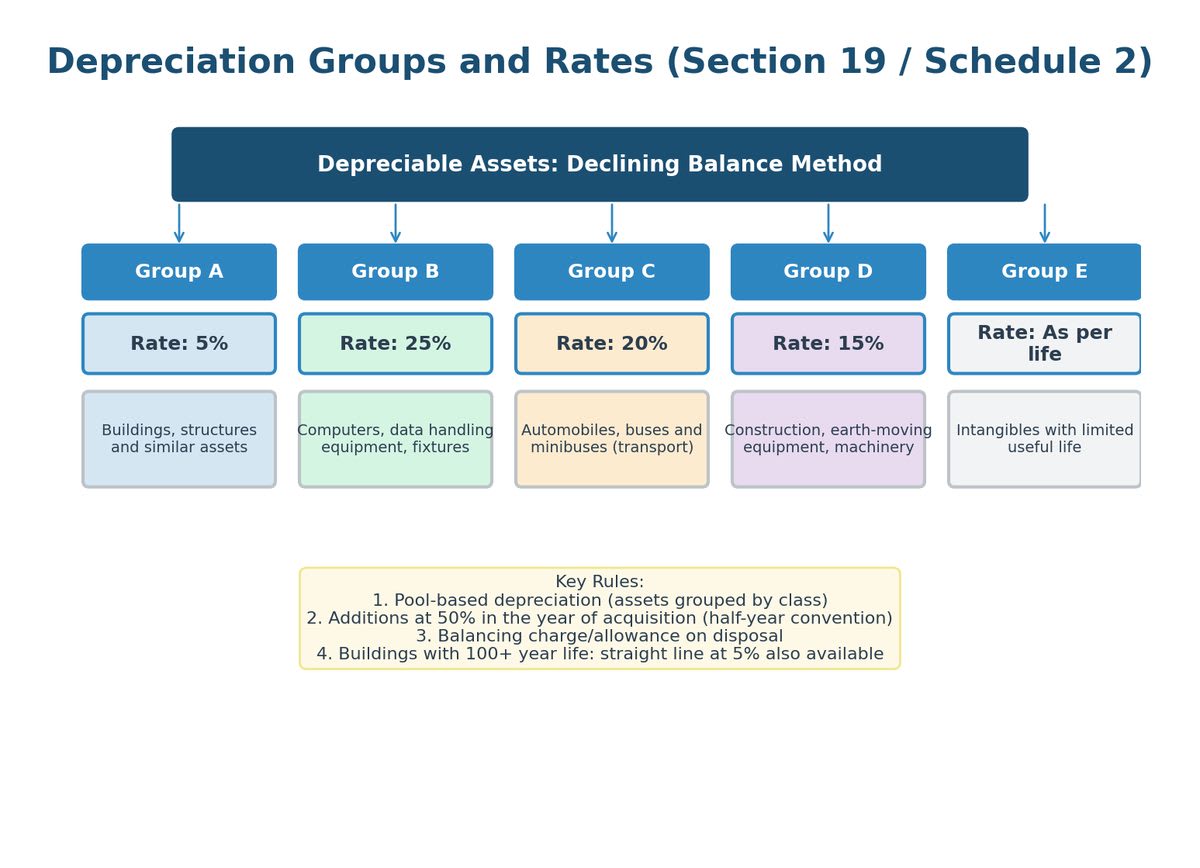
Figure: Depreciation Groups and Rates (Section 19 / Schedule 2)
(1) For the purposes of computing the income earned by any person from any business or investment in any income year, such person shall deduct depreciation pursuant to Schedule-2 in lieu of depreciation of the depreciable properties owned and used by that person in that year in earning income from that business or investment.
Conditions for claiming depreciation:
(1) the asset must be used in business or investment income activities;
(2) that person must have ownership of the asset;
(3) the asset must be a depreciable asset.
Depreciation must be claimed per Schedule 2.
Schedule 2 provides:
Sub section 1: Classification and Pooling of Depreciable Assets: Depreciable assets are classified into Classes A, B, C, D, and E. Class A, B, C, and D assets of the same class are pooled together. Class E assets (intangible assets) must be placed in separate pools even if of the same class, as each has different status and useful life.
Classification of Depreciable Assets (Schedule 2, Section 1) | |
Class | Asset Description |
'A' | Buildings, structures, and other permanent constructions (includes roads, tunnels, dams, powerhouses, warehouses, stadiums, bridges, etc.) |
'B' | Computers, data processing equipment, furniture, fixtures, and office equipment |
'C' | Automobiles, buses, and minibuses |
'D' | Construction and excavation equipment; assets capitalized under Sections 17(3) and 18(3); other depreciable assets not classified elsewhere |
'E' | Intangible assets (patents, copyrights, trademarks, formulas, brands, time-bound rights-linked assets). Each Class 'E' asset is placed in a separate pool. |
For depreciation purposes, class 'ka' (permanent structures) includes buildings, roads, tunnels, dams, swimming pools, power houses, warehouses, stadiums, view towers, canals, bridges, airport aprons, parking lots, and similar permanent assets. Structures built on leased land for a fixed period and structures built in rented commercial premises are depreciated over the period determined by the agreement between the lessor and lessee. The cost of such structures must be included in class 'nga' and depreciation claimed subject to the terms of that agreement.
Class 'nga' (intangible assets) includes patents, copyrights, trademarks, formulas, brands and other time-limited rights (but goodwill is not treated as an asset for tax purposes). A royalty tied to per-unit production or sales is not an intangible asset but a royalty.
Example 18.6.12 A:
Sunrise Boarding School Pvt. Ltd. purchased chairs/tables worth Rs. 1,00,000 and Diamond Restaurant Pvt. Ltd. purchased chairs/tables worth Rs. 2,00,000 for a party hall. Both must add to Class 'B' depreciation base.
Example 18.6.12 B:
Sunrise Boarding School Pvt. Ltd. bought a bus for Rs. 30,00,000 to transport students. Angela Travel Pvt. Ltd. bought a jeep for Rs. 40,00,000. Both are Class 'C' assets.
Section 3 Depreciation Rates: Three types are available:
(1) Normal Rate per Schedule 2, Section 3(1);
(2) Accelerated Rate per Schedule 2, Section 3(2) for manufacturing industries and specified bodies.
The following entities may claim an accelerated rate of one-third additional depreciation on Class A, B, C and D assets.
(a) Special industries (as defined in the Industrial Enterprises Act, 2076, Section 17) - meaning manufacturing industries other than cigarettes, bidi, cigar, khansu (tobacco), mines, industries whose main raw material is tobacco and similar products, wine, beer and similar products.
(b) Entities operating trolley buses or mini-buses on a specific route, or constructing and operating a ropeway, cable car or sky bridge, or constructing and operating roads, bridges, tunnels, railways or airports.
(c) Entities constructing public infrastructure and transferring it to the Government of Nepal, and hydropower generation, production and transmission projects.
(d) Cooperative unions and institutions registered under the Cooperative Act, 2074, other than tax-exempt ones.
A person who has developed an asset for the purpose of generating electricity required for their own business purpose may claim fifty percent of the capitalised amount of such asset as depreciation expense in the same year.
A person who issues bills and invoices using a fiscal printer and cash machine may claim the entire amount of expenditure incurred on such printer and cash machine as depreciation expense in the same year.
Depreciation Rates (Schedule 2, Section 3) | |||
Class | Normal Rate (Sec 3(1)) | Accelerated Rate (Sec 3(2)) - Manufacturing/Specified Bodies | Basis |
'A' | 5% | 6.67% | Declining balance |
'B' | 25% | 33.33% | Declining balance |
'C' | 20% | 26.67% | Declining balance |
'D' | 15% | 20.00% | Declining balance |
'E' | Cost/useful life (rounded to nearest half year) | Same as normal | Straight line |
Section 2 Depreciation of Asset
(1) General Rule
Any person can claim depreciation expense for each pool of depreciable assets in an income year.
Depreciation Formula
Depreciation=A×B
Meaning
A- Depreciation base of the pool at year-end
B- Depreciation rate applicable to that asset class
(2) Calculation of Depreciable Base
The depreciation base of depreciable assets in Class "A", "B", "C" and "D" is computed pool-wise, while the base of each asset in Class "E" is computed separately.
Item | Amount |
Opening depreciation base (previous year end base minus depreciation, if less than Rs. 2,000 deduct entirely) | |
Add: assets purchased during the year (per timing rules) | |
Add: prior-year amounts added to pool under Section 16 | |
Add: amounts added per Schedule 2(5) for next year's pool | |
Less: amounts received from disposal of pool assets in the year | |
Closing depreciation base |
The depreciation base of each depreciable asset under Class "E" at the end of any income year shall be the total of the following amounts:
Component | Description |
Opening Base | Previous year's depreciation base |
Additions | New assets added during the year |
(3) How New Asset Cost is Added to Pool
The full cost is not always added immediately.
A proportion is added in the year of purchase depending on when the asset is acquired.
First Instalment Formula
A/3×B
Meaning
A-Time factor as shown below B-Cost of asset
Period of Addition | Value of A | Portion Added This Year (A/3) | Balance Added Next Year |
Shrawan to Poush | 3 | Full cost (3/3) | None |
Magh to Chaitra | 2 | Two-thirds (2/3) | One-third |
Baisakh to Ashadh | 1 | One-third (1/3) | Two-thirds |
Remaining Cost
The balance not added in the first year:
Added in the following income year
Not added if the pool is dissolved before then.
(4) Additional Depreciation for Small Balances
Applicable only to Class A, B, C and D.
After calculating normal depreciation:
Condition | Treatment |
Remaining balance ≥ Rs. 2,000 | Carry forward normally |
Remaining balance < Rs. 2,000 | Claim entire balance as additional depreciation |
Section 4 Disposal of Depreciable Assets
Disposal of Depreciable Assets:
SubSection (1): If disposal proceeds of Class A, B, C, or D pool assets exceed the depreciation base at year-end, the excess (Balancing Charge) must be included in income.
SubSection (2): If all assets in a pool are disposed of before year-end, the pool is dissolved: if base exceeds proceeds, the excess is Terminal Depreciation (expense); if proceeds exceed base, the excess is income.
Summary of Depreciation (Sec 19, Schedule 2): asset must be (i) owned, (ii) used in business/investment, (iii) of a depreciable nature.
Pools (declining balance): A buildings/structures 5%, B computers/furniture/office equipment 25%, C automobiles/buses 20%, D plant/unclassified + assets capitalised u/s 17(3)/18(3) 15%; E intangibles = cost ÷ useful life (straight line, each in a separate pool).
Accelerated rate (manufacturing & specified bodies) = normal + one-third (A 6.67%, B 33.33%, C 26.67%, D 20%). Addition timing: added Shrawan-Poush = 100% of cost, Magh-Chaitra = two-thirds, Baisakh-Ashadh = one-third (balance added the next year)
Example 18.6.14: Suppose Nepal Trade Development Pvt. Ltd.'s depreciation base for pool 'kha' at the end of income year 2080/81 is Rs. 1,00,000. The depreciation expense for that pool in that income year is:
Depreciation base at end of income year (ka) | Rs. 1,00,000 |
Depreciation rate (kha) | 25 percent |
Depreciation expense = ka x kha | Rs. 25,000 |
Example 18.6.15: Suppose Nepal Trade Development Pvt. Ltd.'s class 'kha' depreciation base at the end of income year 2080/81 is Rs. 2,400. After deducting 25 percent depreciation of Rs. 600, the balance is Rs. 1,800. Since this is less than Rs. 2,000, the entire remaining balance of Rs. 1,800 may be claimed as additional depreciation in that income year.
Example 18.6.16: A computer worth Rs. 60,000 purchased in FY 2080/81: if added within Poush 2080, full Rs. 60,000 included in that year's pool; if added Magh-Chaitra, two-thirds Rs. 40,000 added this year and Rs. 20,000 next year; if added Baisakh-Ashadh, one-third Rs. 20,000 added this year and Rs. 40,000 next year.
Example 18.6.17 (Class E - Trade Mark License): Trade mark license purchased on Magh 10, 2080 at Rs. 6,00,000 with useful life 5 years 2 months (rounded to 5 years). Annual rate: 20%. Annual depreciation: Rs. 1,20,000. Since purchased in Magh-Chaitra, two-thirds of cost (Rs. 4,00,000) is added in FY 2080/81 and Rs. 2,00,000 in FY 2081/82.
Description | FY 2080/81 | FY 2081/82 | FY 2082/83 |
Cost (Rs.) | 6,00,000 | 6,00,000 | 6,00,000 |
Opening depreciation base (Rs.) | - | 5,20,000 | 4,00,000 |
Added this year timing-based (Rs.) | 4,00,000 | - | - |
Depreciation expense (Rs.) | 80,000 | 1,20,000 | 1,20,000 |
Next year opening depreciation base (Rs.) | 5,20,000 | 4,00,000 | 2,80,000 |
Amount to add to pool next year (Rs.) | 2,00,000 | - | - |
Example 18.6.18: Nepal Trade Development Pvt. Ltd. at end of FY 2079/80 had Pools C and D. In Magh FY 2080/81, added a motorcycle worth Rs. 1,00,000. In FY 2080/81, sold car for Rs. 17 lakh and machinery for Rs. 9 lakh. Motorcycle destroyed in accident; no assets remain in either pool.
Description | Pool C (Rs.) | Pool D (Rs.) | Total (Rs.) |
Opening depreciation base | 15,00,000 | 10,50,000 | 25,50,000 |
Added this year (timing-based) | 1,00,000 | - | 1,00,000 |
Disposed this year | 17,00,000 | 9,00,000 | 26,00,000 |
Assets remaining | None | None | None |
Balancing Charge (income) | 1,00,000 | - | 1,00,000 |
Terminal Depreciation | - | 1,50,000 | 1,50,000 |
Depreciation base | - | - | - |
Balancing Charge (excess proceeds over base) of Rs. 1,00,000 in Pool C is included in income per Section 7(2)(d). Pool D has no remaining assets but a value of Rs. 1,50,000 remains, so Terminal Depreciation of Rs. 1,50,000 is claimed per Schedule 2, Section 4.
If an asset still exists but its block value is zero, any repair/improvement cost is added to the depreciation base and depreciated in future years instead of being immediately deducted.
(2) Notwithstanding anything contained in sub-section (1), the following provisions shall apply in respect of the depreciation deduction of the devices, equipment and other machineries installed by any entity in the projects involving construction and operation of public infrastructure to be transferred to the Government of Nepal and in the projects on construction of powerhouses and generation and transmission of electricity:-
(a) If the devices, equipment and other machineries installed previously become obsolete because of being old or worn out and new devices, equipment and other machineries have to be installed in lieu thereof, the value which remains by subtracting the depreciation deduction up to the income year from the cost of the obsolete property that was installed previously in the income year in which such new installation was made may be deducted as expenses.
(b) In respect of properties other than the old properties replaced pursuant to clause (a), if any value remains by subtracting the depreciation deduction up to the income year when transfer takes place from the cost of those properties at the time when the entity transfers such a project to the Government of Nepal, that entity may deduct such remaining value as expenses.
Example 18.6.21 Nepal Hydropower Project Pvt. Ltd. received a 30-year license for a 30-megawatt BOOT project. In addition to other assets, land worth Rs. 90 lakh was purchased for the project. Since this is a BOOT project requiring land handover at the end of the 30-year contract period, the land investment can be included in Class 'E' and claimed as Rs. 3 lakh per year (Rs. 90 lakh / 30 years) for income tax purposes.
Example 18.6.23 A company purchased a fiscal printer and cash machine for Rs. 50,000. Since these are assets specified under Schedule 2, Section 3(4), the full cost of Rs. 50,000 can be claimed as depreciation in the year the assets are put into use.
Example 18.6.22: Kattha Limited, special industry, installed a generator worth Rs. 9 lakh in Magh 2080. Pool D other assets opening depreciation base Rs. 29 lakh. The opening depreciation base of class 'D' other assets at the start of the year is Rs. 29 lakh. Since the generator qualifies for 50 percent first-year depreciation, the calculation is:
Opening dep. base | Rs. 29,00,000 |
Depreciation at (15+15/3) 20% (a) | Rs. 5,80,000 |
Special depreciation 50%*9,00,000 (b) | Rs. 4,50,000 |
Total depreciation (a + b) | Rs. 10,30,000 |
Opening dep. base next year | Rs. 38,00,000 - Rs. 10,30,000 = Rs. 27,70,000 |
Example 21.6.9: Suppose the assets in Gobinda Prasad's Pool "C" at the end of fiscal year 2079/80 were as follows. He did not add any assets in fiscal year 2080/81. In fiscal year 2080/81, he sold his car for Rs.14 lakhs. The outgoings and incomings of that pool are as follows:
Item | Amount (Rs.) |
(a) Total Pool "C" | 15,00,000/- |
(b) Fiscal year 2079/80 depreciation base | 15,00,000/- |
(c) Fiscal year 2079/80 depreciation expense | 3,00,000/- |
(d) Amount remaining after deducting depreciation (b-c) | 12,00,000/- |
(e) Fiscal year 2080/81 depreciation base (Outgoings) | 12,00,000/- |
(f) Amount received from sale of asset (Incomings) | 14,00,000/- |
Amount to be included in income (f-e) | 2,00,000/- |
Since the incomings exceeded the outgoings in that asset pool and there are no other assets in that pool, the pool is considered dissolved, and the excess of incomings over outgoings of Rs.2 lakhs must be included in investment income. If he had sold the car for only Rs.11 lakhs, since outgoings exceeded incomings by Rs.1 lakh, he would have been entitled to claim such amount as an expense deduction in that fiscal year under Section 19.
20. Loss from business or investment
(1) For the purposes of computing the income earned by any person from any business or investment in any income year, such person may deduct the following loss:-
(a) Loss suffered by that person from any other business and not deducted in that year, and
Example 18.8.1: Ganesh Sinkhada had Rs. 1 crore import business income and Rs. 50 lakh hotel operation loss in FY 2080/81. He can claim the hotel loss against import income in that year's return.
Example 18.8.2: If Ganesh Sinkhada had only hotel losses of Rs. 50 lakh in FY 2080/81 with no other income, losses can be carried forward for 7 years (until FY 2087/88) and deducted from business or investment income from 2081/82 through 2087/88.
Per Section 57, if 50% or more of any body's ownership (control) changes compared to three years prior, the body is deemed to have disposed of its assets or liabilities, and losses incurred before the ownership change cannot be deducted after the change.
Example 21.8.1: Suppose Ganesh Bahadur incurred a loss of Rs. 10 lakhs from a hotel business in fiscal year 2080/81. He sold shares of a listed company (investment income) in that year and earned a gain of Rs. 15 lakhs from such sale. In computing the net gain from share disposal in that fiscal year, the hotel business loss of Rs. 10 lakhs may be deducted, leaving a net gain of only Rs. 5 lakhs. In the above example, investment loss cannot be claimed as a deduction against income from hotel business.
Example 21.8.2: Suppose Ganesh Bahadur sold shares of a listed company (investment income) in fiscal year 2079/80 and incurred a loss of Rs. 6 lakhs from such sale, and such loss could not be adjusted in that year. In fiscal year 2080/81, he sold land (non-business taxable asset) for Rs. 1 crore (investment income) and earned a gain of Rs. 20 lakhs. In computing the net gain from disposal of non-business taxable asset in that fiscal year, the investment loss of Rs. 6 lakhs from fiscal year 2079/80 may be deducted, leaving a net gain of only Rs. 14 lakhs.
(b) Loss suffered by that person from any business and not deducted in the past seven income years.
Provided that in the case of a project of building and operation of any public infrastructure to be transferred to the Government of Nepal, a project on construction of a powerhouse and generation and transmission of electricity, and an entity conducting petroleum work pursuant to the Nepal Petroleum Act, 2040, loss not deducted in the last twelve income years.
(2) For the purposes of computing the income earned by any person from any investment in any income year, such person may deduct the loss suffered by that person from any other investment and not deducted in that year and the loss incurred by that person from such investment or any other investment which could not be deducted in the past seven income years.
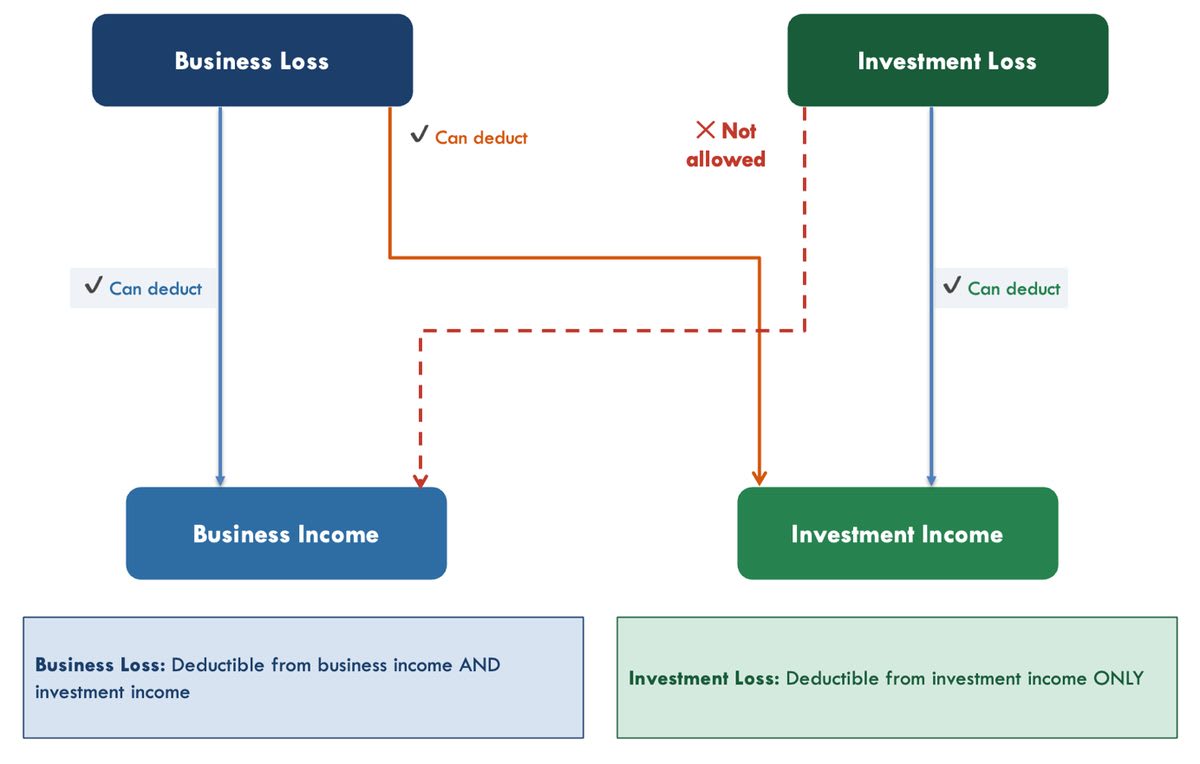
In this sense, while business loss may be claimed as a deduction against investment income, investment loss cannot be claimed as a deduction against business income. Similarly, losses from business or investment cannot be deducted from employment income.
(3) Subject to sub-sections (1) and (2), and for the purposes of those sub-sections, any loss suffered by any person in respect of foreign source and not deducted may be deducted only in computing the income earned by that person from his foreign source, and the loss suffered in earning any non-taxable income and not deducted may be deducted only in computing the non-taxable income of that person.
Any undeducted loss incurred by a person from a foreign source may be deducted only in computing income of that person from that foreign source, and any undeducted loss incurred in receiving a tax-exempt income may be deducted only in computing the tax-exempt income of that person. That is, investment losses incurred in a particular country may only be deducted against investment income earned in that same country.
(4) Subject to sub-sections (1) and (2), if any person suffers a loss in an income year when a long-term contract obtained by carrying on the business at the international level in competition was completed or disposed of in any other manner, or where a loss not deducted which the liability whereof is allowed to be carried forward to the coming year pursuant to clause (b) of sub-section (1) is related with a long-term contract, the Department may, by a notice in writing, give permission to deal with that loss as follows:-
(a) The loss may be carried backward to the last income year or years, and
(b) The loss not deducted may be treated only to the extent of the excess where, in computing the income of the business related with that long-term contract, the amounts to be included in the incomings exceed the amounts to be included in the outgoings.
Comprehensive Numerical Illustration
Company: ABC Infrastructure Pvt. Ltd.
Business: Construction of large infrastructure projects
Nature of Contract: Long-term construction contract obtained through international competitive bidding (Global Contract)
Contract Period: FY 2077/78 to FY 2080/81
Accounting Method: Percentage of Completion Method (Estimated Cost Basis)
Applicable Income Tax Rate (assumed for illustration): 25%
FY 2077/78:
Contract Revenue Recognised: Rs. 100,000,000
Contract Cost Incurred: Rs. 80,000,000
Profit: Rs. 20,000,000
FY 2078/79:
Contract Revenue Recognised: Rs. 120,000,000
Contract Cost Incurred: Rs. 95,000,000
Profit: Rs. 25,000,000
FY 2079/80:
Contract Revenue Recognised: Rs. 60,000,000
Contract Cost Incurred: Rs. 120,000,000
Loss: Rs. 60,000,000
FY 2077/78 Tax: Rs. 20,000,000 × 25% = Rs. 5,000,000
FY 2078/79 Tax: Rs. 25,000,000 × 25% = Rs. 6,250,000
Total Tax Paid in Earlier Years: Rs. 11,250,000
In FY 2079/80, the company incurs a loss of Rs. 60,000,000 related to the long-term contract. Upon completion of the contract, the Inland Revenue Department issues a written notice allowing carry-back of the loss.
Step 1: Set-off against FY 2078/79 profit
Profit available: Rs. 25,000,000
Remaining loss: Rs. 60,000,000 − Rs. 25,000,000 = Rs. 35,000,000
Step 2: Set-off against FY 2077/78 profit
Profit available: Rs. 20,000,000
Remaining loss: Rs. 35,000,000 − Rs. 20,000,000 = Rs. 15,000,000
Tax Benefit:
Refund/Credit Adjustment of FY 2078/79 tax: Rs. 6,250,000
Refund/Credit Adjustment of FY 2077/78 tax: Rs. 5,000,000
Total immediate tax refund/Credit Adjustment: Rs. 11,250,000
Balance loss of Rs. 15,000,000 carried forward to future years.
Assume that carry-back is not approved by the Department. In such a case, clause (b) applies.
While computing income from the business related to the long-term contract in FY 2079/80:
Income side amount: Rs. 60,000,000
Expense side amount: Rs. 120,000,000
Excess of income over expense: Nil
Result under clause (b):
Entire loss of Rs. 60,000,000 is treated as ‘loss not allowed to be deducted’. The loss is legally recognised but cannot be set off against other business income. The loss is carried forward and adjusted only against future income from the same long-term contract.
If carry-back is allowed: Immediate cash-flow benefit through tax refund of Rs. 11,250,000.
If carry-back is not allowed: Genuine loss of Rs. 60,000,000 is preserved for future adjustment and not permanently disallowed.
(5) The following loss suffered by any person in any income year shall be allocated as if it were related with a long-term contract or contracts of that person:-
(a) The loss resulted from a long-term contract or contracts related with the business, and
(b) The loss on excess of the expenses to be deductible in computing the income earned from that business in the year related with the contract for each such contract over the amounts to be included.
(6) If, when computing the income earned by any person from more than one business or investment in any income year, that person is allowed to deduct the loss not deducted from more than one business or investment, that person may on his own determine the priority of the business or investment from which the portion of loss is deducted.
Example 18.8.3: Globe Nepal Pvt. Ltd. has a Trading Business in Kathmandu and LPG factories in Bhairahawa (Rs. 1 crore income) and Dhangadhi (Rs. 20 lakh income). Trading Business had Rs. 10 lakh loss in FY 2080/81. The company must decide itself whether to deduct the loss from Bhairahawa or Dhangadhi income, as per Section 20(6).
(7) If, when computing the loss suffered by any person from any business or investment in any income year, this Section is not applied and the deductible amounts exceed the amounts includable in computing the income from the business or investment of that person, such excess amounts shall be computed.
(8) If any person has received full tax exemption in respect of income of business or investment in any income year, the loss incurred in that income year shall not be carried forward to the upcoming income year.
For example, a loss from a business that is fully exempt from tax under Section 11 of the Act cannot be claimed as a deduction against computing income from other businesses or investments, and such loss also cannot be carried forward.
Example 18.8.4: Globe Electricity Company Pvt. Ltd. operated a small hydropower plant with full tax exemption until FY 2079/80, accumulating Rs. 60 lakh in losses. In FY 2080/81, the company earned Rs. 10 lakh. Since full exemption was received in 2079/80, losses cannot be carried forward to 2080/81. The company must file tax on Rs. 10 lakh at 20% = Rs. 2 lakh.
Example 18.8.5: If Globe Electricity Company received only partial tax exemption until FY 2079/80, the Rs. 60 lakh losses can be carried forward and deducted from FY 2080/81 income. Any undeducted amount can be carried forward subject to Section 20(1).
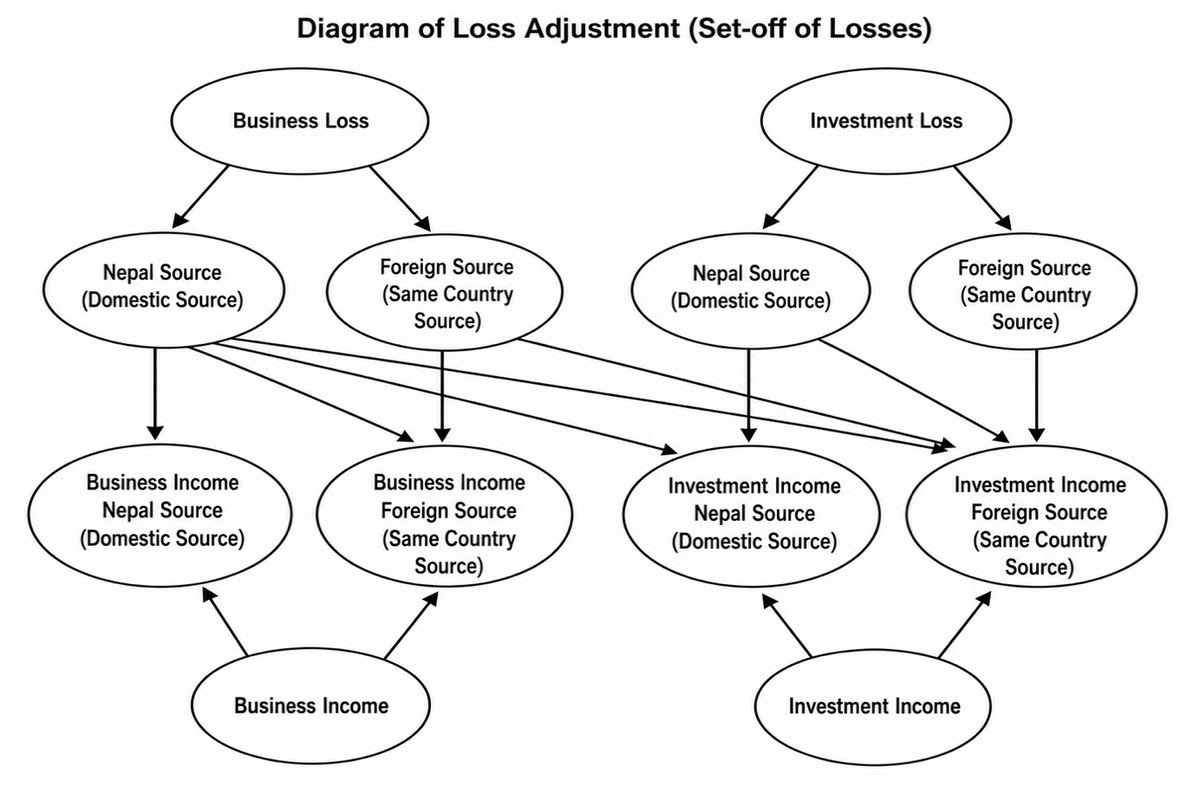
Loss Type | Business Income (Nepal Source) | Business Income (Foreign Source-Same Country) | Investment Income (Nepal Source) | Investment Income (Foreign Source-Same Country) |
Business Loss -Nepal Source | ✓ | ✓ | ✓ | ✓ |
Business Loss -Foreign Source | ✗ | ✓ | ✗ | ✓ |
Investment Loss - Nepal Source | ✗ | ✗ | ✓ | ✓ |
Investment Loss - Foreign Source | ✗ | ✗ | ✗ | ✓ |
Loss set-off & carry-forward (Sec 20): business loss → deductible against business AND investment income; investment loss → only against investment income (NOT business); neither against employment income.
Carry forward 7 years (12 years for BOT/BOOT infrastructure, power and petroleum projects). Foreign-source loss → only against same-country foreign-source income; tax-exempt-income loss → only against that exempt income.
Sec 20(6): taxpayer chooses which business/investment to set the loss against.
Sec 20(8): a fully tax-exempt year's loss cannot be carried forward. Sec 57: if ownership changes 50% or more vs 3 years earlier, pre-change losses lapse
21. Expenses not allowed for deduction
(1) Notwithstanding anything contained elsewhere in this Act, for the purpose of computing the income earned by any person from any business, employment or investment in any income year, the following expenses or amounts shall not be deducted:-
(a) Expenses of domestic or personal nature,
(b) Tax payable under this Act and a fine or similar other fee paid to the government of any country or any local body thereof for a violation of any law or regulation or byelaw framed thereunder,
Provided that the tax paid to the Provincial Government and Local Level shall be deducted as expenses.
(c) Expenses to the extent of those spent by any person to obtain the amounts enjoying exemption pursuant to Section 10 or expenses made to obtain the amounts from which tax has been finally deducted,
(d) Expenses for the payments referred to in sub-section (2),
(d1) Remuneration and wages expenses distributed to employees and workers having no Permanent Account Number except for wages of a periodic nature paid up to three thousand rupees,
(d2) Expenses against invoices of more than two thousand rupees wherein the Permanent Account Number is not mentioned,
Provided that the purchase expenses shall be valid if the seller does not have a Permanent Account Number, in the case of a natural person directly buying agricultural, forest, animal or other household goods without carrying on commercial business transactions.
(e) Distribution of profits by any entity,
(e1) Remuneration of more than twenty-five thousand rupees per person per month not paid through a banking channel,
(f) Similar other amounts notwithstanding that they are not so mentioned in clauses (a), (b), (c), (d), (d1), (d2), (e) and (e1) as not to be deductible, except those allowable under this Chapter or Chapter-6, 7, 10, 11, 12 or 13.
(2) If a person whose annual turnover is more than twenty lakh rupees in any income year makes a cash payment of more than twenty five thousand rupees at a time in that income year, he shall not be allowed to make that deduction except in the following circumstances:-
(a) Payment made to the Government of Nepal, a constitutional body, a corporation or bank or financial institution owned by the Government of Nepal,
(b) Payment made to a farmer or producer producing a primary agro-product, and payment to a farmer who has processed such product on his own, notwithstanding that primary processing of such product has already been carried out,
(c) Payment for retirement contribution or retirement payment,
(d) Payment made in a place where banking services are not available,
(e) Payment made on the day when banking services are closed or payment involving a mandatory provision of payment in cash, or
(f) Amount deposited in the bank account of the recipient of payment.
(3) Subject to the provisions of Sections 14, 15, 16, 17, 18, 19, 20 and 71, no amount shall be deductible for capital expenses or foreign income tax.
Explanation: For the purposes of this Section,-
(a) "Expenses of domestic or personal nature" means the following expenses:-
(1) Private expenses of any natural person, and expenses including the following expenses to the extent a loan has been used for personal purpose, in respect of interest on a loan borrowed by an natural person:-
(a) Expenses made for an natural person for the provision of lodging, food, snacks, entertainment or other activities of amusement,
(b) Expenses for the movement by an natural person from his house to the place where the business or investment is operated, except for movement in the course of business or investment,
(c) Expenses made to purchase clothes for an natural person except those clothes which are not proper to put on at times other than working times, and
(d) Expenses made for education or training.
Provided that the expenses made only for education directly related with the business or investment, where no degree or diploma is achieved, shall be deductible.
(2) Except in the following circumstances and to that extent, expenses incurred in respect of a payment made by any person to any natural person and expenses made for a third person:-
(a) If that payment has been included in computing the income of an natural person,
(b) If the natural person has made, as a consideration, a return payment to that person in a sum equal to the market value of the payment received, or
(c) If payment is made for such prescribed petty amounts of which accounts are difficult or administratively impracticable to be maintained.
(b) "Place where banking service is available" means any place within a ten-kilometer area whereof banking service is available.
(c) "Cash payment" means a payment other than a payment by letter of credit, account payee cheque, draft, money order, telegraphic transfer, money transfer (Hundi) through a bank or financial institution to be deposited in a bank account, payment made through a digital wallet approved by Nepal Rastra Bank, and a transfer made by any other means between banks or financial institutions.
(d) "Capital expenses" means the following expenses, excluding the ones incurred in the issuance of shares or debentures:-
(1) Expenses incurred in feasibility study, exploration and development of natural resources,
(2) Expenses incurred in acquiring any property with useful life for more than twelve months, or
(3) Expenses in disposing of a liability.
Non-deductible expenses (Sec 21): (a) domestic/personal expenses + (b) income tax & fines/penalties for legal violations (BUT provincial & local tax = deductible) + (c) expenses to earn Sec 10 exempt or final-WHT income + (d) Sec 21(2) cash payments > Rs. 25,000 + (d1) wages to employees without PAN (except periodic wages up to Rs. 3,000) + (d2) invoices over Rs. 2,000 without PAN + (e) distribution of profits + (e1) remuneration over Rs. 25,000/month not paid through a banking channel + (f) similar amounts.
Sec 21(2): turnover over Rs. 20 lakh + single cash payment over Rs. 52,000 = not deductible (exceptions: govt/bank payee, farmers, retirement, no-banking areas, bank-closed days, deposit to payee's account). Sec 21(3): capital expenses & foreign income tax not deductible.