94. Payment of tax in installments
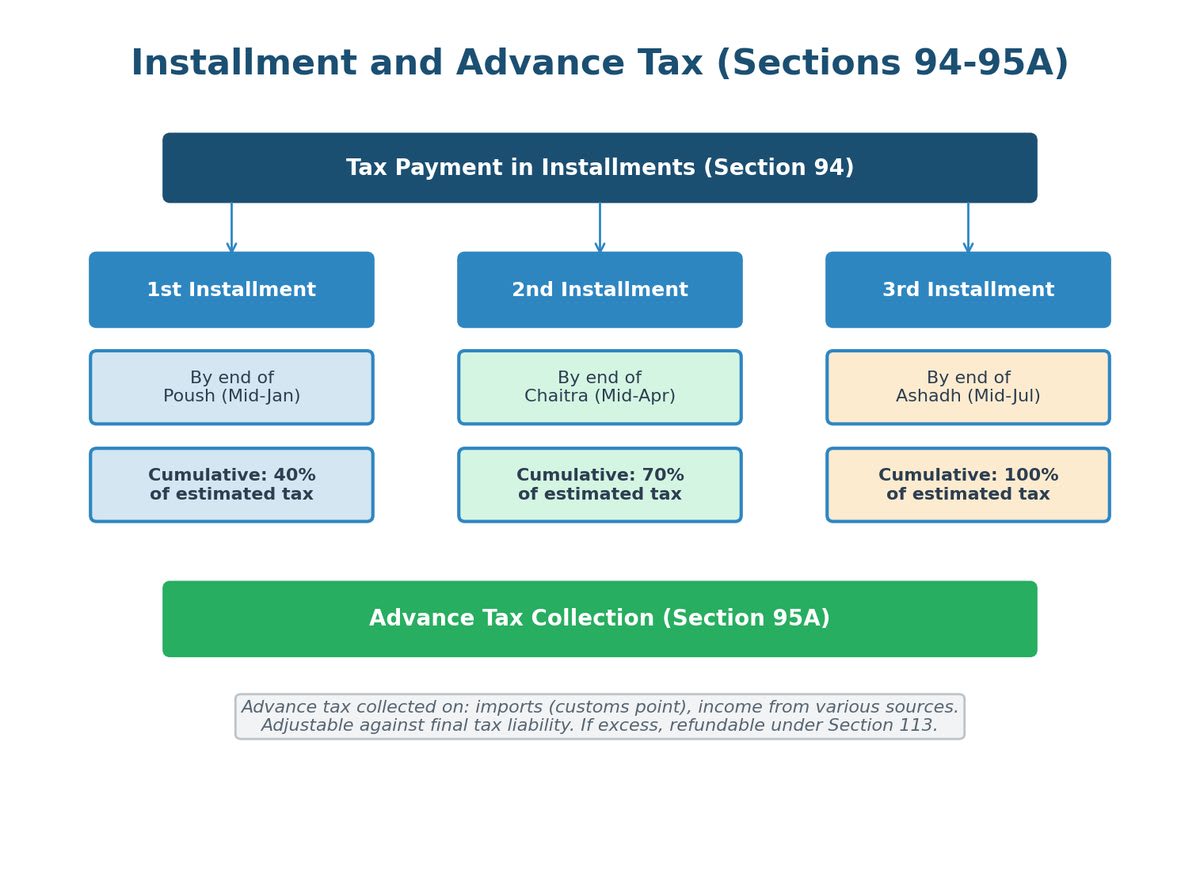
Figure: Installment and Advance Tax (Sections 94-95A)
(1) A person who has or will have assessable income from any business or investment in any income year shall pay tax in three installments as follows:-
Date on which payment is to be made | Amount to be paid |
By the end of Poush (mid-January) | Amount remaining from forty percent of the estimated tax, after deducting tax already paid |
By the end of Chaitra (mid-April) | Amount remaining from seventy percent of the estimated tax, after deducting tax already paid |
By the end of Ashad (mid-July) | Amount remaining from one hundred percent of the estimated tax, after deducting tax already paid |
Explanation: For the purposes of this sub-section,-
(a) "Estimated tax" means the estimated tax in installment computed by any person liable to pay tax in installments pursuant to Section 95 at the time when the installment tax is to be paid in any year.
(b) "Tax remaining to be paid" means the amount found to be insufficient upon subtracting the following aggregate sum from the amount as specified by the percentage for installment payment of the estimated tax in this sub-section:-
(1) The amount of tax deposited in that income year by a prior installment before the date on which the installment in question is to be paid,
Example 24.11.1: Suppose ABC Enterprises filed a return with the relevant office by the specified time that the amount required to be paid for the first installment of income year 2080/81 is 40 percent of the pre-estimated tax of Rs. 1 lakh, i.e., Rs. 40 thousand. For the second installment at end of Chaitra 2080, they must file the total 70 percent, i.e., Rs. 70 thousand, minus the Rs. 40 thousand already filed at end of Poush, leaving the balance of Rs. 30 thousand. Thus, in this example, the balance tax amount after deducting amounts already paid refers to Rs. 30 thousand.
(2) The amount of tax withheld from payments to be included in computing the income of any person in any income year pursuant to Chapter-17 before the date on which the installment in question is to be paid in that year,
Example 24.11.2: Suppose Bishal Enterprises Pvt. Ltd. rented the first floor of its building to a cooperative institution at Rs. 50 thousand per month. When the institution paid Bishal Enterprises Pvt. Ltd., it deducted Rs. 5 thousand advance tax at 10 percent and paid the balance of Rs. 45 thousand. Since such rental income is income to be included in that enterprise's income, when calculating the installment tax amount to be paid, only the balance installment tax amount after deducting source-withheld tax must be filed.
(3) If the person withholding advance tax or the person subject to tax withholding pays to the Department the amount of tax deemed to have been withheld from the payment referred to in clause (2) pursuant to sub-section (3) of Section 90 in that year, before the date on which the installment is to be paid, such amount of tax, and
Example 24.11.3: Suppose Rameshwar Panthi and Company is a legal consulting firm not registered for value added tax purposes. For legal advice provided to NB Ltd., they received Rs. 50 thousand payment on date 2080.6.27 without deducting advance tax. In this situation, even if advance tax was not deducted on the date of payment 2080.6.27, it is deemed to have been deducted. If that company filed Rs. 7,500/- (15 percent of the payment) as advance tax with the relevant office within 25 days of the end of the month in which payment was received, that company must deduct Rs. 7,500/- from the estimated tax amount to be paid at end of Poush and file the balance amount, i.e., the tax amount to be paid.
(4) The amount of tax adjustment for approved medical treatment expenses which that person may claim pursuant to Section 51 in respect of approved medical treatment expenses incurred by that person before the date on which the installment is to be paid.
Example 24.11.4: Suppose Adhikari and Co. is an auditing firm. The proprietor, Mr. Kamles, incurred Rs. 15 thousand for medical treatment up to date 2080.8.29. According to the estimated return for income year 2081/82, the installment he must pay at end of Poush is Rs. 40 thousand. If he deducts the medical tax credit amount of Rs. 1,500/- for medical expenses pursuant to Section 51 of the Act from that installment amount and files the balance Rs. 38,500/-, the obligation of paying the end-of-Poush installment tax is deemed fulfilled.
Rule 32: If the following evidence is submitted to the Department, the installment amount calculated pursuant to Section 94(1) of the Act may be reduced by the amount proven by such evidence:
(a) if advance tax has been withheld pursuant to Chapter 17, the tax withholding certificate issued pursuant to Section 91(1),
(b) if medical tax credit is claimed for medical treatment, the bill and receipt of approved medical treatment expenses incurred for medical treatment.
Example 24.11.5: Suppose a company has already paid Rs. 25,00,000/- out of the total estimated tax of Rs. 32,50,000/- to be paid in income year 2080/81 by the second installment. The third installment still remains to be paid. When that company calculates the third installment amount to be paid, or when filing the installment, it must pay only Rs. 7,50,000/- after deducting the tax amount already paid by the second installment of Rs. 25,00,000/- from the total estimated tax of Rs. 32,50,000/-. Even though the third installment amount is 30 percent of estimated tax, i.e., Rs. 9,75,000/-, since the company paid more than required by the second installment and one must not pay more than the total estimated tax as installments, that company need not pay more than Rs. 7,50,000/- for the third installment.
(1a) The person paying tax on the basis of transaction shall pay tax in two installments as follows:-
Date on which payment be made | Amount of tax to be paid |
By the end of Poush (mid-January) | Tax at the prescribed rate on the transaction up to the 20th of Poush |
By the end of Ashad (mid-July) | Tax amount to be set by subtracting the tax paid up to the end of Poush (mid-January) from the amount of tax calculated at the prescribed rate, after estimating the transaction to be carried out by the end of Ashad (mid-July) on the basis of actual transactions up to the 20th of Ashad |
(2) Notwithstanding anything contained in sub-section (1), if the total amount of installments to be paid pursuant to that sub-section is less than seven thousand five hundred rupees, the amount of such installment need not be paid.
Example 24.3.1: Suppose Ramhari Agarwal has a pan shop in Kathmandu. If the annual estimated tax amount required to be filed for transactions up to Poush 25, 2080 of income year 2080/81 is only Rs. 7,000/-, such person is not required to file installment tax amounts due by end of Poush 2080, end of Chaitra 2080, and end of Ashadh 2081.
(2a) Notwithstanding anything contained in this Section, the advance tax payable pursuant to Section 95A in respect of income from the disposal of non-business taxable assets shall not be required to be paid in installment form.
Example 24.3.3: Suppose Kamal Prasad Singh (single person) is an employee at Nepal Chemicals Pvt. Ltd. In income year 2081/82, he received Rs. 7,50,000/- salary from that company. In that year, he donated Rs. 10,000/- to a tax-exempt organization. In that year, that company deducted Rs. 70,000/- from his salary and deposited it in an approved retirement fund. Besides that, he made no contributions to any other approved retirement fund. That company paid Rs. 1,000/- for Medical Insurance and included it in his income in that year. In addition, he separately spent Rs. 2,000/- on medical treatment in that year. That company deducted and filed tax pursuant to Section 87 of the Act on the salary paid by it. In this situation, he must file an income return to claim a deduction for his charity donation and to claim Rs. 300/- (15 percent of Rs. 2,000/-) Medical Tax Credit on Rs. 2,000/- spent on medical treatment. If he did not claim a deduction for his charity donation and did not claim the additional Rs. 300/- Medical Tax Credit, he is not required to file tax installments and the return thereof.
(3) The person paying tax in installments shall be allowed to deduct the amount of tax paid in any income year by way of installments pursuant to this Section from the tax chargeable in that year.
Any person may set off the tax amount filed as installments pursuant to Section 94(1) of the Income Tax Act, 2058 and the advance tax withheld amount against the actual tax amount payable according to the income return for that income year.
Example 24.12.1: The company mentioned in Example 24.11.5 above has already paid Rs. 25,00,000/- out of the total estimated tax of Rs. 32,50,000/- to be paid in income year 2080/81 by the second installment. The third installment still remains to be paid. That company received interest due in income year 2077 Ashadh 20 and the payer withheld Rs. 1,50,000/- tax while paying that interest. When that company calculates or files the third installment, it must pay only Rs. 6,00,000/- after deducting from the total estimated tax of Rs. 32,50,000/- both the tax already paid by the second installment of Rs. 25,00,000/- and the tax withheld by the payer while paying interest of Rs. 1,50,000/-, totaling Rs. 26,50,000/-.
Installment tax (Sec 94): a person with business/investment income pays estimated tax in 3 INSTALMENTS - by end of Poush (mid-Jan) 40% cumulative, by end of Chaitra (mid-Apr) 70%, by end of Ashad (mid-Jul) 100% - each net of tax already paid (prior instalments + WHT credits + Sec 51 medical credit).
Turnover-basis taxpayers pay in 2 instalments (Poush & Ashad). No instalment is due if the total would be under Rs. 7,500 (94(2)). Advance tax on disposal of NBTA under Sec 95A is not paid in instalments (94(2a)).
Instalments paid are credited against the final tax for the year (94(3))
95. Return of estimated tax to be paid
(1) Each person who has to pay tax in installments in any income year shall submit to the Department a return, in such format and manner as may be prescribed by the Department, setting out estimates of the following amounts of that person for that year, within the date on which the first installment of tax is to be paid in that year pursuant to Section 94:-
(a) Assessable income that could be earned by that person from each source of employment, business and investment in that year, and the source of such income,
(b) Taxable income of that person that could be earned in that year and the amount of tax to be paid by the person referred to in clause (a) of Section 3, computed pursuant to Section 4 without subtracting the amount of tax adjustment for medical treatment expenses,
(c) In respect of a non-resident person's foreign permanent establishment situated in Nepal, the amount of income sent abroad by such foreign establishment in that year and the amount of tax to be paid by the person referred to in clause (b) of Section 3, computed pursuant to sub-section (5) of Section 4 in respect of that income, and
Income remitted abroad means that if any person working as a foreign permanent establishment of a non-resident person situated in Nepal earns any income that is deemed a Nepal source, after paying the tax due on such income pursuant to the Act, the remaining income sent to that non-resident person is the remitted amount. Since five percent tax applies to the income sent abroad by such person, the estimated tax for any income year of such person equals five percent of the estimated amount to be sent abroad by that person in that year.
Example 24.6.1: Suppose the branch office of American Life Insurance Company (ALICO) has received a license from the relevant authority of Nepal and is a foreign permanent establishment of a non-resident person situated in Nepal conducting business in Nepal. When that entity earns profit from investment insurance in Nepal and cannot distribute that amount itself, and sends that amount to its Parent Company, such amount is deemed to be income remitted abroad. Since five percent tax applies to the income sent abroad by such person, the estimated tax for any income year of such person equals five percent of the estimated amount to be sent abroad by that person in that year.
(d) Any other details as specified by the Department.
Rule 34: Any person required to file installments in any income year shall submit the estimated tax return pursuant to Section 95 of the Act to the Department in the form prescribed by Schedule-2.
Every person required to file installment tax must submit the estimated tax return to the relevant office by the end of Poush of the income year, i.e., by the deadline for filing the first tax installment. For the convenience of taxpayers, a provision has also been made to file such estimated tax return through electronic means. The person required to file the estimated tax return must state in the return the estimated taxable income from each income source for that year, the estimated taxable income for that year, the estimated tax on such income, and in relation to the foreign permanent establishment of a non-resident person situated in Nepal, the estimated income that such foreign establishment can remit abroad in that year and the estimated tax amount to be filed on such income. Although the deadline for filing the estimated tax return is specified as the end of Poush of the income year, for businesses registered up to Chaitra, such return must be submitted by Chaitra, and for businesses registered after that, by Ashadh.
(2) The sum total of the tax amounts mentioned in clauses (b) and (c) of sub-section (1) shall be the estimated tax payable by the person referred to in sub-section (1) in that income year.
The estimated tax required to be filed by any person required to file installment tax in any income year means the total of the estimated tax required to be filed on the estimated taxable income from any business or investment by that person in that year and the estimated tax required to be filed on the estimated income to be remitted or expected to be remitted abroad by any foreign permanent establishment of any non-resident person situated in Nepal.
Example 24.7.1: Suppose Sagarmatha Pvt. Ltd. produces and sells juice. In income year 2080/81, that company estimated earning Rs. 1 crore taxable income from its business. This company has invested Rs. 5 crores in debentures of a company in Nepal and earns Rs. 50 lakhs interest each year from that. In income year 2080/81, the total estimated tax required to be filed by this company is as follows:
Income Source | Estimated Taxable Income | Tax Rate | Estimated Tax |
Business | 1,00,00,000/- | 20 percent | 20,00,000/- |
Investment | 50,00,000/- | 25 percent | 12,50,000/- |
Total Estimated Tax | 32,50,000/- |
(3) In computing the foreign tax adjustment amount to be claimed pursuant to Section 71 in order to estimate the tax to be paid in any income year pursuant to clause (b) of sub-section (1), only the foreign tax paid by any person in that year or the foreign income tax estimated by that person as payable in that year shall be computed.
If any person required to file installment tax from any business or investment has taxable income in any income year and receives or is expected to receive any income subject to tax from a foreign source in that year, that income must also be estimated for the purpose of calculating the estimated tax for that year. Tax must be calculated on the estimated or expected foreign source income at the rate specified by Schedule-1 of the Act to arrive at the total estimated tax. However, if any tax has been paid or is to be paid abroad on the foreign source income included in the tax calculation, the paid or estimated to be paid tax amount may be deducted when calculating the estimated tax.
Example 24.8.1: In income year 2080/81 of Sagarmatha Pvt. Ltd. mentioned in Example 24.7.1, in addition to the income mentioned in that example, if Rs. 10 lakhs income is to be earned from investing Rs. 1 crore in debentures of a company in India and Rs. 1 lakh tax is to be paid in India on that income, the total estimated tax required to be filed by this company in income year 2080/81 is as follows:
Income Source | Estimated Taxable Income | Tax Rate | Estimated Tax |
Business | 1,00,00,000/- | 20 | 20,00,000/- |
Investment | 50,00,000/- | 25 | 12,50,000/- |
Foreign source investment income | 10,00,000/- | 25 | 2,50,000/- |
Total Estimated Tax | 35,00,000/- | ||
Deduct: | |||
Foreign tax payable on foreign source income | 1,00,000/- | ||
Total Estimated Tax to be Filed | 34,00,000/- |
(4) Unless any person paying installment of tax submits to the Department an amended estimate in the format referred to in sub-section (1) setting out the necessary information and the reasons for amendment, the estimate made by that person pursuant to that sub-section shall remain in force throughout the income year.
(5) Notwithstanding anything contained in sub-section (2), the amended estimate submitted by any person pursuant to sub-section (4) shall be applicable only in computing the installment of tax to be paid pursuant to Section 94 in that income year after the date of its submission to the Department.
If any person files a new estimated tax return, their previously filed estimated tax return is deemed cancelled or amended and the later return is treated as that person's estimated tax return. The new return must clearly mention the reasons for amending the previous return. However, any person's filed amended estimated tax return applies only to calculate the estimated installment tax required to be filed after they filed the amendment. According to this provision of the Act, a person who does not file an amended estimate must calculate the installments to be filed for that year based on the estimated tax return they filed.
(6) Notwithstanding anything contained in sub-sections (1) and (5), the Department may so specify that any person or class who has to pay installment of tax is not required to submit an estimate pursuant to sub-section (1).
Rule 33: For the purposes of Section 95(6) of the Act, the Department may specify the following persons as not required to file an estimated tax return pursuant to Section 95(1) of the Act:
(a) persons not required to file a return pursuant to Section 96 of the Act,
(b) persons covered by Section 4(3) of the Act, and
(c) persons mentioned in Section 4(4) of the Act.
Pursuant to the above, the following persons are not required to file their required tax amount in the form of installments:
(1) Persons including presumptive tax payers whose total tax to be paid in any income year is less than seven thousand five hundred rupees;
(2) Persons whose income received in any income year is only payments subject to final withholding tax;
(3) Persons with only employment income pursuant to Section 4(3) of the Act; and (4) Persons with only business income with turnover upto 30 lakh.
(7) Notwithstanding anything contained in sub-section (2), if any person who has to pay installment of tax does not submit an estimate in any income year pursuant to sub-section (1) or the Department is not satisfied with the submitted estimate or amended estimate, ...... the Department may do as follows:-
(a) The person referred to in clause (a) or (b) of Section 3 may make an estimate of the estimated tax to be paid by that person in that year on the basis of the tax required to be paid by that person in the last income year, and
(b) If the Department is not satisfied with the estimate prepared pursuant to clause (a), the Department shall give a written notice to the person who has to pay installment, setting out the method used in preparing the estimate and the reasons for not being satisfied with the estimate submitted by the person.
(8) If the Department gives a notice to the person who has to pay installment of tax pursuant to sub-section (7), the amount of estimated tax to be paid by that person in that year shall be the amount estimated by the Department.
If any person required to file an estimated tax return and file installment tax does not file the estimated taxable income and estimated tax for that year at the relevant office by the end of Poush of that year, the relevant office or tax officer may estimate the tax required to be filed by that person in that income year. Also, if the office is not satisfied with the estimated tax return or amended estimated tax return filed by any person, the office may amend the taxable income and estimated tax amount mentioned in the estimated tax return or amended estimated tax return filed by that person. When preparing such an estimate or amending the estimated tax return or amended estimated tax return filed by any person, the office may also take as a basis the tax filed or required to be filed by that person in the previous income year. Written information of such estimate prepared by the office or tax officer must be given to the relevant person. Such information must clearly state the basis on which the office prepared such estimate. When any person's tax estimate for any year has been prepared and written information thereof has been given to that person, the tax amount estimated by the office is the estimated tax amount that person must file in that year.
Estimated tax return (Sec 95, Rule 34): a person liable to pay tax in instalments must file an estimated-tax return (Schedule-2 form, e-filing available) by the FIRST instalment date (end of Poush) showing estimated assessable & taxable income per source, the estimated tax, and (for a non-resident's Nepal PE) income to be remitted abroad.
Estimated tax = tax on estimated taxable income + 5% on a PE's estimated remittance; foreign income is included and the estimated foreign tax credit (Sec 71) deducted.
Deadlines flex to Chaitra for businesses registered up to Chaitra, and Ashad for later registrations; a revised estimate may be filed if income changes
95A. Collection of advance tax
(1) The entity operating commodity future market service shall collect advance tax at the rate of ten percent on the profit and benefit earned by a person trading under the commodity future market from such business.
Example 24.15.1: Suppose Nepal Commodity Exchange Limited (NCEL) is a company operating Commodity Future Market services. More than 20 brokers are registered in this company, including Himal Broker Company P.Ltd. A person named Krishna Prasad made a purchase agreement for 1 kilogram of gold on date 2080.4.15 through this broker company. The international market price of 1 kg gold was Rs. 25 lakhs on that day. According to the agreement, the provision was for Krishna Prasad to sell on date 2080.6.15, i.e., 2 months later. Krishna Prasad deposited Rs. 2,50,000/- (10 percent of the market value of that gold on the agreement date) at NCEL through the broker on the agreement date. A service fee of Rs. 10,000/- was paid when making the purchase agreement. For that service fee, advance tax must be deducted at 1.5 percent pursuant to Section 88(1)(4) of the Act if registered for VAT, or at 15 percent pursuant to Section 88(1) of the Act if not registered for VAT. Suppose at the end of the agreement (date 2080.6.15), the market price of 1 kg gold was Rs. 27 lakhs. In this transaction, NCEL must collect Rs. 19 thousand advance tax (10 percent of Krishna Prasad's gain of Rs. 1 lakh 90 thousand [Rs. 27 lakhs - Rs. 25 lakhs - Rs. 10 thousand]) and file it with the relevant office.
(2) If any person other than a resident entity registered under the prevailing law carrying on transactions for the purchase and sale of securities derives benefit from the disposal of interest in any resident entity, advance tax shall be collected on such benefit computed pursuant to Section 37, as follows:-
(a) In the case of benefit derived from the disposal of interest in an entity enlisted in the Securities Board of Nepal, by the entity operating the securities exchange market, at the rate of seven and half percent of the profit amount for a resident natural person who has held the interest for more than three hundred sixty-five days, ten percent for a resident natural person who has held the interest for three hundred sixty-five days or less, ten percent of the profit for a resident entity, and twenty-five percent for others,
Example 24.15.2: Suppose resident natural person Anil has 500 ordinary shares of Standard Chartered Bank Nepal Ltd., listed on Nepal Stock Exchange Ltd., with a face value of Rs. 100/- each, purchased on date 2080.06.01. He requested a stock broker (share agent) to sell those shares. He purchased those shares at Rs. 1,000/- per share. Anil paid Rs. 4,000/- broker commission when purchasing the shares. The share agent sold those shares on date 2081.07.20 at Rs. 7,000/- per share. He paid Rs. 17,500/- as commission to the broker when selling the shares.
The gain calculation on that share sale is as follows:
Particulars | Amount |
Sale price: 500 x Rs. 7,000 | Rs. 35,00,000/- |
Cost: | |
Share value 500 x Rs. 1,000 | Rs. 5,00,000/- |
Add: Share agent commission on purchase | Rs. 4,000/- |
Add: Share agent commission on sale | Rs. 17,500/- |
Total cost | Rs. 5,21,500/- |
Gain on share sale | Rs. 29,78,500/- |
Nepal Stock Exchange Ltd. must collect Rs. 2,23,387.5/- advance tax (7.5 percent of gain from share sale) through the relevant broker and pay the balance Rs. 33,33,575/- to Anil as follows:
Particulars | Amount |
Sale price | Rs. 35,00,000/- |
Less: | |
Share agent commission on sale | Rs. 17,500/- |
Source tax amount to be withheld | Rs. 2,23,387.5/- |
Total payment | Rs. 32,59,112.5/- |
Similarly, if those shares were sold on date 2081.05.20, with ownership for less than 365 days, the gain must be calculated as follows and advance tax collected and balance paid:
Nepal Stock Exchange Ltd. must collect Rs. 2,97,850/- advance tax (10 percent of gain from share sale) through the relevant broker and pay the balance Rs. 31,84,650/- to Anil. However, if that share sale was made not by a resident natural person but by a resident entity, advance tax must be collected at 10 percent, and if made by a non-resident person, at 25 percent.
(b) In the case of benefit derived from the disposal of interest in an entity not enlisted in the Securities Board of Nepal, by the entity in which the interest has been disposed, at the rate of ten percent of the profit for a resident natural person, fifteen percent of the profit for a resident entity, and twenty-five percent for others.
Example 24.15.3: Suppose Nepal Bank Ltd. sold 2,00,000 units of shares in Purbanchal Rural Development Bank, which is not listed on Nepal Securities Board, to Shinas Company at Rs. 114/- per unit. The cost value of those shares was Rs. 100/-. In this situation, the entity conducting share registration must collect advance tax from Nepal Bank Limited as follows:
Particulars | Amount |
Sale price: 114 x 2,00,000/- | Rs. 2,28,00,000/- |
Less: Cost value 100 x 2,00,000 | Rs. 2,00,00,000/- |
Gain: | Rs. 28,00,000/- |
Advance tax must be collected at 15 percent on the gain amount of Rs. 28,00,000/- calculated pursuant to Section 37. The obligation to deduct tax on such gain belongs to Purbanchal Rural Development Bank. However, if those shares were sold by a resident natural person who is a shareholder of that entity, advance tax must be collected at 10 percent, and if sold by a non-resident person, at 25 percent.
(2a) In computing the benefit pursuant to clause (a) of sub-section (2), it shall be computed on the basis of the weighted average cost of the interest owned by that person in the entity of which the interest is to be disposed on that date.
Under this system, there is only one cost basis for any one person for any one company. If any person purchased shares of any one company at different prices, the weighted average cost for that company for that person is calculated by dividing total cost by total number of shares. The actual Weighted Average Cost is calculated on the basis of the investor's actual cost.
Example 24.15.4 (It is incorrect in the directive): Suppose the Weighted Average Cost in the following share purchase and sale situation of Yuva Prasad Subedi in ABC Company is calculated as follows:
S.N. | Particular | No. of Share | Cost per Share | Amount | Cost in Total | Balance Share | Weighted Cost per Share |
1 | IPO | 100 | 100 | 10000 | 10000 | 100 | 100 |
2 | Bonus | 50 | 100 | 5000 | 15000 | 150 | 100 |
3 | Secondary buy | 200 | 400 | 80000 | 95000 | 350 | 271 |
4 | Secondary sale | -50 | 271 | -13571 | 81429 | 300 | 271 |
5 | Secondary buy | 70 | 350 | 24500 | 105929 | 370 | 286 |
6 | Right share | 50 | 100 | 5000 | 110929 | 420 | 264 |
As mentioned above, when calculating the weighted average, capital gains tax is calculated on the basis of the actual cost of each investor.
(3) While recording the share in the Company Registrar's Office upon disposal of interest pursuant to clause (b) of sub-section (2), it shall record the same only after the submission of evidence of advance tax payment on the profit amount.
(4) ......
(5) The registering authority shall collect advance tax as follows at the time of registration on capital gain earned from the disposal of land or a private building by any natural person:-
(a) If the disposed non-business taxable asset (land and building) has been in ownership for five years or more, at the rate of seven and half percent,
(a1) In the case of a non-business taxable asset (land and building) compulsorily disposed of due to acquisition of land belonging to a natural person by the Government of Nepal, at the rate of two and one-half percent (2.5%),
Example 24.15.5: Suppose Ramesh Bagale purchased a house-land for Rs. 30 lakhs on date 2073.08.15. He sold that house-land on date 2080.07.04 for Rs. 52 lakhs. The capital gain on the house-land he sold is as follows:
Particulars | Amount |
Incoming (sale price) | Rs. 52,00,000/- |
Outgoing (expense) | Rs. 30,00,000/- |
Gain | Rs. 22,00,000/- |
Tax must be collected as advance tax by the land revenue office at 7.5% during registration when the buyer pays Ramesh Bagale. Such collected advance tax can be adjusted by Ramesh Bagale by filing an income return against his total tax liability.
Example 24.15.6: Suppose the house-land mentioned in Example 24.15.5 above was purchased by Ramesh Bagale on date 2070.04.15 (i.e., 10 years before the date of sale) and he has also been residing there continuously. Since such house-land is not considered a non-business taxable asset pursuant to Section 2(r) of the Act, advance tax (capital gains tax) need not be collected on the sale of such house-land.
Example 24.15.7: Suppose the house-land mentioned in Example 24.15.5 above was purchased by Ramesh Bagale on date 2074.04.15 and that house-land was sold on date 2080.04.20 for Rs. 9 lakhs. Since such house-land is not considered a non-business taxable asset pursuant to Section 2(r) of the Act, advance tax (capital gains tax) need not be collected on the sale of such house-land.
(b) If the disposed non-business taxable asset (land and building) has been in ownership for less than five years, at the rate of ten percent.
Example 24.15.8: Suppose Ramesh Bagale purchased a house-land for Rs. 40 lakhs on date 2076.04.15 (i.e., less than 5 years before the date of sale). He sold that house-land on date 2079.10.15 for Rs. 52 lakhs. The advance tax (capital gains tax) on that house-land he sold must be collected as follows:
Particulars | Amount |
Sale price | Rs. 52,00,000/- |
Expense | Rs. 40,00,000/- |
Gain | Rs. 12,00,000/- |
Tax of Rs. 1,20,000/- (10 percent of the calculated gain amount of Rs. 12,00,000/-) must be collected as advance tax by the land revenue office during registration when the buyer pays Ramesh Bagale. Such collected advance tax can be adjusted by Ramesh Bagale by filing an income return against his total tax liability.
(5A) Notwithstanding anything contained in Sub-section (5), where a natural person transfers, free of charge, land or a private building owned by him/her to the Government of Nepal, a Provincial Government, or a Local Level, no capital gain shall be deemed to arise from such disposal of the land or private building.
(6) If any land or building owned by any other person except as mentioned in sub-section (5) is disposed, the registering authority shall collect advance tax at the rate of one and half percent of the value of disposal at the time of registration.
(6a) A resident bank or financial institution providing the facility of foreign currency exchange to students going abroad for study, for language examination fees or standardised test fees, shall collect advance tax at the rate of fifteen percent of the amount of such examination fees at the time of providing such foreign currency exchange facility.
(6b) If a resident natural person not involved in the operation of a business receives payment in foreign currency for providing software or other similar electronic services outside Nepal, the concerned bank, financial institution or money transfer institution shall collect advance tax at the rate of five percent of the amount received at the time of making such payment.
(6c) If a resident natural person not involved in the operation of a business receives payment in foreign currency for personally providing consultancy services outside Nepal, the concerned bank, financial institution or money transfer institution shall collect advance tax at the rate of five percent of the amount received at the time of making such payment.
(6d) If a resident natural person not involved in the operation of a business receives payment in foreign currency for uploading audio-visual content on social networks, the concerned bank, financial institution or money transfer institution shall collect advance tax at the rate of five percent of the amount received at the time of making such payment.
(6e) A resident electronic commerce operator (e-commerce operator) shall collect advance tax at the rate of one percent at the time of making payment of the amount for the sale of goods, services or goods and services to a person providing goods, services or goods and services through its platform.
(6f) A resident ride-sharing service operator shall collect final tax at the rate of one percent (1%) on the amount paid for services to a natural person providing services through the operator’s platform.
(7) ......
(8) Even though the person or entity responsible for collecting advance tax pursuant to sub-sections (1), (2), (5), (6), (6a), (6b), (6c), (6d) and (6e) does not collect it, the tax shall be deemed to have been collected at the time required for such collection.
(9) The person responsible for collecting advance tax shall submit details to the Department in the mode and format prescribed by the Department within twenty-five days of the expiration of each month.
(10) The amount collected as advance tax or the amount deemed to have been collected pursuant to sub-section (8) shall be paid to the Department within the time-limit mentioned in sub-section (9), together with the details referred to in sub-section (9).
(11) The person required to deposit advance tax and the person responsible for collecting advance tax shall both be jointly and severally responsible for depositing such amount in the Department in the following circumstances:-
(a) If the person responsible for collecting advance tax does not collect the tax, and
(b) If the person responsible for collecting advance tax does not deposit the amount deemed to have been collected pursuant to sub-section (8) in the Department pursuant to sub-section (10).
(12) The person required to deposit advance tax pursuant to sub-section (11) shall deposit such tax within twenty-five days of the expiration of the date referred to in sub-section (9).
(13) If the person responsible for collecting advance tax deposits in the Department the advance tax not collected, pursuant to sub-section (10), that person may recover the amount equal to the tax so deposited from the person required to deposit such tax.
(14) The person required to deposit tax shall be allowed to deduct the advance tax deposited pursuant to this Section from the annual tax liability.
(15) If the Department is satisfied that the person responsible for collecting and depositing advance tax pursuant to this Section has not collected, deposited, or has deposited short, or has not deposited within the prescribed time, it may issue an order to deposit the amount not deposited or short-deposited together with the interest referred to in Section 119 and, in the case of failure to collect advance tax, the charge referred to in Section 120.
Provided that prior to issuing such an order, a written notice shall be given setting out an appropriate reason, with a time-limit of fifteen days to submit evidence in defence in respect of such order.
Advance-tax collection on disposal & receipts (Sec 95A):
Sub-section | Transaction / Income Type | Person Responsible to Collect Advance Tax | Rate of Advance Tax |
95(1) | Profit and benefit earned from commodity future market transactions | Entity operating commodity future market service | 10% of profit |
95(2)(a) | Gain from disposal of interest in a listed entity (holding period > 365 days) | Entity operating securities exchange | 5% of profit (Resident Natural Person) |
95(2)(a) | Gain from disposal of interest in a listed entity (holding period ≤ 365 days) | Entity operating securities exchange | 7.5% of profit (Resident Natural Person) |
95(2)(a) | Gain from disposal of interest in a listed entity | Entity operating securities exchange | 10% of profit (Resident Entity) |
95(2)(a) | Gain from disposal of interest in a listed entity | Entity operating securities exchange | 25% of profit (Others) |
95(2)(b) | Gain from disposal of interest in an unlisted entity | Entity whose interest is disposed | 10% of profit (Resident NP) |
95(2)(b) | Gain from disposal of interest in an unlisted entity | Entity whose interest is disposed | 15% of profit (Resident Entity) |
95(2)(b) | Gain from disposal of interest in an unlisted entity | Entity whose interest is disposed | 25% of profit (Others) |
95(5)(a) | Capital gain on disposal of non-business land/building held for 5 years or more | Land Revenue Office | 5% of capital gain |
95(5)(b) | Capital gain on disposal of non-business land/building held for less than 5 years | Land Revenue Office | 7.5% of capital gain |
95(6) | Disposal of land/building by persons other than those covered under subsection (5) | Land Revenue Office | 1.5% of disposal value |
95(6a) | Foreign currency exchange for study-abroad language or standardized test fees | Resident Bank or Financial Institution | 15% of examination fee amount |
95(6b) | Foreign currency income from software or similar electronic services provided outside Nepal by a resident natural person not carrying on business | Bank, Financial Institution or Money Transfer Institution | 5% of amount received |
95(6c) | Foreign currency income from personal consultancy services provided outside Nepal by a resident natural person not carrying on business | Bank, Financial Institution or Money Transfer Institution | 5% of amount received |
95(6d) | Foreign currency income from uploading audio-visual content on social networks by a resident natural person not carrying on business | Bank, Financial Institution or Money Transfer Institution | 5% of amount received |
95(6e) | Payment for sale of goods/services through an e-commerce platform | Resident E-commerce Operator | 1% of payment amount made to seller/service provider |
95(6f) | Payment for services to a natural person providing services through operator’s platform | Resident ride-sharing service operator | 1% of payment amount made |