7. Computation of income from business
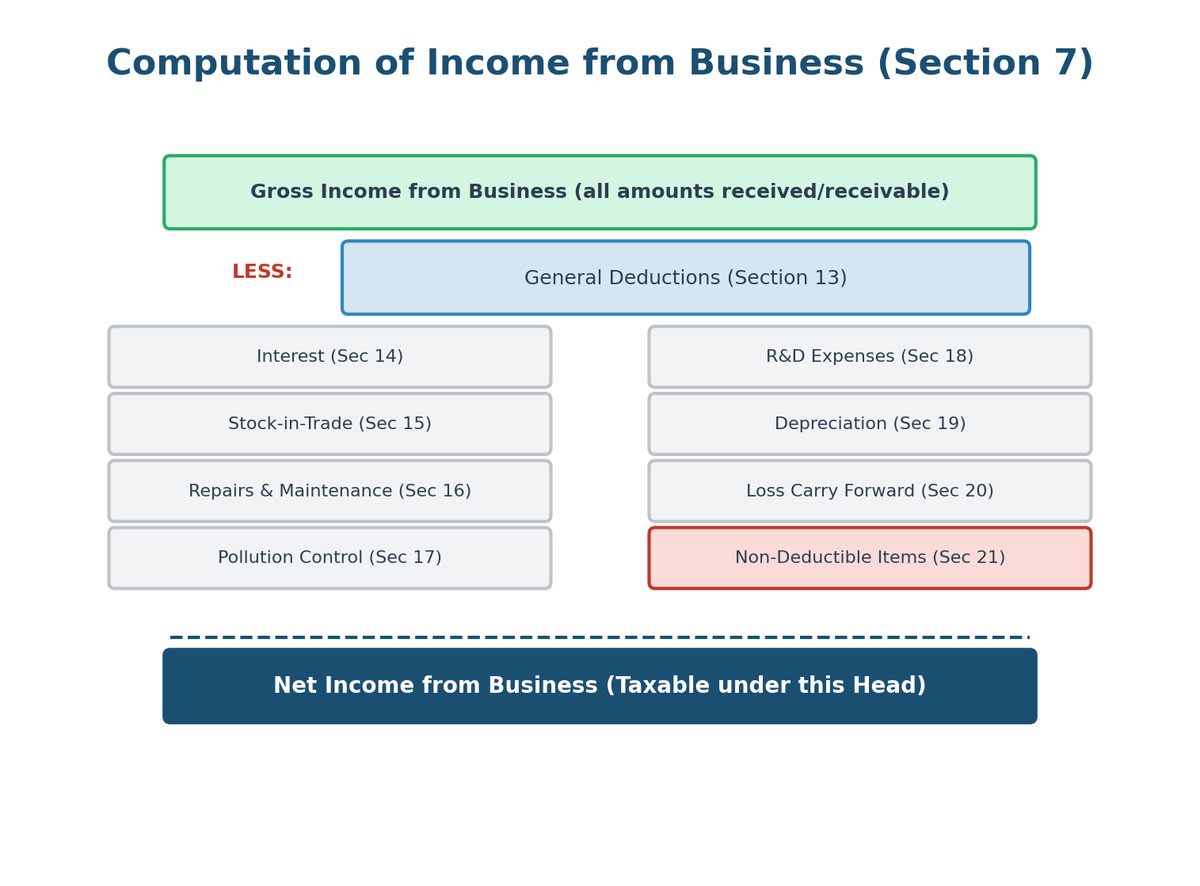
Figure: Computation of Income from Business (Section 7)
(1) The profits and gains made by any person in any year from any business shall be the income of that business of that person in that income year.
The total of profits and gains remaining after deducting expenses from income earned from conducting any such business, together with gains from the disposal of other assets, constitutes the business income.
Business includes industry (manufacturing and selling goods), trading (buying and selling tangible or intangible goods), profession, or similar commercial transactions. There is sometimes confusion between business (particularly professional service) and employment. The following points help distinguish business from employment:
(i) Mode of work: An independent contractor must complete a specified task - direction on the mode of working is generally not given. However, workers or employees are given clear instructions on the mode and nature of work.
(ii) Use of materials and tools: An independent contractor uses or purchases their own materials and tools to complete assigned work. The employer provides materials and tools to workers or employees.
(iii) Work timing: An independent contractor is given a deadline for completing work and sets their own schedule within that time. Workers or employees are generally told when and at what time to work and usually work full-time.
(iv) Person performing the work: An independent contractor can complete assigned work with or without assistance. Employees generally complete assigned work themselves or through their assistant.
(v) Exclusivity: An independent contractor can work with more than one client at a time, whereas employees generally work with a single employer.
(vi) Training: An independent contractor arranges their own training and bears all costs. The employer arranges and bears training costs for employees.
(vii) Payment arrangement: An independent contractor is paid based on quality or time of work. This may not apply to employees.
(viii) Continuity of relationship: An independent contractor's relationship with the employer lasts until the specified work is completed. An employee's relationship is continuous.
(ix) Calculation of remuneration: An independent contractor bears profit/loss risk and receives a fixed amount for any work. Employees are paid fixed remuneration for specified hours without room for profit or loss.
Independent contractor (business income) = own mode of work, own tools, own schedule, multiple clients, self-arranged training, bears profit/loss risk, relationship ends when task done;
Employee (employment income) = directed work, employer's tools, fixed timing, single employer, continuous relationship
The following accounting method applies to business income:
Accounting Method by Person and Income Head | ||
Person | Head of Income | Accounting Method |
Natural Person | Employment, Investment | Cash Basis (except Section 22(2) restriction) |
Natural Person | Business | Cash or Accrual Basis |
Company | Business, Investment | Accrual Basis |
Bodies other than Company | Business, Investment | Cash or Accrual Basis |
Example 18.4.1: Suppose ABC Company is a manufacturing company. In FY 2080/81, Rs. 2 crore was received from operations and Rs. 20 lakh gain was made from selling business assets. The total of Rs. 2 crore 20 lakh is business income for tax purposes in that FY.
(2) In computing the profits and benefits earned by any person from the business in any income year, it shall be computed so as to include the following amounts received by that person within that year:-
(a) Service charge,
(b) Amount obtained from the disposal of stock-in-trade,
If any person holds foreign currency, such property is a business asset, not stock-in-trade. Foreign currency must be converted to Nepali currency per Section 28 and included in cash and bank balances. Exchange gains or losses from conversion are not included in income or deducted as expense for income tax purposes. Only exchange gains or losses at the rate at the time of receiving or using foreign currency property must be included. For banks and financial institutions, Nepal Rastra Bank's standards apply.
(c) Net profit derived from the disposal of business assets or business liability of any person, computed pursuant to Chapter-8,
While the service charges mentioned in clause (a) and the amounts received from the disposal of stock-in-trade mentioned in clause (b) require the full amount received (Gross Receipt) to be included in income, clause (c) does not require the full amount of the payment to be included. Instead, net gain or profit must be computed in accordance with Chapter 8 of the Act, and only the net gain amount is required to be included in income.
(d) Amount considered to have been derived pursuant to clause (a) of sub-section (2) of Section 4 of Schedule-2 from the disposal of depreciable property of the business,
Where the depreciation base (the amount before deducting depreciation expense) of all assets in any pool of depreciable assets is less than the amount received from the disposal of any asset in that pool, the excess amount is treated as a gain under this section and must be included in computing income. This is clarified by the examples below.
Example 6.2.1: Suppose ABC Company has the following assets in pool 'B' for income year 2080/81 before depreciation deduction: Pool 'B' contains furniture and computers with an opening depreciation base of Rs. 9,00,000. If the furniture is sold for Rs. 10,00,000, the amount to be included in profit and gain is computed as follows and amounts to Rs. 1,00,000. Depreciation base of all assets in pool 'B' (a): Rs. 9,00,000. Amount received from disposal of furniture in pool 'B' (b): Rs. 10,00,000. Gain (b-a): Rs. 1,00,000.
Example 6.2.2: Suppose in Example 6.2.1 above, the furniture was sold for only Rs. 8,00,000. In that case, the depreciation base of pool 'B' assets would be Rs. 1,00,000, and depreciation expense would be claimed accordingly. Depreciation base of all assets in pool 'B': Rs. 9,00,000. Amount received from disposal of furniture in pool 'B': Rs. 8,00,000. Depreciation base remaining: Rs. 1,00,000.
Even if a gain arose from the disposal of furniture in the taxpayer's financial accounting (Financial Accounting), for income tax purposes gain must be computed on a pooled basis. A gain on an individual asset basis should not be included in income. Gain or loss for income tax purposes must be computed and included in income or as an expense in the income return only when all assets in a pool are disposed of.
Example 6.2.4: Suppose in Example 6.2.1 the computer broke down and became unusable, or was stolen. In such a case, disposal is deemed to have occurred under Section 40 of the Act and is computed as follows: Depreciation base: Rs. 9,00,000. Amount received from disposal: Rs. 0. Remaining depreciation base: Rs. 9,00,000. In the above example, since not all assets of pool 'B' have been disposed of and the pool is not dissolved, depreciation expense must be claimed in the following income year based on the same remaining depreciation base.
Example 18.4.2: ABC Company's Pool 'B' depreciation base before depreciation in FY 2080/81 is Rs. 9,00,000. If furniture in that pool is sold for Rs. 10,00,000: Depreciation base of Pool 'B' (B): Rs. 9,00,000; Amount received from disposal (A): Rs. 10,00,000; Gain (A - B): Rs. 1,00,000. This gain of Rs. 1,00,000 must be included in business income as per Section 7(2)(d).
Example 18.4.3: If all assets in Pool 'B' (furniture Rs. 10,00,000 and computers Rs. 5,00,000, total Rs. 15,00,000) are sold and the pool is dissolved, the gain from dissolution is: Rs. 15,00,000 (disposal proceeds) minus Rs. 9,00,000 (depreciation base) = Rs. 6,00,000. This Rs. 6,00,000 gain must be included in business income.
Example 18.4.4: If the computer in Example 18.4.2 became irreparable or was stolen, disposal is deemed under Section 40. Depreciation base Rs. 9,00,000; disposal proceeds 0; remaining base Rs. 9,00,000. Since furniture remains in Pool 'B', pool dissolution has not occurred, so depreciation continues on the remaining base of Rs. 9,00,000.
(e) Gift received from any person in respect of the business,
If any gifts are received from any person in the course of business, such gifts must also be included in business income. "Gift" means a payment without consideration, or where there is consideration, the portion of the payment exceeding the market value of the consideration.
Example 6.2.5: Suppose Diwakar is a dealer for a TV company. In income year 2080/81, since he was able to achieve the target set by the TV company, that company provided him with a music system worth Rs. 50,000 as a gift. Such additional benefit received in connection with the business is treated as a gift received in connection with business, and such a gift must be included in business income.
(f) Amount received for having accepted any restriction in connection with the operation of the business,
Example 6.2.6: Suppose Nepal Rasbari Factory and Gusbari Co. Pvt. Ltd. have a contract under which Gusbari pays Nepal Rasbari Rs. 1 lakh per month in exchange for Rasbari agreeing not to sell its products in the Kamalpadi area. In this situation, Nepal Rasbari must include the Rs. 1 lakh received for accepting such restriction in its income.
(g) Amount received by a person, even though it is of the nature of income from investment, that is directly connected to and received in the course of that person's business, and
For example, interest income received by banks and financial institutions from loan investments must be included under this clause for the purpose of computing income under this section. Although income from loan investment is ordinarily income earned from investment, since the principal business activity of banks is loan investment, interest income must be included and reported under this clause.
(h) Other amounts required to be included pursuant to Chapter-6 or 7 or Section 56 or 60.
Section/Provision | Nature of amount |
Section 22 | Amounts per accounting method (cash or accrual) |
Section 22 | Amounts from change in accounting method |
Section 23 | Cash basis amounts |
Section 24 | Accrual basis amounts |
Banking approved method | Banking business amounts |
Section 25 | Written-off bad debts recovered |
Section 26 | Long-term contract amounts |
Section 27 | Benefit quantification |
Section 28 | Foreign currency conversion |
Section 29 | Indirect payment quantification |
Section 31 | Compensation amounts |
Section 32 | Financial lease and annuity |
Section 33 | Value transfer amounts |
Section 34 | Income splitting amounts |
Section 35 | General tax accounting rule amounts |
Section 56 | Profit distribution income |
Section 60 | Insurance business amounts |
As provided in Chapter 6 of the Act, if a person changes their accounting method for tax purposes without obtaining approval from the Department, or if the accounting method changes due to other provisions in that chapter, an adjustment must be made in the income year of the change to ensure that no amount is omitted or duplicated in the amounts included, deducted, or to be included or deducted in computing that person's income. This is clarified in the following example:
Example 6.2.7: Suppose Deven Mahara is a legal professional. He has been accounting for income from his profession on a cash basis. He submitted an application to the Department to change his accounting method from Cash Basis to Accrual Basis from income year 2080/81. Since the accounts were consistent with prevailing accounting principles, the Department approved the change effective from income year 2080/81.
At the time of the accounting change, his accounts were as follows:
(1) Services rendered up to income year 2079/80 but not yet received in cash, therefore not included in income for that year: Rs. 80,000.
(2) Advance received up to 2079/80 for services to be rendered in 2080/81, included in income for 2079/80 on cash basis even though services not yet rendered: Rs. 30,000.
(3) House rent prepaid from Magh 2079 to end of Poush 2080, paid in 2079/80 and claimed as expense for that year on cash basis: Rs. 48,000.
In this situation, the following income and expense adjustments must be made in income year 2080/81:
(1) Rs. 80,000 receivable for services already rendered up to income year 2079/80 must be included in income for income year 2080/81 on the Accrual Basis.
(2) The advance of Rs. 30,000 received before services were rendered up to 2079/80 was already computed as income in 2079/80; even though services are rendered in 2080/81, it should not be included again in that year's income to avoid duplication.
(3) Out of the prepaid house rent of Rs. 48,000, Rs. 24,000 relating to 6 months falls in income year 2080/81, but since it was already claimed as a deduction in income year 2079/80 on the cash basis, it cannot be claimed again in income year 2080/81.
After making such adjustments to income and expense items in income year 2080/81 to avoid duplication, accounting must be done on the Accrual Basis in subsequent income years.
As mentioned in Chapter 7 of the Act, where a transaction is settled not in cash but by transfer of an asset, the amount equal to the market value of such transferred asset must be included in income. The value of the transferred asset is not the value stated in the agreement between the parties or the book value, but the market value determined at the time of transfer, which is treated as the official transaction value for the purposes of the Act and must be included in income.
Example 6.2.8: Suppose Digam Bantawa provided services to an organization called Scott Nepal Pvt. Ltd. Instead of paying cash, the organization gave Digam a television. The market value of that television is Rs. 50,000. In this situation, Bantawa is treated as having received a payment equivalent to Rs. 50,000 even without receiving a cash payment.
Included in business income u/s 7(2): (a) service charge (incl. meeting, management & technical fees) + (b) disposal of stock-in-trade + (c) net gain on disposal of business assets or liabilities (per Ch 8) + (d) gain on disposal of depreciable assets + (e) business gifts + (f) amount for accepting a business restriction + (g) investment-type income directly related to the business + (h) amounts under Ch 6 or 7 or Sec 56 or 60
(3) Notwithstanding anything contained in sub-section (2), the amounts deductible under Sections 10, 54 and 69 and payments from which tax is withheld finally shall not be included in computing the profits and benefits derived from the operation of business.
In accordance with Section 10 of the Act, the following amounts shall not be included in income:
(a) The exempt amount received by any person eligible for a tax exemption as provided in a bilateral or multilateral treaty or agreement between the Nepal Government and any foreign country or international organization.
Any amount received by a person eligible for a tax exemption under a bilateral treaty between the Nepal Government and any foreign country or international organization, while subject to that treaty, constitutes an exempt amount.
(g) Donations, gifts, or other contributions directly related to the activities of an exempt organization received by that organization with or without the expectation of a return are treated as exempt amounts.
Example 18.5.1: See Example 9.2.6
(j) Amounts earned by Nepal Rastra Bank in accordance with its objectives.
Example 18.5.3: See Example 9.2.9
(l) Amounts earned by a Collective Investment Fund (Mutual Fund) approved by the Securities Board of Nepal in accordance with its objectives are also treated as exempt amounts and shall not be included in income.
(m) Amounts earned by an educational institution established and operating on the basis of a memorandum of understanding with the Nepal Government with the objective of not earning or distributing profit, in accordance with its objectives, are also treated as exempt amounts and shall not be included in income.
Example 18.5.2: An international NGO selected a tax-exempt NGO to run computer education training for street children. Since the international NGO expected training in return, even though the receiving body is tax-exempt, the amount received is a service charge, not a donation, and is not tax-exempt.
Final withholding payments need not be included in income.
Dividends distributed by a company or partnership:
Dividends distributed by companies and partnerships are taxed through final withholding per Section 54.
Amounts distributed by Controlled Foreign Entities:
Dividend amounts distributed by controlled foreign entities per Section 69(2) need not be included in income.
Excluded from business income u/s 7(3): amounts deductible u/s 10 (exempt), 54 & 69 + payments under final WHT.
8. Computation of income earned from employment
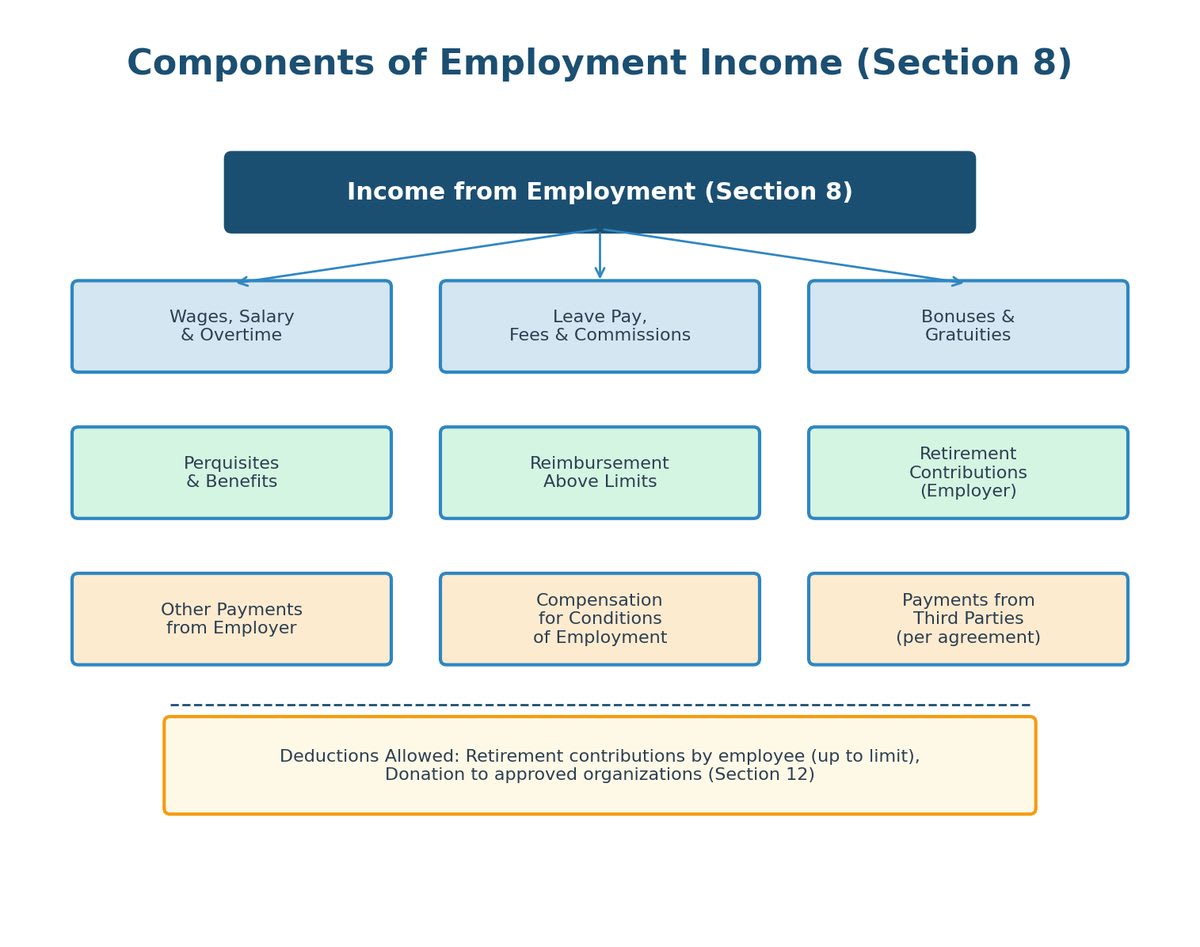
Figure: Components of Employment Income (Section 8)
(1) The remuneration derived by any natural person from employment in any income year shall be computed as the income earned from employment by that person in that year.
In computing employment income, the amounts received directly or indirectly by an employee from an employer in cash, goods, services or benefits in the course of employment must be included.
Employment and Consultant: There is sometimes verbal confusion between employment and a consultant. Generally, a Contract of Service signifies employment while a Contract for Service indicates a consultant. "Employment" means the condition under which a person working for a particular natural person or body in a managerial, supervisory, administrative, technical, or any other similar capacity, where written or unwritten employee service conditions and benefits or similar conditions of that body apply, and such a body pays a salary, wage, or other similar payment. Such an natural person or body can be resident or non-resident.
A payment that establishes the relationship between the worker and the employer is to be included in employment.
Example 17.2.1: Suppose Ramila is employed at a certain body with a monthly remuneration of Rs. 50,000. Similarly, a person named Hanif has been appointed to study market conditions for the same body and submit a report within six months for a remuneration of Rs. 3,00,000. The body makes payment to Hanif at a rate of Rs. 50,000 per month. In this situation, the payment to Ramila falls under employment (Contract of Service), while the payment to Hanif falls under a service charge (Contract for Service). Hanif must include the total amount received (before tax) in his business income and claim the tax deducted as advance tax.
Remuneration received by the employee for past, present, and future employment must be included in employment income and tax calculated on a cash receipt basis..
Example 17.2.2: Suppose Katrina was appointed as a store keeper at Samari Institution in 2069 with a monthly salary of Rs. 20,000. Since the institution's financial condition was not good, it could not pay salaries from Baisakh 2074 onwards. Katrina resigned in Baisakh 2076 and started working at Bikash Bank Limited. When the institution's financial condition improved, Katrina received Rs. 4,80,000 in a lump sum from Samari Institution on Shrawan 10, 2080. In this case, the lump sum remuneration received must be included in income under FY 2080/81, i.e., the financial year of receipt, on a cash receipt basis as per Section 22 of the Act. Here, Samari Institution is the past employer and the remuneration received is income from past employment.
Example 17.2.5: Suppose an industry sent an employee at a cost of Rs. 5,00,000 to undergo training to gain expertise in operating machinery used in its production operations. Since the purpose of such training expense is for the industry's business, such expense should not be included in the concerned employee's income. However, if such expense is not related to the employer's business, such training fees must be included in the concerned employee's income as per Section 22 of the Act.
Employment income = return for services under a Contract of Service (employer-employee bond); a Consultant works under a Contract for Service = business income.
Covers past (already left), present (currently working) and future (signed for a fixed future start) employment; taxed on cash-receipt basis u/s 22
(2) The following payments made by an employer to an natural person in any income year shall be included in computing the remuneration earned by such natural person from employment in that income year:-
(a) Amount for wages, salary, leave, amount for overtime work, fee, commission, prize, gift, bonus, and payment for other facilities,
Wages and Salary: There is not much practical difference between wages and salary. Both terms refer to the return received for providing services. For income tax purposes, since salary and wages are calculated under the same income head in determining employment income, it is not necessary to distinguish between them.
Leave Amounts: Workers and employees may receive various types of leave according to the employee regulations or their contract with the institution, such as annual leave, sick leave, special leave, contingency leave, etc. The amount payable to the employee for accumulated leave not used during employment or at the time of termination of employment is called the leave amount. As per Rule 20, Sub-rule (6), Clause (a), the principal, interest, and other amounts accumulated in an employee's Provident Fund or Citizens Investment Trust in income years prior to the commencement of the Act, and the gratuity and accumulated leave amounts earned up to that date, shall be tax exempt.
Fees: Fees received by an employee from an employer in the context of employment (such as job joining fees or similar payments) must be included in employment income.
Commission and Bonus: Amounts paid based on predetermined management criteria related to sales targets, profit targets, legal obligations, or other similar reasons are called commission and bonus amounts. A medical representative appointed as an employee by a pharmaceutical manufacturing company, in addition to salary, receives commission based on sales ratio or performance bonus, and bonuses given to employees under the Bonus Act are examples of this.
Prize and Gift: A payment received from an employer for outstanding work by an employee is called a prize or gift. If such prizes or gifts are received in kind rather than cash, they should be valued at prevailing market price and included in income as per Section 8. If such a prize or gift is received from an open competition in which employees and other persons can also participate, such prize and gift need not be included in employment income.
Example 17.3.1: Suppose a commercial bank gave Rs. 10,000 cash as a prize to its outstanding employee on its annual celebration. The employee must include such prize in employment income as per Section 8 of the Act.
Example 17.3.2: Suppose a commercial bank, in coordination with the National Sports Council, organized a national-level running competition on its annual celebration, with provisions for the general public including the bank's employees to participate. If one of the bank's employees became outstanding in that running competition and received a prize of Rs. 20,000, since the awarded person received the prize as an outstanding runner and not as an employee of the bank, the employee need not include such prize in employment income as per Section 8 of the Act. Such amount will be windfall gain income for that employee.
(b) Payment for any personal allowance including amount for cost of living allowance, subsistence allowance, rent, entertainment or transport allowance,
(c) Payment received for settlement of or reimbursement of expenses incurred by him or his associated person for personal purpose,
Associated Person: In the context of an employee, associated person means the relatives of that person. "Relative" is defined in section 2.
Personal Purpose: If an employee of a body or their associated person has incurred expenses for their personal work and received such amount from the body as reimbursement, then since such payment was for personal purposes, it must be included in their employment income.
Example 17.3.3: Suppose a person named Bharat is an employee at a company. He went on a holiday trip with his family for vacation. As per the company's rules, the company pays transportation expenses for such a trip. In this situation, since the transportation expenses paid by the company for the holiday trip are personal expenses of Bharat, they must be included in Bharat's employment income.
Example 17.3.4: Suppose a person named Hari Prasad is employed at a company. His son studies at a school called Kid Bold and he pays Rs. 10,000 per month in school fees. He takes such fee amount as monthly reimbursement from the company where he works. Since such reimbursement is not for the employer's business purpose but for the employee's personal purpose, the payment received as such reimbursement must be included in his employment income.
(d) Payments made for having given consent to any terms of employment,
Example 17.3.5: Suppose a bank agreed to pay the Chief Executive Officer 5 percent of the bank's earned profit as an incentive as a condition of appointment. The amount received as such payment must be included in employment income.
(e) Payments made for termination, loss of employment or for compulsory retirement,
Termination of Employment: An employee may be retired from employment through loss of employment, retirement, compulsory retirement, or any other method. Regardless of the modality through which the employee is retired from employment, the retirement payment received from the employer must be paid after deducting tax at 15% on the payment as per Section 88(1) of the Act. Since such payment is a final withholding payment as per Section 92(1)(f) of the Act, it need not be included in employment income as per Section 8(3) of the Act.
Loss of Employment: Loss of employment is one of the processes of retirement. For example, liquidation, privatization with a condition of not retaining current employees, a situation where an employee/worker at an institution becomes incapacitated and unable to work, employees facing retrenchment, etc. In such situations, the compensation amount received from the relevant institution due to such loss of employment must be included in employment income as per Section 8(2)(e) of the Act. However, since tax must be deducted at 15% on payment as per Section 88(1) of the Act and it is a final withholding as per Section 92(1)(f), such amounts need not be included in employment income during calculation as per Section 8(3).
Example 17.3.6: Suppose in the process of privatizing Krishi Samari Institution, the employees were to be retired but a decision was made to provide, in addition to the usual benefits for loss of employment, additional salary as compensation at the rate of 2 months per year of service. In this context, a person named Dipak received the following payments: Previous salary and benefits: Rs. 80,000; Leave amount earned before the Act came into force: Rs. 50,000; Gratuity earned after the Act came into force: Rs. 2,50,000; Additional salary received as compensation: Rs. 4,00,000.
Of the above payments, the leave amount of Rs. 50,000, the gratuity of Rs. 2,50,000, and the additional salary of Rs. 4,00,000 are subject to 15% tax deduction on payment as per Section 88(1), and since they are final withholding amounts as per Section 92(1)(f), they need not be included in income. However, the previous salary and benefits of Rs. 80,000 must be included in employment income.
Compulsory Retirement: The process by which an institution retires a specified group of workers/employees from employment, or retires them upon reaching a specified period/age as per Staff Regulation, is called compulsory retirement. In giving compulsory retirement other than retirement upon reaching the period/age specified in Staff Regulation, special benefits may also be provided. Such payment received as special benefit is a retirement payment, and therefore, tax must be deducted at 15% on payment at source as per Section 88(1), and since it is a final withholding as per Section 92(1)(f), it need not be included in employment income during calculation as per Section 8(3).
Termination, loss of employment & compulsory-retirement payments (incl. gratuity, leave, VRS special benefits) = 15% TDS at source u/s 88(1), final withholding u/s 92(1)(f), so NOT included in employment income u/s 8(3); only normal salary & benefits are included
Example 17.3.7: Suppose a commercial bank, in the process of reducing employees, allowed employees who had completed 20 years of service to apply for voluntary retirement, and for employees retiring under this VRS scheme, provided special benefits of 2 months' salary for each year of service. Under this scheme, an employee named Rasik Kalam retired effective from Ashadh end of 2065. As per the bank's rules, those with more than 15 years of service received gratuity at 2 months' salary rate, and those with more than 20 years received 2.5 months' salary rate, paid by the bank. As per the employee regulations before Chaitra 18, 2058, he also received three months' medical treatment expenses at the time of retirement. His payments in FY 2064/65 including retirement amounts were as follows:
Salary at retirement | Rs. 20,000 per month |
Salary in Chaitra 2058 | Rs. 15,000 per month |
Allowances | Rs. 10,000 per month |
Service period | 25 years (19 years until Chaitra 18, 2058) |
Leave | 150 days (60 days until Chaitra 18, 2058) |
Dashain expense | Rs. 20,000 |
Retirement contribution | 10% of salary |
Description | Employment Income | Retirement Payment |
Salary Rs. 20,000 x 12 months | 2,40,000 | |
Allowances Rs. 10,000 x 12 months | 1,20,000 | |
Dashain expense | 20,000 | |
Retirement fund contribution (10% of 2,40,000) | 24,000 | |
Gratuity (25 x 2.5 x 20,000 = 12,50,000) Less: Gratuity earned until Chaitra 18, 2058 (19x2.5x20,000) | 12,50,000 (9,50,000) | |
Medical treatment: not applicable | ||
VRS benefit (25 x 2 x 20,000) | 10,00,000 | |
Leave earned from Chaitra 19, 2058 (90 days) (20,000/30 x 90) | 60,000 | |
Total | 4,04,000 | 13,60,000 |
As per Rule 20, Sub-rule (6), Clause (a), leave, gratuity, and medical treatment expenses earned until Chaitra 18, 2058 are tax exempt. The employer must deduct tax at 15% on payment for VRS/CRS benefit, gratuity, and leave amounts, and since the amounts paid after such tax deduction are deemed final withholding payments as per Section 92(1)(f), they need not be included in employment income during calculation as per Section 8(3).
(f) Retirement payment and retirement contribution including the amount deposited by the employer for that employee in the retirement fund,
"Retirement payment" means a payment made to the following persons:
(1) a payment made to a natural person upon their retirement, or
(2) a payment made to a natural person's dependent upon that natural person's death.
The conditions under which payment can be made from an approved retirement fund are as per Rule 20(2)(d): payment from a retirement fund can only be made to the beneficiary of the retirement fund in the following situations:
(1) when the employee or worker is retired from service,
(2) when the beneficiary reaches the age of 58 years, or
(3) when the beneficiary dies or becomes permanently disabled.
As per Rule 20(6): Notwithstanding anything written above,
(a) the principal, interest, and other amounts accumulated in an employee's or worker's Provident Fund or Citizens Investment Trust in income years prior to the commencement of the Act, and the gratuity and accumulated leave amounts earned up to that date, shall be tax exempt; and
(b) medical treatment expenses up to Rs. 1,80,000 payable to employees or workers who were in service when the Act commenced, upon retirement as per their service conditions regulations, shall not be included in the income of such employees or workers.
Example 17.3.8: Hafiz Singh works at a government company with a monthly remuneration of Rs. 20,000. In addition to monthly remuneration, Rs. 2,000 per month is deposited in a retirement fund in his name, which is called the retirement contribution, and such amount must be included in his employment income.
(g) Other payments made in respect of employment, and
Eg: holiday trips and shopping, must also be included in employment income.
(h) Other amounts required to be included pursuant to Chapter-6 or 7.
Any person must quantify and characterise various facilities provided by the employer and include them in their own income.
Method and Timing of Tax Accounting for Employment Income: Tax accounting for employment income must be done on a cash basis for natural persons. As per Section 22(2) of the Act, a natural person must account for income from employment on a cash basis for tax purposes. An amount shall be deemed received and included in the calculation of income only when they receive payment or when such payment becomes available to them.
Example 17.3.9 Suppose Kamal is an employee at Samari Institution. This person received Rs. 2,40,000 (at the rate of Rs. 20,000 per month for Shrawan 2078 to Ashadh 2079) only in Shrawan 2080. In this situation, since accounting is done on a cash basis, the amount must be included in income for tax purposes in the month of receipt, Shrawan 2080. Therefore, under this method, regardless of which financial year the income was earned, it must be included in the income of the financial year in which it was received.
Indirect Payment: As per Section 29 of the Act, if any person indirectly benefits from a payment made by the payer or their associated person, or designates another person to receive the payment, the Department may, by issuing written notice, deem such benefiting person or the person making such designation as the person receiving such payment.
Example 17.3.17 Suppose Hari Prasad is a retired government employee. He has arranged for his wife, who lives separately from him, to receive his pension. Even though he has designated another person to receive payment, the Department may issue written notice and deem the person benefiting, i.e., his wife, or the person making such designation, i.e., him, as the person receiving such payment.
Included in employment income u/s 8(2): (a) wages, salary, leave pay, overtime, fees, commission, prizes, gifts, bonus & similar + (b) personal allowances (cost-of-living, rent, entertainment, transport) + (c) employer reimbursement of the employee's personal expenses + (d) payment for agreeing to employment conditions + (e) payment for termination or loss of employment + (f) retirement payment & retirement contribution (incl. employer's fund deposit) + (g) other employment-related payments + (h) amounts under Ch 6 or 7
(3) Notwithstanding anything contained in sub-section (2), the following matters need not be included in computing the remuneration earned by any natural person from employment:-
(a) The amounts deductible under Section 10 and payments from which tax is withheld finally,
(1) Amounts exempt under Section 10 of the Act with regard to employment:
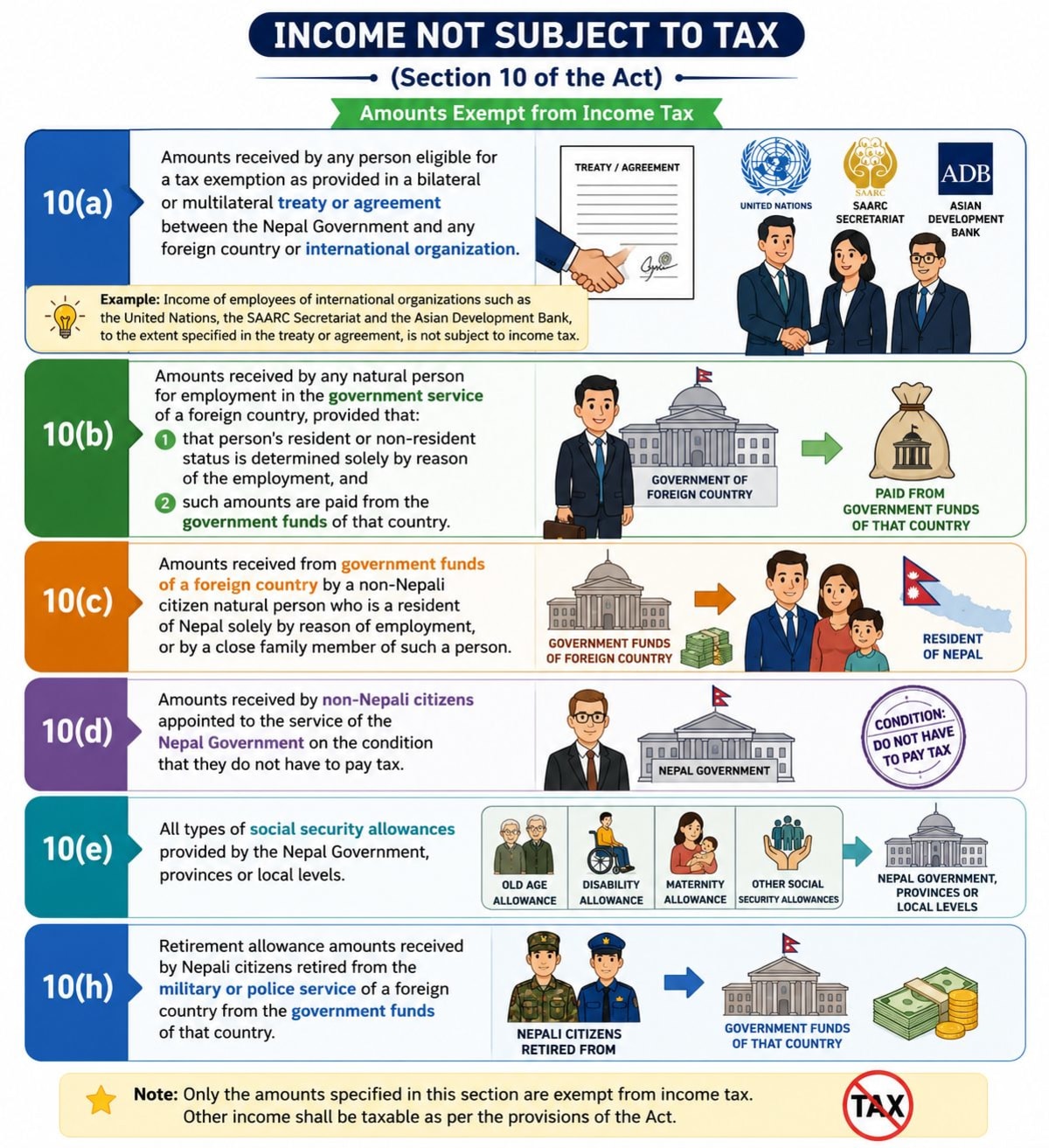
(2) Payments subject to final withholding tax:
Section 92 of the Act provides for payments subject to final advance tax withholding. Income received after final withholding tax has been deducted shall not be included in computing employment income. Those payments include: benefit received by a resident person from investment insurance; benefit received by a resident person from an interest in an unapproved retirement fund; all types of retirement payments (other than regularly paid pension); meeting allowances up to Rs. 20,000 per meeting; windfall gain payments; returns distributed by Collective Investment Funds (Mutual Funds) to natural persons; and rent or freight payments for the vehicle or transport means of a natural person (other than a sole proprietorship).
Example 17.4.1: Suppose Mr. Harish is a foreign national working at a foreign embassy in Nepal. He has been working there continuously for the past 5 years and receives salary and allowances paid from that foreign government's official treasury. In this situation, the source of his income is not deemed to be Nepal. Since his residency in Nepal is solely because of that employment and he is a resident of Nepal, his received salary and allowances are not subject to remuneration tax. However, if he has business, investment in Nepal, or employment income paid from sources other than that foreign government's official treasury, tax will apply.
Example 17.4.2: Suppose in Example 17.4.1, Mr. Harish's father Mr. Jack is a foreign national and has been living in Nepal with his son for a long time after retiring from government service there. If he receives a monthly pension of GBP 2,000 from that foreign government, the said pension amount received by him need not be included in income calculation as per Section 10, Clause (c) of the Act.
Example 17.4.3: Suppose Ratnakar De Silva is a non-Nepali citizen. If the Government of Nepal appoints him as a specialist to assist the peace process with a monthly payment of USD 20,000 on a no-tax condition, then the payment amount received by him need not be included in income.
Example 17.4.4: Suppose Ram Bahadur is a Captain employed in the Indian Army. After completing 20 years of service, he currently lives in Dhikura Thok Gaun Palika of Kanchanpur District. He receives monthly Indian pension of INR 20,000 from the Indian Pension Camp in Pokhara. He is also working as Security Chief at Bikash Bank Limited with a monthly remuneration of Rs. 15,000. In this situation, the monthly INR 20,000 received from the Indian government's state treasury as pension need not be included in employment income. The monthly Rs. 15,000 received from Bikash Bank Limited must be included in income as per Section 8 of the Act.
Example 17.4.5: Suppose Ram Prasad is an employee working at the officer level at Bikash Bank Limited. He purchased ordinary shares worth Rs. 1,00,000 in Nabil Bank. The bank declared a dividend of Rs. 5,000 on such shares and after deducting advance tax of 5%, i.e., Rs. 250, it paid the remaining Rs. 4,750 to him. Since the dividend after final withholding tax is received as Rs. 4,750, Ram Prasad need not include such amount in his employment income.
Example 17.4.6: Suppose Vishwa Compass Pvt. Ltd. rented 8 anna of land from a person named Rahim Mia at Rs. 10,000 per month to operate its business. Rahim Mia is also employed at a non-governmental office with a monthly remuneration of Rs. 30,000. The Pvt. Ltd. deducted advance tax at 10% on the contracted amount of Rs. 10,000 and paid the remaining Rs. 9,000 to the landlord Rahim Mia. Since the land rent income received by the landlord Rahim Mia is after final tax deduction, he need not include it in income.
Example 17.4.7: Suppose an employee working at Bikash Bank Limited has life insurance at an insurance company. While accumulating premium at Rs. 1,000 per month for such insurance, Rs. 2,00,000 had been paid in premiums by the end of Ashadh 2080. Since this insurance matured, the insurance company paid Rs. 3,00,000 and deducted 5% tax on the profit of Rs. 1,00,000 (3,00,000 - 2,00,000) and paid the benefit. In this situation, the payment received by the employee need not be included in income.
Example 17.4.8: Suppose Haris is an employee at Bikash Bank. He deposited a total of Rs. 10,00,000 in a savings account. If he received Rs. 1,00,000 interest on that account in FY 2080/81, the bank deposited Rs. 1,00,000 in his account and simultaneously debited advance tax at 6%, i.e., Rs. 6,000, from his account. Haris need not include such received interest in employment income. However, interest received from a bank account related to his business must be included in income. In addition, interest received from other persons not mentioned in Section 88(3) must be included in income, and if tax has been deducted at the time of payment, such deducted tax amount can be set off against the tax liability as advance tax.
Example 17.4.9: Suppose Hari Prasad Kafle was appointed as an Assistant at Ne.Ba.Li. (Nepal Bank Limited) on Baisakh 1, 2044. He retired from service on Jestha 1, 2065. At the time of retirement, he received the following amounts:
(1) Provident Fund - principal until Chaitra 18, 2058: Rs. 4,00,000
(2) Provident Fund - principal from Chaitra 19, 2058 to end of Baisakh 2065: Rs. 8,00,000
(3) Provident Fund - interest until Chaitra 18, 2058: Rs. 1,50,000
(4) Provident Fund - interest from Chaitra 19, 2058 to end of Baisakh 2065: Rs. 1,50,000
Total Provident Fund to be received: Rs. 15,00,000
As per Rule 20, Sub-rule (6)(a) of the Income Tax Regulations, 2059, the tax-exempt amount must be calculated as follows:
Provident Fund principal before Act came into force: Rs. 4,00,000
Provident Fund interest before Act came into force: Rs. 1,50,000
Total Provident Fund amount exempt: Rs. 5,50,000
Retirement payment calculation after Act came into force:
Provident Fund (retirement fund) amount after Act: Rs. 8,00,000
Interest on Provident Fund (retirement fund) after Act: Rs. 1,50,000
Total Provident Fund amount: Rs. 9,50,000
The Provident Fund amount after the Act is called a retirement fund. If such retirement fund is an approved retirement fund, the payment from that fund must be calculated as follows for tax purposes:
Total amount received from approved retirement fund after Act came into force: Rs. 9,50,000
As per Section 65, Subsection (1), Clause (b) when calculating profit, 50% of the payment amount or Rs. 5,00,000 whichever is higher must be deducted:
(1) 50% of payment amount: Rs. 4,75,000
(2) Specified amount: Rs. 5,00,000
Since a total of Rs. 9,50,000 was received from the approved retirement fund after the Act came into force, and Rs. 5,00,000 is exempt from profit as per Section 65, Subsection (1), Clause (b), tax must be deducted at 5% on the remaining Rs. 4,50,000 as per Section 88, Subsection (1) before paying the balance.
If the retirement fund after the Act came into force is an unapproved retirement fund, 5% advance tax must be deducted on the difference between the received amount and the contributed amount as per Section 88(2)(c).
Suppose:
(1) Provident Fund - from Chaitra 19, 2058 to end of Baisakh 2060 - principal: Rs. 4,50,000
(2) Interest on Provident Fund for same period: Rs. 50,000
Total payment amount: Rs. 5,00,000
Of the principal amount, Hari Kafle's own contribution is Rs. 4,50,000, so tax must be deducted as follows:
(1) Payment to be made: Rs. 5,00,000
(2) Own contribution to the fund: Rs. 4,50,000
Profit for tax purposes: Rs. 50,000
As per Section 88(2)(c), advance tax at 5% amounting to Rs. 2,500 must be deducted on payment and the remaining paid.
Example 17.4.10: Suppose Nilima Shrestha is a professor working at a campus. She received Rs. 1,000 as meeting allowance for attending one of the campus's meetings. She also received Rs. 1,500 for teaching a special class in English at another campus and additionally received Rs. 10,000 for preparing question papers and Rs. 20,000 for marking answer sheets. Tax must be deducted at 15% on the meeting allowance of Rs. 1,000, and on Rs. 1,500 for occasional teaching, Rs. 10,000 for question paper preparation, and Rs. 20,000 for answer sheet marking, and the payments received after such tax deduction need not be included in employment income calculation.
However, if Nilima also regularly teaches at another institution three times per week and receives monthly remuneration, such remuneration must be included in income as per Section 8 of the Act.
(b) Food and tiffin provided by the employer to the employee at the work site in a manner that it is available to all employees on the same terms,
Meals and refreshments provided by the employer to employees at the workplace, uniformly available to all employees on equal terms, need not be included in employment income.
Example 17.4.11: Suppose a call center named Call America Pvt. Ltd. provides food equally to all employees present at the office daily, costing an average of Rs. 200 per person per day. The snacks received equally by employees at the workplace need not be included in employment income. However, if food and snacks are provided to employees in cash rather than in kind, it must be included in the concerned employee's employment income.
(c) The settlement or reimbursement of the following expenditure incurred by any employee:-
Reimbursements or settlements received by an employee from an employer for expenses incurred in fulfilling the employer's business purpose need not be included in the employee's employment income.
Example 17.4.12: Suppose Gopi is working as an employee at Nepal Bank Limited's Head Office, Kathmandu. While on official duty, he was sent on assignment to Nepal Bank Limited Pokhara for four days and received: Daily travel allowance for 4 days at Rs. 1,000 per day: Rs. 4,000; Airfare Rs. 3,000 x 2: Rs. 6,000; Other expenses as per bills: Rs. 1,000; Total: Rs. 11,000. Gopi went to Pokhara in the course of official work and submitted bills for reimbursement, which were approved by the authorized person. Such Rs. 11,000 received from the employer is for the employer's business purpose and need not be included in his remuneration income.
(1) The expenditure fulfils the business purpose of the employer, or
(2) The expenditure exempted or to be exempted in the computation of income from the natural person's business or investment.
(d) Payment of such petty amounts of which accounts are impracticable or administratively difficult to maintain as prescribed.
(e) The amount equivalent to sweat equity shares received as remuneration for employment in the information technology industry.
Rule 6: In making payment of petty amounts mentioned in Clause (d) of Sub-section (3) of Section 8 of the Act, the payer may make payment of a maximum of Five Hundred Rupees at a time for tea expenses, stationery, gift, prize, casual medical treatment and for similar kind of payment as specified by the Department.
Explanation: For the purposes of this Section, "payment" means the following payment:-
(a) Made by the employer,
(b) Made by the associated person of the employer, and
(c) Made by any third person as referred to in the agreement made with the employer or his associated person.
Excluded from employment income u/s 8(3): (a) Section 10 exempt amounts + payments under final WHT + (b) food/tiffin provided at the workplace equally to all employees + (c) reimbursement or settlement of employer-business-purpose expenses + (d) prescribed petty payments up to Rs. 500 per occasion (Rule 6: tea, stationery, gift, prize, casual medical)
9. Computation of income earned from investment
(1) The profits and benefits derived by any person from investment in any income year shall be the income earned by that person from that investment in that year.
Investment means the act of holding (Holding) assets and earning income. Keeping assets for personal use by the owner, or owning assets used in employment or business, is excluded - while ownership of other assets and keeping non-business taxable assets are called investment.
Generally, the person earning income from investment activities does not need to be actively and continuously involved.
(2) The following amounts received by any person in any income year shall be included in computing the profits and benefits derived by that person from investment in that income year:-
(a) Dividend, interest derived from that investment, payment for natural resources, rent, royalty, profit from investment insurance, profit from interest in a retirement fund which has not got approval pursuant to sub-section (1) of Section 63, or retirement payment made from an approved retirement fund,
Similarly, royalties received for granting permission for petroleum exploration or for use of technical support or a trademark must also be included in investment income. However, dividend amounts received, interest and rent received by a natural person other than through business, profit from investment insurance, and retirement payments from a retirement fund, where tax has been withheld in advance under Section 88 and is treated as final withholding tax under Section 92, need not be included in investment income. However, where such income is paid by a non-resident (except dividends where the non-resident entity is a controlled foreign entity under Section 69), such income must be included in profit and gain.
Example 6.4.4: Suppose Harris & Co. made a loan investment of Rs. 1,00,000 in ABC Company Ltd. at 10 percent interest. That company paid interest of Rs. 10,000 at 10 percent, withheld advance tax of Rs. 1,500 at 15 percent under Section 88(1), and paid the balance of Rs. 8,500. In this situation, Harris & Co. must include the full amount of Rs. 10,000 in its investment income. Similarly, if Mr. Harris, as a personal investment, invested Rs. 1,00,000 in ABC Company Ltd. (which is not authorised to issue debentures) at 10 percent interest, and the company paid interest of Rs. 10,000, withheld advance tax of Rs. 1,500 at 15 percent under Section 88(1), and paid the balance of Rs. 8,500, then Harris must include the full amount of Rs. 10,000 in his investment income and file an income return. However, if he deposited the amount in a bank or in an entity authorised to issue debentures and received interest, such interest received after tax deduction is treated as a final withholding tax payment, and Harris need not include such interest income in his investment income.
(b) Net profits derived from the disposal of non-business taxable assets of the investment of that person, computed pursuant to Chapter-8,
Non-business taxable assets are assets not directly used in business or investment. When non-business taxable assets comprising land, buildings and interests in any entity are disposed of, the net gain received at the time of disposal must be included in income. In computing such net gain, the net gain is the amount remaining after deducting expenses from income and further deducting any undeducted losses.
Example 21.4.2: Suppose Haris had purchased 100 units (kirra) of shares of ABC Company Ltd., listed on Nepal Stock Exchange, for Rs.20,000/- on date 2080.08.20. He sold those shares for Rs.25,000/- on date 2081.08.15. The net gain of Rs.5,000/- from disposal of shares not related to a natural person's business - i.e., non-business chargeable assets - must be included in his investment income.
(c) If, in disposing the depreciable property of the investment made by that person, the incomings to be received exceed the remaining value comprising the outgoings made for the property of the group of depreciable property pursuant to clause (a) of sub-section (2) of Section 4 of Schedule-2, the excess amount,
(d) Gift received by that person in respect of investment,
Example 6.4.5: Suppose Haris invested Rs. 2 crores in shares of Sampanna Bank Ltd. In some income year, the bank provided shareholders with a share investment exceeding Rs. 1 crore with a one-tola gold coin as a gift for Dashain. Since the gold coin was received as a gift in connection with an investment, such a gift must be valued at market value and included in investment income.
(e) Retirement payment made in respect of that investment and retirement contribution including the amount deposited in the retirement fund for that person,
(f) Amounts received for having accepted any restriction in connection with investment, and
(g) Other amounts required to be included pursuant to Chapter-6 or 7 or Section 56.
Included in investment income u/s 9(2): (a) dividend, interest, natural-resource payment, rent, royalty, investment-insurance profit, unapproved retirement-fund profit / approved-fund retirement payment + (b) net gain on disposal of non-business taxable assets (Ch 8) + (c) gain on disposal of depreciable investment property + (d) gift relating to investment + (e) retirement payment & contribution relating to investment + (f) amount for accepting an investment restriction + (g) amounts under Ch 6 or 7 or Sec 56
(3) Notwithstanding anything contained in sub-section (2), the following matters shall not be included in computing profits and benefits derived by any person from investment:-
(a) The amounts deductible under Sections 10, 54 and 69 and payments from which tax is withheld finally, and
(b) The amounts to be included in computing income earned by that person from employment or business.
To avoid double counting, amounts included in computing income earned from employment or business shall not be included in investment income. Amounts included in computing business income under Section 7 and amounts included in computing employment income under Section 8 shall not be included in computing investment income.
Investment income is thus a residual income that is computed or defined only after computing income from employment and business.
Investment income is residual = computed only after employment & business income (9(3)(b)). Excluded u/s 9(3): Sec 10 / 54 / 69 amounts + final-WHT payments. A natural person's dividend, interest, rent, investment-insurance & retirement income with final TDS u/s 88/92 is not included; but the same income from a non-resident is included.