87. Withholding of tax by employer
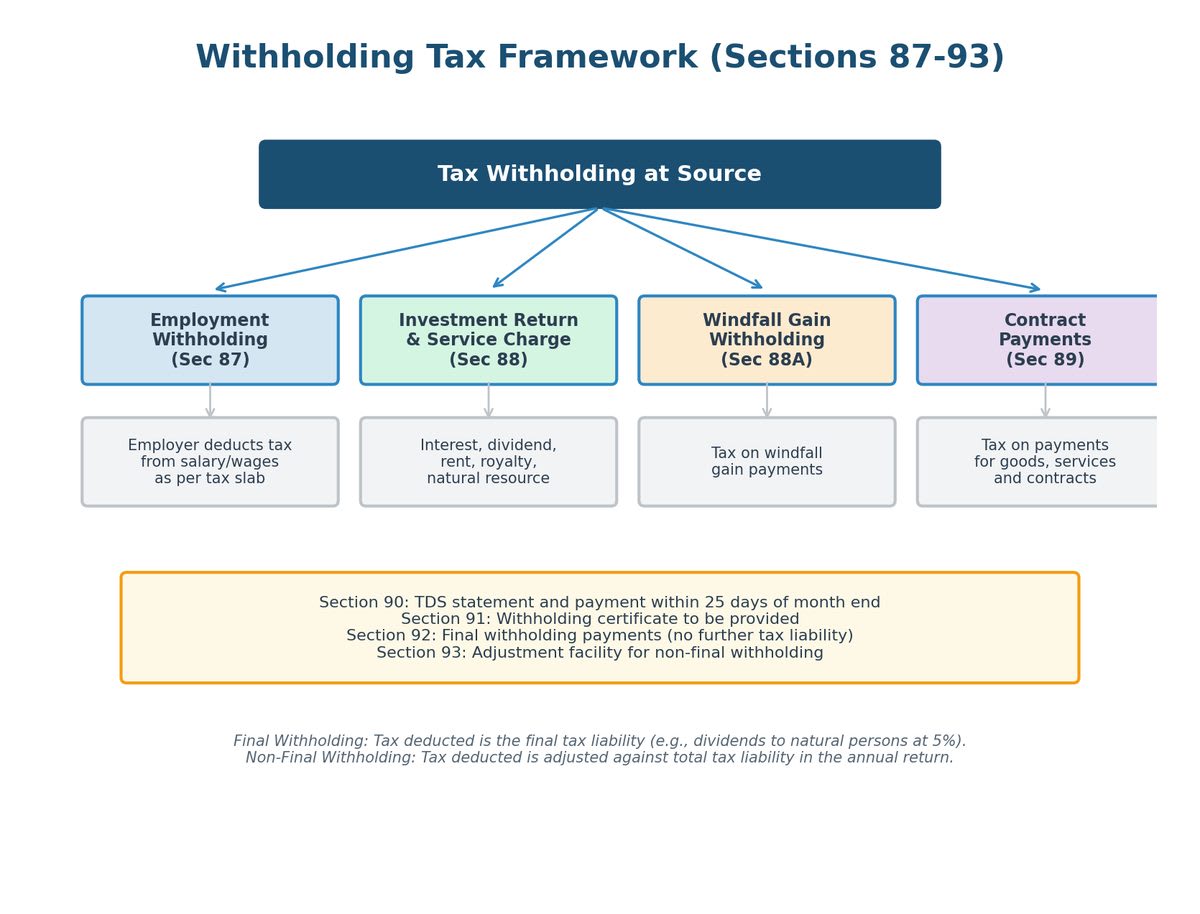
Figure: Withholding Tax Framework (Sections 87-93)
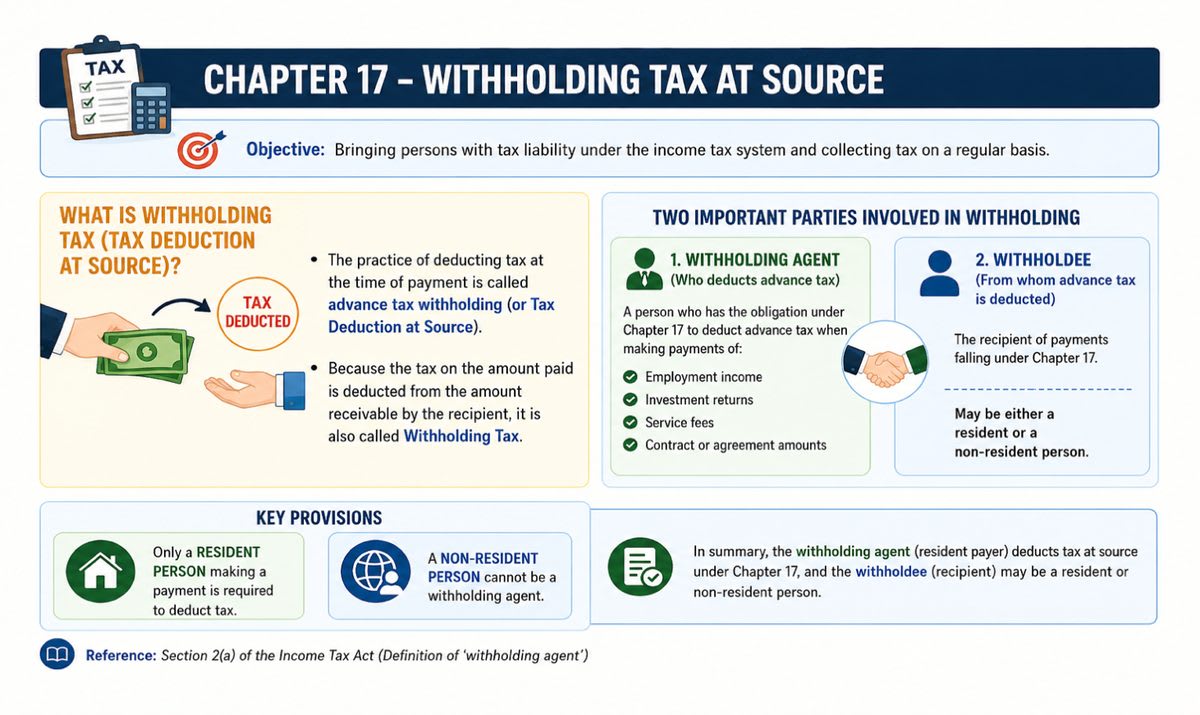
Example 16.2.1: Assume that the committee formed for burning old banknotes at Nepal Rastra Bank includes representatives from the District Treasury and the Comptroller of Financial Accounts Office. The committee provides a meeting allowance of Rs. 250 for attending each meeting. Accordingly, on the Rs. 250 meeting allowance payable to Mrs. Sunyana Swanr for attending the committee meeting, 15 percent advance tax of Rs. 37.50 must be deducted under Section 88 and the balance of Rs. 212.50 must be paid to her. Nepal Rastra Bank is the withholding agent in this transaction.
Example 16.2.2: In Example 16.2.1 above, Mrs. Sunyana Swanr, who receives Rs. 212.50 after advance tax deduction, is the withholdee.
(1) When making payment of any amount having source in Nepal that is to be included in computing the income derived by any employee or worker from employment, each resident employer shall withhold (deduct) tax at the rate referred to in Schedule-1.
Rule 31: Any employer shall, in withholding tax from employment pursuant to Sub-section (1) of Section 87 of the Act, carry out as follows:
(a) if an adjustment of tax for medical treatment is allowed pursuant to Section 51 of the Act, adjust such amount; and
(b) withhold tax on a monthly basis on pro rata of the tax payable on the annual remuneration of the employee or worker.
An employer must:
Step | Calculation / Adjustment | Reference |
1 | Estimate total annual remuneration receivable by the employee (salary, allowances, benefits, bonuses, etc.) before the first payment in the income year. Revise if circumstances change. | Section 8 |
2 | Less: Employer's contribution to an approved retirement fund eligible for deduction. | Section 63(2), Rule 21 |
3 | Less: Remote Area Allowance (if eligible). | Schedule 1, Sec. 1(5) |
4 | Less: 75% of Foreign Allowance received by Govt employees working at Nepali diplomatic missions abroad. | Schedule 1, Sec. 1(6) |
5 | Less: Disability Deduction (resident employee only). | Schedule 1, Sec. 1(10) |
6 | Less: Eligible Investment Insurance Premium. | Schedule 1, Sec. 1(12) |
7 | Less: Eligible Health Insurance Premium. | Schedule 1, Sec. 1(16) |
8 | Result = Assessable Employment Income | |
9A | For Resident Employees: Calculate annual tax using progressive rates under Schedule 1. | Schedule 1 |
9B | For Non-Resident Employees: Tax = Assessable Employment Income × 25% | Schedule 1 |
10 | Less: 10% Tax Concession for resident female employee whose income consists only of employment income. | Schedule 1, Sec. 1(11) |
11 | Less: Medical Tax Credit (if eligible). | Section 51 |
12 | Result = Net Annual Tax Liability | |
13 | Monthly Withholding Tax = Net Annual Tax Liability ÷ 12 (or actual employment months if less than 12 months). | Section 87 |
The following examples illustrate the calculation of employment income tax and the determination of monthly withholding amounts.
Example 17.11.1: Suppose Dipika is a single woman employed at Nepal Bikash Bank. She received annual salary and benefits of Rs. 12,50,000 from Nepal Bikash Bank in FY 2080/81.
Description | Amount | Amount |
Annual salary and benefits | 12,50,000 | |
Employment assessable income | 12,50,000 | |
Exempt amount | - | |
Taxable income | 12,50,000 | |
Tax calculation: | ||
On Rs. 10,00,000 at 1% (Single) | 10,000 | |
Additional Rs. 2,50,000 at 10% | 25,000 | |
Total | 35,000 | |
Less: 10% exemption for woman's employment income only | (3,500) | |
Total annual tax liability | 31,500 | |
Monthly tax to be deducted by Nepal Bikash Bank (31,500/12) | 2,625 |
Example 17.11.2: Suppose Hrekendra, a single person, joined Nepal Bikash Bank on Poush 1, 2080. He received 7 months' salary and benefits of Rs. 8,80,000 from Nepal Bikash Bank in FY 2080/81.
Description | Amount (Rs.) | Amount (Rs.) |
7 months' salary and benefits | 8,80,000 | |
Employment assessable income | 8,80,000 | |
Taxable income | 8,80,000 | |
On Rs. 8,80,000 at 1% (Single) | 8,800 | |
Total annual tax liability | 8,800 | |
Monthly tax from Poush 2080 to Ashadh 2081 (7 months) (8,800/7) | 1258 |
Additional Comprehensive Examples - Employment Income Calculation (Section 17.13)
Example 17.13.1: If salary and allowances of a Nepali citizen employee at a Nepali Embassy in France are paid by the Government of Nepal through the Nepali Embassy in France, such received income is deemed income with source in Nepal. Even though the place of payment and work is France, the source of income is deemed Nepal. However, if foreign allowance is received, up to 75% of the allowance can be claimed as deductible from taxable income as per Schedule 1, Section 1(6) of the Act.
Example 17.13.2: Suppose Gyanesh Pradhan, an employee at Bikash Bank Limited, retired on Baisakh 6, 2073. He obtained permanent residence visa for Australia on Shrawan 5, 2073 and has been residing there since. He receives a monthly pension of Rs. 40,000 in FY 2080/81. He paid a life insurance premium of Rs. 50,000 and donated Rs. 25,000 to a tax-exempt organization registered in Nepal. Since he is a non-resident person, the 25% flat rate applies. Life insurance premium cannot be deducted (must be a resident person). His tax liability must be calculated as follows:
Description | Amount (Rs.) |
Pension (Rs. 40,000 x 12) | 4,80,000 |
Dashain expense (Rs. 40,000 x 1) | 40,000 |
Assessable income | 5,20,000 |
Less: Deductions (non-resident: none applicable) | - |
Taxable income | 5,20,000 |
Tax at 25% flat rate | 1,30,000 |
Medical tax credit: not claimable (non-resident) | - |
Total tax liability | 1,30,000 |
Note: Even if a person retired from Nepal employment receives their retirement payment abroad, the source of employment remains in Nepal. If the payment recipient is a non-resident person, the exemptions available to resident persons will not apply and tax will be charged at a flat 25%.
Example 17.13.3: Suppose an employee at a company in Nepal went to Afghanistan to work from Shrawan 1, 2079 taking one year of special leave. The employee's monthly salary is USD 5,000. He entered Nepal on Bhadra 10, 2080 and rejoined the same company. Since he was not present in Nepal for more than 183 days in FY 2079/80, he is a non-resident. Since the work-related activity was done in Afghanistan (not Nepal) and payment was not from the Government of Nepal, the source of income is not Nepal. As a non-resident with no Nepal-source income, the assessable income is nil and such income is not taxable in Nepal for FY 2079/80.
Example 17.13.4 (Resident Person Having More than One Employment): Suppose a person named Bhaireja is working as a Chief Manager at a financial institution. In addition to that institution, he also teaches Accounting at a campus. He received the following income from employers in FY 2081/82:
Salary: Rs. 60,000 per month
Dashain expense: Rs. 60,000
Educational allowance: Rs. 5,000 per month
Dearness allowance: Rs. 5,000 per month
Bonus: Rs. 60,000
Salary from campus teaching: Rs. 10,000 per month
A car with driver was provided for office and personal use.
Monthly driver salary and allowances: Rs. 8,000
Average monthly petrol expense for the Chief Manager's car: Rs. 10,000, and repair expense of Rs. 25,000 was incurred for the car in FY 2081/82.
The office also provided accommodation.
The office provides telephone expense of Rs. 2,000 per month for telephone connected at his residence, of which 50% is personal telephone expense.
A security guard was provided to look after his residence and the guard was given Rs. 6,000 per month. Rs. 3,000 per month is deducted from his monthly salary for the guard.
He used a loan of Rs. 30,00,000 from the office at 5% interest throughout the year. The institution charges an average 8% interest on such loans to other borrowers.
He received one month's salary as annual leave in Mangsir 2081.
The office deducts 10% of drawn salary and adds an equal amount to deposit in the Employees Provident Fund, and he himself deposits Rs. 20,000 per month in the Citizens Investment Trust.
He donated Rs. 60,000 to a tax-exempt organization approved by the Department.
He took life insurance of Rs. 2,50,000 for himself and Rs. 1,50,000 for his wife at Nepal Insurance Company and paid premiums of Rs. 19,000 and Rs. 14,000 respectively in FY 2081/82.
He spent Rs. 20,000 on approved medical treatment at Tribhuvan University Teaching Hospital in that FY.
He chose to file as a couple for that FY.
His assessable income, taxable income must be calculated and income return filed as follows:
Description | Amount (Rs.) | Amount (Rs.) |
Salary | 7,20,000 | |
Dashain expense | 60,000 | |
Educational allowance | 60,000 | |
Dearness allowance | 60,000 | |
Bonus | 60,000 | |
Vehicle benefit (7,20,000 x 0.5) | 3,600 | |
Driver salary: not applicable | ||
Petrol expense: not applicable | ||
Repair expense: not applicable | ||
Accommodation benefit (7,20,000 x 0.5) | 14,400 | |
Telephone expense (2,000 x 12 x 50%) | 12,000 | |
Security guard benefit (6,000-3,000) x 12 | 36,000 | |
Loan benefit (8%-5%) x 30,00,000 | 90,000 | |
Annual leave salary | 60,000 | |
Retirement fund contribution | 72,000 | |
Total employment income from financial institution | 12,48,000 | |
Salary from campus teaching | 1,20,000 | |
Employment assessable income | 13,68,000 | |
Exempt amounts: | ||
Deductible retirement contribution | (3,84,000) | |
Actual contributions: | ||
Employer to Provident Fund | 72,000 | |
Employee to Provident Fund | 72,000 | |
Employee to Citizens Investment Trust (20,000 x 12) | 2,40,000 | |
Total retirement contribution | 3,84,000 | |
One-third of assessable income | 4,56,000 | |
Maximum limit | 5,00,000 | |
Adjusted taxable income (13,68,000 - 3,84,000) | 9,84,000 | |
Charitable contribution | (49,200) | |
5% of adjusted taxable income | 49,200 | |
Actual charitable contribution | 60,000 | |
Maximum limit | 1,00,000 | |
Taxable income | 9,34,800 | |
Life insurance premium deduction | (33,000) | |
Premium paid for self and wife | 33,000 | |
Maximum limit | 40,000 | |
Taxable income (for tax calculation) | 9,01,800 | |
Tax calculation: | ||
Rs. 9,01,800 (couple) at 1% - FY 2081/82 | 9,018 | |
Less: Medical expense credit | (1,500) | |
Total tax liability | 7,518 |
Bhaireja spent Rs. 20,000 on approved medical treatment, 15% of which amounts to Rs. 3,000, of which Rs. 1,500 can be claimed as tax credit this year and the remaining Rs. 1,500 can be claimed in the following year. Since he deducted his own retirement contributions and charitable contributions, and since he had two employers at the same time, he must file an income return.
Example 17.13.5/ Example 17.13.6 (Resident Person Having Business, Employment, and Investment Income): Suppose in Examples 17.13.4 and 17.13.5, Bhaireja sold listed company shares purchased on Mangsir 10, 2079 on Poush 15, 2081 and earned a profit of Rs. 2,50,000 from the sale. His assessable income, taxable income, and tax:
Description | Amount (Rs.) | Amount (Rs.) |
Business income | 2,00,000 | |
Employment income (per Example 17.13.4) | 13,68,000 | |
Investment income (non-business taxable asset disposal gain) | 2,50,000 | |
Assessable income | 18,18,000 | |
Deductible retirement contribution | (3,84,000) | |
Actual contributions (same as 17.13.4) | 3,84,000 | |
One-third of assessable income | 6,06,000 | |
Maximum limit | 5,00,000 | |
Adjusted taxable income (18,18,000 - 3,84,000) | 14,34,000 | |
Charitable contribution (5% of 14,34,000 = 71,700; actual 60,000; limit 1,00,000) | (60,000) | |
Taxable income | 13,74,000 | |
Life insurance premium (33,000; limit 40,000) | (33,000) | |
Taxable income for tax calculation | 13,41,000 | |
Tax on Rs. 10,00,000 at 1% | 10,000 | |
Tax on Rs. 91,000 at 10% (13,41,000 - 2,50,000 - 10,00,000) | 9,100 | |
Non-business taxable asset disposal gain Rs. 2,50,000 at 5% (held > 365 days) | 12,500 | |
Total tax | 31,600 | |
Less: Medical expense credit | (1,500) | |
Total tax liability | 30,100 | |
Notes: (1) Medical credit: Rs. 1,500 this year, Rs. 1,500 carries forward.
(2) Business losses cannot be offset against employment income but can be offset against investment income.
(3) Non-business taxable property disposal losses cannot be offset against business or employment income but can be carried forward indefinitely.
Example 17.13.7 (Resident Natural Person Contributing to the Social Security Fund with Additional CIT Contributions): Suppose a person named Laxmi Kumar Rijal is working as Chief Manager at a commercial bank. He received the following income from employers in FY 2080/81:
Salary: Rs. 2,00,000 per month
Dashain expense: Rs. 2,00,000
Educational allowance: Rs. 10,000 per month
Dearness allowance: Rs. 10,000 per month
Bonus: Rs. 2,00,000
A car with driver was provided for office and personal use.
Monthly driver salary and allowances: Rs. 20,000.
Average monthly petrol expense for the Chief Manager's car: Rs. 10,000, and repair expense of Rs. 40,000 was incurred in FY 2080/81.
The office also provided accommodation.
The office provides Rs. 6,000 per month for telephone connected at his residence, of which 50% is personal telephone expense.
A security guard was provided and paid Rs. 16,000 per month. Rs. 8,000 per month is deducted from his monthly salary for the guard.
He used a loan of Rs. 30,00,000 from the office at 5% interest throughout the year. The institution charges an average 8% interest on such loans to other borrowers.
He received one month's salary as annual leave in Mangsir 2080.
The office deducts 10% of drawn salary and adds an equal amount to deposit in the Contributory Social Security Fund, and he himself deposits Rs. 20,000 per month in the Citizens Investment Trust.
He took life insurance of Rs. 5,00,000 at Nepal Insurance Company and paid Rs. 30,000 premium in FY 2080/81.
He paid health insurance premium of Rs. 20,000 in that FY.
His assessable income, taxable income must be calculated and income return filed as follows:
Description | Amount (Rs.) | Amount (Rs.) |
Salary | 24,00,000 | |
Dashain expense | 2,00,000 | |
Educational allowance | 1,20,000 | |
Dearness allowance | 1,20,000 | |
Bonus | 2,00,000 | |
Vehicle benefit | 12,000 | |
Driver salary: not applicable | ||
Petrol expense: not applicable | ||
Repair expense: not applicable | ||
Accommodation benefit | 48,000 | |
Telephone expense (6,000 x 12 x 50%) | 36,000 | |
Security guard benefit (16,000-8,000) x 12 | 96,000 | |
Loan benefit (8%-5%) x 30,00,000 | 90,000 | |
Annual leave salary | 2,00,000 | |
Social Security Fund contribution | 2,40,000 | |
Employment assessable income | 37,62,000 | |
Exempt amounts: | ||
Social Security Fund contribution deductible | (5,00,000) | |
Actual contributions: | ||
Employer to Social Security Fund | 2,40,000 | |
Employee to Social Security Fund | 2,40,000 | |
Employee to Citizens Investment Trust | 2,40,000 | |
Total retirement contribution | 7,20,000 | |
One-third of assessable income | 12,54,000 | |
Maximum limit | 5,00,000 | |
Taxable income | 32,62,000 | |
Life insurance premium deduction | (30,000) | |
Premium paid for self | 30,000 | |
Maximum limit | 40,000 | |
Health insurance premium deduction | (20,000) | |
Premium for health insurance | 20,000 | |
Maximum limit | 20,000 | |
Taxable income (for tax calculation) | 32,12,000 | |
Tax calculation: | ||
Up to Rs. 10,00,000: no tax | ||
Next Rs. 5,00,000 at 10% | 50,000 | |
Next Rs. 10,00,000 at 20% | 2,00,000 | |
Next Rs. 7,12,000 at 27% | 1,92,240 | |
Total tax liability | 4,42,240 |
Note: Since Laxmi Kumar Rijal contributed to the Social Security Fund and to the Citizens Investment Trust, the maximum deductible retirement contribution is limited to Rs. 5,00,000 (or one-third of assessable income, whichever is lower), not a combination of both separately. Persons contributing to the SSF are not eligible for the 1% slab.
Example 17.13.8 (Resident Natural Person Contributing Only to the Social Security Fund): Same as Example 17.13.7 but without the additional CIT contributions. His assessable income, taxable income:
Description | Amount (Rs.) | Amount (Rs.) |
Employment assessable income (As calculated in 17.13.8) | 37,62,000 | |
SSF contribution deductible | (4,80,000) | |
Employer SSF contribution | 2,40,000 | |
Employee SSF contribution | 2,40,000 | |
Total contributions | 4,80,000 | |
One-third of assessable income | 12,54,000 | |
Maximum limit | 5,00,000 | |
Taxable income | 32,82,000 | |
Life insurance premium (30,000; limit 40,000) | (30,000) | |
Health insurance premium (20,000; limit 20,000) | (20,000) | |
Taxable income for tax calculation | 32,32,000 | |
Tax on Rs. 10,00,000: no tax (SSF contributor - no 1% slab) | 0 | |
Tax on next Rs. 5,00,000 at 10% | 50,000 | |
Tax on next Rs. 10,00,000 at 20% | 2,00,000 | |
Tax on next Rs. 7,32,000 at 27% | 1,97,640 | |
Total tax liability | 4,47,640 |
Example 16.2.4: Assume that Nepal Sewa Bank Ltd. has appointed a Chief Executive Officer with an annual gross salary of Rs. 40,00,000 on the condition that tax will not be deducted from the salary and the bank will pay the tax on his behalf. Even though the employment contract provides that tax cannot be deducted from his remuneration at source, the bank's obligation to withhold employment income tax on the CEO's employment income is not extinguished. The bank must gross up the salary treating the tax paid on the CEO's behalf as additional income calculate the total gross salary, and deduct and deposit Rs. 17,14,754 in tax as shown below:
Particulars | Amount (Rs.) |
Total employment income (gross salary) | 49,36,620 |
Up to Rs. 10,00,000 at 1% | 10000 |
Next Rs. 5,00,000 at 10% | 50000 |
Next Rs. 10,00,000 at 20% | 200000 |
Next Rs. 15,00,000 at 27% | 4,05,000 |
Balance Rs. 9,36,620 at 29% | 2,71,620 |
Total tax | 9,36,620 |
After-tax salary (net amount due to CEO) | 40,00,000 |
(2) The liability of an employer required to withhold tax pursuant to sub-section (1) shall not decrease or end by virtue of the following:-
(a) If the employer has the right or duty to deduct, hold up or subtract any other amount from the said payment, or
(b) If the income earned by the employee or worker from employment cannot be subtracted pursuant to other laws in force.
Example 16.2.3: Assume that an employee of Nepal Sewa Bank Ltd. receives a monthly salary of Rs. 50,000 in fiscal year 2080/81. The bank is required to deduct Rs. 6,000 in tax from the employee's monthly payment. In Ashadh 2081, the bank is required to deduct Rs. 48,000 from the salary in respect of an advance taken by the employee, leaving only Rs. 2,000 as net cash payment. Even though the bank may deduct Rs. 48,000 for the advance before paying salary, the bank cannot be exempted from its withholding obligation. The bank must first deduct Rs. 6,000 tax and deposit it at the relevant office, and then deduct the advance amount.
Where an employee has only one resident employer and only Nepal-source employment income with no additional claims, the tax withheld is the final tax. Such an employee need not file an income return. Employees with employment income must obtain a Personal Permanent Account Number (PAN), which must be included in the E-TDS return when depositing withheld tax.
Employer withholding (Sec 87, Rule 31): each RESIDENT employer must withhold tax from an employee's Nepal-source employment income at Schedule-1 rates, deposited by the 25th of the following month.
88. Withholding of tax in making payment for investment return and service charge
Section 88 of the Act provides the withholding provisions on investment returns and service fees. A resident person making a payment of Nepal-source interest, natural resource payments, rent, royalty, service fee, commission, sales bonus, retirement payment, or any other return must deduct tax at 15 percent of the total payment amount, subject to the specific rates specified in the provisos.
'Natural resource payment' means a payment for the right to extract water, minerals, or other living or non-living resources from the ground, or an amount computed on the basis of the quantity or value of natural resources extracted. 'Service fee' means any fee paid at market value to a person for services provided, including meeting allowances, management fees, and technical service fees. Examples of service fees include consultancy fees paid to a consultant for services rendered, and audit fees paid to an auditor for audit services. However, if an internal auditor is an employee of the payer, remuneration paid to such an auditor falls under employment income.
In the case of tax-exempt non-governmental organizations, international non-governmental organizations, or any mission, office, or other institution, when they make payments under a Local Subsidy, a Consulting Contract, or any other service-related contract for activities from which they do not receive any consideration, the following shall be followed:
(1) When payment is made as a grant (subsidy) to an organization that has submitted a tax exemption certificate, for carrying out programs in line with its objectives without expecting any consideration, tax deduction at source is not required. This means that:
The payment must be made by the payer to a tax-exempt organization.
The payer must not expect or receive any form of consideration (benefit/return) from the payment.
The nature of the payment must be that of a grant (subsidy).
The payment must be made specifically for carrying out activities aligned with the objectives of the tax-exempt organization.
Only when all these conditions are fulfilled, tax is not required to be deducted at the time of payment.
(2) Even if a tax exemption certificate is submitted, if any of the conditions mentioned in Clause (1) are not fulfilled at the time of payment, or if payment is made to an organization that has not submitted a tax exemption certificate, or to any other person, the following shall be done:
a reimbursement of expenses incurred by the payer and settled on the basis of original bills and vouchers submitted by the recipient is not subject to advance tax withholding (this is an expense of the payer, not income of the recipient);
however, when settling expense reimbursements, the payer must verify whether the counterparty has withheld tax on payments requiring withholding.
Example 16.2.7: Assume that the Department of Health Services, Government of Nepal, pays Rs. 40,000 to a private limited company for a public health awareness programme, and additionally pays Rs. 20,000 to cover airfare, hotel, and daily expenses of the company's employees. Since the travel costs incurred by the company's employees for the awareness programme are also part of the service fee, advance tax must be deducted on the total Rs. 60,000. The rate is 15 percent if the company is not VAT-registered, or 1.5 percent if VAT-registered. However, if instead of engaging the company's employees, the Department sends its own employees to conduct the programme and reimburses Rs. 20,000 to the company based on original bills and vouchers submitted by the Department's employees, no advance tax need be deducted on that reimbursement.
Example 16.2.8: Assume that for the services described in Example 16.2.7, the Department of Health Services gives a grant to a tax-exempt NGO for carrying out public health awareness work, on a bill-reimbursement basis. No advance tax is required to be deducted on such a payment under Section 88(4)(ga).
Example 16.2.9: Assume that a tax-exempt international NGO (INGO) enters into an agreement with a local Chamber of Commerce to establish a contact office at the Chamber premises for three years in order to support and coordinate the programme 'The Promotion of Local Product of the Region' in a particular district. (Assume the Chamber is registered as an NGO with local administration but has not registered as a tax-exempt organisation.) The agreed budget is as follows:
Particulars | Amount (Rs.) |
Programme coordinator (max Rs. 14,000/month, with bill to INGO) - 3 years | 5,04,000 |
Office manager (max Rs. 14,000/month, with bill to INGO) - 3 years | 5,04,000 |
Driver (max Rs. 8,000/month, with bill to INGO) - 3 years | 2,88,000 |
Office rent (2 rooms at Rs. 10,000/month, with bill to INGO) - 3 years | 3,60,000 |
Electricity and water (Rs. 1,500/month, with bill) - 3 years | 54,000 |
Office cleaning (Rs. 1,500/month, with bill) - 3 years | 54,000 |
Telephone charges (max Rs. 3,000/month, with bill) - 3 years | 1,08,000 |
Internet charges (max Rs. 1,500/month, with bill) - 3 years | 54,000 |
Tea, coffee, water (Rs. 2,700/month, with bill) - 3 years | 97,200 |
Miscellaneous (max Rs. 5,000, per INGO rules, with bill) - 3 years | 1,80,000 |
Office overhead (no bill required) - 3 years | 2,54,100 |
Total expenditure | 24,57,300 |
Chamber's in-kind contribution | 4,50,000 |
The INGO's payment obligations are as follows: For bill-based reimbursements made to the Chamber (which is not registered as a tax-exempt entity), no advance tax need be deducted on the reimbursement amounts. However, when settling accounts, the INGO must verify whether the Chamber has withheld and deposited tax on any payments it makes that are subject to withholding. For the office overhead (Rs. 2,54,100) which requires no bill, this amount is income of the Chamber (not a reimbursable expense), so the INGO must deduct advance tax when paying the Chamber, which is not registered as a tax-exempt entity.
Example 16.2.10: Assume that a tax-exempt NGO with a poverty alleviation objective receives a local subsidy from a tax-exempt INGO on a bill-reimbursement basis to conduct income-generating training, with no expectation of return (total budget Rs. 11,07,000 including office operating expenses Rs. 6,31,000 and programme expenses Rs. 4,76,000). Under this arrangement, since the INGO is paying the tax-exempt NGO to carry out activities consistent with the NGO's objectives on a bill-reimbursement basis, no advance tax need be deducted. However, when the NGO spends these funds, it must deduct tax on any payments that require withholding under the Act.
Example 16.2.11: Assume that Gaun Sewa Pariwar (an NGO) engages Harish Mathema, a Kathmandu-based consultant, for training in Nepalgunj, authorising the following expenditure (payable after submission of bills and vouchers, except for daily remuneration and allowance):
Particulars | Amount (Rs.) |
Daily remuneration (Rs. 5,000/day x 2 days) | 10,000 |
Kathmandu-Nepalgunj airfare | 9,000 |
Local travel expenses | 1,000 |
Daily allowance (TADA) | 2,000 |
Meals (max Rs. 500/day) | 1,000 |
Stationery (max Rs. 50/person) | 2,000 |
Participants' lunch (max Rs. 300/person) | 30,000 |
Hall rental | 5,000 |
Total | 60,000 |
Section 89 (contract/agreement) does not apply here as the arrangement is not for supply of goods, labour, or construction of tangible assets. Under Section 88, the amounts received by Harish Mathema as the consultant are: consultancy fee Rs. 10,000 + airfare Rs. 9,000 + local travel Rs. 1,000 + daily allowance Rs. 2,000 + meals Rs. 1,000 = Rs. 23,000. Advance tax at 15 percent = Rs. 3,450 must be deducted on Rs. 23,000. The stationery (Rs. 2,000), participants' lunch (Rs. 30,000), and hall rental (Rs. 5,000) are expenses of the NGO (not income of the consultant) incurred by the consultant on the NGO's behalf with bill-submission authority, so no advance tax need be deducted on these amounts. However, advance tax must be deducted on hall rental (as it is a withholding-applicable payment) and the hall rental provider must be required to deposit it.
Example 16.2.12: Assume that in Example 16.2.11 above, the same training work is contracted to Harish Mathema for a lump sum of Rs. 60,000 without requiring bill submission. In this case, advance tax must be deducted on the entire Rs. 60,000.
(1) When a resident person makes payment for interest, natural resource, rent, royalty, service charge, commission, sales bonus, retirement payment and any other consideration having source in Nepal, and in making payment of the amount, that person shall withhold tax at the rate of fifteen percent of the total amount of payment.
Provided that tax shall be withheld in the following payments at the following rate:-
(1) In the case of retirement payment from the Government of Nepal or contribution-based retirement payment from an approved retirement fund, at the rate of five percent on the benefit computed under clause (b) of sub-section (1) of Section 65,
'Retirement payment' for advance withholding purposes is classified as follows:
Contribution based retirement payments from the Government of Nepal or from an approved retirement fund | 5 percent on the gain computed under Section 65(1)(b) |
Retirement payments from an unapproved retirement fund | 5 percent on the gain |
Retirement payments from non contributory funds | 15 percent on the full payment |
Other retirement payments (gratuity, leave encashment, medical expenses) | 15 percent on the full payment |
Example 16.2.13: See Example 12.4.6 in Section 65
Example 16.2.14: See Example 12.4.7 in Section 65
Example 16.2.19: Assume that Hari Prasad Kafle retires from Vikashansil Bank on 1 Shrawan 2080 (joined in 2044). The bank pays him a monthly pension of Rs. 70,000 for life. He and his wife have elected couple status for FY 2080/81 and his wife has no income. His monthly tax computation is:
Particulars | Amount (Rs.) |
Annual pension income (Rs. 70,000 x 13 months) | 9,10,000 |
Less: pension income exemption (25% of Rs. 10,00,000 - first slab) | (2,50,000) |
Taxable income | 6,60,000 |
No 1% tax on amount upto 10 lakh for pension income |
Example 16.2.20: Assume the same facts as Example 16.2.19, except that his wife has Rs. 4,00,000 business income in this year. They have elected couple status for FY 2080/81. The overall tax and the pension payer's monthly withholding are computed as follows:
Overall Tax Computation (couple filing) | Amount (Rs.) |
Annual pension income | 9,10,000 |
Business income | 4,00,000 |
Total income | 13,10,000 |
Less: pension exemption (25% of Rs. 10,00,000) [1% rate not applicable] | (2,50,000) |
Taxable income | 10,60,000 |
First Rs. 10,00,000: couple exemption (no tax) | - |
Next Rs. 60,000 at 10% | 6,000 |
Total tax payable | 6,000 |
Note: The pension payer withholds tax based only on pension income, as the payer is unaware of the business income. The employee must file a return to account for total income and pay any additional tax.
(2) In a commission paid by the resident employment company to a non-resident person, at the rate of five percent,
This covers commissions paid by a resident manpower agency to its foreign-based local agent.
Example 16.2.21: Assume that Everest Manpower Company (Nepal) Pvt. Ltd. pays commission to the non-resident Everest International Manpower Incorporation, Doha, of US$100 per worker for supplying Nepali workers to Qatar. On the commission of Rs. 13,400 (assuming US$1 = Rs. 134), advance tax at 5 percent = Rs. 670 is deducted and only the balance of Rs. 12,730 is remitted. When applying exchange rates for tax deposit purposes, the NRB's selling rate for foreign currency on that date must be used.
(3) In payment of amount for lease of aircraft, at the rate of ten percent,
Example 16.2.22: Assume that Everest Airlines Corporation has leased an aircraft from a French company at US$3,000 per flight hour. In one month, the corporation operated the aircraft for 300 hours. The total lease rent is US$900,000 (300 hours x US$3,000). The corporation must deduct 10 percent advance tax of US$90,000 and remit the balance to the French company. The NRB selling rate on that date is used to determine the amount to be deposited at the relevant office.
Note: Under a financial lease arrangement, the interest component calculated under Section 32 is subject to 15 percent withholding under this section.
(4) In service charge paid to a service provider resident person registered in value added tax, or to a resident entity carrying on transactions exempt from value added tax, at the rate of one and half percent of the payment amount,
Service fees paid to VAT-registered resident service providers are subject to 1.5 percent advance tax. Service fees paid to resident entities carrying on VAT-exempt transactions are also subject to 1.5 percent.
Example 16.2.23: Rocy & Co. is a VAT-registered accounting firm. It issues an invoice of Rs. 2,26,000 (service fee Rs. 2,00,000 + VAT Rs. 26,000) to Jacky & Sons Pvt. Ltd. for consulting services. When Jacky & Sons pays, it must deduct 1.5 percent on the service fee of Rs. 2,00,000 = Rs. 3,000 advance tax and pay the balance of Rs. 2,23,000 to Rocy & Co. Rocy & Co. may claim the Rs. 3,000 withheld as advance tax credit against its total tax liability.
Example 16.2.24: D.B. Cold Store Pvt. Ltd. provides cold storage services for agricultural produce. Since cold storage for agricultural produce falls under Schedule 1 of the VAT Act (VAT-exempt), D.B. Cold Store is not VAT-registered. Prasad Fruit Processing Industry stores its fruit inventory at D.B. Cold Store and is required to pay Rs. 30,000 service fee in Asoj 2081. Prasad must deduct 1.5 percent withholding tax on the service fee payment to D.B. Cold Store.
Example 16.2.25: Assume that Khappa Cement Industry Pvt. Ltd. pays a sales commission to Ram Cement Sales Store Pvt. Ltd. for achieving a specified cement sales target. Even though Ram Cement Sales Store Pvt. Ltd. is VAT-registered, the standard 15 percent rate (not the 1.5 percent VAT-registered rate) applies under Section 88(1). This is because the amount is not a service fee for services rendered but is an incentive (sales bonus) for meeting the sales target.
(5) In rent payment made by a resident person having source in Nepal, at the rate of ten percent,
'Rent' under Section 2(af) means all payments including house rent and lease premiums for tangible property (movable or immovable). The term does not include natural resource payments or amounts received by natural persons (other than sole proprietorships) for house rent.
Example 16.2.26: Assume that Ramshri Pvt. Ltd. has agreed to pay Aadishri & Company a monthly rent of Rs. 50,000 for a building in Pokhara's New Road. Ramshri Pvt. Ltd. must deduct 10 percent advance tax = Rs. 5,000 and pay the balance of Rs. 45,000 to Aadishri & Company.
Example 16.2.27: Assume that Aadishri & Company rents furniture for one month at Rs. 25,000. On payment of Rs. 25,000 for furniture rental, 10 percent advance tax = Rs. 2,500 must be deducted and the balance Rs. 22,500 paid.
Provided that
(a) In an amount paid to a person registered in value added tax and operating a business of providing vehicles on rent, for rent of such vehicles, one and half percent shall be withheld from such amount,
Example 16.2.28: Assume that Aadishri & Company rents a vehicle from Daman Vehicle Services Pvt. Ltd. (a VAT-registered entity) for business purposes. In Asoj 2076, the company issues an invoice of Rs. 50,000 (vehicle rental Rs. 30,000 + driver and other services Rs. 20,000 + VAT). When Aadishri pays the total amount of Rs. 50,000 (excluding VAT), it must deduct 1.5 percent = Rs. 750 advance tax and remit the balance.
Example 16.2.29: Assume that Aadishri & Company rents a vehicle owned by Daman Thapa (registered for rent) at Rs. 25,000. Advance tax at 10 percent = Rs. 2,500 must be deducted and the balance Rs. 22,500 paid to Daman Thapa.
(b) No tax shall be withheld on an amount received by an natural person for house rent,
Example 16.2.30: Assume that Aadishri & Company has agreed to pay landlord Mr. Garibdas a monthly house rent of Rs. 50,000 for operating a business in Pokhara's New Road. When paying rent to Garibdas (an natural person), the company is not required to deduct advance tax.
caroshanpoudel.com.npPlease Refer my analysis of Court Cases on Payment of Rent TDS to ward or Tax office
Summary- Payment of House Rent to Natural Person – TDS at ward &
Payment of House Rent to Entity – TDS at Inland Revenue Office
(6) In an amount paid as consideration distributed to an natural person by a mutual fund, at the rate of five percent,
Example 16.2.31: Golden Mutual Fund distributed a 10 percent return to its beneficiaries on 6 Poush 2076. On the portion of this return distributed to natural persons, 5 percent advance tax must be deducted. For other persons, 15 percent advance tax applies.
(7) In a payment for use of satellite, bandwidth, optical fiber, tools related to telecommunications or electricity transmission line by a resident person, at the rate of ten percent,
(8) In a payment for carriage service or in payment for renting a carrier vehicle, at the rate of two and half percent,
Provided that in an amount paid to a person registered in value added tax and operating a business of providing carriage service or renting carrier vehicles, one and half percent shall be withheld from such payment.
(9) In payment of interest for a loan received in foreign currency from a foreign bank or other financial institution by a resident bank and financial institution for investment in the sectors as specified by the Nepal Rastra Bank, at the rate of five percent,
Example 16.2.32: Assume that City Commerce and Development Bank Ltd. has taken a 5-year loan of US$1 crore at 5 percent per annum from Nippon Bank of Japan for investment in NRB-prescribed sectors. When paying interest on this loan to Nippon Bank, City Commerce and Development Bank must deduct advance tax at 5 percent on the interest payment.
(9a) In payment of interest by a hydropower project having a capacity above two hundred megawatts with reservoir and semi-reservoir for which financial closure is completed by Chaitra of 2082 (mid-April 2026), on a loan received in foreign currency from a foreign bank or other foreign financial institution, at the rate of five percent,
(10) Tax shall not be withheld on the incentives amount provided for payment made through payment card, e-money (wallet), mobile banking or similar electronic payment instruments under the prevailing law in the purchase of goods and services by a consumer,
Example 16.2.33: Assume that Aadishri & Company operates a department store. Hanumandas purchases goods of Rs. 50,000 plus Rs. 6,500 VAT using an electronic payment method. A 10 percent cash incentive of Rs. 650 is credited to his bank account. Aadishri & Company is not required to deduct withholding tax on this incentive of Rs. 650.
(11) In payment of registration charge, tuition charge and examination charge to a foreign school or university, at the rate of five percent of the paid amount,
(12) In payment of interest by a resident bank and financial institution to a life insurance company on deposits, at the rate of five percent, and
(13) In payment of royalty to a resident person for a literary work or composition, at the rate of one and half percent of the payment amount.
(14) At the rate of twenty percent (20%) on service fees or commission paid to a resident individual acting as an insurance agent.
(2) A resident person shall, in making the following payments having source in Nepal, withhold tax at the following rate:-
(a) In a dividend payment, at the rate of five percent of the paid amount,
A company's or partnership firm's liability to pay dividends arises only after the general meeting or partners' meeting has approved the distribution. When paying dividends, whether to a resident or non-resident, 5 percent advance tax must be deducted. 'Dividend' includes both cash dividends and bonus share distributions. Under Section 53 of the Act, capitalisation of profit by an entity is treated as a distribution, and under Section 54, such distribution from a company is subject to dividend tax. Thus, bonus share distributions are also subject to dividend tax.
Example 16.2.34: Assume that the general meeting of Aadishri & Company Limited held on 28 Falgun 2081 resolves to distribute a cash dividend of Rs. 50,000 (10% of share capital) and bonus shares of Rs. 1,00,000 (20% of share capital) from the profit of FY 2080/81. The total distribution of Rs. 1,50,000 is treated as dividends. The date of the general meeting is the payment date. The company is obligated to deduct and deposit 5 percent advance tax of Rs. 7,500 on total dividends of Rs. 1,50,000.
Example 16.2.35: Assume that the partners' meeting of Aadishri & Partnership Firm held on 28 Falgun 2081 resolves to distribute Rs. 1,50,000 from FY 2080/81 profit among partners proportionate to their investment. The firm is obligated to deduct 5 percent advance tax of Rs. 7,500 on the dividend distribution of Rs. 1,50,000.
Example 16.2.36: Assume that Aadishri & Company Limited distributes watches worth Rs. 9,500 to its shareholders as dividend in lieu of cash dividend in FY 2080/81. Since this in-kind distribution to beneficiaries is treated as a dividend under Section 53, and since this is a post-withholding distribution (95% of gross), the gross dividend is Rs. 10,000 (= Rs. 9,500 / 95 x 100). The company is obligated to deposit 5 percent of Rs. 10,000 = Rs. 500.
(b) In a benefit payment of investment insurance, at the rate of five percent of the paid amount, or
'Gain' on investment insurance (life insurance or insurance with more than 5 years' risk cover) is the amount received less the total premium paid. This gain is subject to 5 percent advance tax when paid.
Example 16.2.37: Assume that Purnata has a life insurance policy with sum insured Rs. 8,00,000 at Nepal Life Insurance Corporation, paying an annual premium of Rs. 40,000. By the time the policy matures, she has paid total premiums of Rs. 6,00,000. The maturity value is Rs. 12,00,000. When paying this amount, the corporation computes gain as Rs. 6,00,000 (= Rs. 12,00,000 - Rs. 6,00,000) and deducts 5 percent advance tax of Rs. 30,000. The balance Rs. 11,70,000 is paid. Purnata need not include this amount in her other income.
Example 16.2.38: Assume that Sajag Sapkota has an accidental insurance policy from Nepal Life Insurance Corporation. In the third year of the policy, he meets with an accident and breaks his arm. The insurance company pays Rs. 50,000 as compensation. As of the payment date, he has paid Rs. 20,000 in premiums. Since such compensation is exempt from tax under Section 31 of the Act, no advance tax withholding is required under Section 88.
(c) In a benefit payment from an unapproved retirement fund, at the rate of five percent of the paid amount.
Where a payment is made from an unapproved retirement fund, the natural person (beneficiary) will have included contributions to such fund in employment income at the time of contribution and paid tax on them. When computing the gain on such a payment, the amount previously taxed (own contributions) is deducted from the retirement payment, and 5 percent tax is withheld on the balance (gain).
Example 16.2.15: Assume that Hari Prasad Kafle is an employee at Himalayan Industries. The industry annually contributed Rs. 1,00,000 to an unapproved retirement fund in his name for 7 years as a gratuity provision, and the contributions were included in his annual employment income. After retirement, the fund pays him Rs. 10,00,000. Computation: total gratuity received Rs. 10,00,000; less own contributions already taxed Rs. 7,00,000; gain Rs. 3,00,000; withholding tax at 5% on gain Rs. 15,000; net payment to employee Rs. 9,85,000.
Example 16.2.16: Assume that Hari Prasad Kafle is an employee at Vikashansil Bank. The bank has established a welfare fund to which the bank contributes annually (a non-contributory fund). Upon retirement, he receives Rs. 6,00,000 from this fund. The full Rs. 6,00,000 is subject to 15 percent withholding. Tax of Rs. 90,000 is withheld and the balance of Rs. 5,10,000 is paid.
Example 16.2.17: Assume that Hari Prasad Kafle retires from Vikashansil Bank (joined in 2059). The bank is required to pay him a lump sum gratuity of Rs. 6,00,000. Tax at 15 percent = Rs. 90,000 must be withheld and Rs. 5,10,000 paid.
Example 16.2.18: Assume that Hari Prasad Kafle retires from Vikashansil Bank (joined in 2059). The bank is required to pay him Rs. 50,000 for unused leave and Rs. 1,00,000 for unused medical entitlement. Tax at 15 percent must be withheld on each of these amounts before payment.
TDS on investment return & service charge (Sec 88): base rate = 15% on interest, natural-resource payment, rent, royalty, service charge, commission, sales bonus, retirement payment & other Nepal-source returns (88(1)).
Key special rates: GoN/approved-fund retirement-payment gain = 5%; manpower commission to a non-resident = 5%; aircraft lease = 10%; service charge to a VAT-registered / VAT-exempt resident = 1.5%; rent of Nepal property = 10% (BUT house rent to a natural person = NO TDS; VAT-registered vehicle-rental business = 1.5%); mutual-fund distribution to a natural person = 5% (others 15%); satellite/bandwidth/optical-fibre/telecom & transmission line = 10%; carriage/freight = 2.5% (1.5% if VAT-registered); interest on a foreign-currency loan from a foreign bank to a resident BFI for NRB-specified sectors = 5%; large reservoir hydropower (>200 MW) foreign-loan interest = 5%; foreign school/university registration, tuition & exam fees = 5%; bank interest to a life insurer on deposits = 5%; royalty to a resident for a literary work = 1.5%; consumer e-payment incentive = NO TDS.
88(2): dividend = 5% (incl. bonus shares); investment-insurance benefit gain = 5%; unapproved-fund benefit gain = 5%.
A sales bonus/incentive for meeting a target = 15% (not the 1.5% service rate)
(3) Notwithstanding anything contained in sub-section (1), a resident bank, financial institution, cooperative organization or any other entity issuing bonds, or a company enlisted under the prevailing law, shall, in making payment to any natural person of interest or of an amount in the form of interest as follows in consideration for deposits, bonds, debentures and government bonds, withhold tax at the rate of six percent of the total amount of payment:-
(a) Which has source in Nepal, and
(b) Which is not related with the operation of business.
Banks, financial institutions, cooperatives, debenture-issuing entities, and stock exchange-listed companies paying interest on deposits, debentures, or government bonds to any natural person must deduct 6 percent advance tax and pay the balance. For payments to entities other than natural persons, 15 percent advance tax applies.
Example 16.2.40: Assume that Himalayan Infotech Ltd. is a company listed on the Nepal Stock Exchange. The company has issued 10 percent debentures to raise capital. Dipika holds Rs. 5,00,000 of debentures; ABC & Co. holds Rs. 20,00,000. When paying interest: Dipika's interest Rs. 50,000 - deduct 6 percent = Rs. 3,000 and pay Rs. 47,000. This is a payment from which tax is withheld finally under Section 92(1)(e) and Dipika need not include it in income. ABC & Co.'s interest Rs. 2,00,000 - deduct 15 percent = Rs. 30,000 and pay Rs. 1,70,000. This is not a final withholding for ABC & Co.; Rs. 30,000 is advance tax that can be credited against total tax liability, and the full Rs. 2,00,000 is included in income.
(4) Notwithstanding anything contained in sub-sections (1), (2) and (3), this Section shall not apply to the following payments:-
(a) Any payment other than that related to the operation of business by an natural person,
Example 16.2.41: Assume that Gobind is constructing his own house and pays Rs. 20,000 per month to engineer Krishna Sharma for architectural design and construction supervision. No advance tax need be deducted on this payment. However, Krishna Sharma must include this consultancy fee in his own income.
(a1) Payment for a feature or article in a newspaper,
Example 16.2.42: Assume that Shyam is a professor. He receives Rs. 5,000 for an economics article published in a journal. The journal is not required to deduct advance tax on this payment. However, Shyam must include this amount in his income when filing his return.
(b) Interest paid to a resident bank or other resident financial institution,
Example 16.2.43: Assume that S & Company borrows Rs. 2,00,00,000 at 10 percent per annum as working capital from City Commerce and Development Bank Ltd. It pays Rs. 20,00,000 annual interest to the bank. No advance tax need be deducted on interest paid to a financial institution.
(b1) Interest paid by a cooperative bank and cooperative union or organization to each other for loan investment,
(c) Payment enjoying tax exemption or payment liable to tax withholding pursuant to Section 87,
Example 16.2.44: Assume that Poor & Support is a non-profit NGO that has obtained a tax exemption certificate from the tax office. It provides education to vulnerable rural populations using grants from donors with no expectation of return. Since grants received by this NGO are tax-exempt under Section 10(g), the donor need not deduct advance tax on the grant. However, on non-exempt amounts such as interest on deposits, advance tax must still be deducted by the payer.
(d) Inter-regional interchange charge paid to the bank issuing a credit card,
Example 16.2.45: Assume that National Bank Limited is a commercial bank operating a credit card scheme (e.g. Mastercard). The bank is required to transfer a portion of the fee charged for Mastercard usage to Mastercard International. No advance tax need be deducted on this service fee transferred to Mastercard International.
WHT exemptions (Sec 88(4)): no TDS on -
(a) inter-bank interest between resident banks/FIs;
(b) interest paid to a resident bank/FI;
(b1) interest between cooperatives on loan investment;
(c) a tax-exempt payment or a payment already subject to Sec 87 (employment) WHT;
(d) inter-regional interchange fee paid to a credit-card-issuing bank (e.g. to Mastercard International).
A tax-exempt organisation's exempt grants bear no WHT, but WHT still applies to its non-exempt income (e.g. deposit interest)
88A. Tax withholding in windfall gain
'Windfall gain' means a lottery, gift, prize, bonus, winnings, or any other gain received accidentally. Windfall gains include lottery winnings, gifts, prizes, bonuses, competition winnings, or any other amount received without certainty of receipt and without use of the recipient's labour or capital. Under Section 92(1)(i), the withholding on such windfall gains is a payment from which tax is withheld finally.
(1) Tax shall be withheld at the rate of twenty-five percent in making a payment for a windfall gain.
Example 16.2.47: Assume that Dipak Niraula wins Rs. 1,00,000 at Casino Nepal. Casino Nepal must deduct 25 percent advance tax of Rs. 25,000 and pay only Rs. 75,000. Under Section 92(1)(jha), this withholding is a payment from which tax is withheld finally.
Example 16.2.48: Assume that Dipak Kayastha purchases a lottery ticket during Dashain and wins Rs. 1,00,000. When paying the winnings, 25 percent tax of Rs. 25,000 must be deducted and only Rs. 75,000 paid. Under Section 92(1)(i), this is a payment from which tax is withheld finally.
Provided that the Government of Nepal may, by a notification in the Nepal Gazette, provide exemption from levying windfall gain tax on national and international awards for contribution made to literature, art, culture, sports, journalism, science, technology, agriculture and public administration.
(2) Notwithstanding anything contained in sub-section (1), no windfall gain tax shall be levied on a national and international award of up to five hundred thousand rupees for contribution made to literature, art, culture, sports, journalism, science, technology, agriculture and public administration.
Provided that if the award amount exceeds five hundred thousand rupees, windfall gain tax shall be levied on the amount exceeding that.
On national and international awards of up to Rs. 5,00,000 received for contributions in the fields of literature, art, culture, sports, journalism, science, technology, and public administration, no windfall gain tax is payable. If the prize amount exceeds Rs. 5,00,000, windfall gain tax is payable on the excess amount only.
Windfall gain TDS (Sec 88A): 25% final withholding (Sec 92(1)(i)) on any lottery, gift, prize, bonus or winnings received accidentally without the recipient's labour or capital.
Exception: national & international awards for contribution to literature, art, culture, sports, journalism, science, technology or public administration are exempt up to Rs. 5,00,000; only the excess over Rs. 5,00,000 is taxed
89. Tax withholding in making payment of deed or contract
(1) In making payment of a sum exceeding fifty thousand rupees for a deed or contract, a resident person shall withhold tax at the rate of one and half percent of the total amount of payment.
Example 16.2.49: Assume that ABC & Co. receives Rs. 51,000 from CBS International under a ration supply contract. Since the payment exceeds Rs. 50,000, tax must be deducted on the full payment amount. CBS International must deduct 1.5 percent = Rs. 765 and pay the balance Rs. 50,235 to ABC & Co.
(2) The amount referred to in sub-section (1) shall be fixed by also adding any other payments, if any, made by that person or the associated person of that person under the same contract to the person entitled to payment under that contract or the associated person of that person in the past ten days.
Example 16.2.50: Assume that Zenith Hotel Pvt. Ltd. has entered into an annual supply agreement with Haris Fresh House to purchase all the chicken needed by the hotel. Payments made: 2080/4/17 Rs. 5,000; 2080/4/15 Rs. 10,000; 2080/4/13 Rs. 5,000; 2080/4/12 Rs. 10,000; 2080/4/7 Rs. 25,000. All payments within the past 10 days total Rs. 55,000, which exceeds Rs. 50,000. Withholding at 1.5 percent on Rs. 55,000 = Rs. 825 must be deducted.
(3) Notwithstanding anything contained in sub-section (1), tax shall be withheld as follows from payment made by any resident person to any non-resident person under any contract:-
(a) For deed or contract, five percent,
(b) For a commission in payment of a premium to a non-resident insurance company or a premium amount received for reinsurance from a non-resident insurance company, one and half percent,
Example 16.2.51: Assume that Nepal Life Insurance Company Ltd. has entered into a reinsurance agreement with a Japanese life insurance company. In FY 2080/81, it pays Rs. 10,00,000 reinsurance premium to the Japanese company. Since the Japanese company is a non-resident insurance company, 1.5 percent = Rs. 15,000 must be deducted and the balance Rs. 9,85,000 paid.
(c) Where the Department has given that resident person a notice in writing, except as referred to in clause (a) or (b), at the rate specified in the notice.
(3a) [Omitted by the Finance Bill, 2083.]
Payments exceeding Rs. 50,00,000 made by the Government of Nepal, provincial governments, and local government bodies through consumer committees must have 1.5 percent withholding deducted.
(4) Notwithstanding anything contained in sub-section (1), this Section shall not apply to the following payments:-
(a) Any other payment to an natural person other than one operating a business, except rent paid for a land or house and fixtures and equipment installed therein having source in Nepal,
Example 16.2.52: Assume that Gobind has given a construction contract for his own house at Rs. 50 lakh to a construction company. He is not required to deduct advance tax on payments under this contract. However, the construction company must include the contract amount in its own income.
(b) Payments enjoying tax exemption or payments liable to tax withholding pursuant to Sections 87, 88 or 88A.
Example 16.2.53: Assume that Nepal Retirement Fund is an approved retirement fund. Its deposits are held at Shubha Bank Ltd. Since income of an approved retirement fund is tax-exempt, the bank need not deduct advance tax on interest paid to the fund.
Where a payment falls under both Section 87 or 88 and Section 89, the rate applicable under Section 87 or 88 prevails.
Explanation: For the purposes of this Section, "deed or contract" means a contract or agreement concluded for the supply of any goods or labor, or construction, installation or establishment of tangible property or structure, and such act as specified to be a deed or contract by the Department, and such contract or agreement also includes payment for the service related to construction, installation or establishment if such service is also covered by it.
Contract/deed TDS (Sec 89): a resident paying over Rs. 50,000 under a contract (supply of goods or labour, construction/installation of tangible property, and related services) withholds 1.5%. The Rs. 50,000 threshold AGGREGATES all payments to the payee (or associates) under the same contract within the past 10 days.
Non-resident contract payments (89(3)): 5% (contract/agreement); 1.5% (reinsurance premium/commission to a non-resident insurer); other = rate set by Department notice.
Consumer-committee work over Rs. 50 lakh = 1.5% (89(3a)).
EXEMPT (89(4)): payments to a non-business natural person (except Nepal-source rent), and payments already under Sec 87/88/88A. Where both Sec 88 and 89 could apply, the Sec 87/88 rate prevails
90. Statement and payment of tax withheld
(1) Each person who has to withhold tax shall submit to the Department a statement in such mode and format as specified by the Department within twenty-five days of the expiration of each month.
(2) The person withholding tax shall pay to the Department the amount of tax withheld or deemed to be withheld pursuant to sub-section (3), along with the statement referred to in sub-section (1), within the time-limit referred to in sub-section (1).
(3) Even though the person withholding advance tax has not withheld tax pursuant to Sections 87, 88, 88A. or 89, the tax shall be deemed to be withheld at the time when it has to be withheld.
(4) The person withholding advance tax shall pay to the Department the amount of tax withheld pursuant to Sections 87, 88, 88A. or 89 or the amount of tax deemed to have been withheld pursuant to sub-section (3); and if sub-section (5) is applicable, the person subject to advance tax withholding shall pay the tax within twenty-five days after the period referred to in sub-section (1).
(4a) Notwithstanding anything contained in sub-section (4), the person paying tax on the basis of transaction pursuant to sub-section (4a) of Section 4 of this Act shall pay the advance tax withheld under Chapter-17 at the time of payment of the installment tax.
(5) The person subject to withholding advance tax and the person withholding advance tax shall both be jointly and severally responsible to pay such tax amount to the Department in the following circumstances:-
(a) If the person withholding advance tax does not withhold tax from any payment pursuant to Sections 87, 88, 88A. or 89, and
(b) If the person withholding advance tax does not pay to the Department the amount of tax deemed to have been withheld pursuant to sub-section (3) within the date on which tax has to be paid pursuant to sub-section (4).
(6) If the person withholding advance tax withholds tax and pays it to the Department pursuant to Sections 87, 88, 88A. or 89, and the person subject to tax withholding makes any claim as to that payment subject to tax withholding, that amount shall be treated as if it were paid to the person subject to tax withholding.
(7) If the person withholding advance tax pays to the Department the amount of tax not withheld pursuant to Sections 87, 88, 88A. or 89, that person may recover the amount equal to the amount of tax so paid from the person subject to tax withholding.
(8) If the Department believes that any person has not submitted a return or paid tax required to be submitted or paid under sub-section (1) or (2), or that the circumstance referred to in sub-section (5) exists in respect of any person, it may issue an order to pay the amount not paid or the amount paid less, and the interest referred to in Section 119, as well as the charge referred to in Section 120 if advance tax has not been deducted from the payment subject to advance tax deduction.
Provided that prior to issuing such an order, a written notice shall be given to submit evidence in defence in respect of such order, within the time-limit of fifteen days, setting out an appropriate reason.
Withholding statement & payment (Sec 90): the agent files a monthly TDS statement and deposits the tax within 25 days of each month-end.
Tax is DEEMED withheld at the due time even if not actually withheld (90(3)).
The agent and the withholdee are JOINTLY and severally liable if the agent fails to withhold or deposit (90(5)).
Tax withheld and deposited is credited to the withholdee as if paid by them (90(6));
an agent who pays tax it did not withhold may recover it from the withholdee (90(7)).
The Department may order the shortfall plus Sec 119 interest and Sec 120 fees (90(8))
91. Tax withholding certificate
(1) The person withholding advance tax shall provide the tax withholding certificate, as follows, to the person subject to tax withholding at the time specified in sub-section (2):-
(a) Having been certified in accordance with the manner, if any, as prescribed by the Department,
(b) Setting out the amount of tax withheld pursuant to Sections 87, 88, 88A. or 89 and the paid amounts.
(2) The tax withholding certificate setting out the period of advance tax withholding shall be provided within twenty-five days from the date of expiration of the month in which advance tax is withheld.
(3) Notwithstanding anything contained in sub-section (1), if tax is withheld pursuant to Section 87, the tax withholding certificate shall be provided as follows:-
(a) The certificate shall be valid only for the period when the employee continues to serve in that income year.
(b) The certificate shall be provided within thirty days from the expiration of that year, or if the employee leaves employment with the person withholding advance tax in that year, within thirty days from the date of leaving employment.
92. Payment from which tax is withheld finally
(1) The following payments shall be treated as payments from which tax is withheld finally:-
(a) Dividend paid by a resident company or partnership firm,
(b) Rent paid for the land or building and fixtures and equipment appurtenant thereto having source in Nepal to an natural person other than one who is carrying on business,
(c) Profit paid by a resident person for investment insurance,
(d) Profit paid by a resident person for the interest of an unapproved retirement fund,
(e) The following interest paid by a bank, financial institution or other entity issuing bonds or a company enlisted under prevailing law or cooperative organization mentioned in sub-section (3) of Section 88:-
(1) Payment made to an natural person having source in Nepal and not related to operation of business,
(2) Payment made to an organization entitled to enjoy exemption pursuant to clause (s) of Section 2.
(f) Payment subject to tax withholding made to a non-resident person pursuant to Sections 87, 88, 88A or 89,
(g) All kinds of retirement payment, including that paid by the Government of Nepal or an approved retirement fund or unapproved retirement fund (except regularly paid pension),
(h) Meeting allowance of up to twenty thousand rupees per meeting, payment for teaching each time, payment for preparing question papers or checking answer sheets,
(i) Payment for a windfall gain,
(j) Amount of consideration distributed to natural persons from a mutual fund,
(Ja1) In the case of a resident natural person and a non-resident person who are not required to submit an income statement under Section 95A(2) and (5): gain, and payments in foreign currency as referred to in Sub-sections (6b), (6c) and (6d), and service payments as referred to in Sub-section (6e),
(Ja2) Service fees or commission paid by a resident natural person to an insurance agent,
(k) Payment for rent of a motor vehicle or carrier vehicle or carriage service of an natural person other than a private firm.
(2) If the person withholding advance tax or the person subject to tax withholding pays to the Department the amount of tax withheld from the payment from which tax is withheld finally pursuant to Sections 87, 88, 88A or 89 or the amount of tax deemed to have been withheld pursuant to sub-section (3) of Section 90, the person referred to in clause (c) of Section 3 shall be deemed to have fulfilled the tax liability.
93. Adjustment facility and inclusion of tax not to be withheld finally
(1) If any tax is withheld from any payment for the purposes of computing the amount of such payment, such tax-withheld amount shall be treated as a portion of that payment.
(2) If any tax is withheld from any payment except the payment from which tax is withheld finally, the person subject to tax withholding shall be deemed to have paid the amount of tax as follows:-
(a) The amount of tax withheld from payment pursuant to Sections 87, 88 or 89,
(b) If the person withholding advance tax or the person subject to tax withholding pays to the Department the amount referred to in sub-section (3) of Section 90 or the amount of tax deemed to have been withheld from payment, such amount.
(3) The person subject to tax withholding may make a claim for adjustment of the amount referred to in sub-section (2) only against the amount of tax payable in the income year in which that payment is made.
Creditable (non-final) WHT (Sec 93): for payments NOT subject to final withholding, the tax withheld under Sec 87/88/89 (or deemed withheld u/s 90(3)) is treated as tax PAID by the withholdee, who includes the gross payment in income and credits the WHT against that year's tax liability (93(2)).
The adjustment may be claimed only against tax payable in the income year in which the payment was made (93(3))