3. Tax to be levied
Tax shall be levied on each of the following persons in each income year and be collected pursuant to this Act:-
(a) A person who has taxable income in any income year,
The income on which tax is computed using the tax rate is called the tax base. The income remaining after claiming expense deductions on income received in accordance with Section 7 (business income) and Section 9 (investment income) of the Act, reduced by any income exempt under Section 11 or retirement fund income under Section 64 or both, together with the amount under Section 8 (employment income), is called assessable income. The taxable income is then the amount computed by deducting from the assessable income any amount claimed under Sections 12, 12A, 12B, 12C, or Section 63, or under all such sections. This amount is called the tax base, and the tax is computed by applying the rates specified in Schedule 1 of the Act.
(b) A non-resident person's foreign permanent establishment situated in Nepal, which sends income of any income year abroad pursuant to sub-sections (3) and (4) of Section 68, and
Income remitted abroad by a foreign permanent establishment located in Nepal is also deemed to be the tax base for income tax purposes, and income tax on such taxable income must be computed by applying the tax rate specified in Schedule 1, Section 2(6).
(c) A person who receives payment liable to final tax withholding in any income year.
Payments subject to final withholding tax are also deemed to be the tax base, and the tax payable on such income must be computed by applying the tax rates specified in Sections 87, 88, 88A and 89 of the Act. In addition, Section 95A provides for the collection of advance tax.
The payment subject to withholding tax at source is the payment from which tax is withheld. When a payer makes a payment that is subject to withholding tax, the payer must withhold tax at the specified rate on behalf of the payment recipient at the time of making the payment.
The tax base is further illustrated in the diagram below:
Tax Base (Section 3) | ||
Section 3(a) | Section 3(b) | Section 3(c) |
Taxable income (Defined in Section 5) x Tax rate (Schedule 1) - Medical tax credit - Foreign tax credit | Income remitted abroad (Defined in Sections 2, 68(3) and 68(4)) x Tax rate (Schedule 1, Section 2(6)) | Payment subject to final withholding (Defined in Section 92) x Tax rate (Sections 87, 88, 88A and 89) |
4. Computation and rate of tax
(1) The amount of tax required to be paid by any person referred to in Section 3 for any income year shall be equal to the total amount of tax required to be paid by such person in the capacity of any one person or more than one person mentioned in clauses (a), (b) and (c) of that Section.
In accordance with Section 3 of the Act, the tax liability of a person consists of: the tax required to be filed by a person with taxable income in any income year; the tax required to be filed on income remitted abroad by a foreign permanent establishment located in Nepal; and the tax required to be filed on a payment subject to final withholding tax. Where a person has one or more of these capacities, the total of all such tax amounts constitutes the tax that person is required to file.
Example 5.5.1: Suppose the branch office of Global Life Insurance Company is a permanent establishment of a non-resident person located in Nepal, conducting business in Nepal with authorisation from the relevant authority. That entity is required to file tax in three separate capacities: tax on the taxable income from the insurance business conducted in Nepal; tax withheld on dividends received from shares purchased in another company; and, where that entity remits profits to its parent company, tax on income remitted abroad in accordance with Schedule 1, Section 2(6). The total tax required to be filed in these separate capacities constitutes the total tax of that entity.
(2) In computing the tax required to be paid by any person referred to in clause (a) of Section 3, it shall be computed by applying the related rates mentioned in Schedule-1 to the taxable income of that person for that income year. In so computing the tax, it shall be computed by deducting the amount that is adjustable in tax, and claimed by that person pursuant to Section 51 or 71 or both.
A natural person may deduct from the tax required to be filed any medical tax credit (Medical Tax Credit) claimable under Section 51 of the Act, or any foreign tax credit (Foreign Tax Credit) claimable under Section 71 of the Act, or both amounts, from the tax liability. The following example illustrates this situation.
Example 5.5.2: Suppose Sankalpa Thapa, a resident person, had foreign-source employment income of Rs. 7,00,000 in income year 2080/81, and paid income tax of Rs. 55,000 in the country where that income was sourced. If he is a single person, his tax liability for that income year is computed as follows:
Description | Amount (Rs.) |
Assessable foreign-source income | 7,00,000 |
Less: Exempt amount | - |
Taxable income | 7,00,000 |
Tax computation: | |
On Rs. 7,00,000 at 1% | 7,000 |
Tax payable before foreign tax credit | 7,000 |
Nepal's average tax rate (tax before foreign tax credit / taxable income) | 1% |
Claimable foreign tax credit (Nepal's average tax rate x assessable foreign income) (700000*1%) | 700 |
Foreign tax paid | 55,000 |
Amount to be carried forward (remaining unpaid foreign tax) | 54,300 |
Net tax liability remains after crediting foreign tax against total tax liability is Rs. 7,000-700= 6,300 | |
(3) Notwithstanding anything contained in sub-section (2), the tax payable by a resident natural person referred to in clause (a) of Section 3, who has fulfilled all of the following requirements, shall be equal to the total amount of tax deducted pursuant to Section 87 from the payments made by the employer to such resident natural person in that income year:-
(a) Only the income of any employment having source in Nepal is included in the income of that income year,
(b) All employers have been resident persons in that income year and there is only one employer at one time, and
(c) The employer has made a claim for the adjustment of tax for medical expenses paid by the employer and for the retirement contribution paid by the employer itself, and has not made a claim to deduct expenses for donation pursuant to Section 12.
Only Nepal salary income + resident employers + one employer at a time + claimed only employer paid medical and retirement payments + no donation deduction = TDS is the final tax & No filing of Tax Return Required
In accordance with Section 4(3) of the Act, where a person has only one employer at any one time and has claimed only the medical tax credit for medical expenses paid by the employer and retirement contributions paid by the employer itself, and has not claimed donation expenses, and where the tax on employment income payable and paid by that person has been withheld under Section 87, that person is not required to file an income return. Where a taxpayer's employer changes during the income year, such a taxpayer, in order to avail themselves of this benefit, must present the tax deduction certificate showing the payment received from the previous employer and the tax withheld on such payment to the new employer. The new employer must also adjust the payment made by the previous employer and the tax withheld on such payment, compute the tax on the payment made by the new employer, and withhold tax on such payment in accordance with Section 87. Where a person has more than one employer at the same time, that person is required to file an income return.
Example 5.5.3: Suppose Harish Mathema, an employee, was working at Nepal Bank Ltd. (NBL) in income year 2080/81. He had no other income apart from employment at NBL. He received a salary and allowances of Rs. 5,00,000 from NBL in that income year. NBL deposited Rs. 80,000 into his NBL retirement fund and deducted Rs. 20,000 from his salary and deposited it into the Citizens Investment Fund on his behalf. He claimed a deduction for the retirement contribution amount deposited but did not claim any donation expense or medical tax credit. In this case, he is not required to file an income return. In this situation, the tax withheld by NBL from the salary payment in accordance with Section 87 of the Act is his tax liability.
(4) Notwithstanding anything contained in sub-section (2), the tax payable in any income year by a resident natural person referred to in clause (a) of Section 3, who has fulfilled all of the following requirements, shall be equal to the amount mentioned in sub-section (7) of Section 1 of Schedule-1:-
(a) That person has only income earned from business having source in Nepal in that income year,
(a1) Has not claimed for tax adjustment for medical expenses under Section 51 and for advance tax deduction under Section 93,
(b) The taxable income earned from the business does not exceed three lakh rupees and the turnover of the business does not exceed thirty lakh rupees,
Only Nepal-source business income + No Sec. 51/93 claims + Income ≤ Rs. 3 lakh + Turnover ≤ Rs. 30 lakh = Presumptive Tax as per Schedule 1(7).
Location of Business Operation | Minimum Tax Amount (Rs.) |
Metropolitan City / Sub-Metropolitan City | 7,500 |
Municipality | 4,000 |
Areas other than above mentioned(e.g., Rural Municipality) | 2,500 |
Example 5.5.4: Suppose Mintu Jonathan has a sole proprietorship business called Zenith Industries located in Bareshwar, Kathmandu. That business had sales of Rs. 14 lakhs in income year 2076/77. The business earned income of Rs. 1,42,000 in that year, which included interest income of Rs. 8,500 received from a bank after Rs. 1,500 had been withheld at 15 percent on Rs. 10,000. During that year, he also incurred Rs. 6,000 on medical treatment. If Mintu Jonathan opts for the provision under Section 4 of the Act, his tax liability in accordance with Schedule 1, Section 1(7) is Rs. 7,500. However, the advance tax of Rs. 1,500 withheld from the deposit interest income of that business cannot be credited against his tax liability, and even though he incurred medical expenses, the tax credit claimable under Section 51 of the Act cannot be credited against his tax liability.
(4a) Notwithstanding anything contained in sub-section (2), the tax to be paid on the basis of turnover in any income year by a resident natural person referred to in clause (a) of Section 3, who has met the following conditions, shall be equal to the amount calculated according to the rate prescribed in sub-section (17) of Section 1 of Schedule-1:-
(a) That person has only income earned from business having source in Nepal in that income year,
(b) The taxable income earned from the business is up to ten lakh rupees and the turnover of the business is more than thirty lakh rupees and up to one crore rupees,
(c) ......,
(d) Income is not from consultancy and expertise services provided by doctors, engineers, auditors, legal professionals, sportspersons, artists, consultants and the like natural persons.
Only Business Income + Income ≤ Rs. 10 Lakh + Turnover Rs. 30 Lakh-1 Crore + Not Professional Income = Turnover-Based Tax under Schedule 1(17).
Nature of Business | Turnover Range | Tax Rate |
Trading in goods with commission/value addition up to 3% (including petrol & cigarette) | Rs. 30 lakh - Rs. 50 lakh | 0.25% |
Above Rs. 50 lakh - Rs. 1 crore | 0.30% | |
Other businesses | Rs. 30 lakh - Rs. 50 lakh | 1.00% |
Above Rs. 50 lakh - Rs. 1 crore | 0.80% | |
Service businesses | Above Rs. 30 lakh - Rs. 1 crore | 2.00% |
(4b) Notwithstanding anything contained in sub-sections (4) and (4a), the person must have opted for such provision to apply in that income year.
(5) In computing the tax required to be paid by any foreign permanent establishment referred to in clause (b) of Section 3, it shall be computed by applying the rates mentioned in sub-section (6) of Section 2 of Schedule-1 to the income sent abroad by such establishment in that income year.
Tax is levied on income remitted abroad by a foreign permanent establishment located in Nepal at the rate of 5 percent as specified in Schedule 1, Section 2(6).
Example 5.5.5: Suppose the branch office of Global Life Insurance Company is a permanent establishment of a non-resident person conducting business in Nepal with authorisation from the relevant authority. That entity earned income of Rs. 3 crores 50 lakhs from the investment insurance business in Nepal in income year 2080/81. It remitted Rs. 2 crores to its parent company in that year. Accordingly, tax of Rs. 10 lakhs, computed at 5 percent on the income remitted abroad in accordance with Schedule 1, Section 2(6), must be filed.
(6) The amount of tax required to be paid by the person referred to in clause (c) of Section 3 shall be equal to the total amount computed by applying the rates mentioned in Sections 87, 88, 88A. and 89 to the amount of each payment liable to final tax withholding received by that person in that income year.
Payments subject to final withholding tax as mentioned in Section 92 of the Act do not need to be included in income.
In computing the tax liability of a person, the provisions and rates specified in Schedule 1, Sections 1 and 2 of the Act must be applied to the taxable income. The details are set out in the tables below.
Tax Computation Framework - Natural Persons | |
Section 5 Taxable Income | |
Amount to be deducted from taxable income | |
Subsection (5) - Remote area allowance | |
Subsection (6) - Foreign allowance | |
Subsection (9) - Retirement allowance limit (not applicable from income year 2077/78) | |
Subsection (10) - Disability limit | |
Subsection (12) - Life insurance | |
Subsection (16) - Health insurance | |
Subsection (16A) - Private building insurance | |
Schedule 1 rate applied on remaining taxable income after deductions | |
Amount to be deducted | |
Subsection (11) - Women employment tax credit | |
Section 51 - Medical tax credit | |
Section 71 - Foreign tax credit | |
Tax Liability | |
Tax Computation Framework - Entities | |
Taxable Income - Section 5 | |
Tax rate per Schedule 1, Section 2 | Amount to be deducted |
Section 71 - Foreign tax credit | |
Tax Liability | |
5. Taxable income and classification of income headings
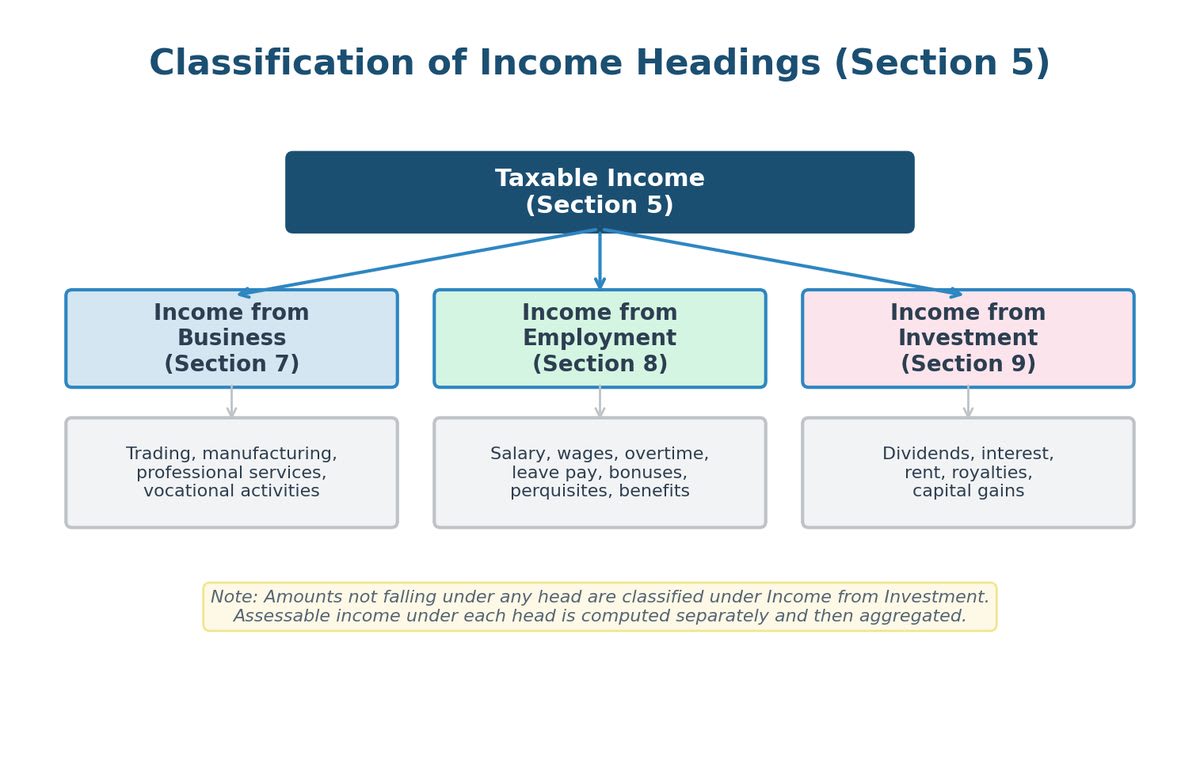
Figure: Classification of Income under Three Headings (Section 5)
The taxable income of any person in any income year shall be equal to the amount computed by subtracting the amount, if any, claimed pursuant to Sections 12, 12A, 12B, 12C, 12D, 63 or all these Sections from the grand total amount of assessable income of each of the following income headings in that income year:-
(a) Business,
(b) Employment,
(c) Investment, and
(d) Windfall gain.
The provisions for computing taxable income are set out in the table below:
Provisions for Computing Taxable Income | |||
Description | Business Income | Employment Income | Investment Income |
Turnover (Inclusions) | Amounts required to be included in income under Section 7 (excluding amounts mentioned in subsection (3)) | Amounts required to be included in income under Section 8 (excluding amounts mentioned in subsection (3)) | Amounts required to be included in income under Section 9 (excluding amounts mentioned in subsection (3)) |
Less - Deductible amounts: | |||
Amounts deductible under Sections 13 to 21 | Deduction claimable | Not applicable | Deduction claimable |
Amounts transferred to risk reserve fund under Section 59(1A)/(1B) | Banking business and cooperative institutions - Deduction claimable | Not applicable | Not applicable |
Amounts claimable under Section 60(2)(b) | General insurance business - Deduction claimable | Not applicable | Not applicable |
Foreign tax paid under Section 71(4) | Claimable as expense where foreign tax credit is not claimed | Claimable as expense where foreign tax credit is not claimed | Claimable as expense where foreign tax credit is not claimed |
Income | Income | Income | Income |
Less - Amounts not to be included in assessable income: | |||
Amounts exempt under Section 11 of the Act | Deduct exempt amounts from income | Not applicable | Deduct exempt amounts from income |
Income of an approved retirement fund not subject to tax under Section 64 of the Act | Deduct exempt amounts from income | Not applicable | Not applicable |
Assessable Income | Assessable Income | Assessable Income | Assessable Income |
Donation amount deductible under Section 12 of the Act | Natural persons and entities - claimable | ||
Expenditure on conservation of natural resources and development of sports under Section 12A of the Act | Only companies - claimable | ||
Contribution to Prime Minister Disaster Relief Fund and Nepal Government Reconstruction Fund under Section 12B of the Act | Natural persons and entities - claimable | ||
Grant of up to Rs. 1 lakh per startup business as seed capital to a maximum of 5 startup businesses (other than related persons) under Section 12C of the Act | Natural persons and entities - claimable | ||
Retirement contribution amount under Section 63 of the Act | Only natural persons - claimable | ||
Taxable Income | |||
A natural person may have income from employment, business and investment heads, while a person other than a natural person (an entity) may only have income from business and investment heads. Where a person has income from more than one income head, the total assessable income of all such income heads for that income year constitutes the assessable income of that taxpayer for that income year. In computing the taxable income for that income year, donations given to tax-exempt institutions, gifts and retirement contributions may be deducted from assessable income of any source.
6. Assessable income
Subject to this Act, the following incomes earned by any person for any employment, business, investment or windfall gain in any income year shall be considered assessable income:-
(a) Income earned by a resident person from his employment, business, investment or windfall gain in that income year irrespective of the place of source of his income, and
(b) Income earned in that income year by a non-resident person from employment, business, investment or windfall gain having income source in Nepal.
Provided that the assessable income shall not include any income exempted from tax pursuant to Section 11 or 64 or both.
See table in Section 5 for better understanding.
Assessable income is the amount remaining after including amounts required to be included in each income head and deducting all permissible expenses, and then reducing that figure by income exempt from tax under Section 11(1) and (2) for agricultural and cooperative business income, and income of approved retirement funds exempt under Section 64(2). Income tax is levied on the worldwide income (Global Income) of a resident person regardless of the source of income, while tax is levied in Nepal on a non-resident person only on income with a Nepal source.