67. Source of income, loss, profit and payment
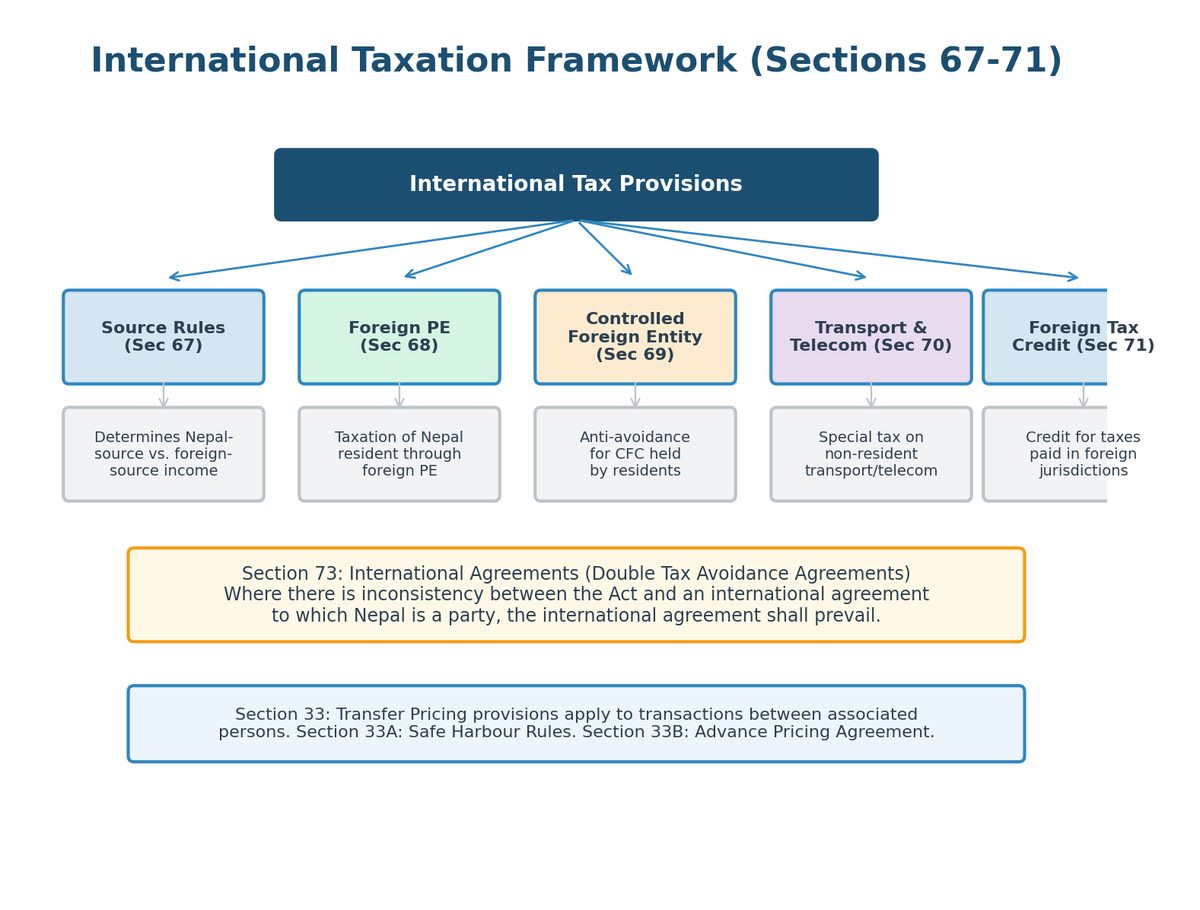
Figure: International Taxation Framework (Sections 67-71)
(1) If, in the source of income earned from any employment, business or investment of any person, the amounts mentioned in clause (a) exceed the amounts mentioned in clause (b), the amounts to the extent of such excess shall be deemed to have source in Nepal:-
(a) The amounts with source in Nepal included in computing the income,
(b) The amounts with source in Nepal deducted in computing the income.
Example 3.3.1: Suppose Ram Preet Singh, a non-resident person, ran a business selling spices at a stall rented at the Dashain fair held at Bhrikuti Mandap during income year 2080/81. He sold spices worth Rs. 10 lakhs at the fair. He incurred total expenses of Rs. 8 lakhs, comprising Rs. 7 lakhs for purchasing the spices sold and Rs. 1 lakh as stall rent. In this situation, the amount to be included in Ram Preet Singh's income is Rs. 10 lakhs, and the expenses incurred to earn such income amounting to Rs. 8 lakhs may be deducted. Since the amount to be included in Ram Preet Singh's income (Rs. 10 lakhs) exceeds the amount deductible as expenses (Rs. 8 lakhs) by Rs. 2 lakhs, those Rs. 2 lakhs are deemed to be income with a Nepal source for Ram Preet Singh.
(2) If the amounts mentioned in clause (a) exceed the amounts mentioned in clause (b) in the loss suffered from any business or investment of any person, the amounts to the extent of such excess shall be deemed to have source in Nepal:-
(a) The amounts with source in Nepal to be deducted in computing the income of the business or investment,
(b) The amounts with source in Nepal included in computing the income.
Example 3.3.2: Suppose Mohammad Hussein, a resident of Lucknow, India, took a stall at the Dashain fair held at Bhrikuti Mandap to sell goats during income year 2080/81. He incurred Rs. 5 lakhs for 100 goats brought to the stall for sale. He paid Rs. 50,000 as rent to the fair organizer for the stall. Because the climate of Lucknow and Kathmandu differed, 20 out of the goats brought from Lucknow died before they could be sold. Mohammad Hussein received income of Rs. 4 lakhs from selling the remaining 80 goats during the fair period. In this situation, the amount to be included in his income is Rs. 4 lakhs, and the deductible expenses comprising the cost of the goats and the stall rent amount to Rs. 5 lakhs 50 thousand. Since the amount deductible as expenses exceeds the amount to be included in income by Rs. 1 lakh 50 thousand, a loss has occurred. This loss of Rs. 1 lakh 50 thousand is deemed to have a Nepal source.
(3) The amounts to be included in computing the income shall be deemed to have source in Nepal in the following circumstances:-
(a) The net profits referred to in clause (c) of sub-section (2) of Section 7 or clause (b) of sub-section (2) of Section 9 to be set by subtracting the loss suffered from the disposal of the asset or liability with source in Nepal from the profit made from the disposal of the asset or liability with source in Nepal,
Section 67(3) addresses the source of gains arising from the disposal of depreciable assets used for earning income from business and investment activities of a person, and the disposal of non-business chargeable assets of a person. Section 67(3) deems income arising from the disposal of an asset or liability with a Nepal source to have a Nepal source.
Example 3.3.3: Suppose Brasil Drill Ltd. is a Brazilian company that constructs tunnels. The company obtained a contract to construct a tunnel with a Nepali company producing hydroelectric power on the Trishuli River in Nepal. To complete the tunnel construction, Brasil Drill Ltd. purchased 10 bighas of land in Muglin for Rs. 10 crores for the purpose of storing construction machinery and materials. The company also took a loan of USD 5 lakhs from GHI Bank of the United Kingdom for purchasing machinery and equipment to be used in the construction work. The company completed the tunnel construction work in income year 2080/81 and also repaid the outstanding loan of USD 5 lakhs to the UK bank in income year 2080/81. The exchange rate at the time of taking the loan was Rs. 60 per US dollar in Nepal, while the exchange rate at the time of repaying the loan in income year 2080/81 was Rs. 70 per US dollar. Since the construction work was completed, the land purchased for storing construction machinery and materials was also no longer required for the company's business use and was accordingly sold in income year 2080/81. The company received Rs. 15 crores from the sale of that land. In this situation, Brasil Drill Ltd. has a gain from the sale of land (a business asset) and a loss from the disposal of a foreign currency loan liability (a business liability).
In the above example, Brasil Drill Ltd. has a gain of Rs. 5 crores from the disposal of land. Upon disposal of the foreign currency loan liability, a payment of Rs. 3 crores 50 lakhs in Nepali rupee equivalent is required for USD 5 lakhs due to currency depreciation, whereas when the loan liability was created, it was recorded in Nepali rupees at only Rs. 3 crores. In this situation, a loss of Rs. 50 lakhs arises upon disposal of the liability. In accordance with Section 67(3) of the Act, the net gain is Rs. 4 crores 50 lakhs, arrived at by deducting the loss of Rs. 50 lakhs on the disposal of the loan (a business liability) from the gain of Rs. 5 crores on the disposal of the land (a business asset). The source of such gain of Rs. 4 crores 50 lakhs is deemed to be Nepal.
Example 3.3.4: Suppose Mr. Ricky is a resident of the Netherlands. He developed software useful for banking operations. He licensed such software to a commercial bank in Nepal for use on a royalty basis of Rs. 1 crore per annum. From the royalty payments received, he purchased shares worth Rs. 1 crore in that same bank in income year 2079/80. Mr. Ricky disposed of those shares in income year 2080/81 by selling them for Rs. 1 crore 50 lakhs, thereby realising a gain of Rs. 50 lakhs. Since Mr. Ricky is a natural person and the gain from the disposal of the shares constitutes income under Section 9(2)(b) of the Act, namely a gain from the disposal of non-business chargeable assets, the gain from the disposal of the shares is deemed to be income with a Nepal source.
(b) If a asset situated in Nepal or a liability to be borne in Nepal is included, the profits and amounts to be included in computing the income as mentioned in clause (d) of sub-section (2) of Section 7 or clause (c) of sub-section (2) of Section 9,
A person engaged in business and investment activities in Nepal holds various assets and liabilities for the purpose of earning income. Such assets and liabilities are disposed of in the course of business or investment. A gain arising upon the disposal of such assets and liabilities is deemed to have a Nepal source.
The amount to be included in respect of depreciable assets is the amount that, where a net gain arises from the disposal of some or all depreciable assets in a depreciable asset pool, is included in the profit and gain of the business in accordance with Schedule 2, Section 4. As mentioned above, where a depreciable asset is located in Nepal, the source of its income or expense is deemed to be in Nepal.
Where there are no assets remaining in a depreciable asset pool at year-end but a depreciation base remains, the remaining amount is deductible as terminal depreciation in accordance with Schedule 2, Section 4(2). Where a negative depreciation base arises regardless of whether assets remain in the pool at year-end, it indicates that income exceeding the cost of the pool has been received, and such negative amount (balancing charge) is computed in accordance with Schedule 2, Section 4(2) and included in the profit and gain of the business in accordance with Section 7(2)(d).
The following example further illustrates the above provisions.
Example 3.3.5: Suppose Brasil Drill Ltd. obtained a contract to construct a tunnel with a Nepali company producing hydroelectric power on the Trishuli River in Nepal. The tunnel construction was completed in income year 2080/81. After the tunnel construction was completed, the company sold all the machinery and equipment used in the tunnel construction in the local market for Rs. 6 crores. The machinery and equipment used in the tunnel construction were classified under Section 1(d) of Schedule 2 of the Act, and the opening depreciation base of that pool for income year 2080/81 was Rs. 5 crores. In this situation, a gain (balancing charge) of Rs. 1 crore arises from the disposal of the depreciable assets of that pool. Such gain (balancing charge) from the disposal of the assets is deemed to be a gain included in the company's income with a Nepal source.
Similarly, if the above-mentioned company received only Rs. 4 crores in total from selling all the machinery and equipment used in the tunnel construction after the construction was completed, a loss of Rs. 1 crore would arise from the disposal of the depreciable assets of that pool. In such a circumstance where the pool is dissolved, the company is entitled to deduct the loss of Rs. 1 crore arising from the disposal of the assets of that pool as an expense in that income year.
(c) Received payments with source in Nepal, subject to clauses (a) and (b).
Other payments received in connection with amounts with a Nepal source to be included in income, as referred to in clauses (a) and (b) of Section 67(3) of the Act, are also deemed to be amounts with a Nepal source to be included in income. The following example further illustrates this provision.
Example 3.3.6: Suppose Brasil Drill Ltd. obtained a contract to construct a tunnel with a Nepali company producing hydroelectric power on the Trishuli River in Nepal. The company insured the machinery used in the tunnel construction with an insurance company located in Brazil. During the tunnel construction, a machine worth Rs. 1 crore was damaged in an accident and became unusable, and the Brazilian insurance company paid compensation therefore. Accordingly, the compensation received from the Brazilian insurance company for a risk with a Nepal source is deemed to have a Nepal source.
(4) If a asset situated in Nepal or a liability to be borne in Nepal is included, the source of profit or loss made or suffered from the disposal of the asset or liability shall be deemed to have source in Nepal.
The following example further illustrates this provision.
Example 3.3.7: Suppose Kalp Lab Pvt. Ltd. is a company producing medicines in Nepal. Mr. Lee from Singapore lent Rs. 1 crore to that company in income year 2079/80 at an annual interest rate of 10 percent. The loan given to the Nepali company is an asset of Mr. Lee with a Nepal source. In income year 2080/81, Kalp Lab Pvt. Ltd.'s financial condition weakened and it decided it could not continue the pharmaceutical manufacturing business, so a decision was made to send the company into liquidation, and a liquidator was appointed to dispose and realise the assets and liabilities and carry out the liquidation. The liquidator disposed of all assets, but the proceeds were insufficient to pay all the company's liabilities. Accordingly, paying on a pro-rata basis in order of payment priority, Mr. Lee received only Rs. 50 lakhs out of the Rs. 1 crore loan he had extended. After receiving Rs. 50 lakhs as payment against the loan he had invested in Nepal, Mr. Lee's asset with a Nepal source (loan investment) is disposed of. Accordingly, the loss of Rs. 50 lakhs arising upon the disposal of the loan investment asset (in accordance with Section 37) is deemed to be a loss with a Nepal source.
A person earning income by conducting business in Nepal incurs various types of expenses. Accordingly, where a person is engaged through a head office, branch, factory, sales outlet, or construction, assembly and installation activities lasting more than 90 days, or for any similar reason, the amounts of expenses incurred in operating the business for the purpose of earning income in Nepal are deemed to have a Nepal source.
(5) If the following amounts are included in the amounts deducted in assessing the income, the source of such amounts shall be deemed to be in Nepal:-
(a) The amount that can be deducted as cost expenditure mentioned in sub-section (1) of Section 15 in respect of the properties situated in Nepal,
(b) The expenses referred to in sub-section (1) of Section 16 in respect of the properties situated in Nepal, and the expenses to the extent allowed to be deducted pursuant to Section 19, and
(c) The payments with source in Nepal, subject to clauses (a) and (b).
The following example further illustrates this provision.
Example 3.3.8: Suppose Brasil Drill Ltd. of Brazil was engaged in constructing a tunnel for the hydroelectric project on the Trishuli River. The company incurred Rs. 10 crores in construction materials for the tunnel construction in income year 2080/81. Depreciation expense on the machinery and equipment used in the construction work amounted to Rs. 1 crore. Repair and maintenance of the machinery and equipment cost Rs. 50 lakhs. Accordingly, the source of expenses such as Rs. 10 crores for consumption of construction materials, Rs. 1 crore for depreciation, and Rs. 50 lakhs for repair and maintenance is deemed to be in Nepal.
(6) The following payments shall be deemed to have source in Nepal:-
Basis 1: Payments made by a resident (Residency Based Payments) - interest, dividends, annuities, investment insurance proceeds, retirement payments and government service.
Basis 2: For payments other than those arising from the disposal of assets and liabilities, where the location of the payment base is in Nepal (Location of Payment-base) - all types of income or expense-determining payments (Sections 7, 8, 9 and 13), other than those determined on the basis of residency.
(a) Dividends paid by a resident entity,
(b) Interest paid by a resident person,
(c) Payment for natural resources made in respect of the natural resource derived from the land situated in Nepal or calculated with reference to such source,
(d) Rent paid for the use of any property situated in Nepal,
(e) Royalty received by any person for having allowed any person to use any property situated in Nepal or for accepting the right to use the property or the restriction on the use of such property,
The following example further illustrates this provision.
Example 3.3.9: Suppose a Nepali film producer authorizes a person to exhibit a film produced in Nepal. The source of the royalty received by the producer for granting such authorization is deemed to be in Nepal.
Example 3.3.10: Suppose the producer in Example 3.3.9 receives any payment from that person on the condition that the film will not be exhibited to anyone other than that person. The source of such payment is deemed to be in Nepal.
(f) Amount for the general insurance paid by any person in respect of insurance against risks in Nepal and premium paid to that person for general insurance,
The following example illustrates this provision.
Example 3.3.11: Suppose an Indian insurance company insured the risk of a factory located in Nepal. The source of the insurance premium paid by that factory to the Indian insurance company is deemed to be Nepal.
(g) Payments received by any person as follows by operating inland, sea or air transport or charter service business in Nepal, except as a result of transshipment:-
(1) The carriage of departing passengers, or
(2) The shipment of mail, livestock or other direct movable property.
Where a person operates an air service in Nepal and transports passengers and cargo, the source of the amount paid to the airline company by passengers departing from Nepal for air travel is deemed to be in Nepal. Similarly, the source of the payment received by an airline company for transporting cargo sent from Nepal is also deemed to be in Nepal. Where an export company in Nepal transports goods being exported by road to the final destination country, the source of the payment received for such transport is Nepal. Where a shipping company sends goods for export from Nepal by sea route via a land route and a port to the destination country, the source of the payment received therefor is also deemed to be in Nepal.
(h) Payments received by a person who carries on a business of dispatching information or news through means of communication such as wire, radio, optical fiber or satellite in respect of dispatch of news or information through networks established in Nepal, irrespective of whether or not such news or information is originated in Nepal
This clause specifically relates to the transmission of information and news. It is difficult to identify the origin of information or news and the person transmitting it. The transmission of such information and news involves not only the transmitter but also the participation of other persons in between. In this situation, it is difficult to ascertain the location of the transmission of information or news. Keeping this difficulty in mind, this provision of the Act deems the source of a payment made for news or information transmitted through installations located in Nepal to be in Nepal. The following example illustrates this provision.
Example 3.3.12: Suppose the Star Africa Channel, which operates in South Africa, is broadcasting a cricket match being played live in that country. The Star Africa Channel authorized Nepal's Fly Cable TV to broadcast the live cricket coverage and make it available to Nepali viewers. Fly Cable TV accordingly provided the service to its subscribers. The source of the payment made by Fly Cable TV to the Star Africa Channel, which holds the rights to broadcast the live cricket match, for the broadcast made using Fly Cable TV's installations established in Nepal, is deemed to be Nepal.
(i) Payments in the following circumstances including service charges of the kinds not mentioned in clauses (g) or (h) for doing employment or rendering service or accepting restriction in those acts:-
(1) Where the acts are carried out in Nepal irrespective of the place of payment, or
(2) Where the Government of Nepal is to make payment irrespective of the place of employment.
This provision of the Act deems the source of a payment received by a person for performing employment or providing services in Nepal to be in Nepal, regardless of where such payment is made. Similarly, where the Nepal Government makes a payment for employment, the source of such payment is deemed to be Nepal even if the employment is performed outside Nepal. The following examples illustrate this provision.
Example 3.3.13: Suppose IMGD of the Netherlands conducted a training program to build the capacity of employees working in Nepal's revenue administration. The Danish Government provided financial support to the program. The company conducted the training for employees in Nepal itself, and the service fee for providing such training was to be paid in the Netherlands. In this situation, since the training activity was conducted in Nepal, the source of the payment received by IMGD for the service fee is deemed to be in Nepal.
Example 3.3.14: The Nepal Government has opened a resident embassy in France. The Nepal Government pays remuneration to the persons employed in that embassy. Even though such persons are working in the embassy located in France, since the Nepal Government is making the payment for employment, the source of such payment is deemed to be in Nepal.
(j) Annuities, amount for investment insurance and retirement payment paid by a resident person which does not fall under clause (i), and any premium or other payment paid to the resident person in order to ensure such amounts,
The following example further illustrates this provision.
Example 3.3.15: Suppose a person retired from employment. During the period of employment, they had been contributing to the Citizens Investment Trust (a resident person). After retirement, the Citizens Investment Trust made a retirement payment to them. In this situation, the source of the retirement payment made by the Citizens Investment Trust is deemed to be in Nepal. In addition, the source of the retirement contributions made by the employer to the Citizens Investment Trust (a resident person) during the period of employment to secure the retirement payment is also deemed to be in Nepal.
(k) Gifts received in respect of a business or investment operated from the asset situated in Nepal, and
The source of gifts received in connection with a business or investment conducted from an asset located in Nepal is deemed to be Nepal regardless of where they are received. The following example further illustrates this provision.
Example 3.3.16: Suppose Fukuda & Co., a Japanese company, has an investment in a botanical garden in Kathmandu. Various types of research on plants and trees are also conducted at the botanical garden. For making a notable contribution to research on plants and trees in Nepal, Fukuda & Co. received a gift of 1 million Japanese yen in Japan from the Botanical Association of Japan. The source of such gift received in connection with the business in Nepal is deemed to be Nepal.
(l) The following payments except those mentioned in clauses (a), (b), (c), (d), (e), (f), (g), (h), (i), (j) and (k) above:-
(1) Payments made in respect of disposal of the property situated in Nepal or in respect of acquiring liability to be borne in Nepal, or
(2) Payments made in respect of activities carried out in Nepal.
Clauses (a) through (k) of Section 67(6) of the Act enumerate various types of payments with a Nepal source. In addition to the above types of payments, the source of payments for all activities (business or investment) conducted in Nepal is also deemed to be in Nepal. Similarly, the source of any payment made upon the disposal of any asset located in Nepal or upon acquiring any liability is also deemed to be in Nepal. The following example further illustrates this provision.
Example 3.3.17: Suppose Fukuda & Co., mentioned in Example 3.3.16, sold its share investment in the botanical garden to another Japanese company. The source of such shares sold by Fukuda & Co. is deemed to be Nepal, and the source of the income received from such sale, computed in accordance with Section 36, is also deemed to be Nepal.
(7) Any income, loss, amount, profit or payment other than the one deemed to have source in Nepal as mentioned in the above sub-sections shall be deemed to have foreign source, and the references to Nepal given in this Act shall be applicable as if they were used in the case of any particular foreign country for the purposes of ascertaining in which country such income, loss, amount, profit or payment has source.
Income, loss, amounts, gains and payments not mentioned in subsections (1) through (6) are deemed to have a foreign source. Such amounts deemed to have a foreign source are attributed to the source country using the same basis by which they would be deemed to be a Nepal source if they were in Nepal. For instance, just as income received from an asset located in Nepal is deemed to have a Nepal source, income received from an asset located in Japan is deemed to have a Japan source.
Section 67(1) through (6) of the Act provides for circumstances where Nepal is deemed to be the source, while all other circumstances are deemed to have a foreign source. The following example further illustrates this.
Example 3.4.1: Suppose Diwakar Thapa, a Nepali citizen, is a resident of Canada and has been conducting business there. He has earned income from business conducted in Canada and other countries other than Nepal, and the source of such income is not deemed to be Nepal.
Explanation: For the purposes of this Section,-
(a) "Asset situated in Nepal" means the land or buildings situated in Nepal and the asset other than land or building of a resident person situated in any foreign country, or if the person is associated with a controlled foreign entity pursuant to Section 69, inclusive of his interest in that entity.
Example 3.4.1a:
Suppose Durga Sapkota is a Nepali resident person who has obtained permanent residency in Canada. He also has a house and land in Canada. For the past 4 years, he has been residing in Nepal and conducting business. He also has a house, land and shares in various companies in Nepal. In addition, he has an investment in the shares of certain Canadian companies. In this situation, the house and land of Durga Sapkota in Canada are not deemed to be assets with a Nepal source, whereas his house and land in Nepal, the interest attributable to the shares in Nepali companies, and the interest attributable to the shares in Canadian companies are deemed to be assets with a Nepal source, i.e., asset situated in Nepal.
(b) "Liability to be borne in Nepal" means the liability of a resident person created from activities carried out in Nepal.
Liabilities to be borne in Nepal refers to liabilities that a resident person is required to bear. For example, liabilities payable in Nepal or abroad for goods or services purchased by a resident person, and loan amounts borrowed from Nepal or abroad, may be included. The following example further illustrates this.
Example 3.4.2: Suppose Golden Investment Inc., USA extended a loan investment of USD 1 lakh to Sunakhadi Pvt. Ltd., a resident company. The source of the interest payment (income) to be paid by Sunakhadi Pvt. Ltd. to Golden Investment Inc., USA is deemed to be Nepal.
Example 3.4.3: Suppose Diwakar Thapa, a Nepali citizen, is a resident of Canada and has been conducting business there. He took a personal loan of Rs. 1 crore from a bank in Nepal. Since he was unable to repay the loan, the bank wrote off Rs. 10 lakhs and settled his loan. Since Diwakar Thapa disposed of a liability of Rs. 1 crore located in Nepal for Rs. 90 lakhs, a saving (income) of Rs. 10 lakhs arose, and the source of such income is deemed to be Nepal.
Source of income (Sec 67): Nepal-source income/loss = Nepal-source inclusions − Nepal-source deductions (67(1)/(2)); gains/profits on disposal of asset situated in Nepal or liabilities borne in Nepal = Nepal source (67(3)/(4)/(5)).
67(6) PAYMENTS deemed Nepal source: dividends/interest paid by a resident; rent, royalty & natural-resource payments for Nepal asset; general insurance of a Nepal risk; transport/charter of passengers/cargo departing Nepal; communications via Nepal networks; payment for employment/services performed in Nepal (or paid by GoN wherever performed); annuities, investment-insurance & retirement payments by a resident; gifts re a Nepal business/investment; and any payment for disposing Nepal asset or for activities carried out in Nepal.
67(7): anything not deemed Nepal source is FOREIGN source (assigned to the foreign country by the same tests).
'Asset situated in Nepal' = Nepal land/buildings + a resident's movable asset anywhere + an interest in a Sec 69 controlled foreign entity
‘Liability to be borne in Nepal’ = liability of a resident person created from activities carried out in Nepal.
68. Foreign permanent establishments
Refer Section 2(aab) for detailed understanding of Permanent establishment.
A foreign permanent establishment is a place outside the country of residence where a non-resident person carries on business in Nepal.
For tax purposes, a foreign permanent establishment is treated as an independent entity from its parent company. Amounts invested in a permanent establishment are treated as equity of that establishment. Only expenses directly related to the establishment's business are treated as its expenses; however, indirect expenses incurred by the parent company allocated per Section 33 up to that allocation are treated as expenses of the establishment. Transactions (purchases, transfers, or payments) between the permanent establishment and the parent company or associated persons must be at arm's length, and withholding tax and other tax treatment apply to transactions with the parent company the same as to transactions with other independent parties.
(1) Notwithstanding anything contained in Section 3, any foreign permanent establishment of a non-resident person situated in Nepal shall be liable to pay tax payable on the income of such establishment, subject to other provisions of this Act.
Section 3 of the Act sets out the following bases for levying income tax: (a) a person with taxable income in any income year; (b) a foreign permanent establishment located in Nepal of a non-resident person that remits income abroad in any income year; and (c) a person who receives payments with final advance tax withholding in any income year. Income of the person under clause (a), whether sourced in Nepal, abroad, or both countries, is subject to tax, while under clauses (b) and (c) only income sourced in Nepal is subject to tax. This provision places the tax payment obligation for income from the foreign permanent establishment's Nepal operations on the foreign permanent establishment itself.
Example 14.2.5: Suppose Dare Devil Inc. from Spain is a company that provides entertainment through adventure activities. The company operates a branch in Nepal providing Sky Jump entertainment to Nepali people and foreign tourists visiting Nepal. In income year 2080/81, Dare Devil Inc.'s Nepal branch earned taxable income of Rs. 1 crore. Since Dare Devil Inc. is a foreign entity and operates in Nepal through a branch, that branch constitutes a foreign permanent establishment under the Nepal Income Tax Act. The tax obligation on taxable income in FY 2080/81 rests not with Dare Devil Inc. in Spain but with the branch in Nepal. Dare Devil Inc.'s Nepal branch must pay tax on such income at the same rate as a domestic company. In addition, the obligation to file tax on income remitted to Spain also rests with the branch office.
(2) The income of a person having ownership of a foreign permanent establishment shall be separated from the income of that establishment pursuant to Section 69.
If a foreign entity's permanent establishment in Nepal conducts taxable transactions and earns income, and a Nepali resident has an interest in that foreign entity, the proportional amount corresponding to the Nepali resident's interest must be separated from the full income of the foreign permanent establishment.
Example 14.2.6 (INCORRECT IN DIRECTIVE) : Suppose Timilaa Construction Company Pvt. Ltd., a resident company of Nepal, holds 60% of the shares in Daso Construction Company Ltd., a company incorporated in Bhutan. Since Timilaa Construction Company controls Daso Construction Company, Daso is a Controlled Foreign Entity (CFE) under Section 69 of the Income Tax Act.
During an income year, Daso Construction Company undertakes a construction contract in Bhutan and earns:
Particulars | Amount (Rs.) |
Contract Revenue | 5,00,00,000 |
Deductible Expenses | 4,00,00,000 |
Net Profit | 1,00,00,000 |
Under Section 69, Timilaa Construction Company must include in its income the portion of Daso's attributable income corresponding to its ownership interest: 1,00,00,000×60%=60,00,000
Therefore, Rs. 60 lakh shall be included in Timilaa Construction Company's income for that income year, regardless of whether any dividend has actually been distributed. After paying 25% tax on income of NPR 10 million, the remaining NPR 7.5 million when repatriated to the parent company in Bhatrun, only NPR 3 million shall be treated as income remitted abroad.
Subsequent Distribution
Assume that in a later year Daso distributes its entire after-tax profit.
If Bhutan corporate tax is 25%:
Particulars | Amount (Rs.) |
Profit before tax | 1,00,00,000 |
Tax @ 25% | 25,00,000 |
Profit after tax | 75,00,000 |
Timilaa's share of the distributable profit: 75,00,000×60%=45,00,000. Accordingly, Timilaa receives a dividend of Rs. 45 lakh.
Since Timilaa has already been taxed on the attributed income under Section 69, the dividend is dealt with under the Act's provisions preventing double taxation of previously attributed CFE income.
(3) Tax shall be imposed on the permanent establishment referred to in clause (b) of Section 3 in the income sent abroad by the foreign permanent establishment of a non-resident person situated in Nepal.
Section 3 of the Act provides for levying tax on a foreign permanent establishment located in Nepal of a non-resident person for income remitted abroad by such establishment. Section 68(1) provides that the foreign permanent establishment is taxed like a company on income from business operations. Since a permanent establishment is not registered under the Companies Act or other laws of the country, it does not distribute income as dividends, and income earned from business operations is repatriated to the home country of the parent entity. Tax is levied on such repatriated income under this section.
Example 14.2.7: Suppose Buloski Construction Company from Italy is a road construction company. It received a road construction contract in Nepal. In FY 2080/81, it completed road construction work over 9 months under the contract. Since the company was engaged for 9 months, it qualifies as a permanent establishment under Nepal's law. The company earned taxable income of Rs. 1 crore. Since the company is a foreign permanent establishment, it must pay Rs. 25 lakh as corporate income tax at 25 percent. After paying Rs. 25 lakh corporate income tax, the remaining Rs. 75 lakh remitted to the company's head office abroad is treated as income remitted abroad by the foreign permanent establishment, and tax at 5 percent under Schedule-1, Section 2(6) of the Act must be paid on such income. When remitting all Rs. 75 lakh, the 5 percent tax of Rs. 3.75 lakh must be deducted and only Rs. 71.25 lakh may be remitted.
(4) The income sent abroad in any income year by the foreign permanent establishment of a non-resident person situated in Nepal shall be equal to the amount of dividends distributed by that foreign permanent establishment in that year.
If a foreign permanent establishment of a non-resident person located in Nepal remits income earned from Nepal operations abroad to a non-resident entity, such repatriated income is treated the same as dividends paid by an associated resident entity to another non-resident entity. However, for repatriated income, tax is levied under Section 3(b) and the applicable rate is specified in Schedule-1, Section 2(6). Since the source of dividends paid by associated entities is in Nepal under Section 67(6)(a), advance tax withholding under Section 88(2)(a) applies to such dividends; but for income remitted abroad by the foreign permanent establishment, tax is levied at 5 percent under Schedule-1, Section 2(6) and the obligation rests with the foreign permanent establishment itself.
Example 14.2.8: Suppose the Indian company Kasmir Insurance Company has established a branch office in Nepal and has been conducting general insurance business in Nepal. The company earned income of Rs. 1 crore from general insurance operations in Nepal in FY 2080/81. The branch paid Rs. 30 lakh as corporate income tax at Nepal's corporate rate on that income, and of the remaining Rs. 70 lakh, Rs. 50 lakh was remitted to its head office in India. On such remitted income, the Nepal branch must file Rs. 2.5 lakh (5 percent of Rs. 50 lakh) as tax under Schedule-1, Section 2(6).
Foreign permanent establishment (Sec 68): a non-resident's place of business in Nepal, taxed as a SEPARATE resident entity. Four PE types: (1) FIXED-PLACE - branch, factory, office, mine, farm etc. (no minimum duration); (2) AGENCY - a dependent agent who habitually concludes contracts for the non-resident (an independent agent is not a PE); (3) SERVICE - own employees/representatives present 90+ days in any rolling 12-month (365-day) period; (4) CONSTRUCTION/INSTALLATION - site present 90+ continuous days.
The PE pays tax on its Nepal income at the company rate (68(1)); income then remitted abroad is a deemed dividend taxed at 5% (Schedule 1, Sec 2(6)), payable by the PE itself (68(3)/(4))
69. Controlled foreign entities
A controlled foreign entity means a non-resident entity in which a resident person has a direct interest or an indirect interest through one or more intermediary non-resident entities in any income year, and that person is associated with the entity, or if that person and their associated persons together with any other up to four resident persons are associated with such entity. In other words, a foreign company, trust, or partnership in which a Nepali resident holds more than 50 percent ownership or interest through income, capital, or voting rights is a controlled foreign entity.
Example 14.3.1: Suppose Sagarmatha Company Ltd. is a Nepali resident company. The company holds 70 percent share ownership in MountFuji Company Pvt. Ltd. in Japan. Since Nepali resident Sagarmatha Company Ltd. has a direct interest in and control over MountFuji Company Pvt. Ltd., MountFuji Company Pvt. Ltd. is a controlled foreign entity controlled by the Nepali resident.
Example 14.3.2: Suppose Koshi Company Ltd. is a Nepali resident company. The company has invested in preference shares with priority profit-sharing rights in Askari Group of Companies Pvt. Ltd. in Pakistan. The share agreement provides that 70 percent of the company's income from the preference shares belongs to Koshi Company. Since the Nepali resident has direct income control over Askari Group of Companies Pvt. Ltd., that company is a controlled foreign entity controlled by the Nepali resident.
Example 14.3.3: Suppose Mechi Company Ltd. is a Nepali resident company. The company has invested in 40 percent ordinary shares in a company in Pakistan. The class of shareholders has the right in the company's articles to appoint 4 out of 7 directors. Since the Nepali resident has direct operational control, that company is a controlled foreign entity controlled by the Nepali resident.
Example 14.3.4: Suppose MountFuji Company Pvt. Ltd. mentioned in Example 14.3.1 above is a non-resident company but is controlled by a Nepali resident. MountFuji Company Pvt. Ltd. holds 80 percent share ownership in Nippon Pvt. Ltd. in Japan. Since Nepali resident company Sagarmatha Company Ltd. indirectly controls Nippon Pvt. Ltd. through its associated entity, Nippon Pvt. Ltd. is also a controlled foreign entity. Control in Nippon Company by the Nepali resident through its associated entity amounts to 56 percent (70 percent of 80 percent), making it a controlled foreign entity.
Example 14.3.5: Suppose A, B, C, D, E, and F are Nepali residents. They each hold 10 percent ownership in ABC Company in Japan. Although they collectively hold 60 percent ownership at 10 percent each, since the company is controlled by more than 4 persons, it is not treated as a controlled foreign entity controlled by Nepali residents.
If a foreign entity in which a resident person has invested qualifies as a controlled foreign entity, such an entity is treated as a Nepali resident entity for purposes of the Income Tax Act, 2058. Income returns must be prepared according to Nepal's income year regardless of the tax year of the country where such entity is located. Business income or investment income is determined under the Income Tax Act, 2058, and income computed for Nepal's income year period is called attributed income in relation to the controlled foreign entity.
Example 14.3.6: Suppose Sagarmatha Ltd. is registered in Nepal and holds 70 percent share ownership in MountFuji Company Pvt. Ltd. in Japan. MountFuji Company Pvt. Ltd. is a controlled foreign entity of Sagarmatha Ltd. MountFuji Company earned business income of Rs. 1 crore from its business in income year 2080/81. The taxable income computed under the Income Tax Act, 2058 for Nepal's income year is the attributed income of MountFuji Company Pvt. Ltd. The income attributable to Nepali company Sagarmatha Ltd. from this entity is Rs. 70 lakh being 70 percent of the attributed income, constituting Sagarmatha Company's Japan-source income.
(1) If any entity distributes dividends of the associated income earned in any income year as a controlled foreign entity at the end of the income year, it shall be deemed to have distributed dividends in proportion to its beneficiaries, as follows:-
(a) As per the rights of the beneficiaries to the income in distributing dividends, or
(b) If the rights are not determinable in a reasonable manner, as per the method which the Department thinks proper according to the circumstance.
The Act provides for including a proportional amount based on the resident person's interest in the attributed income of a controlled foreign entity in income. Even if the controlled foreign entity has not distributed dividends to its beneficiaries, it is treated as if dividends were distributed, and the amount arising from such person's right must be included in the person's income. Since the resident person has a decisive right in the controlled foreign entity, the Act makes this special provision to prevent deferring tax obligations by not including income earned in such entities in Nepal's income.
Example 14.3.7: Suppose the directly controlled foreign entity of Nepali company Sagarmatha Ltd. is Annapurna Company Pvt. Ltd. in Japan, and the indirectly controlled foreign entity is Kanchenjunga Pvt. Ltd. In income year 2080/81, per the Income Tax Act, 2058, Annapurna Company has income of Rs. 1 crore. Similarly, Kanchenjunga Pvt. Ltd. also has income of Rs. 1 crore in that year. Since Annapurna Company and Kanchenjunga Pvt. Ltd. are controlled entities of Sagarmatha Ltd. Nepal, the income of these entities in FY 2080/81 is attributed income of Sagarmatha Nepal. Sagarmatha Nepal is treated as having received dividends as follows: since Sagarmatha holds 70 percent shares in Annapurna Company, the attributed income proportional to share ownership is Rs. 70 lakh; since Annapurna Company holds 80 percent shares in Kanchenjunga Pvt. Ltd., Sagarmatha Company's effective proportion is 56 percent (70% x 80%), so the proportional amount is Rs. 56 lakh. Nepali company Sagarmatha Ltd.'s total attributed income from directly and indirectly held controlled foreign entities: Rs. 70 lakh + Rs. 56 lakh = Rs. 1.26 crore as Japan-source income. Sagarmatha Ltd. must include Rs. 1.26 crore as income received from controlled foreign entities in its income return for FY 2080/81.
(2) Tax shall not be levied on the dividends distributed by an entity as a controlled foreign entity at the end of any income year except those distributed pursuant to sub-section (1).
Since a resident person has already included the attributed income of the controlled foreign entity proportionally in their income return for the same year, when the controlled foreign entity later distributes dividends, the resident person need not include such dividend amount in income again.
Example 14.3.8: Suppose Nepali resident company Sagarmatha Ltd. holds 70 percent shares in MountFuji Company Pvt. Ltd. registered in Japan. MountFuji Company Pvt. Ltd. distributed dividends of Rs. 50 lakh out of the FY 2079/80 attributed income of Rs. 1 crore to its beneficiaries in FY 2080/81. Sagarmatha Nepal Ltd. received Rs. 35 lakh of the distributed dividend based on its share ownership (70 percent in MountFuji Company). Since Sagarmatha Ltd. already included the amount based on its interest in the controlled foreign entity in its income return for FY 2079/80 and filed tax, in FY 2080/81 the amount received as dividends from the controlled foreign entity need not be included in income.
(3) The following shall be deemed to have occurred in respect of the dividends distributed by a controlled foreign entity pursuant to sub-section (1) to the beneficiaries associated with that entity at the time of distribution of dividends:-
(a) Having the characteristic equivalent to the type and source of the associated income of that entity, and
(b) Having distributed proportionately out of each type and source of the associated income of that entity.
Simple Explanation- Section 69(3)
When a CFE distributes dividends to its shareholders:
a. The dividend is treated as having the same character as the underlying income from which it was derived.
b. The dividend is deemed to come proportionately from all categories of the CFE's income, not from just one category chosen by the taxpayer.
Example 1
Suppose a CFE earns:
Income Type | Amount (Rs.) |
Business Income | 60 lakh |
Interest Income | 20 lakh |
Capital Gain | 20 lakh |
Total | 100 lakh |
The CFE distributes a dividend of Rs. 50 lakh.
Under Section 70(3)(b), the dividend is deemed to be distributed proportionately from each income source:
Income Type | Share | Dividend Portion |
Business Income | 60% | 30 lakh |
Interest Income | 20% | 10 lakh |
Capital Gain | 20% | 10 lakh |
Total Dividend | 100% | 50 lakh |
Effect of Clause (a)
The dividend portions retain the same character as the underlying income:
Dividend Portion | Character |
Rs. 30 lakh | Business Income |
Rs. 10 lakh | Interest Income |
Rs. 10 lakh | Capital Gain |
Thus, the shareholder is deemed to receive a dividend that consists of different income types rather than a single generic dividend.
Why is this rule needed?
Without this provision, taxpayers could argue:
"The dividend came only from income that has already been taxed or from a favorable source."
The law prevents such cherry-picking by requiring the dividend to be traced proportionately to all underlying income pools.
(4) Any tax paid by any controlled foreign entity including that deemed to have been paid pursuant to sub-section (5) or sub-section (5) of Section 52 in respect of the amounts deemed to be distributed pursuant to sub-section (3) shall be set aside for the beneficiary associated with that entity.
This provision grants the controlling resident persons of a controlled foreign entity foreign tax credit benefits. The corporate income tax paid by the controlled foreign entity in the country where it is located must be credited against the tax payable when earning corporate income. The amount equal to the tax on dividends must be given as an exemption to the beneficiary proportionally based on the dividends deemed to have been received.
Example 14.3.9: Suppose Nepali resident company Sagarmatha Ltd. holds 70 percent shares in MountFuji Company Pvt. Ltd. registered in Japan. MountFuji Company distributed dividends of Rs. 35 lakh to Sagarmatha Nepal in FY 2080/81. The company's attributed income was Rs. 1 crore and corporate tax paid for that year was Rs. 29 lakh. MountFuji Company Pvt. Ltd. is a Japan-based company and Japan's income tax law requires 10 percent advance tax withholding on dividend payments. In this case, the advance tax withheld from dividends distributed by MountFuji Company and the proportional corporate tax amount are treated as amounts eligible for the tax credit under Section 71.
(5) The tax set aside pursuant to sub-section (4) at the time of allocation shall be deemed to have been paid by the beneficiary, and the beneficiary may get facility of tax adjustment for such tax as provided for in Section 71.
For purposes of this Act, foreign income tax paid under sub-section (5) and tax filed by any person, whether by the beneficiary or the entity, is treated as filed by the entity.
(6) The amount deemed as distributed to the beneficiary pursuant to sub-section (1), at the time of distribution shall be included in the expenses for any asset or liability of the recipient beneficiary in the entity making such distribution.
The Act provides for including a proportional amount of attributed income of a controlled foreign entity in income. This creates a temporary tax difference: income is taxed before receipt, but when income is actually received, tax is not levied again. Sections 69(6) and (7) eliminate such differences by adjusting the cost base of the interest held.
Example 14.3.10: As mentioned in Example 14.3.7 above, Nepali company Sagarmatha Ltd.'s directly controlled foreign entity Annapurna Company's FY 2080/81 attributed income under Section 69(1) is Rs. 70 lakh, and the proportional amount of attributed income of the indirectly held controlled foreign entity Kanchenjunga Pvt. Ltd. included in income is Rs. 56 lakh, totalling Rs. 1.26 crore to be included in Sagarmatha Ltd.'s income. This total amount of Rs. 1.26 crore must be included as expenditure (outgoing) for the interest held in MountFuji Pvt. Ltd.
(7) The dividends distributed to the beneficiary enjoying tax exemption pursuant to sub-section (2) at the time of distribution shall be included in the income for any asset or liability of the recipient beneficiary as an interest in the entity making such distribution.
Example 14.3.11: As mentioned in Example 14.3.7 above, Sagarmatha Ltd. received Rs. 35 lakh as dividends from the controlled foreign entity MountFuji Pvt. Ltd. in FY 2080/81. Under sub-section (2), Sagarmatha Ltd. must include the Rs. 35 lakh received as income (incoming) for the asset of the related controlled foreign entity.
Reading Section 69(6) and 69(7) together
Reading Section 69(6) and 69(7) together
Situation | Tax Treatment |
Section 69(6) | Previously attributed income increases the cost base of the interest in the CFE. |
Section 69(7) | Dividends later received out of that previously attributed income reduce that cost base (or are included in income from the interest). |
The translation of Section 69(7) is somewhat awkward, but its purpose is clear: to reverse the adjustment made under Section 69(6) when the profit is actually distributed.
Example
Year 1
Nepal Co. owns 60% of Foreign Co. (CFE).
Foreign Co. earns profit = Rs. 100 lakh.
Under Section 69: Rs. 60 lakh is attributed to Nepal Co. and taxed in Nepal.
Effect of Section 69(6)
Cost of shares = Rs. 200 lakh
Add attributed income: 200+60=260lakh
Adjusted cost base = Rs. 260 lakh
Year 2
Foreign Co. distributes dividend. After foreign tax, Nepal Co. receives dividend = Rs. 45 lakh.
Since this dividend relates to income that was already attributed under Section 69, it is exempt from further taxation under Section 69(2). However, if nothing further happened, Nepal Co. would still retain the additional Rs. 60 lakh in its cost base.
That would result in a double benefit:
Income already taxed → cost base increased.
Dividend received tax-free. Cost base remains inflated.
Effect of Section 69(7)
The exempt dividend reduces the previously increased cost base.
Particulars | Rs. lakh |
Cost base after 69(6) | 260 |
Less: Exempt dividend received | 45 |
Revised cost base | 215 |
Thus, the earlier upward adjustment is gradually reversed as profits are actually distributed.
(8) For the purposes of this Act, the foreign income tax paid or foreign income tax deemed as paid by any controlled foreign entity pursuant to sub-section (5) or sub-section (5) of Section 52 shall be deemed as tax amount paid by that entity or deemed to be paid by that entity pursuant to this Act.
Explanation: For the purposes of this Section,-
(a) "Associated income" means, in computing the taxable income of any controlled foreign entity in any income year, a taxable income computed as if that entity were a resident entity.
(b) "Controlled foreign entity" means any non-resident entity in which any resident person has interest directly or indirectly through one or more interposed non-resident entities in any income year; and where that person is associated with that entity, or where any person deemed to be associated with that person and any other resident persons not exceeding four persons are associated with that entity, it includes such entity, as well.
Controlled foreign entity / CFE (Sec 69): a non-resident entity is a CFE if a resident - alone, or with associates and up to 4 other residents - controls it (over 50% of income, capital or voting rights; direct or indirect through intermediaries).
Anti-deferral: the CFE's ATTRIBUTED income (computed under Nepal rules for Nepal's income year) is deemed distributed to the resident in proportion to interest and taxed NOW, even if no actual dividend is paid (69(1)).
When the CFE later actually distributes that income, it is NOT taxed again (69(2)).
Indirect control multiplies through the chain (e.g. 70% × 80% = 56%).
NOT a CFE if controlled by more than 5 residents (e.g. 6 residents at 10% each).
Foreign corporate tax and dividend WHT paid by the CFE are creditable to the resident under Sec 71 (69(4)/(5))
70. Tax chargeable on non-resident person providing water transport, air transport or telecommunications service in Nepal
Section 67(6)(g) of the Act provides that payments received by a non-resident person from operating water transport, charter services, or air transport in Nepal constitute Nepal-source income. Similarly, Section 67(6)(h) provides that payments received by a non-resident person operating cross-border data transmission business in Nepal through telegraph, radio, optical fibre, or satellite communication constitute Nepal-source income. A special provision makes the tax rate and taxable income computation for such persons different from that for other business income. For purposes of this section, 'non-resident person' means a resident entity within a group of associated entities whose main office is outside Nepal. In this context, even if a water transport, charter service, or air service operator has established an office in Nepal or appointed an authorised sales agent, for purposes of this section they are treated as non-resident persons rather than having a Nepal permanent establishment.
(1) The taxable income of any non-resident person who operates water traveling/rafting, charter service or air transport in any income year shall consist of the amounts derived from the following acts except the amounts derived from transshipment in that year:-
(a) Carriage of passengers departing from Nepal, or
(b) Carriage of the mail, animals or goods dispatched from Nepal.
If an airline uses Nepal's airport as a transit point, payments made by transit passengers need not be included in the airline's Nepal-source income for this section's purposes. Similarly, freight received for goods transported from another country to Nepal's airport and then to another destination also need not be included. Only the amount received for transporting passengers who originate from Nepal and the amount received for transporting goods dispatched from Nepal constitute income to be included. The same applies to water transport and charter services.
Example 14.4.1: Suppose Gold Airways registered in Saudi Arabia operates air services between Kathmandu and Riyadh. The airline has opened a branch to manage air transport operations in Kathmandu. The airline's income from air service operations and other activities in Shrawan 2080 was as follows:
Item | Amount (Rs.) |
1. Amount received for passengers departing from Kathmandu | 1,00,00,000 |
2. Amount received for cargo originating from Kathmandu | 50,00,000 |
3. Amount received from passengers transiting Kathmandu from Bhutan and Lhasa | 50,00,000 |
4. Freight for cargo arriving from Bhutan and transiting Kathmandu | 50,00,000 |
5. Revenue from restaurant operated at Kathmandu airport for air travellers | 50,00,000 |
6. Revenue from ground services provided to other airlines | 25,00,000 |
Total income | 3,00,00,000 |
Includable per Section 70(1): | |
1. Passenger transport from Kathmandu | 1,00,00,000 |
2. Cargo originating from Kathmandu | 50,00,000 |
Total includable per Section 70(1) | 1,50,00,000 |
The amounts includable for Gold Airways in Shrawan per this section are as per the table above (items 1 and 2 totalling Rs. 1,50,00,000). This includable income is the taxable income of that airline per Section 70(1), and per Section 70(3) no expenses related to computing such amounts may be deducted when computing such taxable income. Tax at 5 percent per Schedule-1, Section 2, sub-section (7) applies to the taxable income computed in this manner.
In the above example, the Rs. 50,00,000 received from passengers transiting Kathmandu from Bhutan and Lhasa and the Rs. 50,00,000 freight for cargo arriving from Bhutan and transiting Kathmandu need not be included in the airline's income per this section. Similarly, Rs. 50,00,000 from the restaurant operated at Kathmandu airport for air travellers and Rs. 25,00,000 from ground services provided to other airlines must be computed as regular business income and tax paid at 25 percent on the resulting taxable income.
(2) The taxable income of any non-resident person who carries on a business of cable, radio, optical fiber or satellite communication in any income year shall consist of the amounts derived from the dispatch of news or information through any device established in Nepal, whether originated in Nepal or not.
Example 14.4.2: Suppose Super Star TV Network is a non-resident entity. The network has installed equipment in Kathmandu to broadcast all of its programmes to Nepali viewers. It transmits its programmes to Nepali TV cable operators through such installed equipment and collects a fixed amount as a toll from TV cable networks for such transmission. The amounts received by Super Star TV Network from TV cable operators must be included as income for this section's purposes. Tax at 5 percent under Schedule-1, Section 2(7) applies to the taxable income computed in this manner.
Example 14.4.3: Suppose HSBC Nepal Bank Limited is a resident bank within the HSBC banking network. The bank has connected a device at its office to transmit information to all banks in the HSBC network. Information flows to all banks in the HSBC network through such device. Since the device is connected in Nepal, the amount received or deemed received by the HSBC group is subject to tax in Nepal under Section 70(2).
(3) Tax shall be levied on the amounts to be included in the taxable income of any non-resident person pursuant to sub-section (1) or (2) at the rate specified in sub-section (7) of Section 2 of Schedule-1.
Provided that
(a) Those amounts need not to be computed in computing the tax payable in respect of any due taxable income of that person,
(b) The expenses related with the computation of those amounts shall not be allowed to be deducted in computing that due taxable income, and
(c) That person shall not be entitled to any facility of tax adjustment from the amount of tax payable by that person pursuant to this Section.
A special rate of tax applies to non-resident persons earning income from water transport, charter services, air transport, and telegraph, radio, optical fibre, or satellite communication businesses in Nepal. Tax at 5 percent under Schedule-1, Section 2(7) applies on gross income. Since expenses related to earning such income cannot be deducted, the gross income is itself the taxable income. If such a person has income beyond that included under sub-sections (1) and (2), that additional income must be computed together with other regular business income, and no expense related to sub-section (1) and (2) income may be deducted when computing other income.
Example 14.4.4: Suppose Gold Airways operates air services between Kathmandu and Riyadh. The airline has opened a branch to manage air transport operations in Kathmandu. The airline's income from air service operations and other activities in Shrawan 2080 was as follows:
1. Amount received for passengers departing from Kathmandu | Rs. 1,00,00,000 |
2. Amount for cargo originating from Kathmandu | Rs. 50,00,000 |
3. Amount received from passengers transiting Kathmandu from Bhutan and Lhasa | Rs. 50,00,000 |
4. Freight for cargo arriving from Bhutan, transiting Kathmandu, and departing from Kathmandu | Rs. 50,00,000 |
5. Revenue from restaurant operated at Kathmandu airport for air travellers | Rs. 25,00,000 |
6. Revenue from ground services provided to other airlines | Rs. 25,00,000 |
Total income | Rs. 3,00,00,000 |
Gold Airways incurred the following expenses to earn the above income | |
7. Air ticket expenses | Rs. 50,00,000 |
8. Crew hotel and food expenses | Rs. 50,00,000 |
9. Ground service operation expenses | Rs. 30,00,000 |
10. Restaurant operation expenses | Rs. 20,00,000 |
11. Expenses for passengers from Bhutan and Lhasa | Rs. 50,00,000 |
12. Re-shipping expenses for cargo arriving from Bhutan | Rs. 50,00,000 |
Total expenses | Rs. 2,50,00,000 |
Note: Gold Airways managed ground handling for its own 100 flights and another 100 flights of other airlines, totalling 200 flights in that FY.
For the above example, the income to be included for the non-resident person for Section 70 purposes, other income, and deductible expenses are as follows:
1. For Section 70 purposes, Gold Airways' Shrawan income per items (1) and (2) is Rs. 1,50,00,000 only. Tax at 5 percent per Schedule-1, Section 2, sub-section (7) amounts to Rs. 7,50,000 on such income.
2. Income per items (3) and (4) of Rs. 1,00,00,000 is not Nepal income and thus not subject to tax under the Income Tax Act, 2058.
3. Gold Airways' income per items (5) and (6) is not income per Section 70 and must be computed as regular business income and corporate tax applies at the applicable rate.
4. When computing Gold Airways' income per items (5) and (6), expenses incurred to earn that income may be deducted.
5. Among expenses, items (7), (8), and (9) - ground handling expenses for own air services - are expenses for Section 70 purposes but cannot be deducted from Section 70 income.
6. Expenses in items (11) and (12) are for income that is not subject to income tax in Nepal and thus cannot be deducted.
7. Expenses incurred to earn income per items (5) and (6) - half of ground service operation expenses Rs. 15,00,000 and restaurant operation expenses Rs. 20,00,000, totalling Rs. 35,00,000 - may be deducted.
8. Of the income per items (5) and (6) of Rs. 50,00,000, deducting expenses per point 7 of Rs. 35,00,000 leaves Rs. 15,00,000, on which corporate tax at 25 percent applies.
Example 14.4.5: Suppose Alpha Airways registered in Malaysia does not operate flights in Nepal, but through a sales agent it sold tickets and provided services to passengers travelling from Bangkok to other countries worth Rs. 5 crore in that income year. Since services were provided to passengers departing from Bangkok, the proviso of Schedule-1, Section 2(7) applies and tax at 2 percent of Rs. 5 crore amounts to Rs. 10 lakh.
Example 23.4.2: Suppose Globe Airlines is an airline company registered in Denmark. The company opened a liaison office in Nepal and also operates flights in Nepal. In fiscal year 2080/81, the company sold the following tickets in Nepal:
(1) Rs.50 crore for tickets sold to passengers departing from Nepal.
(2) Rs.10 crore for tickets sold in Nepal to passengers departing from other countries.
Although Globe Airlines has a liaison office in Nepal, it is treated as a non-resident for the income mentioned in the above example.
In this situation, income of Rs.50 crore from ticket sales to passengers departing from Nepal and income of Rs.10 crore from tickets sold in Nepal for passengers departing from other countries are treated as the taxable income of that company for the purpose of this section, and tax must be paid at rates of 5 percent and 2 percent respectively on such income.
Example 23.4.3: Suppose Globe Telecommunication Ltd. is a resident company of Singapore. That company established a Communication Hub in Nepal for the purpose of telecommunications, information exchange, and data switch. However, it has not established any office. Companies from America and Europe used the said system to perform their data switch and information exchange activities. The Singapore company received USD ten lakh in return. Under Section 70(2) of the Act, the amount received through equipment established in Nepal has its source in Nepal and such income is treated as taxable income. Accordingly, tax must be paid at the rate of five percent on such income as per Section 2(7) of Schedule 1. Such income and related expenses of that company are not treated as deductible expenses for income tax purposes.
Explanation: For the purposes of this Section, "non-resident person" means a resident entity within the group of associated entities with head offices outside Nepal.
Non-resident water/air transport & telecom (Sec 70): a non-resident operating water transport, charter or air service, or cross-border cable/radio/optical-fibre/satellite communication via equipment in Nepal, is taxed at 5% on GROSS Nepal income (Schedule 1, Sec 2(7)) - only amounts for passengers/cargo DEPARTING Nepal and for news/info transmitted through Nepal equipment count (transit passengers/cargo are excluded).
No expenses are deductible and no tax credit is allowed against this 5%; any other Nepal income (restaurant, ground services etc.) is taxed separately as ordinary business income at the company rate.
Tickets sold via an agent for travel departing another country = 2% (proviso).
'Non-resident' here includes a group entity with its head office outside Nepal even if it has a Nepal office/agent
71. Foreign tax adjustment
The Act provides that a Nepali resident person must include income earned anywhere in the world in Nepal's income and pay income tax. If a resident person earns income from business, employment, investment, or casual gains outside Nepal, they may have paid tax in that country. Since a resident person must include income earned anywhere in Nepal's income and pay tax, and tax has already been paid in the country where income outside Nepal was earned, a situation of double taxation arises. To avoid double taxation, Section 71 of the Act provides the foreign tax credit facility.
Example 14.5.1: Suppose Ms. Rameshwori Sharma is a person employed and earning income in Nepal. She works at Subhalaxmi Bank in Nepal in FY 2080/81. From Magh to Chaitra, she took three months' leave from her employing bank and worked at Maybank in Malaysia. She earned income of Rs. 3 lakh for 3 months from that bank. She filed Rs. 60,000 as income tax on Rs. 3 lakh earned, per Malaysia's income tax law. In this case, Ms. Rameshwori Sharma may claim credit for tax paid in Malaysia under Section 71 of the Act when filing tax in Nepal on her assessable income computed by including the Rs. 3 lakh income earned in Malaysia with Nepal income.
(1) Any resident person may claim for adjustment of tax for the foreign income tax paid by that person in any income year to the extent of the tax paid for the assessable foreign income of that person in that year.
(2) When computing the foreign tax adjustment claimed pursuant to sub-section (1), it shall be done as follows:-
(a) Separate computation shall be done for the assessable foreign income having source in each country, and
(b) Foreign tax adjustment claim shall not be made in respect of the assessable foreign income at the rate of tax higher than the average rate of tax of Nepal payable by that person in that year in respect of each computation.
The Act allows a resident person to claim a credit up to the tax paid on their assessable foreign income. However, to prevent full foreign tax from being credited when more than Nepal's average rate was paid abroad, a limit is imposed so that the credit does not exceed Nepal's average tax rate. Nepal's average tax rate means the rate arrived at by dividing the tax amount to be filed by a person under Section 3(a) for that year (before any foreign tax credit) by that person's taxable income for that income year, multiplied by one hundred. If a person has foreign income from more than one country, the foreign tax paid in those countries must be claimed as separate foreign tax credits by country; foreign income from various countries cannot be combined for a single credit claim.
The formula is: Average tax rate = (Total tax before foreign tax credit / Taxable income) x 100%.
Example 14.5.2: Ms. Rameshwori Sharma mentioned in Example 14.5.1 above received Rs. 8 lakh as remuneration from Subhalaxmi Bank in Nepal in FY 2080/81, of which the employing bank deposited Rs. 2 lakh into an approved retirement fund. She worked at Maybank in Malaysia from Magh to Chaitra for three months, earning Rs. 3 lakh, on which she paid Rs. 60,000 income tax per Malaysia's income tax law. Having elected single natural person for tax purposes, her computation is:
Description | Amount (Rs.) | Amount (Rs.) |
Nepal employment income | 8,00,000 | |
Malaysia employment income | 3,00,000 | |
Assessable income | 11,00,000 | |
Less: Approved retirement contribution | (2,00,000) | |
Taxable income | 9,00,000 | |
Tax: Up to Rs. 5,00,000 at 1% | 5,000 | |
Next Rs. 2,00,000 at 10% | 20,000 | |
Next Rs. 2,00,000 at 20% | 40,000 | |
Total tax | 65,000 | |
Less: Female exemption (10% of tax under Sch.1(1)(11)) | (6,500) | |
Total tax before foreign tax credit | 58,500 | |
Less: Foreign tax credit | (19,500) | |
Total tax liability | 39,000 |
Foreign Tax Credit Computation | Amount (Rs.) |
Average tax rate = (Total tax before FTC / Taxable income) x 100% = 58,500/65,000 | 6.5% |
Assessable foreign income (Malaysia) | 3,00,000 |
Tax paid in Malaysia | 60,000 |
Claimable credit (6.5% of Rs. 3,00,000) | 19,500 |
Ms. Rameshwori Sharma had Rs. 60,000 deducted as tax on her Malaysia employment income. Since Nepal's average tax rate for FY 2080/81 on her taxable income is 6.5 percent, the claimable foreign tax credit is Rs. 19,500 (6.5 percent of Rs. 3 lakh assessable foreign income from Malaysia). Even though she paid Rs. 60,000 in foreign tax, only Rs. 19,500 may be claimed as foreign tax credit.
(3) Any foreign income tax paid in respect of the assessable foreign income of any person who is not entitled to the foreign tax adjustment facility pursuant to sub-section (1) by virtue of the limit provided for in clause (b) of sub-section (2) may be dealt with as follows:-
(a) It may be carried forward in the coming year, and
(b) It shall be deemed to be paid in respect of the assessable foreign income in the future income year of the person having source in the country where such foreign income has been earned.
If a resident person has business, employment, or investment income earned outside Nepal and pays tax in that country, such tax may be credited against Nepal tax payable as foreign tax credit within Nepal's average tax rate. However, since the credit is limited to Nepal's average tax rate, a portion of the paid amount may not be creditable in the current year. If foreign tax paid cannot be fully credited, the uncredited foreign tax amount may be carried forward to future years. Such uncredited amount is treated as filed for assessable foreign income from the same source country in future income years.
Foreign tax credit (Sec 71): a resident taxed on worldwide income may credit foreign income tax paid against Nepal tax - but capped at Nepal's AVERAGE tax rate on that foreign income. Average tax rate = (total tax before FTC ÷ taxable income) × 100.
Computed SEPARATELY per country (foreign incomes from different countries cannot be combined).
Example: Rs. 60,000 paid abroad on Rs. 3 lakh, Nepal average rate 6.5% → credit limited to Rs. 19,500. EXCESS foreign tax (Rs. 40,500) is NOT lost - it is carried forward and treated as paid on future foreign income from the SAME country (71(3)).
Alternatively (71(4)) the person may forgo the credit and instead deduct the foreign tax as an expense
Example 14.5.3: Suppose Ms. Rameshwori Sharma mentioned in Example 14.5.2 has Rs. 40,500 of FY 2080/81 foreign tax (Rs. 60,000) that could not be adjusted against her FY 2080/81 income tax liability (after Rs. 19,500 was credited). The remaining Rs. 40,500 may be carried forward and adjusted against tax on her future foreign income (Malaysia income).
Example 14.5.4: Suppose Santosh Handicraft Enterprises produces and sells handicraft goods. The enterprise has sales offices in Kolkata, India and Doha, Qatar, in addition to Kathmandu, for selling its goods. In FY 2080/81, the assessable income from the enterprise's sales offices in Nepal and abroad is as follows:
In the above sales offices, Santosh Handicraft Enterprises paid foreign tax as follows:
(1) On Rs. 10,00,000 assessable income of Kolkata sales office at 30 percent: Rs. 3,00,000
(2) On Rs. 5,00,000 assessable income of Doha, Qatar sales office at 15 percent: Rs. 75,000
If Santosh Handicraft Enterprises is a natural person and opted as a couple in that FY, in FY 2080/81 the tax payable on Nepal business income and foreign income is as follows:
Description | Amount (Rs.) | Amount (Rs.) |
Kathmandu sales office | 5,00,000 | |
Kolkata (India) sales office | 10,00,000 | |
Doha (Qatar) sales office | 5,00,000 | |
Assessable income (a) | 20,00,000 | |
Taxable income (a - b - c) | 20,00,000 | |
Tax computation (couple): | ||
Up to Rs. 6,00,000 at 1% | 0 | |
Next Rs. 2,00,000 at 10% | 20,000 | |
Next Rs. 3,00,000 at 20% | 60,000 | |
Balance Rs. 9,00,000 at 30% | 2,70,000 | |
Total tax | 3,50,000 | |
Less: Foreign tax credit - India | (1,75,000) | |
Less: Foreign tax credit - Qatar | (75,000) | |
Total tax liability | 1,00,000 |
Foreign tax credit computation:
Taxable income: Rs. 20,00,000
Tax before foreign tax credit: Rs. 3,50,000
Nepal's average tax rate = (Rs. 3,50,000 / Rs. 20,00,000) x 100% = 17.5%
Country | India (Rs.) | Qatar (Rs.) |
Assessable income | 10,00,000 | 5,00,000 |
At average rate (17.5%) | 1,75,000 | 87,500 |
Tax paid in that country | 3,00,000 | 75,000 |
Claimable FTC | 1,75,000 | 75,000 |
Carry forward to next year | 1,25,000 | - |
(4) Notwithstanding anything contained in sub-section (1), any person may give up a claim for foreign tax adjustment to which that person is entitled in any income year and also claim for credit for the foreign income tax for which such adjustment facility is available in that year as an expense.
If a resident person paid tax abroad in any income year, they may opt not to credit such foreign tax against Nepal income tax and instead claim the amount of foreign tax paid as an expense deduction. In such case, such paid tax amount is treated as a claimable expense.
Example 14.5.5: Suppose Vishwarup Carpet Pvt. Ltd. is engaged in producing and selling carpets in Nepal. In FY 2079/80, the Pvt. Ltd. opened a sales office in Frankfurt, Germany, and earned assessable income of Rs. 10,00,000 from transactions through that sales office. It paid Rs. 3,50,000 as tax per Germany's income tax law on the Frankfurt sales office assessable income. The Pvt. Ltd. also earned Rs. 10,00,000 assessable income from Nepal operations. In this case, it may determine its tax liability as follows:
Description | Nepal business | Germany business |
Assessable income in Nepal | 10,00,000 | 10,00,000 |
Less: Tax paid in Germany | (3,50,000) | |
Total taxable income | 10,00,000 | 6,50,000 |
Tax payable (Nepal 20%, Germany 30% effective) | 2,00,000 | 1,62,500 |
Total tax payable in Nepal | 3,62,500 | |
In this example, the Pvt. Ltd. must pay Rs. 3,62,500 as total tax in Nepal, which includes Rs. 1,62,500 as tax on the Germany operations.
Explanation: For the purposes of this Section,-
(a) "Assessable foreign income" means the following income to be included in the assessable income earned by any resident person in any income year from any employment, business or investment:-
(1) Income earned from a foreign source, or
(2) Income of a non-resident person deemed as distributed to that resident person under Section 69 irrespective of the source.
(b) "Average rate of tax of Nepal" means the rate resulted from multiplying by one hundred the amount to be set by dividing the amount of tax required to be paid by the person referred to in clause (a) of Section 3 in that year before any foreign tax adjustment, by the taxable income of that person for that income year.