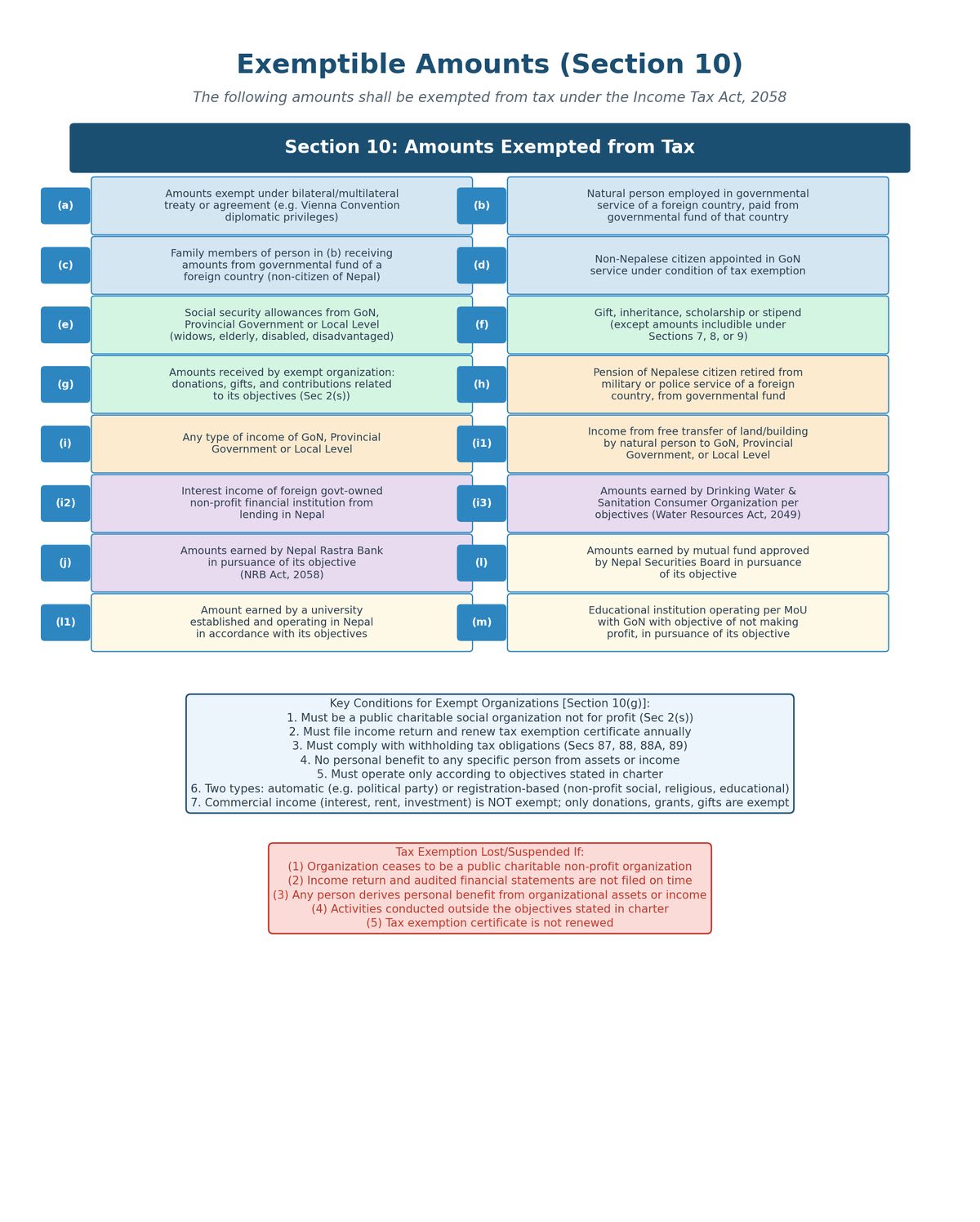
Figure: Exemptible Amounts and Exemptions (Sections 10-12D)
10. Exemptible amounts
The following amounts shall be exempted from tax
(a) Amount exempted from tax granted to any person entitled to tax exemption facility as provided for in a bilateral or multilateral treaty or agreement concluded between the Government of Nepal and any foreign country or international organization,
For example, persons who receive diplomatic privileges under the Vienna Convention, that is, foreign diplomatic officers, consuls and others, are exempt from income tax on employment income received for their own government's official service. Even though the workplace of such persons is in Nepal, Section 10(a) of the Act provides for a tax exemption on income received from such employment.
Nepal has granted a tax exemption on the employment income of foreign diplomatic officers working in foreign embassies and missions in Nepal, received from their own country, by virtue of being a signatory to the Vienna Convention 1961 (ratified by Nepal on 28 September 1968).
(b) Amount received by any natural person for doing employment in the governmental service of a foreign country,
Provided that
(1) The person has to be a resident or non-resident person only because of doing employment, and
(2) Such amounts have to be paid from the governmental fund of that country.
Where an natural person is employed in the governmental service of a foreign country in Nepal, has become a resident or non-resident person only because of that employment, and receives payment from the governmental fund of that country, such income is exempt from tax in Nepal. This provision is further clarified in the following examples:
Example 9.2.1: Suppose a person named Ruin Peyere works at the Ministry of Foreign Affairs of a foreign country. That foreign government has assigned him to Nepal to assist in Conflict Management. Ruin Peyere has been working in Nepal on this task for the past one year. He receives a monthly remuneration of Euro 10,000 from that foreign government. Since Ruin Peyere is doing official governmental service of that foreign country, became a resident of Nepal only because of the employment, and receives his remuneration from the official governmental fund of that foreign country, the amount he receives is deemed an exempt amount.
Example 9.2.2: Suppose Dinesh Chatakuli, a resident of Nepal, is an employee working on a Conflict Management Programme operated by a foreign government in Nepal. He receives a monthly remuneration of Euro 5,000 from that foreign government. He receives such remuneration from the official governmental fund of that foreign government. Even though he receives the payment from the official governmental fund of a foreign country, since he is a resident of Nepal, such income is not deemed an exempt amount and he must include such income in his employment income.
If a person was already residing in Nepal before engaging in such governmental service and only afterwards works in the governmental service of a foreign country, such a person does not receive an exemption in computing income under this provision of the Act.
(c) Amount received by an natural person referred to in clause (b) who is not a citizen of Nepal or by his nearest family member from the governmental fund of a foreign country,
Payments received from the governmental fund of a foreign country, such as pension, far station allowance, family allowance and other amounts, by the nearest family member of a person who became a resident only because of employment and who receives remuneration from the governmental fund of a foreign country, even where such payment is received in Nepal, are exempt from tax in Nepal. This provision is clarified in the following example:
Example 9.2.3: Suppose Maria Smith is a foreign woman. Her husband works at the embassy of the same foreign country in Nepal. In accordance with the rules of that foreign government for allowances to family members of embassy employees, Maria Smith has been receiving 3,000 pounds per month as a Far Station Allowance from the official governmental fund of that foreign country. In this situation, the amount of such allowance she receives is deemed an exempt amount.
(d) Amount received by a non-Nepalese citizen appointed in the service of the Government of Nepal under the condition of tax exemption,
The Government of Nepal may appoint any non-Nepalese citizen on the condition that no tax has to be paid, and where such appointment is made, the income amount received by that person from the Government of Nepal is deemed an exempt amount. This provision is clarified in the following example:
Example 9.2.4: Suppose the Government of Nepal formed a high-level task force for the proper utilisation of Nepal's water resources, and appointed a foreign national, Teve Fernando, to that task force on the condition of not having to pay tax, with a monthly remuneration of Euro 10,000. In this situation, even though the source of his income is in Nepal, the amount he receives is deemed an exempt amount.
(e) All kinds of allowances provided by the Government of Nepal, Provincial Government or Local Level as social security,
All kinds of allowances provided by the Government of Nepal, Provincial Government or Local Level to widows, the elderly, the disabled and disadvantaged persons as social security for their livelihood are not subject to tax.
(f) Amounts received as gift, inheritance, scholarship or stipend except the amounts required to be included in computing income pursuant to Section 7, 8 or 9,
Gifts related to employment, business or investment must be included in the respective income head. Similarly, amounts received as gift, inheritance, alimony or scholarship, other than those subject to windfall gain tax, such as a dowry received at the time of marriage, or a scholarship available to a poor or meritorious student, are also deemed exempt amounts. This provision is further clarified in the following example:
Example 9.2.5: Suppose Gopi Bantawa is studying MBBS at a medical college under a scholarship from the Government of Nepal. The cost would be Rs. 15 lakhs. In addition, he receives Rs. 10,000 per month in cash under the same scholarship. The expenses for his studies and the amounts received need not be included in his income; such amounts are deemed exempt amounts.
(g) Amounts received by an organization entitled to exemption for the following:-
(1) Donation, gift,
(2) Other contributions directly related with the work of an organization entitled to exemption as referred to in clause (s) of Section 2 without having consideration or without hoping for consideration, or
(3) ......,
Two types of situations for tax exemption exist under the Act:
Basis | Organization Entitled to Exemption | Tax-Exempt Income |
Exemption relates | Organization/Entity | Specific Income |
Requirement | Must qualify as exempt organization | Registration/approval may be required |
Focus | Status-based exemption | Income-based exemption |
For any organization to register as an organization entitled to exemption, obtain a tax exemption certificate, and continue to enjoy the tax exemption benefit, the following process and conditions must be fulfilled:
Area | Key Requirement |
1. Registration | Submit application with registration certificate, constitution/charter, PAN certificate, and previous year's audit report & tax return (if already operating). |
2. Eligible Organization | Must be a public charitable social organization established not for profit (Sec. 2(s)). |
3. Annual Compliance | Must file income return and renew tax exemption certificate within 1 year from the end of each income year. |
4. Financial Statements | Income return must be submitted along with audited annual financial statements. |
5. Tax on Non-Exempt Income | If income other than exempt income under Sec. 10(g) is earned, applicable tax must be paid. |
6. Auditor's Responsibility | Audit report must state whether: (i) withholding taxes were deducted, (ii) non-exempt income was earned, and (iii) activities were conducted according to organizational objectives. |
7. Withholding Tax Compliance | Must deduct tax at source on salary, rent, interest, service fee, royalty, contracts, securities disposal gains, etc. under Secs. 87, 88, 88A & 89. |
8. Competitive Grants | Grants received through competition with taxable persons/entities are not exempt income. |
9. No Personal Benefit | Assets or income must not provide benefit to any specific person. |
10. Activities as per Charter | Organization must operate only according to objectives stated in its charter. |
Tax exemption is lost/suspended if:
1. Organization ceases to be a public charitable non-profit organization.
2. Income return and audited financial statements are not filed on time.
3. Any person derives personal benefit from organizational assets or income.
4. Activities are conducted outside the objectives stated in the charter.
5. Tax exemption certificate is not renewed.
Exempt organisation: only its donations, grants & gifts (Sec 10(g)) are tax-exempt, not its interest, rent, investment or commercial income. Two types: (1) automatic exemption (e.g. political party registered with the Election Commission); (2) exemption only after registration/approval (public non-profit social, religious, educational, charitable & amateur sports bodies). Any personal benefit to a specific person = loses exempt status
Example 9.2.6: Suppose Nepal Dalit Bikas Mancha is an entity registered with the Department as an organization entitled to exemption. The Mancha received donations of Rs. 5,00,000 from various donors. It also received a grant of Rs. 10 lakhs from the Government of Nepal to be spent on Dalit upliftment activities. Both amounts are deemed exempt amounts for that entity.
Example 9.2.7: Suppose Nepal Dalit Bikas Mancha mentioned in Example 9.2.6 has been placing its received funds in savings deposits at a financial institution. The entity received interest income of Rs. 1 lakh from such deposits. Since such interest income is not income in accordance with the objectives of the entity, this amount is not exempt from tax. The person making the interest payment to that entity must withhold tax at 15 percent on such interest payment in accordance with Section 88(1) of the Act, and the interest received by that entity after such tax withholding is treated as a payment from which tax is withheld finally under Section 92(1)(e)(2) of the Act.
(h) Amount received for pension by a Nepalese citizen having retired from the military or police service of a foreign country from the governmental fund of that country,
Nepalese citizens are serving in the military or police of India, the United Kingdom and other countries. Where such persons, after retiring from their service, return to and reside in Nepal, and where they or their families receive pension amounts, no tax is levied in Nepal. However, where a Nepalese citizen has provided service other than military or police service of a foreign country and receives a retirement pension amount in Nepal for themselves or their family, such amount must be included in income for tax purposes. This provision is clarified in the following example:
Example 9.2.8: Suppose Ram Bahadur Thapa is a retired captain from the British Gurkha military service and currently resides in Pokhara. He receives a monthly retirement pension of 1,200 pounds from the British government. Such retirement pension amount he receives is an exempt amount.
(i) Any type of income of the Government of Nepal, Provincial Government or Local Level,
In this context, the income of a commercial entity (such as Rastriya Banijya Bank) that is wholly owned by the Government of Nepal is not deemed exempt income on the basis of this clause. Generally, amounts deposited in the Consolidated Fund of the Government of Nepal and amounts deposited in funds operated by government entities under prevailing law are treated as income of the Government of Nepal. Similarly, amounts deposited in the Consolidated Fund of provincial governments or local levels are treated as income of the respective Provincial Government or Local Level.
(i1) Income received from the transfer, free of charge, of land or a private building owned by a natural person to the Government of Nepal, a Provincial Government, or a Local Level.
(i2) Interest income earned from lending in Nepal by a financial institution established with full ownership of a foreign government and operating on a non-profit basis.
(i3) Amount earned by a Drinking Water and Sanitation Consumer Organization registered under the Water Resources Act, 2049, in accordance with its objectives.
(j) Amounts earned by Nepal Rastra Bank in pursuance of its objective,
Amounts earned by Nepal Rastra Bank from financial activities conducted in accordance with the objectives of the Nepal Rastra Bank Act, 2058 relating to maintaining financial stability are exempt from tax.
Example 9.2.9: Suppose Nepal Rastra Bank allocated Rs. 20 crores to a Banking Development Fund. The amount in that fund is deposited in various banks and financial institutions, and Nepal Rastra Bank earned interest income of Rs. 1 crore from those deposits. Since such income is income of a fund whose earnings are spent in accordance with the objectives of Nepal Rastra Bank, such income is deemed exempt income.
(k) ......,
(l) Amounts earned by a mutual fund having obtained approval from Nepal Securities Board in pursuance of its objective,
(l1) Amount earned by a university established and operating in Nepal in accordance with its objectives.
(m) Amounts earned by an educational institution operating on the basis of a memorandum of understanding with the Government of Nepal with the objective of not making profit or not distributing profit, in pursuance of its objective.
In addition to the above provisions, amounts received from the disposal of assets or liabilities other than those designated as chargeable assets or liabilities under the Act are also not subject to tax. The sale of personal assets unrelated to business by an natural person, such as furniture, jewellery and so on, other than the disposal of non-business chargeable assets (house, land, interests in entities) of an natural person, is exempt from tax.
11. Professional exemptions and facilities
(1) No tax shall be levied on an income earned by carrying on an agricultural business by any person other than registered as a firm, company, partnership or corporate body and on agricultural income other than that earned from an agricultural business in land as referred to in clauses (d) and (e) of Section 12 of the Act Relating to Land, 2021 (1964).
Provided that fifty percent tax shall be exempted in the income earned from agricultural business, vegetable dehydration business or cold storage business by any firm, company, partnership or corporate body so registered.
The above provision of the Act includes agricultural income derived from organized and commercially operated agricultural business in the income of the person. However, income derived by an natural person from land within the ceiling prescribed by the Land Act, 2021 is not subject to tax. However, agricultural income derived from land mentioned in clauses (d) and (e) of Section 12 of the Land Act, 2021 through agricultural business must be included in income for purposes of income tax computation. Clauses (d) and (e) of Section 12 of the Land Act, 2021 contain the following provisions:
(d) Land up to the limit fixed by a notified order of the Government of Nepal for industrial work under the conditions prescribed in such order, so long as such work continues.
(e) Land up to the limit fixed by a notified order of the Government of Nepal for agricultural industry work under the conditions prescribed in such order, so long as such work continues under those conditions.
The Land Act, 2021 provides for a ceiling on land ownership, and also provides that the Government of Nepal may raise the ceiling limit for conducting industrial or agricultural business on such land.
Example 10.2.1: Suppose Dhak Bahadur Bamjan has been cultivating tea on land owned by his family or joint family (within the ceiling of the Land Act, 2021). In doing so, he earned income of Rs. 10,00,000 in income year 2070/71. Such income falls within tax-exempt income. However, if any person has obtained approval from the Government of Nepal and cultivated land exceeding the ceiling in the manner prescribed under Section 12(d) or (e) of the Land Act, 2021, the income derived from such cultivation shall not be exempt from tax. Similarly, in any circumstances, if any agricultural income is earned through any business firm or entity, tax shall be levied on such income.
(2) No tax shall be levied on the income of a cooperative organization and union operated and registered under the Cooperatives Act, 2074 (2018) that carries on agricultural or forest-based industrial business such as sericulture and silk production, fruit farming, production and fruit processing, animal husbandry, dairy industry, poultry farming, fishery, tea gardening and processing, coffee farming and processing, herbiculture and herb processing, vegetable seed production, bee keeping, honey production, rubber farming, leasehold forestry, agro-forestry and other professional forest-related businesses, cold storage established for the storage of vegetables, agro-seeds, animal feed, pesticides, fertilizers and agricultural tools (except those operated with mechanical power), and cooperative organization or union operated in the area of a Rural Municipality. No tax shall also be levied on the dividends distributed by such organization or union.
This sub-section of the Act, is not available to cooperative organizations operating in metropolitan municipalities, sub-metropolitan municipalities, and municipalities. This is further clarified by the following example.
Example 10.2.2: Suppose Kanyam Community Tea Garden Ltd. is a cooperative organization registered under the Cooperative Act, 2074. In that organization, 40 farmers from the Kanyam area collectively engaged in tea cultivation, processing, and sale of processed tea. The organization earned income of one crore rupees in income year 2070/71. In this case, the income earned by such organization shall be exempt from tax. In addition, if the organization distributes dividends to its shareholders, advance tax withholding is not required on such dividends.
(2a) No tax shall be levied on interest income of up to twenty-five thousand rupees per annum earned from deposits in a micro-financial institution, rural development bank, postal saving bank and cooperative referred to in sub-section (2) operating in the area of a Rural Municipality.
Provided that where the amount of interest exceeds NPR 25,000, tax shall be levied on the amount of interest exceeding NPR 25,000.
(2b) Exemption from the tax leviable on income earned by a special industry, hotel, resort and information technology industry in full operation throughout the year in any income year shall be as follows:-
(a) By one-third of the tax if tax is levied at the rate of thirty percent on the income of a resident natural person,
(b) By twenty percent on tax leviable on the income of an entity,
(c) ......
Example 11.5.1 Suppose Sushri Shashikala Rai operates an industry producing juice from fruits in Achham district. In FY 2081/82, the business turnover of the industry is Rs. 2,45,00,000 and deductible amounts are Rs. 2,10,00,000. In that year, she opted as a single individual for taxable income computation purposes. Her taxable income and tax for the year shall be as follows:
Heading | Tax Rate | Amount (Rs.) |
Total business receipts (amounts included in income) | 24,500,000 | |
Less: deductible amounts | 21,000,000 | |
Assessable income | 3,500,000 | |
Less: retirement fund contribution and donation | 0 | |
Taxable income | 3,500,000 | |
Less from taxable income: remote area concession (Category 'Ga') | 30,000 | |
Balance taxable income | 3,470,000 | |
First slab up to Rs. 1,000,000 (tax nil for sole proprietor registrants) | 1% | 0 |
Second slab next Rs. 500,000 | 10% | 50,000 |
Third slab next Rs. 1,000,000 | 20% | 200,000 |
Fourth slab (next Rs. 1,500,000) on Rs. 970,000 (27%-9%= 18%) but considering the forth slab rate can’t be lower than third slab rate, the rate taken in 20%- Since no clarification has been obtained from IRD till date, 30% is considered 27% to determine rebate- 27%/3= 9% | 20% | 194,000 |
Total tax payable | 444,000 |
(3) Tax shall be levied as follows on the income earned by any person from a special industry, hotel, resort and information technology industry in any income year:-
(a) If the person gives direct employment to one hundred or more Nepali citizens throughout the year, ninety percent of the tax leviable on the income of that year; if the person gives direct employment to three hundred or more Nepali citizens throughout the year, eighty percent of the tax leviable on the income of that year; if the person gives direct employment to five hundred or more Nepali citizens throughout the year, seventy-five percent of the tax leviable on the income of that year; if the person gives direct employment to one thousand or more Nepali citizens throughout the year, seventy percent of the tax leviable on the income of that year,
Provided that additional ten percent exemption shall be provided in the amount of tax payable if the person gives direct employment to more than one hundred Nepali citizens throughout the year including at least thirty-three percent from among women, Dalits or persons with disability,
Direct Employment (Nepali citizens, full year) | Tax Applicable (% of General Tax Rate) |
100 or more | 90% |
300 or more | 80% |
500 or more | 75% |
1,000 or more | 70% |
(b) If a special industry has been operated in least developed, undeveloped and underdeveloped areas, respectively ten, twenty and thirty percent of the tax leviable on the income of the years for up to ten years from the date of commencement of the commercial production or transaction by that industry,
Provided that the special industry established in Karnali Province and hilly districts of Sudurpashchim Province providing direct employment to more than one hundred Nepali citizens shall be exempt from income tax for a period of fifteen years from the date of commencement of its transaction,
Area where Special Industry Operates | Tax Applicable (% of tax leviable) | Period (from commencement of commercial production / transaction) |
Least developed area | 10% | Up to 10 years |
Undeveloped area | 20% | Up to 10 years |
Underdeveloped area | 30% | Up to 10 years |
Karnali Province & hilly districts of Sudurpashchim Province (with direct employment to more than 100 Nepali citizens) | Fully exempt (0%) | 15 years |
(c) If a special industry and tourism industry (except casino) established with capital investment of more than one arab rupees providing direct employment to more than five hundred throughout the year shall be provided with full income tax exemption for five years from the date of commencement of its transaction and fifty percent of the tax leviable for three years afterwards,
Provided that if an industry in operation at present increases its installed capacity at least by twenty-five percent making its capital two arab rupees and provides direct employment to more than three hundred throughout the year, full income tax exemption shall be provided in the income earned from such capacity enhancement for five years and fifty percent of the tax leviable shall be exempted for three years afterwards.
Condition | Tax Applicable (% of tax leviable) | Period from Commencement of Transaction |
New special & tourism industry (except casino): capital investment more than Rs. 1 arab and direct employment to more than 500 Nepali citizens throughout the year | 0% (fully exempt) for first 5 years; 50% for next 3 years | 5 + 3 years |
Existing industry that increases installed capacity by at least 25%, raising capital to Rs. 2 arab, with direct employment to more than 300 throughout the year (exemption applies to income from the capacity enhancement) | 0% (fully exempt) for first 5 years; 50% for next 3 years | 5 + 3 years |
Example 10.2.3: Suppose Nepal Cement Industry Pvt. Ltd. has established a cement industry with shareholder capital investment of one arab fifty crore rupees and total investment of four arab rupees. The industry has an installed capacity of 1,500 tons per day and commenced production from 2071/6/1, with 510 workers and employees working throughout the year. In this case, from 2071/6/1 to 2076/5/31, the taxable income of the industry shall be fully exempt from tax, and from 2076/6/1 to 2079/5/31, a fifty percent exemption on taxable income shall apply.
(3a) Exemption from the income tax leviable on income of an industry established in a special economic zone and tax on dividends distributed by such industry shall be as follows:-
(a) The industry established in a special economic zone in a mountainous district and hilly district as specified by the Government of Nepal shall be provided with hundred percent income tax exemption for ten years from the date of commencement of its transaction and fifty percent for the income years afterwards,
(b) The industry established in a special economic zone in an area other than the area referred to in clause (a) shall be provided with hundred percent income tax exemption for five years from the date of commencement of its transaction and fifty percent for the income years afterwards,
(c) On dividends distributed by an industry established in a special economic zone, hundred percent tax exemption for five years from the date of commencement of its transaction and fifty percent for three years afterwards,
(d) Fifty percent of the income tax leviable on income earned by foreign investors from foreign technology or management service charge and royalty in an industry established in a special economic zone.
Item / Industry in Special Economic Zone (SEZ) | Exemption on Income Tax Leviable | Period from Commencement of Transaction |
(a) Industry in SEZ in a mountainous / hilly district specified by the Government of Nepal | 100% exempt, then 50% | 100% for 10 years; 50% for years afterwards |
(b) Industry in SEZ in any other area | 100% exempt, then 50% | 100% for 5 years; 50% for years afterwards |
(c) Dividends distributed by an industry in SEZ | 100% exempt, then 50% | 100% for 5 years; 50% for 3 years afterwards |
(d) Foreign technology / management service charge and royalty earned by foreign investors in an SEZ industry | 50% of tax leviable | No specified period |
Under Section 88(1) of the Act, 15 percent advance tax withholding is required on royalties and service fees such as technology and management fees, and under Section 92(1)(f) such tax withheld on payments to non-resident persons constitutes a payment from which tax is withheld finally. For foreign investors in industries established in special economic zones, such fees shall be subject to tax at only 7.5 percent.
(3b) A person carrying on the business of exploration and excavation of minerals, petroleum substances, natural gas and fuel who commenced commercial operation by Chaitra of 2080 (mid-April 2024) shall be provided with full income tax exemption for the first seven years from the date of commencement of the transaction and fifty percent income tax exemption for three years afterwards.
(3c) Seventy-five percent exemption shall be provided from the income tax leviable on income of the industry related to software development, data processing, cyber cafe, digital mapping established within the operation of the zoological, geological, biotech related park, technology park and information technology park as specified by the Government of Nepal by a notification in the Nepal Gazette.
(3d) The person having commercial transaction of electricity shall be provided with tax exemption as follows:-
(a) A licensed person commencing commercial production, transmission or distribution of hydropower, electricity produced from solar, wind and biological substance by Chaitra of 2084 (mid-April 2028) shall be provided with full income tax exemption for the first ten years and fifty percent exemption for five years afterwards.
Provided that in the case of hydropower projects above forty megawatts capacity with reservoir and semi-reservoir for which financial closure) is completed by Chaitra of 2085 (mid-April 2029), and lower riparian hydropower projects operated in tandem operation (Tandem Operation) with such projects, full income tax exemption shall be provided for the first fifteen years and fifty percent exemption for six years afterwards.
(b) Notwithstanding anything contained in clause (a), the provision prevailing at the time of issuance of the licence shall apply for any licensed person that has already commenced commercial production at the time of commencement of this sub-section.
Condition | Income Tax Exemption | Period |
(a) Licensed person commencing commercial production, transmission or distribution of hydropower / solar / wind / biological electricity by Chaitra 2084 (mid-April 2028) | 100% exempt, then 50% | 100% for first 10 years; 50% for 5 years afterwards |
Proviso: Reservoir / semi-reservoir hydropower projects above 40 MW with financial closure by Chaitra 2085 (mid-April 2029), and lower riparian projects in tandem operation with them | 100% exempt, then 50% | 100% for first 15 years; 50% for 6 years afterwards |
(b) Licensed person that had already commenced commercial production when this sub-section came into force | Provision prevailing at the time the licence was issued applies | As per the licence |
(3e) Tax exemption on income earned from export in any income year from a source in Nepal shall be as follows:-
(a) If tax is chargeable at the rate of twenty percent on the income of a resident natural person, twenty-five percent of that tax; and if tax is chargeable at the rate of thirty percent, fifty percent of that tax,
(b) Twenty percent of tax leviable on the income of an entity,
(c) Fifty percent of the tax leviable on income earned up to the extent of income received in foreign currency by such person for exporting information technology-based services including business process outsourcing, software programming, cloud computing and the like and earning foreign currency therefrom, up to fiscal year 2084/85.
Example 11.5.2 Suppose the business income mentioned in Example 11.5.1 above is derived from exports. The taxable income and tax for the year shall be as follows:
Heading | Tax Rate | Amount (Rs.) |
Total business receipts (amounts included in income) | 24,500,000 | |
Less: deductible amounts | 21,000,000 | |
Assessable income | 3,500,000 | |
Less: retirement fund contribution and donation | 0 | |
Taxable income | 3,500,000 | |
Less from taxable income: remote area concession (Category 'Ga') | 30,000 | |
Balance taxable income | 3,470,000 | |
First slab up to Rs. 10,00,000 (tax nil for sole proprietor registrants) | 1% | 0 |
Second slab next Rs. 5,00,000 | 10% | 50,000 |
Third slab next Rs. 1,000,000 (20% - 5% = 15%) (note: 20% base - 25% export relief = effective 15% below) | 15% | 150,000 |
Fourth slab (next Rs. 1,000,000) on Rs. 970,000 (30% - 15% = 15%) Same explanation as in example 11.5.2 | 15% | 145,500 |
Total tax payable | 345,500 |
Export income concession (Sec 11(3e)): resident natural person taxed at 20% → 25% off (effective 15%), at 30% → 50% off (effective 15%); entity → 20% off; IT-based services (BPO, software, cloud) earning foreign currency → 50% off up to FY 2084/85
(3f) In the case of income earned by any entity from any of the following activities, there shall be exemption from the tax leviable on income for up to ten years from the date of commencement of the commercial transaction as follows:-
(a) Forty percent, in the case of operation of a tram or trolley bus,
(b) Forty percent, in the case of construction and operation of a ropeway, cable car or sky bridge,
(c) Fifty percent, in the case of construction and operation of a road, bridge, underground route, tunnel, railway or airport.
(3g) The production-based, tourism service, hydropower generation, distribution and transmission entities listed in the securities market and entities mentioned in sub-section (3c) of Section 11 shall have fifteen percent exemption from the tax leviable.
(3h) The industry established in the least developed area and undeveloped area producing brandy, cider and wine based on fruits shall have respectively forty and twenty-five percent exemption from income tax for ten years from the date of commencement of the transaction.
(3i) Any person receiving royalty income from the export of intellectual property shall have twenty-five percent exemption at the rate of income tax leviable on such income.
(3j) Any person receiving income from the sale through transfer of intellectual property shall have fifty percent exemption at the rate of income tax leviable on such income.
(3k) The industry related to tourism or the airlines company operating international flight shall be provided with tax exemption as follows:
(a) An industry established with capital investment of more than one arab rupees shall have full exemption for five years from the date of commencement of the transaction and fifty percent exemption at the rate of leviable income tax for three years afterwards.
(b) An industry established with capital investment of more than three arab rupees shall have full exemption for ten years from the date of commencement of the transaction and fifty percent exemption at the rate of leviable income tax for five years afterwards.
(c) An industry established with capital investment of more than five arab rupees shall have full exemption for fifteen years from the date of commencement of the transaction.
(3l) If a special industry, information technology industry or an industry related to the tourism sector capitalizes its accumulated profit into shares for the purpose of increasing the capacity of the same industry, there shall be hundred percent exemption from the dividend tax leviable in the form of dividend distribution from such capitalization.
(3m) If any company having paid-up capital of fifty crore rupees or more operating as a private company converts into a public company and commences transaction, it shall have ten percent exemption from the leviable tax for three years from the date of its conversion into a public company.
Provided that a company required to be incorporated as a public company under Section 12 of the Company Act, 2063 (2006) shall not be entitled to the facility referred to in this sub-section.
(3n) A domestic tea producing and processing industry, dairy industry carrying on the business of milk products or textile production industry shall have fifty percent exemption at the rate of income tax leviable on income earned from the sale of its products.
(3o) A health institution operated by a community organization shall have twenty percent exemption from the tax leviable on its taxable income.
(3p) A micro-enterprise shall have full exemption from the leviable income tax for seven years from the date of commencement of its business or transaction. If such a micro-enterprise is operated by a woman entrepreneur, it shall have full exemption from the leviable income tax for an additional three years.
(3q) If any entity in any income year constructs and operates a public infrastructure to be transferred to the Government of Nepal or constructs, generates and transmits electricity, such entity shall have twenty percent tax exemption from the tax leviable on its taxable income.
(3r) A special industry established and operated in an industrial area or industrial village shall have fifty percent tax exemption for three years from the date of commencement of production and twenty-five percent tax exemption for five years afterwards.
(3s) Twenty percent tax exemption shall be provided in the income earned from the sale of raw material or associated raw material produced domestically to a special industry.
(3t) A start-up business as specified by the Department that uses innovative knowledge, ideas, skills, technology, practices and methods and has annual turnover of up to ten crore rupees shall be provided with hundred percent tax exemption for five years from the date of commencement of its transaction.
(3u) If any special industry operating in the Kathmandu valley relocates and operates outside the Kathmandu valley, hundred percent tax exemption shall be provided for three years from the date of such relocation and operation and fifty percent tax exemption for two years afterwards.
(3v) The industry using only previously used goods having direct impact on the environment as raw material to produce new goods shall be provided with fifty percent tax exemption for the first three years from the date of commencement of its transaction and twenty-five percent for two years afterwards.
(3w) The industry producing health vaccine, oxygen gas and sanitary pad shall be provided with hundred percent tax exemption for five years from the date of commencement of its production and fifty percent for two years afterwards.
(3x) The industry established by Ashad of 2082 (mid-July 2025) with the objective of producing and assembling electric vehicles shall have forty percent tax exemption for five years from the date of commencement of its transaction.
(3y) The industry established by Ashad of 2082 (mid-July 2025) with the objective of producing agricultural tools shall have hundred percent tax exemption for five years from the date of commencement of its transaction.
(3z) The industry producing green hydrogen shall have full income tax exemption for five years from the date of commencement of its transaction.
(3aa) The industry producing and assembling electric vehicle charging machines operated by electric energy shall have income tax exemption for five years from the date of commencement of its transaction.
(3ab) A person constructing, establishing and operating an industrial area or industrial village shall have full income tax exemption for the first ten years from the date of commencement of the transaction and fifty percent income tax exemption for five years thereafter.
(4) If any person carries on transactions qualifying for different tax exemption facilities pursuant to this Section, income shall be computed to obtain such facility as if that income were derived by separate persons.
A person availing the exemption concession under Section 11 of the Act must compute income as if only that income exists. In other words, other income of such person, if any, shall not be entitled to such concession. This is further clarified by the following example:
Example 10.2.5: Suppose Swastik Garment Industry Pvt. Ltd. has a factory in Kathmandu. Another unit of the same company is also operating in Dhading (underdeveloped area). The business status of the two units of the company in income year 2075/76 (amounts in Rs. thousands) is:
Amount in Rs. thousands
Description | Kathmandu (Rs. thousands) | Dhading (Rs. thousands) | Total (Rs. thousands) |
Sales | 2,10,00 | 1,40,00 | 3,50,000 |
Cost of sales | 1,50,00 | 1,25,00 | 2,75,000 |
Operating expenses | 10,00 | 8,00 | 18,00 |
In addition to the expenses that can be separated from the above accounts, the Pvt. Ltd. incurred centralized indirect expenses of Rs. 5,00,000. The tax liability of the Pvt. Ltd. for fiscal year 2075/76 shall be computed as follows:
Amount in Rs. thousands
Description | Kathmandu (Rs. thousands) | Dhading (Rs. thousands) | Total (Rs. thousands) |
Sales | 2,10,00 | 1,40,00 | 3,50,00 |
Less: | |||
Cost of sales | 1,50,00 | 1,25,00 | 2,75,00 |
Operating expenses | 10,00 | 8,00 | 18,00 |
Other expenses (indirect expenses apportioned in ratio of total sales) | 3,00 | 2,00 | 5,00 |
Assessable income | 47,00 | 5,00 | 52,00 |
Exemption | - | - | - |
Taxable income | 47,00 | 5,00 | 52,00 |
Applicable tax rate | 20% | 6% | |
Tax amount | 9,40 | 30 | 9,70 |
In this manner, the exemption on the tax rate is available only on the income of the special industry in the less developed area. Furthermore, if one unit incurs a loss, it cannot be set off against the income of another unit. When computing tax, the income computation forms of the Pvt. Ltd. must be prepared separately.
Multiple exemption activities (Sec 11(4)): compute each concession activity's income as if it were a separate person; one unit's loss cannot be set off against another unit's income; prepare separate income computations
(5) A person who is in a position to have more than one exemption in respect of the same income pursuant to this Section shall enjoy only one exemption of his choice in addition to the facility referred to in sub-section (2b).
If a person is eligible for more than one of the exemption concessions in the sub-sections of this Section for the same income, the person may choose only one. For example, a special industry providing direct employment to 100 or more persons throughout the year is entitled to a 10 percent exemption on tax under Section 11(3)(a), and if such industry operates in an underdeveloped area only 20 percent on applicable tax under Section 11(3)(b). In such a case, the person may choose only one exemption, either under Section 11(3)(a) or Section 11(3)(b). This is further clarified through the following example:
Example 10.2.6: Suppose the Dhading unit of Swastik Garment Industry Pvt. Ltd. mentioned in Example 10.2.5 above has more than 100 Nepali workers working throughout the year, of whom more than 33 percent are women, Dalits, and persons with disabilities. In such case, the company may choose either the concession available to industries providing more than the prescribed employment under Section 11(3)(a) of the Act, or the concession available to industries operating in an underdeveloped area under Section 11(3)(b) of the Act. Only one concession may be chosen.
When granting tax exemption concessions to industries within a time limit, if the assets used to operate the industry are old (previously used), the time limit shall be counted from the period of prior use. This is further clarified through the following example:
Same income, multiple concessions (Sec 11(5)): may claim only ONE exemption of choice (plus the 2b employment concession). For time-limited concessions, if the assets were previously used, that prior-use period counts against the exemption period (Sec 11(6))
(6) Notwithstanding anything contained in sub-section (3), if any other person has previously used the properties used to operate the industry referred to in clause (b) of that sub-section for the operation of the industry of the same type, the period during which they have been so used shall also be reckoned while reckoning the time-limit referred to in that sub-section.
(7) Notwithstanding anything contained in sub-sections (3a) and (3c), if the property used in operating the industry or business mentioned in those sub-sections is an old property previously used by another person for the operation of an industry or business of the same or other kind, the facilities referred to in those sub-sections shall not be available.
Example 10.2.7: If the assets used to operate the Dhading unit of Swastik Garment Industry Pvt. Ltd. mentioned in Example 10.2.5 above are new, the exemption concession under Section 11(3)(b) of the Act would be for 10 years. However, if such assets had been previously used for 3 years by another person to operate a similar industry, the Dhading unit of the company would receive the exemption concession only for the remaining period of 7 years.
Explanation: For the purposes of this Section,-
(a) "Agricultural Business" means a business involving the cultivation of grains and crops, fruit farming, animal and poultry farming, fish farming, and beekeeping.
(b) "Least developed", "undeveloped" and "underdeveloped area" means the areas referred to in Schedule-10 of the Industrial Enterprises Act, 2076 (2019).
The list of "least developed", "undeveloped", and "underdeveloped" areas mentioned in Schedule-10 of the Industrial Enterprises Act, 2076 is set out in the schedule of this Directive.
(c) "Special industry" means a production-based industry, industry based on agriculture and forest products and mineral industry as classified in sub-section (2) of Section 17 of the Industrial Enterprises Act, 2076 (2019), other than any industry producing cigarette, Bidi, Sigar, chewing tobacco, Khaini, Gutkha, Pan Masala, other products of similar nature involving tobacco as the principal raw material, liquors, beer and products of similar kind.
(d) "Micro-enterprise" means any micro-enterprise classified in clause (a) of sub-section (1) of Section 17 of the Industrial Enterprises Act, 2076 (2019).
(e) "Information technology industry" means an industry related to technology park, information technology park, biotech park, software development, data processing, digital mapping, business process outsourcing, data mining and cloud computing.
11A. Tax chargeable on construction and operation of infrastructure
If any agreement is concluded between the Government of Nepal and any person for the construction and operation of any infrastructure, the person constructing and operating such infrastructure shall enjoy the tax facilities provided by the Act in force at the time of conclusion of the agreement for the whole period of the agreement.
When the Government of Nepal enters into an agreement with any person for the construction and operation of infrastructure, the tax provisions and concessions in force at that time, such as tax rates and concessions, depreciation provisions, and loss set-off provisions, shall continue to be enjoyed by such person for the duration of the agreement, even if the Act is subsequently amended.
12. Donation and gift given to organizations entitled to tax exemption
(1) In computing the taxable income in any income year, any person may make a claim to subtract the amount of donation and gift given to an organization entitled to tax exemption approved by the Department for the purpose of this Section.
(2) Notwithstanding anything contained in sub-section (1), the expenditure deductible in any income year pursuant to that sub-section shall not exceed three lakh rupees or five percent of the adjusted taxable income of such person for that year, whichever is the lesser.
"Adjusted taxable income" is defined in Section 2(aad1) of the Act as the taxable income computed without deducting any amount under Sections 12, 12A, 12B, and 12C, and without any set-off under Section 14(2), Section 17, or Section 18, in computing the taxable income of any person for any income year.
When claiming a deduction for donation expenses for income tax purposes, only the lesser of five percent of adjusted taxable income, one hundred thousand rupees, or the actual payment may be claimed. When computing adjusted taxable income for donation expense purposes, deductions allowable under Sections 14(2), 17, and 18 of the Act must be deducted.
Example 10.4.1: Suppose the business status of Swastik Nepal Pvt. Ltd. for income year 2075/76 is as follows: Sales Rs. 10,00,000; Cost of sales Rs. 6,00,000; Depreciation expenses Rs. 50,000; Other administrative expenses Rs. 2,50,000; Donation expenses Rs. 15,000. Adjusted taxable income: Rs. 1,00,000 (Sales 10,00,000 less Cost of sales 6,00,000 less Depreciation 50,000 less Other administrative expenses 2,50,000).
(a) Actual donation expenses: Rs. 15,000.
(b) 5% of adjusted taxable income: Rs. 5,000.
Claimable donation expenses (lesser of (a) and (b)): Rs. 5,000.
Accordingly, although the company paid Rs. 15,000 as donation in income year 2075/76, only Rs. 5,000 may be claimed as a deduction from taxable income.
(3) Notwithstanding anything contained in sub-sections (1) and (2), in any special situation the Government of Nepal may, by a notification in the Nepal Gazette, specify that any amount spent or donated by any person for any work specified in that notification may be deducted fully or partly for expenditure in determining the income of that person.
Where the Government of Nepal has published a notice in the Nepal Gazette for a special purpose (such as the Prime Minister Natural Calamities Relief Fund), donations made for such purpose may be claimed without the limit specified in Section 12(2), and such donation expenses may exceed the limit of Section 12(2).
Example 10.4.2: Suppose Swastik Nepal Pvt. Ltd. mentioned in Example 10.4.1 above also donated an additional Rs. 50,000 for a purpose for which the Government of Nepal has published a Gazette notice providing a tax exemption. In that case, in addition to the 5 percent of adjusted taxable income of Rs. 5,000, the Rs. 50,000 may also be deducted, totalling Rs. 55,000 as a full expense deduction.
Donation/gift to an approved exempt organisation (Sec 12): deductible = least of (actual donation, Rs. 1,00,000, or 5% of adjusted taxable income).
Adjusted taxable income = taxable income before Sec 12/12A/12B/12C deductions and before Sec 14(2)/17/18 set-offs. Special Gazette-notified donations (e.g. PM Relief Fund) = deductible in full, no limit (Sec 12(3))
12A. Expenses on heritage protection and sports development
In computing its taxable income in any income year, any company may make a claim to subtract, upon prior approval of the Department, an amount which is the lesser of ten lakh rupees or an amount equivalent to ten percent of the assessable income, out of the expenditure made by it in that year in the protection and preservation of historical, religious and cultural heritages in Nepal or in the construction of public physical infrastructure of sports.
Prior approval of the Department is required. When seeking such approval, an application must be filed with the relevant office or the Department at least 7 days before the expenditure, stating the purpose of the expenditure, the estimated amount, the timeframe, and the procedure (such as direct payment to the relevant authority, direct arrangement, or payment through cheque).
Company + Approval + Heritage/Sports = Lower of 10 lakh or 10% deduction.
Example 10.5.1: (Incorrect In Directive)
Suppose the business status of Deep Jyoti Nepal Ltd. for fiscal year 2075/76 is as follows:
Sales | Rs. 2,00,00,000 |
Cost of sales | Rs. 1,35,00,000 |
Depreciation expenses | Rs. 8,50,000 |
Other administrative expenses | Rs. 35,00,000 |
Ancient temple renovation expenses | Rs. 5,00,000 |
Donation to a tax-exempt institution approved by the Department | Rs. 1,30,000 |
The deductible donation expense for the company in that fiscal year shall be computed as follows:
Sales | Rs. 2,00,00,000 | |
Less: Cost of sales | Rs. (1,35,00,000) | |
Less: Depreciation expenses | Rs. (8,50,000) | |
Less: Other administrative expenses | Rs. (35,00,000) | |
Assessable income/Adjusted Taxable Income | Rs. 21,50,000 | |
10% of assessable income | Rs. 2,15,000 | |
Actual ancient temple renovation expenses | Rs. 5,00,000 | |
Claimable ancient temple renovation expenses | Rs. (2,15,000) | |
5% of adjusted taxable income (21,50,000*5%) | Rs. 107,500 | |
Maximum limit | Rs. 1,00,000 | |
Actual donation expenses | Rs. 1,30,000 | |
Claimable donation expenses | Rs. (100,000) | |
Taxable income | Rs. 18,35,000 |
12B. Expenses contributed to Prime Minister Natural Calamities Relief Fund and reconstruction fund established by the Government of Nepal
Any person contributing any amount in any income year to the Prime Minister Natural Calamities Relief Fund and reconstruction fund established by the Government of Nepal may deduct such amount in computing the taxable income for that year.
Sec 12B contribution to PM Natural Calamities Relief Fund & GoN reconstruction fund = fully deductible.
12C. Seed capital provided to start-up businesses
Any person making available seed capital of up to one lakh rupees per business as a grant to up to five start-up businesses other than to an associated person may deduct such amount as expenses in computing taxable income.
Sec 12C startup seed grant = up to Rs. 1 lakh per startup, max 5 startups (not associated persons), fully deductible
12D. Deduction for Corporate Social Responsibility (CSR) Expenditure
A person may deduct, while calculating taxable income for an income year, the amount spent during that year for the purpose of discharging Corporate Social Responsibility (CSR) in accordance with the prevailing law.
Provided that, such deductible amount shall not exceed one percent (1%) of the total taxable income of that income year.