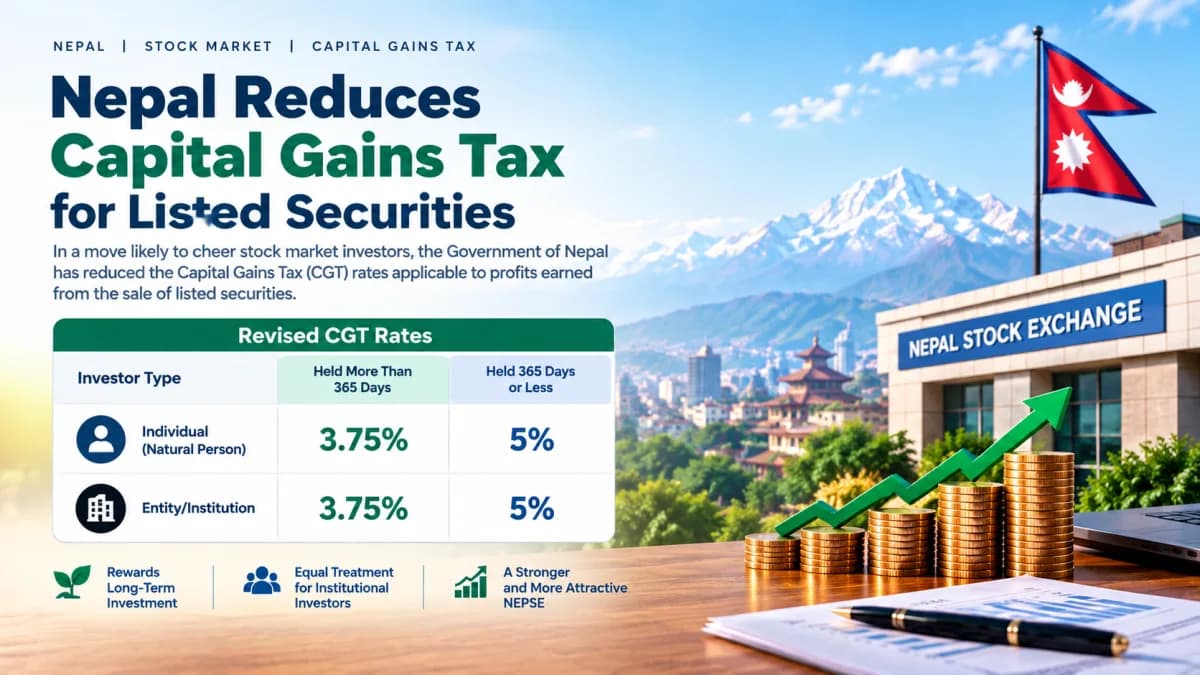
In a move likely to cheer stock market investors, the Government of Nepal has reduced the Capital Gains Tax (CGT) rates applicable to profits earned from the sale of listed securities. The decision, published in the Nepal Gazette on Bhadra 31, 2083 B.S., was taken by the Council of Ministers using powers granted under Section 18(1) of the Finance Act, 2083, and is signed by Government Secretary Dr. Ghanashyam Upadhyaya.
What Has Changed
Until now, individual and institutional investors faced differing tax treatment on their stock market gains. Under the new notice, that gap has narrowed considerably, with both categories of investors now taxed at nearly identical rates depending on how long they held their shares.
Investor Type | Held More Than 365 Days | Held 365 Days or Less |
|---|---|---|
Individual (Natural Person) | 3.75% | 5% |
Entity/Institution | 3.75% | 5% |
The reduced rate for individuals has been introduced under Section 95A(2)(a) of the Income Tax Act, 2058, while the corresponding rate for institutional investors falls under Schedule 1, Section 1(4)(b), Proviso (3) of the same Act.
Why It Matters
The reform effectively rewards patience in the stock market. An investor who holds a listed share for more than a year now pays tax at less than half the rate charged to someone who sells within the year, 3.75% versus 5%. This reinforces a long-standing policy signal from the government: short-term speculation is taxed more heavily than long-term investment.
What stands out most in this notice, however, is the equal treatment now extended to institutional investors. Previously, mutual funds, insurance companies and other institutional holders were often taxed differently from individual retail investors. Bringing both groups under a common rate structure removes a longstanding point of friction and could make the market more attractive to institutional participation.
Who Is Affected
Retail investors trading shares of companies listed with the Nepal Securities Board (SEBON) will see their tax liability on gains fall immediately.
Institutional investors including mutual funds and other collective investment vehicles, now face the same CGT structure as individuals, simplifying tax planning and portfolio strategy.
Brokers and depository participants who are responsible for withholding CGT at the time of settlement, will need to update their systems to reflect the revised rates.
Tax consultants and auditors advising clients on securities transactions should factor in the new rates for any computations going forward.
The Bigger Picture
Capital markets regulators and market participants have periodically flagged Nepal's CGT regime as a factor discouraging both retail participation and long-term institutional investment. This adjustment appears to respond directly to that concern, lowering the cost of holding and eventually exiting listed positions while preserving a clear incentive structure that favors longer holding periods over short-term trading.
Whether this translates into higher trading volumes or renewed institutional interest in the Nepal Stock Exchange (NEPSE) will likely become clearer in the coming quarters, but the immediate effect is a lighter tax bill for anyone selling listed shares held for over a year.