



Contents
Chapter-1 Preliminary
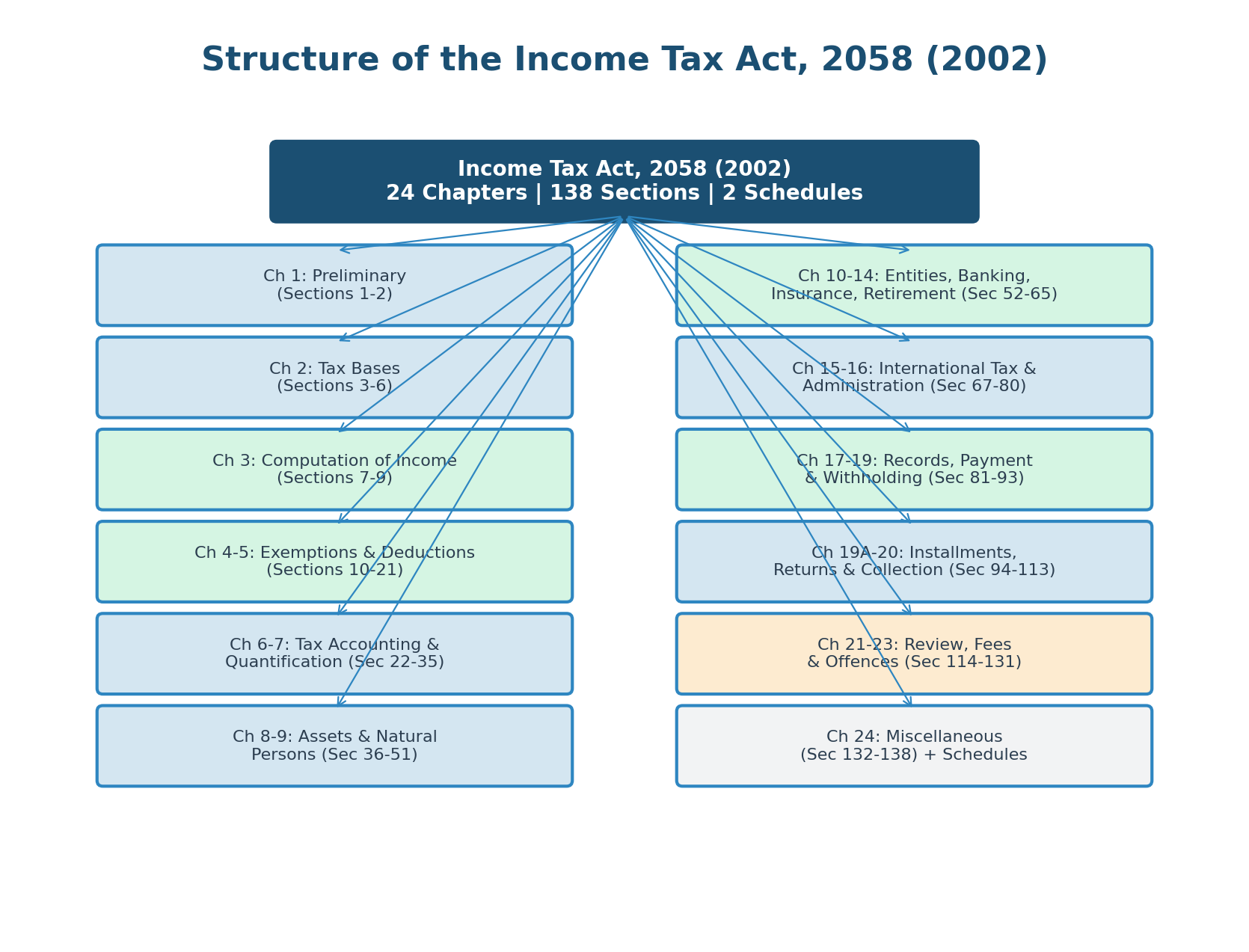
Figure: Structure of the Income Tax Act, 2058
1. Short title, extent and commencement
(1) This Act may be cited as the "Income Tax Act, 2058 (2002)."
(2) This Act shall come into force throughout Nepal and shall also apply to residents residing wherever outside Nepal.
(3) This Act shall come into force immediately.
2. Definitions
Unless the subject or the context otherwise requires in this Act
(a) "Person withholding advance tax" means a person with a duty to withhold advance tax pursuant to Chapter-17 in making payments for employment, investment return, service charge and contract or agreement, as well.
When making a payment that requires advance tax to be withheld, the amount of tax at the rate prescribed in the Act must be deducted from the payment, and only the remaining balance may be paid. A Withholding Agent is therefore a person who has the obligation to withhold advance tax before making payment. For example, when an entity pays remuneration to its employees and is required to distribute remuneration with tax applied, such entity is a Withholding Agent. When a company pays a service fee to a consultant, such company has the obligation to withhold advance tax on the service fee payment and is therefore a Withholding Agent.
(b) "Officer" means the Director General, Deputy Director General, Chief Tax Administrator, Director, Chief Tax Officer, Tax Officer and other Officers in the Department, as referred to in Section 72.
Section 72 of the Act establishes that the Inland Revenue Department is responsible for implementation and administration of this Act. The Department includes the Inland Revenue Department as well as Inland Revenue Offices, Large Taxpayer Offices, Medium Taxpayer Offices, and Taxpayer Service Offices. Section 72(4)(c) also provides that the Director General may designate certain powers to be exercised by any civil service officer or employee.
(b1) "International Transaction" means any transaction relating to goods, services, finance, or intangible assets conducted by any person with at least one non-resident person. The term also includes any other transaction that affects income, expenditure, assets, or liabilities.
(c) "Payment from which tax is withheld finally" means any dividend, rent, profit, interest and payment from which tax has to be withheld made to the non-resident person, as referred to in Section 92.
The Act treats withheld advance tax amounts in two ways: as creditable withholding tax and as final withholding tax. Creditable withholding tax is the amount of advance tax deducted that a taxpayer may credit against the annual tax payable. Final withholding tax is the amount deducted from the payment at the prescribed rate at the time of payment, which constitutes the final tax payment. A taxpayer subject to creditable withholding is required to file an income return and must include such income received with withholding in the aggregate income in that return, then deduct the withheld tax from the annual tax liability. A taxpayer subject to final withholding is not required to include the amount received with such withholding as income in the income return, nor may such withheld tax be credited against other tax liabilities.
(d) "Retirement fund" means an entity established with the sole objective to accept retirement contribution fund for making retirement payments from the fund to the entity's beneficiary natural persons or their dependents, and invest such funds.
An entity operated solely for the purpose of managing a retirement fund is called a Retirement Fund. Such a retirement fund performs only the following functions:
(1) to accept contributions brought by natural persons to be deposited in their names in the fund;
(2) to make retirement payments to such contributing persons (i.e., beneficiaries), or their dependents, after the beneficiary's retirement or death; and
(3) to invest the accumulated retirement contributions.
For tax purposes, retirement funds have two structural types: Approved Retirement Fund and Unapproved Retirement Fund. Examples of retirement funds include the Employees Provident Fund (Karmachari Sanchayakosh), Citizen Investment Trust (Nagrik Lagani Kosh), Social Security Fund (Samajik Suraksha Kosh), retirement fund operated by the Civil Servants' Retirement Gratuity Fund (Nivritti Bharan Kosh), and entities approved by the Department to operate retirement funds.
(e) "Retirement payment" means any payment made to the following person:-
(1) Payment made to an natural person where such person has got retirement, or
(2) Payment to the dependent of an natural person where such person has died.
Retirement payment refers to payment made after a natural person has in principle reached a state of being unable to perform any employment, profession, or business and has retired. Similarly, where a natural person dies, the amount payable to that person, if paid to that person's dependent, is also called a retirement payment. Examples of retirement payments include payments from a retirement fund for retirement contributions made, gratuity, provident fund, encashment of accumulated leave, medical expenses, long service gratuity, and payment from a welfare fund. Such retirement payments may come from the Government of Nepal, an approved retirement fund, an unapproved retirement fund, an employer, or any other fund. Payments from an approved retirement fund may only be made in the following three circumstances:
(1) when an employee or worker retires from service;
(2) when the beneficiary reaches the age of fifty-eight years; or
(3) when the beneficiary dies or becomes permanently disabled.
Payments received before meeting these conditions, such as Long Service Gratuity, Leave Encashment, or Medical Expenses received during the period of service before actual retirement, do not fall under retirement payments; such payments must be included in income from employment.
(f) "Retirement contribution fund" means any payment made to a retirement fund for provisions of retirement payment or for future provisions thereof.
The retirement contribution amount includes the contribution deposited by the natural person themselves or, in the case of an associated person (i.e., an employer), by the employer on behalf of the natural person.
Example 2.1: Suppose Sujit Singh is employed at Kamal and Co. Pvt. Ltd. at a monthly salary of Rs. 20,000. If the company deposits Rs. 2,000 per month in a retirement fund in his name, and he also contributes Rs. 2,000 from his own side, then the total of Rs. 4,000 contributed by both sides shall be considered the retirement contribution amount for Sujit.
(g) "Incapacitated person" means a person who is not capable of making his or her dealings because of physical or mental illness.
The Act makes special provision so that the legal representatives or guardians of such persons may fulfil tax obligations on their behalf.
(h) "Income" means an income earned by any person from employment, business, investment or windfall gain and the term also includes the total amount of that income calculated in accordance with this Act.
The total amount of such income, calculated in accordance with the Act, is the taxable income on which tax is assessed. Income is classified into four heads: employment, business, investment, and windfall gain.
(h1) "Windfall gain" means a gain obtained by means of lottery, gift, prize, tips, share of earning in a game (Jitauri) or any other gain acquired incidentally.
A lottery, gift, prize, bonus, winnings, or other amount received without certainty of receipt and without the use of the recipient's labor or capital is considered windfall gains. Such amounts are subject to a separate final withholding tax and need not be included in the income return.
(i) "Income year" means a period from the first day of Shrawan of any year to the last day of Ashad of the next year.
The income year runs from the first of Shrawan to the end of Ashad of the following year. However, for a person established or who begins earning income during this period, the income year is from the date of establishment or commencement of income earning to the end of Ashad immediately following. Similarly, where a person's business has been or is deemed to have been closed, that person's income year shall be from the first of Shrawan to the date of closure or deemed closure of the business.
Example 2.2: Suppose Dhruv Company Pvt. Ltd. was liquidated on 2080/07/05. In that case, the final income year of that company shall be from 2080/04/01 to 2080/07/05. If at that date, 50% or more of the ownership of that company changed, then under Section 57 of the Act, in fiscal year 2080/81, the period from 2080/04/01 to 2080/07/05 shall be one income year and the period from 2080/07/06 to 2081/03/31 shall be another income year.
(j) "Gift" means any payment made without any consideration or in the case of any payment with consideration, where the market value of payment exceeds the market value of consideration, payment to the extent of such excess.
Example 2.3: Suppose a person named Vishwabandhu purchased a TV worth Rs. 25,000. The TV seller provided him a DVD player worth Rs. 5,000 at no charge. Such a player received without payment is considered a gift. Where a payment is made with consideration but the payment exceeds the market value of the consideration, the excess is also treated as a gift.
(k) "Debt liability" means the liability equivalent to the debt claim.
Where a person has an obligation to make a payment to another person for an arrangement, and such obligation is to be paid after a specified period or condition, such obligation is considered a debt liability. For example, if a person has taken a loan from a bank, the amount payable under the loan agreement is a debt liability. Such amount includes not only the principal but also the return on that principal, i.e., interest.
(l) "Debt claim" means the right of any person to receive payment from another person, and the term also includes the right of any person to have repaid a loan lent by such person to another person, the right to receive deposits made in a bank and financial institution, to receive sums to which such person is entitled and to receive money from the sale of debentures, bills of exchange, bonds, rights under annuities, financial lease and installments.
A debt claim is the corresponding right held by the lender to receive repayment of a debt liability. Examples of debt claims include deposits held in banks and financial institutions, receivable amounts, debentures, bills of exchange, bonds, rights under annuities, rights to receive amounts from financial leases, and instalment sales.
(m) "Company" means any company incorporated under the prevailing company law, and for the purpose of tax the following institutions shall also be treated as if they were companies:-
(1) Any corporate body established under the laws in force;
(2) Any unincorporated association, committee, institution, or society, or any group of persons other than a registered or unregistered sole proprietorship and partnership, or a trust;
(3) A partnership firm with twenty or more partners, whether registered or not under the prevailing law, a retirement fund, a cooperative institution, a unit trust, or a joint venture;
(4) Any foreign company;
(5) Any other foreign institution as specified by the Director General.
For income tax purposes, organizations duly registered under prevailing law, such as private limited companies, public companies, corporations, associations, non-governmental organizations (NGOs), and international non-governmental organizations (INGOs), are considered companies. All organized entities except sole proprietorships and partnership firms with fewer than twenty partners are considered companies.
(n) "Tax" means the tax chargeable under this Act, and this term includes the following payments:-
(1) The expenditures referred to in clause (a) of sub-section (8) of Section 104 as incurred by the Department for any claim in respect of, and auction sale of, the property in which the tax is due and outstanding,
(2) The amount payable by the person withholding advance tax or the person subject to tax withholding under Section 90 or the amount payable by the person making payment in installment under Section 94 or the amount payable by the person withholding advance tax under Section 95A. or the amount payable after the tax assessment under Sections 99, 100 and 101,
(3) The amount payable to the Department in respect of tax liability of the third party under sub-section (2) of Section 107, sub-section (3) or (4) of Section 108, sub-section (1) of Section 109, sub-section (1) of Section 110,
(4) The amount referred to in Chapter-22 payable for a fee and interest, and
(5) The amount of fine referred to in Section 129 required to be paid as per the order of the Department.
Under Section 104 of the Act, the Government of Nepal has a claim over the property of a person having tax arrears, and Sub-section (8)(a) provides that costs incurred by the Department in claiming and auctioning such property may be recovered from the person with tax arrears; therefore such costs are also considered tax. Under Section 90, a withholding agent is required to deposit the withheld advance tax amount within 25 days of the end of that month. Under Section 94, a person who has assessable income or will have assessable income from business or investment is required to file tax on an instalment basis. The amount to be paid at self-assessment under Section 99, jeopardy assessment under Section 100, and amended assessment under Section 101 are also considered tax. Amounts payable by managers of entities under Section 107(2), by receivers under Sections 108(3) and (4), by debtors of taxpayer under Section 109(1), and by agents of non-residents under Section 110(1) are also considered tax.
Example 2.4: Suppose Yuga Prasad has been appointed as liquidator of a limited liability company. As of the time of liquidation, there is Rs. 10,00,000 in withheld advance tax and Rs. 30,00,000 in other tax arrears. After selling the assets and deducting liquidation expenses, Rs. 1,00,00,000 remains. There is a secured loan of Rs. 30,00,000 that has priority over the tax, and Rs. 50,00,000 in unsecured liabilities. In that case, the liquidator must first set aside Rs. 10,00,000 in advance withheld tax from the sale proceeds, even before deducting liquidation expenses. Thereafter, after deducting liquidation expenses and the Rs. 30,00,000 secured loan, from the remaining amount, Rs. 30,00,000 in other tax arrears must first be settled, and the remaining Rs. 30,00,000 distributed pro-rata to settle unsecured liabilities.
(o) "Person subject to tax withholding" means any person who receives payment or has the right to receive payment by withholding tax under Chapter-17 in making payment for employment, investment return, service charge or contract or agreement.
A person subject to tax withholding is a person who receives payment after tax has been deducted at source.
(p) "Tax assessment" means the assessment of tax to be made under this Act and this term includes the assessment of a fee and interest under Section 122.
Provided that this term does not mean the previous tax assessment substituted by the amended tax assessment under Section 101.
The Act provides for three types of tax assessment:
(1) Self-assessment under Section 99, i.e., the system where a person with a tax liability assesses their own tax;
(2) Jeopardy Assessment under Section 100 for an income year or a portion thereof before the taxpayer's time to file an income return has expired; and
(3) Amended tax assessment made by the Department under Section 101 to adjust a person's tax liability on a fair and equitable basis.
Since an amended tax assessment replaces the original tax, in the event of an amended assessment, the prior self-assessment (Section 99) or jeopardy assessment (Section 100) shall not be considered a tax assessment(An amended assessment supersedes and replaces the previous assessment, making the amended assessment the only valid tax assessment). Additionally, Section 99(2) provides that for a taxpayer who does not file a self-assessment income return within the prescribed time, a self-assessment shall be deemed to have occurred automatically on the last day for filing the income return. The fees and interest calculated by the Department under Section 122 are also considered a tax assessment, covering fees under Sections 117, 119A, 120, and 121, and interest under Sections 118 and 119.
(p1) "Transaction" means a transaction equal to the total amount included pursuant to Section 7, 8 or 9 for the purpose of calculation of income of employment, business or investment in any income year.
Transaction means the total amount included in computing income under Sections 7, 8, or 9 for an income year. It represents the gross level of activity in employment, business, or investment income computation and is used as the basis for determining whether the presumptive tax provisions of Section 4(4) apply.
(q) "Non-resident person" means any person other than the resident person.
(r) "Non-business taxable assets" means any land, building and interest or security in any entity except the following properties:-
(1) Business assets, depreciable assets or stocks-in-trade,
Business assets include shares, land, receivables, advance accounts, cash and bank balances, and other assets other than stock-in-trade or depreciable assets of the business. Depreciable assets means assets used to earn income in any business or investment that lose value through wear and tear, obsolescence, or the passage of time. Stock-in-trade refers to assets held for sale in the ordinary course of a business operated by a person, assets in work-in-progress, and stocks of materials to be incorporated into such assets.
Example 6.4.1: Suppose Hada Furniture Pvt. Ltd. buys and sells furniture. In income year 2080/81, it purchased 10 chairs for Rs. 1,00,000 and sold 6 of them for Rs. 70,000. In that income year, the 10 chairs held for sale constitute the stock-in-trade of that company.
(2) A private building owned by an natural person in the following situation:-
(a) Being under ownership for a continuous period of ten years or more, and
(b) Where that person has resided for a total period of ten years or more continuously or at several times,
Explanation: For the purpose of this clause, "private building" means building, land occupied by the building and additional land of equal area occupied by the building or one Ropani of land whichever is lesser.
(3) Any interest of any beneficiary in retirement fund,
Every person who contributes to a retirement fund is a beneficiary with respect to the investment in that retirement fund. Such a beneficiary's interest in that retirement fund is not treated as a non-business taxable asset. Their investment in any entity other than the retirement fund is treated as a non-business taxable asset.
Example 6.4.2: Suppose Ramprasad contributes Rs. 4,000 every month to a retirement fund. He has also purchased shares worth Rs. 1 lakh in a financial institution. The amount accumulated through contributions to the retirement fund is not treated as a non-business taxable asset. However, his investment in the shares of the financial institution is treated as a non-business taxable asset.
(4) A land, land with building and private building belonging to and disposed of by any natural person for a value less than ten lakh rupees, or
If a natural person disposes of land and a personal building for a value of less than Rs. 10 lakhs, such asset is not treated as a non-business taxable asset. If disposed of for a value exceeding that, such an asset is treated as a non-business taxable asset.
Example 6.4.3: Suppose Suresh purchased a house on date 2069.03.31 for Rs. 20 lakhs and sold that house on date 2081.10.05 for Rs. 80 lakhs. Since the disposal value exceeds Rs. 10 lakhs, that house is treated as his non-business taxable asset, and the amount received from the disposal of that house is treated as non-business taxable asset income. The net gain computed from such income in accordance with Chapter 8 of the Act is treated as non-business taxable asset income and must be included in computing investment income. If he had purchased that house 10 years ago or earlier and had resided in it continuously or intermittently for a total of 10 years or more, that house would not be treated as a non-business taxable asset and the gain from the disposal of such an asset would not be included in his investment income.
(5) Any asset disposed of by way of transfer in any manner other than the purchase and sale within three generations.
Ordinarily, property transfers within three generations are made through partition, gift and similar means rather than purchase and sale. However, sometimes property is bought and sold within three generations. Accordingly, the sale amount of property sold within three generations is treated as non-business taxable asset income, while transfer by means other than purchase and sale within three generations is not treated as non-business taxable asset income or investment for tax purposes. However, even where property is sold within three generations, if the value is less than Rs. 10 lakhs, such property is still not treated as a non-business taxable asset.
Example 2.5: Suppose Prem Prasad Acharya purchased a building in Kathmandu on 23rd Kartik 2070 for Rs. 2,00,00,000. He sold that building on 26th Push 2080 for Rs. 3,00,00,000. He was abroad for a cumulative total of 120 days from 23rd Kartik 2070 to 26th Push 2080. Even though he was the owner of that building for more than ten years, because he resided in it for less than ten years cumulatively, the above building is considered a non-business chargeable asset. However, if he had sold the building two months later, the condition of having resided therein for more than ten years would also have been met, and the building would not have been considered a non-business chargeable asset.
Example 2.5.1: In the example above, had it been a building only, the building and in the case of a building with land, land up to one ropani or the area covered by the building (whichever is less), that portion of property would not have been considered a non-business chargeable asset.
Example 2.5.2: Even if the building in the above example had been sold for less than Rs. 10,00,000, it would not have been considered a non-business chargeable asset.
Example 2.5.3: The building in the above example became a non-business chargeable asset when sold. Had that building been transferred free of charge within three generations, it would not have been considered a non-business chargeable asset.
Example 2.6: Suppose a person named Laxmi Rimal purchased land in Kathmandu worth Rs. 20,00,000 on 3rd Falgun 2075. She sold that land on 6th Aswin 2080 for Rs. 45,00,000. Since the sale value of the above land exceeds Rs. 10,00,000, the above land is a non-business chargeable asset.
Example 2.7: Suppose Yubaraj Basnet transferred land worth Rs. 5,00,00,000 registered in his name, purchased one year ago, to his grandson by a gift deed. Even if the market value of that property at the time of transfer was Rs. 6,00,00,000, that property shall not be considered a non-business chargeable asset.
Securities (shares, bonds, debentures) in the ownership of a natural person, except for free-of-charge transfer of rights within three generations, shall be considered non-business chargeable assets when disposed of through purchase and sale or other transfer of rights.
(s) "Organization entitled to enjoy exemption" means the following entity:-
(1) The following entities registered in the Department as organizations entitled to enjoy exemption:-
(a) A social, religious, educational or benevolent organization of public nature established with non-profit motive,
(b) An amateur sports organization so formed with a view to promoting social or sports related facilities that the organization or its members does not derive profits,
(2) A political party registered in the Election Commission,
Provided that if any person has derived any benefit from the property of that organization and the monies obtained from that organization except in making payment for the property or the service provided by any person to that organization or in discharging functions in consonance with the objective of the organization entitled to exemption, tax exemption shall not be granted.
Rule 3(1): Any organization entitled to enjoy tax exemption pursuant to Section 2(s) of the Act shall submit an application, accompanied by the following details, to the Department for the exemption of tax:
(a) in the case of an organization required to be registered pursuant to the prevailing law, a duplicate copy of the registration certificate;
(b) a copy of the statute of the organization;
(c) where the permanent account number has been obtained, a copy of such certificate; and
(d) a duplicate copy of an audit report, if any.
Rule 3(2): Upon conducting necessary examination as to the application for tax exemption submitted pursuant to Sub-rule (1), the Department shall register such organization as an organization entitled to enjoy tax exemption and issue a certificate.
Rule 3(3): Notwithstanding anything contained in Sub-rules (1) and (2), the Department may specify any entity falling within the organization entitled to enjoy tax exemption so as they may not be required to be registered.
Rule 5A(1): Any tax-exempt organization that has obtained a certificate of tax exemption pursuant to Rule 3 shall renew such certificate within one year from the date of expiry of the income year.
Rule 5A(2): In renewing pursuant to Sub-rule (1), the application shall be accompanied by the income return of the preceding income year, the details showing that advance tax has been withheld and deposited, and other supporting evidence, and shall be submitted to the Department in the format prescribed by the Department.
Rule 5A(3): On the basis of the application received pursuant to Sub-rule (2), if upon examination the applicant appears to be entitled to enjoy tax exemption, the certificate shall be renewed.
Rule 5A(4): Where the format of the certificate of tax exemption received for renewal pursuant to this Rule does not match the format specified by the Department, a new certificate shall be issued in place of the previous certificate of tax exemption.
Rule 5A(5): Unless the certificate of tax exemption is renewed pursuant to Sub-rule (1), the organization that has obtained a certificate of tax exemption shall not be entitled to avail of the benefit of tax exemption.
Rule 27(1): Any person entitled to enjoy tax exemption may submit an application to the Department for the tax exemption certificate.
Rule 27(2): Upon receiving an application pursuant to Sub-rule (1), if it appears that the person is entitled to enjoy tax exemption, the Department shall provide the tax exemption certificate to such person.
(t) "Trust" means an arrangement whereby a trustee holds any property.
Provided that this term does not include a partnership, corporate body or organization referred to in sub-clause (3) of clause (m).
A trust is an arrangement whereby a trustee holds and manages property for the benefit of another person (the beneficiary). For income tax purposes, trusts are treated as entities. A trust that is established in Nepal, whose trustee is a resident person in the relevant income year, or a trust controlled directly or through one or more interposed entities by a resident person or a group of associated persons, shall be considered a resident of Nepal.
(u) "Trustee" means an natural person, trust (Guthi) or other body corporate who, natural personly or jointly with other natural person, trust (Guthi) or corporate body, holds a property in trust, and the term also includes the following person:-
(1) The operator or administrator of the assets of a deceased,
(2) A liquidator, recipient or trustee,
(3) Any person who protects, directs, controls or manages the assets of an incapacitated person in personal or official capacity,
(4) Any person who manages the assets under a private enterprise or similar other enterprise, and
(5) Any other person in a position similar to that of the person as referred to in clauses (1), (2), (3) and (4).
A trustee holds property on behalf of a beneficiary and is responsible for managing such property in accordance with the terms of the trust. For tax purposes, the trustee is responsible for fulfilling the tax obligations of the trust. Trustees include the operator or administrator of assets of a deceased person, a liquidator, a receiver or trustee, any person who protects or manages the assets of an incapacitated person, any person managing assets under a private enterprise, and any other person in a similar position.
(v) "Long-term contract" means a contract referred to in Section 26 of which validity period is more than twelve months.
A long-term contract is a contract for production, construction or installation, or a contract on the fulfillment of services related thereto, where the contract is estimated to span more than one income year at the time of conclusion. The special provisions for computing income from long-term contracts are provided in Section 26 of the Act and Rule 12 of the Income Tax Regulations, 2059. The key characteristic is that the contract value exceeds what is ordinary for a single income year, requiring special methods for recognizing income across periods.
(w) "Relative" means an natural person's husband, wife, son, daughter (adopted son, daughter as well), father, mother, grand-father, grand-mother, elder brother, younger brother, sister-in-law, daughter-in-law, elder sister, younger sister, father-in-law, mother-in-law, brother-in-law, elder brother-in-law, wife's sister, uncle, aunt, nephew, niece, grand-son and grand-daughter.
Relatives of a natural person are associated persons of that natural person. This is significant for tax purposes because transactions between associated persons may be subject to arm's-length pricing requirements under Section 33 of the Act, and payments to associated persons may require special treatment.
(x) "Entity" means the following organization or body:-
(1) A partnership, trust or company,
(2) District Coordination Committee,
(3) Government of Nepal, Provincial Government or Local Level,
(4) Any foreign government or provincial or local government under that government or a public international organization established by any treaty, or
(5) A permanent establishment of the organization or body referred to in clauses (1), (2), (3) and (4), which is not situated in a country of which it is a resident.
(y) "Interest in entity" means and includes the contingent right to receive income or capital of any entity.
Interest in an entity means the right, including a contingent right, to receive the income or capital of the entity. For example, interest in entity refers to a partner's share in a partnership firm, a shareholder's share in a limited liability company, an investor's contribution in a retirement fund, a partner's interest in a joint venture, and a person's ownership in a permanent establishment.
(z) "Disposal" means a disposal inclusive of the sale or transfer of any property or liability as mentioned in Section 40.
Disposal includes the sale or transfer of any property or liability, and also any event that is deemed to be a disposal under the Act. The significance of disposal in the Income Tax Act is that it triggers recognition of income or loss on the property or liability disposed of. Deemed disposals include situations such as the death of a natural person, a property becoming subject to a bad debt, a change in use of a business asset to personal use, and a change in residence status from resident to non-resident.
(aa) "Vested ownership" means the following ownership:-
(1) In the case of any entity, ownership created on the basis of the interest which any natural person or any entity in which an natural person has no interest has in that entity directly or indirectly through one or more interposed entities, or
(2) In the case of the assets owned by any entity, ownership of the assets as determined in proportion to the ownership of the persons who have vested ownership in that entity.
Vested ownership refers to full and absolute ownership of an asset or interest, as opposed to contingent or future ownership rights. For an entity, vested ownership is determined by the interest which a person holds in that entity. For assets owned by an entity, vested ownership is determined by the proportionate interest of each holder in the entity's assets.
(ab) "Lease" means the provisional right of any person to enjoy or use any property except movable property belonging to another person, and the term also includes a license, rent agreement, trenches, royalty agreement or right of a lessee/tenant.
For income tax purposes, a distinction is made between operating leases and financial leases. Payments under an operating lease are treated as rental income and expense. Financial leases, where ownership risk and rewards are substantially transferred, are treated differently, with the lessee treating the asset as owned and the payment broken into principal and interest components.
(ac) "Natural person" means an natural person, and, for the purposes of this Act this term also includes a sole proprietorship owned by an natural person, whether registered or not, and a spouse so selected under Section 50 as to be considered as the single natural person.
An natural person means a human being. For income tax purposes, the tax treatment of a natural person differs from that of an entity. Natural persons have graduated tax rates, personal exemptions, and specific deductions available to them (such as medical tax credits and retirement contribution deductions) that are not available to entities. A natural person may be a resident or a non-resident for income tax purposes.
(ad) "Payment for natural resources" means an amount of any of the following payments:-
(1) Amounts received for having right to extract water, minerals or other living and non-living resources from the earth, or
(2) Amounts calculated on the basis of the quantity or value of living or non-living resources of the natural resources and minerals extracted from the earth, in full or in part.
Natural resource payments are amounts received for the right to extract water, minerals, or other living or non-living resources from natural sources, or amounts calculated on the basis of the quantity or value of such resources extracted or to be extracted. Such payments are treated as investment income under Section 9 of the Act.
(ae) "Market value" means ordinary transaction value of any property or service in the ordinary course of trade between unrelated persons in respect of such property or service.
Market value means the ordinary transaction value of any property or service in an arm's-length transaction between unrelated parties. For tax purposes, where transactions are not conducted at market value (particularly between associated persons), the Department may re-characterize or re-allocate amounts to reflect arm's-length market values under Section 33 of the Act.
(af) "Rent" means a premium/sum received for the house rent as well as for the lease of a tangible property and all payments including premium made under the lease.
Provided that this term does not include any payment made for natural resources or amount received by the natural person as a rent of house except for private/sole firm.
Rent includes both house rent and amounts received for the lease of land. Rent received from the lease of property is investment income under Section 9 of the Act. Natural resource payments are separately defined and treated; they do not constitute rent.
(ag) "Payment" means the following activities:-
(1) If the money or property owned by any one person is transferred to another person and the liability of any other person is transferred to that person,
(2) If the ownership over any property created by any person devolves on another person after the creation of that property or if any person bears the onus of liability of another person,
(3) If any person delivers service to another person,
(4) If any person uses any property owned by another person or such property is available for such use.
Payment is a broad concept under the Act that covers not only cash transfers but also property transfers, creation of ownership rights, delivery of services, and provision of the use of property. This broad definition ensures that non-cash transactions are also captured within the tax system.
(ah) "Distribution of profit" means the distribution of profits of any entity made pursuant to Section 53, including the capitalization of profits.
A distribution of profit by an entity reduces the value of the entity's assets and liabilities and represents a transfer of value to the interest holders. Capitalization of profit (bonus shares) is also treated as a distribution. Payments made to interest holders on arm's-length terms for services or property provided are not distributions.
(ai) "Unit trust" means a trust in which a trustee holds property for the benefit of at least twenty persons, and in which the rights of the persons to participate in income or capital are arranged to be divided on the basis determined by the number of units held.
A unit trust is a trust divided on the basis of a fixed number of units, where each unit represents an equal proportionate share in the trust property. Unit trusts are treated as entities for income tax purposes. Income distributed by a unit trust to unit holders is generally treated as dividend income.
(ai1) "Contribution-based retirement payment" means a payment consisting of an amount included in the income of a natural person and deposited into an approved retirement fund out of that income, together with the amount increased on that sum.
A contribution-based retirement payment comprises: (1) the amount deducted monthly from an employee's or worker's remuneration that is deposited in an approved retirement fund; (2) the employer's additional retirement contribution deposited in an approved retirement fund on behalf of the employee; and (3) the amount by which both of the above have increased (i.e., investment returns on contributions). Such payments are subject to special tax treatment under Chapter 12 of the Act.
(aj) "Employment" means any kind of past, present or future employment.
For tax purposes, a natural person must account for income from employment on a cash basis under Section 22(2) of the Act, meaning employment income is included in income in the year it is actually received in cash.
Example 2.15 (Past employment): Suppose Lalit has been employed at a company since 2070. From 2075, only 50% of salary was being paid due to financial difficulties. In fiscal year 2080/81, the remaining 50% salary arrears were paid to Lalit in Magh 2080. Even though the company may expense the accrued salary in the relevant income year on an accrual basis, Lalit received the payment in cash in Magh 2080 and must include it in income for fiscal year 2080/81 on a cash basis.
Example 2.16 (Future employment): Suppose Suvarna works at a company. Needing money, and on the condition of not receiving salary for the next year, he received one year's salary in advance from the company. Since he received this amount on the condition of future employment, it must be counted in income from employment for the income year in which the amount was received.
(ak) "Royalty" means any payment made under the lease of any intangible property, and the term also includes any payment made for the following purpose:-
(1) To use or have the right to use a copyright, patent, design, model, plan, secret formula or process or trademark,
(2) To render technical know-how,
(3) To provide the right to use any motion picture film, video tape, sound recording or similar other means and to use or render industrial, business or scientific experience,
(4) To render any assistance in a manner to be ancillary to the matters referred to in clauses (1), (2), or (3), or
(5) To have full or partial restrictions on the matters referred to in (1), (2), (3) or (4).
Provided that the term does not mean any payment made for natural resources.
Royalty refers to payments under a lease of intangible property or for the use of intangible property. Examples include payments for the right to use a trade name, payments to a singer, lyricist, or composer for playing their songs on a radio station, or fees paid for the right to use a patent. Natural resource payments are separately defined and do not constitute royalty.
(al) "Investment" means the act of holding one or more properties or investing such properties, except the following:-
(1) Holding any property used by the owner in personal use, or
(2) Employment or occupation.
Provided that the act of holding any non-business taxable assets is considered as investment.
The act of holding property to earn income is called an investment. In earning investment income, the person earning the income generally does not have continuous active engagement. Income such as dividends, interest, natural resource payments, rent, royalties, gains from investment insurance, gains from an interest in an unapproved retirement fund, retirement payments from an approved retirement fund, or net gains from disposal of non-business chargeable assets are investment income. To determine whether something qualifies as an investment, attention must be paid to the nature of holding the assets. Generally, assets held for investment purposes are held for a long period. In investment, income arises from the same asset, whereas in business, income is earned by buying, selling, or otherwise using the asset.
(am) "Investment insurance" means any of the following insurance:-
(1) An insurance against the death of the insured or of the associated person of the insured,
(2) An insurance against personal injuries of the insured or his associated person or against any event leading to incapacity in any particular manner,
Provided that the validity period of the insurance contract shall be at least five years or the contract shall be without any validity period and the contract is so made that it cannot be terminated by the insurer prior to expiration of a period of five years except in exceptional circumstances.
(3) An insurance so made that any money or series of moneys are paid to the insured in the future,
(4) Reinsurance of the insurance referred to in clause (1), (2) or (3), or
(5) Reinsurance of the reinsurance referred to in clause (4).
Examples of investment insurance include Life Insurance, Superannuation, and Endowment Policy. Even if it is insurance related to a life risk, if the period of an accidental insurance contract expires in less than five years, such contract does not fall under investment insurance.
(an) "Dividend" means the distribution to be made by an entity.
Dividend refers to the share of profit distributed by an entity to its interest holders (shareholders). Such term also refers to the capitalization of profit, i.e., bonus shares. Dividends are subject to final withholding tax under Section 88 of the Act.
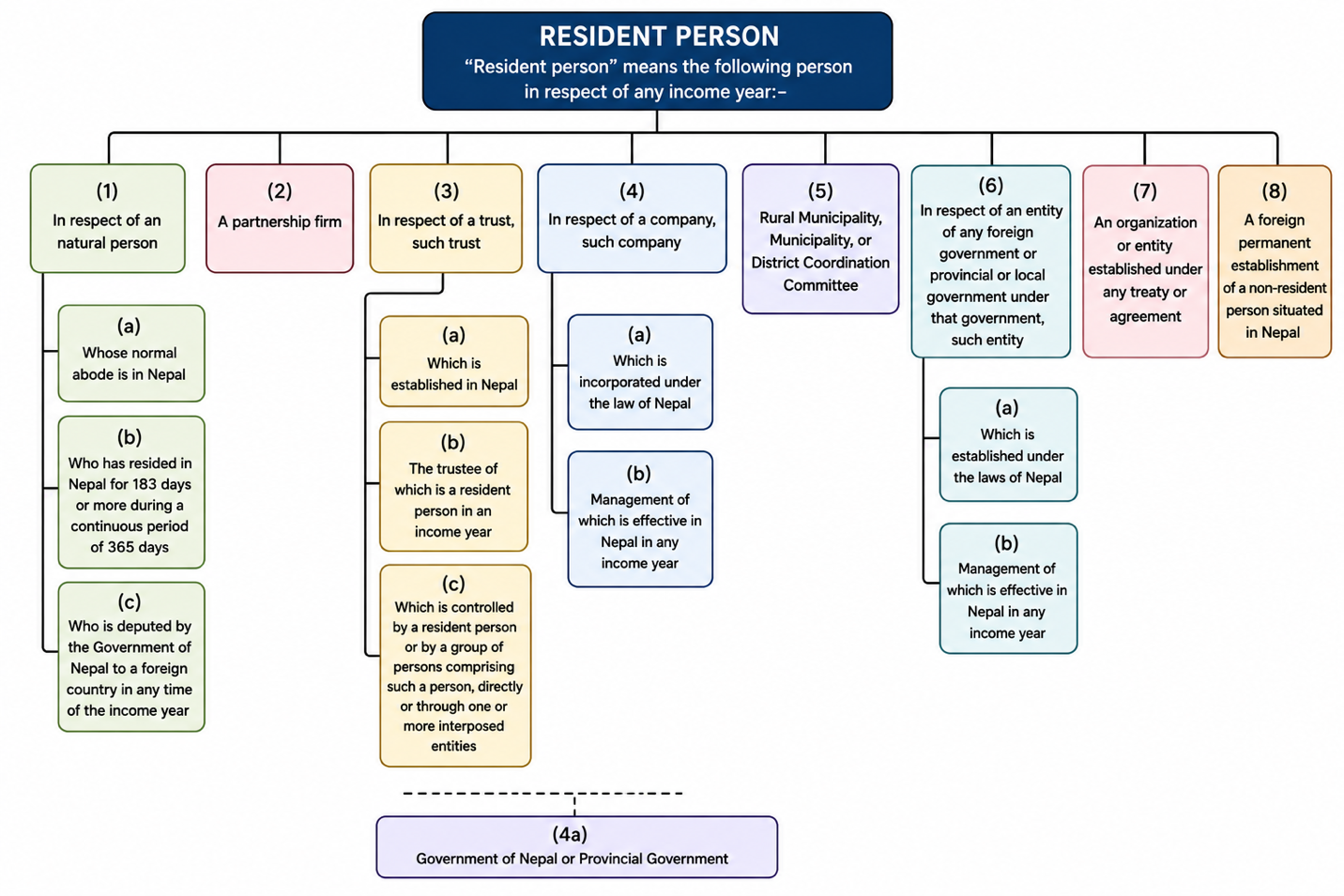
(ao) "Resident person" means the following person in respect of any income year:-
(1) In respect of an natural person,-
(a) Whose normal abode is in Nepal,
(b) Who has resided in Nepal for 183 days or more during a continuous period of 365 days, or
(c) Who is deputed by the Government of Nepal to a foreign country in any time of the income year.
(2) A partnership firm,
(3) In respect of a trust, such trust,-
(a) Which is established in Nepal,
(b) The trustee of which is a resident person in an income year, or
(c) Which is controlled by a resident person or by a group of persons comprising such a person, directly or through one or more interposed entities,
(4) In respect of a company, such company,-
(a) Which is incorporated under the law of Nepal, or
(b) Management of which is effective in Nepal in any income year.
(4a) Government of Nepal or Provincial Government,
(5) Rural Municipality, Municipality, or District Coordination Committee,
(6) In respect of an entity of any foreign government or provincial or local government under that government, such entity,-
(a) Which is established under the laws of Nepal, or
(b) Management of which is effective in Nepal in any income year.
(7) An organization or entity established under any treaty or agreement, and
(8) A foreign permanent establishment of a non-resident person situated in Nepal.
Habitual place of abode in Nepal refers to the place where the concerned person's main economic activity takes place; having a permanent address or house in Nepal alone does not make Nepal the habitual place of abode.
Example 2.17: Suppose Om Bahadur Thapa, who has a permanent home in Chitwan, went to Malaysia three years ago for foreign employment. He returns to Nepal once a year to visit his family. In this case, even though his permanent home is in Nepal, since his continuous residence and primary economic activity are not in Nepal, his habitual place of abode shall not be considered to be in Nepal.
Example 2.18: In Example 2.17 above, if Om Bahadur Thapa's business is in Nepal and he traveled to various countries outside Nepal for more than 183 days that year due to business or personal reasons, then since his major economic activities are in Nepal, his habitual place of abode shall be considered to be in Nepal.
Example 2.19: If Om Bahadur Thapa went to Malaysia on 6th Bhadra 2078 for foreign employment and returned to Nepal on 5th Bhadra 2080, after which he permanently resided in Nepal: since he left Nepal on 6th Bhadra 2078, he was present in Nepal for fewer than 183 days in a continuous 365-day period for income years 2078/79 and 2079/80, making him a non-resident for those income years. For income year 2080/81, since he was present in Nepal for 330 days, he is a resident of Nepal for that fiscal year.
Example 2.20: If Om Bahadur Thapa was posted on deputation by the Government of Nepal to the Nepali embassy abroad and has been working there for the past four years, then in such a case he shall be considered a resident of Nepal.
Example 2.21: Suppose a trust is in operation in Kolkata, India. If that trust is controlled by residents of Nepal, such trust shall also be considered a resident of Nepal. A foreign permanent establishment of a non-resident person located in Nepal shall also be considered a resident of Nepal.
(ap) "Person" means an natural person or entity.
The word person refers to both a natural person (such as Ram, John, Rahim) and a legal person (artificial person) such as a company, trust, institution, etc.
(aq) "Manager" means any person involved in making managerial decisions of any entity, and the term also includes a trustee of any trust and a person having ownership in a foreign permanent establishment.
For tax purposes, managers are jointly and severally liable for the tax obligations of the entity under Section 107 of the Act if the entity fails to pay tax by the due date.
(ar) "Occupation" means any kind of industry, business, profession or business transactions of similar other nature, and the term also includes past, present or future occupations of similar type.
Provided that this term does not include employment.
In employment, generally labor is consumed. In business and investment, both labor and capital are consumed. In investment, there is generally no active engagement of the person earning income in holding assets and earning income. In business, however, there is active engagement of the person in income-earning activities. Holding assets without active participation and earning only rent is considered investment, whereas if the person actively manages the property and rental income, it is considered business. Business includes industry (producing and selling goods), trading (buying and selling goods), profession, or similar commercial transactions.
(as) "Interest" means the following payment or profit:-
(1) Payment under debt liability except the principal,
(2) Profit made from concession, concession under debt liability, premium, alteration payment or from similar payment, and
(3) The amounts referred to in Section 32 receivable as an interest out of the payment to be made by a person who acquires any property under annuities or installment sale or of the payment made to any person for the use of any property under a financial lease.
Interest generally refers to the return on capital or investment. When an investment is returned with an amount greater than the capital invested, such excess is called interest. Discounts, premiums, or swap payments under a debt liability are also considered interest.
Example 2.22: Suppose a bank purchased a Treasury Bill issued by Nepal Rastra Bank with a face value of Rs. 1,00,00,000, payable in 90 days, for Rs. 98,50,000. Although the bank invested Rs. 98,50,000, since the bank shall receive Rs. 1,00,00,000 at the time of payment, the excess amount of Rs. 1,50,000 is considered interest.
Example 2.23: Suppose a financial institution provided a loan of Rs. 50,00,000 to a customer with an Annual Fixed Instalment of Rs. 11,48,037. If the interest rate on that loan is 10 percent, the principal repayment and interest income on such received instalments must be calculated as follows:
Outstanding Principal (Rs.) | Instalment Amount (Rs.) | Principal Repaid (Rs.) | Interest Amount (Rs.) |
50,00,000 | 11,48,037 | 6,48,037 | 5,00,000 |
43,51,963 | 11,48,037 | 7,12,841 | 4,35,196 |
36,39,122 | 11,48,037 | 7,84,125 | 3,63,912 |
28,54,997 | 11,48,037 | 8,62,537 | 2,85,500 |
19,92,460 | 11,48,037 | 9,48,791 | 1,99,246 |
10,43,669 | 11,48,037 | 10,43,670 | 1,04,367 |
68,88,222 | - | 50,00,000 | 18,88,222 |
(at) "Stock-in-trade" means the property owned by any person and to be sold in the course of regular business carried on by such person, the property in work-in-progress and the inventory of materials to be incorporated in the property.
Provided that this term does not include a property held in foreign currency.
Assets held directly or indirectly for sale in a business are called trading stock. Examples may differ depending on the nature of the person's business. Furniture is trading stock for a person who buys and sells furniture, but for other persons it would be a depreciable asset. Assets in progress (work-in-progress) in the course of production are also included in trading stock. Foreign currency and traveler's cheques held by a bank are not trading stock but are foreign currency assets.
(au) "Business asset" means any property used in any occupation.
Provided that this term does not mean stock-in-trade or depreciable assets of the occupation.
Business assets include all assets other than trading stock or depreciable assets of a business, such as shares, land, receivables, advance accounts, cash, and bank balances. All assets owned by a business other than trading stock and depreciable assets are business assets.
(av) "Distribution" means a distribution to be made by any entity as referred to in Section 53.
Generally, transactions conducted on arm's-length terms between an interest holder and an entity, and payments related thereto, are not distributions; all other payments by an entity are considered a distribution. Section 53 of the Act clarifies the distribution of profit and return of capital by an entity. Only when a distribution by an entity reduces the value of the assets and liabilities of that entity shall such distribution be considered a distribution of profit or return of capital.
(av1) "Electronic means" means computer, fax, email, internet, electronic cash machine and fiscal printer, and this term also includes other approved means as specified by the Department.
The Department may designate additional electronic mediums beyond those listed. Electronic mediums are used for filing returns, making payments, and conducting other tax-related transactions. The use of electronic mediums is encouraged by the Department and is mandatory for certain categories of taxpayers.
(aw) "Income sent abroad" means an income required to be sent abroad by a foreign permanent establishment of a non-resident person situated in Nepal as referred to in Section 68, which has been sent abroad through a bank or paid in any other manner.
For business or investment purposes, a non-resident person may have permanent establishments in Nepal. The obligation to file and pay tax on income of a foreign permanent establishment of a non-resident person located in Nepal rests with that establishment itself. Even though such establishments may be independent entities under the prevailing law of Nepal, they cannot independently distribute their profits and must remit their earned profits to the related parent company (non-resident). Such an amount is called income sent abroad. Income sent abroad in any income year equals the dividend amount distributed by the foreign permanent establishment in that year.
Example 2.24: Suppose the branch office of Global Life Insurance Company is a foreign permanent establishment of a non-resident person operating a business in Nepal. If the profit earned by that entity from conducting investment insurance business in Nepal is remitted to the parent company, such amount shall be considered income sent abroad, and only the balance after withholding tax at 5 percent shall be paid.
(ax) "Foreign income tax" means a foreign income tax referred to in sub-section (8) of Section 69 levied by any foreign country, and the term also includes any finally withheld tax levied by any foreign country.
Foreign income tax paid or payable by a resident person on foreign-source income may be credited against the Nepal income tax liability on such foreign income under Section 71 of the Act, subject to the limitations set out in that section.
(ay) "Foreign permanent establishment" means an entity referred to in sub-clause (5) of clause (x).
A foreign permanent establishment means an entity that is not located in its country of residence. For example, the branch office of American Life Insurance Company, USA located in Nepal is a foreign permanent establishment.
(az) "Department" means the Inland Revenue Department.
Under Section 72 of the Act, Large Taxpayer Offices, Medium Taxpayer Offices, Inland Revenue Offices, and Taxpayer Service Offices are all treated as components of the Department. Accordingly, the term Department refers to those offices as well. Actions taken by any subordinate office are deemed to be actions of the Department.
(aaa) "Property held in foreign currency" means any property held in a foreign currency other than Nepalese rupees.
Assets held in any foreign currency other than Nepali rupees are assets in foreign currency. For a bank, foreign currency held in its stock is treated as a foreign currency asset rather than as trading stock. The value of foreign currency assets must be converted to Nepali rupees at the applicable exchange rate for tax purposes.
(aab) "Permanent establishment" means a place where any person carries on a business fully or partly, and the term includes the following place:-
(1) A place where any person carries on a business fully or partly, through any agent except a general agent who acts independently in the ordinary course of carrying on business,
(2) A place where any person's main equipment or main machinery is situated or used or installed,
(3) One or more than one place in any country where any person has delivered technical, professional or consultancy service through an employee or in any other manner for more than ninety days at one or several times in a period of any twelve months, or
(4) A place where any person is involved in a construction, installation or establishment project and has carried out supervisory works of that project for a period of ninety days or more.
Fixed place + Dependent agent + Services (90 days rolling 12 months) + Construction (90 days) = PE
A fixed place (Fixed Place) where a person conducts their business is called a permanent establishment. For tax purposes, a foreign permanent establishment must be treated as an independent entity. For a non-resident person, a place of business falls under a foreign permanent establishment in the following circumstances:
Fixed Place Permanent Establishment: Any structure established in any manner by a non-resident to conduct business in Nepal is a permanent establishment. Such structures include branches, factories, workshops, management offices, oil wells, mines, gas wells, etc. For a non-resident's fixed place of business in Nepal, the duration of stay need not be counted to determine if it is a permanent establishment.
Example 2.25: Suppose American Sport Inc. opened a branch office on New Road to sell and distribute its goods in Nepal. Even if it is only a branch of a non-resident, it constitutes a permanent establishment under the Income Tax Act, 2058.
Agency Permanent Establishment: Where a person fully or partially carries on business through an agent in Nepal, other than an ordinary independent agent, the place of work of such agent is a permanent establishment. Where a local agent has been given authority by a foreign entity to enter into contracts and uses that authority in the normal course of business to enter into contracts in the name of that entity, such agency is considered a dependent agent, and the agent's place of business is a permanent establishment.
Example 2.26: Suppose American Sport Inc. appointed Amco Sports Pvt. Ltd. as its distributor in Nepal. If Amco Sports Pvt. Ltd. imports goods at its own risk and sets prices independently, it is not a Nepali permanent establishment of the American company. However, if Amco Sports Pvt. Ltd. operates as a dependent agent through which the American company sets the selling price and bears the profit and loss, it is considered a permanent establishment.
Service Permanent Establishment: Where a non-resident provides services in Nepal by sending employees or through other representatives, and the cumulative stay of such employees or representatives reaches 90 days in the preceding 12 months (90 days in a rolling 365-day period), the non-resident shall have a service permanent establishment.
Example 2.27: Suppose American Sport Inc. received work to conduct research in Nepal. It sent 2 employees for 35 days from January 1, then 2 employees for 30 days in July and 60 days in December. Since the employees stayed in Nepal for 90 days in the preceding 12 months, American Sport Inc. shall be considered to have a permanent establishment.
Construction and Installation Permanent Establishment: Where a non-resident carries out construction, installation, or assembly work in Nepal, and the presence continuously reaches 90 days or more, such site itself is a permanent establishment.
Example 2.28: Suppose Singapore Construction Company received an order of 100 days to drain mud from the Melamchi project tunnel. It sent 5 employees who completed the work within 95 days. Since Singapore Construction Company was continuously engaged in work in Nepal for more than 90 days, it shall be considered to have a permanent establishment.
(aac) "Property" means a tangible or intangible property of any kind, and the term also includes currency, good-will, technological knowledge, assets, any person's ownership or interest in a foreign branch, a right to make income or acquire income in the future and any part of such property.
Property includes any type of tangible or intangible property, currency, goodwill, technical knowledge, estate, ownership or interest in a foreign branch, the right to earn or receive income in the future, and any part of such property.
(aad) "Associated person" means any one or more than one person or group of persons who act as per the intention of each other, and the term also includes the following persons:-
(1) An natural person and relative of that person or any person or a partner of that person,
(2) A foreign permanent establishment and a person having ownership in that establishment, and
(3) Any entity which by itself or jointly with any other person related with it or with an assisting entity or any other person or entity related with such assisting entity controls fifty percent or more of the income, capital or voting right of any entity or derives benefits therefrom.
Provided that the following person shall not be an associated person:-
(1) An employee,
(2) A person specified by the Department as a non-associated person.
(4) For the purposes of Sections 33, 33A and 33B:
(a) An entity that, either by itself or together with its related persons, associated entities, or other persons/entities related to such associated entities, controls 30 percent or more of the income, capital, or voting rights of another entity, or derives benefit therefrom;
(b) An entity that receives a loan amount equal to 50 percent or more of its total assets from any person providing the loan;
(c) An entity whose income-generating activities are substantially or wholly dependent on the intellectual property rights, technical knowledge, or commercial rights of another person;
(d) An entity that supplies 90 percent or more of the raw materials or consumable goods required by another person.
Where an arrangement exists in which one person conducts transactions on behalf of or in the manner of another person, such a person is called an Associated Person. For income tax purposes, where a payment required to be made to a person is made to that person's associated person, such payment is deemed to have been made to that person.
Example 2.29: Suppose Ram and Binod are partners in Ram-Binod Partnership Firm. In that case, Ram and Binod are associated persons for that partnership. Even as partners, they are also associated persons with each other.
Example 2.30: Suppose Ram and Binod are partners in Ram-Binod Partnership Firm, and apart from that partnership, Ram and Binod each hold 35% shares in Nepal Company Limited. In that case, Ram and Binod are associated persons for Nepal Company Limited.
Example 2.31: Suppose Ram, Ram's wife, Ram's nephew, Binod, and Binod's grandson each hold 15% shares in Nepal Company, and Ram and Binod are partners in one firm. Due to family and partnership relationships, since 75% of Nepal Company's shares are held by associated persons, each person is an associated person.
Example 2.32: Suppose Kathmandu Company holds 60% and Bhaktapur Company holds 40% of the shares in Purva Upatyaka Company. Kathmandu Company and Purva Upatyaka Company are associated persons. If Upatyaka Company's shares are 40% from Purva Upatyaka, 40% from Lalitpur Company, and 20% from Kathmandu Company, then Upatyaka Company, Purva Upatyaka Company, and Kathmandu Company are mutually associated persons.
Example 2.33: Suppose (Ka) Limited has two subsidiary companies: (Kha) Ltd. (52% ownership) and (Ga) Ltd. (60% ownership). (Ga) Ltd. purchased 52% of the shares in (Ta) Ltd. (Kha) Ltd., (Ga) Ltd., and (Ta) Ltd. each purchased 18% of the shares in (Pa) Ltd. In such circumstances, each of the companies is considered an associated person.
(aad1) "Adjusted taxable income" means the taxable income of any person for any income year calculated without reducing any amount under Sections 12, 12A, 12B, 12C and 12D or without any deduction under sub-section (2) of Section 14, Section 17 or 18.
Adjusted taxable income is calculated without reducing any amount under Sections 12, 12A, 12B, 12C (charitable donations) and 12D (corporate social responsibility), without claiming deductions for interest under Section 14(2) (thin capitalisation), pollution control expenses under Section 17, or research and development expenses under Section 18. The concept is used to calculate the maximum deductible limit for each of these expense categories.
Type of Limit | What is NOT Deducted | What is Deducted (Without limitation) | Basis of Calculation |
Donation Limit | Donation amount | Sec 14(2), Sec 17, Sec 18 expenses | Taxable income after deducting Sec 14(2), 17, 18 but before donation |
Interest Limit | Donation, Sec 14(2) | Sec 17, Sec 18 expenses | Taxable income after deducting Sec 17, 18 but before donation and Sec 14(2) |
Pollution Control Expense Limit | Donation, Sec 17(2) | Sec 14(2), Sec 18 expenses | Taxable income after deducting Sec 14(2), 18 but before donation and Sec 17(2) |
R&D Expense Limit | Donation, Sec 18(2) | Sec 14(2), Sec 17 expenses | Taxable income after deducting Sec 14(2), 17 but before donation and Sec 18(2) |
(aae) "Partnership" means a firm consisting of less than twenty partners, whether registered under the law in force or not.
Provided that this term does not include a sole proprietorship or joint venture, whether registered or not.
A partnership firm with fewer than twenty partners, whether registered or not, is treated as a partnership for income tax purposes. If a partnership has twenty or more partners, it is treated as a company. A sole proprietorship or joint venture is not a partnership regardless of structure.
(aaf) "General insurance" means an insurance other than investment insurance.
General insurance is all insurance other than investment insurance. Examples include motor vehicle insurance, fire insurance, health insurance, and travel insurance. Premiums paid for general insurance may be deductible as a business expense, and claim amounts received may be includible in income depending on the circumstances. General insurance premiums for health and medical treatment purposes may qualify for the medical tax credit under Section 51 of the Act.
(aag) "General interest rate" means the rate of interest of fifteen percent per annum.
The ordinary (general) interest rate of fifteen percent per annum is the benchmark rate used throughout the Act for calculating interest on late payments of tax under Section 119, interest paid on tax refunds under Section 113(6), and for computing the interest component of financial lease and instalment payments under Section 32.
(aah) "Approved retirement fund" means a retirement fund having obtained approval from the Department pursuant to sub-section (1) of Section 63.
Retirement funds that have obtained approval from the Department to operate a retirement fund, the Employees Provident Fund, the Citizen Investment Trust, the Social Security Fund, and retirement funds operated by the Civil Servants' Retirement Gratuity Fund are called Approved Retirement Funds. Entities operating retirement funds without obtaining approval from the Department are called unapproved or disapproved retirement funds.
(aah1) "Safe Harbour Rule" means the conditions specified in Section 33A under which the transfer price shall be accepted as the arm’s length market value.
(aai) "Service charge" means any charge paid to any person, according to the market value, for the service rendered by such a person, and the term also includes any meeting allowance, management fee or technical service charge.
Service fee is a charge paid at market value to any person for services provided by that person. Examples include a fee paid to a consultant for services provided (Consultancy Fee), or remuneration paid to an auditor for providing audit services. However, the salary paid to an internal auditor who is an employee is included under remuneration (employment income), not service fee. Service fees are subject to advance tax withholding under Chapter 17 of the Act.
(aaj) "Shareholder" means a beneficiary of any company.
A shareholder is a person who has an interest in a company. In the context of income tax, shareholders receive dividends from companies. Dividends distributed to shareholders are subject to final withholding tax under Section 88 of the Act. A shareholder's interest in a company is a non-business chargeable asset or a business asset depending on the circumstances.
(aak) "Depreciable property" means a property, which is used in any business or investment for earning income, and declines in value because of wear and tear, being old or passage of time.
Provided that the term does not mean stock-in-trade.
The depreciation deduction is calculated on a pooling basis under Section 19 and Schedule 2 of the Act.
(aal) "Beneficiary" means a person who has an interest referred to in clause (y) in any entity.
Interest holder (beneficiary) refers to a partner in a partnership firm, a shareholder in a limited liability company, an investor (natural person making retirement contributions) in a retirement fund, a partner in a joint venture, and a person who holds ownership in a permanent establishment. The interest held by a beneficiary in a retirement fund is specifically excluded from the definition of non-business chargeable assets under Section 2(r)(3).
(aam) "Prescribed" or "as prescribed" means prescribed or as prescribed in the Rules framed under this Act.
Where the Act uses the words 'prescribed' or 'as prescribed,' the Government of Nepal must prescribe them by making regulations. Accordingly, the Government of Nepal has issued the Income Tax Regulations, 2059 and prescribed therein matters that need to be prescribed. Such matters prescribed in the regulations are treated as part of the Act. The Department may also issue directives (such as the Income Tax Directive, 2066) prescribing operational details within the authority granted by the Act and Regulations.
Chapter-2 Tax Bases
3. Tax to be levied
Tax shall be levied on each of the following persons in each income year and be collected pursuant to this Act:-
(a) A person who has taxable income in any income year,
The income on which tax is computed using the tax rate is called the tax base. The income remaining after claiming expense deductions on income received in accordance with Section 7 (business income) and Section 9 (investment income) of the Act, reduced by any income exempt under Section 11 or retirement fund income under Section 64 or both, together with the amount under Section 8 (employment income), is called assessable income. The taxable income is then the amount computed by deducting from the assessable income any amount claimed under Sections 12, 12A, 12B, 12C, or Section 63, or under all such sections. This amount is called the tax base, and the tax is computed by applying the rates specified in Schedule 1 of the Act.
(b) A non-resident person's foreign permanent establishment situated in Nepal, which sends income of any income year abroad pursuant to sub-sections (3) and (4) of Section 68, and
Income remitted abroad by a foreign permanent establishment located in Nepal is also deemed to be the tax base for income tax purposes, and income tax on such taxable income must be computed by applying the tax rate specified in Schedule 1, Section 2(6).
(c) A person who receives payment liable to final tax withholding in any income year.
Payments subject to final withholding tax are also deemed to be the tax base, and the tax payable on such income must be computed by applying the tax rates specified in Sections 87, 88, 88A and 89 of the Act. In addition, Section 95A provides for the collection of advance tax.
The payment subject to withholding tax at source is the payment from which tax is withheld. When a payer makes a payment that is subject to withholding tax, the payer must withhold tax at the specified rate on behalf of the payment recipient at the time of making the payment.
The tax base is further illustrated in the diagram below:
Tax Base (Section 3) | ||
Section 3(a) | Section 3(b) | Section 3(c) |
Taxable income (Defined in Section 5) x Tax rate (Schedule 1) - Medical tax credit - Foreign tax credit | Income remitted abroad (Defined in Sections 2, 68(3) and 68(4)) x Tax rate (Schedule 1, Section 2(6)) | Payment subject to final withholding (Defined in Section 92) x Tax rate (Sections 87, 88, 88A and 89) |
4. Computation and rate of tax
(1) The amount of tax required to be paid by any person referred to in Section 3 for any income year shall be equal to the total amount of tax required to be paid by such person in the capacity of any one person or more than one person mentioned in clauses (a), (b) and (c) of that Section.
In accordance with Section 3 of the Act, the tax liability of a person consists of: the tax required to be filed by a person with taxable income in any income year; the tax required to be filed on income remitted abroad by a foreign permanent establishment located in Nepal; and the tax required to be filed on a payment subject to final withholding tax. Where a person has one or more of these capacities, the total of all such tax amounts constitutes the tax that person is required to file.
Example 5.5.1: Suppose the branch office of Global Life Insurance Company is a permanent establishment of a non-resident person located in Nepal, conducting business in Nepal with authorisation from the relevant authority. That entity is required to file tax in three separate capacities: tax on the taxable income from the insurance business conducted in Nepal; tax withheld on dividends received from shares purchased in another company; and, where that entity remits profits to its parent company, tax on income remitted abroad in accordance with Schedule 1, Section 2(6). The total tax required to be filed in these separate capacities constitutes the total tax of that entity.
(2) In computing the tax required to be paid by any person referred to in clause (a) of Section 3, it shall be computed by applying the related rates mentioned in Schedule-1 to the taxable income of that person for that income year. In so computing the tax, it shall be computed by deducting the amount that is adjustable in tax, and claimed by that person pursuant to Section 51 or 71 or both.
A natural person may deduct from the tax required to be filed any medical tax credit (Medical Tax Credit) claimable under Section 51 of the Act, or any foreign tax credit (Foreign Tax Credit) claimable under Section 71 of the Act, or both amounts, from the tax liability. The following example illustrates this situation.
Example 5.5.2: Suppose Sankalpa Thapa, a resident person, had foreign-source employment income of Rs. 7,00,000 in income year 2080/81, and paid income tax of Rs. 55,000 in the country where that income was sourced. If he is a single person, his tax liability for that income year is computed as follows:
Description | Amount (Rs.) |
Assessable foreign-source income | 7,00,000 |
Less: Exempt amount | - |
Taxable income | 7,00,000 |
Tax computation: | |
On Rs. 7,00,000 at 1% | 7,000 |
Tax payable before foreign tax credit | 7,000 |
Nepal's average tax rate (tax before foreign tax credit / taxable income) | 1% |
Claimable foreign tax credit (Nepal's average tax rate x assessable foreign income) (700000*1%) | 700 |
Foreign tax paid | 55,000 |
Amount to be carried forward (remaining unpaid foreign tax) | 54,300 |
Net tax liability remains after crediting foreign tax against total tax liability is Rs. 7,000-700= 6,300 | |
(3) Notwithstanding anything contained in sub-section (2), the tax payable by a resident natural person referred to in clause (a) of Section 3, who has fulfilled all of the following requirements, shall be equal to the total amount of tax deducted pursuant to Section 87 from the payments made by the employer to such resident natural person in that income year:-
(a) Only the income of any employment having source in Nepal is included in the income of that income year,
(b) All employers have been resident persons in that income year and there is only one employer at one time, and
(c) The employer has made a claim for the adjustment of tax for medical expenses paid by the employer and for the retirement contribution paid by the employer itself, and has not made a claim to deduct expenses for donation pursuant to Section 12.
Only Nepal salary income + resident employers + one employer at a time + claimed only employer paid medical and retirement payments + no donation deduction = TDS is the final tax & No filing of Tax Return Required
In accordance with Section 4(3) of the Act, where a person has only one employer at any one time and has claimed only the medical tax credit for medical expenses paid by the employer and retirement contributions paid by the employer itself, and has not claimed donation expenses, and where the tax on employment income payable and paid by that person has been withheld under Section 87, that person is not required to file an income return. Where a taxpayer's employer changes during the income year, such a taxpayer, in order to avail themselves of this benefit, must present the tax deduction certificate showing the payment received from the previous employer and the tax withheld on such payment to the new employer. The new employer must also adjust the payment made by the previous employer and the tax withheld on such payment, compute the tax on the payment made by the new employer, and withhold tax on such payment in accordance with Section 87. Where a person has more than one employer at the same time, that person is required to file an income return.
Example 5.5.3: Suppose Harish Mathema, an employee, was working at Nepal Bank Ltd. (NBL) in income year 2080/81. He had no other income apart from employment at NBL. He received a salary and allowances of Rs. 5,00,000 from NBL in that income year. NBL deposited Rs. 80,000 into his NBL retirement fund and deducted Rs. 20,000 from his salary and deposited it into the Citizens Investment Fund on his behalf. He claimed a deduction for the retirement contribution amount deposited but did not claim any donation expense or medical tax credit. In this case, he is not required to file an income return. In this situation, the tax withheld by NBL from the salary payment in accordance with Section 87 of the Act is his tax liability.
(4) Notwithstanding anything contained in sub-section (2), the tax payable in any income year by a resident natural person referred to in clause (a) of Section 3, who has fulfilled all of the following requirements, shall be equal to the amount mentioned in sub-section (7) of Section 1 of Schedule-1:-
(a) That person has only income earned from business having source in Nepal in that income year,
(a1) Has not claimed for tax adjustment for medical expenses under Section 51 and for advance tax deduction under Section 93,
(b) The taxable income earned from the business does not exceed three lakh rupees and the turnover of the business does not exceed thirty lakh rupees,
Only Nepal-source business income + No Sec. 51/93 claims + Income ≤ Rs. 3 lakh + Turnover ≤ Rs. 30 lakh = Presumptive Tax as per Schedule 1(7).
Location of Business Operation | Minimum Tax Amount (Rs.) |
Metropolitan City / Sub-Metropolitan City | 7,500 |
Municipality | 4,000 |
Areas other than above mentioned(e.g., Rural Municipality) | 2,500 |
Example 5.5.4: Suppose Mintu Jonathan has a sole proprietorship business called Zenith Industries located in Bareshwar, Kathmandu. That business had sales of Rs. 14 lakhs in income year 2076/77. The business earned income of Rs. 1,42,000 in that year, which included interest income of Rs. 8,500 received from a bank after Rs. 1,500 had been withheld at 15 percent on Rs. 10,000. During that year, he also incurred Rs. 6,000 on medical treatment. If Mintu Jonathan opts for the provision under Section 4 of the Act, his tax liability in accordance with Schedule 1, Section 1(7) is Rs. 7,500. However, the advance tax of Rs. 1,500 withheld from the deposit interest income of that business cannot be credited against his tax liability, and even though he incurred medical expenses, the tax credit claimable under Section 51 of the Act cannot be credited against his tax liability.
(4a) Notwithstanding anything contained in sub-section (2), the tax to be paid on the basis of turnover in any income year by a resident natural person referred to in clause (a) of Section 3, who has met the following conditions, shall be equal to the amount calculated according to the rate prescribed in sub-section (17) of Section 1 of Schedule-1:-
(a) That person has only income earned from business having source in Nepal in that income year,
(b) The taxable income earned from the business is up to ten lakh rupees and the turnover of the business is more than thirty lakh rupees and up to one crore rupees,
(c) ......,
(d) Income is not from consultancy and expertise services provided by doctors, engineers, auditors, legal professionals, sportspersons, artists, consultants and the like natural persons.
Only Business Income + Income ≤ Rs. 10 Lakh + Turnover Rs. 30 Lakh-1 Crore + Not Professional Income = Turnover-Based Tax under Schedule 1(17).
Nature of Business | Turnover Range | Tax Rate |
Trading in goods with commission/value addition up to 3% (including petrol & cigarette) | Rs. 30 lakh - Rs. 50 lakh | 0.25% |
Above Rs. 50 lakh - Rs. 1 crore | 0.30% | |
Other businesses | Rs. 30 lakh - Rs. 50 lakh | 1.00% |
Above Rs. 50 lakh - Rs. 1 crore | 0.80% | |
Service businesses | Above Rs. 30 lakh - Rs. 1 crore | 2.00% |
(4b) Notwithstanding anything contained in sub-sections (4) and (4a), the person must have opted for such provision to apply in that income year.
(5) In computing the tax required to be paid by any foreign permanent establishment referred to in clause (b) of Section 3, it shall be computed by applying the rates mentioned in sub-section (6) of Section 2 of Schedule-1 to the income sent abroad by such establishment in that income year.
Tax is levied on income remitted abroad by a foreign permanent establishment located in Nepal at the rate of 5 percent as specified in Schedule 1, Section 2(6).
Example 5.5.5: Suppose the branch office of Global Life Insurance Company is a permanent establishment of a non-resident person conducting business in Nepal with authorisation from the relevant authority. That entity earned income of Rs. 3 crores 50 lakhs from the investment insurance business in Nepal in income year 2080/81. It remitted Rs. 2 crores to its parent company in that year. Accordingly, tax of Rs. 10 lakhs, computed at 5 percent on the income remitted abroad in accordance with Schedule 1, Section 2(6), must be filed.
(6) The amount of tax required to be paid by the person referred to in clause (c) of Section 3 shall be equal to the total amount computed by applying the rates mentioned in Sections 87, 88, 88A. and 89 to the amount of each payment liable to final tax withholding received by that person in that income year.
Payments subject to final withholding tax as mentioned in Section 92 of the Act do not need to be included in income.
In computing the tax liability of a person, the provisions and rates specified in Schedule 1, Sections 1 and 2 of the Act must be applied to the taxable income. The details are set out in the tables below.
Tax Computation Framework - Natural Persons | |
Section 5 Taxable Income | |
Amount to be deducted from taxable income | |
Subsection (5) - Remote area allowance | |
Subsection (6) - Foreign allowance | |
Subsection (9) - Retirement allowance limit (not applicable from income year 2077/78) | |
Subsection (10) - Disability limit | |
Subsection (12) - Life insurance | |
Subsection (16) - Health insurance | |
Subsection (16A) - Private building insurance | |
Schedule 1 rate applied on remaining taxable income after deductions | |
Amount to be deducted | |
Subsection (11) - Women employment tax credit | |
Section 51 - Medical tax credit | |
Section 71 - Foreign tax credit | |
Tax Liability | |
Tax Computation Framework - Entities | |
Taxable Income - Section 5 | |
Tax rate per Schedule 1, Section 2 | Amount to be deducted |
Section 71 - Foreign tax credit | |
Tax Liability | |
5. Taxable income and classification of income headings
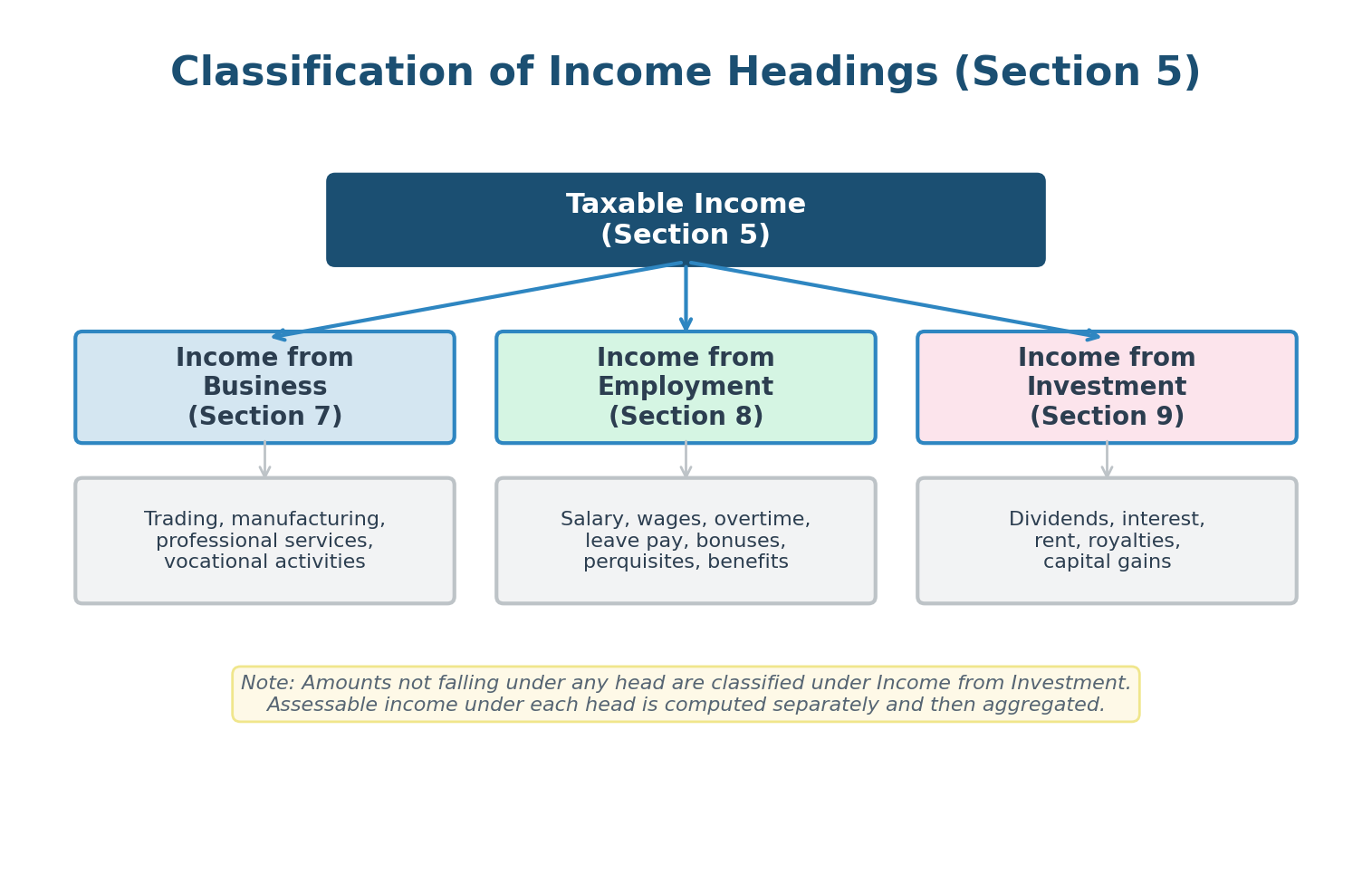
Figure: Classification of Income under Three Headings (Section 5)
The taxable income of any person in any income year shall be equal to the amount computed by subtracting the amount, if any, claimed pursuant to Sections 12, 12A, 12B, 12C, 12D, 63 or all these Sections from the grand total amount of assessable income of each of the following income headings in that income year:-
(a) Business,
(b) Employment,
(c) Investment, and
(d) Windfall gain.
The provisions for computing taxable income are set out in the table below:
Provisions for Computing Taxable Income | |||
Description | Business Income | Employment Income | Investment Income |
Turnover (Inclusions) | Amounts required to be included in income under Section 7 (excluding amounts mentioned in subsection (3)) | Amounts required to be included in income under Section 8 (excluding amounts mentioned in subsection (3)) | Amounts required to be included in income under Section 9 (excluding amounts mentioned in subsection (3)) |
Less - Deductible amounts: | |||
Amounts deductible under Sections 13 to 21 | Deduction claimable | Not applicable | Deduction claimable |
Amounts transferred to risk reserve fund under Section 59(1A)/(1B) | Banking business and cooperative institutions - Deduction claimable | Not applicable | Not applicable |
Amounts claimable under Section 60(2)(b) | General insurance business - Deduction claimable | Not applicable | Not applicable |
Foreign tax paid under Section 71(4) | Claimable as expense where foreign tax credit is not claimed | Claimable as expense where foreign tax credit is not claimed | Claimable as expense where foreign tax credit is not claimed |
Income | Income | Income | Income |
Less - Amounts not to be included in assessable income: | |||
Amounts exempt under Section 11 of the Act | Deduct exempt amounts from income | Not applicable | Deduct exempt amounts from income |
Income of an approved retirement fund not subject to tax under Section 64 of the Act | Deduct exempt amounts from income | Not applicable | Not applicable |
Assessable Income | Assessable Income | Assessable Income | Assessable Income |
Donation amount deductible under Section 12 of the Act | Natural persons and entities - claimable | ||
Expenditure on conservation of natural resources and development of sports under Section 12A of the Act | Only companies - claimable | ||
Contribution to Prime Minister Disaster Relief Fund and Nepal Government Reconstruction Fund under Section 12B of the Act | Natural persons and entities - claimable | ||
Grant of up to Rs. 1 lakh per startup business as seed capital to a maximum of 5 startup businesses (other than related persons) under Section 12C of the Act | Natural persons and entities - claimable | ||
Retirement contribution amount under Section 63 of the Act | Only natural persons - claimable | ||
Taxable Income | |||
A natural person may have income from employment, business and investment heads, while a person other than a natural person (an entity) may only have income from business and investment heads. Where a person has income from more than one income head, the total assessable income of all such income heads for that income year constitutes the assessable income of that taxpayer for that income year. In computing the taxable income for that income year, donations given to tax-exempt institutions, gifts and retirement contributions may be deducted from assessable income of any source.
6. Assessable income
Subject to this Act, the following incomes earned by any person for any employment, business, investment or windfall gain in any income year shall be considered assessable income:-
(a) Income earned by a resident person from his employment, business, investment or windfall gain in that income year irrespective of the place of source of his income, and
(b) Income earned in that income year by a non-resident person from employment, business, investment or windfall gain having income source in Nepal.
Provided that the assessable income shall not include any income exempted from tax pursuant to Section 11 or 64 or both.
See table in Section 5 for better understanding.
Assessable income is the amount remaining after including amounts required to be included in each income head and deducting all permissible expenses, and then reducing that figure by income exempt from tax under Section 11(1) and (2) for agricultural and cooperative business income, and income of approved retirement funds exempt under Section 64(2). Income tax is levied on the worldwide income (Global Income) of a resident person regardless of the source of income, while tax is levied in Nepal on a non-resident person only on income with a Nepal source.
3 Computation of Income
7. Computation of income from business
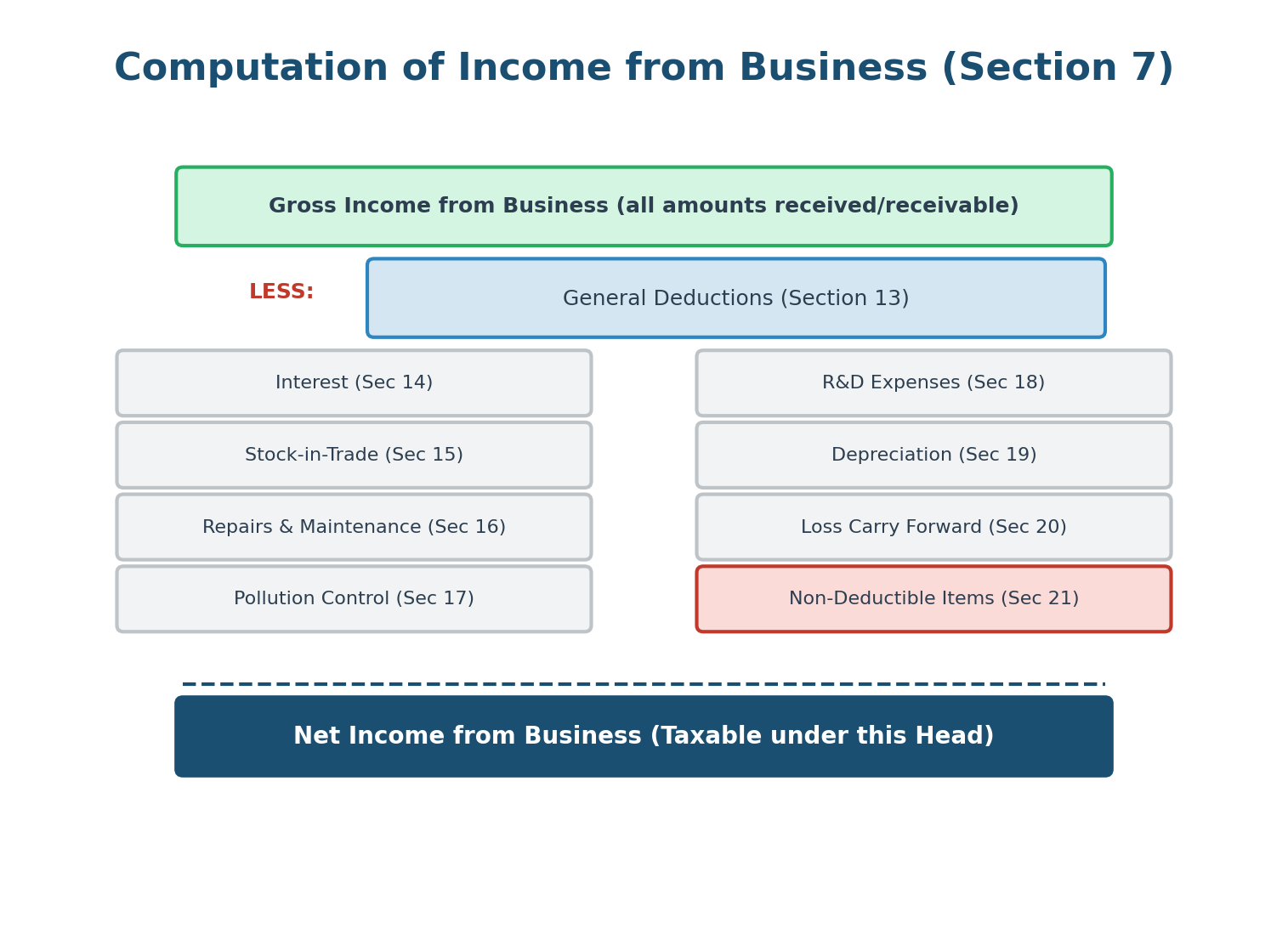
Figure: Computation of Income from Business (Section 7)
(1) The profits and gains made by any person in any year from any business shall be the income of that business of that person in that income year.
The total of profits and gains remaining after deducting expenses from income earned from conducting any such business, together with gains from the disposal of other assets, constitutes the business income.
Business includes industry (manufacturing and selling goods), trading (buying and selling tangible or intangible goods), profession, or similar commercial transactions. There is sometimes confusion between business (particularly professional service) and employment. The following points help distinguish business from employment:
(i) Mode of work: An independent contractor must complete a specified task - direction on the mode of working is generally not given. However, workers or employees are given clear instructions on the mode and nature of work.
(ii) Use of materials and tools: An independent contractor uses or purchases their own materials and tools to complete assigned work. The employer provides materials and tools to workers or employees.
(iii) Work timing: An independent contractor is given a deadline for completing work and sets their own schedule within that time. Workers or employees are generally told when and at what time to work and usually work full-time.
(iv) Person performing the work: An independent contractor can complete assigned work with or without assistance. Employees generally complete assigned work themselves or through their assistant.
(v) Exclusivity: An independent contractor can work with more than one client at a time, whereas employees generally work with a single employer.
(vi) Training: An independent contractor arranges their own training and bears all costs. The employer arranges and bears training costs for employees.
(vii) Payment arrangement: An independent contractor is paid based on quality or time of work. This may not apply to employees.
(viii) Continuity of relationship: An independent contractor's relationship with the employer lasts until the specified work is completed. An employee's relationship is continuous.
(ix) Calculation of remuneration: An independent contractor bears profit/loss risk and receives a fixed amount for any work. Employees are paid fixed remuneration for specified hours without room for profit or loss.
Independent contractor (business income) = own mode of work, own tools, own schedule, multiple clients, self-arranged training, bears profit/loss risk, relationship ends when task done;
Employee (employment income) = directed work, employer's tools, fixed timing, single employer, continuous relationship
The following accounting method applies to business income:
Accounting Method by Person and Income Head | ||
Person | Head of Income | Accounting Method |
Natural Person | Employment, Investment | Cash Basis (except Section 22(2) restriction) |
Natural Person | Business | Cash or Accrual Basis |
Company | Business, Investment | Accrual Basis |
Bodies other than Company | Business, Investment | Cash or Accrual Basis |
Example 18.4.1: Suppose ABC Company is a manufacturing company. In FY 2080/81, Rs. 2 crore was received from operations and Rs. 20 lakh gain was made from selling business assets. The total of Rs. 2 crore 20 lakh is business income for tax purposes in that FY.
(2) In computing the profits and benefits earned by any person from the business in any income year, it shall be computed so as to include the following amounts received by that person within that year:-
(a) Service charge,
(b) Amount obtained from the disposal of stock-in-trade,
If any person holds foreign currency, such property is a business asset, not stock-in-trade. Foreign currency must be converted to Nepali currency per Section 28 and included in cash and bank balances. Exchange gains or losses from conversion are not included in income or deducted as expense for income tax purposes. Only exchange gains or losses at the rate at the time of receiving or using foreign currency property must be included. For banks and financial institutions, Nepal Rastra Bank's standards apply.
(c) Net profit derived from the disposal of business assets or business liability of any person, computed pursuant to Chapter-8,
While the service charges mentioned in clause (a) and the amounts received from the disposal of stock-in-trade mentioned in clause (b) require the full amount received (Gross Receipt) to be included in income, clause (c) does not require the full amount of the payment to be included. Instead, net gain or profit must be computed in accordance with Chapter 8 of the Act, and only the net gain amount is required to be included in income.
(d) Amount considered to have been derived pursuant to clause (a) of sub-section (2) of Section 4 of Schedule-2 from the disposal of depreciable property of the business,
Where the depreciation base (the amount before deducting depreciation expense) of all assets in any pool of depreciable assets is less than the amount received from the disposal of any asset in that pool, the excess amount is treated as a gain under this section and must be included in computing income. This is clarified by the examples below.
Example 6.2.1: Suppose ABC Company has the following assets in pool 'B' for income year 2080/81 before depreciation deduction: Pool 'B' contains furniture and computers with an opening depreciation base of Rs. 9,00,000. If the furniture is sold for Rs. 10,00,000, the amount to be included in profit and gain is computed as follows and amounts to Rs. 1,00,000. Depreciation base of all assets in pool 'B' (a): Rs. 9,00,000. Amount received from disposal of furniture in pool 'B' (b): Rs. 10,00,000. Gain (b-a): Rs. 1,00,000.
Example 6.2.2: Suppose in Example 6.2.1 above, the furniture was sold for only Rs. 8,00,000. In that case, the depreciation base of pool 'B' assets would be Rs. 1,00,000, and depreciation expense would be claimed accordingly. Depreciation base of all assets in pool 'B': Rs. 9,00,000. Amount received from disposal of furniture in pool 'B': Rs. 8,00,000. Depreciation base remaining: Rs. 1,00,000.
Even if a gain arose from the disposal of furniture in the taxpayer's financial accounting (Financial Accounting), for income tax purposes gain must be computed on a pooled basis. A gain on an individual asset basis should not be included in income. Gain or loss for income tax purposes must be computed and included in income or as an expense in the income return only when all assets in a pool are disposed of.
Example 6.2.4: Suppose in Example 6.2.1 the computer broke down and became unusable, or was stolen. In such a case, disposal is deemed to have occurred under Section 40 of the Act and is computed as follows: Depreciation base: Rs. 9,00,000. Amount received from disposal: Rs. 0. Remaining depreciation base: Rs. 9,00,000. In the above example, since not all assets of pool 'B' have been disposed of and the pool is not dissolved, depreciation expense must be claimed in the following income year based on the same remaining depreciation base.
Example 18.4.2: ABC Company's Pool 'B' depreciation base before depreciation in FY 2080/81 is Rs. 9,00,000. If furniture in that pool is sold for Rs. 10,00,000: Depreciation base of Pool 'B' (B): Rs. 9,00,000; Amount received from disposal (A): Rs. 10,00,000; Gain (A - B): Rs. 1,00,000. This gain of Rs. 1,00,000 must be included in business income as per Section 7(2)(d).
Example 18.4.3: If all assets in Pool 'B' (furniture Rs. 10,00,000 and computers Rs. 5,00,000, total Rs. 15,00,000) are sold and the pool is dissolved, the gain from dissolution is: Rs. 15,00,000 (disposal proceeds) minus Rs. 9,00,000 (depreciation base) = Rs. 6,00,000. This Rs. 6,00,000 gain must be included in business income.
Example 18.4.4: If the computer in Example 18.4.2 became irreparable or was stolen, disposal is deemed under Section 40. Depreciation base Rs. 9,00,000; disposal proceeds 0; remaining base Rs. 9,00,000. Since furniture remains in Pool 'B', pool dissolution has not occurred, so depreciation continues on the remaining base of Rs. 9,00,000.
(e) Gift received from any person in respect of the business,
If any gifts are received from any person in the course of business, such gifts must also be included in business income. "Gift" means a payment without consideration, or where there is consideration, the portion of the payment exceeding the market value of the consideration.
Example 6.2.5: Suppose Diwakar is a dealer for a TV company. In income year 2080/81, since he was able to achieve the target set by the TV company, that company provided him with a music system worth Rs. 50,000 as a gift. Such additional benefit received in connection with the business is treated as a gift received in connection with business, and such a gift must be included in business income.
(f) Amount received for having accepted any restriction in connection with the operation of the business,
Example 6.2.6: Suppose Nepal Rasbari Factory and Gusbari Co. Pvt. Ltd. have a contract under which Gusbari pays Nepal Rasbari Rs. 1 lakh per month in exchange for Rasbari agreeing not to sell its products in the Kamalpadi area. In this situation, Nepal Rasbari must include the Rs. 1 lakh received for accepting such restriction in its income.
(g) Amount received by a person, even though it is of the nature of income from investment, that is directly connected to and received in the course of that person's business, and
For example, interest income received by banks and financial institutions from loan investments must be included under this clause for the purpose of computing income under this section. Although income from loan investment is ordinarily income earned from investment, since the principal business activity of banks is loan investment, interest income must be included and reported under this clause.
(h) Other amounts required to be included pursuant to Chapter-6 or 7 or Section 56 or 60.
Section/Provision | Nature of amount |
Section 22 | Amounts per accounting method (cash or accrual) |
Section 22 | Amounts from change in accounting method |
Section 23 | Cash basis amounts |
Section 24 | Accrual basis amounts |
Banking approved method | Banking business amounts |
Section 25 | Written-off bad debts recovered |
Section 26 | Long-term contract amounts |
Section 27 | Benefit quantification |
Section 28 | Foreign currency conversion |
Section 29 | Indirect payment quantification |
Section 31 | Compensation amounts |
Section 32 | Financial lease and annuity |
Section 33 | Value transfer amounts |
Section 34 | Income splitting amounts |
Section 35 | General tax accounting rule amounts |
Section 56 | Profit distribution income |
Section 60 | Insurance business amounts |
As provided in Chapter 6 of the Act, if a person changes their accounting method for tax purposes without obtaining approval from the Department, or if the accounting method changes due to other provisions in that chapter, an adjustment must be made in the income year of the change to ensure that no amount is omitted or duplicated in the amounts included, deducted, or to be included or deducted in computing that person's income. This is clarified in the following example:
Example 6.2.7: Suppose Deven Mahara is a legal professional. He has been accounting for income from his profession on a cash basis. He submitted an application to the Department to change his accounting method from Cash Basis to Accrual Basis from income year 2080/81. Since the accounts were consistent with prevailing accounting principles, the Department approved the change effective from income year 2080/81.
At the time of the accounting change, his accounts were as follows:
(1) Services rendered up to income year 2079/80 but not yet received in cash, therefore not included in income for that year: Rs. 80,000.
(2) Advance received up to 2079/80 for services to be rendered in 2080/81, included in income for 2079/80 on cash basis even though services not yet rendered: Rs. 30,000.
(3) House rent prepaid from Magh 2079 to end of Poush 2080, paid in 2079/80 and claimed as expense for that year on cash basis: Rs. 48,000.
In this situation, the following income and expense adjustments must be made in income year 2080/81:
(1) Rs. 80,000 receivable for services already rendered up to income year 2079/80 must be included in income for income year 2080/81 on the Accrual Basis.
(2) The advance of Rs. 30,000 received before services were rendered up to 2079/80 was already computed as income in 2079/80; even though services are rendered in 2080/81, it should not be included again in that year's income to avoid duplication.
(3) Out of the prepaid house rent of Rs. 48,000, Rs. 24,000 relating to 6 months falls in income year 2080/81, but since it was already claimed as a deduction in income year 2079/80 on the cash basis, it cannot be claimed again in income year 2080/81.
After making such adjustments to income and expense items in income year 2080/81 to avoid duplication, accounting must be done on the Accrual Basis in subsequent income years.
As mentioned in Chapter 7 of the Act, where a transaction is settled not in cash but by transfer of an asset, the amount equal to the market value of such transferred asset must be included in income. The value of the transferred asset is not the value stated in the agreement between the parties or the book value, but the market value determined at the time of transfer, which is treated as the official transaction value for the purposes of the Act and must be included in income.
Example 6.2.8: Suppose Digam Bantawa provided services to an organization called Scott Nepal Pvt. Ltd. Instead of paying cash, the organization gave Digam a television. The market value of that television is Rs. 50,000. In this situation, Bantawa is treated as having received a payment equivalent to Rs. 50,000 even without receiving a cash payment.
Included in business income u/s 7(2): (a) service charge (incl. meeting, management & technical fees) + (b) disposal of stock-in-trade + (c) net gain on disposal of business assets or liabilities (per Ch 8) + (d) gain on disposal of depreciable assets + (e) business gifts + (f) amount for accepting a business restriction + (g) investment-type income directly related to the business + (h) amounts under Ch 6 or 7 or Sec 56 or 60
(3) Notwithstanding anything contained in sub-section (2), the amounts deductible under Sections 10, 54 and 69 and payments from which tax is withheld finally shall not be included in computing the profits and benefits derived from the operation of business.
In accordance with Section 10 of the Act, the following amounts shall not be included in income:
(a) The exempt amount received by any person eligible for a tax exemption as provided in a bilateral or multilateral treaty or agreement between the Nepal Government and any foreign country or international organization.
Any amount received by a person eligible for a tax exemption under a bilateral treaty between the Nepal Government and any foreign country or international organization, while subject to that treaty, constitutes an exempt amount.
(g) Donations, gifts, or other contributions directly related to the activities of an exempt organization received by that organization with or without the expectation of a return are treated as exempt amounts.
Example 18.5.1: See Example 9.2.6
(j) Amounts earned by Nepal Rastra Bank in accordance with its objectives.
Example 18.5.3: See Example 9.2.9
(l) Amounts earned by a Collective Investment Fund (Mutual Fund) approved by the Securities Board of Nepal in accordance with its objectives are also treated as exempt amounts and shall not be included in income.
(m) Amounts earned by an educational institution established and operating on the basis of a memorandum of understanding with the Nepal Government with the objective of not earning or distributing profit, in accordance with its objectives, are also treated as exempt amounts and shall not be included in income.
Example 18.5.2: An international NGO selected a tax-exempt NGO to run computer education training for street children. Since the international NGO expected training in return, even though the receiving body is tax-exempt, the amount received is a service charge, not a donation, and is not tax-exempt.
Final withholding payments need not be included in income.
Dividends distributed by a company or partnership:
Dividends distributed by companies and partnerships are taxed through final withholding per Section 54.
Amounts distributed by Controlled Foreign Entities:
Dividend amounts distributed by controlled foreign entities per Section 69(2) need not be included in income.
Excluded from business income u/s 7(3): amounts deductible u/s 10 (exempt), 54 & 69 + payments under final WHT.
8. Computation of income earned from employment
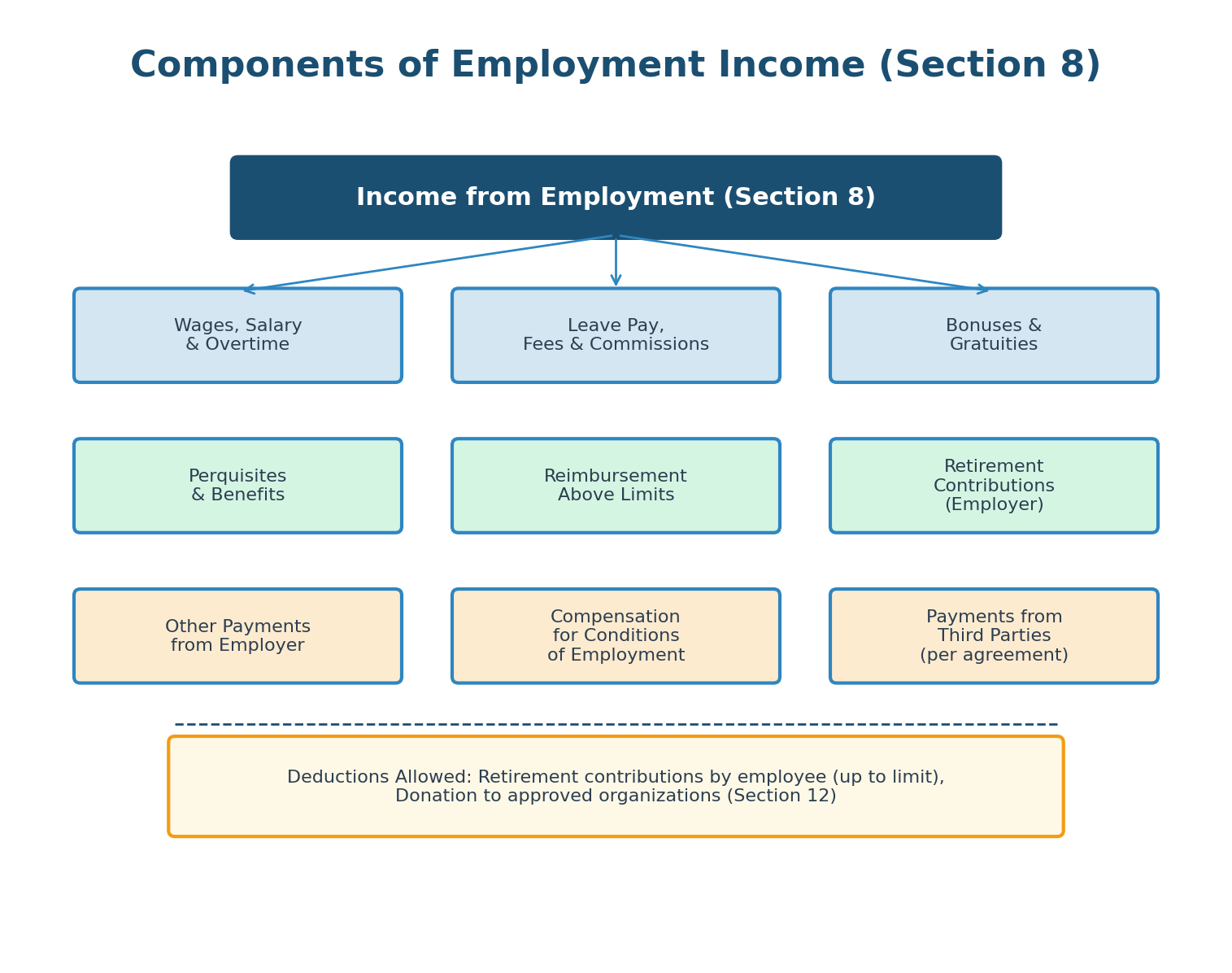
Figure: Components of Employment Income (Section 8)
(1) The remuneration derived by any natural person from employment in any income year shall be computed as the income earned from employment by that person in that year.
In computing employment income, the amounts received directly or indirectly by an employee from an employer in cash, goods, services or benefits in the course of employment must be included.
Employment and Consultant: There is sometimes verbal confusion between employment and a consultant. Generally, a Contract of Service signifies employment while a Contract for Service indicates a consultant. "Employment" means the condition under which a person working for a particular natural person or body in a managerial, supervisory, administrative, technical, or any other similar capacity, where written or unwritten employee service conditions and benefits or similar conditions of that body apply, and such a body pays a salary, wage, or other similar payment. Such an natural person or body can be resident or non-resident.
A payment that establishes the relationship between the worker and the employer is to be included in employment.
Example 17.2.1: Suppose Ramila is employed at a certain body with a monthly remuneration of Rs. 50,000. Similarly, a person named Hanif has been appointed to study market conditions for the same body and submit a report within six months for a remuneration of Rs. 3,00,000. The body makes payment to Hanif at a rate of Rs. 50,000 per month. In this situation, the payment to Ramila falls under employment (Contract of Service), while the payment to Hanif falls under a service charge (Contract for Service). Hanif must include the total amount received (before tax) in his business income and claim the tax deducted as advance tax.
Remuneration received by the employee for past, present, and future employment must be included in employment income and tax calculated on a cash receipt basis..
Example 17.2.2: Suppose Katrina was appointed as a store keeper at Samari Institution in 2069 with a monthly salary of Rs. 20,000. Since the institution's financial condition was not good, it could not pay salaries from Baisakh 2074 onwards. Katrina resigned in Baisakh 2076 and started working at Bikash Bank Limited. When the institution's financial condition improved, Katrina received Rs. 4,80,000 in a lump sum from Samari Institution on Shrawan 10, 2080. In this case, the lump sum remuneration received must be included in income under FY 2080/81, i.e., the financial year of receipt, on a cash receipt basis as per Section 22 of the Act. Here, Samari Institution is the past employer and the remuneration received is income from past employment.
Example 17.2.5: Suppose an industry sent an employee at a cost of Rs. 5,00,000 to undergo training to gain expertise in operating machinery used in its production operations. Since the purpose of such training expense is for the industry's business, such expense should not be included in the concerned employee's income. However, if such expense is not related to the employer's business, such training fees must be included in the concerned employee's income as per Section 22 of the Act.
Employment income = return for services under a Contract of Service (employer-employee bond); a Consultant works under a Contract for Service = business income.
Covers past (already left), present (currently working) and future (signed for a fixed future start) employment; taxed on cash-receipt basis u/s 22
(2) The following payments made by an employer to an natural person in any income year shall be included in computing the remuneration earned by such natural person from employment in that income year:-
(a) Amount for wages, salary, leave, amount for overtime work, fee, commission, prize, gift, bonus, and payment for other facilities,
Wages and Salary: There is not much practical difference between wages and salary. Both terms refer to the return received for providing services. For income tax purposes, since salary and wages are calculated under the same income head in determining employment income, it is not necessary to distinguish between them.
Leave Amounts: Workers and employees may receive various types of leave according to the employee regulations or their contract with the institution, such as annual leave, sick leave, special leave, contingency leave, etc. The amount payable to the employee for accumulated leave not used during employment or at the time of termination of employment is called the leave amount. As per Rule 20, Sub-rule (6), Clause (a), the principal, interest, and other amounts accumulated in an employee's Provident Fund or Citizens Investment Trust in income years prior to the commencement of the Act, and the gratuity and accumulated leave amounts earned up to that date, shall be tax exempt.
Fees: Fees received by an employee from an employer in the context of employment (such as job joining fees or similar payments) must be included in employment income.
Commission and Bonus: Amounts paid based on predetermined management criteria related to sales targets, profit targets, legal obligations, or other similar reasons are called commission and bonus amounts. A medical representative appointed as an employee by a pharmaceutical manufacturing company, in addition to salary, receives commission based on sales ratio or performance bonus, and bonuses given to employees under the Bonus Act are examples of this.
Prize and Gift: A payment received from an employer for outstanding work by an employee is called a prize or gift. If such prizes or gifts are received in kind rather than cash, they should be valued at prevailing market price and included in income as per Section 8. If such a prize or gift is received from an open competition in which employees and other persons can also participate, such prize and gift need not be included in employment income.
Example 17.3.1: Suppose a commercial bank gave Rs. 10,000 cash as a prize to its outstanding employee on its annual celebration. The employee must include such prize in employment income as per Section 8 of the Act.
Example 17.3.2: Suppose a commercial bank, in coordination with the National Sports Council, organized a national-level running competition on its annual celebration, with provisions for the general public including the bank's employees to participate. If one of the bank's employees became outstanding in that running competition and received a prize of Rs. 20,000, since the awarded person received the prize as an outstanding runner and not as an employee of the bank, the employee need not include such prize in employment income as per Section 8 of the Act. Such amount will be windfall gain income for that employee.
(b) Payment for any personal allowance including amount for cost of living allowance, subsistence allowance, rent, entertainment or transport allowance,
(c) Payment received for settlement of or reimbursement of expenses incurred by him or his associated person for personal purpose,
Associated Person: In the context of an employee, associated person means the relatives of that person. "Relative" is defined in section 2.
Personal Purpose: If an employee of a body or their associated person has incurred expenses for their personal work and received such amount from the body as reimbursement, then since such payment was for personal purposes, it must be included in their employment income.
Example 17.3.3: Suppose a person named Bharat is an employee at a company. He went on a holiday trip with his family for vacation. As per the company's rules, the company pays transportation expenses for such a trip. In this situation, since the transportation expenses paid by the company for the holiday trip are personal expenses of Bharat, they must be included in Bharat's employment income.
Example 17.3.4: Suppose a person named Hari Prasad is employed at a company. His son studies at a school called Kid Bold and he pays Rs. 10,000 per month in school fees. He takes such fee amount as monthly reimbursement from the company where he works. Since such reimbursement is not for the employer's business purpose but for the employee's personal purpose, the payment received as such reimbursement must be included in his employment income.
(d) Payments made for having given consent to any terms of employment,
Example 17.3.5: Suppose a bank agreed to pay the Chief Executive Officer 5 percent of the bank's earned profit as an incentive as a condition of appointment. The amount received as such payment must be included in employment income.
(e) Payments made for termination, loss of employment or for compulsory retirement,
Termination of Employment: An employee may be retired from employment through loss of employment, retirement, compulsory retirement, or any other method. Regardless of the modality through which the employee is retired from employment, the retirement payment received from the employer must be paid after deducting tax at 15% on the payment as per Section 88(1) of the Act. Since such payment is a final withholding payment as per Section 92(1)(f) of the Act, it need not be included in employment income as per Section 8(3) of the Act.
Loss of Employment: Loss of employment is one of the processes of retirement. For example, liquidation, privatization with a condition of not retaining current employees, a situation where an employee/worker at an institution becomes incapacitated and unable to work, employees facing retrenchment, etc. In such situations, the compensation amount received from the relevant institution due to such loss of employment must be included in employment income as per Section 8(2)(e) of the Act. However, since tax must be deducted at 15% on payment as per Section 88(1) of the Act and it is a final withholding as per Section 92(1)(f), such amounts need not be included in employment income during calculation as per Section 8(3).
Example 17.3.6: Suppose in the process of privatizing Krishi Samari Institution, the employees were to be retired but a decision was made to provide, in addition to the usual benefits for loss of employment, additional salary as compensation at the rate of 2 months per year of service. In this context, a person named Dipak received the following payments: Previous salary and benefits: Rs. 80,000; Leave amount earned before the Act came into force: Rs. 50,000; Gratuity earned after the Act came into force: Rs. 2,50,000; Additional salary received as compensation: Rs. 4,00,000.
Of the above payments, the leave amount of Rs. 50,000, the gratuity of Rs. 2,50,000, and the additional salary of Rs. 4,00,000 are subject to 15% tax deduction on payment as per Section 88(1), and since they are final withholding amounts as per Section 92(1)(f), they need not be included in income. However, the previous salary and benefits of Rs. 80,000 must be included in employment income.
Compulsory Retirement: The process by which an institution retires a specified group of workers/employees from employment, or retires them upon reaching a specified period/age as per Staff Regulation, is called compulsory retirement. In giving compulsory retirement other than retirement upon reaching the period/age specified in Staff Regulation, special benefits may also be provided. Such payment received as special benefit is a retirement payment, and therefore, tax must be deducted at 15% on payment at source as per Section 88(1), and since it is a final withholding as per Section 92(1)(f), it need not be included in employment income during calculation as per Section 8(3).
Termination, loss of employment & compulsory-retirement payments (incl. gratuity, leave, VRS special benefits) = 15% TDS at source u/s 88(1), final withholding u/s 92(1)(f), so NOT included in employment income u/s 8(3); only normal salary & benefits are included
Example 17.3.7: Suppose a commercial bank, in the process of reducing employees, allowed employees who had completed 20 years of service to apply for voluntary retirement, and for employees retiring under this VRS scheme, provided special benefits of 2 months' salary for each year of service. Under this scheme, an employee named Rasik Kalam retired effective from Ashadh end of 2065. As per the bank's rules, those with more than 15 years of service received gratuity at 2 months' salary rate, and those with more than 20 years received 2.5 months' salary rate, paid by the bank. As per the employee regulations before Chaitra 18, 2058, he also received three months' medical treatment expenses at the time of retirement. His payments in FY 2064/65 including retirement amounts were as follows:
Salary at retirement | Rs. 20,000 per month |
Salary in Chaitra 2058 | Rs. 15,000 per month |
Allowances | Rs. 10,000 per month |
Service period | 25 years (19 years until Chaitra 18, 2058) |
Leave | 150 days (60 days until Chaitra 18, 2058) |
Dashain expense | Rs. 20,000 |
Retirement contribution | 10% of salary |
Description | Employment Income | Retirement Payment |
Salary Rs. 20,000 x 12 months | 2,40,000 | |
Allowances Rs. 10,000 x 12 months | 1,20,000 | |
Dashain expense | 20,000 | |
Retirement fund contribution (10% of 2,40,000) | 24,000 | |
Gratuity (25 x 2.5 x 20,000 = 12,50,000) Less: Gratuity earned until Chaitra 18, 2058 (19x2.5x20,000) | 12,50,000 (9,50,000) | |
Medical treatment: not applicable | ||
VRS benefit (25 x 2 x 20,000) | 10,00,000 | |
Leave earned from Chaitra 19, 2058 (90 days) (20,000/30 x 90) | 60,000 | |
Total | 4,04,000 | 13,60,000 |
As per Rule 20, Sub-rule (6), Clause (a), leave, gratuity, and medical treatment expenses earned until Chaitra 18, 2058 are tax exempt. The employer must deduct tax at 15% on payment for VRS/CRS benefit, gratuity, and leave amounts, and since the amounts paid after such tax deduction are deemed final withholding payments as per Section 92(1)(f), they need not be included in employment income during calculation as per Section 8(3).
(f) Retirement payment and retirement contribution including the amount deposited by the employer for that employee in the retirement fund,
"Retirement payment" means a payment made to the following persons:
(1) a payment made to a natural person upon their retirement, or
(2) a payment made to a natural person's dependent upon that natural person's death.
The conditions under which payment can be made from an approved retirement fund are as per Rule 20(2)(d): payment from a retirement fund can only be made to the beneficiary of the retirement fund in the following situations:
(1) when the employee or worker is retired from service,
(2) when the beneficiary reaches the age of 58 years, or
(3) when the beneficiary dies or becomes permanently disabled.
As per Rule 20(6): Notwithstanding anything written above,
(a) the principal, interest, and other amounts accumulated in an employee's or worker's Provident Fund or Citizens Investment Trust in income years prior to the commencement of the Act, and the gratuity and accumulated leave amounts earned up to that date, shall be tax exempt; and
(b) medical treatment expenses up to Rs. 1,80,000 payable to employees or workers who were in service when the Act commenced, upon retirement as per their service conditions regulations, shall not be included in the income of such employees or workers.
Example 17.3.8: Hafiz Singh works at a government company with a monthly remuneration of Rs. 20,000. In addition to monthly remuneration, Rs. 2,000 per month is deposited in a retirement fund in his name, which is called the retirement contribution, and such amount must be included in his employment income.
(g) Other payments made in respect of employment, and
Eg: holiday trips and shopping, must also be included in employment income.
(h) Other amounts required to be included pursuant to Chapter-6 or 7.
Any person must quantify and characterise various facilities provided by the employer and include them in their own income.
Method and Timing of Tax Accounting for Employment Income: Tax accounting for employment income must be done on a cash basis for natural persons. As per Section 22(2) of the Act, a natural person must account for income from employment on a cash basis for tax purposes. An amount shall be deemed received and included in the calculation of income only when they receive payment or when such payment becomes available to them.
Example 17.3.9 Suppose Kamal is an employee at Samari Institution. This person received Rs. 2,40,000 (at the rate of Rs. 20,000 per month for Shrawan 2078 to Ashadh 2079) only in Shrawan 2080. In this situation, since accounting is done on a cash basis, the amount must be included in income for tax purposes in the month of receipt, Shrawan 2080. Therefore, under this method, regardless of which financial year the income was earned, it must be included in the income of the financial year in which it was received.
Indirect Payment: As per Section 29 of the Act, if any person indirectly benefits from a payment made by the payer or their associated person, or designates another person to receive the payment, the Department may, by issuing written notice, deem such benefiting person or the person making such designation as the person receiving such payment.
Example 17.3.17 Suppose Hari Prasad is a retired government employee. He has arranged for his wife, who lives separately from him, to receive his pension. Even though he has designated another person to receive payment, the Department may issue written notice and deem the person benefiting, i.e., his wife, or the person making such designation, i.e., him, as the person receiving such payment.
Included in employment income u/s 8(2): (a) wages, salary, leave pay, overtime, fees, commission, prizes, gifts, bonus & similar + (b) personal allowances (cost-of-living, rent, entertainment, transport) + (c) employer reimbursement of the employee's personal expenses + (d) payment for agreeing to employment conditions + (e) payment for termination or loss of employment + (f) retirement payment & retirement contribution (incl. employer's fund deposit) + (g) other employment-related payments + (h) amounts under Ch 6 or 7
(3) Notwithstanding anything contained in sub-section (2), the following matters need not be included in computing the remuneration earned by any natural person from employment:-
(a) The amounts deductible under Section 10 and payments from which tax is withheld finally,
(1) Amounts exempt under Section 10 of the Act with regard to employment:

(2) Payments subject to final withholding tax:
Section 92 of the Act provides for payments subject to final advance tax withholding. Income received after final withholding tax has been deducted shall not be included in computing employment income. Those payments include: benefit received by a resident person from investment insurance; benefit received by a resident person from an interest in an unapproved retirement fund; all types of retirement payments (other than regularly paid pension); meeting allowances up to Rs. 20,000 per meeting; windfall gain payments; returns distributed by Collective Investment Funds (Mutual Funds) to natural persons; and rent or freight payments for the vehicle or transport means of a natural person (other than a sole proprietorship).
Example 17.4.1: Suppose Mr. Harish is a foreign national working at a foreign embassy in Nepal. He has been working there continuously for the past 5 years and receives salary and allowances paid from that foreign government's official treasury. In this situation, the source of his income is not deemed to be Nepal. Since his residency in Nepal is solely because of that employment and he is a resident of Nepal, his received salary and allowances are not subject to remuneration tax. However, if he has business, investment in Nepal, or employment income paid from sources other than that foreign government's official treasury, tax will apply.
Example 17.4.2: Suppose in Example 17.4.1, Mr. Harish's father Mr. Jack is a foreign national and has been living in Nepal with his son for a long time after retiring from government service there. If he receives a monthly pension of GBP 2,000 from that foreign government, the said pension amount received by him need not be included in income calculation as per Section 10, Clause (c) of the Act.
Example 17.4.3: Suppose Ratnakar De Silva is a non-Nepali citizen. If the Government of Nepal appoints him as a specialist to assist the peace process with a monthly payment of USD 20,000 on a no-tax condition, then the payment amount received by him need not be included in income.
Example 17.4.4: Suppose Ram Bahadur is a Captain employed in the Indian Army. After completing 20 years of service, he currently lives in Dhikura Thok Gaun Palika of Kanchanpur District. He receives monthly Indian pension of INR 20,000 from the Indian Pension Camp in Pokhara. He is also working as Security Chief at Bikash Bank Limited with a monthly remuneration of Rs. 15,000. In this situation, the monthly INR 20,000 received from the Indian government's state treasury as pension need not be included in employment income. The monthly Rs. 15,000 received from Bikash Bank Limited must be included in income as per Section 8 of the Act.
Example 17.4.5: Suppose Ram Prasad is an employee working at the officer level at Bikash Bank Limited. He purchased ordinary shares worth Rs. 1,00,000 in Nabil Bank. The bank declared a dividend of Rs. 5,000 on such shares and after deducting advance tax of 5%, i.e., Rs. 250, it paid the remaining Rs. 4,750 to him. Since the dividend after final withholding tax is received as Rs. 4,750, Ram Prasad need not include such amount in his employment income.
Example 17.4.6: Suppose Vishwa Compass Pvt. Ltd. rented 8 anna of land from a person named Rahim Mia at Rs. 10,000 per month to operate its business. Rahim Mia is also employed at a non-governmental office with a monthly remuneration of Rs. 30,000. The Pvt. Ltd. deducted advance tax at 10% on the contracted amount of Rs. 10,000 and paid the remaining Rs. 9,000 to the landlord Rahim Mia. Since the land rent income received by the landlord Rahim Mia is after final tax deduction, he need not include it in income.
Example 17.4.7: Suppose an employee working at Bikash Bank Limited has life insurance at an insurance company. While accumulating premium at Rs. 1,000 per month for such insurance, Rs. 2,00,000 had been paid in premiums by the end of Ashadh 2080. Since this insurance matured, the insurance company paid Rs. 3,00,000 and deducted 5% tax on the profit of Rs. 1,00,000 (3,00,000 - 2,00,000) and paid the benefit. In this situation, the payment received by the employee need not be included in income.
Example 17.4.8: Suppose Haris is an employee at Bikash Bank. He deposited a total of Rs. 10,00,000 in a savings account. If he received Rs. 1,00,000 interest on that account in FY 2080/81, the bank deposited Rs. 1,00,000 in his account and simultaneously debited advance tax at 6%, i.e., Rs. 6,000, from his account. Haris need not include such received interest in employment income. However, interest received from a bank account related to his business must be included in income. In addition, interest received from other persons not mentioned in Section 88(3) must be included in income, and if tax has been deducted at the time of payment, such deducted tax amount can be set off against the tax liability as advance tax.
Example 17.4.9: Suppose Hari Prasad Kafle was appointed as an Assistant at Ne.Ba.Li. (Nepal Bank Limited) on Baisakh 1, 2044. He retired from service on Jestha 1, 2065. At the time of retirement, he received the following amounts:
(1) Provident Fund - principal until Chaitra 18, 2058: Rs. 4,00,000
(2) Provident Fund - principal from Chaitra 19, 2058 to end of Baisakh 2065: Rs. 8,00,000
(3) Provident Fund - interest until Chaitra 18, 2058: Rs. 1,50,000
(4) Provident Fund - interest from Chaitra 19, 2058 to end of Baisakh 2065: Rs. 1,50,000
Total Provident Fund to be received: Rs. 15,00,000
As per Rule 20, Sub-rule (6)(a) of the Income Tax Regulations, 2059, the tax-exempt amount must be calculated as follows:
Provident Fund principal before Act came into force: Rs. 4,00,000
Provident Fund interest before Act came into force: Rs. 1,50,000
Total Provident Fund amount exempt: Rs. 5,50,000
Retirement payment calculation after Act came into force:
Provident Fund (retirement fund) amount after Act: Rs. 8,00,000
Interest on Provident Fund (retirement fund) after Act: Rs. 1,50,000
Total Provident Fund amount: Rs. 9,50,000
The Provident Fund amount after the Act is called a retirement fund. If such retirement fund is an approved retirement fund, the payment from that fund must be calculated as follows for tax purposes:
Total amount received from approved retirement fund after Act came into force: Rs. 9,50,000
As per Section 65, Subsection (1), Clause (b) when calculating profit, 50% of the payment amount or Rs. 5,00,000 whichever is higher must be deducted:
(1) 50% of payment amount: Rs. 4,75,000
(2) Specified amount: Rs. 5,00,000
Since a total of Rs. 9,50,000 was received from the approved retirement fund after the Act came into force, and Rs. 5,00,000 is exempt from profit as per Section 65, Subsection (1), Clause (b), tax must be deducted at 5% on the remaining Rs. 4,50,000 as per Section 88, Subsection (1) before paying the balance.
If the retirement fund after the Act came into force is an unapproved retirement fund, 5% advance tax must be deducted on the difference between the received amount and the contributed amount as per Section 88(2)(c).
Suppose:
(1) Provident Fund - from Chaitra 19, 2058 to end of Baisakh 2060 - principal: Rs. 4,50,000
(2) Interest on Provident Fund for same period: Rs. 50,000
Total payment amount: Rs. 5,00,000
Of the principal amount, Hari Kafle's own contribution is Rs. 4,50,000, so tax must be deducted as follows:
(1) Payment to be made: Rs. 5,00,000
(2) Own contribution to the fund: Rs. 4,50,000
Profit for tax purposes: Rs. 50,000
As per Section 88(2)(c), advance tax at 5% amounting to Rs. 2,500 must be deducted on payment and the remaining paid.
Example 17.4.10: Suppose Nilima Shrestha is a professor working at a campus. She received Rs. 1,000 as meeting allowance for attending one of the campus's meetings. She also received Rs. 1,500 for teaching a special class in English at another campus and additionally received Rs. 10,000 for preparing question papers and Rs. 20,000 for marking answer sheets. Tax must be deducted at 15% on the meeting allowance of Rs. 1,000, and on Rs. 1,500 for occasional teaching, Rs. 10,000 for question paper preparation, and Rs. 20,000 for answer sheet marking, and the payments received after such tax deduction need not be included in employment income calculation.
However, if Nilima also regularly teaches at another institution three times per week and receives monthly remuneration, such remuneration must be included in income as per Section 8 of the Act.
(b) Food and tiffin provided by the employer to the employee at the work site in a manner that it is available to all employees on the same terms,
Meals and refreshments provided by the employer to employees at the workplace, uniformly available to all employees on equal terms, need not be included in employment income.
Example 17.4.11: Suppose a call center named Call America Pvt. Ltd. provides food equally to all employees present at the office daily, costing an average of Rs. 200 per person per day. The snacks received equally by employees at the workplace need not be included in employment income. However, if food and snacks are provided to employees in cash rather than in kind, it must be included in the concerned employee's employment income.
(c) The settlement or reimbursement of the following expenditure incurred by any employee:-
Reimbursements or settlements received by an employee from an employer for expenses incurred in fulfilling the employer's business purpose need not be included in the employee's employment income.
Example 17.4.12: Suppose Gopi is working as an employee at Nepal Bank Limited's Head Office, Kathmandu. While on official duty, he was sent on assignment to Nepal Bank Limited Pokhara for four days and received: Daily travel allowance for 4 days at Rs. 1,000 per day: Rs. 4,000; Airfare Rs. 3,000 x 2: Rs. 6,000; Other expenses as per bills: Rs. 1,000; Total: Rs. 11,000. Gopi went to Pokhara in the course of official work and submitted bills for reimbursement, which were approved by the authorized person. Such Rs. 11,000 received from the employer is for the employer's business purpose and need not be included in his remuneration income.
(1) The expenditure fulfils the business purpose of the employer, or
(2) The expenditure exempted or to be exempted in the computation of income from the natural person's business or investment.
(d) Payment of such petty amounts of which accounts are impracticable or administratively difficult to maintain as prescribed.
(e) The amount equivalent to sweat equity shares received as remuneration for employment in the information technology industry.
Rule 6: In making payment of petty amounts mentioned in Clause (d) of Sub-section (3) of Section 8 of the Act, the payer may make payment of a maximum of Five Hundred Rupees at a time for tea expenses, stationery, gift, prize, casual medical treatment and for similar kind of payment as specified by the Department.
Explanation: For the purposes of this Section, "payment" means the following payment:-
(a) Made by the employer,
(b) Made by the associated person of the employer, and
(c) Made by any third person as referred to in the agreement made with the employer or his associated person.
Excluded from employment income u/s 8(3): (a) Section 10 exempt amounts + payments under final WHT + (b) food/tiffin provided at the workplace equally to all employees + (c) reimbursement or settlement of employer-business-purpose expenses + (d) prescribed petty payments up to Rs. 500 per occasion (Rule 6: tea, stationery, gift, prize, casual medical)
9. Computation of income earned from investment
(1) The profits and benefits derived by any person from investment in any income year shall be the income earned by that person from that investment in that year.
Investment means the act of holding (Holding) assets and earning income. Keeping assets for personal use by the owner, or owning assets used in employment or business, is excluded - while ownership of other assets and keeping non-business taxable assets are called investment.
Generally, the person earning income from investment activities does not need to be actively and continuously involved.
(2) The following amounts received by any person in any income year shall be included in computing the profits and benefits derived by that person from investment in that income year:-
(a) Dividend, interest derived from that investment, payment for natural resources, rent, royalty, profit from investment insurance, profit from interest in a retirement fund which has not got approval pursuant to sub-section (1) of Section 63, or retirement payment made from an approved retirement fund,
Similarly, royalties received for granting permission for petroleum exploration or for use of technical support or a trademark must also be included in investment income. However, dividend amounts received, interest and rent received by a natural person other than through business, profit from investment insurance, and retirement payments from a retirement fund, where tax has been withheld in advance under Section 88 and is treated as final withholding tax under Section 92, need not be included in investment income. However, where such income is paid by a non-resident (except dividends where the non-resident entity is a controlled foreign entity under Section 69), such income must be included in profit and gain.
Example 6.4.4: Suppose Harris & Co. made a loan investment of Rs. 1,00,000 in ABC Company Ltd. at 10 percent interest. That company paid interest of Rs. 10,000 at 10 percent, withheld advance tax of Rs. 1,500 at 15 percent under Section 88(1), and paid the balance of Rs. 8,500. In this situation, Harris & Co. must include the full amount of Rs. 10,000 in its investment income. Similarly, if Mr. Harris, as a personal investment, invested Rs. 1,00,000 in ABC Company Ltd. (which is not authorised to issue debentures) at 10 percent interest, and the company paid interest of Rs. 10,000, withheld advance tax of Rs. 1,500 at 15 percent under Section 88(1), and paid the balance of Rs. 8,500, then Harris must include the full amount of Rs. 10,000 in his investment income and file an income return. However, if he deposited the amount in a bank or in an entity authorised to issue debentures and received interest, such interest received after tax deduction is treated as a final withholding tax payment, and Harris need not include such interest income in his investment income.
(b) Net profits derived from the disposal of non-business taxable assets of the investment of that person, computed pursuant to Chapter-8,
Non-business taxable assets are assets not directly used in business or investment. When non-business taxable assets comprising land, buildings and interests in any entity are disposed of, the net gain received at the time of disposal must be included in income. In computing such net gain, the net gain is the amount remaining after deducting expenses from income and further deducting any undeducted losses.
Example 21.4.2: Suppose Haris had purchased 100 units (kirra) of shares of ABC Company Ltd., listed on Nepal Stock Exchange, for Rs.20,000/- on date 2080.08.20. He sold those shares for Rs.25,000/- on date 2081.08.15. The net gain of Rs.5,000/- from disposal of shares not related to a natural person's business - i.e., non-business chargeable assets - must be included in his investment income.
(c) If, in disposing the depreciable property of the investment made by that person, the incomings to be received exceed the remaining value comprising the outgoings made for the property of the group of depreciable property pursuant to clause (a) of sub-section (2) of Section 4 of Schedule-2, the excess amount,
(d) Gift received by that person in respect of investment,
Example 6.4.5: Suppose Haris invested Rs. 2 crores in shares of Sampanna Bank Ltd. In some income year, the bank provided shareholders with a share investment exceeding Rs. 1 crore with a one-tola gold coin as a gift for Dashain. Since the gold coin was received as a gift in connection with an investment, such a gift must be valued at market value and included in investment income.
(e) Retirement payment made in respect of that investment and retirement contribution including the amount deposited in the retirement fund for that person,
(f) Amounts received for having accepted any restriction in connection with investment, and
(g) Other amounts required to be included pursuant to Chapter-6 or 7 or Section 56.
Included in investment income u/s 9(2): (a) dividend, interest, natural-resource payment, rent, royalty, investment-insurance profit, unapproved retirement-fund profit / approved-fund retirement payment + (b) net gain on disposal of non-business taxable assets (Ch 8) + (c) gain on disposal of depreciable investment property + (d) gift relating to investment + (e) retirement payment & contribution relating to investment + (f) amount for accepting an investment restriction + (g) amounts under Ch 6 or 7 or Sec 56
(3) Notwithstanding anything contained in sub-section (2), the following matters shall not be included in computing profits and benefits derived by any person from investment:-
(a) The amounts deductible under Sections 10, 54 and 69 and payments from which tax is withheld finally, and
(b) The amounts to be included in computing income earned by that person from employment or business.
To avoid double counting, amounts included in computing income earned from employment or business shall not be included in investment income. Amounts included in computing business income under Section 7 and amounts included in computing employment income under Section 8 shall not be included in computing investment income.
Investment income is thus a residual income that is computed or defined only after computing income from employment and business.
Investment income is residual = computed only after employment & business income (9(3)(b)). Excluded u/s 9(3): Sec 10 / 54 / 69 amounts + final-WHT payments. A natural person's dividend, interest, rent, investment-insurance & retirement income with final TDS u/s 88/92 is not included; but the same income from a non-resident is included.
Chapter-4 Exemptible Amounts and Other Exemptions
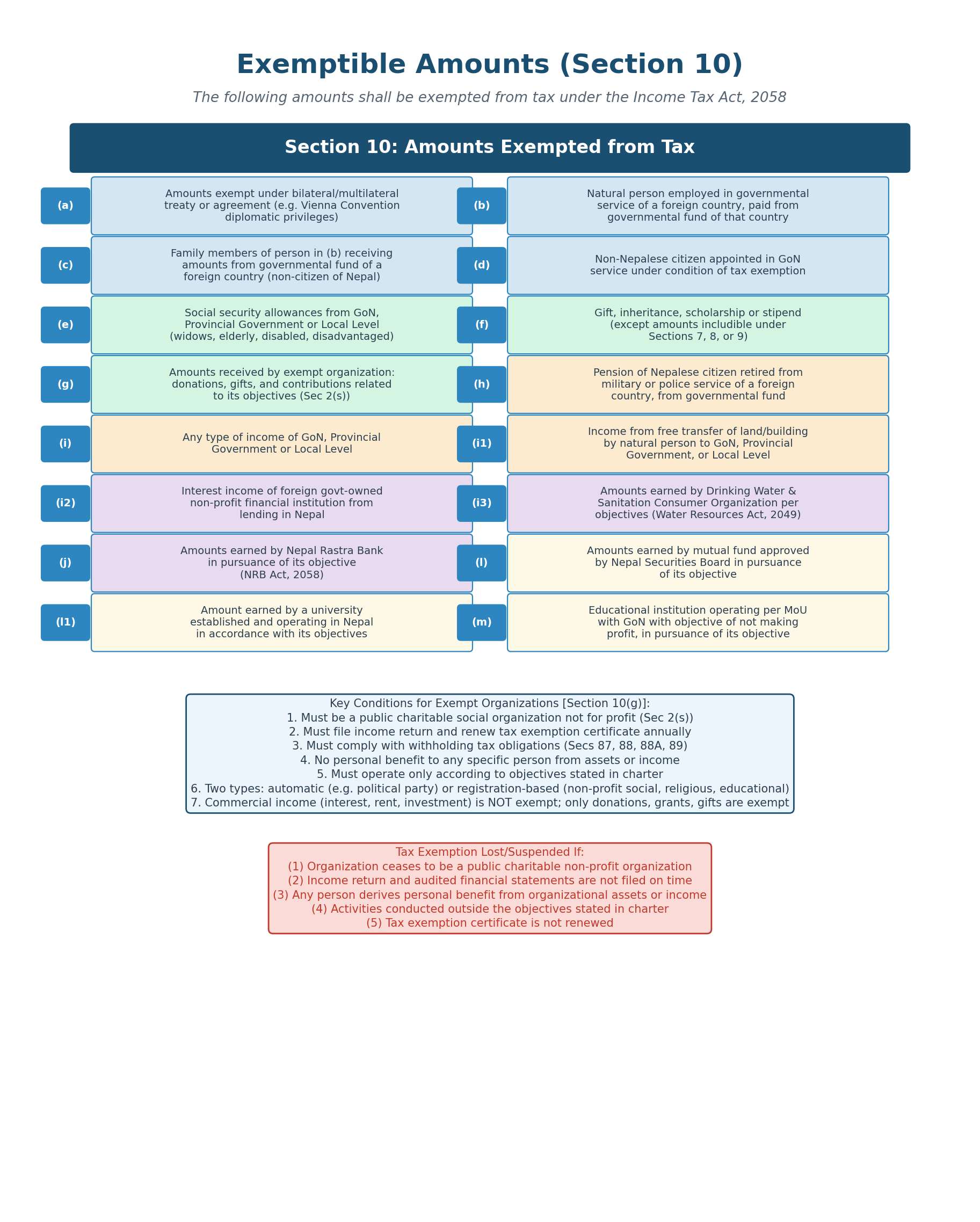
Figure: Exemptible Amounts and Exemptions (Sections 10-12D)
10. Exemptible amounts
The following amounts shall be exempted from tax
(a) Amount exempted from tax granted to any person entitled to tax exemption facility as provided for in a bilateral or multilateral treaty or agreement concluded between the Government of Nepal and any foreign country or international organization,
For example, persons who receive diplomatic privileges under the Vienna Convention, that is, foreign diplomatic officers, consuls and others, are exempt from income tax on employment income received for their own government's official service. Even though the workplace of such persons is in Nepal, Section 10(a) of the Act provides for a tax exemption on income received from such employment.
Nepal has granted a tax exemption on the employment income of foreign diplomatic officers working in foreign embassies and missions in Nepal, received from their own country, by virtue of being a signatory to the Vienna Convention 1961 (ratified by Nepal on 28 September 1968).
(b) Amount received by any natural person for doing employment in the governmental service of a foreign country,
Provided that
(1) The person has to be a resident or non-resident person only because of doing employment, and
(2) Such amounts have to be paid from the governmental fund of that country.
Where an natural person is employed in the governmental service of a foreign country in Nepal, has become a resident or non-resident person only because of that employment, and receives payment from the governmental fund of that country, such income is exempt from tax in Nepal. This provision is further clarified in the following examples:
Example 9.2.1: Suppose a person named Ruin Peyere works at the Ministry of Foreign Affairs of a foreign country. That foreign government has assigned him to Nepal to assist in Conflict Management. Ruin Peyere has been working in Nepal on this task for the past one year. He receives a monthly remuneration of Euro 10,000 from that foreign government. Since Ruin Peyere is doing official governmental service of that foreign country, became a resident of Nepal only because of the employment, and receives his remuneration from the official governmental fund of that foreign country, the amount he receives is deemed an exempt amount.
Example 9.2.2: Suppose Dinesh Chatakuli, a resident of Nepal, is an employee working on a Conflict Management Programme operated by a foreign government in Nepal. He receives a monthly remuneration of Euro 5,000 from that foreign government. He receives such remuneration from the official governmental fund of that foreign government. Even though he receives the payment from the official governmental fund of a foreign country, since he is a resident of Nepal, such income is not deemed an exempt amount and he must include such income in his employment income.
If a person was already residing in Nepal before engaging in such governmental service and only afterwards works in the governmental service of a foreign country, such a person does not receive an exemption in computing income under this provision of the Act.
(c) Amount received by an natural person referred to in clause (b) who is not a citizen of Nepal or by his nearest family member from the governmental fund of a foreign country,
Payments received from the governmental fund of a foreign country, such as pension, far station allowance, family allowance and other amounts, by the nearest family member of a person who became a resident only because of employment and who receives remuneration from the governmental fund of a foreign country, even where such payment is received in Nepal, are exempt from tax in Nepal. This provision is clarified in the following example:
Example 9.2.3: Suppose Maria Smith is a foreign woman. Her husband works at the embassy of the same foreign country in Nepal. In accordance with the rules of that foreign government for allowances to family members of embassy employees, Maria Smith has been receiving 3,000 pounds per month as a Far Station Allowance from the official governmental fund of that foreign country. In this situation, the amount of such allowance she receives is deemed an exempt amount.
(d) Amount received by a non-Nepalese citizen appointed in the service of the Government of Nepal under the condition of tax exemption,
The Government of Nepal may appoint any non-Nepalese citizen on the condition that no tax has to be paid, and where such appointment is made, the income amount received by that person from the Government of Nepal is deemed an exempt amount. This provision is clarified in the following example:
Example 9.2.4: Suppose the Government of Nepal formed a high-level task force for the proper utilisation of Nepal's water resources, and appointed a foreign national, Teve Fernando, to that task force on the condition of not having to pay tax, with a monthly remuneration of Euro 10,000. In this situation, even though the source of his income is in Nepal, the amount he receives is deemed an exempt amount.
(e) All kinds of allowances provided by the Government of Nepal, Provincial Government or Local Level as social security,
All kinds of allowances provided by the Government of Nepal, Provincial Government or Local Level to widows, the elderly, the disabled and disadvantaged persons as social security for their livelihood are not subject to tax.
(f) Amounts received as gift, inheritance, scholarship or stipend except the amounts required to be included in computing income pursuant to Section 7, 8 or 9,
Gifts related to employment, business or investment must be included in the respective income head. Similarly, amounts received as gift, inheritance, alimony or scholarship, other than those subject to windfall gain tax, such as a dowry received at the time of marriage, or a scholarship available to a poor or meritorious student, are also deemed exempt amounts. This provision is further clarified in the following example:
Example 9.2.5: Suppose Gopi Bantawa is studying MBBS at a medical college under a scholarship from the Government of Nepal. The cost would be Rs. 15 lakhs. In addition, he receives Rs. 10,000 per month in cash under the same scholarship. The expenses for his studies and the amounts received need not be included in his income; such amounts are deemed exempt amounts.
(g) Amounts received by an organization entitled to exemption for the following:-
(1) Donation, gift,
(2) Other contributions directly related with the work of an organization entitled to exemption as referred to in clause (s) of Section 2 without having consideration or without hoping for consideration, or
(3) ......,
Two types of situations for tax exemption exist under the Act:
Basis | Organization Entitled to Exemption | Tax-Exempt Income |
Exemption relates | Organization/Entity | Specific Income |
Requirement | Must qualify as exempt organization | Registration/approval may be required |
Focus | Status-based exemption | Income-based exemption |
For any organization to register as an organization entitled to exemption, obtain a tax exemption certificate, and continue to enjoy the tax exemption benefit, the following process and conditions must be fulfilled:
Area | Key Requirement |
1. Registration | Submit application with registration certificate, constitution/charter, PAN certificate, and previous year's audit report & tax return (if already operating). |
2. Eligible Organization | Must be a public charitable social organization established not for profit (Sec. 2(s)). |
3. Annual Compliance | Must file income return and renew tax exemption certificate within 1 year from the end of each income year. |
4. Financial Statements | Income return must be submitted along with audited annual financial statements. |
5. Tax on Non-Exempt Income | If income other than exempt income under Sec. 10(g) is earned, applicable tax must be paid. |
6. Auditor's Responsibility | Audit report must state whether: (i) withholding taxes were deducted, (ii) non-exempt income was earned, and (iii) activities were conducted according to organizational objectives. |
7. Withholding Tax Compliance | Must deduct tax at source on salary, rent, interest, service fee, royalty, contracts, securities disposal gains, etc. under Secs. 87, 88, 88A & 89. |
8. Competitive Grants | Grants received through competition with taxable persons/entities are not exempt income. |
9. No Personal Benefit | Assets or income must not provide benefit to any specific person. |
10. Activities as per Charter | Organization must operate only according to objectives stated in its charter. |
Tax exemption is lost/suspended if:
Organization ceases to be a public charitable non-profit organization.
Income return and audited financial statements are not filed on time.
Any person derives personal benefit from organizational assets or income.
Activities are conducted outside the objectives stated in the charter.
Tax exemption certificate is not renewed.
Exempt organisation: only its donations, grants & gifts (Sec 10(g)) are tax-exempt, not its interest, rent, investment or commercial income. Two types: (1) automatic exemption (e.g. political party registered with the Election Commission); (2) exemption only after registration/approval (public non-profit social, religious, educational, charitable & amateur sports bodies). Any personal benefit to a specific person = loses exempt status
Example 9.2.6: Suppose Nepal Dalit Bikas Mancha is an entity registered with the Department as an organization entitled to exemption. The Mancha received donations of Rs. 5,00,000 from various donors. It also received a grant of Rs. 10 lakhs from the Government of Nepal to be spent on Dalit upliftment activities. Both amounts are deemed exempt amounts for that entity.
Example 9.2.7: Suppose Nepal Dalit Bikas Mancha mentioned in Example 9.2.6 has been placing its received funds in savings deposits at a financial institution. The entity received interest income of Rs. 1 lakh from such deposits. Since such interest income is not income in accordance with the objectives of the entity, this amount is not exempt from tax. The person making the interest payment to that entity must withhold tax at 15 percent on such interest payment in accordance with Section 88(1) of the Act, and the interest received by that entity after such tax withholding is treated as a payment from which tax is withheld finally under Section 92(1)(e)(2) of the Act.
(h) Amount received for pension by a Nepalese citizen having retired from the military or police service of a foreign country from the governmental fund of that country,
Nepalese citizens are serving in the military or police of India, the United Kingdom and other countries. Where such persons, after retiring from their service, return to and reside in Nepal, and where they or their families receive pension amounts, no tax is levied in Nepal. However, where a Nepalese citizen has provided service other than military or police service of a foreign country and receives a retirement pension amount in Nepal for themselves or their family, such amount must be included in income for tax purposes. This provision is clarified in the following example:
Example 9.2.8: Suppose Ram Bahadur Thapa is a retired captain from the British Gurkha military service and currently resides in Pokhara. He receives a monthly retirement pension of 1,200 pounds from the British government. Such retirement pension amount he receives is an exempt amount.
(i) Any type of income of the Government of Nepal, Provincial Government or Local Level,
In this context, the income of a commercial entity (such as Rastriya Banijya Bank) that is wholly owned by the Government of Nepal is not deemed exempt income on the basis of this clause. Generally, amounts deposited in the Consolidated Fund of the Government of Nepal and amounts deposited in funds operated by government entities under prevailing law are treated as income of the Government of Nepal. Similarly, amounts deposited in the Consolidated Fund of provincial governments or local levels are treated as income of the respective Provincial Government or Local Level.
(i1) Income received from the transfer, free of charge, of land or a private building owned by a natural person to the Government of Nepal, a Provincial Government, or a Local Level.
(i2) Interest income earned from lending in Nepal by a financial institution established with full ownership of a foreign government and operating on a non-profit basis.
(i3) Amount earned by a Drinking Water and Sanitation Consumer Organization registered under the Water Resources Act, 2049, in accordance with its objectives.
(j) Amounts earned by Nepal Rastra Bank in pursuance of its objective,
Amounts earned by Nepal Rastra Bank from financial activities conducted in accordance with the objectives of the Nepal Rastra Bank Act, 2058 relating to maintaining financial stability are exempt from tax.
Example 9.2.9: Suppose Nepal Rastra Bank allocated Rs. 20 crores to a Banking Development Fund. The amount in that fund is deposited in various banks and financial institutions, and Nepal Rastra Bank earned interest income of Rs. 1 crore from those deposits. Since such income is income of a fund whose earnings are spent in accordance with the objectives of Nepal Rastra Bank, such income is deemed exempt income.
(k) ......,
(l) Amounts earned by a mutual fund having obtained approval from Nepal Securities Board in pursuance of its objective,
(l1) Amount earned by a university established and operating in Nepal in accordance with its objectives.
(m) Amounts earned by an educational institution operating on the basis of a memorandum of understanding with the Government of Nepal with the objective of not making profit or not distributing profit, in pursuance of its objective.
In addition to the above provisions, amounts received from the disposal of assets or liabilities other than those designated as chargeable assets or liabilities under the Act are also not subject to tax. The sale of personal assets unrelated to business by an natural person, such as furniture, jewellery and so on, other than the disposal of non-business chargeable assets (house, land, interests in entities) of an natural person, is exempt from tax.
11. Professional exemptions and facilities
(1) No tax shall be levied on an income earned by carrying on an agricultural business by any person registered as a firm, company, partnership or corporate body and on agricultural income other than that earned from an agricultural business in land as referred to in clauses (d) and (e) of Section 12 of the Act Relating to Land, 2021 (1964).
Provided that fifty percent tax shall be exempted in the income earned from agricultural business, vegetable dehydration business or cold storage business by any firm, company, partnership or corporate body so registered.
The above provision of the Act includes agricultural income derived from organized and commercially operated agricultural business in the income of the person. However, income derived by an natural person from land within the ceiling prescribed by the Land Act, 2021 is not subject to tax. However, agricultural income derived from land mentioned in clauses (d) and (e) of Section 12 of the Land Act, 2021 through agricultural business must be included in income for purposes of income tax computation. Clauses (d) and (e) of Section 12 of the Land Act, 2021 contain the following provisions:
(d) Land up to the limit fixed by a notified order of the Government of Nepal for industrial work under the conditions prescribed in such order, so long as such work continues.
(e) Land up to the limit fixed by a notified order of the Government of Nepal for agricultural industry work under the conditions prescribed in such order, so long as such work continues under those conditions.
The Land Act, 2021 provides for a ceiling on land ownership, and also provides that the Government of Nepal may raise the ceiling limit for conducting industrial or agricultural business on such land.
Example 10.2.1: Suppose Dhak Bahadur Bamjan has been cultivating tea on land owned by his family or joint family (within the ceiling of the Land Act, 2021). In doing so, he earned income of Rs. 10,00,000 in income year 2070/71. Such income falls within tax-exempt income. However, if any person has obtained approval from the Government of Nepal and cultivated land exceeding the ceiling in the manner prescribed under Section 12(d) or (e) of the Land Act, 2021, the income derived from such cultivation shall not be exempt from tax. Similarly, in any circumstances, if any agricultural income is earned through any business firm or entity, tax shall be levied on such income.
(2) No tax shall be levied on the income of a cooperative organization and union operated and registered under the Cooperatives Act, 2074 (2018) that carries on agricultural or forest-based industrial business such as sericulture and silk production, fruit farming, production and fruit processing, animal husbandry, dairy industry, poultry farming, fishery, tea gardening and processing, coffee farming and processing, herbiculture and herb processing, vegetable seed production, bee keeping, honey production, rubber farming, leasehold forestry, agro-forestry and other professional forest-related businesses, cold storage established for the storage of vegetables, agro-seeds, animal feed, pesticides, fertilizers and agricultural tools (except those operated with mechanical power), and cooperative organization or union operated in the area of a Rural Municipality. No tax shall also be levied on the dividends distributed by such organization or union.
This sub-section of the Act, is not available to cooperative organizations operating in metropolitan municipalities, sub-metropolitan municipalities, and municipalities. This is further clarified by the following example.
Example 10.2.2: Suppose Kanyam Community Tea Garden Ltd. is a cooperative organization registered under the Cooperative Act, 2074. In that organization, 40 farmers from the Kanyam area collectively engaged in tea cultivation, processing, and sale of processed tea. The organization earned income of one crore rupees in income year 2070/71. In this case, the income earned by such organization shall be exempt from tax. In addition, if the organization distributes dividends to its shareholders, advance tax withholding is not required on such dividends.
(2a) No tax shall be levied on interest income of up to twenty-five thousand rupees per annum earned from deposits in a micro-financial institution, rural development bank, postal saving bank and cooperative referred to in sub-section (2) operating in the area of a Rural Municipality.
Provided that where the amount of interest exceeds NPR 25,000, tax shall be levied on the amount of interest exceeding NPR 25,000.
(2b) Exemption from the tax leviable on income earned by a special industry, hotel, resort and information technology industry in full operation throughout the year in any income year shall be as follows:-
(a) By one-third of the tax if tax is levied at the rate of thirty percent on the income of a resident natural person,
(b) By twenty percent on tax leviable on the income of an entity,
(c) ......
Example 11.5.1 Suppose Sushri Shashikala Rai operates an industry producing juice from fruits in Achham district. In FY 2081/82, the business turnover of the industry is Rs. 2,25,00,000 and deductible amounts are Rs. 2,10,00,000. In that year, she opted as a single individual for taxable income computation purposes. Her taxable income and tax for the year shall be as follows:
Heading | Tax Rate | Amount (Rs.) |
Total business receipts (amounts included in income) | 22,500,000 | |
Less: deductible amounts | 21,000,000 | |
Assessable income | 1,500,000 | |
Less: retirement fund contribution and donation | 0 | |
Taxable income | 1,500,000 | |
Less from taxable income: remote area concession (Category 'Ga') | 30,000 | |
Balance taxable income | 1,470,000 | |
First slab up to Rs. 500,000 (tax nil for sole proprietor registrants) | 1% | 0 |
Second slab next Rs. 200,000 | 10% | 20,000 |
Third slab next Rs. 300,000 | 20% | 60,000 |
Fourth slab (next Rs. 1,000,000) on Rs. 470,000 (30%-10%= 20%) | 20% | 94,000 |
Total tax payable | 174,000 |
(3) Tax shall be levied as follows on the income earned by any person from a special industry, hotel, resort and information technology industry in any income year:-
(a) If the person gives direct employment to one hundred or more Nepali citizens throughout the year, ninety percent of the tax leviable on the income of that year; if the person gives direct employment to three hundred or more Nepali citizens throughout the year, eighty percent of the tax leviable on the income of that year; if the person gives direct employment to five hundred or more Nepali citizens throughout the year, seventy-five percent of the tax leviable on the income of that year; if the person gives direct employment to one thousand or more Nepali citizens throughout the year, seventy percent of the tax leviable on the income of that year,
Provided that additional ten percent exemption shall be provided in the amount of tax payable if the person gives direct employment to more than one hundred Nepali citizens throughout the year including at least thirty-three percent from among women, Dalits or persons with disability,
Direct Employment (Nepali citizens, full year) | Tax Applicable (% of General Tax Rate) |
100 or more | 90% |
300 or more | 80% |
500 or more | 75% |
1,000 or more | 70% |
(b) If a special industry has been operated in least developed, undeveloped and underdeveloped areas, respectively ten, twenty and thirty percent of the tax leviable on the income of the years for up to ten years from the date of commencement of the commercial production or transaction by that industry,
Provided that the special industry established in Karnali Province and hilly districts of Sudurpashchim Province providing direct employment to more than one hundred Nepali citizens shall be exempt from income tax for a period of fifteen years from the date of commencement of its transaction,
Area where Special Industry Operates | Tax Applicable (% of tax leviable) | Period (from commencement of commercial production / transaction) |
Least developed area | 10% | Up to 10 years |
Undeveloped area | 20% | Up to 10 years |
Underdeveloped area | 30% | Up to 10 years |
Karnali Province & hilly districts of Sudurpashchim Province (with direct employment to more than 100 Nepali citizens) | Fully exempt (0%) | 15 years |
(c) If a special industry and tourism industry (except casino) established with capital investment of more than one arab rupees providing direct employment to more than five hundred throughout the year shall be provided with full income tax exemption for five years from the date of commencement of its transaction and fifty percent of the tax leviable for three years afterwards,
Provided that if an industry in operation at present increases its installed capacity at least by twenty-five percent making its capital two arab rupees and provides direct employment to more than three hundred throughout the year, full income tax exemption shall be provided in the income earned from such capacity enhancement for five years and fifty percent of the tax leviable shall be exempted for three years afterwards.
Condition | Tax Applicable (% of tax leviable) | Period from Commencement of Transaction |
New special & tourism industry (except casino): capital investment more than Rs. 1 arab and direct employment to more than 500 Nepali citizens throughout the year | 0% (fully exempt) for first 5 years; 50% for next 3 years | 5 + 3 years |
Existing industry that increases installed capacity by at least 25%, raising capital to Rs. 2 arab, with direct employment to more than 300 throughout the year (exemption applies to income from the capacity enhancement) | 0% (fully exempt) for first 5 years; 50% for next 3 years | 5 + 3 years |
Example 10.2.3: Suppose Nepal Cement Industry Pvt. Ltd. has established a cement industry with shareholder capital investment of one arab fifty crore rupees and total investment of four arab rupees. The industry has an installed capacity of 1,500 tons per day and commenced production from 2071/6/1, with 510 workers and employees working throughout the year. In this case, from 2071/6/1 to 2076/5/31, the taxable income of the industry shall be fully exempt from tax, and from 2076/6/1 to 2079/5/31, a fifty percent exemption on taxable income shall apply.
(3a) Exemption from the income tax leviable on income of an industry established in a special economic zone and tax on dividends distributed by such industry shall be as follows:-
(a) The industry established in a special economic zone in a mountainous district and hilly district as specified by the Government of Nepal shall be provided with hundred percent income tax exemption for ten years from the date of commencement of its transaction and fifty percent for the income years afterwards,
(b) The industry established in a special economic zone in an area other than the area referred to in clause (a) shall be provided with hundred percent income tax exemption for five years from the date of commencement of its transaction and fifty percent for the income years afterwards,
(c) On dividends distributed by an industry established in a special economic zone, hundred percent tax exemption for five years from the date of commencement of its transaction and fifty percent for three years afterwards,
(d) Fifty percent of the income tax leviable on income earned by foreign investors from foreign technology or management service charge and royalty in an industry established in a special economic zone.
Item / Industry in Special Economic Zone (SEZ) | Exemption on Income Tax Leviable | Period from Commencement of Transaction |
(a) Industry in SEZ in a mountainous / hilly district specified by the Government of Nepal | 100% exempt, then 50% | 100% for 10 years; 50% for years afterwards |
(b) Industry in SEZ in any other area | 100% exempt, then 50% | 100% for 5 years; 50% for years afterwards |
(c) Dividends distributed by an industry in SEZ | 100% exempt, then 50% | 100% for 5 years; 50% for 3 years afterwards |
(d) Foreign technology / management service charge and royalty earned by foreign investors in an SEZ industry | 50% of tax leviable | No specified period |
Under Section 88(1) of the Act, 15 percent advance tax withholding is required on royalties and service fees such as technology and management fees, and under Section 92(1)(f) such tax withheld on payments to non-resident persons constitutes a payment from which tax is withheld finally. For foreign investors in industries established in special economic zones, such fees shall be subject to tax at only 7.5 percent.
(3b) A person carrying on the business of exploration and excavation of minerals, petroleum substances, natural gas and fuel who commenced commercial operation by Chaitra of 2080 (mid-April 2024) shall be provided with full income tax exemption for the first seven years from the date of commencement of the transaction and fifty percent income tax exemption for three years afterwards.
(3c) Seventy-five percent exemption shall be provided from the income tax leviable on income of the industry related to software development, data processing, cyber cafe, digital mapping established within the operation of the zoological, geological, biotech related park, technology park and information technology park as specified by the Government of Nepal by a notification in the Nepal Gazette.
(3d) The person having commercial transaction of electricity shall be provided with tax exemption as follows:-
(a) A licensed person commencing commercial production, transmission or distribution of hydropower, electricity produced from solar, wind and biological substance by Chaitra of 2084 (mid-April 2028) shall be provided with full income tax exemption for the first ten years and fifty percent exemption for five years afterwards.
Provided that in the case of hydropower projects above forty megawatts capacity with reservoir and semi-reservoir for which financial closure) is completed by Chaitra of 2085 (mid-April 2029), and lower riparian hydropower projects operated in tandem operation (Tandem Operation) with such projects, full income tax exemption shall be provided for the first fifteen years and fifty percent exemption for six years afterwards.
(b) Notwithstanding anything contained in clause (a), the provision prevailing at the time of issuance of the licence shall apply for any licensed person that has already commenced commercial production at the time of commencement of this sub-section.
Condition | Income Tax Exemption | Period |
(a) Licensed person commencing commercial production, transmission or distribution of hydropower / solar / wind / biological electricity by Chaitra 2084 (mid-April 2028) | 100% exempt, then 50% | 100% for first 10 years; 50% for 5 years afterwards |
Proviso: Reservoir / semi-reservoir hydropower projects above 40 MW with financial closure by Chaitra 2085 (mid-April 2029), and lower riparian projects in tandem operation with them | 100% exempt, then 50% | 100% for first 15 years; 50% for 6 years afterwards |
(b) Licensed person that had already commenced commercial production when this sub-section came into force | Provision prevailing at the time the licence was issued applies | As per the licence |
(3e) Tax exemption on income earned from export in any income year from a source in Nepal shall be as follows:-
(a) If tax is chargeable at the rate of twenty percent on the income of a resident natural person, twenty-five percent of that tax; and if tax is chargeable at the rate of thirty percent, fifty percent of that tax,
(b) Twenty percent of tax leviable on the income of an entity,
(c) Fifty percent of the tax leviable on income earned up to the extent of income received in foreign currency by such person for exporting information technology-based services including business process outsourcing, software programming, cloud computing and the like and earning foreign currency therefrom, up to fiscal year 2084/85.
Example 11.5.2 Suppose the business income mentioned in Example 11.5.1 above is derived from exports. The taxable income and tax for the year shall be as follows:
Heading | Tax Rate | Amount (Rs.) |
Total business receipts (amounts included in income) | 22,500,000 | |
Less: deductible amounts | 21,000,000 | |
Assessable income | 1,500,000 | |
Less: retirement fund contribution and donation | 0 | |
Taxable income | 1,500,000 | |
Less from taxable income: remote area concession (Category 'Ga') | 30,000 | |
Balance taxable income | 1,470,000 | |
First slab up to Rs. 500,000 (tax nil for sole proprietor registrants) | 1% | 0 |
Second slab next Rs. 200,000 | 10% | 20,000 |
Third slab next Rs. 300,000 (20% - 5% = 15%) (note: 20% base - 25% export relief = effective 15% below) | 15% | 45,000 |
Fourth slab (next Rs. 1,000,000) on Rs. 470,000 (30% - 15% = 15%) | 15% | 70,500 |
Total tax payable | 135,500 |
Export income concession (Sec 11(3e)): resident natural person taxed at 20% → 25% off (effective 15%), at 30% → 50% off (effective 15%); entity → 20% off; IT-based services (BPO, software, cloud) earning foreign currency → 50% off up to FY 2084/85
(3f) In the case of income earned by any entity from any of the following activities, there shall be exemption from the tax leviable on income for up to ten years from the date of commencement of the commercial transaction as follows:-
(a) Forty percent, in the case of operation of a tram or trolley bus,
(b) Forty percent, in the case of construction and operation of a ropeway, cable car or sky bridge,
(c) Fifty percent, in the case of construction and operation of a road, bridge, underground route, tunnel, railway or airport.
(3g) The production-based, tourism service, hydropower generation, distribution and transmission entities listed in the securities market and entities mentioned in sub-section (3c) of Section 11 shall have fifteen percent exemption from the tax leviable.
(3h) The industry established in the least developed area and undeveloped area producing brandy, cider and wine based on fruits shall have respectively forty and twenty-five percent exemption from income tax for ten years from the date of commencement of the transaction.
(3i) Any person receiving royalty income from the export of intellectual property shall have twenty-five percent exemption at the rate of income tax leviable on such income.
(3j) Any person receiving income from the sale through transfer of intellectual property shall have fifty percent exemption at the rate of income tax leviable on such income.
(3k) The industry related to tourism or the airlines company operating international flight shall be provided with tax exemption as follows:
(a) An industry established with capital investment of more than one arab rupees shall have full exemption for five years from the date of commencement of the transaction and fifty percent exemption at the rate of leviable income tax for three years afterwards.
(b) An industry established with capital investment of more than three arab rupees shall have full exemption for ten years from the date of commencement of the transaction and fifty percent exemption at the rate of leviable income tax for five years afterwards.
(c) An industry established with capital investment of more than five arab rupees shall have full exemption for fifteen years from the date of commencement of the transaction.
(3l) If a special industry, information technology industry or an industry related to the tourism sector capitalizes its accumulated profit into shares for the purpose of increasing the capacity of the same industry, there shall be hundred percent exemption from the dividend tax leviable in the form of dividend distribution from such capitalization.
(3m) If any company having paid-up capital of fifty crore rupees or more operating as a private company converts into a public company and commences transaction, it shall have ten percent exemption from the leviable tax for three years from the date of its conversion into a public company.
Provided that a company required to be incorporated as a public company under Section 12 of the Company Act, 2063 (2006) shall not be entitled to the facility referred to in this sub-section.
(3n) A domestic tea producing and processing industry, dairy industry carrying on the business of milk products or textile production industry shall have fifty percent exemption at the rate of income tax leviable on income earned from the sale of its products.
(3o) A health institution operated by a community organization shall have twenty percent exemption from the tax leviable on its taxable income.
(3p) A micro-enterprise shall have full exemption from the leviable income tax for seven years from the date of commencement of its business or transaction. If such a micro-enterprise is operated by a woman entrepreneur, it shall have full exemption from the leviable income tax for an additional three years.
(3q) If any entity in any income year constructs and operates a public infrastructure to be transferred to the Government of Nepal or constructs, generates and transmits electricity, such entity shall have twenty percent tax exemption from the tax leviable on its taxable income.
(3r) A special industry established and operated in an industrial area or industrial village shall have fifty percent tax exemption for three years from the date of commencement of production and twenty-five percent tax exemption for five years afterwards.
(3s) Twenty percent tax exemption shall be provided in the income earned from the sale of raw material or associated raw material produced domestically to a special industry.
(3t) A start-up business as specified by the Department that uses innovative knowledge, ideas, skills, technology, practices and methods and has annual turnover of up to ten crore rupees shall be provided with hundred percent tax exemption for five years from the date of commencement of its transaction.
(3u) If any special industry operating in the Kathmandu valley relocates and operates outside the Kathmandu valley, hundred percent tax exemption shall be provided for three years from the date of such relocation and operation and fifty percent tax exemption for two years afterwards.
(3v) The industry using only previously used goods having direct impact on the environment as raw material to produce new goods shall be provided with fifty percent tax exemption for the first three years from the date of commencement of its transaction and twenty-five percent for two years afterwards.
(3w) The industry producing health vaccine, oxygen gas and sanitary pad shall be provided with hundred percent tax exemption for five years from the date of commencement of its production and fifty percent for two years afterwards.
(3x) The industry established by Ashad of 2082 (mid-July 2025) with the objective of producing and assembling electric vehicles shall have forty percent tax exemption for five years from the date of commencement of its transaction.
(3y) The industry established by Ashad of 2082 (mid-July 2025) with the objective of producing agricultural tools shall have hundred percent tax exemption for five years from the date of commencement of its transaction.
(3z) The industry producing green hydrogen shall have full income tax exemption for five years from the date of commencement of its transaction.
(3aa) The industry producing and assembling electric vehicle charging machines operated by electric energy shall have income tax exemption for five years from the date of commencement of its transaction.
(3ab) A person constructing, establishing and operating an industrial area or industrial village shall have full income tax exemption for the first ten years from the date of commencement of the transaction and fifty percent income tax exemption for five years thereafter.
(4) If any person carries on transactions qualifying for different tax exemption facilities pursuant to this Section, income shall be computed to obtain such facility as if that income were derived by separate persons.
A person availing the exemption concession under Section 11 of the Act must compute income as if only that income exists. In other words, other income of such person, if any, shall not be entitled to such concession. This is further clarified by the following example:
Example 10.2.5: Suppose Swastik Garment Industry Pvt. Ltd. has a factory in Kathmandu. Another unit of the same company is also operating in Dhading (underdeveloped area). The business status of the two units of the company in income year 2075/76 (amounts in Rs. thousands) is:
Amount in Rs. thousands
Description | Kathmandu (Rs. thousands) | Dhading (Rs. thousands) | Total (Rs. thousands) |
Sales | 2,10,00 | 1,40,00 | 3,50,000 |
Cost of sales | 1,50,00 | 1,25,00 | 2,75,000 |
Operating expenses | 10,00 | 8,00 | 18,00 |
In addition to the expenses that can be separated from the above accounts, the Pvt. Ltd. incurred centralized indirect expenses of Rs. 5,00,000. The tax liability of the Pvt. Ltd. for fiscal year 2075/76 shall be computed as follows:
Amount in Rs. thousands
Description | Kathmandu (Rs. thousands) | Dhading (Rs. thousands) | Total (Rs. thousands) |
Sales | 2,10,00 | 1,40,00 | 3,50,00 |
Less: | |||
Cost of sales | 1,50,00 | 1,25,00 | 2,75,00 |
Operating expenses | 10,00 | 8,00 | 18,00 |
Other expenses (indirect expenses apportioned in ratio of total sales) | 3,00 | 2,00 | 5,00 |
Assessable income | 47,00 | 5,00 | 52,00 |
Exemption | - | - | - |
Taxable income | 47,00 | 5,00 | 52,00 |
Applicable tax rate | 20% | 6% | |
Tax amount | 9,40 | 30 | 9,70 |
In this manner, the exemption on the tax rate is available only on the income of the special industry in the less developed area. Furthermore, if one unit incurs a loss, it cannot be set off against the income of another unit. When computing tax, the income computation forms of the Pvt. Ltd. must be prepared separately.
Multiple exemption activities (Sec 11(4)): compute each concession activity's income as if it were a separate person; one unit's loss cannot be set off against another unit's income; prepare separate income computations
(5) A person who is in a position to have more than one exemption in respect of the same income pursuant to this Section shall enjoy only one exemption of his choice in addition to the facility referred to in sub-section (2b).
If a person is eligible for more than one of the exemption concessions in the sub-sections of this Section for the same income, the person may choose only one. For example, a special industry providing direct employment to 100 or more persons throughout the year is entitled to a 10 percent exemption on tax under Section 11(3)(a), and if such industry operates in an underdeveloped area only 20 percent on applicable tax under Section 11(3)(b). In such a case, the person may choose only one exemption, either under Section 11(3)(a) or Section 11(3)(b). This is further clarified through the following example:
Example 10.2.6: Suppose the Dhading unit of Swastik Garment Industry Pvt. Ltd. mentioned in Example 10.2.5 above has more than 100 Nepali workers working throughout the year, of whom more than 33 percent are women, Dalits, and persons with disabilities. In such case, the company may choose either the concession available to industries providing more than the prescribed employment under Section 11(3)(a) of the Act, or the concession available to industries operating in an underdeveloped area under Section 11(3)(b) of the Act. Only one concession may be chosen.
When granting tax exemption concessions to industries within a time limit, if the assets used to operate the industry are old (previously used), the time limit shall be counted from the period of prior use. This is further clarified through the following example:
Same income, multiple concessions (Sec 11(5)): may claim only ONE exemption of choice (plus the 2b employment concession). For time-limited concessions, if the assets were previously used, that prior-use period counts against the exemption period (Sec 11(6))
(6) Notwithstanding anything contained in sub-section (3), if any other person has previously used the properties used to operate the industry referred to in clause (b) of that sub-section for the operation of the industry of the same type, the period during which they have been so used shall also be reckoned while reckoning the time-limit referred to in that sub-section.
(7) Notwithstanding anything contained in sub-sections (3a) and (3c), if the property used in operating the industry or business mentioned in those sub-sections is an old property previously used by another person for the operation of an industry or business of the same or other kind, the facilities referred to in those sub-sections shall not be available.
Example 10.2.7: If the assets used to operate the Dhading unit of Swastik Garment Industry Pvt. Ltd. mentioned in Example 10.2.5 above are new, the exemption concession under Section 11(3)(b) of the Act would be for 10 years. However, if such assets had been previously used for 3 years by another person to operate a similar industry, the Dhading unit of the company would receive the exemption concession only for the remaining period of 7 years.
Explanation: For the purposes of this Section,-
(a) "Agricultural Business" means a business involving the cultivation of grains and crops, fruit farming, animal and poultry farming, fish farming, and beekeeping.
(b) "Least developed", "undeveloped" and "underdeveloped area" means the areas referred to in Schedule-10 of the Industrial Enterprises Act, 2076 (2019).
The list of "least developed", "undeveloped", and "underdeveloped" areas mentioned in Schedule-10 of the Industrial Enterprises Act, 2076 is set out in the schedule of this Directive.
(c) "Special industry" means a production-based industry, industry based on agriculture and forest products and mineral industry as classified in sub-section (2) of Section 17 of the Industrial Enterprises Act, 2076 (2019), other than any industry producing cigarette, Bidi, Sigar, chewing tobacco, Khaini, Gutkha, Pan Masala, other products of similar nature involving tobacco as the principal raw material, liquors, beer and products of similar kind.
(d) "Micro-enterprise" means any micro-enterprise classified in clause (a) of sub-section (1) of Section 17 of the Industrial Enterprises Act, 2076 (2019).
(e) "Information technology industry" means an industry related to technology park, information technology park, biotech park, software development, data processing, digital mapping, business process outsourcing, data mining and cloud computing.
11A. Tax chargeable on construction and operation of infrastructure
If any agreement is concluded between the Government of Nepal and any person for the construction and operation of any infrastructure, the person constructing and operating such infrastructure shall enjoy the tax facilities provided by the Act in force at the time of conclusion of the agreement for the whole period of the agreement.
When the Government of Nepal enters into an agreement with any person for the construction and operation of infrastructure, the tax provisions and concessions in force at that time, such as tax rates and concessions, depreciation provisions, and loss set-off provisions, shall continue to be enjoyed by such person for the duration of the agreement, even if the Act is subsequently amended.
12. Donation and gift given to organizations entitled to tax exemption
(1) In computing the taxable income in any income year, any person may make a claim to subtract the amount of donation and gift given to an organization entitled to tax exemption approved by the Department for the purpose of this Section.
(2) Notwithstanding anything contained in sub-section (1), the expenditure deductible in any income year pursuant to that sub-section shall not exceed three lakh rupees or five percent of the adjusted taxable income of such person for that year, whichever is the lesser.
"Adjusted taxable income" is defined in Section 2(aad1) of the Act as the taxable income computed without deducting any amount under Sections 12, 12A, 12B, and 12C, and without any set-off under Section 14(2), Section 17, or Section 18, in computing the taxable income of any person for any income year.
When claiming a deduction for donation expenses for income tax purposes, only the lesser of five percent of adjusted taxable income, one hundred thousand rupees, or the actual payment may be claimed. When computing adjusted taxable income for donation expense purposes, deductions allowable under Sections 14(2), 17, and 18 of the Act must be deducted.
Example 10.4.1: Suppose the business status of Swastik Nepal Pvt. Ltd. for income year 2075/76 is as follows: Sales Rs. 10,00,000; Cost of sales Rs. 6,00,000; Depreciation expenses Rs. 50,000; Other administrative expenses Rs. 2,50,000; Donation expenses Rs. 15,000. Adjusted taxable income: Rs. 1,00,000 (Sales 10,00,000 less Cost of sales 6,00,000 less Depreciation 50,000 less Other administrative expenses 2,50,000).
(a) Actual donation expenses: Rs. 15,000.
(b) 5% of adjusted taxable income: Rs. 5,000.
Claimable donation expenses (lesser of (a) and (b)): Rs. 5,000.
Accordingly, although the company paid Rs. 15,000 as donation in income year 2075/76, only Rs. 5,000 may be claimed as a deduction from taxable income.
(3) Notwithstanding anything contained in sub-sections (1) and (2), in any special situation the Government of Nepal may, by a notification in the Nepal Gazette, specify that any amount spent or donated by any person for any work specified in that notification may be deducted fully or partly for expenditure in determining the income of that person.
Where the Government of Nepal has published a notice in the Nepal Gazette for a special purpose (such as the Prime Minister Natural Calamities Relief Fund), donations made for such purpose may be claimed without the limit specified in Section 12(2), and such donation expenses may exceed the limit of Section 12(2).
Example 10.4.2: Suppose Swastik Nepal Pvt. Ltd. mentioned in Example 10.4.1 above also donated an additional Rs. 50,000 for a purpose for which the Government of Nepal has published a Gazette notice providing a tax exemption. In that case, in addition to the 5 percent of adjusted taxable income of Rs. 5,000, the Rs. 50,000 may also be deducted, totalling Rs. 55,000 as a full expense deduction.
Donation/gift to an approved exempt organisation (Sec 12): deductible = least of (actual donation, Rs. 1,00,000, or 5% of adjusted taxable income).
Adjusted taxable income = taxable income before Sec 12/12A/12B/12C deductions and before Sec 14(2)/17/18 set-offs. Special Gazette-notified donations (e.g. PM Relief Fund) = deductible in full, no limit (Sec 12(3))
12A. Expenses on heritage protection and sports development
In computing its taxable income in any income year, any company may make a claim to subtract, upon prior approval of the Department, an amount which is the lesser of ten lakh rupees or an amount equivalent to ten percent of the assessable income, out of the expenditure made by it in that year in the protection and preservation of historical, religious and cultural heritages in Nepal or in the construction of public physical infrastructure of sports.
Prior approval of the Department is required. When seeking such approval, an application must be filed with the relevant office or the Department at least 7 days before the expenditure, stating the purpose of the expenditure, the estimated amount, the timeframe, and the procedure (such as direct payment to the relevant authority, direct arrangement, or payment through cheque).
Company + Approval + Heritage/Sports = Lower of 10 lakh or 10% deduction.
Example 10.5.1: (Incorrect In Directive)
Suppose the business status of Deep Jyoti Nepal Ltd. for fiscal year 2075/76 is as follows:
Sales | Rs. 2,00,00,000 |
Cost of sales | Rs. 1,35,00,000 |
Depreciation expenses | Rs. 8,50,000 |
Other administrative expenses | Rs. 35,00,000 |
Ancient temple renovation expenses | Rs. 5,00,000 |
Donation to a tax-exempt institution approved by the Department | Rs. 1,30,000 |
The deductible donation expense for the company in that fiscal year shall be computed as follows:
Sales | Rs. 2,00,00,000 | |
Less: Cost of sales | Rs. (1,35,00,000) | |
Less: Depreciation expenses | Rs. (8,50,000) | |
Less: Other administrative expenses | Rs. (35,00,000) | |
Assessable income/Adjusted Taxable Income | Rs. 21,50,000 | |
10% of assessable income | Rs. 2,15,000 | |
Actual ancient temple renovation expenses | Rs. 5,00,000 | |
Claimable ancient temple renovation expenses | Rs. (2,15,000) | |
5% of adjusted taxable income (21,50,000*5%) | Rs. 107,500 | |
Maximum limit | Rs. 1,00,000 | |
Actual donation expenses | Rs. 1,30,000 | |
Claimable donation expenses | Rs. (100,000) | |
Taxable income | Rs. 18,35,000 |
12B. Expenses contributed to Prime Minister Natural Calamities Relief Fund and reconstruction fund established by the Government of Nepal
Any person contributing any amount in any income year to the Prime Minister Natural Calamities Relief Fund and reconstruction fund established by the Government of Nepal may deduct such amount in computing the taxable income for that year.
Sec 12B contribution to PM Natural Calamities Relief Fund & GoN reconstruction fund = fully deductible.
12C. Seed capital provided to start-up businesses
Any person making available seed capital of up to one lakh rupees per business as a grant to up to five start-up businesses other than to an associated person may deduct such amount as expenses in computing taxable income.
Sec 12C startup seed grant = up to Rs. 1 lakh per startup, max 5 startups (not associated persons), fully deductible
12D. Deduction for Corporate Social Responsibility (CSR) Expenditure
A person may deduct, while calculating taxable income for an income year, the amount spent during that year for the purpose of discharging Corporate Social Responsibility (CSR) in accordance with the prevailing law.
Provided that, such deductible amount shall not exceed one percent (1%) of the total taxable income of that income year.
Chapter-5 Deductible Amounts
13. General deduction
Any person may, for the purpose of computing his income from any business or investment in any income year, deduct the following expenditures related with the transactions, subject to this Act:-
(a) Made in that income year,
(b) Made by that person, and
(c) Made in earning income from the business or investment.
This section allows claiming expenses incurred by that person in that year related to income-earning activities as general deductions. If all three conditions are not met, expenses cannot be claimed. Preliminary and pre-operational expenses can be claimed all at once in the year business commences. They cannot be deferred to future years, and except for capital-nature expenses, they cannot be added to fixed assets.
General deduction (Sec 13): an expense is deductible only if all 3 conditions are met = (a) incurred in that income year + (b) incurred by that person + (c) incurred in earning business or investment income. Preliminary & pre-operational expenses = claimed fully in the year business commences (cannot defer)
Example 21.6.1 (Investment context)
Suppose Gobinda Prasad had lent money to any entity. For the purpose of collecting interest and maintaining accounts on the loan, an employee was appointed in fiscal year 2080/81, and a salary of Rs. 30,000 was paid to such employee in that income year. Since such expense was incurred in earning investment income in that income year, the salary payment may be claimed as an expense deduction for fiscal year 2080/81.
Example 18.6.1 Nepal Dakshata Company Pvt. Ltd. incurred advertising expenses of Rs. 10,000 for business purposes in FY 2080/81, paid only in FY 2081/82. Since the expense was incurred in FY 2080/81 and is business-related, the deduction can be claimed in FY 2080/81 (accrual basis). However, if not claimed in FY 2080/81 but in FY 2081/82, since it is not related to FY 2081/82 income-earning activities, it cannot be deducted in FY 2081/82.
Bonus Expense Deduction
The Bonus Act, 2030 requires establishments to allocate and distribute bonus to employees at not more than 10% of net profit beyond the base net profit. The Department has clarified that bonus allocation amounts are deductible expenses under Sections 13 and 24 of the Income Tax Act, 2058, as distributed bonuses are included in the recipient's income and the government receives income tax on them.
The following rules apply:
(1) Amounts at not more than 10% of net profit allocated as bonus per the Bonus Act, 2030 must be deducted as expense for income tax purposes.
(2) Bonus amounts claimed as expense deductions in any income year must be fully distributed in the immediately following income year; for public entities requiring Government of Nepal prior approval, bonuses must be distributed in the year for which approval was given.
(3) If allocated bonus and claimed deductions in full or in part are not distributed within the specified time, such undistributed amount must be included in income in the immediately following income year as per Section 25(1)(c); however, amounts deposited in a national welfare fund or establishment welfare fund per the Bonus Act, 2030 in the immediately following year need not be included in income.
14. Interest deduction
(1) Any person may, for the purpose of computing his income from any business or investment in any income year, deduct all interests chargeable in that year under the following debt liabilities of that person created for the act of generating income from business or investment:-
(a) If the debt liability has been created for having borrowed any amount, and that amount has been used in that year or used to purchase any property used in that year, or
(b) That debt liability has been created in any other circumstance.
Interest includes: payments under a debt obligation other than principal; discount, premium, swap payment, or benefit from such arrangements; and amounts treated as interest under Section 32 from financial lease or annuity payments. Interest can be deducted from the year the purchased asset starts being used in business. Even if use starts mid-year, the full year's interest is deductible.
Example 18.6.2: A person took a loan 2 years ago to purchase a machine currently in use. This year's interest on that loan can be deducted. If the machine is not yet in use, interest must be capitalized. Interest on loans for working capital (paying salaries, purchasing raw materials, etc.) can also be deducted.
Example 18.6.3: A person took a loan of Rs. 2 crore on Shrawan 1 at 12% annual interest to purchase machinery this year. The machinery started operation from Baisakh 1. Expenses this year:
a) Service fee 1%, annual renewal fee 0.5%, payable on Shrawan 1 each year.
b) Loan registration fee: Rs. 20,000
c) Mortgage valuation: Rs. 20,000, stamp duty Rs. 2,000, insurance Rs. 30,000
d) Every 4 months independent inspection by bank and insurance company, valuer charges Rs. 2,000 per visit.
Deductible: Interest of Rs. 26 lakh (interest Rs. 24 lakh + service fee Rs. 2 lakh). Since the machine was used from Baisakh 1, all interest per Section 14(1) is deductible.
Loan registration fee Rs. 20,000 and mortgage valuation Rs. 20,000 are liability outgoings. Stamp duty Rs. 2,000, insurance Rs. 30,000, and periodic inspection fee Rs. 6,000 are general asset maintenance expenses.
Example 18.6.4: A jute company borrowed Rs. 30 lakh via overdraft to purchase raw jute, paying Rs. 3,40,000 interest this year. Since this is current capital for raw material and stock-in-trade purchases, all interest is deductible per Section 14(1).
Example 21.6.2 (Investment context):
Suppose Gobinda Prasad had lent Rs. 10 lakhs to any entity. To make such loan investment, he had taken a loan of Rs. 5 lakhs from a bank. In fiscal year 2080/81, he earned interest income of Rs. 1 lakh 20 thousand from such investment and paid interest of Rs. 50,000 on the loan. Since such interest payment was incurred by him to earn investment income in that year, he may claim such interest payment as an expense deduction for fiscal year 2080/81 as it is related to earning investment income.
(c) ......
(2) Notwithstanding anything contained in sub-section (1), if a resident entity controlled by an organization entitled to tax exemption pays interest to the controlling person or associated person, the interest amount deductible pursuant to that sub-section (1) shall not exceed the total of the following amounts:-
(a) All interest amounts received in that year to be included in the computation of the taxable income of that entity, and
(b) Fifty percent of the adjusted taxable income of that entity in that year, computed excluding any interest derived by that entity or without deducting any interest paid by that entity.
This provision (Section 14(2)) is known as the thin capitalisation rule. It limits interest deductions for a resident body controlled by tax-exempt organizations, non-residents, or associated persons, where such interest is paid to the controlling or associated person. The ratio must be calculated on each day shareholders change. If 25% or more ownership is held on any day, interest paid to that group must be calculated per Section 14(2).
Example 18.6.5: Info America Incorporation (non-resident) holds 50% in Info Nepal Pvt. Ltd. In FY 2081/82, Info Nepal paid Rs. 75,000 interest to Info America. The deductible interest is calculated as follows:
Description | Amount (Rs.) |
Sales | 7,50,000 |
Interest income | 5,000 |
Total income | 7,55,000 |
Cost of sales | 5,00,000 |
Administrative expenses | 1,20,000 |
Interest expense (controlling person) | 75,000 |
Interest expense (others) | 10,000 |
Depreciation | 20,000 |
Total expenses | 7,25,000 |
Adjusted taxable income:
Description | Amount (Rs.) |
Includable amounts | 7,55,000 |
Less: Cost of sales | 5,00,000 |
Administrative expenses | 1,20,000 |
Interest (others) | 10,000 |
Depreciation | 20,000 |
Total deductions | 6,50,000 |
Adjusted taxable income | 1,05,000 |
Claimable interest this year:
Interest income (A) | Rs. 5,000 | |
Adjusted taxable income (1,05,000 x 50%) (B) | Rs. 1,05,000 | |
Add: Interest expense to others per Section 14(1) | Rs. 10,000 | |
Less: Interest income | Rs. (5,000) | |
Total Adjusted Base | Rs. 1,10,000 | |
50% of Adjusted Base | Rs. 55,000 | |
Total claimable interest (A + B) | Rs. 60,000 |
Of total interest of Rs. 75,000, only Rs. 60,000 can be claimed this year. The remaining Rs. 15,000 can be carried forward to the next year and claimed within the limit for that year's income.
(3) Any interest not allowed to be deducted or not deducted pursuant to sub-section (2) may be carried forward or credited in the forthcoming income year.
Explanation: For the purposes of this Section, "a resident entity controlled by an organization entitled to tax exemption" means an entity which, being a resident entity in that year, is subject to a vested ownership or control of twenty-five percent or more of the following persons or organizations in any time of that year:-
(a) An organization entitled to tax exemption and a person associated with that organization,
(b) A person entitled to tax exemption pursuant to Section 11 in that year or a person associated with that person,
(c) A non-resident person or a person associated with the non-resident person, or
(d) Any combination of the persons referred to in clauses (a), (b) and (c).
Interest deduction (Sec 14(1)): interest on debt used to earn business/investment income is deductible from the year the asset is put to use (full year even if used only part of the year). Thin capitalisation (Sec 14(2)): where a resident entity is 25% or more owned/controlled by a tax-exempt organisation, a non-resident or an associated person, interest paid to that controller is deductible only up to (interest income + 50% of adjusted taxable income); the excess is carried forward (14(3))
15. Allowances for cost of stock-in-trade
(1) For the purpose of computing the income earned by any person from any business in any income year, no allowances other than the allowances for the cost computed pursuant to sub-section (2) shall be allowed in respect of the disposal of the stock-in-trade of the business of that person in that year.
(2) The allowances for the cost referred to in sub-section (1) shall be computed as follows by deducting the amount referred to in clause (b) from the amount referred to in clause (a):-
(a) The amount to be set by adding the cost of the stock-in-trade derived from any business in any income year to the opening value of the stock-in-trade of that business in that year,
(b) The amount of the final value of the stock-in-trade of any business in the income year referred to in clause (a).
(3) The initial value of the stock-in-trade of any business in any income year shall be the closing value of the stock-in-trade of that business at the end of the last income year.
(4) Whichever is lesser out of the following amounts shall be considered the closing value of the stock-in-trade of that business for that income year:-
(a) The cost of the stock-in-trade of that business at the end of that income year, or
(b) The market value of the stock-in-trade of that business at the end of that income year.
(5) In computing the cost of the stock-in-trade of a business, a person shall do as follows, subject to Section 45 and sub-section (6):-
(a) In computing the income of a business, in the case of a person maintaining accounts on the cash basis, by using the method of production While valuing on the basis of cost of production, the following components must be included:
(b) In computing the income of a business, in the case of a person maintaining accounts on the accrual basis, by using the method of consumption cost.
A. While valuing on the basis of cost of production, the following components must be included:
Direct Material Cost
Direct Labour Cost
Variable Factory Overhead
However, within the variable factory overhead cost, the following expenses shall not be included:
Repairs and maintenance expenses
Depreciation expenses
Under this method, while calculating the cost per unit of production:
Fixed Factory Overhead should not be included in the unit cost.
Instead:
The entire amount of fixed factory overhead actually paid during the year shall be allowed as a deduction on a cash basis.
B. Under consumption cost valuation, include:
Direct Material
Direct Labour
Factory Overhead
Factory overhead includes:
Fixed Factory Overhead
Variable Factory Overhead
Exclude:
Repairs and maintenance
Depreciation
(6) If the stock-in-trade of the business of any person cannot be determined, that person may choose either the first-in-first-out method or the weighted average cost method to compute the cost of stock-in-trade.
(7) When computing the cost of stock-in-trade pursuant to sub-section (5), it shall be computed by the following method:-
(a) When computing as per the consumption cost method, to so compute the cost of the stock-in-trade under the widely recognized accounting principle that it is equal to the sum total of direct material cost, direct labor cost and overhead cost of factory.
(b) When computing as per the production cost method, to so compute the cost of the stock-in-trade under the widely recognized accounting principle that it is equal to the sum total of direct material cost, direct labor cost and Variable overhead cost of factory.
(8) When computing the cost of stock-in-trade pursuant to sub-section (6), it shall be computed by the following method:-
(a) When computing as per the weighted average cost method, to compute all the stock-in-trade of the same type in the business under the widely recognized accounting principle as per the weighted average cost method.
(b) When computing as per the first-in-first-out method, to compute on the basis that the stock-in-trade received first is also disposed first, under the widely recognized accounting principle.
(9) ......
(10) ......
Explanation: For the purposes of this Section,-
(a) "Direct labor cost" means the labor cost directly related with the production of the stock-in-trade.
(b) "Direct material cost" means the cost of materials which are or will be an integral part of the stock-in-trade.
(c) "Overhead cost of factory" means the total cost incurred in producing stock-in-trade except the direct labor cost and direct material cost.
Provided that no amount for repair and maintenance and depreciation deduction shall be included in the overhead cost of the factory.
(d) "Variable overhead cost of factory" means the overhead cost of factory that alters directly with a change in the produced quantity of stock-in-trade.
Provided that no amount for repair and maintenance and depreciation deduction shall be included in the Variable overhead cost of the factory.
Stock-in-trade cost allowance (Sec 15) = opening stock + purchases - closing stock; closing stock valued at LOWER of cost or market. Costing method: cash basis = cost price or consumption cost; accrual basis = consumption cost; if not determinable = FIFO or weighted-average. Consumption cost = direct material + direct labour + factory overhead (repair/maintenance & depreciation excluded from overhead)
Example 18.6.6: Nepal Trade Development Pvt. Ltd. made the following purchases and disposals of trading stock.
S.N. | Date | Purchase Units | Rate | Total | Disposal |
1 | 2080/04/10 | 5 | 10 | 50 | |
2 | 2080/06/12 | 10 | 11 | 110 | |
3 | 2080/08/02 | 3 | |||
4 | 2081/02/02 | 6 |
FIFO Method
S.N. | Date | Pur. Units | Rate (Rs.) | Total (Rs.) | Disp. Units | Rate (Rs.) | Total (Rs.) | Bal. Units | Balance (Rs.) |
1 | 2080/04/10 | 5 | 10 | 50 | 5 | 50 | |||
2 | 2080/06/12 | 10 | 11 | 110 | 15 | 160 | |||
3 | 2080/08/02 | 3 | 10 | 30 | 12 | 130 | |||
4 | 2081/02/02 | 2 | 10 | 20 | |||||
4 | 4 | 11 | 44 | 6 | 66 | ||||
Total | 15 | 160 | 9 | 94 | 6 | 66 |
Example 18.6.7 (Weighted Average Method):
Using the same purchase and disposal data as Example 18.6.6, closing stock under the weighted average cost method:
S.N. | Date | Pur. Units | Rate | Total (Rs.) | Disp. Units | Rate | Total (Rs.) | Bal. Units | Bal. Rate | Balance (Rs.) |
1 | 4/10 | 5 | 10 | 50 | 5 | 10 | 50 | |||
2 | 6/12 | 10 | 11 | 110 | 15 | 10.66 | 160 | |||
3 | 8/2 | 3 | 10.66 | 31.98 | 12 | 10.66 | 106.70 | |||
4 | 2/2 | 6 | 10.66 | 63.96 | 6 | 10.66 | 64.06 | |||
Total | 15 | 160 | 9 | 95.94 | 6 | 64.06 |
Example 18.6.8 (Direct Material Cost):
ABC Company in Kathmandu purchases raw materials from Birgunj. Per bill Rs. 1,00,000; coolies Rs. 5,000; truck Rs. 20,000; municipality tax Rs. 2,000; other expenses Rs. 1,000; unloading Rs. 10,000. Total direct material cost: Rs. 1,38,000. If the other expenses of Rs. 1,000 relate to the previous year and were not deducted then, the direct material cost is Rs. 1,37,000. All costs of bringing the goods to the place of use are included in direct material cost.
Example 18.6.9 (Direct Labour Cost): A factory employs 10 workers who are paid Rs. 2 lakh in total to produce finished goods. This Rs. 2,00,000 is the direct labour cost, representing remuneration paid to workers directly engaged in converting raw materials into finished goods.
16. Repair and maintenance expenses
(1) When computing the income of any business or investment in any income year, a person may deduct all expenses incurred in the repair and maintenance of the depreciable property owned and used in that year to earn income from that business or investment.
(2) Notwithstanding anything contained in sub-section (1), in deducting the expenses allowable under that sub-section, such expenses shall not exceed seven percent of the depreciation base amount of the class of property remaining at the end of that income year.
Rule 7: In computing the depreciation base of any class of any property for purposes of computing the threshold referred to in Sub-section (2) of Section 16 of the Act, the excess expenses to be incurred pursuant to Sub-section (3) of Section 16 of the Act or any portion thereof shall not be included.
The 7% limit applies to the depreciation base at year-end for each pool separately. Excess repair and maintenance expenses not deductible due to this limit are added to the depreciation base of the concerned pool at the beginning of the following income year. If leased assets are used for business income activities and repairs are incurred, such repair expenses cannot be claimed under Section 16 but must be claimed under Section 13.
Provided that no such limit shall be applicable to repair and maintenance expenses incurred in the testing of an airplane pursuant to the standards determined by the Civil Aviation Authority of Nepal by the person providing air transport service.
(3) Any excess expense or part thereof on repair and maintenance which is not deductible because of the limit referred to in sub-section (2) may be added to the depreciation base amount of the class of the concerned property in the beginning of the upcoming income year.
Example 18.6.10: Suppose Nepal Trade Development Pvt. Ltd.'s repair and maintenance expense and fixed asset position in income year 2080/81 is as follows:
1. Repair and maintenance expenses incurred:
a. Building pool | Rs. 10,00,000 |
b. Computer/office equipment pool | Rs. 50,000 |
c. Automobiles pool | Rs. 8,00,000 |
2. Depreciation base:
a. Building pool | Rs. 5,00,00,000 |
b. Computer/office equipment pool | Rs. 4,00,000 |
c. Automobiles pool | Rs. 80,00,000 |
3. Allowable repair and maintenance expense:
a. Building pool at 7 percent | Rs. 35,00,000 (entire expense deductible) |
b. Computer/office equipment at 7 percent | Rs. 28,000 |
c. Automobiles pool at 7 percent | Rs. 5,60,000 |
4. Non-deductible repair expense (added to depreciation base):
a. Fully deductible.
b. Rs. 22,000 (50,000 - 28,000) added to opening depreciation base of 'C' pool next year.
c. Rs. 2,40,000 (8,00,000 - 5,60,000) added to opening depreciation base of 'D' pool next year.
Example 21.6.3 (Investment context):
Suppose in fiscal year 2080/81, Gobinda Prasad had rented out a car to Nepal Trade Development Pvt. Ltd. and under the agreement, the repair and maintenance expenses for that car were to be borne by him.
Repair and maintenance expenses incurred for automobiles (Class D) | Rs. 1,15,000. |
Depreciation base of automobiles (Class D) | Rs. 15,00,000. |
Claimable at 7% | Rs. 1,05,000 (only Rs. 1,05,000 can be claimed). |
Non-deductible amount to be added to opening depreciation base of next year | Rs. 10,000 (Rs. 1,15,000 - Rs. 1,05,000). |
Repair & maintenance (Sec 16): deductible up to 7% of the year-end depreciation base of each pool separately; the excess is added to that pool's opening depreciation base next year (then depreciated).
Repairs on leased assets = claim under Sec 13, not 16.
No 7% limit on aircraft-testing repairs by an air-transport service provider
17. Pollution control expenses
(1) For the purposes of computing the income earned by any person from any business in any income year, such person may deduct the pollution control expenses to the extent incurred in the operation of that business in that year.
(2) Notwithstanding anything contained in sub-section (1), in computing the limit of expenses deductible under that sub-section in any income year, it shall not exceed fifty percent of the adjustable taxable income of all businesses operated by such person.
(3) Any excess expense or part thereof which is not deductible in excess of the limit referred to in sub-section (2) may be capitalized and depreciated pursuant to Schedule-2 in the beginning of the upcoming income year.
Only up to 50% of the adjusted taxable income may be deducted for pollution control expenses. Expenses unrelated to any business process cannot be deducted. Excess expenses not deductible due to this limit may be capitalized at the beginning of the following year and depreciation claimed per Schedule 2 (Pool 'D').
Explanation: For the purposes of this Section, "pollution control expenses" means the expenses incurred by any person related with any process for the purpose of controlling pollution or protecting or conserving the environment in any other manner.
Example 18.6.11: Suppose Nepal Trade Development Pvt. Ltd.'s income statement for income year 2080/81 is as follows:
Expenses | Rs. | Income | Rs. |
Cost of trading stock | 44,00,000 | Sales | 71,50,000 |
Administrative expenses | 5,00,000 | Interest income | 5,000 |
Donations | 10,000 | ||
Bank interest expense | 2,80,000 | ||
Pollution control expense | 12,00,000 | ||
Research and development | 7,00,000 | ||
Depreciation expense | 50,000 | ||
Net profit | 15,000 | ||
Total | 71,55,000 | Total | 71,55,000 |
The pollution control expense deductible in that income year is calculated as follows:
Adjusted taxable income calculation | Rs. | Rs. |
Amounts included | 71,55,000 | |
Less: | ||
Interest expense | 2,80,000 | |
Cost of trading stock | 44,00,000 | |
Depreciation | 50,000 | |
Other admin expenses | 5,00,000 | |
R&D expense | 7,00,000 | |
Total deductions | 59,30,000 | |
Adjusted taxable income | 12,25,000 | |
50 percent | 6,12,500 | |
Actual pollution control expense | 12,00,000 | |
Deductible amount | 6,12,500 | |
Amount to be capitalised | 5,87,500 |
Of the Rs. 12,00,000 pollution control expense, only Rs. 6,12,500 may be deducted. The remaining Rs. 5,87,500 is added to the depreciation base of class 'D' assets and may be depreciated from the following year.
18. Research and development expenses
(1) For the purposes of computing the income earned by any person from any business in any income year, such person may deduct the research and development expenses to the extent incurred in the operation of that business in that year.
(2) Notwithstanding anything contained in sub-section (1), in computing the limit of expenses deductible under that sub-section in any income year, it shall not exceed fifty percent of the adjustable taxable income of all businesses operated by such person.
(3) Any excess expense or part thereof which is not deductible in excess of the limit referred to in sub-section (2) may be capitalized and depreciated pursuant to Schedule-2 in the beginning of the upcoming income year.
Explanation: For the purposes of this Section, "research and development expenses" means the expenses incurred by any person for the purpose of developing his business and improving commercial production or process.
Provided that such expenses shall not include the cost incurred in acquiring any property referred to in sub-section (3) of Section 1 of Schedule-2.
Only up to 50% of the adjusted taxable income may be deducted for research and development expenses. Expenses unrelated to business development cannot be deducted. Excess expenses not deductible due to this limit may be capitalized and depreciation claimed per Schedule 2 (Pool 'D').
Example 18.6.12: Continuing Example 18.6.11, The following research and development expenses of Nepal Vyapar Bikash Pvt. Ltd. are deductible in that income year.”
Adjusted taxable income calculation | Rs. | Rs. |
Amounts included | 71,55,000 | |
Less: | ||
Interest expense | 2,80,000 | |
Cost of trading stock | 44,00,000 | |
Depreciation | 50,000 | |
Other admin expenses | 5,00,000 | |
Pollution Control expense | 12,00,000 | |
Total deductions | 64,30,000 | |
Adjusted taxable income | 7,25,000 | |
50 percent | 3,62,500 | |
Actual pollution control expense | 7,00,000 | |
Deductible amount | 3,62,500 | |
Amount to be capitalised | 3,37,500 |
Of the R&D expense of Rs. 7,00,000, only Rs. 3,62,500 may be deducted. The remaining Rs. 3,37,500 is added to the depreciation base of class 'D' assets and may be depreciated from the following year.
Pollution control (Sec 17) & Research and development (Sec 18) expenses: each deductible up to 50% of the adjusted taxable income of all the person's businesses; the excess is capitalised, added to Pool 'D' and depreciated per Schedule 2 from the following year. R&D excludes the cost of acquiring depreciable/capital property
19. Depreciation deduction expenses
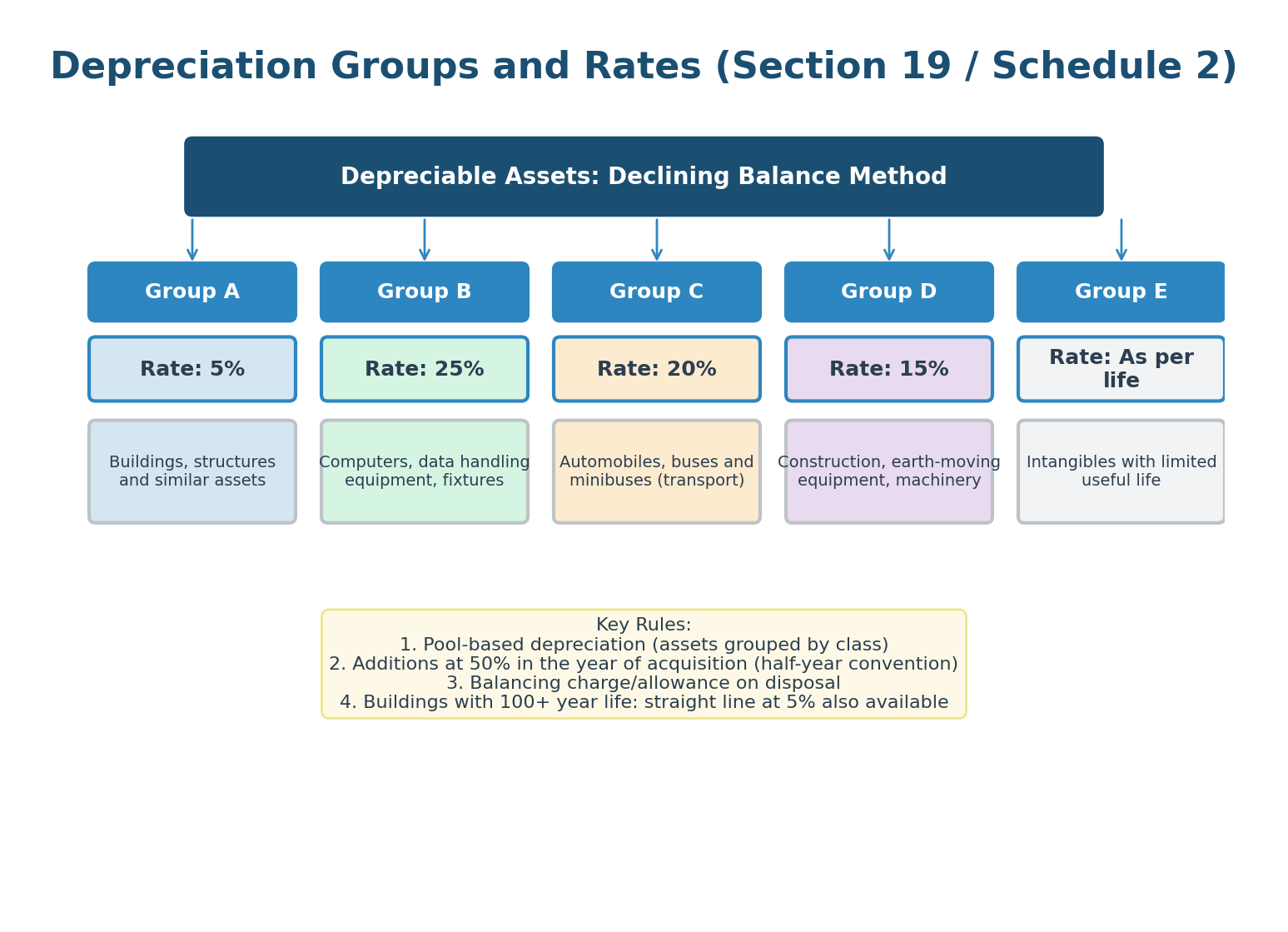
Figure: Depreciation Groups and Rates (Section 19 / Schedule 2)
(1) For the purposes of computing the income earned by any person from any business or investment in any income year, such person shall deduct depreciation pursuant to Schedule-2 in lieu of depreciation of the depreciable properties owned and used by that person in that year in earning income from that business or investment.
Conditions for claiming depreciation:
(1) the asset must be used in business or investment income activities;
(2) that person must have ownership of the asset;
(3) the asset must be a depreciable asset.
Depreciation must be claimed per Schedule 2.
Schedule 2 provides:
Sub section 1: Classification and Pooling of Depreciable Assets: Depreciable assets are classified into Classes A, B, C, D, and E. Class A, B, C, and D assets of the same class are pooled together. Class E assets (intangible assets) must be placed in separate pools even if of the same class, as each has different status and useful life.
Classification of Depreciable Assets (Schedule 2, Section 1) | |
Class | Asset Description |
'A' | Buildings, structures, and other permanent constructions (includes roads, tunnels, dams, powerhouses, warehouses, stadiums, bridges, etc.) |
'B' | Computers, data processing equipment, furniture, fixtures, and office equipment |
'C' | Automobiles, buses, and minibuses |
'D' | Construction and excavation equipment; assets capitalized under Sections 17(3) and 18(3); other depreciable assets not classified elsewhere |
'E' | Intangible assets (patents, copyrights, trademarks, formulas, brands, time-bound rights-linked assets). Each Class 'E' asset is placed in a separate pool. |
For depreciation purposes, class 'ka' (permanent structures) includes buildings, roads, tunnels, dams, swimming pools, power houses, warehouses, stadiums, view towers, canals, bridges, airport aprons, parking lots, and similar permanent assets. Structures built on leased land for a fixed period and structures built in rented commercial premises are depreciated over the period determined by the agreement between the lessor and lessee. The cost of such structures must be included in class 'nga' and depreciation claimed subject to the terms of that agreement.
Class 'nga' (intangible assets) includes patents, copyrights, trademarks, formulas, brands and other time-limited rights (but goodwill is not treated as an asset for tax purposes). A royalty tied to per-unit production or sales is not an intangible asset but a royalty.
Example 18.6.12 A:
Sunrise Boarding School Pvt. Ltd. purchased chairs/tables worth Rs. 1,00,000 and Diamond Restaurant Pvt. Ltd. purchased chairs/tables worth Rs. 2,00,000 for a party hall. Both must add to Class 'B' depreciation base.
Example 18.6.12 B:
Sunrise Boarding School Pvt. Ltd. bought a bus for Rs. 30,00,000 to transport students. Angela Travel Pvt. Ltd. bought a jeep for Rs. 40,00,000. Both are Class 'C' assets.
Section 3 Depreciation Rates: Three types are available:
(1) Normal Rate per Schedule 2, Section 3(1);
(2) Accelerated Rate per Schedule 2, Section 3(2) for manufacturing industries and specified bodies.
The following entities may claim an accelerated rate of one-third additional depreciation on Class A, B, C and D assets.
(a) Special industries (as defined in the Industrial Enterprises Act, 2076, Section 17) - meaning manufacturing industries other than cigarettes, bidi, cigar, khansu (tobacco), mines, industries whose main raw material is tobacco and similar products, wine, beer and similar products.
(b) Entities operating trolley buses or mini-buses on a specific route, or constructing and operating a ropeway, cable car or sky bridge, or constructing and operating roads, bridges, tunnels, railways or airports.
(c) Entities constructing public infrastructure and transferring it to the Government of Nepal, and hydropower generation, production and transmission projects.
(d) Cooperative unions and institutions registered under the Cooperative Act, 2074, other than tax-exempt ones.
A person who has developed an asset for the purpose of generating electricity required for their own business purpose may claim fifty percent of the capitalised amount of such asset as depreciation expense in the same year.
A person who issues bills and invoices using a fiscal printer and cash machine may claim the entire amount of expenditure incurred on such printer and cash machine as depreciation expense in the same year.
Depreciation Rates (Schedule 2, Section 3) | |||
Class | Normal Rate (Sec 3(1)) | Accelerated Rate (Sec 3(2)) - Manufacturing/Specified Bodies | Basis |
'A' | 5% | 6.67% | Declining balance |
'B' | 25% | 33.33% | Declining balance |
'C' | 20% | 26.67% | Declining balance |
'D' | 15% | 20.00% | Declining balance |
'E' | Cost/useful life (rounded to nearest half year) | Same as normal | Straight line |
Section 2 Depreciation of Asset
(1) General Rule
Any person can claim depreciation expense for each pool of depreciable assets in an income year.
Depreciation Formula
Depreciation=A×B
Meaning
A- Depreciation base of the pool at year-end
B- Depreciation rate applicable to that asset class
(2) Calculation of Depreciable Base
The depreciation base of depreciable assets in Class "A", "B", "C" and "D" is computed pool-wise, while the base of each asset in Class "E" is computed separately.
Item | Amount |
Opening depreciation base (previous year end base minus depreciation, if less than Rs. 2,000 deduct entirely) | |
Add: assets purchased during the year (per timing rules) | |
Add: prior-year amounts added to pool under Section 16 | |
Add: amounts added per Schedule 2(5) for next year's pool | |
Less: amounts received from disposal of pool assets in the year | |
Closing depreciation base |
The depreciation base of each depreciable asset under Class "E" at the end of any income year shall be the total of the following amounts:
Component | Description |
Opening Base | Previous year's depreciation base |
Additions | New assets added during the year |
(3) How New Asset Cost is Added to Pool
The full cost is not always added immediately.
A proportion is added in the year of purchase depending on when the asset is acquired.
First Instalment Formula
A/3×B
Meaning
A-Time factor as shown below B-Cost of asset
Period of Addition | Value of A | Portion Added This Year (A/3) | Balance Added Next Year |
Shrawan to Poush | 3 | Full cost (3/3) | None |
Magh to Chaitra | 2 | Two-thirds (2/3) | One-third |
Baisakh to Ashadh | 1 | One-third (1/3) | Two-thirds |
Remaining Cost
The balance not added in the first year:
Added in the following income year
Not added if the pool is dissolved before then.
(4) Additional Depreciation for Small Balances
Applicable only to Class A, B, C and D.
After calculating normal depreciation:
Condition | Treatment |
Remaining balance ≥ Rs. 2,000 | Carry forward normally |
Remaining balance < Rs. 2,000 | Claim entire balance as additional depreciation |
Section 4 Disposal of Depreciable Assets
Disposal of Depreciable Assets:
SubSection (1): If disposal proceeds of Class A, B, C, or D pool assets exceed the depreciation base at year-end, the excess (Balancing Charge) must be included in income.
SubSection (2): If all assets in a pool are disposed of before year-end, the pool is dissolved: if base exceeds proceeds, the excess is Terminal Depreciation (expense); if proceeds exceed base, the excess is income.
Summary of Depreciation (Sec 19, Schedule 2): asset must be (i) owned, (ii) used in business/investment, (iii) of a depreciable nature.
Pools (declining balance): A buildings/structures 5%, B computers/furniture/office equipment 25%, C automobiles/buses 20%, D plant/unclassified + assets capitalised u/s 17(3)/18(3) 15%; E intangibles = cost ÷ useful life (straight line, each in a separate pool).
Accelerated rate (manufacturing & specified bodies) = normal + one-third (A 6.67%, B 33.33%, C 26.67%, D 20%). Addition timing: added Shrawan-Poush = 100% of cost, Magh-Chaitra = two-thirds, Baisakh-Ashadh = one-third (balance added the next year)
Example 18.6.14: Suppose Nepal Trade Development Pvt. Ltd.'s depreciation base for pool 'kha' at the end of income year 2080/81 is Rs. 1,00,000. The depreciation expense for that pool in that income year is:
Depreciation base at end of income year (ka) | Rs. 1,00,000 |
Depreciation rate (kha) | 25 percent |
Depreciation expense = ka x kha | Rs. 25,000 |
Example 18.6.15: Suppose Nepal Trade Development Pvt. Ltd.'s class 'kha' depreciation base at the end of income year 2080/81 is Rs. 2,400. After deducting 25 percent depreciation of Rs. 600, the balance is Rs. 1,800. Since this is less than Rs. 2,000, the entire remaining balance of Rs. 1,800 may be claimed as additional depreciation in that income year.
Example 18.6.16: A computer worth Rs. 60,000 purchased in FY 2080/81: if added within Poush 2080, full Rs. 60,000 included in that year's pool; if added Magh-Chaitra, two-thirds Rs. 40,000 added this year and Rs. 20,000 next year; if added Baisakh-Ashadh, one-third Rs. 20,000 added this year and Rs. 40,000 next year.
Example 18.6.17 (Class E - Trade Mark License): Trade mark license purchased on Magh 10, 2080 at Rs. 6,00,000 with useful life 5 years 2 months (rounded to 5 years). Annual rate: 20%. Annual depreciation: Rs. 1,20,000. Since purchased in Magh-Chaitra, two-thirds of cost (Rs. 4,00,000) is added in FY 2080/81 and Rs. 2,00,000 in FY 2081/82.
Description | FY 2080/81 | FY 2081/82 | FY 2082/83 |
Cost (Rs.) | 6,00,000 | 6,00,000 | 6,00,000 |
Opening depreciation base (Rs.) | - | 5,20,000 | 4,00,000 |
Added this year timing-based (Rs.) | 4,00,000 | - | - |
Depreciation expense (Rs.) | 80,000 | 1,20,000 | 1,20,000 |
Next year opening depreciation base (Rs.) | 5,20,000 | 4,00,000 | 2,80,000 |
Amount to add to pool next year (Rs.) | 2,00,000 | - | - |
Example 18.6.18: Nepal Trade Development Pvt. Ltd. at end of FY 2079/80 had Pools C and D. In Magh FY 2080/81, added a motorcycle worth Rs. 1,00,000. In FY 2080/81, sold car for Rs. 17 lakh and machinery for Rs. 9 lakh. Motorcycle destroyed in accident; no assets remain in either pool.
Description | Pool C (Rs.) | Pool D (Rs.) | Total (Rs.) |
Opening depreciation base | 15,00,000 | 10,50,000 | 25,50,000 |
Added this year (timing-based) | 1,00,000 | - | 1,00,000 |
Disposed this year | 17,00,000 | 9,00,000 | 26,00,000 |
Assets remaining | None | None | None |
Balancing Charge (income) | 1,00,000 | - | 1,00,000 |
Terminal Depreciation | - | 1,50,000 | 1,50,000 |
Depreciation base | - | - | - |
Balancing Charge (excess proceeds over base) of Rs. 1,00,000 in Pool C is included in income per Section 7(2)(d). Pool D has no remaining assets but a value of Rs. 1,50,000 remains, so Terminal Depreciation of Rs. 1,50,000 is claimed per Schedule 2, Section 4.
If an asset still exists but its block value is zero, any repair/improvement cost is added to the depreciation base and depreciated in future years instead of being immediately deducted.
(2) Notwithstanding anything contained in sub-section (1), the following provisions shall apply in respect of the depreciation deduction of the devices, equipment and other machineries installed by any entity in the projects involving construction and operation of public infrastructure to be transferred to the Government of Nepal and in the projects on construction of powerhouses and generation and transmission of electricity:-
(a) If the devices, equipment and other machineries installed previously become obsolete because of being old or worn out and new devices, equipment and other machineries have to be installed in lieu thereof, the value which remains by subtracting the depreciation deduction up to the income year from the cost of the obsolete property that was installed previously in the income year in which such new installation was made may be deducted as expenses.
(b) In respect of properties other than the old properties replaced pursuant to clause (a), if any value remains by subtracting the depreciation deduction up to the income year when transfer takes place from the cost of those properties at the time when the entity transfers such a project to the Government of Nepal, that entity may deduct such remaining value as expenses.
Example 18.6.21 Nepal Hydropower Project Pvt. Ltd. received a 30-year license for a 30-megawatt BOOT project. In addition to other assets, land worth Rs. 90 lakh was purchased for the project. Since this is a BOOT project requiring land handover at the end of the 30-year contract period, the land investment can be included in Class 'E' and claimed as Rs. 3 lakh per year (Rs. 90 lakh / 30 years) for income tax purposes.
Example 18.6.23 A company purchased a fiscal printer and cash machine for Rs. 50,000. Since these are assets specified under Schedule 2, Section 3(4), the full cost of Rs. 50,000 can be claimed as depreciation in the year the assets are put into use.
Example 18.6.22: Kattha Limited, special industry, installed a generator worth Rs. 9 lakh in Magh 2080. Pool D other assets opening depreciation base Rs. 29 lakh. The opening depreciation base of class 'D' other assets at the start of the year is Rs. 29 lakh. Since the generator qualifies for 50 percent first-year depreciation, the calculation is:
Opening dep. base | Rs. 29,00,000 |
Depreciation at (15+15/3) 20% (a) | Rs. 5,80,000 |
Special depreciation 50%*9,00,000 (b) | Rs. 4,50,000 |
Total depreciation (a + b) | Rs. 10,30,000 |
Opening dep. base next year | Rs. 38,00,000 - Rs. 10,30,000 = Rs. 27,70,000 |
Example 21.6.9: Suppose the assets in Gobinda Prasad's Pool "C" at the end of fiscal year 2079/80 were as follows. He did not add any assets in fiscal year 2080/81. In fiscal year 2080/81, he sold his car for Rs.14 lakhs. The outgoings and incomings of that pool are as follows:
Item | Amount (Rs.) |
(a) Total Pool "C" | 15,00,000/- |
(b) Fiscal year 2079/80 depreciation base | 15,00,000/- |
(c) Fiscal year 2079/80 depreciation expense | 3,00,000/- |
(d) Amount remaining after deducting depreciation (b-c) | 12,00,000/- |
(e) Fiscal year 2080/81 depreciation base (Outgoings) | 12,00,000/- |
(f) Amount received from sale of asset (Incomings) | 14,00,000/- |
Amount to be included in income (f-e) | 2,00,000/- |
Since the incomings exceeded the outgoings in that asset pool and there are no other assets in that pool, the pool is considered dissolved, and the excess of incomings over outgoings of Rs.2 lakhs must be included in investment income. If he had sold the car for only Rs.11 lakhs, since outgoings exceeded incomings by Rs.1 lakh, he would have been entitled to claim such amount as an expense deduction in that fiscal year under Section 19.
20. Loss from business or investment
(1) For the purposes of computing the income earned by any person from any business or investment in any income year, such person may deduct the following loss:-
(a) Loss suffered by that person from any other business and not deducted in that year, and
Example 18.8.1: Ganesh Sinkhada had Rs. 1 crore import business income and Rs. 50 lakh hotel operation loss in FY 2080/81. He can claim the hotel loss against import income in that year's return.
Example 18.8.2: If Ganesh Sinkhada had only hotel losses of Rs. 50 lakh in FY 2080/81 with no other income, losses can be carried forward for 7 years (until FY 2087/88) and deducted from business or investment income from 2081/82 through 2087/88.
Per Section 57, if 50% or more of any body's ownership (control) changes compared to three years prior, the body is deemed to have disposed of its assets or liabilities, and losses incurred before the ownership change cannot be deducted after the change.
Example 21.8.1: Suppose Ganesh Bahadur incurred a loss of Rs. 10 lakhs from a hotel business in fiscal year 2080/81. He sold shares of a listed company (investment income) in that year and earned a gain of Rs. 15 lakhs from such sale. In computing the net gain from share disposal in that fiscal year, the hotel business loss of Rs. 10 lakhs may be deducted, leaving a net gain of only Rs. 5 lakhs. In the above example, investment loss cannot be claimed as a deduction against income from hotel business.
Example 21.8.2: Suppose Ganesh Bahadur sold shares of a listed company (investment income) in fiscal year 2079/80 and incurred a loss of Rs. 6 lakhs from such sale, and such loss could not be adjusted in that year. In fiscal year 2080/81, he sold land (non-business taxable asset) for Rs. 1 crore (investment income) and earned a gain of Rs. 20 lakhs. In computing the net gain from disposal of non-business taxable asset in that fiscal year, the investment loss of Rs. 6 lakhs from fiscal year 2079/80 may be deducted, leaving a net gain of only Rs. 14 lakhs.
(b) Loss suffered by that person from any business and not deducted in the past seven income years.
Provided that in the case of a project of building and operation of any public infrastructure to be transferred to the Government of Nepal, a project on construction of a powerhouse and generation and transmission of electricity, and an entity conducting petroleum work pursuant to the Nepal Petroleum Act, 2040, loss not deducted in the last twelve income years.
(2) For the purposes of computing the income earned by any person from any investment in any income year, such person may deduct the loss suffered by that person from any other investment and not deducted in that year and the loss incurred by that person from such investment or any other investment which could not be deducted in the past seven income years.
In this sense, while business loss may be claimed as a deduction against investment income, investment loss cannot be claimed as a deduction against business income. Similarly, losses from business or investment cannot be deducted from employment income.
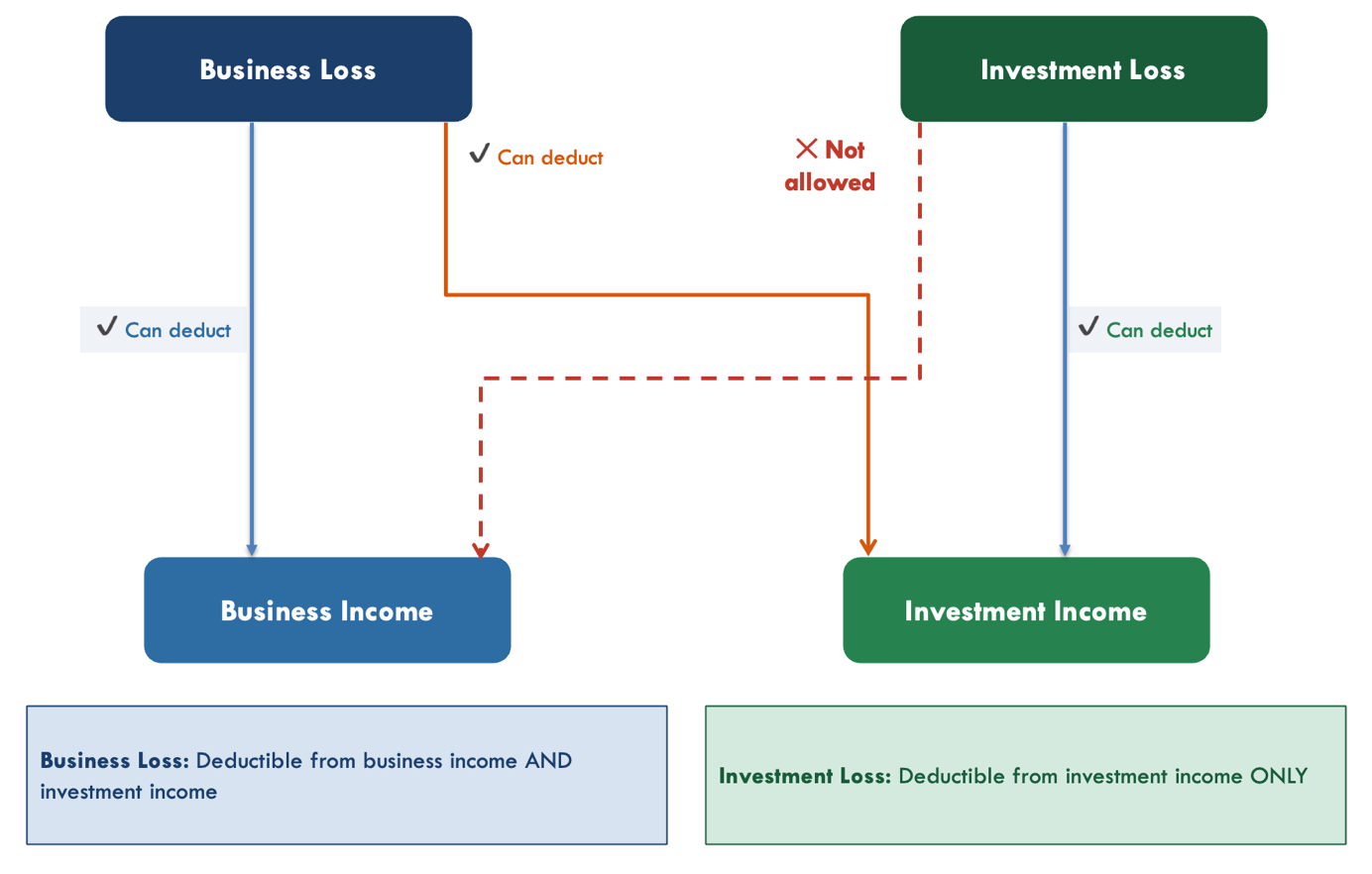
(3) Subject to sub-sections (1) and (2), and for the purposes of those sub-sections, any loss suffered by any person in respect of foreign source and not deducted may be deducted only in computing the income earned by that person from his foreign source, and the loss suffered in earning any non-taxable income and not deducted may be deducted only in computing the non-taxable income of that person.
Any undeducted loss incurred by a person from a foreign source may be deducted only in computing income of that person from that foreign source, and any undeducted loss incurred in receiving a tax-exempt income may be deducted only in computing the tax-exempt income of that person. That is, investment losses incurred in a particular country may only be deducted against investment income earned in that same country.
(4) Subject to sub-sections (1) and (2), if any person suffers a loss in an income year when a long-term contract obtained by carrying on the business at the international level in competition was completed or disposed of in any other manner, or where a loss not deducted which the liability whereof is allowed to be carried forward to the coming year pursuant to clause (b) of sub-section (1) is related with a long-term contract, the Department may, by a notice in writing, give permission to deal with that loss as follows:-
(a) The loss may be carried backward to the last income year or years, and
(b) The loss not deducted may be treated only to the extent of the excess where, in computing the income of the business related with that long-term contract, the amounts to be included in the incomings exceed the amounts to be included in the outgoings.
Comprehensive Numerical Illustration
Company: ABC Infrastructure Pvt. Ltd.
Business: Construction of large infrastructure projects
Nature of Contract: Long-term construction contract obtained through international competitive bidding (Global Contract)
Contract Period: FY 2077/78 to FY 2080/81
Accounting Method: Percentage of Completion Method (Estimated Cost Basis)
Applicable Income Tax Rate (assumed for illustration): 25%
FY 2077/78:
Contract Revenue Recognised: Rs. 100,000,000
Contract Cost Incurred: Rs. 80,000,000
Profit: Rs. 20,000,000
FY 2078/79:
Contract Revenue Recognised: Rs. 120,000,000
Contract Cost Incurred: Rs. 95,000,000
Profit: Rs. 25,000,000
FY 2079/80:
Contract Revenue Recognised: Rs. 60,000,000
Contract Cost Incurred: Rs. 120,000,000
Loss: Rs. 60,000,000
FY 2077/78 Tax: Rs. 20,000,000 × 25% = Rs. 5,000,000
FY 2078/79 Tax: Rs. 25,000,000 × 25% = Rs. 6,250,000
Total Tax Paid in Earlier Years: Rs. 11,250,000
In FY 2079/80, the company incurs a loss of Rs. 60,000,000 related to the long-term contract. Upon completion of the contract, the Inland Revenue Department issues a written notice allowing carry-back of the loss.
Step 1: Set-off against FY 2078/79 profit
Profit available: Rs. 25,000,000
Remaining loss: Rs. 60,000,000 − Rs. 25,000,000 = Rs. 35,000,000
Step 2: Set-off against FY 2077/78 profit
Profit available: Rs. 20,000,000
Remaining loss: Rs. 35,000,000 − Rs. 20,000,000 = Rs. 15,000,000
Tax Benefit:
Refund/Credit Adjustment of FY 2078/79 tax: Rs. 6,250,000
Refund/Credit Adjustment of FY 2077/78 tax: Rs. 5,000,000
Total immediate tax refund/Credit Adjustment: Rs. 11,250,000
Balance loss of Rs. 15,000,000 carried forward to future years.
Assume that carry-back is not approved by the Department. In such a case, clause (b) applies.
While computing income from the business related to the long-term contract in FY 2079/80:
Income side amount: Rs. 60,000,000
Expense side amount: Rs. 120,000,000
Excess of income over expense: Nil
Result under clause (b):
Entire loss of Rs. 60,000,000 is treated as ‘loss not allowed to be deducted’. The loss is legally recognised but cannot be set off against other business income. The loss is carried forward and adjusted only against future income from the same long-term contract.
If carry-back is allowed: Immediate cash-flow benefit through tax refund of Rs. 11,250,000.
If carry-back is not allowed: Genuine loss of Rs. 60,000,000 is preserved for future adjustment and not permanently disallowed.
(5) The following loss suffered by any person in any income year shall be allocated as if it were related with a long-term contract or contracts of that person:-
(a) The loss resulted from a long-term contract or contracts related with the business, and
(b) The loss on excess of the expenses to be deductible in computing the income earned from that business in the year related with the contract for each such contract over the amounts to be included.
(6) If, when computing the income earned by any person from more than one business or investment in any income year, that person is allowed to deduct the loss not deducted from more than one business or investment, that person may on his own determine the priority of the business or investment from which the portion of loss is deducted.
Example 18.8.3: Globe Nepal Pvt. Ltd. has a Trading Business in Kathmandu and LPG factories in Bhairahawa (Rs. 1 crore income) and Dhangadhi (Rs. 20 lakh income). Trading Business had Rs. 10 lakh loss in FY 2080/81. The company must decide itself whether to deduct the loss from Bhairahawa or Dhangadhi income, as per Section 20(6).
(7) If, when computing the loss suffered by any person from any business or investment in any income year, this Section is not applied and the deductible amounts exceed the amounts includable in computing the income from the business or investment of that person, such excess amounts shall be computed.
(8) If any person has received full tax exemption in respect of income of business or investment in any income year, the loss incurred in that income year shall not be carried forward to the upcoming income year.
For example, a loss from a business that is fully exempt from tax under Section 11 of the Act cannot be claimed as a deduction against computing income from other businesses or investments, and such loss also cannot be carried forward.
Example 18.8.4: Globe Electricity Company Pvt. Ltd. operated a small hydropower plant with full tax exemption until FY 2079/80, accumulating Rs. 60 lakh in losses. In FY 2080/81, the company earned Rs. 10 lakh. Since full exemption was received in 2079/80, losses cannot be carried forward to 2080/81. The company must file tax on Rs. 10 lakh at 20% = Rs. 2 lakh.
Example 18.8.5: If Globe Electricity Company received only partial tax exemption until FY 2079/80, the Rs. 60 lakh losses can be carried forward and deducted from FY 2080/81 income. Any undeducted amount can be carried forward subject to Section 20(1).
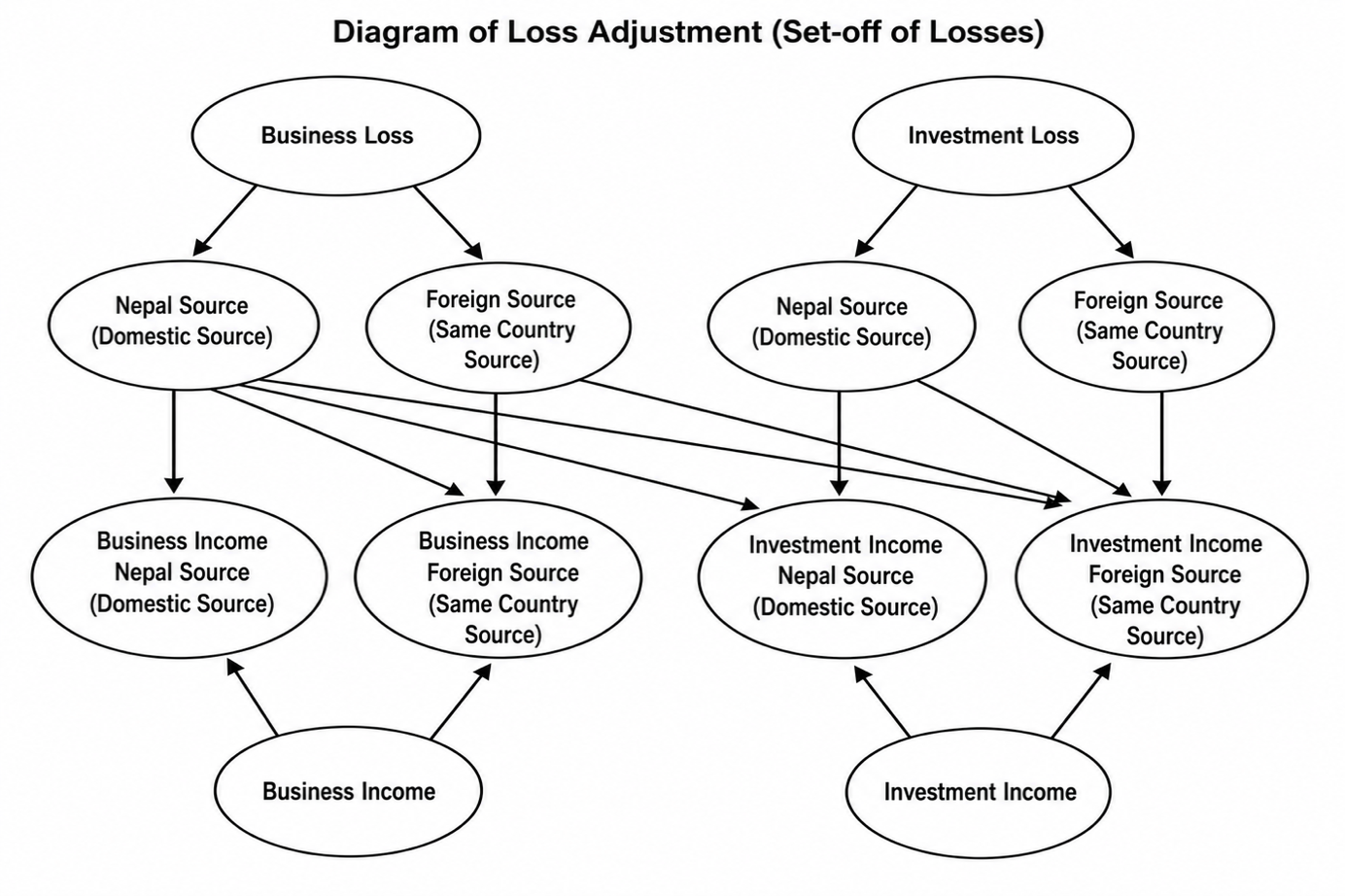
Loss Type | Business Income (Nepal Source) | Business Income (Foreign Source-Same Country) | Investment Income (Nepal Source) | Investment Income (Foreign Source-Same Country) |
Business Loss -Nepal Source | ✓ | ✓ | ✓ | ✓ |
Business Loss -Foreign Source | ✗ | ✓ | ✗ | ✓ |
Investment Loss - Nepal Source | ✗ | ✗ | ✓ | ✓ |
Investment Loss - Foreign Source | ✗ | ✗ | ✗ | ✓ |
Loss set-off & carry-forward (Sec 20): business loss → deductible against business AND investment income; investment loss → only against investment income (NOT business); neither against employment income.
Carry forward 7 years (12 years for BOT/BOOT infrastructure, power and petroleum projects). Foreign-source loss → only against same-country foreign-source income; tax-exempt-income loss → only against that exempt income.
Sec 20(6): taxpayer chooses which business/investment to set the loss against.
Sec 20(8): a fully tax-exempt year's loss cannot be carried forward. Sec 57: if ownership changes 50% or more vs 3 years earlier, pre-change losses lapse
21. Expenses not allowed for deduction
(1) Notwithstanding anything contained elsewhere in this Act, for the purpose of computing the income earned by any person from any business, employment or investment in any income year, the following expenses or amounts shall not be deducted:-
(a) Expenses of domestic or personal nature,
(b) Tax payable under this Act and a fine or similar other fee paid to the government of any country or any local body thereof for a violation of any law or regulation or byelaw framed thereunder,
Provided that the tax paid to the Provincial Government and Local Level shall be deducted as expenses.
(c) Expenses to the extent of those spent by any person to obtain the amounts enjoying exemption pursuant to Section 10 or expenses made to obtain the amounts from which tax has been finally deducted,
(d) Expenses for the payments referred to in sub-section (2),
(d1) Remuneration and wages expenses distributed to employees and workers having no Permanent Account Number except for wages of a periodic nature paid up to three thousand rupees,
(d2) Expenses against invoices of more than two thousand rupees wherein the Permanent Account Number is not mentioned,
Provided that the purchase expenses shall be valid if the seller does not have a Permanent Account Number, in the case of a natural person directly buying agricultural, forest, animal or other household goods without carrying on commercial business transactions.
(e) Distribution of profits by any entity,
(e1) Remuneration of more than twenty-five thousand rupees per person per month not paid through a banking channel,
(f) Similar other amounts notwithstanding that they are not so mentioned in clauses (a), (b), (c), (d), (d1), (d2), (e) and (e1) as not to be deductible, except those allowable under this Chapter or Chapter-6, 7, 10, 11, 12 or 13.
(2) If a person whose annual turnover is more than twenty lakh rupees in any income year makes a cash payment of more than twenty five thousand rupees at a time in that income year, he shall not be allowed to make that deduction except in the following circumstances:-
(a) Payment made to the Government of Nepal, a constitutional body, a corporation or bank or financial institution owned by the Government of Nepal,
(b) Payment made to a farmer or producer producing a primary agro-product, and payment to a farmer who has processed such product on his own, notwithstanding that primary processing of such product has already been carried out,
(c) Payment for retirement contribution or retirement payment,
(d) Payment made in a place where banking services are not available,
(e) Payment made on the day when banking services are closed or payment involving a mandatory provision of payment in cash, or
(f) Amount deposited in the bank account of the recipient of payment.
(3) Subject to the provisions of Sections 14, 15, 16, 17, 18, 19, 20 and 71, no amount shall be deductible for capital expenses or foreign income tax.
Explanation: For the purposes of this Section,-
(a) "Expenses of domestic or personal nature" means the following expenses:-
(1) Private expenses of any natural person, and expenses including the following expenses to the extent a loan has been used for personal purpose, in respect of interest on a loan borrowed by an natural person:-
(a) Expenses made for an natural person for the provision of lodging, food, snacks, entertainment or other activities of amusement,
(b) Expenses for the movement by an natural person from his house to the place where the business or investment is operated, except for movement in the course of business or investment,
(c) Expenses made to purchase clothes for an natural person except those clothes which are not proper to put on at times other than working times, and
(d) Expenses made for education or training.
Provided that the expenses made only for education directly related with the business or investment, where no degree or diploma is achieved, shall be deductible.
(2) Except in the following circumstances and to that extent, expenses incurred in respect of a payment made by any person to any natural person and expenses made for a third person:-
(a) If that payment has been included in computing the income of an natural person,
(b) If the natural person has made, as a consideration, a return payment to that person in a sum equal to the market value of the payment received, or
(c) If payment is made for such prescribed petty amounts of which accounts are difficult or administratively impracticable to be maintained.
(b) "Place where banking service is available" means any place within a ten-kilometer area whereof banking service is available.
(c) "Cash payment" means a payment other than a payment by letter of credit, account payee cheque, draft, money order, telegraphic transfer, money transfer (Hundi) through a bank or financial institution to be deposited in a bank account, payment made through a digital wallet approved by Nepal Rastra Bank, and a transfer made by any other means between banks or financial institutions.
(d) "Capital expenses" means the following expenses, excluding the ones incurred in the issuance of shares or debentures:-
(1) Expenses incurred in feasibility study, exploration and development of natural resources,
(2) Expenses incurred in acquiring any property with useful life for more than twelve months, or
(3) Expenses in disposing of a liability.
Non-deductible expenses (Sec 21): (a) domestic/personal expenses + (b) income tax & fines/penalties for legal violations (BUT provincial & local tax = deductible) + (c) expenses to earn Sec 10 exempt or final-WHT income + (d) Sec 21(2) cash payments > Rs. 25,000 + (d1) wages to employees without PAN (except periodic wages up to Rs. 3,000) + (d2) invoices over Rs. 2,000 without PAN + (e) distribution of profits + (e1) remuneration over Rs. 25,000/month not paid through a banking channel + (f) similar amounts.
Sec 21(2): turnover over Rs. 20 lakh + single cash payment over Rs. 52,000 = not deductible (exceptions: govt/bank payee, farmers, retirement, no-banking areas, bank-closed days, deposit to payee's account). Sec 21(3): capital expenses & foreign income tax not deductible.
Chapter-6 Tax Accounting and Time
22. Method of tax accounting
Rule 8(1): In maintaining accounts of tax pursuant to Section 22 of the Act, accounts shall be maintained in accordance with the accounting standards, if any, prescribed by the prevailing law.
Rule 8(2): In cases where any accounting standards are not specified pursuant to Sub-rule (1), tax accounting shall be carried out as per the accounting standards specified by the Department based on any prevailing international principle or practice.
In this context, the Act provides that accounting must be done in accordance with Nepal Accounting Standards/Nepal Financial Reporting Standards (NAS/NFRS) issued by the Institute of Chartered Accountants of Nepal (ICAN), and where such standards are not available, in accordance with International Accounting Standards/International Financial Reporting Standards (IAS/IFRS) or other prevailing principles.
(1) The matter of when any person receives any income or makes any expense shall be determined in accordance with the widely recognized accounting principle, subject to this Act.
(2) An natural person shall, while computing the income to be earned from his employment and investment, maintain accounts on the cash basis, for purposes of tax.
Provided that where, after the filing of a case in court and its determination, any natural person receives a lump-sum payment of remuneration for past income years in respect of employment, such remuneration shall be accounted for on the accrual basis in the relevant income years for tax purposes.
This provision is clarified in the following example:
Example 8.2.1: Suppose Kamal Pariyar is an employee at the Agriculture Supplies Corporation. He received the total amount of Rs. 2,40,000 due as salary and allowances at the rate of Rs. 20,000 per month from 2080 Shrawan to 2081 Ashadh only in 2081 Shrawan. In this situation, since accounting is on a cash basis, the amount must be included in income for tax purposes in the month in which it was received, namely 2081 Shrawan. Therefore, under this method, regardless of which income year the income relates to, it must be accounted for as income in the income year in which it is received.
(3) A company shall maintain accounts on the accrual basis, for purposes of tax.
For tax purposes, the term "company" has a broader meaning than "company" in the corporate sense. The entities that fall within the term "company" for tax purposes are listed in Section 2(m) of the Act. Such companies must account on the accrual basis. The provision is clarified in the following example:
Example 8.2.2: Suppose Kamal Services and Company Pvt. Ltd. entered into a contract to provide security guards to the Agriculture Supplies Corporation, and in this context, the company provided 5 security guards in 2081 Ashadh. The invoice value under the agreement for providing security guards for that month was Rs. 30,000. Since the right of the company to receive Rs. 30,000 from the Agriculture Supplies Corporation for providing security guards was created, even though the cash payment was not received from the Agriculture Supplies Corporation, the company must include the above-mentioned Rs. 30,000 in its income for income year 2080/81.
(4) Except if the Department has otherwise specified by issuing a notice in writing, any person may, for purposes of income tax, shall maintain accountxs on the cash or accrual basis, subject to sub-sections (1), (2) and (3).
An natural person must account on a cash basis for income from employment and investment, and a company must account on an accrual basis for tax purposes. In other circumstances, such as an natural person or a partnership firm with fewer than 20 partners accounting for business income, either the cash or accrual basis may be used.
(5) Any person may make an application to change the method of accounting for tax purposes, subject to sub-sections (2) and (3). If the Department thinks that it is necessary to change the method of accounting to clearly show the income of such person, the Department may give permission to change the method of accounting.
Generally, an accounting method once adopted must be used consistently. However, a person other than a company who considers that their accounting method has become difficult to compare with the accounting method used by other persons conducting similar businesses, or for any other valid reason, may apply to the Department to change the accounting method. That is, a person who has been accounting on a cash basis and wishes to account on the accrual basis, or a person who has been accounting on the accrual basis and wishes to change to the cash basis, may apply to the Department. If the Department considers it necessary to change the accounting method in order to clearly present income, it may grant approval for such change. Since the employment and investment income of an natural person must be on a cash basis except for the restrictive provision under the proviso to Section 22(2), and the accounting for a company's income must be on the accrual basis for tax purposes, applications to change these provisions cannot be submitted.
(6) If the method of accounting of any person for purposes of tax is changed pursuant to sub-section (5), in computing the income of that person in the income year when such change is made, adjustment shall be so made that no amounts out of those included, deducted or to be included or deducted are omitted or duplicated.
Where an accounting method is changed for tax purposes without obtaining the Department's approval, an adjustment must be made in the income year of the change to ensure that no amount is omitted or duplicated. This provision is clarified in the following example:
Example 8.2.3: See Example 6.2.7
Person | Income Head | Accounting Method |
Natural person | Employment, Investment | Cash basis (except for the restriction under Section 22(2)) |
Natural person (and entities other than companies) | Business | Cash or accrual basis |
Company | Business, Investment | Accrual basis |
Tax accounting method (Sec 22): natural person → CASH basis for employment & investment income (exception: court-awarded lump-sum back-pay = accrual in the relevant years);company → ACCRUAL basis; others (incl. partnership with fewer than 20 partners) → cash OR accrual by choice. Method once chosen must be applied consistently; a change needs Department approval, with an adjustment in the change year so no amount is omitted or duplicated.
23. Cash basis accounting
Any person shall, in maintaining accounts on the cash basis of his income earned from employment, business or investment for tax purposes, subject to this Act, do as follows:-
(a) To treat as income received and include it in his income computation only at the time when payment is received by him or made available to him.
(b) To deduct for expense only after he makes payment.
The system of including amounts in income only after cash is received, and recording expenses only after cash has been paid, is called the cash-basis accounting method. However, even where accounting is on a cash basis, expenses under Section 15 (Cost of Goods Sold) must be recorded on the accrual basis. The provisions on cash-basis accounting are clarified in the following example:
Example 8.3.1: Suppose Mohan Kasaju & Sons is a sole proprietorship. That firm accounts for its income and expenses on a Cash Basis for income tax purposes. The position of the firm's transactions in income year 2080/81 is as follows:
a. Cash received in 2080/81 from credit sales made in 2079/80: Rs. 50,000.
b. Total sales of 2080/81 were Rs. 10,00,000, of which Rs. 9,00,000 was received in cash.
c. Employee salary expense of Rs. 2,00,000 for 2080/81, of which Rs. 1,80,000 was paid; Rs. 20,000 was paid only on date 2081.4.14.
d. Cost of sales of Rs. 6,00,000 already paid.
e. In 2080/81, advance payment of Rs. 1,00,000 for rent for 2081/82 was made.
f. The rent of Rs. 90,000 for 2080/81 was paid in cash in income year 2079/80.
g. Of the total interest expense for 2080/81 of Rs. 60,000, Rs. 10,000 was paid only on date 2081.4.20.
Based on the above, the income of that firm for income year 2080/81 must be computed on a cash basis as follows:
Description | Deduction (Rs.) | Income (Rs.) |
a. Cash received in 2080/81 from credit sales of 2079/80 | 50,000 | |
b. Cash sales of 2080/81 | 9,00,000 | |
c. Salary paid in cash to employees in 2080/81 | 1,80,000 | |
d. Cost of sales | 6,00,000 | |
e. House rent paid in cash in 2080/81 | 1,00,000 | |
f. House rent for 2080/81 paid in cash in 2079/80 (already paid) | - | |
g. Interest paid in cash | 50,000 | |
Total | Rs. 9,30,000 | Rs. 9,50,000 |
In this way, where the firm accounts on a cash basis for income tax purposes, Rs. 9,50,000 must be included in income (Inclusion) and Rs. 9,30,000 may be claimed as a deduction (Deduction).
Cash basis (Sec 23): include income only when payment is actually received or made available; deduct an expense only when it is actually paid. Exception: stock-in-trade expenses under Sec 15 are recorded on the accrual basis even under cash accounting
24. Accrual basis accounting
(1) Any person shall, in maintaining accounts on the accrual basis of his income earned from business or investment, subject to this Act, for purposes of tax, include any payment in computation of his income, considering that such payment has been received immediately when the right to receive such payment is created.
Example 8.4.1: Suppose Mohan Kasaju & Sons mentioned in Example 8.3.1 above accounted for its income and expenses on an Accrual basis for income tax purposes. In that case, the transactions mentioned in that example must be included in income and claimed as deductions as follows:
Description | Deduction (Rs) | Income (Rs) |
a. Cash received in 2080/81 from credit sales of 2079/80 | - | |
b. Sales of 2080/81 | 10,00,000 | |
c. Employee salary expense for 2080/81 | 2,00,000 | |
d. Cost of sales | 6,00,000 | |
e. Advance rent paid for 2081/82 | - | |
f. House rent expense for 2080/81 | 90,000 | |
g. Interest expense | 60,000 | |
Total | 9,50,000 | 10,00,000 |
In this way, where the firm accounts on an accrual basis for income tax purposes, Rs. 10,00,000 must be included in income (Inclusion) and Rs. 9,50,000 may be claimed as a deduction (Deduction).
(2) For the purposes of making deduction in computing income earned by any person as mentioned in sub-section (1), the following expenses shall be deemed to have been borne:-
(a) If any payment involving such expenses has been made in lieu of a payment made by any other person, the expenses shall be deemed to have been borne in the following circumstances:-
(1) The person has the liability to make that payment,
(2) The value of such liability can be ascertained in a realistic manner, and
(3) Payment has been received from another person, or
For an expense to be deducted on an accrual basis, the following three conditions must be met:
First condition: The party to be paid must be identified. An expense arrangement with an unidentified party is a probable obligation (provision), and a provision expense is not deductible. Suppose Shailesh purchased a computer from City Computer Pvt. Ltd. for Rs. 1,00,000 on credit. Since the ownership of that computer was transferred from City Computer to Shailesh, Shailesh's obligation to pay Rs. 1 lakh to City Computer Pvt. Ltd. was created.
Second condition: For an expense to be deducted on an accrual basis, the value of that obligation must be ascertained in a realistic manner. Even if there is an obligation to pay, if the amount is uncertain, the estimated loss is recorded as a provision expense in the financial statements, and provision expenses are not deductible. In the above example, since Shailesh purchased goods worth Rs. 1 lakh from City Computer Pvt. Ltd. and a bill has been issued, the value of that obligation is Rs. 1 lakh, which is determinable.
Third condition: For an expense to be deducted on an accrual basis, the amount must be in respect of goods or services received from the party to be paid. Where goods or services have not been received, even if the paying party is identified or the amount is identified, such an amount is not an expense but a prepayment. The other person, City Computer Pvt. Ltd. in the above example, has provided payment (goods) to Shailesh. Since all three conditions mentioned above are met for this purchase transaction, Shailesh must record this purchase transaction as an expense on the accrual basis. The provisions on payment accounting are further clarified in the following example:
Example 8.4.2: Suppose Bikash Nepal Trading Pvt. Ltd. sold goods worth Rs. 50,000 to Swarnima Pvt. Ltd. on the condition of payment one month later. In this situation, since Swarnima Pvt. Ltd. received goods worth Rs. 50,000 from Bikash Nepal Trading Pvt. Ltd. and has an obligation to pay one month later, and such an obligation can be ascertained in a realistic manner, Swarnima Pvt. Ltd. may claim that expense as a deduction on the accrual basis at the same time.
(b) In all other circumstances except that mentioned in clause (a), an expense shall be deemed to have been borne at the time when payment is made.
As stated above, although a provision expense is treated as an expense in the financial statements, it is not treated as an expense for tax purposes. However, where actual payment is made in the income year, such expense is allowed as a deduction. Such expenses are treated as borne on the basis of actual payments. This provision is clarified in the following example:
Example 8.4.3: Suppose by the end of income year 2080/81, Red Nepal and Company Pvt. Ltd. had an employee gratuity liability of Rs. 5,00,000 that had been created based on the employee service condition regulations. In preparing the financial statements in accordance with Nepal Accounting Standards, the company must record that amount as an expense and account for it as a liability. However, since the employees had not yet retired and the liability amount could change by the time they retire in the future, such gratuity liability cannot be treated as a liability whose value can be ascertained in a realistic manner for income tax purposes, and even though the expense was claimed in the financial accounts, it is not treated as deductible for income tax purposes. If the company had paid such liability to an approved retirement fund in such a way that it cannot be used by the company and on an identified basis for employees, that is, in such a way that the value of the liability can be ascertained in a realistic manner, it may claim the deduction at the time of payment for income tax purposes. Otherwise, the gratuity liability may be treated as an expense only at the time it is actually paid to the employee upon retirement.
(3) Notwithstanding anything contained in sub-section (1), the Department may recognize the accounting specified by the Nepal Rastra Bank with respect to banking business, subject to the Nepal Rastra Bank Act, 2058 (2002) and prevailing laws relating to banking.
Provided that a cooperative organization may keep accounting of interest income on cash basis.
Under Section 24(1) of the Act, accounting must be maintained on an accrual basis. However, Section 24(3) provides that in the case of banking business, the Department may recognise the accounting method prescribed by Nepal Rastra Bank, subject to the Nepal Rastra Bank Act, 2058 and prevailing laws relating to banking. Similarly, cooperative institutions may also account for interest income on the cash basis. This means that a banking business is not obligated to strictly follow the general accrual basis rule for interest income if Nepal Rastra Bank prescribes a different accounting treatment - for example, where a loan has become non-performing, Nepal Rastra Bank may direct that interest not yet received should not be recognised as income. In such cases, the banking entity may follow the NRB-prescribed treatment for income tax purposes.
(4) Where, in computing on the accrual basis the income earned by any person from a business or investment, any payment receivable by that person is included or any payment to be borne by that person is deducted, and a difference occurs in the amount received or paid by that person because of, inter alia, difference in the exchange rate, the difference shall be adjusted in receiving or making payment.
Nepal Accounting Standards require that foreign currency receivables or payables be restated at the exchange rate prevailing on the last day of the income year, and any resulting gain or loss must be recorded in the profit and loss account for that income year. Although that NAS provision is applicable or mandatory for financial purposes, for income tax purposes, foreign currency receivables or payables cannot be included as income or deducted as expense based on a restatement at the exchange rate prevailing on the last day of the income year. For income tax purposes, the foreign exchange gain or loss must be computed using the exchange rate on the date of actual receipt or payment, and such gain or loss due to change in exchange rate must be included in income or deducted as expense in the income year of actual receipt or payment. The following examples further clarify this provision:
Example 8.5.1: See Section 28
Example 8.5.2: See Section 28
Example 8.5.3: See Section 28
Accrual basis (Sec 24): include income when the RIGHT to receive arises (not when received); deduct an expense only when ALL 3 are met = (1) the payee is identified + (2) the liability value is realistically ascertainable + (3) the goods/services have been received. A mere provision (uncertain amount or unidentified payee, e.g. unfunded gratuity) is NOT deductible until actually paid.
Banking business may follow NRB-prescribed accounting (24(3)); cooperatives may keep interest income on cash basis; exchange-rate differences are adjusted on receipt/payment (24(4))
25. Reverse of amounts including bad debt
(1) When maintaining accounts of the amounts received and expenses borne in the computation of the income earned by any person from any employment, business or investment, the person shall make proper adjustments at the time of reimbursement, recovery, relinquishment of claim, writing off or remission in any of the following circumstances:-
(a) Where that person pays back such amount, or recovers the expense, as the case may be,
This provision is clarified in the following example:
Example 8.6.1: Suppose Ganesh General Stores Pvt. Ltd. purchased goods worth Rs. 5,00,000 from Nepal Trading Company Ltd. on date 2081.03.20. Accordingly, Ganesh General Stores Pvt. Ltd. claimed Rs. 5,00,000 as an expense deduction in income year 2080/81, and Nepal Trading Company Ltd. included that amount in income for the sale. On date 2081.04.10, Ganesh General Stores Pvt. Ltd. claimed that goods worth Rs. 40,000 out of the purchased goods had expired and become unusable. Based on confirmation of this fact, Ganesh General Stores Pvt. Ltd. returned those goods to Nepal Trading Company Ltd. on date 2081.5.20. In this situation, Nepal Trading Company Ltd. must adjust by claiming a deduction on date 2081.5.20, while Ganesh General Stores Pvt. Ltd. must adjust by including the amount of the returned goods in income on the same date.
(b) Where the accounts of the amount received have been maintained on the accrual basis and the person subsequently relinquishes his right to receive that amount, or where that amount is a debt claim of that person and he writes off the debt as a bad debt, or
Where any person who has accounted on the accrual basis for income tax purposes has computed a receivable and subsequently relinquishes the right to receive such amount, that is, abandons the debt claim, that person may claim an expense deduction accordingly. This provision is clarified in the following example:
Example 8.6.2: Suppose Himal Public Services Pvt. Ltd. has been selling goods on credit to customers. That company has a receivable of Rs. 60,000 recorded as income on the accrual basis from sales in income year 2080/81. Among the outstanding receivables, Rs. 10,000 was outstanding from Chipalu Company. A dispute arose regarding this transaction, and in the context of resolving the dispute, by court order, Himal Public Services Pvt. Ltd. relinquished Rs. 2,000 on date 2081.2.5 on the condition that Chipalu Company would pay the remaining Rs. 8,000. The Rs. 2,000 relinquished may be claimed as a deduction by that company on the date of relinquishment. The amount that Chipalu Company no longer needs to pay is included in income.
(c) Where the accounts of the expense incurred have been maintained on the accrual basis and the person subsequently relinquishes his liability to incur such expense, or where that expense is a debt claim, the person to whom the debt is to be repaid remits the debt.
Where any person who has accounted on the accrual basis for income tax purposes has computed a payable (liability or loan) and subsequently the liability no longer exists or the person entitled to receive payment relinquishes their right, an adjustment must be made to income accordingly. This provision is clarified in the following example:
Example 8.6.3: Suppose Shubhalaxmi Commercial Bank Ltd. forgave Rs. 40,000 out of Rs. 1,00,000 in outstanding interest from Diva Industries Pvt. Ltd. while recovering its old loan on date 2081.02.01. In this situation, since that company had previously claimed the interest expense as a deduction on an accrual basis, Diva Industries Pvt. Ltd. must include the forgiven interest of Rs. 40,000 in income at the time of forgiveness.
(2) Any person may relinquish the right to receive any amount or write off the debt claim of that person as a bad debt only in the following circumstances:-
(a) In the case of a debt claim of any financial institution or bank, the debt claim is converted into a bad debt as per the specified criteria, and
Rule 9: For purposes of Clause (a) of Sub-section (2) of Section 25 and Sub-clause (1) of Clause (c) of Sub-section (3) of Section 40 of the Act, the standards determined by the Nepal Rastra Bank shall apply in respect of a debt of a bank or financial institution becoming unrecoverable or its conversion into a bad debt.
Banks and financial institutions may write off debt claims subject to the above criteria. However, banks and financial institutions that have claimed risk reserve expenses under Section 59(1A) of the Act may not claim expense deductions for loan write-offs under this section. However, where the amount in the risk reserve fund is reduced to the extent of the written-off loan and included in income upon such write-off, such loan write-off is not deemed to have occurred under this section. Accordingly, when writing off a loan, the amount from the loan loss provision equivalent to the written-off loan must also be included as income in the profit and loss account. The accounting provisions in this regard are clarified in the following examples:
Example 8.6.4: Suppose the loan position of New Bank Ltd. at the end of income year 2064/65 is as follows:
Description | Amount (Rs.) |
1. Total loan outstanding before write-off | 1,00,00,00,000 |
2. Loan to be written off | 6,00,00,000 |
3. Loan balance after write-off | 94,00,00,000 |
The bank wrote off loans within the criteria specified by Nepal Rastra Bank and has not claimed risk reserve expenses under Section 59(1a) of the Act. In this situation, the bank may claim the written-off loan of Rs. 6 crores as an expense deduction under this section. The accounting for the above loan write-off is as follows:
At the time of loan write-off: Rs. 6,00,00,000
Dr. Loan Write-off (Profit & Loss Account): Rs. 6,00,00,000
Cr. Loans and Advances: Rs. 6,00,00,000
Adjusting to loan loss provision:
Dr. Loan Loss Provision (Profit & Loss Account): Rs. 6,00,00,000
Cr. Loan Loss Provision (Balance Sheet): Rs. 6,00,00,000
Example 8.6.5: Suppose New Bank Ltd. has been claiming risk reserve expenses under Section 59(1a) of the Act. The position of the bank's total loan outstanding, loan loss provision and written-off loan at the end of income year 2064/65 is as follows:
Particulars | Amount (Rs.) |
Loan balance before write-off | 100,00,00,000 |
Loan written off | 1,00,00,000 |
Loan balance after write-off | 99,00,00,000 |
Opening provision (2063/64) | 3,70,00,000 |
Provision expense charged this year | 2,50,00,000 |
Provision transferred to income | 1,10,00,000 |
Closing provision balance | 5,10,00,000 |
Under Section 59(1A), loan loss provision is allowed only up to 5% of year-end outstanding loans.
Year-end loans = Rs. 99 crore
Maximum allowable provision: 0.05×99,00,00,000=4,95,00,000
Therefore:
Particulars | Amount (Rs.) |
Actual closing provision | 5,10,00,000 |
Maximum allowable provision | 4,95,00,000 |
Excess provision | 15,00,000 |
So, Rs. 15 lakhs is disallowed for tax purposes.
Why Only Rs. 2.35 Crore is Allowed?
The bank charged:
Particulars | Amount (Rs.) |
Provision expense claimed | 2,50,00,000 |
Less: Excess provision not allowed | 15,00,000 |
Allowable deduction | 2,35,00,000 |
Thus, tax deduction = Rs. 2.35 crore, not Rs. 2.50 crore.
What Happened to the Rs. 1 Crore Loan Write-off?
Normally, when a loan is written off, a bank may want to claim a bad debt deduction under Section 25.
However, the bank has already been claiming deductions through the loan loss provision account.
To prevent double deduction, the bank transferred Rs. 1.10 crore from the provision account to income.
Particulars | Amount (Rs.) |
Loan written off | 1,00,00,000 |
Provision reversed to income | 1,10,00,000 |
Since the provision reversal (Rs. 1.10 crore) exceeds the write-off (Rs. 1 crore), the tax system treats the write-off as already absorbed by the provision.
Therefore: No separate bad debt deduction is allowed under Section 25(2)(a).
(b) If, after having followed all proper measures to receive payment in circumstances other than those referred to in clause (a), that person is reasonably satisfied that the right or debt claim cannot be realized or recovered.
For persons other than banks and financial institutions to write off a debt claim, they must have made attempts to recover the debt, such as police action and court proceedings as appropriate, based on the debtor's financial condition and efforts to recover. Only after such efforts have failed may such an uncollectible amount be written off.
Reverse of amounts (Sec 25): adjust income/expense when a previously-claimed amount is repaid, recovered, relinquished, written off or remitted. Bad-debt write-off allowed only if (a) a bank/FI loan is classified bad per NRB criteria (Rule 9), or (b) for others, reasonable recovery efforts (incl. legal action) have failed. A bank that already claims the Sec 59(1A) risk-reserve cannot also deduct the loan write-off.
26. Method of deriving average of amounts includible and deductible under long-term contract
(1) For the purposes of computing the income earned by any person from any employment, business or investment in any income year, the estimated amounts includible and deductible according to the sum of sequential increase as per the percentage of completion of the contract under the long-term contract of that person shall be deemed to have been received or spent.
Explanation: For the purposes of this Section, "long-term contract" means any contract of the following nature:-
(a) A contract with a validity period of more than twelve months, and
(b) A contract with a deferred consideration other than made for a contract which is concluded for production, installation or construction or for the discharge of relevant services for each of such works or a contract not containing such elements.
Rule 12(1): In cases where the income derived by any person from investment, employment or business at any time is not computed likewise in a normal income year at any time, the amounts to be included in computing the income at that time or at the time preceding it shall be the amounts to be included as per the sum of gradual increase.
Rule 12(2): In cases where the income derived by any person from business or investment at any specific time is not computed likewise in a normal income year at any time, the amounts allowed to be deducted in computing the income at that time or at the time preceding it shall be the amounts to be deducted as per the sum of gradual increase.
Rule 12(5): The provisions of the long-term contract mentioned in Section 26 of the Act shall apply to the following contract: (a) a contract related with production, construction or installment or a contract on the fulfillment of the services related thereto, at the time of commencement of the Act; and (b) in cases other than those mentioned in clause (a), a contract as per such time and condition as specified by the Department.
A long-term contract means a contract for production, installation, or construction of any goods or property, or for providing services necessary for such work, where the contract tenure period exceeds twelve months, and a contract with deferred return. The contract tenure period means the period from commencing the work required to be done under the contract to completing such work, including any warranty or guarantee period. For a contract to be a long-term contract, at the time the contract is made, it must have been accepted by the parties that completing the contract will take more than 12 months.
If a contract was estimated to have a tenure period exceeding 12 months at the time of entering the contract, but the contract was completed in less than 12 months, the contract tenure period must still be considered to be more than 12 months, and such contract still falls under long-term contracts. Conversely, if a contract was estimated to have a tenure period of less than 12 months at the time of entering the contract, but completing the contract took more than 12 months due to circumstantial reasons, the contract does not fall under long-term contracts.
Example 20.1.1: New Nepal Construction Company Pvt. Ltd. entered into a contract with the Department of Roads in income year 2075/76 to construct a road for Rs. 11 crores to be completed within 4 years. Since both parties entering into the road construction contract agreed at the time of entering the contract that completing the contract would take more than 12 months, i.e., four years, and entered the contract accordingly, the said road construction contract is a long-term contract. If the condition was mentioned in the above contract that if the road constructed and handed over by Nepal Construction Company suffered any damage within one year of handing over, Nepal Construction Company would have to repair it, then the warranty period must also be included in the contract tenure period, and in this situation, the contract tenure period of the above contract would be 5 years.
Example 20.1.2: New Nepal Construction Company Pvt. Ltd. entered into a contract with the Department of Roads in income year 2078/79 to construct a road for Rs. 5 crores to be completed within 16 months. However, while working, the company completed the road construction work and handed over the constructed road to the Department of Roads within 10 months. Although the said road construction contract was completed in less than 12 months, since both parties entering the contract agreed at the time of entering the contract that completing the contract would take more than 12 months, i.e., 16 months, and entered the contract accordingly, the said contract is still a long-term contract.
Example 20.1.3: New Nepal Construction Company Pvt. Ltd. entered into a contract with the Department of Roads in income year 2078/79 to construct a road for Rs. 3 crores to be completed within 10 months. However, while working, before the company had completed the road construction work, a flood came and some of the already constructed road was damaged. Since the damaged road had to be reconstructed, Nepal Construction Company took 14 months to complete the contract. Although the said road construction contract took more than 12 months to complete, since both parties entering the contract agreed at the time of entering the contract that completing the contract would take less than 12 months, i.e., 10 months, and entered the contract accordingly, and since the contract tenure period increased due to circumstantial reasons, the said contract does not fall under long-term contracts.
However, if someone, with malicious intent or with the objective of keeping their contract within or outside the scope of long-term contracts, determines the contract period to be more or less than 12 months at the time of initially entering the contract, and then gradually reduces or increases the contract period, the tax officer may characterize such contract as a long-term contract or another type of contract and determine the income and tax liability of the contract accordingly.
According to the provision of Section 26 of the Income Tax Act, whether a contract is a long-term contract is determined not only by the contract tenure period but also by the type of contract. According to the provisions of the Income Tax Act, a contract can be a long-term contract for income tax purposes only if it relates to the production, installation, or construction of any goods or property, or relates to providing services necessary for production, installation, or construction works, or is a contract with deferred return. Contracts other than these do not fall within the definition of long-term contracts. The types of contracts falling under long-term contracts according to the provisions of the Income Tax Act are explained below.
A production-related contract is one in which one party to the contract, i.e., a producer of some goods, is required to produce one or more tangible goods for the other party to the contract. In other words, if one person enters into a contract with another person to produce and hand over some goods or property to that person, such contract is considered a production-related contract. If a contract made to produce and hand over goods this way takes more than twelve months to complete, such contract is considered a long-term contract for income tax purposes.
Example 20.2.1: Pashupati Pvt. Ltd. entered into a contract on Shrawan 1, 2079 to produce and supply penstock pipes and turbines for a hydropower company. The company entered into the contract to produce and hand over the said goods by the end of Ashadh 2081. Since the said contract for producing penstock pipes and turbines is a production-related contract and the contract tenure period exceeds twelve months, the said contract falls under long-term contracts.
An installation-related contract (Installation) means a contract in which one party to the contract, i.e., the installer, is required to install one or more tangible goods provided by themselves at the location specified by the other party to the contract, for the benefit of the other party.
Example 20.2.2: Pashupati Pvt. Ltd. entered into a contract on Shrawan 1, 2079 to install (Install) penstock pipes and turbines imported from abroad by another company operating a hydropower project at the location where that company operates the project. The contract was made for the company to complete the installation of the said goods by the end of Mangsir 2080. Since the said contract for installing penstock pipes and turbines is an installation-related contract and the contract tenure period exceeds twelve months, the said contract falls under long-term contracts.
A construction (Construction) related contract means a contract in which one party to the contract (commonly known in everyday language as a construction entrepreneur) is to construct one or more tangible goods at the location specified by that person for the benefit of the other party to the contract. Construction-related contracts generally include contracts for the construction of physical structures.
Example 20.2.3: Pashupati Pvt. Ltd. entered into a contract on Shrawan 1, 2079 to construct a tunnel at the location where another company operating a hydropower project operates the project. The contract was made for the company to complete the tunnel construction by the end of Mangsir 2081. Since the said contract for constructing a tunnel is a construction-related contract and the contract tenure period exceeds twelve months, the said contract falls under long-term contracts.
Example 20.2.4: Pashupati Pvt. Ltd. entered into a contract on Shrawan 1, 2078 to construct a tunnel and a motor road to reach the project site at the location where another company operating a hydropower project operates the project. The contract was made for the company to complete the construction of the said tunnel and motor road by the end of Poush 2081. Since the said contract for constructing the tunnel is a construction-related contract, and since both the tunnel and motor road construction works are interrelated and interdependent with the hydropower project, and since the contract tenure period exceeds twelve months, both contracts fall under a single long-term contract.
Example 20.2.5: Pashupati Pvt. Ltd. entered into a contract on Shrawan 1, 2078 to construct a tunnel at the location where another company operating a hydropower project operates the project. The said agreement also included the work of preparing the design of the hydropower project by the company. The contract was made for the company to complete the design preparation and tunnel construction work by the end of Poush 2081. Since the said contract for constructing the tunnel is a construction-related contract, both the tunnel construction and design preparation works are interrelated and interdependent with the hydropower project, and the design preparation work, although a service-related work, is directly related to the tunnel construction work, and since the contract tenure period exceeds twelve months, both contracts fall under a single long-term contract.
Example 20.2.6: A company operating a hydropower project published a notice proposing to construct a tunnel at the location where it operates the project and a motor road to reach the project site. Pashupati Pvt. Ltd. entered into a contract on Shrawan 1, 2079 to complete both works mentioned in the notice for a lump sum of Rs. 10 crores. Even though the tunnel construction and motor road construction are separate works, since a single proposal was submitted for both works, there was a single agreement rather than separate agreements for both works, a single price was set for both works, the situation was not such that the price and cost of each work could be separated, and the situation was not such that a contract could be made for only one of the two works and the proposal for the other work rejected, both works must be treated as work under a single contract even though there are more than one work under the above contract.
Example 20.2.7: A company operating a hydropower project published a notice with separate cost estimates for each work, treating them as separate works, proposing to construct a tunnel at the location where it operates the project and a motor road to reach the project site. Pashupati Pvt. Ltd. obtained both works from the said notice and entered into contracts for both works on Shrawan 1, 2079. Even though the tunnel construction and motor road construction are interrelated works, the customer and contractor are the same persons, and a single contract was entered into for both works, since separate proposals were submitted for both works, separate prices were set for both works, the situation was such that the price and cost of each work could be separated, and the situation was such that a contract could be made for only one of the two works and the proposal for the other work rejected, even though the above works were done under a single contract, both works must be treated as work under separate contracts.
Example 20.2.8: Pashupati Consult Pvt. Ltd. entered into a contract on Shrawan 1, 2079 to prepare a detailed design for the project operated by another company operating a hydropower project. The contract was made for the company to complete the design preparation work by the end of Poush 2080. Although the design preparation work is a service-providing work, since it is work related to the construction of the hydropower project and the contract tenure period for doing such work exceeds twelve months, the said service contract falls under long-term contracts.
Rule 10, Contract with Deferred Return: If a party to a contract does not show the items specified by the Department regarding estimated profit and estimated loss within each six-month period after the contract commences, such contract shall be a contract with deferred return.
This means that if a person performing a contract does not submit a statement containing a notice in the manner specified by the Department regarding the estimated profit or estimated loss of the work done under the contract, such contract takes the form of a contract with deferred return and falls under long-term contracts. In this situation, such person must calculate the income for their contract on the basis of the percentage of completion in accordance with Section 26 of the Act.
(2) A contract with deferred consideration, a contract to be included according to the sum of sequential increase, a contract to be deducted according to the sum of sequential increase, an excluded contract and a contract of completion percentage shall be as prescribed.
Rule 12(3): In determining the completion percentage of the contract mentioned in Sub-section (2) of Section 26 of the Act at any specific time, it shall be determined as follows: (a) in respect of a contract related with production, construction or installment or a contract on the fulfillment of the services related thereto, by comparing the amount to be deducted as per the sum of gradual increase at that time with the amount to be deducted as per the sum of gradual increase at the time when the contract expires; or (b) in cases other than those mentioned in clause (a), as specified by the Department subject to that clause.
The percentage of completion of any long-term contract is the ratio of actual direct expenses up to any income year of any contract to the estimated total direct expenses of that contract. Rule 12(3) of the Income Tax Rules, 2059 provides that when determining the percentage of completion, it shall be determined by comparing the amount to be deducted according to the total of cumulative inclusions at that time with the amount to be deducted according to the total of cumulative inclusions at the time the contract is completed. The income of any long-term contract at any time means the amount resulting from multiplying the percentage of completion of that contract at that time by the total amount (contract value) to be received for that contract.
Example 20.8.1: New Nepal Construction Company Pvt. Ltd. entered into a contract with the Department of Roads in income year 2076/77 to construct a road for Rs. 13 crores to be completed within 4 years. The total estimated direct cost amount of that contract was Rs. 10 crores. If the company deducted Rs. 2 crores in direct expenses in income year 2076/77, then the percentage of completion of that contract for that income year is: Direct Cost Deduction Amount for Income Year 2076/77 (Rs. 2,00,00,000) / Total Estimated Direct Cost Amount of Contract (Rs. 10,00,00,000) x 100% = 20%.
Example 20.8.2: New Nepal Construction Company Pvt. Ltd. obtained a road construction contract from the Department of Roads in income year 2076/77 for Rs. 11 crores to be completed within 4 years. The total estimated cost amount of that contract was Rs. 10 crores. If the company claimed expense deductions of Rs. 5 crores in income years 2076/77 and 2077/78, then the percentage of completion of that contract for 2077/78 is: Cost Deduction Amount up to 2077/78 (Rs. 5,00,00,000) / Total Estimated Amount of Contract (Rs. 10,00,00,000) x 100% = 50%.
Example 20.13.1: Assume that New Nepal Construction Company Pvt. Ltd. obtained a contract in Income Year 2078/79 to construct a shopping mall for NPR 2 billion. The construction work was required to be completed within a period of three years.
The initial estimated cost of the contract was NPR 1.80 billion. In the second year, the owner of the shopping mall issued a Variation Order of NPR 35 million. In the third year, an additional NPR 5 million was added to that Variation Order, increasing the total Variation Order to NPR 40 million.
Due to the Variation Order, the estimated cost increased by NPR 25 million in the second year, and by an additional NPR 5 million in the third year, making the total increase in estimated cost NPR 30 million.
The construction costs incurred by the company were:
• NPR 900 million in Income Year 2078/79,
• NPR 414 million in Income Year 2079/80, and
• NPR 516 million in Income Year 2080/81.
Accordingly, New Nepal Construction Company Pvt. Ltd. must compute its deductible expenses and include income for tax purposes from Income Year 2078/79 to Income Year 2080/81 as shown below, and calculate taxable income.
Answer: Year Wise computation in Lakh
Particulars | FY 2078/79 | FY 2079/80 | FY 2080/81 |
Original Contract Value | 20,000 | 20,000 | 20,000 |
Variation Order | 0 | 350 | 450 |
Total Contract Value (A) | 20,000 | 20,350 | 20,450 |
Original Estimated Cost | 18,000 | 18,000 | 18,000 |
Increase in Estimated Cost | 0 | 250 | 300 |
Total Estimated Cost (B) | 18,000 | 18,250 | 18,300 |
Cost Incurred During the Year | 9,000 | 4,140 | 5,160 |
Cost incurred till Last Year | 0 | 9,000 | 13,140 |
Cumulative Cost Incurred (C) | 9,000 | 13,140 | 18,300 |
Completion Percentage (C ÷ B) | 50% | 72% | 100% |
Cumulative Income (A × Completion %) (D) | 10,000 | 14,652 | 20,400 |
Less: Income Recognized Earlier (E) | 0 | 10,000 | 14,652 |
Income Recognized in the Year (F=D-E) | 10,000 | 4,652 | 5,748 |
Allowable Cost of the Year (G) | 9,000 | 4,140 | 5,160 |
Taxable Income (G-F) | 1,000 | 512 | 588 |
Section 20(4): Subject to sub-sections (1) and (2), if any person incurs a loss in the income year when a long-term contract obtained through international competition in their business is completed or otherwise disposed of, or if there is a loss that cannot be carried forward to subsequent years under clause (b) of sub-section (1) and that loss is related to long-term contracts, the Department may, upon giving written notice, permit the following: (a) to carry it back to past income years, and (b) to treat only so much of the unclaimed loss as the amount by which the amounts to be included on the income side exceed the amounts to be included on the expense side when calculating the income of the business related to that long-term contract in those years.
Example 20.14.2: Assume that, in the examples referred to in 20.13.1, due to an increase in market prices in the second year, the estimated cost of the contract increased and was expected to reach NPR 2.10 billion. In that year, the Shopping Mall owner refused to compensate the contractor for the increased cost.
However, at the end of the third year, an agreement was reached between New Nepal Construction Company Pvt. Ltd. and the Shopping Mall owner, under which the owner agreed to make a total payment of NPR 2.11 billion, including the variation amount.
Accordingly, for Income Years 2078/79 to 2080/81, the amounts deductible, the income to be included, and the loss adjustments to be made by New Nepal Construction Company Pvt. Ltd. shall be as follows:
Year-wise Computation (Amounts in NPR Crore)
Particulars | FY 2078/79 | FY 2079/80 | FY 2080/81 |
Original Contract Value | 20,000 | 20,000 | 20,000 |
Variation / Additional Value | - | 350 | 1,100 |
Total Contract Value (A) | 20,000 | 20,350 | 21,100 |
Original Estimated Cost | 18,000 | 18,000 | 18,000 |
Additional Estimated Cost (Note 1 & 2) | - | 3,000 | 3,050 |
Total Estimated Cost (B) | 18,000 | 21,000 | 21,050 |
Cost Incurred During the Year (C) | 9,000 | 4,620 | 7,430 |
Cumulative Cost Incurred (D) | 9,000 | 13,620 | 21,050 |
Completion Percentage (E=B/D) | 50% | 65% | 100% |
Cumulative Income (F=E × A) | 10,000 | 13,198 | 21,100 |
Less: Income Recognized Earlier | - | (10,000) | (13,198) |
Income of the Year (G) | 10,000 | 3,198 | 7,902 |
Loss Carried forward (s.20(1)(b))(H) | 1,422 | ||
Income / (Loss) (G-C-H) | 1,000 | (1,422) | (950) |
Loss Carried Back (s.20(4)) | (950) | ||
Note 1: The Estimated cost increase in 79/80 to Rs 2.1 billion (including variation cost of Rs 25 million) from 1.8 billion. Therefore, the additional estimated cost is 3000 lakh. Note 2: The Estimated cost increase in 80/81 to Rs 2.105 billion (due to increase in variation cost to 30 million from 25 million). Therefore, the additional estimated cost is 30akh. | |||
Since long-term contract income is based on estimated costs, losses may arise in later years after initial taxable income. For global contracts where carry-forward alone may not allow adjustment, Section 20(4) permits carry-backward upon Department approval.
Rule 11: The following contract shall be an excluded contract: (a) any contract created because of having an interest in any entity or having obtained membership of a retirement fund; or (b) any contract of investment insurance.
According to the above provision of the Rules, a contract naturally created due to acquiring interest (ownership) in any entity or obtaining membership in a retirement fund by contributing to it, and a contract for investment insurance, i.e., life insurance, accident insurance entered into for a minimum of five years, and similar insurance contracts, constitute excluded contracts. Even if the return of an excluded contract is deferred, the Act provides that such contracts are not long-term contracts.
Example 20.4.1: Devesh Dhakal entered into an agreement with a certain insurance company and took out a life insurance policy for a period of 15 years. He is to receive a lump sum payment of Rs. 1,50,000/- after the period specified in the insurance agreement. Even though the tenure period of such a contract for receiving payment after 15 years exceeds 12 months, such an investment insurance contract does not fall under long-term contracts.
According to the provisions of the Income Tax Act and Rules, even if a contract falls under long-term contracts, there is also a provision that the long-term contract provisions do not apply to such contracts in special circumstances. The Income Tax Rules provide that the long-term contract provisions do not apply to persons who are not required to file estimated tax returns in any income year. The following provision is in Sub-rule (4) of Rule 12 of the Rules in this regard:
Rule 12(4): The provision of long-term contract made in Section 26 of the Act shall not apply to a person who is not required to file an estimated tax return in any income year pursuant to Section 95 of the Act.
The long-term contract provisions under Section 26 apply only to persons required to file an estimated tax return under Section 95.
Under Section 95(1), only persons required to pay tax by installments must file an estimated tax return.
Under Section 94(2), a person is not required to pay installments if the total installment tax payable is less than Rs. 7,500.
Natural persons covered by Section 4(4) generally have tax payable below Rs. 7,500; therefore:
they are not required to pay installments,
they are not required to file estimated tax returns, and
Section 26 (long-term contract provisions) does not apply to them.
Further, under Section 95(6) and Rule 33, the Department may specify any person or class of persons as not required to file an estimated tax return.
Whenever the contract price increases due to variations, reimbursements, claims, incentives, bonuses, or additional work, the revised amount becomes part of the total contract income, and future income recognition is calculated based on the revised contract value.
Example 20.13.3: New Nepal Construction Company Pvt. Ltd. obtained a road construction contract from the Department of Roads in income year 2076/77 for Rs. 11 crores to be completed within 4 years, and the total estimated cost amount of that contract was Rs. 10 crores. However, due to a significant increase in the cost of construction materials needed to complete the contract, the construction cost was expected to reach Rs. 12 crores in income year 2078/79. New Nepal Construction Company claimed reimbursement of the additional cost of Rs. 2 crores from the Department of Roads under the terms of the contract, and the Department of Roads agreed to reimburse the claimed amount. In this situation, the amount to be included in income according to the total of cumulative inclusions for that contract at the time the contract is completed is the total cost including the additional Rs. 2 crores due to the cost increase of that contract, i.e., Rs. 13 crores. Therefore, for income years 2076/77 and 2077/78 of the said contract, the total income of the contract is Rs. 11 crores, and for subsequent years the total cost is Rs. 13 crores, and the income of the contract must be determined accordingly.
If a person engaged in a long-term contract receives any amount that is not related to the performance of the work under that contract due to being engaged in that contract, such amount must be included in the income of the income year in which that income is received. Such income must not be taken as part of the income to be received for the contract, but must be included entirely in the income of the year it is received as incidental income in the form of other income.
Example 20.14.1: New Nepal Construction Company Pvt. Ltd. entered into a contract with the Department of Roads in income year 2076/77 to construct a road for Rs. 11 crores to be completed within 4 years. The total estimated cost amount of that contract was Rs. 10 crores. The company incurred expenses of Rs. 2 crores in income year 2076/77, Rs. 3 crores in income year 2077/78, and Rs. 3 crores in income year 2078/79 for that contract. Among such expenses, Rs. 2 lakhs in income year 2076/77, Rs. 5 lakhs in income year 2077/78, and Rs. 10 lakhs in income year 2078/79 were not deductible for income tax purposes. In this situation, the expenses to be deducted according to the total of cumulative inclusions for income tax purposes for those income years for that contract are as follows:
Income Year | This Year's Expenses | Previous Years' Expenses | Total Expenses |
2076/77 | 1,98,00,000/- | 00/- | 1,98,00,000/- |
2077/78 | 2,95,00,000/- | 1,98,00,000/- | 4,93,00,000/- |
2078/79 | 2,90,00,000/- | 4,93,00,000/- | 7,83,00,000/- |
Long-term contract (Sec 26): a contract with tenure over 12 months for production, installation, construction or related services, or a deferred-return contract (Rule 10).
Intent at the contract date governs, not the actual duration.
Income & expense recognised on Percentage of Completion (POC) = cumulative direct cost to date ÷ total estimated direct cost; income this year = POC × total contract value - income already recognised in prior years.
Contracts negotiated as one package are combined; an optional additional asset is treated as a separate contract.
On completion, an unrelieved loss may be carried back to set off prior-year contract income for a refund (Sec 26(2)).
Chapter-7 Quantification, Allocation and Characterization of Amounts
27. Quantification of amounts
(1) Any payment shall be quantified equal to the following amount:-
"Payment" means the following transactions:
(1) Transfer of money or property of one person to another person's name, or transfer of a liability of another person to that person's name;
(2) Creation of property by one person that vests in another person's ownership after its creation, or assumption by one person of the liability of another person;
(3) Provision of services by one person to another person;
(4) Use or availability for use of a property owned by one person to another person.
Under the Act, payment is treated as an accrual-basis expense and income. The concept of "payment" plays an important role in computing a person's income and claiming expense deductions. The word "payment" in practice encompasses every means by which one person can benefit another.
(a) In the case of a payment made by transferring property by any person to another person, the amount equal to the market value of the transferred property,
Under this section, the official transaction value for the purposes of the Act is not the value stated in the agreement between the parties or the book value, but the market value determined at the time of transfer, and such market value must be included in income. If such a transaction is related to employment income, it must be included in employment income; if related to business, in business income; and if related to investment, in investment income.
Example 7.2.1: See Example 6.2.8
Example 7.2.2: Suppose Nepal Oil Corporation has a provision to provide 50 litres of petrol per month to its employees as a benefit, and the market value of such petrol is Rs. 80 per litre. In computing the employment income of the employee, Rs. 48,000 per annum (80 x 50 = Rs. 4,000 per month) must also be included in employment income.
Example 7.2.3: Suppose a noodle factory has a provision to give a colour television to any dealer who sells a specified quantity annually. If a dealer who has sold the specified quantity and met the target receives a television (asset) with a market value of Rs. 20,000, that dealer must include Rs. 20,000 in their business income.
Example 7.2.4: Suppose the Board of Directors of ABC Travel Agency Pvt. Ltd., in recognition of the Managing Director Mr. Hariprakash Shrestha's honesty toward the organization, decided to transfer a Jeep to him. In this situation, since the payment in recognition of his honesty was made through the transfer of an asset, the amount equal to the market value of that Jeep must be included in his remuneration income. Market value means not the Written Down Value shown in the asset accounts, but the value determined based on how much the Jeep would fetch if sold on the open market.
Example 7.2.5: Suppose an electricity distribution entity has a provision to give employees a waiver of charges up to a certain number of units per month as a benefit, or a telephone company has a provision to give employees a waiver of charges up to a certain number of calls per month as a benefit, or other similar waivers are made available to employees. In such cases, those entities must compute the amount of such waivers at market value, and the amount so computed must be included in the employment income of the workers or employees using the benefit.
(b) The amount to be determined as prescribed for the payment made for the provision of the following matters, or the amounts to be determined pursuant to clause (e) where there is no provision for determining the amount:-
(1) A motor vehicle used or made available for use for personal purposes of the recipient of payment in full or in part, or
Rule 13(1): For a motor vehicle used or made available for use by any person for personal purposes, in full or in part, for any beneficiary including an employee or worker, the amount shall be determined as follows for any income year pursuant to Sub-clause (1) of clause (b) of Sub-section (1) of Section 27 of the Act:
(a) in cases where it is provided to an employee or worker or any other person receiving remuneration on a monthly basis, the amount to be set by zero point five percent (0.5%) of the salary being drawn by such person;
(b) in cases other than those mentioned in clause (a), the amount to be set by one percent of the prevailing market value of the motor vehicle per annum.
Clause | Situation | Amount to be included |
(a) | Provided to an employee or worker or any other person receiving remuneration on a monthly basis | 0.5% of the salary being drawn by such person |
(b) | Cases other than those mentioned in clause (a) | 1% of the market value p.a. |
Explanation: For the purposes of this Rule, 'motor vehicle' means a motorcycle, car, jeep and other motor vehicle of similar kind.
Example 7.2.6: Suppose an employee is provided a car for both personal and official use by their employer. The market value of the car is Rs. 20,00,000. The employee receives their monthly remuneration as follows:
Salary | Rs. 15,000 |
Grade (total annual) | Rs. 5,930 |
Cost of living allowance | Rs. 600 |
Other allowances | Rs. 1,000 |
Since the vehicle is provided for official use as well, the basic salary drawn must be determined to calculate the Perquisite value.
Initial salary (15,000 x 12) | Rs. 1,80,000 |
Grade | Rs. 5,930 |
Basic salary drawn | Rs. 1,85,930 |
Amount at 0.5% rate: (1,85,930 x 0.5/100) = Rs. 929.65. Rs. 929 is treated as a payment received for the use of a vehicle and is included in the employee's employment income. Fractions of a paisa are not counted in such quantification.
Example 7.2.7: Suppose Mr. Harisharan was appointed as a consultant at ABC Travel Agency Pvt. Ltd. for a lump sum fee of Rs. 50,000 to conduct a program. The entity made a car available to him for three months for both personal use and to assist in performing the specified work. The market value of the car is Rs. 20,00,000. In computing his business income, in addition to the Rs. 50,000 received in cash from that entity, he must also include Rs. 5,000 (1 percent of Rs. 20,00,000 for 3 months=20,00,000*1%*3/4) in income.
(2) A building made available for the recipient of payment.
Rule 13(2): For a building used or made available for use by any person for personal purposes, in full or in part, for any beneficiary including an employee or worker, the amount shall be determined as follows for any income year pursuant to Sub-clause (2) of Clause (b) of Sub-section (1) of Section 27 of the Act:
(a) in cases where the person providing the building provides it to an employee or worker or any other person receiving remuneration on a monthly basis, the amount to be set by two percent of the salary being drawn by such person;
(b) in cases where the person providing the building rents it and provides it to a person other than that mentioned in Clause (a), the amount to be set by twenty-five percent of the amount paid for the rent;
(c) in cases where the person providing the building provides a building for which rent is not to be paid to a person other than that mentioned in Clause (a), the amount to be set by twenty-five percent of the prevailing house rent.
Situation | Taxable Value of Benefit |
Building provided to an employee, worker, or any person receiving monthly remuneration | 2% of the salary being drawn by such person |
Building is rented by the provider and then provided to a person other than those covered under Clause (a) | 25% of the rent paid for the building |
Building is provided to a person other than those covered under Clause (a) and no rent is paid by the provider (e.g., provider owns the building) | 25% of the prevailing market house rent |
Rule 14: In certifying any payment pursuant to Section 27 of the Act or making conversion into Nepalese rupees pursuant to Section 28 of the Act, denomination of paisa exceeding the rupee shall not be counted.
Example 7.2.8: Suppose the employee in Example 7.2.6, in addition to salary and allowances, is also provided with a building with an annual rent value of Rs. 60,000. Since that person is an employee of the company, an amount of Rs. 3,718.60 (1,85,930 x 2/100) computed at 2 percent of the basic salary drawn must be included in employment income as the building benefit value. Although the valuation of the building benefit is Rs. 3,718.60, in accordance with Rule 14 of the Income Tax Regulations, 2059, since fractions of a paisa are not counted, only Rs. 3,718 must be included in income. If the employer has made cash or equivalent available to the worker or employee specifically for accommodation purposes, the full amount made available must be included in that person's income as accommodation.
Example 7.2.9: Suppose Nepal Bank Limited has a guest house in Bhairahawa. One flat of that guest house was made available to the bank's Director Mr. Bhajeshwar Mahat for one year. Suppose the prevailing monthly rent for a similar flat in the same area is Rs. 5,000. In this situation, the Director Mr. Bhajeshwar Mahat must include Rs. 1,250 (5,000 x 25/100) per month in his income and compute income accordingly.
Where accommodation is provided to office cleaners, messengers or office assistants working at the office for security reasons, such accommodation is not a benefit to the person but rather for the security of the office (for the employer's business purpose). In such a case, the amount equal to 2 percent of salary for the accommodation provided need not be included in that person's employment income.
Example 7.2.10: Suppose Deepak, an employee earning a monthly salary of Rs. 25,000, is provided accommodation by the office. He pays Rs. 200 per month to the office for the accommodation provided. Since the accommodation is provided to him as a benefit, in accordance with the regulations, the amount equal to 2 percent of the basic salary drawn, i.e., Rs. 500 per month, must be included in his employment income.
(c) The amount which remains by deducting the contributions of the recipient of payment from the expenditure made by the person making payment for the provision of the following:-
(1) The services of a caretaker of the house, cook, driver, gardener or other domestic assistant,
Where an entity provides services of a house caretaker, cook, vehicle driver, gardener or other domestic helper to its employee in accordance with its regulations, the amount remaining after deducting the benefit recipient's contribution must be included in computing that person's employment income.
Example 7.2.13: Suppose Bikash Bank Limited provided a helper to work at the home of its Chief Executive Officer (CEO). The helper is an employee of Bikash Bank Limited with a monthly salary of Rs. 5,000, and the institution designated his working area as the CEO's home. The service agreement at the time of the CEO's appointment provides for a deduction of Rs. 1,000 per month from the CEO's salary for providing one helper. In this situation, the bank pays Rs. 5,000 as remuneration to the helper. Since the contribution of the CEO (the person receiving the service) is Rs. 1,000, the remaining amount of Rs. 4,000 per month (5,000 - 1,000) must be included in computing the CEO's employment income.
(2) Any food, beverage or entertainment, or
Example 7.2.14: Suppose Hotel Kathmandu Regency has a provision under its employee service regulations whereby officer-level employees working there and up to 2 family members can eat a buffet dinner for Rs. 200 per person. If other persons can eat the same buffet at Rs. 700 per person, then after deducting the employee's contribution of Rs. 200 from the employer's expense of Rs. 700, the remaining Rs. 500 must be included in the employment income of the person using the benefit.
(3) Services like water, electricity, telephone installed in the residence of the recipient.
Example 7.2.15: Suppose Nepal Khusi Company Ltd. pays water charges of Rs. 1,000 per month, electricity charges of Rs. 2,000 per month and telephone charges of Rs. 3,000 per month installed at the personal residence of its Chief Executive Officer. The total of Rs. 6,000 per month paid by the entity for the above-mentioned facilities made available at the CEO's residence must be included in computing the CEO's employment income.
Example 7.2.16: Suppose any employer has a provision to make available to its workers or employees up to a specified or unspecified number of units of electricity per month, or up to a specified number of phone calls per month, as a benefit. In such cases, those entities must include the amount paid by the employer for such benefits in computing the employment income of the workers or employees using the benefit. Since a telephone installed at the residence of the person receiving the telephone benefit is used for both personal and official purposes, only the charges for calls made for personal use need be included in income.
(d) If the interest paid by any person who has to receive payment in any income year for a loan is less than the amount of interest to be paid as per the prevailing interest rate, the amount to the extent of such a difference, and
"Prevailing interest rate" means the interest rate available in the market for the particular type of loan extended. For this purpose, the taxpayer themselves has the responsibility to declare the interest rate and demonstrate compliance with it. The interest benefit including concessional interest or interest-free loans provided by the employer to employees must also be included in income.
Example 7.2.17: Suppose a person has been provided with a loan of Rs. 1,00,000 at an annual interest rate of 4 percent, and the prevailing interest rate is 8 percent. The difference of 4 percent, resulting in Rs. 4,000, constitutes an interest subsidy received by that employee and must be computed and included in employment income.
(e) In respect of a payment other than the payment referred to in clauses (a), (b), (c) and (d), if a third person receives payment instead of the recipient of payment, the amount equal to the value of the benefit derivable generally.
Example 7.2.18: Suppose Hariprasad, an employee at Bold Kid Pvt. Ltd., has a son studying at a school called Kinder World. The Pvt. Ltd. directly pays the school Rs. 10,000 per month for the school fee. Such payment is treated as an indirect benefit provided to the employee by the employer, and must be included in the income of Hariprasad when determining his employment income. Here, the Pvt. Ltd. is paying Hariprasad's liability, thereby indirectly benefiting him. Even though the third party Kinder World received the payment, since Hariprasad received the benefit, that amount is treated as his income.
Quantification of payments / perquisite valuation (Sec 27, Rule 13):
(a) payment in property = market value (not book value);
(b) VEHICLE for personal use = employee/monthly-paid person: 0.5% of basic salary (salary + grade), others: 1% per annum of vehicle market value. BUILDING/accommodation = employee: 2% of basic salary; rented building to a non-employee: 25% of rent paid; own building to a non-employee: 25% of prevailing rent;
(c) domestic help, food/entertainment, utilities (water/electricity/phone) = employer's cost minus the recipient's contribution;
(d) concessional or interest-free loan = difference from the prevailing interest rate; (e) indirect/third-party payment = value of the benefit.
Cash given for vehicle/accommodation = full amount taxed.
Rule 14: fractions of a paisa are ignored
(2) The time when a payment is earned, received, made, borne or otherwise worked out for tax purposes in respect of clauses (a) and (e) of sub-section (1) shall be the time when the quantification of amounts has been made.
In accordance with Section 27(2) of the Act, the time at which a payment is accrued, received, given, borne, or otherwise accounted for for tax purposes is deemed to be the time of quantification of such amounts, i.e., payment is treated as made or received on that date.
Example 7.2.19: Suppose Nepal Bank Ltd. appointed ABC Consultancy Pvt. Ltd. as a tax consultant effective from 1st Shrawan 2080 pursuant to an agreement dated 2079.10.28. Under that agreement, the bank has a provision to pay Rs. 1,00,000 per year to the company. As per the agreement, at the time of signing on date 2079.10.28, an advance of Rs. 40,000 was received. Since ABC Consultancy is a company and must account on the Accrual Basis, and the consultancy fee is deemed to accrue only in income year 2080/81, the Rs. 40,000 received as an advance is not treated as accrued in income year 2079/80 and must be accounted for as a liability until it accrues.
Example 7.2.20: Suppose Mr. Harish is an employee of Bikash Bank. In accordance with the bank's regulations, a vehicle has been arranged for both his personal and official use. Suppose his monthly salary is Rs. 40,000. In this situation, the benefit of Rs. 200 per month for using a vehicle is treated as a payment received. That amount is treated as received when the salary payment is made.
Example 7.2.21: Suppose ABC Company's balance sheet for financial year 2080/81 shows Rs. 4 lakhs payable to B&W. On 10th Shrawan 2081, pursuant to a decision of B&W's Board of Directors, the Rs. 4 lakhs owed to B&W was waived due to ABC Company's poor financial condition. ABC Co. must account for the waived Rs. 4 lakhs as income at the same time, i.e., on 10th Shrawan 2081.
Example 7.2.22: Suppose Ram owes Rs. 5 lakhs to Harish & Co. Pursuant to an understanding between Shiv Shankar and Ram, Shiv Shankar assumed Ram's liability to Harish & Co. on date 2080.03.16. In this situation, since the liability is disposed of on that date, Ram must account for that amount as his income.
28. Conversion into money
(1) If the income of any person and the amounts to be included and deducted in assessing that income are quoted in a currency other than Nepalese rupees, such amounts shall be converted into Nepalese rupees.
(2) If the amounts to be included or deducted in computing the income of any person in any income year have been quoted in a currency other than Nepalese rupees, such currency shall be converted into Nepalese rupees as per the exchange rate prevailing at the time when the amount was received, expended, paid, settled or otherwise worked out for tax purposes.
As provided under the Income Tax Act, Nepal Accounting Standard 11 (NAS-21: Effects of Change in Foreign Currency Rates) also provides for transactions in foreign currency to be converted into Nepali rupees (Functional Currency) using the prevailing exchange rate on the date of the transaction. Where a transaction is in foreign currency, the exchange rate of that same day must be used and accounts must be kept in Nepali rupees. When using exchange rates, the selling rate must be used where you are making a payment, and the buying rate must be used where you are to receive payment. Similarly, even where foreign currency payment is made without the need to purchase foreign currency, i.e., where the foreign currency is already available, the buying rate must still be used to convert the amount payable.
Example 7.3.1: Suppose Colgate Nepal Company issued an export bill for US$ 50,000 worth of various types of toothpaste and exported them on date 2080.03.32. On that date, the company recorded the sales in its sales books as US$ 50,000, and using the buying rate specified by Nepal Rastra Bank of NRs. 131.5 per US$, converted the amount and recorded total sales of NRs. 65,75,000 in the Nepali rupee column of the sales book.
It may be difficult for taxpayers to convert every daily transaction in foreign currency into Nepali rupees. In such cases, the taxpayer may also use the average exchange rate specified by the Department for any income year, with the written approval of the Department. For this purpose, "average exchange rate" means the exchange rate specified by the Department applicable to any income year for any person.
Particulars | Accounting Treatment (NAS-21) | Income Tax Treatment (Section 28) | |||
Initial recognition of foreign currency transaction | Recorded using exchange rate on transaction date | Same treatment | |||
Year-end foreign currency receivables/payables | Must be restated using exchange rate on the last day of the income year | No tax recognition of gain/loss arising from year-end restatement | |||
Unrealized exchange gain/loss from year-end restatement | Recognized in Profit & Loss Account | Not taxable/not deductible | |||
|
|
|
The following examples further clarify this provision:
Example 8.5.1: Suppose Ganga Manpower Services Pvt. Ltd. claimed an expense deduction for a commission of US$ 10,000 payable to Overseas International Inc. on date 2080.6.5. After withholding 5 percent tax, the amount payable was US$ 9,500, which was recorded as a liability at the exchange rate prevailing at the time of the transaction of Rs. 133 per US dollar, amounting to Rs. 12,63,500. That company remitted US$ 9,500 to Overseas International Inc. on date 2080.12.3. If the exchange rate at the time of remittance was Rs. 130 per US dollar, the following adjustment to income must be made in income year 2080/81: (1) Payable balance before adjustment: Rs. 12,63,500. (2) Amount at exchange rate on remittance date: Rs. 12,35,000 (US$ 9,500 x 130). (3) Amount to be adjusted (added) to income (exchange gain): Rs. 28,500 (Rs. 12,63,500 - Rs. 12,35,000).
Example 8.5.2: Suppose Ganga Manpower Services Pvt. Ltd. mentioned in Example 8.5.1 above remitted US$ 9,500 to Overseas International Inc. on date 2080.12.3. If the exchange rate on that date was Rs. 134 per US dollar, the following adjustment to income must be made in income year 2080/81: (1) Payable balance before adjustment: Rs. 12,63,500. (2) Amount at exchange rate on remittance date: Rs. 12,73,000 (US$ 9,500 x 134). (3) Amount to be adjusted (additional deduction claimed) (exchange loss): Rs. 9,500 (Rs. 12,73,000 - Rs. 12,63,500).
Example 8.5.3: Suppose Colgate Nepal Company issued an export bill for US$ 50,000 worth of various types of toothpaste and exported them on date 2081.2.30. On that date, the company recorded the sales in its sales book as US$ 50,000, and using the buying rate specified by Nepal Rastra Bank of NRs. 132 per US$, recorded total sales of NRs. 66,00,000 in the Nepali rupee column. When the amount was received on date 2081.8.3, the exchange rate published by Nepal Rastra Bank was NRs. 130 per US$, meaning the company received Rs. 65,00,000 in total. Accordingly, the company must claim Rs. 1,00,000 as an exchange loss expense in income year 2081/82. Similarly, if the buying rate of Nepali rupees against the dollar at the time of receiving US$ 50,000 was Rs. 133, the exchange gain of Rs. 50,000 must be included in the company's income for income year 2081/82. In this example, even if the exchange rate on 2081.3.31, that is, the last day of income year 2080/81, differs from the rate on 2081.2.30, the exchange gain or loss computed based on the exchange rate on that date for the outstanding amount cannot be included in income or claimed as an expense deduction for income tax purposes.
Example 8.5.4: Suppose Colgate Nepal Company opened a Usance LC on date 2081.2.30 to import raw materials worth US$ 50,000, with a provision to make payment within 180 days of the import date. The company imported such goods through the Birgunj Customs Office on date 2081.3.15. Since the exchange rate on that day was Rs. 130 per US dollar, customs clearance was done at that rate and purchase costs of Rs. 65,00,000 were recorded. When payment was made on date 2081.8.3, the exchange rate published by Nepal Rastra Bank was NRs. 128 per US$, meaning the company paid Rs. 64,00,000 in total. Accordingly, the exchange gain of Rs. 1,00,000 must be included in the company's income for income year 2081/82. Similarly, if the buying rate of Nepali rupees against the dollar when paying US$ 50,000 was Rs. 132, the exchange loss of Rs. 1,00,000 must be claimed as an expense as an exchange loss in income year 2081/82. In this example, although the LC was opened and the goods were cleared in income year 2080/81, since the value of the goods cleared had not yet been paid by the end of that year, the difference computed by restating the outstanding amount at the year-end exchange rate cannot be included in income or claimed as an expense deduction.
(3) Notwithstanding anything contained in sub-section (2), if the Department has, by issuing a notice in writing, given permission for the purposes of that sub-section, any person may apply the average exchange rate prescribed by the Department for that income year.
Conversion to NPR (Sec 28): convert foreign-currency amounts at the exchange rate on the transaction date - use the SELLING rate when paying, the BUYING rate when receiving. FX gain/loss is recognised only on the date of actual receipt or payment, NOT on year-end restatement (unlike NAS-21 for accounting). The Department may permit use of an average exchange rate in writing (28(3))
29. Indirect payments
If any person gets indirect benefit from the payments made by the payer or a person associated with him or specifies another person to receive the payment, the Department may, by issuing a notice in writing, treat such person deriving such benefit or such other person so specified as the recipient of the payment.
Where any person, through a special arrangement, order or direction, causes a payment made by any payer or a person associated with the payer to be made to a third party with the intention of benefiting themselves, the Department may issue a written notice treating the person receiving such benefit or such other third party as the person receiving that payment.
Example 7.4.1: Suppose pursuant to an agreement between Zenith Co. and Suleiman Housing Co., Zenith Co. paid interest itself and sold a house to its Managing Director on an instalment basis. The interest expense paid, which indirectly benefited the Managing Director, is treated as a payment received by him.
Example 7.4.2: Suppose Suleiman Company insures its employee. The company pays the insurance premium for 20 years, and after that, the benefit received from the insurance company is to be received by the employee in the capacity of insured. Since the premium amount, shown as payment to the insurance company rather than to the employee is treated as a payment received by the employee, it must be included in that employee's employment income.
Indirect payments (Sec 29): where a payer routes a payment to a third party to benefit someone, the Department may treat the person actually benefiting as the recipient and tax them (e.g. employer paying an employee's child's school fee, or an insurance premium for an employee).
30. Investment under joint ownership
For the purpose of computing the income earned by any person from an investment under joint ownership with other persons, the amounts to be included or deducted in computing the income shall be allocated on the basis of proportion of the respective interests of the joint owners in that investment.
Joint investment (Sec 30): income and expenses from a jointly-owned investment are allocated among the owners in proportion to their ownership/contribution ratio
Example 7.5.1: Suppose Sania and Safiya contributed Rs. 20 lakhs and Rs. 30 lakhs respectively to purchase a piece of land. They purchased a piece of land in Sifaltar, Kathmandu for Rs. 45,00,000 and had it registered in joint names. Registration fees, commission and other costs totalled Rs. 5,00,000. The jointly invested land was sold for Rs. 86 lakhs, and sales commission and other costs totalled Rs. 6,00,000. In that case, the income of each person is allocated as follows:
Example 7.5.1 - Joint Investment Income Allocation | ||
Description | Sania | Safiya |
Cost: | ||
Purchase price of land: Rs. 45,00,000 | ||
Other expenses: Rs. 5,00,000 | ||
Total cost in ratio 2:3 - Rs. 50,00,000 | Rs. 20,00,000 | Rs. 30,00,000 |
Sale proceeds: | ||
Sale price: Rs. 86,00,000 | ||
Less: Other expenses: (Rs. 6,00,000) | ||
Net sale proceeds: Rs. 80,00,000 | Rs. 32,00,000 | Rs. 48,00,000 |
Income in ratio 2:3 - Rs. 30,00,000 | Rs. 12,00,000 | Rs. 18,00,000 |
Example 7.5.2: Suppose Sania deposited Rs. 20 lakhs and Safiya deposited Rs. 30 lakhs in a bank and opened a joint fixed deposit account. Since it is both their investment, this is a joint investment under Section 30, and the income earned from it constitutes each person's income in proportion to their investment. This year the bank paid Rs. 1 lakh 50 thousand interest on that account. Of that interest, Rs. 60,000 is Sania's income and Rs. 90,000 is Safiya's income. Since tax has been levied through the final withholding tax mechanism, they need not include this income in their annual income return.
31. Characterization of payment for compensation
If any person or his associated person has received any compensation amount, including payments for insurance, for the following matters, at the time of receipt of the amount for the compensation, such amount shall be included, as the case may be, in computing the income earned from employment, business or investment:-
Under this section, since expenses or losses are claimed as deductions in the relevant section when they occur, the full amount received as compensation for such expense or loss must be included in income in the year in which the right to receive it is created.
Where compensation is received for loss of an asset, if the taxpayer wishes to avail of the benefit under Section 46, such compensation need not be included in income, but the provisions of Section 46 must be complied with. See Section 46 for Better Understanding.
Example 7.6.1: Suppose Kumar Company Pvt. Ltd. is in the cloth trading business. On date 2080.3.20, a fire broke out in the company's warehouse, destroying stock valued at Rs. 5 lakhs. The company filed an insurance claim with the insurance company where the warehouse was insured on date 2080.3.22. However, the claimed amount was received only on date 2080.10.20. In this situation, the loss from trading stock must be claimed as an expense for income year 2079/80 under Section 15 of the Act, and the insurance claim amount received must be included in income for income year 2080/81 under Section 31 of the Act, since it was received (or the right to receive it was created) only in income year 2080/81.
Example 7.6.2: Suppose in the fire mentioned in Example 7.6.1 above, all furniture and office equipment at Kumar Company Pvt. Ltd. were also destroyed. The company filed an insurance claim with the insurance company on date 2080.3.22 for the loss of the furniture and office equipment, and received the insurance claim amount on date 2080.10.20. The depreciation base of that asset pool at year-end was Rs. 5,00,000. The company had filed an insurance claim of Rs. 6,00,000 under the Insurance Policy with the insurance company, but only Rs. 5,00,000 of the claimed amount was received on date 2080.10.20. In income year 2079/80: Since all assets of the furniture and office equipment pool (pool 'B') of this company were destroyed in the fire, the total depreciation base of Rs. 5 lakhs is deemed disposed of, and Rs. 5 lakhs may be claimed as a deduction under Section 19 of the Income Tax Act, 2058. In income year 2080/81: The amount of Rs. 5 lakhs received from insurance must be included in business income for this year under Sections 31 and 62 of the Income Tax Act, 2058.
(a) Compensation for any income earned or likely to be earned by that person from any business, employment or investment or for any amount to be included in the computation of that income, or
(b) Compensation for any loss suffered or likely to be suffered by that person from any business or investment or for any expenses to be deducted in the computation of the income of that person.
A taxpayer may receive the following types of compensation: income-related compensation (compensation for loss of profit, compensation for loss of income) and deduction-related compensation (compensation for loss of deductible expenses, compensation for loss of assets - trading stock, depreciable assets, business assets or non-business taxable assets).
Provided that
(1) The amount of payment of compensation for physical damage suffered by a resident natural person from a personal accident shall not be included in the income, and the expenses incurred in the treatment of such damage shall not be claimed for tax adjustment pursuant to Section 51.
(2) The compensation amount to be received for the death of an natural person shall not be included in the income.
Compensation / insurance characterization (Sec 31): compensation or insurance received for (a) income lost or foregone, or (b) a deductible loss/expense, is included in income - under the same head (employment / business / investment) and in the year the right to receive it arises. Excluded: (1) personal-accident physical-injury compensation to a resident natural person (and the treatment expenses cannot be claimed u/s 51); (2) compensation for a person's death. Asset-loss compensation may be deferred under Sec 46
32. Characterization of payment under annuities, installment sale and financial lease
(1) Any payment made by a person who acquires a property under annuities or installment sale, or payment made to any person for the use of any property under a financial lease, shall be treated as the interest and return of capital under the debt claim pursuant to this Section.
Amounts paid for receiving an asset through an annuity or instalment sale, or for using an asset under a finance lease, are divided into an interest portion and a capital portion. The lessee under a finance lease is treated as the owner of the leased asset, and the lessor has a loan claim against the lessee.
(2) All payments referred to in sub-section (1) shall be calculated in gross and the total sum thereof shall be divided into two portions as follows:-
(a) Capital portion comprising all payments for annuities as per necessity or equivalent to the market value of any property at the time of selling that property by installment or leasing it, and
(b) Interest portion to be set by subtracting the capital portion from the total sum of all payments referred to in sub-section (1).
(3) A total payment schedule shall be provided by clearly setting out the capital and interest portions, in determining installments, at the time when annuity, installment sale or financial lease is made. One who cannot provide such a schedule shall treat the interest and principal portions, annuity, installment sale or financial lease as if they were mixed loans with interest to be kept on adding in every six months and allocate them among the payments referred to in sub-section (1).
(4) The borrower shall pay the principal in part and the interest in part by working out the portion of interest in the due and payable principal at the time of each payment in a manner that the rate of interest remains the same during the period of the loan of payment to be made pursuant to sub-section (1) as if it were a mixed loan.
(5) The following conditions shall be fulfilled in making a lease under a financial lease pursuant to this Section:-
(a) Where the lease agreement contains an option that ownership is transferred after expiry of the validity period of the lease, or the lessee can purchase that property at a certain or foreseen price after expiry of the validity period of the lease,
Example 7.7.1: Suppose XYZ Co. rented an Excavator from YZ Co. for five years at an annual rent of Rs. 10 lakhs, and the agreement clearly states that XYZ Co. has the option to purchase it at Rs. 20 lakhs after the rental period expires. Since the agreement includes an option to purchase the leased asset at a fixed price of Rs. 20 lakhs at the end of the lease period, the arrangement between XYZ Co. and YZ Co. to rent the machine is a finance lease.
(b) Where the period of lease exceeds seventy-five percent of the useful life of that property,
If the effective useful life of an asset is 8 years, the lease period must exceed 6 years for this condition to be satisfied.
(c) Where the estimated market value of that property after expiry of the period of the lease is less than twenty percent of the market value of that property prevailing at the beginning of the lease,
Example 7.7.2: Suppose YB & Co. leased a machine from BY Co. for 5 years with annual instalments of Rs. 1,00,000. At the time of the lease, the market value of the machine was Rs. 20 lakhs. If the machine were to be sold after 5 years, its estimated market value would be Rs. 2 lakhs. In this situation, the estimated market value of the machine is 10 percent (2 lakhs / 20 lakhs x 100), which is less than the specified 20 percent; therefore, this is also treated as a finance lease.
(d) In the case of a lease that commences prior to the ultimate twenty-five percent of the useful life of the property, where the current value of the minimum lease payment is equal to ninety percent of the market value of that property at the time of commencement of the period of the lease or more than that, or
Example 7.7.3: Suppose the useful life of an asset is 20 years. The asset was made available on lease on date 2080.10.1 within the first 15 years of useful life, and its market value at that time was Rs. 10,000. The prevailing interest rate is 10 percent, the lease term is 5 years, and the annual instalment at the end of each year is Rs. 2,500. The Discounted Value over 5 years is Rs. 9,477 (more than 90 percent of Rs. 10,000), so that transaction is treated as a finance lease.
Year | Instalment (Rs.) | Discount Factor | Discounted Value (Rs.) |
1 | 2,500 | 0.9091 | 2,273 |
2 | 2,500 | 0.8264 | 2,066 |
3 | 2,500 | 0.7513 | 1,878 |
4 | 2,500 | 0.6830 | 1,708 |
5 | 2,500 | 0.6209 | 1,552 |
Total | 12,500 | 9,477 |
(e) Where a property has been prepared in a special manner for the lessee and, after expiry of the period of lease, that property is not of practical use for any other person except the lessee.
(6) Each payment referred to in sub-section (1) shall be divided into two portions pursuant to sub-section (3), and the interest portion under the debt claim shall be treated as paid or to be paid interest and the capital portion as repayment of capital.
Practical Illustration: Section 32(4) - Mixed Loan Amortization
When no payment schedule separating principal and interest has been provided under Section 32(3), each instalment is treated as a mixed loan payment. The interest component each period is computed on the outstanding (reducing) principal at a constant effective rate, so the interest rate remains uniform throughout the loan term.
Given Facts
Capital portion (loan / instalment sale price): Rs. 1,00,000
Annual interest rate: 10% per annum, compounded semi-annually (as required by Section 32(3))
Alternatively | |
Year | PVIF |
1 | 1/1.1025^1 |
2 | 1/1.1025^2 |
3 | 1/1.1025^3 |
PVIFA | 2.47594735 |
EMI | 100000 PVIFA (10.25%,3) = 40389 |
Loan term: 3 years
Payment frequency: Annual (end of each year)
Step 1: Compute the Effective Annual Rate
Semi-annual rate = 10% / 2 = 5%
Effective annual rate = (1.05)^2 - 1 = 10.25% per annum
Step 2: Compute the Fixed Annual Instalment (EMI)
Formula: EMI = P x [r(1+r)^n] / [(1+r)^n - 1]
Where: P = Rs. 1,00,000|r = 10.25% (0.1025)|n = 3 years
(1.1025)^3 = 1.3401
EMI = 1,00,000 x [0.1025 x 1.3401] / [1.3401 - 1]
EMI = 1,00,000 x 0.13736 / 0.3401
EMI = Rs. 40,389 per year (constant for all 3 years)
Step 3: Amortization Schedule (Allocation of Each Payment)
Interest each year = Opening principal x 10.25%. Principal repaid = EMI - Interest. Closing principal = Opening principal - Principal repaid.
Year | Opening Principal (Rs.) | Interest @ 10.25% (Rs.) | Total Payment (Rs.) | Principal Repaid (Rs.) | Closing Principal (Rs.) |
1 | 1,00,000 | 10,250 | 40,389 | 30,139 | 69,861 |
2 | 69,861 | 7,161 | 40,389 | 33,228 | 36,633 |
3 | 36,633 | 3,755 | 40,389 | 36,634 | ~0 |
Total | - | 21,166 | 1,21,167 | 1,00,000 | - |
Tax Treatment Under Section 32(6)
Each annual payment of Rs. 40,389 is split as shown above. Under Section 32(6), the split is recognised as follows:
Interest portion (Rs. 10,250 in Year 1; Rs. 7,161 in Year 2; Rs. 3,755 in Year 3) - treated as interest income for the lender and interest expense for the borrower under the debt claim rules.
Principal portion (Rs. 30,139 in Year 1; Rs. 33,228 in Year 2; Rs. 36,634 in Year 3) - treated as return of capital; neither income nor deductible.
Key Principle
The constant effective rate of 10.25% in every year is what Section 32(4) demands. If a party attempted to inflate interest in early years (to accelerate deductions) or defer it to later years, the Department would recharacterise the payments using this uniform-rate amortization method. The total interest recognised over the term (Rs. 21,166) and total principal recovered (Rs. 1,00,000) remain unchanged regardless of how the payments are structured - only the timing attribution per year is regulated.
(7) A lessee under a financial lease shall be treated as the person having ownership of the property leased, and the lessor shall be treated as having a debt claim over the lessee.
(8) The current value of the lease payment shall be computed by applying a discount rate equal to the general interest rate.
Explanation: "Period of lease" means and includes an additional period for which the lessee is entitled to have the lease renewed.
Annuity / instalment sale / finance lease (Sec 32): each payment is split into a CAPITAL (principal) portion = market value of the property + an INTEREST portion = the balance; if no payment schedule is given, allocated like a mixed loan with 6-monthly compounding.
Under a finance lease the LESSEE is treated as the owner and the lessor as holding a loan claim. A lease is a FINANCE lease if ANY one applies: (a) ownership transfers, or the lessee can buy at a fixed/foreseen price at lease end; (b) lease term exceeds 75% of the asset's useful life; (c) residual value at lease end is under 20% of the initial market value; (d) the lease begins before the final 25% of useful life AND the present value of minimum lease payments is 90% or more of market value; (e) the asset is specially made for the lessee and is useless to others
Example 7.7.4: Suppose Aban Construction Company Pvt. Ltd. is a construction company. In the first year, it rented a Heavy Duty Earth Moving Machine from Zircon Exim Pvt. Ltd. for 5 years at an annual rent of Rs. 5 lakhs. At the end of the 5th year, Aban Construction Company Pvt. Ltd. has the option to purchase the machine for Rs. 30,00,000. Based on the above provisions, since there is an option for Aban Construction Company Pvt. Ltd. to purchase at a fixed price of Rs. 30 lakhs at or after the end of the lease period, such an agreement or contract is called a Finance Lease under Section 32(5)(a). Since such a lease is treated as a sale, Aban Construction Company Pvt. Ltd. is the owner of the rented machine. The rent payment under the lease must be re-characterised as principal repayment and interest payment under a loan liability. In this lump sum of Rs. 55 lakhs (Rs. 30 lakhs + Rs. 25 lakhs), the capital portion is the market value of the machine and the remainder is interest. If the market value of the machine is Rs. 35 lakhs, Rs. 20 lakhs constitutes the interest portion. Each lease payment must be separated into capital and interest portions as follows:
Year | Opening Principal (Rs.) | Total Payment (Rs.) | Interest Portion (Rs.) | Principal Portion (Rs.) | Remaining Principal (Rs.) |
1 | 35,00,000 | 5,00,000 | 4,21,356 | 78,644 | 34,21,356 |
2 | 34,21,356 | 5,00,000 | 4,11,888 | 88,112 | 33,33,244 |
3 | 33,33,244 | 5,00,000 | 4,01,280 | 98,720 | 32,34,524 |
4 | 32,34,524 | 5,00,000 | 3,89,396 | 1,10,604 | 31,23,920 |
5 | 31,23,920 | 35,00,000 | 3,76,080 | 31,23,920 | - |
Total | 20,00,000 | 35,00,000 |
Since no interest rate was available, this interest calculation is based on a PVIF Table simulation (12.04 percent) as shown below. Lease cash flows
Year | Cash Flow (Rs.) |
0 | +35,00,000 (asset value / implied loan principal) |
1 | -5,00,000 |
2 | -5,00,000 |
3 | -5,00,000 |
4 | -5,00,000 |
5 | -35,00,000 (5,00,000 rent + 30,00,000 purchase option) |
So:
PV of future payments = 35,00,000
We solve for r (interest rate) such that:
35,00,000= 5,00,000 * PVIFA (i,5) + 3000000 * PVIF (i,5)
Using Trial and Error Method, Using i=12% and i=13%, we get the interest rate of 12.04%
As illustrated above, tax must be withheld on the interest portion of the payment at the time of payment, and Aban Construction Company Pvt. Ltd. may claim the interest portion as an expense under Section 14 of the Act. Since Aban Construction Company Pvt. Ltd. is treated as having purchased the machine at the commencement of the lease under Section 32(7) of the Act, the market value of the machine (Rs. 35 lakhs) constitutes an outgoing for Aban Construction Company Pvt. Ltd. As the owner of the asset, Aban Construction Company Pvt. Ltd. may claim depreciation expense from the commencement of the lease.
Example 7.7.5: (Incorrect in Directive)
Suppose Aban Construction Company Pvt. Ltd. purchased a Heavy Duty Earth Moving Machine from Zircon Exim Pvt. Ltd. on date 2066.10.1 with annual instalments of Rs. 10 lakhs payable at the start of each year for 5 years. Section 32 of the Act applies to such instalment sales. The present value of the lease payment (principal) must be computed by discounting the total value using the prevailing interest rate under Section 32(8) as follows:
Year | Instalment (Rs.) | Discount Factor @ 10% | Discounted Value (Rs.) |
1 | 10,00,000 | 1.00000 | 10,00,000 |
2 | 10,00,000 | 0.90909 | 9,09,090.91 |
3 | 10,00,000 | 0.82645 | 8,26,446.28 |
4 | 10,00,000 | 0.75131 | 7,51,314.80 |
5 | 10,00,000 | 0.68301 | 6,83,013.46 |
Total | 50,00,000 | 41,69,865.45 |
Summary | |
Total payment | 50,00,000 |
Principal (present value of lease payments) | 41,69,865.45 |
Interest portion | 8,30,134.55 |
The principal repayment and interest portion for the above transaction are as follows:
Year Start | Opening Principal (Rs.) | Total Payment (Rs.) | Interest Portion (Rs.) | Principal Portion (Rs.) | Remaining Principal (Rs.) |
1 | 41,69,865.45 | 10,00,000 | - | 10,00,000 | 31,69,865.45 |
2 | 31,69,865.45 | 10,00,000 | 3,16,986.54 | 6,83,013.46 | 24,86,851.99 |
3 | 24,86,851.99 | 10,00,000 | 2,48,685.19 | 7,51,314.80 | 17,35,537.19 |
4 | 17,35,537.19 | 10,00,000 | 1,73,553.71 | 8,26,446.28 | 9,09,090.91 |
5 | 9,09,090.91 | 10,00,000 | 90,909.09 | 9,09,090.91 | 0.00 |
Total | 50,00,000 | 8,30,134.55 | 41,69,865.45 |
Based on the above computation, of the total instalments of Rs. 50 lakhs to be paid by Aban Construction Company Pvt. Ltd. over five years, Rs. 8,30,134.55 is treated as interest payment and Rs. 41,69,865.45 is treated as loan claim repayment. The company must record the principal of Rs. 41,69,865.45 as an asset purchase in the first year and record the same amount as a loan liability. The company may claim the total interest portion of Rs. 8,30,134.55 as an expense deduction under Section 14 of the Act. Similarly, Zircon Exim Pvt. Ltd. must record the present value of the lease payment as a sale in the first year and the same amount as a receivable. In subsequent years, Rs. 41,69,865.45 must be treated as capital repayment and Rs. 8,30,134.55 must be treated as interest income and included in income.
33. Transfer pricing and other arrangements between associated persons
(1) If any arrangement is made between associated persons and if the Department determines that the arrangement does not reflect the taxable income or payable tax that could be set for them as if it were operated as per arms length, the Department may, by issuing a notice in writing, distribute, appropriate or allocate the amounts to be included or deducted in computing the income between those persons.
(2) In carrying out anything mentioned in sub-section (1), the Department may do as follows:-
(a) To re-characterize any income, loss, amount or source and type of payment, or
(b) Where various expenses including main office expenses which any person had to incur to operate any business have yielded benefits to associated persons, to allocate such expenses between the associated persons on the comparative basis of the turnover of the business.
(3) The transfer pricing valuation method between associated persons pursuant to this Section shall be as determined by the Department.
Rule 15(1): In cases where any one or more than one person makes a request in writing to become clear as to the distribution, allocation or allotment to be made by the Department on the basis of arm's length in respect of the amounts to be included or deducted in computing the income of any person pursuant to Sub-section (1) of Section 33 of the Act, the Department may issue a notice in writing as follows: (a) in a manner that the period of the notice in writing does not exceed five income years at a time; (b) in a manner that the notice in writing can be renewed notwithstanding anything contained in Clause (a).
Rule 15(2): The notice in writing referred to in Sub-rule (1) shall be binding on the Department and the party making such request. Provided that in cases where the Department agrees to the request made by the concerned applicant, the notice in writing shall be invalid.
In this regard, the Transfer Pricing Directive 2081 issued in Ashwin 2081 specifies the Methods of Arm's Length Price Determination in Chapter 5. As provided in the directive, associated persons engaged in cross-border transactions must select an appropriate method from among the following through comparative analysis to determine the arms' length price: (1) Comparable Uncontrolled Price Method; (2) Resale Price Method; (3) Cost Plus Method; (4) Transactional Net Margin Method; (5) Transactional Profit Split Method.
Example 7.8.9: Suppose ABC Global Incorporated sold raw materials to ABC (Nepal) Pvt. Ltd. at Rs. 3 per unit, but the prevailing price of that item in the foreign market was Rs. 2.50. In that case, the Department may, by issuing a notice, re-characterise the expense deduction claimed by ABC (Nepal) Pvt. Ltd. at Rs. 3 per unit and recompute it at Rs. 2.50 per unit. Similarly, if ABC (Nepal) Pvt. Ltd.'s products were purchased by ABC Global Incorporated at Rs. 5 per unit, but the prevailing price of that item in the foreign market was Rs. 6 per unit, the Department may, by issuing a notice, re-characterise the difference of Rs. 1 per unit and include it as income of ABC (Nepal) Pvt. Ltd.
Example 7.8.10: Suppose an international contractor operating in Nepal claimed head office expenses in Nepal that were found to be higher than warranted relative to the work done in Nepal. In this situation, the Department may allow a deduction only for the portion properly attributable to Nepali operations and disallow the remaining claim.
Transfer pricing (Sec 33): for arrangements between associated persons not at arm's length, the Department may re-distribute, re-characterise or re-allocate income, loss, payments & expenses (incl. head-office expenses, allocated by turnover) to reflect an arm's-length result.
As Per the Transfer Pricing Directive 2081, the arm's-length price is set by one of 5 methods: (1) Comparable Uncontrolled Price, (2) Resale Price, (3) Cost Plus, (4) Transactional Net Margin, (5) Profit Split.
An advance ruling is available (Rule 15, up to 5 years)
33A. Special Provisions Relating to Safe Harbour Rules
(1) Notwithstanding anything contained in Section 33, a person having an annual turnover of up to NPR 100 crore and fulfilling the conditions prescribed in subsection (3) may determine the transfer price of a controlled transaction at the ordinary market transaction (arm’s length) value under the Safe Harbour Rule.
(2) A person opting for the Safe Harbour Rule under subsection (1) shall, while filing the income tax return, accept the transfer price as the ordinary market transaction (arm’s length) value in the manner prescribed by the Department.
(3) To qualify for the Safe Harbour Rule, any one of the following conditions must be satisfied:
(a) The operating profit margin from Information Technology (IT) service exports is maintained at not less than fifteen percent (15%) of operating costs.
(b) The interest rate on intra-group loans denominated in foreign currency is fixed at a rate not exceeding the relevant benchmark rate plus 200 to 400 basis points, as prescribed.
(c) For services with low value addition as prescribed by the Department, the service provider has added a profit mark-up of not more than five percent (5%) on the total cost of such services.
(4) Once a taxpayer elects to apply the Safe Harbour Rule under this section, such arrangement shall continue to apply for five consecutive income years, unless there is a material change in the nature and circumstances of the transaction.
(5) The procedures relating to the implementation of the Safe Harbour Rule under this section shall be as prescribed by the Department.
33B. Advance Pricing Agreement (APA)
(1) Notwithstanding anything contained elsewhere in this Act, the Department may enter into an Advance Pricing Agreement (APA) with a taxpayer regarding the basis and methodology for determining the arm’s length value of an international transaction between associated persons.
(2) Where the Government of Nepal has entered into a Double Taxation Avoidance Agreement (DTAA) under Section 73 with a foreign country and such agreement contains provisions relating to the Mutual Agreement Procedure (MAP), the competent authority of Nepal may coordinate with the competent authority of the relevant foreign country and enter into an agreement under subsection (1) on a bilateral or multilateral basis.
(3) An agreement under subsection (1) or (2) shall specify the methodology to be applied for determining the arm’s length price of the international transaction, (a) comparable assumptions, (b) critical assumptions, and (c) other necessary conditions. The value determined according to the methodology and procedure specified in the agreement shall, for the purposes of this Act, be treated as the arm’s length value.
(4) An agreement entered into under subsection (1) or (2) shall remain effective for the period specified in the agreement. However, such period shall not exceed five consecutive income years.
(5) While entering into an agreement under subsection (1) or (2), the parties may mutually agree to include a rollback provision covering international transactions of up to four income years immediately preceding the year in which the agreement becomes effective.
(6) An agreement entered into under this section shall be binding on both parties. Provided that, if there is a material change in the conditions specified in the agreement or in the applicable legal provisions, the agreement shall cease to be binding.
(7) If it is established that a person obtained the agreement by fraud, misrepresentation of facts, or by submitting incorrect or false information, the Department may cancel such agreement with retrospective effect from the beginning. The Department shall provide notice of such cancellation to the concerned person.
(8) The fee payable by a person wishing to enter into an agreement under this section shall be as prescribed.
(9) The format of the application, required documents, renewal procedures of the agreement, and other related procedures under this section shall be as prescribed by the Department.
34. Division of income
(1) If any person attempts to divide his income with another person and it appears that it will reduce the payable tax, the Department may, in order not to allow such reduction in liability, have the amounts to be included or deducted in computing the income of each person adjusted by giving a notice in writing.
Where any person attempts to divide their income with another person and such division is seen to result in a reduction in the tax payable, the Department may, by issuing a written notice, cause adjustments to the amounts to be included or deducted in computing the income of each such person, to prevent the reduction of that person's tax liability.
For example, where tax rates of 10% and 20% apply, if a person still has unused capacity within the 10% tax slab, shifting income to that person (through value transfer, payments, or indirect benefits) is an example of income splitting.
(2) The situations mentioned in sub-section (1) shall also include the transfer of the following amounts directly or indirectly between any person and an associated person through one or more interposed entities, and circumstances where attempts are made to divide income to reduce the tax required to be paid by such person or associated person by virtue of that transfer:-
(a) The amounts to be received and expenses to be incurred, or
(b) The amounts to be received or used from any property by the transferee of that property or expenses incurred or payment made by that person for the acquisition of ownership of that property.
Income splitting is an arrangement to reduce current or future tax liability by establishing a structure for earning income that reduces the possibility of taxation. Transfer pricing is also a type of income splitting, but while transfer pricing is done only between associated persons, income splitting may occur in other circumstances as well. Income splitting occurs where arrangements are made to distribute taxable income among persons so that a lower tax rate applies mutually.
(3) In determining as to whether or not any person has attempted to divide any income pursuant to sub-section (2), the Department shall take the market value of any payment made for the transfer as the basis.
Income splitting (Sec 34): if a person divides income with another to lower tax (incl. through interposed entities), the Department may adjust each person's income, using market value as the basis. Transfer pricing is splitting between associated persons; splitting can also arise otherwise.
35. General rule against tax avoidance
For the purposes of ascertaining the tax liability pursuant to this Act, the Department may carry out the following:
(a) To re-characterize any arrangement or any part of such arrangement made or attempted to be made as a part of a tax avoidance scheme,
(b) To disregard any arrangement or any part of such arrangement that does not show any substantial economic effect, or
(c) To re-characterize any arrangement or any part of such arrangement that does not show any substantial element.
Explanation: For the purposes of this Section, "tax avoidance scheme" means any arrangement with the main objective of having avoidance of tax liability or of reducing the tax liability.
For example, if concessional tax rates are granted for industrial promotion in remote or Himalayan regions, and an enterprise genuinely establishes an industry there and earns income while enjoying such concessions, this is considered legitimate tax planning, and GAAR should not apply.
However, if arrangements are made only on paper to claim such concessions, for instance, where real economic activity such as employment, production, and infrastructure remains in urban areas, and the structure exists only to reduce tax, then GAAR should be applied and such arrangements invalidated.
Tax avoidance scheme: An arrangement with the main purpose of avoiding or reducing tax.
Can be done:
with other persons, or
by the taxpayer alone.
If tax reduction is the primary objective, tax authority may:
ignore the arrangement, and
recalculate tax as if the scheme did not exist.
This power is called General Anti‑Avoidance Rule-GAAR.
Originated from court decisions (e.g., Australia, New Zealand).
Targets artificial, non‑commercial arrangements made only for tax benefits.
Recognized in Nepal’s Income Tax Act, 2058.
If the legal form of a transaction does not match its economic substance: (SUBSTANCE OVER FORM)
The Department or office may invalidate or re‑characterize it.
The tax authority must also clearly distinguish between:
Tax planning, where the State intentionally provides incentives to promote certain economic or business activities, and
Tax avoidance, where arrangements are made only to reduce tax without real economic substance.
GAAR (Sec 35): the Department may re-characterise or disregard any arrangement whose main purpose is to avoid or reduce tax, or that shows no substantial economic effect, and tax as if it did not exist. Genuine tax planning (using a concession the state intended) is allowed; only substance-less avoidance is struck down
Chapter-8 Assessment of Net Profit from Property and Liability
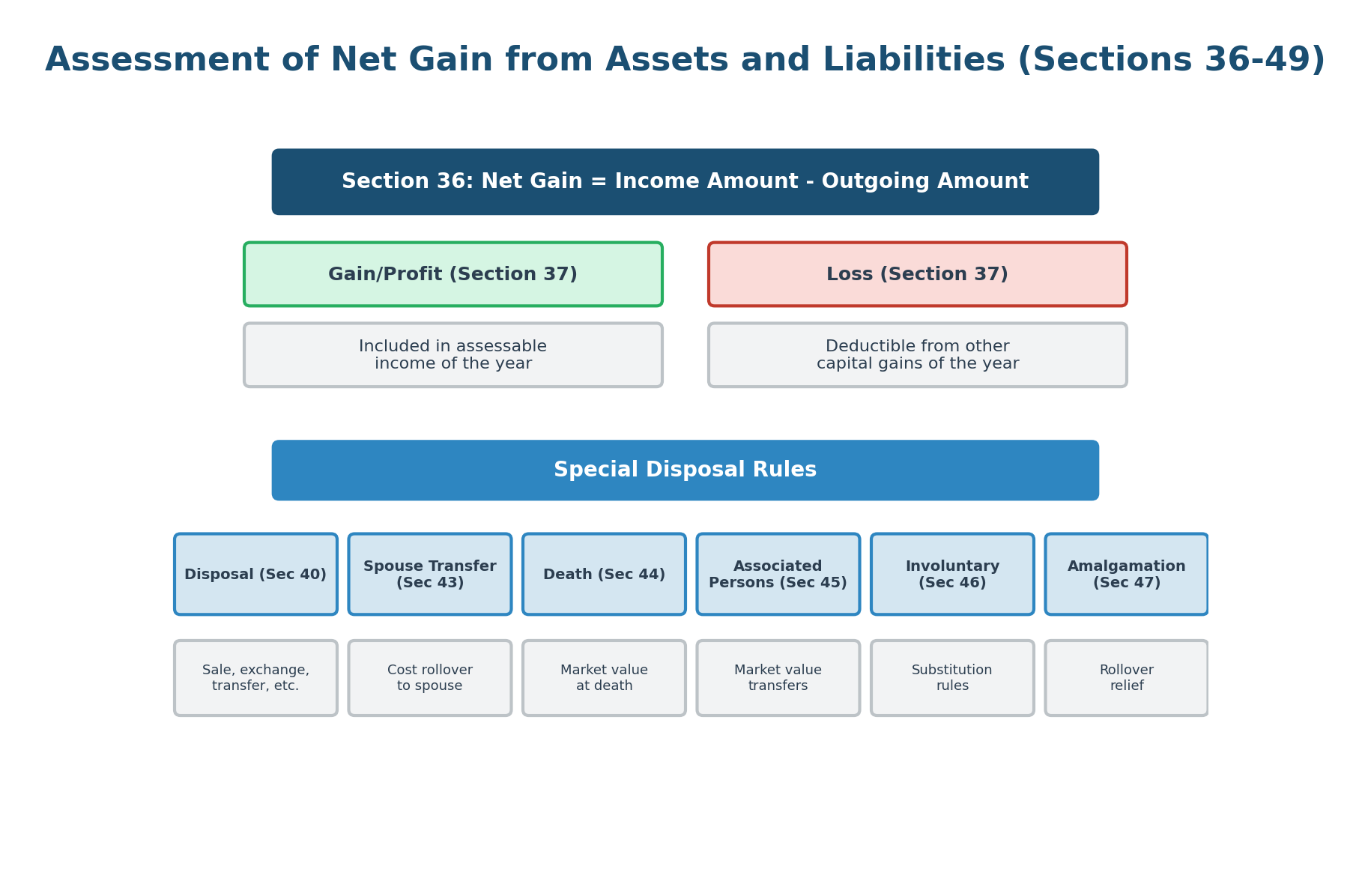
Figure: Assessment of Net Gain from Assets and Liabilities (Sections 36-49)
36. Net profits from asset and liability
(1) The net profits derived from the disposal of business assets or liability of a business of any person for any income year shall be computed by deducting the following losses from the sum of all profits derived from the disposal of business assets or liability of that business in that income year:-
(a) The sum of all losses suffered in that year from the disposal of business assets or liability of that business,
(b) The loss that could not be deducted elsewhere out of the net loss suffered from any other business of that person in that year, and
(c) The loss that could not be deducted out of the net loss suffered from that business or from any other business of that person in any past income year.
Particulars | Amount (Rs.) |
A. Total gains from disposal of business assets/liabilities | XXX |
Less: Deduction of losses | |
(a) Losses from disposal of business assets in the same year | (XXX) |
(b) Unadjusted loss from other business of the same year | (XXX) |
(c) Brought forward unabsorbed business losses | (XXX) |
Net profit from disposal of business assets (Taxable) | XXX |
The net gain from disposal of business assets or liabilities in the business is included when determining the income of the business pursuant to Section 7(2)(c) of the Act.
Example 22.3.1: Suppose Suleman is a natural person. Among his businesses, Suleman Grocery is one. That business had a net loss of Rs. 2 lakhs in income year 2065/66. His other business is Suleman Furniture Trade. That furniture trade had a loss of Rs. 3 lakhs in that year (unrelieved). His furniture trade had a loss of Rs. 2 lakhs in income year 2064/65. Land used for business purposes in that trade was sold in that income year for Rs. 50 lakhs. He had purchased that land four years earlier for Rs. 20 lakhs. Calculation of net gain from disposal of business assets:
Example 22.3.1 - Net Gain from Business Asset Disposal (Suleman) | |
Item | Amount (Rs.) |
1. Incomings: Land sale | Rs. 50 lakhs |
2. Outgoings: Cost value of land | Rs. 20 lakhs |
3. Gain (1 - 2) | Rs. 30 lakhs |
4. Business loss for this income year (Grocery Rs. 2L + Furniture Rs. 3L) | Rs. 5 lakhs |
5. Business loss in previous income year (Furniture FY 2064/65) | Rs. 2 lakhs |
6. Unrelieved business loss due to time expiry | Rs. 0 |
Net Gain (3 - 4 - 5 - 6) | Rs. 23 lakhs |
(2) The net profits derived from the disposal of taxable non-business assets of investment of any person for any income year shall be computed by deducting the following losses from the sum of all profits derived from the disposal of taxable non-business assets of that investment in that income year:-
(a) The sum of all losses suffered in that year from the disposal of non-business taxable assets of that investment,
(b) The loss that could not be deducted elsewhere out of the net loss suffered from any other business or investment of that person in that year, and
(c) The loss that could not be deducted out of the net loss suffered from that investment, any business or any other investment of that person in any past income year.
Particulars | Amount |
A. Total gains from disposal of taxable non-business investment assets | XXX |
Less: Deduction of losses | |
(a) Losses from disposal of taxable non-business assets of same investment (same year) | (XXX) |
(b) Unadjusted loss from other business or investment of same year | (XXX) |
(c) Brought forward unabsorbed losses (business/same or other investment) | (XXX) |
Net profit from disposal of taxable non-business investment assets (Taxable) | XXX |
The net gain from non-business taxable assets used in investment is calculated as the amount to be included when determining investment income pursuant to Section 9(2)(b) of the Act.
Example 22.3.2: Suppose Suleman is a natural person. He had a loss of Rs. 2 lakhs from share sales in income year 2065/66. He also has a furniture trade. That furniture trade had a loss of Rs. 3 lakhs in that year (unrelieved). His furniture trade had a loss of Rs. 2 lakhs in income year 2064/65. He sold his private land (non-business taxable asset) in his own name in that income year for Rs. 60 lakhs. He had purchased that land four years earlier for Rs. 20 lakhs. Calculation of gain on the asset:
Item | Amount |
1. Land sale (disposal of non-business taxable asset) | 60 lakhs |
2. Cost value of land | 20 lakhs |
3. Gain (1-2) | 40 lakhs |
4. Loss this year from disposal of investment taxable non-business assets (shares) | 2 lakhs |
5. Loss in other business in same income year (furniture trade) | 3 lakhs |
6. Loss in other business in previous income year | 2 lakhs |
Net Gain (3-4-5-6) | 33 lakhs |
(3) Any person may make a claim for deduction pursuant to sub-section (1) or (2) in respect of a loss suffered from the disposal of property or liability of foreign source only to the extent of the profit derived from the disposal of any property or liability of foreign source.
Type of Loss | Allowed Set-off Against | Restriction |
Loss from disposal of foreign source business assets or liabilities | (i) Gain from disposal of foreign source business assets or liabilities | Can be set off only within foreign source income; cannot be set off against domestic gains |
Loss from disposal of foreign source investment taxable non-business assets | Gain from disposal of foreign source investment taxable non-business assets | Can be set off only within same foreign source investment gains; no cross-set-off with domestic or business gains |
An example explaining the above provision is presented below.
Example 22.3.3: (Incorrect in Directive)
Suppose Suleman is a resident natural person. He had a loss of Rs. 5 lakhs from sale of shares in India in income year 2065/66. He had a loss of Rs. 2 lakhs from his Nepal business in that income year. He also has a furniture industry in India. That furniture industry had a loss of Rs. 3 lakhs in that year. His industry sold land (business asset) used in India in income year 2064/65 at a loss of Rs. 20 lakhs. That loss could not be set off in the previous income year. In this income year, he sold another piece of land of that same industry in India for Rs. 60 lakhs. He had purchased that land four years earlier for Rs. 20 lakhs. The calculation of gain from disposal of business assets in India is as follows (Rs. in lakhs):
Particulars | Amount (Rs.) |
1. Land sale in India (disposal of business asset) | 60 lakhs |
Deduct: Cost value of land | 20 lakhs |
Gain (1-2) | 40 lakhs |
Less: Loss in Indian furniture industry | 3 lakhs |
Less: Loss from disposal of business assets in India in previous year | 20 lakhs |
Less: Loss from disposal of Indian shares (Investment Loss not claimable) | 0 |
Less: Nepal source business loss | 2 lakhs |
Net Gain | 15 lakhs |
Losses from disposal of foreign source assets and liabilities may only be claimed up to the extent of the gain from disposal of assets and liabilities of the same foreign source. They may not be set off against gains from disposal of Nepal source assets. An example explaining the choice of deduction provision is presented below.
Example 22.3.4: Suppose the income position of any person is as follows:
(1) Gain of Rs. 50,000/- from disposal of business assets;
(2) Loss of Rs. 30,000/- from disposal of business assets in a previous year; (3) Loss of Rs. 10,000/- from foreign source assets.
That person can deduct the loss from disposal of business assets of Rs. 30,000/- in the previous year from the gain of Rs. 50,000/- from the above disposal of business assets, but the loss from foreign source assets of Rs. 10,000/- cannot be deducted from the gain from disposal of Nepal source assets. That is, when calculating foreign source assets/liabilities and gain and loss, separate calculations must be made for each foreign country on a Per Country Basis.
(4) If any person is entitled under sub-section (1) or (2) to deduct the net loss suffered from a business or investment in more than one computation pursuant to sub-section (1) or (2), that person may select computations for the purpose of deducting that loss or portion thereof.
Explanation: For the purposes of this Section,-
(1) "Net loss" means,-
(a) In respect of any business, the amount to the extent that the loss suffered from the disposal of the business assets or liability of that business in any income year exceeds the profit derived from the disposal of business assets or liability of that business in that year, and
(b) In respect of any investment, the amount to the extent that the loss suffered from the disposal of the taxable non-business assets of that investment in any income year exceeds the profit derived from the disposal of taxable non-business assets of that investment in that year.
(2) "Net loss that could not be deducted" means, with respect to any business or investment:-
(a) The loss in any income year that could not be deducted pursuant to clause (b) or (c) of sub-section (1) or clause (b) or (c) of sub-section (2), out of the net loss suffered by that business or investment in that income year, and
(b) Any loss of that business or investment referred to in sub-section (7) of Section 20 that could not be deducted and is not qualified for remission by virtue of the time-limit referred to in sub-section (1) or (2) of Section 20.
Net gain on disposal of assets/liabilities (Sec 36): (1) business assets/liabilities → net gain = total gains − (current-year losses on business assets/liabilities + unrelieved losses of other businesses, current & prior); included u/s 7(2)(c). (2) investment non-business taxable assets (NBTA) → net gain = total gains − (current losses on NBTA + unrelieved business/investment losses, current & prior); included u/s 9(2)(b). (3) Foreign-source loss is ring-fenced: deductible only against gains of the same foreign source
37. Profit and loss made from asset and liability
(1) The profit derived by any person from the disposal of any asset or liability shall be computed, considering it to be the extent that the sum of the incomes derived from that asset or liability exceeds the sum of the outgoings for that asset or liability at the time of disposal.
(2) The loss suffered by any person from the disposal of any asset or liability shall be computed, considering it to be the extent that the sum of the outgoings for that asset or liability exceeds the sum of the incomes earned from that asset or liability at the time of disposal.
Example 22.4.1: Suppose any natural person sold a house built one year earlier. The total cost of purchasing land and building that house up to the time of sale was Rs. 1,20,00,000. At the time of sale, a cost of Rs. 20,000/- was incurred for selling, so the total outgoings (Outgoings) for that house at the time of disposal were Rs. 1,20,20,000.
If Rs. 1,25,00,000/- was received from the sale (Incomings), the outgoings (Outgoings) for that asset were Rs. 1,20,20,000, resulting in a gain of Rs. 4,80,000.
If Rs. 1,19,00,000/- was received from the sale (Incomings), the outgoings (Outgoings) for that asset were Rs. 1,20,20,000, resulting in a loss of Rs. 1,20,000/-.
38. Expenses and net expenses for asset and liability
(1) The following expenses shall be included in the expenses for the asset or liability of any person, subject to this Act:-
(a) In respect of any asset, the expenses made by that person in acquiring that asset, inclusive of the following amounts:-
(1) The related expenses made in the construction and production of that asset, and
(2) Any amount required to be included in the computation of the income of that person as a result of acquisition of such asset.
(b) The expenses made by that person in obtaining the ownership of that asset or liability, inclusive of the expenses incurred in the alteration, improvement and repair and maintenance of the asset or liability, and the expenses in the repair and maintenance of the asset,
(c) The expenses made by that person in the disposal of the asset or liability, and
(d) Casual expenses made by that person in acquiring the asset or bearing liability and in disposing such asset or liability.
Provided that the expenses referred to in clauses (a), (b), (c), (d) and (e) of sub-section (1) of Section 21 and the expenses that are allowed to be deducted in the assessment of income shall not be required to be included in such expenses.
(2) The net expenses for any asset or liability at any particular time shall be so computed as to consider the amounts to the extent of excess of the sum of all expenses for that asset or liability over the sum of all incomes for that asset or liability at that time.
(3) The amount of expenses to be deducted in computing the income as referred to in Chapters-6 and 7 shall be deemed as if they were made in respect of the expenses for any asset or liability and shall be applicable in respect of the expenses referred to in sub-section (1).
Provided that Section 26 shall not apply to the above-mentioned provision.
Example Explaining Section 37(3) Business Asset
A machine is purchased for Rs. 1,000,000.
During use:
Repairs = Rs. 100,000
The Rs. 100,000 is deducted as a business. Later, the machine is sold.
Without sub-section (3), one might argue that the repair cost should again be included in the asset's outgoings when computing gain/loss on disposal.
Outgoings are divided into 4 main categories:
Category | Meaning |
(a) Amount paid at inception | Cost of acquiring asset/liability |
(b) Amount paid during holding | Improvement, repair, maintenance |
(c) Amount paid at disposal | Selling/transfer expenses |
(d) Tax-related payment | Tax paid on receiving asset/liability |
The following are excluded from Outgoings:
Expenses already deducted in business income calculation
Personal expenses
Expenses not related to that asset or liability
Expenses referred to in clauses (a), (b), (c), (d) and (e) of sub-section (1) of Section 21
Example 22.5.1: Suppose Gopal Sapkota purchased land for Rs. 40 lakhs in income year 2060/61. He paid a broker commission of Rs. 2 lakhs when purchasing that land. The expenses for documentation and registration of that land were Rs. 1 lakh 75 thousand. He incurred Rs. 3 lakhs for constructing a boundary wall on that land. He took a loan from a bank to purchase that land. By income year 2066/67, he sold that land for Rs. 1 crore. By that date, interest of Rs. 7 lakhs had been paid. He paid a broker commission of Rs. 3 lakhs when selling the land. He spent Rs. 50 thousand on a feast for his well-wishers at a celebration of purchasing the land. In this situation, the calculation of outgoings (Outgoings) for that land is as follows:
Particulars | Amount |
Purchase price of land | Rs. 40 lakhs |
Broker commission for land purchase | Rs. 2 lakhs |
Documentation and registration | Rs. 1.75 lakhs |
Boundary wall | Rs. 3 lakhs |
Interest expense | Rs. 7 lakhs |
Feast expense (not allowed) | - |
Broker commission for land sale | Rs. 3 lakhs |
Cost of land (outgoing) | Rs. 56.75 lakhs |
Accordingly, Rs. 56 lakhs 75 thousand is considered the outgoing for that land for the purpose of calculating the gain from disposal of that asset.
When the asset was received without paying the cost, or when the person had to pay tax due to the appreciation of the asset, the amount included in the tax accounting for that asset or appreciation is considered the outgoing (Outgoings) for that asset. An example explaining that situation is presented below.
Example 22.5.2: Suppose a foreign government gave employment to Michel, a citizen of that country, at that country's embassy in Nepal. In addition to cash salary, that foreign government also gave him some Bonds issued by that foreign government. The current market value of those Bonds is assumed to be Rs. 1 lakh. For him, the cash and Bonds received as salary are tax-exempt amounts under Section 10 of the Act. Suppose in the following year he sold those Bonds in Nepal for Rs. 1,05,000/-. In this situation, when calculating the gain from disposal of that asset, it must be calculated taking expenses as Rs. 1,00,000/- and income as Rs. 1,05,000/-.
Example 22.5.3: Suppose Gopesh and Company Pvt. Ltd. paid Rs. 40 lakhs for purchasing land. In the following year, the expense for maintaining that land was Rs. 1 lakh. In the third year, it received Rs. 2 lakhs for resolving some unresolved boundary disputes with neighbors. In such a situation, the net outgoings (Outgoings) for that land are calculated as follows:
Year | Transaction | Amount |
First year | Outgoings for land | Rs. 40 lakhs |
Second year | Outgoings for land maintenance | Rs. 1 lakh |
Second year | Outgoings for land (cumulative) | Rs. 41 lakhs |
Third year | Disposal of land (incomings) | Rs. 2 lakhs |
Third year | Outgoings for land (net) | Rs. 39 lakhs |
39. Income and net income for asset and liability
(1) The following amounts shall be included in the income for the asset or liability of any person, subject to this Act:-
(a) The amounts received by that person, in respect of the liability, in bearing the liability,
(b) The amounts to be received by that person in acquiring the asset or in respect of bearing the liability, including the amounts acquired by altering or lessening the value of the asset or increasing the liability, and
(c) The amounts received or to be received by that person in respect of the disposal of that asset or liability.
Provided that the amounts exempted from tax, amounts subject to tax deduction finally, or amounts to be included in the income in assessing the income of that person shall not be included in such income.
Income (Incomings) from an asset or liability is divided into 3 main categories:
Category | Meaning |
(a) Amount received at inception | Amount received in connection with acquiring an asset or assuming a liability |
(b) Amount received during holding period | Amount received due to changes in the value of the asset or increase in the liability |
(c) Amount received at disposal | Amount received or receivable upon disposal of the asset or liability, or upon discharge/settlement of the liability |
Other Incomings Included
Category | Meaning |
Amount received when assuming a liability | Consideration received for taking on an obligation or liability |
Amount received from value changes | Amounts arising from appreciation, revaluation, forgiveness, or other increases in economic benefit related to the asset or liability |
The Following Are excluded from Incomings:
Amounts exempt from tax under Section 10
Amounts subject to final withholding taxation under Section 92
Amounts already included in the calculation of taxable income under another provision of the Act
(2) The net incomes for any asset or liability at any time shall include the amounts to the extent of excess of the incomes for that asset or liability over the sum of all expenses for that asset or liability at that time.
(3) The amount to be included in the income in computing the income as referred to in Chapters-6 and 7 shall be deemed as if they were made in respect of the incomes for any asset or liability and shall be dealt with pursuant to sub-section (1).
Provided that Section 26 shall not apply to the above-mentioned provision.
40. Disposal of asset or liability
(1) If the ownership of any person over any asset ceases, that person shall be deemed to have disposed of that asset. The disposal of asset shall include acts such as distribution of the asset by the owner of the asset, amalgamation of the asset in other asset or liability, sale of the asset by installments or lease of the asset to any other person under a financial lease, cancellation, destruction, loss, expiration or surrender of the same.
(2) If the burden of liability of any person ceases, that person shall be deemed to have disposed of that liability. The disposal of liability shall include acts such as settlement, cancellation, release, completion of the liability or amalgamation of liability in other liability or asset.
Example 22.7.1: Suppose Medico Nepal Pvt. Ltd. is a pharmaceutical manufacturing company. Another pharmaceutical manufacturing company named Global Lab Nepal Limited conducted a Takeover (acquisition) of it effective from date 2065.10.1. In such an acquisition, Medico Nepal Pvt. Ltd. is deemed to have disposed of its assets and liabilities.
(3) Notwithstanding anything contained in sub-sections (1) and (2), any person shall be deemed to have disposed of any asset or liability in the following circumstances:-
(a) In respect of an natural person, immediately before the death of that person,
Any asset in the ownership of a natural person is deemed to have been disposed of immediately before the death of that person. The incomings from this type of disposal are necessary not only for the purpose of calculating the gain for tax purposes but also for the purpose of determining the outgoings for the recipient. An example explaining that situation is presented below.
Example 22.7.2: Suppose Mahendra Malla had a house and land in Nepalgunj purchased on date 2064.3.15 for Rs. 1 crore. He died on date 2066.5.6. At that time, the value of the house and land was Rs. 1 crore 20 lakhs. Immediately before Mahendra Malla's death, i.e., on date 2066.5.6, disposal of his assets at Rs. 1 crore 20 lakhs is deemed to have occurred. So, Rs. 1 crore 20 lakhs is cost for the heir for calculation of outgoing.
(b) In respect of any asset, if the sum of the incomings for that asset exceeds the sum of the outgoings for that asset,
For income tax purposes, depreciable assets are accounted for on a pool basis, and when assets of that pool are disposed of and the amount received (income) exceeds the pool's depreciation base (i.e., outgoings), the excess amount must be included in income pursuant to Section 7(2)(d) of the Act, and the remaining value of that asset pool becomes zero and that asset is deemed to have been disposed of. An example explaining that situation is presented below.
Example 22.7.3: Suppose Sagesh and Company Pvt. Ltd. has the following assets under Group 'B' at the beginning of income year 2065/66:
Furniture | Rs. 50,000 |
Computer | Rs. 1,00,000 |
Total Depreciation Base | Rs. 1,50,000. |
In income year 2065/66, the company did not purchase any additional assets in that pool. However, the company sold furniture for Rs. 2 lakhs in that year. In this situation, the depreciation base of the pool, i.e., Rs. 1 lakh 50 thousand, constitutes the outgoings for disposal purposes, and the received amount, i.e., Rs. 2 lakhs, is the incomings.
Since the received amount (Incomings) from the disposal exceeds the outgoings (depreciation base), the excess amount, i.e., Rs. 50 thousand, must be included in income pursuant to Section 7(2)(d) of the Act, the remaining value of that asset pool becomes zero, and that asset (pool) is deemed to have been disposed of. If the furniture had been sold for an amount less than Rs. 1 lakh 50 thousand, the remaining value would have represented that Group 'B' pool.
(c) In respect of any asset subject to debt claim,-
(1) If it has become a bad debt as per the standards as prescribed in respect of a debt claim of a bank or financial institution, and
(2) If, in any other circumstance, that person has reasonably believed the debt claim as non-recoverable.
Provided that the person shall have already pursued all proper measures to recover that debt claim.
Rule 9: For purposes of Clause (a) of Sub-section (2) of Section 25 and Sub-clause (1) of Clause (c) of Sub-section (3) of Section 40 of the Act, the standards determined by the Nepal Rastra Bank shall apply in respect of a debt of a bank or financial institution becoming unrecoverable or its conversion into a bad debt.
(d) If any person has started using business assets, non-business taxable assets, depreciable asset or stock-in-trade in a manner to alter the type thereof, immediately before the use of the altered form of that asset,
If any person converts a business asset, depreciable asset, non-business taxable asset, or trading stock into another type and uses it, disposal of that asset is also deemed to have occurred immediately before it is used in the converted form. Asset disposal is deemed to have occurred when converted from one type of asset to another type as shown below:
Before Disposal | After Disposal |
Trading Stock | Depreciable Asset, Non-Business Taxable Asset, Business Asset |
Depreciable Asset | Trading Stock, Non-Business Taxable Asset, Business Asset |
Non-Business Taxable Asset | Trading Stock, Depreciable Asset, Business Asset |
Business Asset | Trading Stock, Depreciable Asset, Non-Business Taxable Asset |
An example explaining that situation is presented below.
Example 22.7.4: Suppose Suntali and Company Pvt. Ltd. is a Real Estate company. That company had been conducting house and land business while renting houses. One house in its Trading Stock began being used by that person on date 2066.6.7. Because the Trading Stock in that form was converted to Fixed Assets in its balance sheet, that house (trading stock) is deemed to have been disposed of on that date, and at the same time that asset is counted as a depreciable asset.
(e) In the circumstances referred to in Section 57 in respect of any entity, and
(f) Immediately before that person becomes a non-resident person, except in the case of land or building situated in Nepal.
Other than land, land with building, or buildings situated in Nepal owned by a resident person, disposal of other assets is deemed to have occurred immediately before that person becomes a non-resident (Non-resident). An example explaining that situation is presented below.
Example 22.7.5: Suppose Shailesh was a resident person of Nepal up to income year 2064/65. He has a house and land in Kathmandu. He has shares of a listed company purchased for Rs. 3 lakhs in his name. He left Nepal in income year 2065/66 to go to Australia and has been residing there permanently, and he did not return to Nepal in that income year. In such a situation, those shares in his name are deemed to have been disposed of at the end of Ashadh 2065. However, the house and land in his name are not deemed to have been disposed of.
(4) If any person disposes of any asset by leasing it under a financial lease pursuant to sub-section (1), the lessee of that asset shall be deemed to have acquired the ownership of that asset at the time of disposal.
(5) The following provisions shall apply for the purposes of computing the profits derived by any person from the disposal of the asset or liability:-
(a) The amounts of net expenses for any asset under the ownership of any person at the time of commencement of this Act shall be deemed to be equal to the market value of the asset prevailing at that time,
(b) The amounts of net incomes for liability of any person at the time of commencement of this Act shall be deemed to be equal to the amount as per the market value of the liability prevailing at that time.
Example
Suppose, You bought land in 2050 for Rs. 1,000,000.
On the date the Act commenced, its market value was Rs. 3,000,000.
Later you sold it for Rs. 4,000,000.
Without this rule, Gain = 4,000,000 − 1,000,000= Rs. 3,000,000
This would tax gains that arose before the Act.
With this rule, Deemed cost base = Market value at commencement= Rs. 3,000,000
Gain = 4,000,000 − 3,000,000= Rs. 1,000,000
Only the increase from Rs. 3,000,000 to Rs. 4,000,000 is taxed.
41. Disposal along with retention of asset or liability
If any person disposes of any asset or liability in any manner referred to in clauses (c), (d), (e) and (f) of sub-section (3) of Section 40, the following provisions shall apply:-
(a) In respect of asset,-
(1) That person shall be deemed to have received the amount equal to the market value of that asset at the time of disposal for the disposal, and
(2) When that asset is re-disposed, the net outgoings made for that asset until the time of disposal pursuant to this Section shall be deemed to be equal to the amount receivable.
Regarding Assets: The person retaining the asset is deemed to have received (income) an amount equal to the market value of that asset at the time of deemed disposal. Also, when that asset is subsequently actually disposed of, the market value deemed as income at the time of the earlier deemed disposal is considered the outgoing for that asset for the purpose of determining expenses. An example explaining that situation is presented below.
Example 22.8.1: Suppose Shailesh was a resident person of Nepal up to income year 2063/64. He has shares of a listed company purchased for Rs. 3 lakhs in his name. He left Nepal on Poush 10, 2064 to go to Australia and has been residing there permanently, and he was not a resident of Nepal in that income year. The market value of the shares of that company at that date was Rs. 5 lakhs. He sold those shares on date 2066.4.20 for Rs. 6 lakhs and paid Rs. 1,200/- as Broker Commission. Those shares in his name are deemed to have been disposed of on Poush 10, 2064, and the market value of Rs. 5 lakhs at that date is deemed the income (receipt) from that disposal. The calculation of gain at the time the asset is deemed disposed of and at the time of actual disposal is done as follows:
Calculation of gain at the time deemed disposed of at end of Ashadh 2064:
Particulars | Amount |
Market value of shares at time deemed disposed of (deemed income) | Rs. 5,00,000/- |
Cost value of shares (expense) | Rs. 3,00,000/- |
Gain at time deemed disposed of | Rs. 2,00,000/- |
Calculation of gain at actual re-disposal on 2066.4.20:
Particulars | Amount |
Market value of shares at time of disposal (income) | Rs. 6,00,000/- |
Market value at time deemed disposed of | Rs. 5,00,000/- |
Broker commission paid | Rs. 1,200/- |
Net outgoings on shares | Rs. 5,01,200/- |
Gain at time of share disposal | Rs. 98,800/- |
Thus, the income (Incomings) from the actual disposal, i.e., Rs. 6 lakhs, minus the net outgoings, i.e., Rs. 5,01,200/-, leaves Rs. 98,800/- as the gain at the time of disposal, while at the time deemed disposed of (Poush 10, 2064), a gain of Rs. 2 lakhs is deemed to have occurred.
(b) In respect of liability,-
(1) That person shall be deemed to have incurred expenses in a sum equal to the market value of that liability at the time of disposal for the disposal, and
(2) When that liability is re-disposed, the net incomes derived for that liability pursuant to this Section until that time shall be deemed to be equal to the amount of expenses.
The circumstances of disposal with retention (Retention) of assets or liabilities are explained below.
Regarding Liabilities: The person is deemed to have incurred outgoings (Outgoings) equal to the market value of that liability at the time deemed disposed of. Just as with asset disposal, calculation is made based on market value in liability disposal too. However, while market value is the incomings (Incomings) in asset disposal, market value is the outgoing (Outgoing) in liability disposal. An example explaining that situation is presented below.
Example 22.8.2: Suppose Karma Limited issued 15 percent debentures and raised Rs. 2 crore in debt. Due to the change of new shareholders in the company on date 2065.8.11, Section 57 circumstances arose. The attractive interest rate on those debentures made the market value of the debentures Rs. 2 crores 10 lakhs. The debentures matured at the end of Ashadh 2068 and the principal was repaid. On date 2065.8.11, the company is deemed to have disposed of all its assets and liabilities at market value. Calculation of gain at time deemed disposed of in the 'old' deemed company on date 2065.8.11:
Particulars | Amount |
Amount for liability (deemed income) | Rs. 2,00,00,000/- |
Market value of liability at time deemed disposed of (expense) | Rs. 2,10,00,000/- |
Loss at time liability deemed disposed of | Rs. 10,00,000/- |
Calculation of gain when 'new' deemed company repays (re-disposal) the liability on date 2068.3.32:
Particulars | Amount |
Market value of liability on 2065.8.11 (income) | Rs. 2,10,00,000/- |
Amount of liability repaid at time of disposal (expense) | Rs. 2,00,00,000/- |
Gain at time of liability disposal | Rs. 10,00,000/- |
Thus, at the time of actual disposal, the 'new' company is deemed to have a gain of Rs. 10 lakhs, while at the time deemed disposed of pursuant to Section 57 (date 2065.8.11), the 'old' company is deemed to have a loss of Rs. 10 lakhs.
Disposal with retention (Sec 41): where disposal is DEEMED under Sec 40(3)(c)-(f) (bad debt, asset-type conversion, Sec 57 ownership change, becoming non-resident) but the person keeps the asset/liability:
(a) ASSET - deemed to receive its market value at that time (gain taxed now); on later actual disposal, that market value becomes the outgoing/cost base.
(b) LIABILITY - deemed to incur outgoings equal to market value; that becomes the income figure on later disposal. Net effect: the gain is split between the deemed-disposal date and the actual-disposal date
42. Disposal through installment sale or financial lease
If any person disposes of any asset by way of installment sale or lease under a financial lease to any other person, the following provisions shall apply:-
(a) The person who has disposed of the asset shall be deemed to have received the amount equal to the market value of that asset at the time of disposal for the disposal, and
(b) The person who has acquired the asset through disposal shall be deemed to have incurred cost in a sum equal to clause (a).
Provided that this provision shall not be applicable where the provision of Section 45 applies.
If any person disposes of any asset by giving it on installment sale (Installment Sale) or by leasing under a finance lease (Financial lease) to another person, the person who disposed of the asset is deemed to have realized (Realised) an amount equal to the market value of the asset at the time of disposal. Similarly, for the person who received the asset from the disposal, the same amount is deemed to be the cost incurred. However, this does not apply to transfers between associated persons and other non-market transfers. An example explaining that situation is presented below.
Example 22.9.1: Suppose Air Gurans Ltd. provided one helicopter to AB Nepal Pvt. Ltd. on date 2066.10.15 under Finance Lease arrangements. At that time, the market value of that helicopter was Rs. 9 crores. Under the Finance Lease arrangement, AB Nepal Pvt. Ltd. was to pay Air Gurans Ltd. at an annual rate of Rs. 2 crores over 5 years, and ownership transfer would occur only after that payment was fully received. The company had purchased that helicopter for Rs. 8 crores 75 lakhs. On date 2066.10.15, Air Gurans Ltd. is deemed to have disposed of that helicopter, and the gain or loss from that disposal must be calculated as follows:
Particulars | Amount |
Incomings | Rs. 9 crores |
Outgoings for that asset | Rs. 8 crores 75 lakhs |
Gain | Rs. 25 lakhs |
The cost incurred by AB Nepal Pvt. Ltd. for the helicopter transferred by finance lease is Rs. 9 crores. However, Air Gurans Ltd. must calculate each annual installment of Rs. 2 crores, including principal repayment and interest, as principal repayment and interest income pursuant to Section 32 of the Act.
Disposal by instalment sale or finance lease (Sec 42): the transferor is deemed to receive the asset's market value; the transferee's cost = that same value (unless Sec 45 applies).
43. Transfer of asset to husband, wife or former husband, wife
If any natural person who is a divorcee or lives apart upon having partition share disposes of a asset by transferring it to his or her husband, wife or former husband or wife, and that husband, wife or former husband or wife makes a choice in writing to have this Section enforced, the following provisions shall apply:-
(a) That person shall be deemed to have obtained, for disposal, the amount equal to the net expenses incurred immediately before the disposal, and
(b) The person who has acquired the asset through transfer shall be deemed to have incurred cost in a sum equal to clause (a).
If any natural person transfers an asset to their spouse or former spouse with whom the relationship has been severed or who is living separately without taking a share, and that spouse or former spouse chooses to apply this provision, that person is deemed to have received an amount equal to the net outgoings on that asset immediately before the disposal. Since the incomings and outgoings for the person who transferred the asset are equal, no tax burden falls on them. When the person who received the asset subsequently disposes of it, they treat the previously received cost (net outgoings) as their own outgoings (cost). This section applies only to non-business taxable assets and business assets and liabilities of a sole firm.
An example explaining that situation is presented below.
Example 22.10.1: Suppose Rasendra purchased a piece of land on date 2063.10.1 for Rs. 1 crore. He and his wife Sarala separated on date 2066.5.6. He transferred that land to his former wife Sarala on date 2066.5.10 without any consideration. The market value of that land at the time of transfer was Rs. 1 crore 40 lakhs. At the time of such transfer, Sarala incurred expenses of Rs. 10 thousand for documentation and registration. Rasendra transferred that land to his former wife without any consideration and gave information to the relevant office that Section 43 of this Act is chosen to apply. On date 2066.10.5, she sold that land for Rs. 1 crore 50 lakhs. The gain from disposal of that asset for Rasendra and Sarala must be calculated as follows:
Particulars | Amount |
Incomings (Incoming) | Rs. 1 crore |
Outgoings for that asset (Outgoing) | Rs. 1 crore |
No gain | |
Particulars | Amount |
Amount received from disposal (income) | Rs. 1,50,00,000/- |
Cost deemed for asset received by transfer | Rs. 1,00,00,000/- |
Documentation and registration expenses | Rs. 10,000/- |
Total outgoings for asset | Rs. 1,00,10,000/- |
Gain at time of disposal | Rs. 49,90,000/- |
Thus, Rasendra has no gain from the disposal of that land, whereas Sarala has a gain of Rs. 49 lakhs 90 thousand. That is, when an asset is transferred to a spouse or former spouse with severed relationship or living separately without taking a share, the cost base (Cost Base) is also transferred. If Rasendra had not given written information to the relevant office that Section 43 of the Act is chosen to apply, income and outgoings would need to be calculated pursuant to Section 45 of the Act.
Transfer to spouse/former spouse (Sec 43): on transfer to a (former) spouse who is separated or divorced without taking a partition share, if the recipient elects in writing, the transferor is deemed to receive an amount equal to net outgoings (so No gain arises) and the recipient's cost = that amount (cost rollover). Applies only to NBTA and a sole firm's business assets/liabilities
44. Transfer of asset after death
If the ownership of any asset is disposed through transfer to any other person because of the death of any natural person, the following provisions shall apply:-
(a) That person shall be deemed to have obtained, for disposal, the amount equal to the market value of that asset prevailing at the time of disposal, and
(b) The person who has acquired the asset through transfer shall be deemed to have incurred cost in a sum equal to clause (a).
At the time of death, the asset is deemed to have been disposed of at market value in order to calculate the increase in wealth (wealth creation), and that same amount is carried forward as the cost base for the person inheriting the asset.
Since there is no tax burden on personal assets, this provision applies only to:
Non-business taxable assets, and
Assets and liabilities of a sole proprietorship
According to the definition of non-business taxable assets, if such assets are transferred within three generations, they are not considered non-business taxable assets under Section 2(r) of the Act. In such cases, this provision does not apply. An example explaining that situation is presented below.
Example 22.11.1: Suppose Rasendra purchased a piece of land on date 2065.5.1 for Rs. 1 crore. He had borrowed Rs. 80 lakhs from Upendra to purchase that land and had given that same land as collateral mortgage. He died on date 2066.1.6. Per the loan terms, Upendra's ownership of that land was established. At that time, the market value of that land was Rs. 1 crore 10 lakhs.
Thus, there is a gain of Rs. 10 lakhs from the disposal of that land, and the tax liability on that gain belongs to the recipient of that asset, i.e., Upendra.
Example 22.11.2: Suppose Rasendra purchased a piece of land on date 2065.5.1 for Rs. 1 crore. He died on date 2066.1.6 and after death that asset was transferred to his son Ravindra. At that time, the market value of that land was Rs. 1 crore 10 lakhs. Since the land deemed disposed of by Rasendra was transferred within three generations by other means other than purchase and sale, it is not considered a non-business taxable asset, so this section is not triggered and no gain calculation is made. However, if that same asset is subsequently disposed of by son Ravindra, and at the time of disposal that asset falls within the definition of non-business taxable asset, Ravindra can only claim outgoings up to the extent that his father Rasendra could have claimed on date 2066.1.6.
Particulars | Amount |
Incomings (Incoming) - Market value of house and land at the time of his death | Rs. 1,10,00,000/- |
Outgoings for that asset (Outgoing) | Rs. 1,00,00,000/- |
Gain | Rs. 10,00,000/- |
Transfer of asset on death (Sec 44): the deceased is deemed to dispose at market value, and the recipient's cost = that market value (applies to NBTA and a sole firm's assets/liabilities). EXCEPTION: within 3 generations, an asset transferred other than by purchase/sale is not an NBTA (Sec 2(r)), so no gain arises on death - the heir simply inherits the deceased's cost base and is taxed only on a later actual disposal
45. Transfer between associated persons and other non-market transfers
(1) If any person disposes of any asset by transferring it to an associated person or any other person for no consideration, the following provisions shall apply:-
(a) The person who has disposed of the asset shall be deemed to have received, for the disposal, the amount equal to the greater of the market value of that asset or the net expenses for that asset immediately before the disposal, and
(b) The person who has acquired the asset through disposal shall be deemed to have incurred cost in a sum equal to clause (a).
(c) In the case of asset transferred pursuant to sub-clause (5) of clause (r) of Section 2, the costs incurred by the person transferring such asset shall be deemed to be the costs incurred by the person acquiring such asset.
(2) Notwithstanding anything contained in sub-section (1), if any person disposes of any business assets, non-business taxable assets or asset remaining as stock-in-trade by transferring ownership over such asset to any associated person and the matters contained in sub-section (6) are fulfilled, the following provisions shall apply:-
(a) That person shall be deemed to have received, for the disposal, the amount equal to the net expenses for that asset immediately before the disposal, and
(b) The person who has acquired the asset through transfer shall be deemed to have incurred cost in a sum equal to clause (a).
(3) Notwithstanding anything contained in sub-section (1), if any person disposes of any depreciable asset by transferring ownership over such asset to any associated person by fulfilling the matters contained in sub-section (6), the following provisions shall apply:-
(a) That person shall be deemed to have received, for the disposal, the amount equal to the remaining value of the group of the descending system pursuant to Section 4 of Schedule-2 at the time of disposal, and
(b) The person who has acquired the asset through transfer shall be deemed to have incurred cost in a sum equal to clause (a).
Example 22.12.2: Suppose Yes Nepal Pvt. Ltd. purchased a flat (building) on date 2070.5.1 for Rs. 1 crore 50 lakhs. That building was transferred to its subsidiary company Ramro Nepal Pvt. Ltd. on date 2071.6.5. At the time of transfer (disposal), the declining balance written down value of that pool pursuant to Schedule-2, Section 4, was Rs. 1,42,50,000, and the market value of that building at that time was Rs. 1 crore 60 lakhs. In this situation (assuming Section 45(3) election is made), the incomings (Incoming) for that building transferred to the associated person, i.e., Rs. 1,42,50,000 (Written Down Value), are deemed received by Yes Nepal Pvt. Ltd., and for the subsidiary company Ramro Nepal Pvt. Ltd., that amount is deemed the cost (Outgoing) for that asset.
(4) If any person disposes of any liability by transferring it to an associated person pursuant to this Section or by transferring it to any other person without giving any value, the following provisions shall apply:-
(a) That person shall be deemed to have incurred cost for the disposal in a sum equal to the lesser of the market value or the net income earned for the liability immediately before the disposal, and
(b) The transferee of the liability shall be deemed to have received an amount equal to that liability in respect of assumption of the liability.
Provided that this provision shall not be applicable where the provisions of Sections 43 and 44 apply.
Example 22.12.1: Suppose Rasendra purchased a piece of land on date 2069.5.1 for Rs. 1 crore. In that same year, Rs. 5 lakhs were spent building a wall on that land. He gave that land by gift deed to a person named Dinesh on date 2070.6.5. The market value of that land at that time was Rs. 1 crore 10 lakhs. The calculation of gain on the land deemed disposed of by Rasendra:
Particulars | Amount |
Incomings (Incoming) - Market value of house and land given by gift deed | Rs. 1,10,00,000/- |
Outgoings for that asset (Outgoing) | Rs. 1,05,00,000/- |
Gain | Rs. 5,00,000/- |
Thus, there is a gain of Rs. 5 lakhs from the disposal of that land, and the tax liability on that gain belongs to Rasendra who disposed of the asset. For Dinesh, the person who received the asset, the cost of that asset is deemed to be Rs. 1 crore 10 lakhs.
If the market value of that asset at the time of transfer had been Rs. 1 crore 2 lakhs, then since net outgoings of Rs. 1 crore 5 lakhs exceed the market value of Rs. 1 crore 2 lakhs, the higher amount (net outgoings) would be the deemed incomings:
Particulars | Amount |
Incomings (Incoming) - (Higher of market value Rs. 1,02,00,000 vs net outgoings Rs. 1,05,00,000) | Rs. 1,05,00,000 |
Outgoings for that asset (Outgoing) | Rs. 1,05,00,000 |
Gain | 0 |
Thus, there is no gain from the disposal of that land. Similarly, the cost for Dinesh who received the asset is deemed to be Rs. 1 crore 5 lakhs.
(5) If any person disposes of any liability assumed in earning income from any of that person's businesses by transferring it to an associated person, by fulfilling the matters mentioned in sub-section (6), the following provisions shall apply:-
(a) That person shall be deemed to have incurred cost for the disposal in a sum equal to the net income earned for the liability immediately before the disposal, and
(b) The associated person shall be deemed to have received an amount equal to that amount in respect of assumption of the liability.
(6) For the purposes of sub-sections (2), (3) and (5), the following matters shall have been fulfilled:-
(a) The disposed business assets, stock-in-trade or depreciable assets of the business shall be the business assets, stock-in-trade or depreciable assets of the business of the associated person immediately after the transfer by the person making such disposal.
(b) The disposed non-business taxable assets or depreciable asset of any investment shall be the business assets, non-business taxable assets, depreciable asset or stock-in-trade of the associated person immediately after the transfer by the person making such disposal.
(c) In the case of any liability, the liability shall have been transferred to the associated person for the earning of income from any business or investment of the associated person.
(d) The transferor and the associated person shall have been residents at the time of transfer, and the associated person shall not be a person enjoying tax exemption.
(e) The vested ownership in that asset or vested burden in that liability shall continue to exist at least fifty percent, as the case may be.
(f) Both that person and the associated person shall have made request in writing in order to enforce an option under sub-section (2), (3) or (5), as the case may be.
Transfer between associated persons / non-market transfer (Sec 45): a no-consideration or non-arm's-length transfer (e.g. gift) → transferor deemed to receive the HIGHER of market value or net outgoings (so a gain can arise); recipient's cost = that amount. GROUP ROLLOVER exception (45(2)/(3)/(5)): business assets & stock transferred at net outgoings, depreciable assets at pool written-down value (no immediate gain)
IF the 45(6) conditions are met = both parties resident + associated person not tax-exempt + asset stays a business/investment asset of the recipient + 50% or more ownership continues + both elect in writing. Does not apply where Sec 43 (spouse) or 44 (death) applies
46. Involuntary disposal of asset or liability with substitution
(1) If any person, no later than one year of the involuntary disposal of any asset in any mode out of the modes mentioned in sub-section (1) of Section 40, acquires ownership over other asset of similar type in lieu of that asset and makes request in writing to have this Section applied, the following provisions shall apply:-
(a) That person shall be deemed to have received, for the disposal, an amount equal to the sum of the following amounts:-
(1) Net expenses for that asset immediately before the disposal, and
(2) If the amount derived from the disposal exceeds the expenses incurred in acquiring the substituted asset, the amount of such excess, and
(b) That person shall be deemed to have incurred expenses in a sum equal to the sum of the following amounts, in acquiring the substituted asset:-
(1) Net expenses for the disposed asset immediately before the disposal, and
(2) If the expenses incurred in acquiring the substituted asset exceed the amount derived from the disposal, the amount of such excess.
Example 22.13.1: Suppose Khagendra Gopama purchased one ropani of land in Bhaktapur on date 2062.5.1 for Rs. 50 lakhs. In the course of road expansion, the Nepal Government acquired that land on date 2066.5.7 with compensation of Rs. 80 lakhs. He purchased one ropani of land approximately two kilometres away on date 2067.4.5 (within one year) as replacement land and gave written information choosing Section 46. The gain calculation for the three possible purchase values of replacement land (in Rs. Lakhs):
Example 22.13.1 - Involuntary Disposal with Replacement Land | |||
Particulars | Situation a (Rs. 60L) | Situation b (Rs. 80L) | Situation c (Rs. 85L) |
Net outgoings of disposed asset (1) | 50 | 50 | 50 |
Amount received from disposal (2) | 80 | 80 | 80 |
Value of replacement land (3) | 60 | 80 | 85 |
Amount deemed received from disposal (4)=(1+2-3) | 70 | 50 | 50 |
Outgoings when acquiring replacement asset (5)=(1+3-2) | 50 | 50 | 55 |
Gain (Loss) (6)=(4-1) | 20 | 0 | (5) |
Value allocated to new replacement asset (7)=(1-6) | 30 | 50 | 55 |
Example 22.13.2: Suppose Gopama Limited's depreciable asset building was destroyed by fire. The depreciation base of the building at the beginning of the year was Rs. 50 lakhs. The company had insured the building for its market value of Rs. 80 lakhs and claimed Rs. 80 lakhs from the insurance company. The company constructed another new building at the same location and applied choosing the benefit of Section 46. The new construction was completed within one year. The new building costs are: (a) Rs. 60 lakhs; (b) Rs. 80 lakhs; (c) Rs. 85 lakhs. The tax treatment for the building involuntarily disposed of by Gopama Company is as follows (Rs. in lakhs):
If the company had not chosen the Section 46 benefit, in the year of damage, depreciation would be calculated pursuant to Schedule-2 of the Act, and in the year the insurance compensation was received, that compensation amount must be included in income pursuant to Section 31 and Section 62 of the Act.
Particulars | Case (a) | Case (b) | Case (c) |
Cost of new building (Pool D) | 60 | 80 | 85 |
First Year
Particulars | a | b | c |
Opening WDV | 50 | 50 | 50 |
Addition during year | 0 | 0 | 0 |
Compensation received (Sec. 46 opted) | 0 | 0 | 0 |
Closing WDV | 50 | 50 | 50 |
Depreciation expense | 0 | 0 | 0 |
Second Year
Particulars | a | b | c |
Opening WDV | 50 | 50 | 50 |
Addition (new building) | 60 | 80 | 85 |
Compensation received | 80 | 80 | 80 |
Deemed amount received | 70 | 50 | 50 |
Cost of disposed asset | 50 | 50 | 55 |
Gain/(excess or shortfall) | 20 | 0 | (5) |
Adjusted WDV | 30 | 50 | 55 |
If the company had not chosen the Section 46 benefit, in the year of damage, depreciation would be calculated pursuant to Schedule-2 of the Act, and in the year the insurance compensation was received, that compensation amount must be included in income pursuant to Section 31 and Section 62 of the Act.
(2) If any person, no later than one year of the involuntary disposal of any liability in any mode out of the modes mentioned in sub-section (2) of Section 40, bears other liability of similar type in lieu of that liability and makes request in writing to have this Section applied, the following provisions shall apply:-
(a) That person shall be deemed to have incurred expenses, for the disposal, in a sum to be set by subtracting the amount mentioned in clause (2) from the amount mentioned in clause (1):-
(1) Amount for net incomes for that liability immediately before the disposal, and
(2) If the expenses incurred in making that disposal exceed the amount in assuming the substituted liability, the amount of such excess expenses.
(b) That person shall be deemed to have received a sum equal to the sum of the following amounts, in assuming the substituted liability:-
(1) Net incomes for the disposed liability immediately before the disposal, and
(2) If the amount derived in assuming the substituted liability exceeds the expenses incurred in making the disposal, the amount of such excess.
(3) The circumstances where involuntary disposal is created after substitution of one security of any entity for another security as a result of a change in the security of the interest in the entity or restructuring of the entity shall be as prescribed.
Rule 16(1): In cases where, by virtue of the unification or restructuring of any entity, the interest of any person in any entity is replaced by another interest of that entity or by the interest of any other entity, an involuntary disposal shall be deemed to have been created.
Rule 16(2): In cases where an involuntary disposal is created pursuant to Sub-rule (1), the entity or person shall submit an application to the Department for an approval.
Rule 16(3): The Department may provide approval on the application submitted pursuant to Sub-rule (2).
Example 22.13.3: Assume that Nepal Rastra Bank has directed N. N.D. L. Finance Ltd. to merge into Nepal Laxmi Bank Ltd. Accordingly, the said finance company has merged into that bank. In this context, the shareholders of the finance company have received shares of Nepal Laxmi Bank Ltd.If the transfer and replacement of shares received by the shareholders of the finance company occur in this manner, it shall be regarded as an involuntary disposal. For such an involuntary disposal to be recognized, approval must be obtained from the Department (tax authority).
Involuntary disposal with substitution (Sec 46): where an asset is compulsorily disposed of (government acquisition, court order or similar) AND a same-type replacement asset is acquired within 1 year AND the person elects in writing → rollover relief. Deemed incomings = net outgoings of the disposed asset + (disposal proceeds − replacement cost, only where proceeds exceed replacement cost); the replacement asset's cost is adjusted so the unrecognised gain carries over. If the replacement is not acquired within 1 year, the first year's return must be amended (Sec 101)
47. Disposal upon amalgamation of asset and liability
(1) If, as a result of acquisition of any asset or bearing of any liability by any person, any other asset under ownership of, or any other liability borne by, that person ceases or is amalgamated and thus disposal takes place, the following provisions shall apply:-
(a) Where net expenses were incurred for the amalgamated asset or liability immediately before disposal, that person:-
(1) Shall be deemed to have received an amount equal to the net expenses in respect of the disposal of the amalgamated asset or liability.
Provided that such amount shall not exceed the amount received by that person for the amalgamated liability.
(2) Shall be deemed to have incurred expenses in a sum equal to that amount in holding ownership or bearing liability of the amalgamated asset.
(b) Where net incomes were earned for the amalgamated liability in respect of the amalgamated liability immediately before the disposal of the liability, that person:-
(1) Shall be deemed to have incurred expenses in a sum equal to net incomes for the disposal of the amalgamated liability.
Provided that in the case of the amalgamated asset, that amount shall not exceed the amount spent by that person in acquiring that asset.
(2) Shall be deemed to have received an amount equal to that amount in holding ownership of or bearing liability of the amalgamated asset.
(2) Without prejudice to the matters contained in sub-section (1), that sub-section shall also apply to the following circumstances:-
(a) If that person carries out an act of acquisition or sale of any asset,
(b) If that person acquires the asset leased, and
(c) If the guaranteed liability is transferred by the transferee.
Example 22.14.1: Suppose Khop Ltd. issued a promissory note (bill of exchange) of Rs. 70 lakhs in the name of Nep Pvt. Ltd. Nep Pvt. Ltd. issued a promissory note of Rs. 60 lakhs in the name of Gan Ltd. Gan Ltd. submitted that promissory note to Khop Ltd. Thus, Khop Ltd. has a liability to pay Rs. 70 lakhs and an asset to receive Rs. 60 lakhs in the form of promissory notes. In such a case, Khop Ltd. can net the payable liability and receivable asset and issue a new promissory note. However, the merged liability shall not be deemed to exceed the merged assets. The value and disposal circumstances of the promissory note are as follows:
Particulars | Amount |
Promissory note to be paid | Rs. 70 lakhs |
Promissory note to be received | Rs. 60 lakhs |
Asset merged | Rs. 10 lakhs |
Disposal on amalgamation of asset/liability (Sec 47): where acquiring an asset or assuming a liability causes the person's own existing asset/liability to cease or merge (e.g. netting mutual promissory notes), the merging asset/liability is deemed disposed of at its net outgoings / net incomings, and the same amount becomes the cost/income of the merged item - so no gain or loss arises on the merger itself (capped so the merged liability does not exceed the merged asset)
47A. Disposal upon Merger of BFI and Insurance
Removed
48. Disposal of asset and liability through division
If the rights related with any asset owned by or the burdens related with any liability borne by any person devolve on any other person also by way of lease of any asset or any part thereof, the following provisions shall apply:-
(a) Where the rights or burdens are permanent, that first person shall be deemed to have disposed of any part of that asset or liability but not to have acquired any new asset or liability, and
(b) Where the rights or burdens are temporary or contingent, that first person shall be deemed not to have disposed of any part of that asset or liability.
Provided that such person shall be deemed to have acquired a new asset or assumed a new liability, as the case may be.
For example, if part of a piece of land is divided and transferred to another person, since the rights to that land are permanently transferred to another person through that transfer, the land is considered to have been disposed of through division.
Similarly, if rights related to any asset acquired by ownership by any person or burdens related to any liability assumed by that person are temporarily rather than permanently transferred to another person, such transfer is not considered disposal of the asset or liability, such as transfer of an asset under an operating lease (Operating lease).
Disposal through division (Sec 48): a PERMANENT transfer of rights/burdens in part of an asset/liability (e.g. dividing and selling part of a plot) = disposal of that part; a TEMPORARY transfer (e.g. an operating lease) = NOT a disposal. Allocation of cost/income
49. Disposal through allocation of incomes and expenses
(1) Any person shall, in the following circumstances, allocate the expenses or incomes made in acquiring, bearing or disposing of any asset or liability between properties and liabilities, on the basis of the market value at the time of acquisition, bearing or disposal, as the case may be:-
(a) Where one or more properties are acquired or one or more liabilities assumed at the same time, or
(b) Where one or more properties or liabilities are disposed of at the same time.
(2) If any person who holds ownership of any asset or bears any liability disposes of any part of that asset or liability, the net expenses or net incomes of that asset or liability immediately before the disposal shall be allocated in the portion of the disposed asset or liability and in the remaining portion, as the case may be, on the basis of the market value thereof immediately after the disposal.
Example 22.17.1: Suppose Laxmi Financial Institution Ltd. Pokhara purchased two pieces of land worth Rs. 1 crore and Rs. 50 lakhs respectively. In the process of purchasing that land, Rs. 3 lakhs were paid to V.V. Associates for surveying that land and examining other legal conditions. Such paid expenses must be apportioned among the lands according to their market value. When apportioned accordingly, they must be apportioned as Rs. 2 lakhs (for the Rs. 1 crore land - 2/3 share) and Rs. 1 lakh (for the Rs. 50 lakh land - 1/3 share) respectively.
Example 22.17.2: Suppose Laxmi Financial Institution Ltd. Pokhara purchased two ropani of land for Rs. 1 crore. Rs. 5 lakhs were paid to V.V. Associates for surveying that land, studying market value, and examining other legal conditions. The current market value of that land is Rs. 2 crores. The institution sold one ropani of that two ropani land for Rs. 1 crore 20 lakhs, and the value of the remaining one ropani is Rs. 80 lakhs. The net outgoings for that land are apportioned as follows:
Item | Amount (Rs.) |
1. Cost of land | Rs. 1,00,00,000 |
2. Consulting expense | Rs. 5,00,000 |
3. Total cost of land (Outgoings) (1+2) | Rs. 1,05,00,000 |
4.1 Market value of remaining asset (Rs. 80 lakhs = 40% of Rs. 2 crores) | Rs. 42,00,000 |
4.2 Value of sold asset (Rs. 1,20 lakhs = 60% of Rs. 2 crores) | Rs. 63,00,000 |
5. Cost of remaining land (40% of Rs. 1,05,00,000) | Rs. 42,00,000 |
(Sec 49): where assets/liabilities are acquired or disposed of together, shared expenses & income are apportioned among them by market value; on a part-disposal, the net outgoings/incomings are split between the disposed and the retained portions by their market values immediately after disposal.
Chapter-9 Special Provisions Relating to Natural person
50. Spouse
(1) Both a resident natural person and his or her resident husband or wife may, by giving a notice in writing, choose to be treated as one natural person in any specific income year for tax purposes.
(2) The husband or wife out of the spouses who choose the provision contained in sub-section (1) in respect of any income year shall be jointly and severally responsible between each other for the tax payable by them in that year.
(3) Notwithstanding anything contained in sub-sections (1) and (2), a resident widow or widower responsible for bearing dependents shall be deemed as a couple.
Under this Section, the following general conditions apply for opting as a couple: both husband and wife must be resident natural persons; both must give a notice in writing (information provided in the specified field in the income return form is also considered as having opted); the opt-in is for one income year only.
Couple assessment (Sec 50): a resident natural person and resident spouse may elect IN WRITING to be treated as ONE natural person for a given income year (the election applies for that one year only). Effect: combined income, a single set of slabs, the higher couple exemption limit, and one medical credit covering both. Both are jointly and severally liable for the tax. A resident widow/widower supporting dependants is also treated as a couple
51. Tax adjustment for medical treatment
(1) Any resident natural person may make a claim for adjustment of tax for medical treatment in any income year for the approved medical treatment expenditure incurred by himself or through any other person for himself.
A resident individual may claim a medical tax credit for approved medical treatment expenses incurred for themselves, whether paid personally or by another person (such as an employer). Medical expenses are not deductible from income; instead, after including any related benefits in income and calculating the tax liability, an eligible amount (subject to the prescribed limit) may be deducted directly from the tax payable. Where spouses elect for couple assessment, they are treated as a single individual, allowing either spouse to claim the credit for approved medical expenses incurred by both spouses.
Example 11.3.1: Suppose an employee of a company falls ill and receives medical treatment. Whether the medical treatment expenditure is paid by the employee personally or paid for by the company, the employee may claim the tax adjustment for medical treatment in both cases. However, where the company pays for the medical treatment, the adjustment is available only if the amount paid by the company has been included in the natural person's income.
When claiming the adjustment, the full amount of approved medical treatment expenditure incurred in any income year cannot be deducted from the tax payable. Only fifteen percent of the total approved medical treatment expenditure incurred, plus any unused amount carried forward from previous years, may be deducted.
(2) The tax adjustment amount for medical treatment of an natural person in any income year shall be computed also by adding any amount, if any, referred to in sub-section (4) to the amount to be set by fifteen percent of the approved medical treatment expenditure referred to in sub-section (1).
(3) Notwithstanding anything contained in sub-section (2), the amount of tax adjustment for medical treatment claimed by an natural person in any income year shall not exceed the prescribed limit.
Rule 17(3): The threshold of the amount for which tax can be adjusted pursuant to Sub-section (3) of Section 51 of the Act shall be One Thousand Five Hundred Rupees.
The tax adjustment for medical treatment is the least of:
(a) Rs. 1,500;
(b) the sum of the unused amount carried forward from prior years plus 15% of the current year's approved medical treatment expenditure; and
(c) the tax payable for the current year.
The above provision is clarified by the following example.
Example 11.3.3: Suppose an natural person had unused approved medical treatment adjustment of Rs. 500 carried forward from the prior year. If this year the natural person incurred approved medical treatment expenditure of Rs. 20,000, then 15% of Rs. 20,000 is Rs. 3,000, plus the balance carried forward of Rs. 500, giving a total claimable amount of Rs. 3,500. However, since Rule 17(3) caps the adjustment at Rs. 1,500 per year, the natural person may claim only Rs. 1,500 this year and must carry forward the remaining Rs. 2,000 to the following year.
(4) In the case of any natural person in any income year, the excess amounts as mentioned in clauses (a) and (b), up to the following limit, may be carried forward and included in the amount referred to in sub-section (2) in the forthcoming years:-
(a) Where the amount referred to in sub-section (2) exceeds the limit referred to in sub-section (3), the amount of such excess, and
Example 11.3.4: Suppose in any income year an natural person has approved medical treatment expenditure of Rs. 20,000. Then 15% of Rs. 20,000 is Rs. 3,000. The lesser of this and the annual deduction limit of Rs. 1,500 is Rs. 1,500, so the natural person may deduct Rs. 1,500 from the tax payable this year. The remaining Rs. 1,500 may be carried forward to reduce tax payable in the following year.
(b) The amount to the extent that the person referred to in clause (a) of Section 3 is not allowed to use tax adjustment for medical treatment because of the tax payable by that person in that year being less.
Example 11.3.5: Suppose in any income year an natural person has approved medical treatment expenditure of Rs. 4,000. Then 15% is Rs. 600, which may be deducted from the tax payable this year. However, if the tax payable for the year is only Rs. 500, the natural person may adjust Rs. 500 in that year and carry forward the excess of Rs. 100 to the following year.
Example 17.7.1: Suppose a person incurred Rs. 20,000 in approved medical expenses in one financial year. As per Section 51(2) of the Act, they can claim a tax credit at 15%, and since Rule 17(3) limits such expenses to Rs. 1,500, that person can deduct Rs. 1,500 from their tax liability for that year on the Rs. 20,000 x 15% = Rs. 3,000, and the remaining Rs. 1,500 can be claimed from tax liability in the following year. If their tax liability is less than Rs. 1,500, the remaining amount can be carried forward to the next year. The following table illustrates the medical tax credit provisions:
Medical Tax Credit - Example 17.7.1 | ||||
Description | Year 1 | Year 2 | Year 3 | Year 4 |
Approved medical expenses (Rs.) | 30,000 | 0 | 9,000 | 500 |
Total claimable amount (Rs.) at 15% | 4,500 | 0 | 1,350 | 75 |
Prior year carry forward (Rs.) | 0 | 3,000 | 1,500 | 1,350 |
Total claimable amount (Rs.) | 4,500 | 3,000 | 2,850 | 1,425 |
Rule 17(3) limit (Rs.) | 1,500 | 1,500 | 1,500 | 1,500 |
Claimable amount (Rs.) | 1,500 | 1,500 | 1,500 | 1,425 |
Carry forward to next year (Rs.) | 3,000 | 1,500 | 1,350 | 0 |
Explanation: For the purposes of this Section, "approved medical treatment expenditure" means the approved medical treatment expenditure as prescribed.
Rule 17(1): For purposes of computing tax adjustment for medical treatment pursuant to Section 51 of the Act, the following medical treatment expenses shall be deemed as the approved medical treatment expenses:
(a) …….
(b) the amount as per the bill including the expenses for medicines incurred in doing treatment of any natural person by a recognized hospital, nursing home, health centre or a doctor.
Rule 17(2): Notwithstanding anything contained in Sub-rule (1), the following expenses shall not be deemed as approved medical treatment expenses:
(a) the expenses incurred in cosmetic surgery; and
(b) the expenses mentioned in Sub-section (16) of Section 1 of Schedule-1 of the Act for which compensation has been obtained from insurance.
If an natural person has obtained health insurance and has received reimbursement or compensation for medical treatment expenditure under the terms of that insurance, the natural person cannot claim the tax adjustment for medical treatment for the amount received as compensation.
Example 11.3.6: Suppose Harihar Mathema has taken health insurance paying an annual premium of Rs. 15,000 to an insurance company. When computing employment income, the natural person may deduct the lesser of the insurance premium paid or Rs. 20,000 from taxable income, so the premium of Rs. 15,000 shall be deducted and tax shall apply only on the remaining balance. A resident natural person who deducts health insurance premium from taxable income cannot also claim the Rs. 1,500 tax adjustment for medical treatment expenditure.
Example 11.3.8: Suppose Bharat Kuswaha has a taxable income of Rs. 630,000 in FY 2080/81. He has chosen to be assessed as a couple for that year.In that income year, he incurred Rs. 6,000 for his own medical treatment and Rs. 8,000 for his spouse. Total approved medical expenses = Rs. 14,000. In the next year, FY 2081/82, his taxable income is Rs. 650,000, and he again opts to be treated as a couple. In that year, he incurred Rs. 10,000 medical expenses.
Now, the Medical Tax Credit calculation for both years is as follows:
Particulars | FY 2080/81 (Rs.) | FY 2081/82 (Rs.) |
Tax Calculation | ||
First slab @ 1% | 6,000 | 6,000 |
Next slab @ 10% | 3,000 | 5,000 |
Total Tax Liability (A) | 9,000 | 11,000 |
Medical Tax Credit | ||
Approved Medical Expense | 14,000 | 10,000 |
15% of Medical Expense | 2,100 | 1,500 |
Carry Forward from Previous Year | – | 600 |
Total Credit Available (B) | 2,100 | 2,100 |
Maximum Allowable Credit | 1,500 | 1,500 |
Tax Credit Utilized (C) | 1,500 | 1,500 |
Tax Payable (A-C) | 7,500 | 9,500 |
Unused Credit Carried Forward (B-C) | 600 | 600 |
Medical tax credit (Sec 51, Rule 17): a resident natural person may reduce TAX PAYABLE (not income) by the LEAST of:
(a) Rs. 1,500;
(b) 15% of approved medical expenses + any unused amount carried forward;
(c) the tax payable that year.
Approved expenses = hospital/nursing-home/clinic/doctor bills incl. medicine (NOT cosmetic surgery or insurance-reimbursed amounts). Unused excess carries forward indefinitely. A couple may claim for both spouses. Cannot be combined with the health-insurance premium deduction (up to Rs. 20,000)
Chapter-10 Special Provisions for Entities
52. Principles of taxation applicable in respect of entities
Interest in an entity refers, in the case of a partnership firm, to the partner's right in the profit and asset of the firm. In the case of a limited liability company, the term refers to the right of a shareholder to a return on investment in the company as well as the contingent right upon liquidation of the company. In the case of a retirement fund, it refers to the amount invested and the return thereon by the beneficiary. Interest in an entity specifically refers to the right to participate in the capital and income of that entity. In a partnership firm, the partners have an interest. In a company, the shareholders have an interest, and in a trust, the beneficiaries have an interest. In a joint venture, each member's interest corresponds to the proportion of investment or mutual agreement.
Example 13.2.2: Suppose Dinas Company Ltd. and Dinesh Company Ltd. submitted a bid to the Department of Roads for the contract to build a bridge over Roshi Khola as a joint venture with 60:40 joint ownership. In such case, those companies are said to have an interest in the Dinas-Dinesh joint venture in those respective proportions.
The right of an natural person or an entity without an natural person's interest over the assets and income of an entity, whether held directly or through intermediary entities, is called underlying ownership of that entity.
Example 13.3.1: Suppose Komal and Company Pvt. Ltd. and Shital Investment Pvt. Ltd. are shareholders in Himal Byapar Pvt. Ltd. Komal and Company Pvt. Ltd. purchased 60 percent of the shares and Shital Investment Pvt. Ltd. purchased the remaining 40 percent. This investment creates direct ownership of Komal and Company Pvt. Ltd. and Shital Investment Pvt. Ltd. in Himal Byapar Pvt. Ltd. If 80 percent of the shares in Shital Investment Pvt. Ltd. are purchased by Sharmili Pvt. Ltd. and the remaining 20 percent by Dinakar Pvt. Ltd., then Sharmili Pvt. Ltd. and Dinakar Pvt. Ltd. are said to have indirect underlying ownership in Himal Byapar Pvt. Ltd. of 32 percent (80% x 40%) and 8 percent (20% x 40%) respectively, created through an intermediary entity.
Example 13.3.2: Suppose a company named Kasmic Byapar Pvt. Ltd. has 60 percent shares held by Dineshman and 40 percent held by Ramesh Mall. The company has an investment of Rs. 1 crore in a company named Sunam Byapar Nirman. In this case, Dineshman and Ramesh Mall are said to have underlying ownership in that company's investment in Nirman in the same proportions.
(1) For purposes of payment of tax, any entity shall be responsible distinctly from its beneficiaries.
Example 13.4.1: Suppose that Shital Investment Pvt. Ltd. has two shareholders:
One shareholder holds 60% of the shares, and
The other holds 40% of the shares.
In the fiscal year 2067/68, the company earned a profit of Rs. 50 lakh. From the profit after tax, the company distributed dividends at the rate of 10%.
In this case, the tax applicable on the dividend must be deducted (withheld) before making payment to the beneficiaries (shareholders).
Although the company pays tax on its income (profit), it does not mean that the beneficiaries are exempt from tax on the distribution they receive from the company. In other words:
The tax liability on the company’s income lies with the company itself, and
The tax liability on the income received by the beneficiaries (dividends) lies with the beneficiaries.
Thus, the entity (company) also acts as a withholding agent on behalf of the beneficiaries. However, in the case of dividend income, since tax is already deducted at source while distributing the dividend, the beneficiaries are not required to pay any additional tax separately on that income.
(2) Distributions to be made by an entity shall be as mentioned in Section 53, and in distribution to be so made, tax shall be imposed on its beneficiaries pursuant to Section 54.
(3) The amounts derived by and expenses borne by an entity shall be deemed to have been received or borne by the entity irrespective of whether or not the entity has derived the same or borne expenses for another person.
(4) A asset under ownership of an entity and the liability borne by it shall be deemed to be under ownership or burden of the entity. Such asset under ownership and liability borne shall not be deemed to be under the ownership or burden of any other person.
(5) Foreign income tax paid by the manager, beneficiary of an entity or the entity, whosoever, for the income of the entity shall be deemed to have been paid by the entity.
(6) Transactions between any entity and its managers and beneficiaries shall be recognized subject to Chapter-7 and Section 45.
Entity taxation principles (Sec 52): an entity (any person other than a natural person) is a separate taxable person - it pays tax on its own income; beneficiaries pay tax on distributions they receive.
INTEREST in an entity = right to its capital & income (partner's share, shareholder's shares, beneficiary's interest).
UNDERLYING OWNERSHIP = a natural person's direct or indirect (through intermediary entities) ownership of the entity's assets/income.
The entity's income/expenses and assets/liabilities are the entity's alone (52(3)/(4)); foreign tax paid by the entity, manager or beneficiary on entity income is treated as paid by the entity (52(5)); entity-manager-beneficiary transactions are recognised subject to Ch 7 & Sec 45 (52(6))
53. Distribution by entity
(1) The following matters shall be included in the distribution to be made by an entity:-
(a) Payment made by the entity to any of its beneficiaries in any capacity, or
(b) Capitalization of profits.
If an entity's accumulated profits or other reserves are distributed to its beneficiaries not as a cash dividend but in the form of bonus shares, or by increasing the face value of shares, or by crediting amounts to the share premium account, this is considered capitalisation of profit.
(2) Notwithstanding anything contained in sub-section (1), any payment referred to in clause (a) of that sub-section shall be deemed to have been distributed only in the following circumstances:-
(a) Where the payment exceeds the amount paid by a beneficiary to the entity in exchange for a consideration likely to be obtained from the entity, and
(b) Where the following amounts are not included in the payment:-
(1) The amounts included in computing the income of the beneficiary,
(2) The payments from which tax has been deducted finally except for reason of distribution.
Sub-section (2) excludes the following payments from being distributions: a payment from an entity to a beneficiary that is required to be included in the beneficiary's taxable income computation; and a payment from which tax has been withheld finally, other than by reason of the distribution.
Example 13.5.1: If Raju Sharma, a beneficiary of Surya Pvt. Ltd., provides consultancy services to the entity and receives a service fee of Rs. 1 lakh, the entity must withhold advance tax on such payment under Section 88 of the Act. However, that amount is not a distribution from the entity. Such amount must be included in the beneficiary's taxable income. Similarly, if Raju Sharma, who has no other business, receives rental income from the entity for using his personal vehicle, advance tax must be withheld under Section 88, but that amount is not a distribution from the entity either. It falls under payments from which tax is withheld finally.
Example 13.5.2: Suppose Chheting Dorje is a shareholder and managing director of Shital Garment Pvt. Ltd. He provided Rs. 5 lakh as working capital to the company. When the company refunded this amount, even though the payment was made to a beneficiary, since it is a refund of the amount paid by the beneficiary, it is not a distribution.
Example 13.5.3: Suppose Sampoorna Bank Ltd. has employed Jamal. Jamal is also a shareholder of the bank. In income year 2080/81, Sampoorna Bank Ltd. deposited Rs. 5 lakh salary into Jamal's account at the bank. In that year, the bank credited Rs. 20,000 as interest (after tax withholding) on the amount in that account. In the same year, Jamal took a loan of Rs. 10 lakh from the same bank for purchasing a private home at the same interest rate applicable to other persons and under the same conditions, and the bank directly paid the loan amount to the home seller. The bank declared a 10 percent dividend in that year, and accordingly Jamal received Rs. 5,000 as dividend from the bank after tax withholding, based on his investment. In this case, the salary received by Jamal for working at the bank, the interest received for maintaining a deposit, and the loan facility received at market interest rates are not treated as distributions. Only the dividend received by Jamal in that year is treated as a distribution.
(3) Only if the distribution of any entity reduces the value of asset or liability of that entity, such distribution shall be deemed to be a distribution of profits or return of capital.
Example 13.5.4: Suppose the balance sheet of ABC Co. Pvt. Ltd. is (amounts in Rs. lakhs):
Liabilities & Equity | Amount | Assets | Amount |
Share Capital | 20 | Fixed Assets | 30 |
General Reserve | 20 | Current Assets | 20 |
Other Liabilities | 10 | ||
Total | 50 | Total | 50 |
Suppose the company declared a 10 percent dividend distribution in this income year. The company's assets and accumulated profit decrease, so Rs. 2 lakh is treated as a distribution.
(4) In any of the following circumstances, a distribution of any entity shall be deemed to be a distribution of profits, subject to Section 55:-
(a) Where the distribution is of a type referred to in sub-section (3) and the amount as per the market value of the asset exceeds the total amount of the capital contribution consisting of the market value of the liability of the entity at the time of distribution and of capitalized profits, as well, and
(b) Where profits are capitalized.
Example 13.5.5: Suppose Jumbo Feed Pvt. Ltd. has assets of Rs. 10 lakh. Share capital is Rs. 9 lakh, reserve is Rs. 50,000, and other liabilities are Rs. 50,000. The market value of the company's assets is Rs. 12 lakh and the market value of liabilities is Rs. 50,000. The total of share capital and liabilities is Rs. 9.5 lakh, while market value of assets is Rs. 12 lakh.
A payment of up to Rs. 2.5 lakh is treated as a profit distribution, and any payment beyond that is treated as a return of capital.
Suppose the shareholder takes Rs. 3,00,000:
Distribution = Market value of assets less market value of liabilities less paid-up capital = Rs. 12,00,000 - Rs. 50,000 - Rs. 9,00,000 = Rs. 2,50,000.
Since payment is Rs. 3,00,000, Rs. 2,50,000 is treated as a distribution (profit-first) and the excess Rs. 50,000 as a return of capital.
Capitalisation of profit refers to the process by which an entity, instead of distributing its earned profits or similar amounts as cash dividends, distributes to its shareholders in the form of bonus shares.
Example 13.5.6: Suppose Jumbo Feed Pvt. Ltd. has net assets of Rs. 1,000,000 and share capital of Rs. 950,000. A shareholder named Hari has purchased shares of the company worth Rs. 400,000. In addition, Hari has been lent Rs. 200,000 by the company, which amount has been included in the company’s net assets.
If the company waives (forgives) this loan of Rs. 200,000, the amount waived is treated as a distribution under Section 53, because the company’s net assets are reduced by that amount.
As a result of this distribution, the company’s net assets decrease from Rs. 1,000,000 to Rs. 800,000.
In this case, the market value profit is only Rs. 50,000 (i.e., the difference between net assets of Rs. 1,000,000 and share capital of Rs. 950,000). Therefore:
Rs. 50,000 is treated as distribution of profit, and
The remaining Rs. 150,000 is treated as return of capital.
The profit portion of Rs. 50,000 is subject to final withholding tax on dividend under Section 92.
If Hari had purchased shares of only Rs. 90,000, then after adjusting:
Loan waived = Rs. 200,000
Profit distribution = Rs. 50,000
Return of capital = Rs. 150,000
Since the return of capital exceeds the investment, the excess amount is treated as income exceeding outgoings under Section 40(3)(b). Accordingly, a gain of Rs. 60,000 is included in his income under Section 37.
Example 13.5.7: Suppose Jumbo Feed Pvt. Ltd. has accumulated reserves of Rs. 50 lakh in its balance sheet. The company’s share capital consists of 200,000 shares of face value Rs. 100 each, totaling Rs. 20 crore. In the current income year, the company decides to issue bonus shares at the ratio of 1:5. Such a situation is considered as capitalization of profit.
For capitalization of profit, the following accounting entry is passed:
Reserve A/C Dr. Rs. 40,00,000
To Share Capital A/C Rs. 40,00,000
Thus, capitalization of profit is also treated as a distribution made by the entity.
Example 13.5.8: Suppose Jumbo Feed Pvt. Ltd. has:
Accumulated profit of Rs. 50 lakh, and
Share premium of Rs. 90 lakh in its balance sheet.
The company’s share capital consists of 200,000 shares of face value Rs. 100 each, totaling Rs. 2 crore.
In the current income year, the company decides to issue:
Bonus shares at the ratio of 1 : 5 from accumulated profits, and
Bonus shares at the ratio of 2 : 5 from the share premium account.
The bonus shares issued equal to such capitalization of profits are treated as a distribution.
For the purpose of capitalization, the following accounting entries are passed:
Accumulated Profit A/C Dr Rs. 40,00,000
Securities Premium A/C Dr Rs. 80,00,000
To Share Capital A/C Rs. 1,20,00,000
Thus, capitalization of profit in this manner is treated as a distribution made by the entity.
(5) The distribution referred to in sub-section (3) shall be deemed to be a return of capital to the extent of non-distribution of profits.
(6) The distribution of any entity shall be deemed to be a dividend of that entity to the extent of non-return of capital.
Explanation: For the purposes of this Section, "capitalization of profits" means and includes any capitalization made by issuing bonus share or similar other interest or increasing the paid-up sum of the interest of that entity or crediting the profits to the premium and capital account of that entity.
Distribution by an entity (Sec 53): a distribution = (a) any payment by the entity to a beneficiary in any capacity + (b) capitalisation of profit (bonus shares, raising face value, crediting share premium).
NOT a distribution: amounts already included in the beneficiary's income, final-WHT payments (other than the distribution itself), or a refund of what the beneficiary paid in (53(2)).
A payment counts as profit/capital only if it reduces the entity's net assets (53(3)).
Profit-first rule: (market value of net assets – (paid-up capital+liabilities)) is dividend first, the excess is a return of capital (53(4)/(5)/(6))
54. Tax on dividend
(1) On the dividend distributed by a resident entity, it shall be as follows:-
(a) If dividend is distributed to the shareholder of any company or partner of any partnership firm, tax shall be imposed as per the mode of final tax deduction, and
Example 13.6.1: Suppose Jahir Miyan is a shareholder of Jumbo Feed Pvt. Ltd. with an investment of Rs. 1 lakh. The company declared dividends at 10 percent in income year 2080/81. When paying Rs. 10,000 (10 percent of Jahir Miyan's investment) as dividend, Rs. 500 (5 percent under Section 88 of the Act) must be withheld as dividend tax and Rs. 9,500 paid. Such dividend paid after tax withholding is a payment from which tax is withheld finally under Section 92 of the Act.
Example 13.6.2: Suppose XY is a partnership firm with partners X and Y. The partnership deed provides for profit and loss distribution in the ratio 2:1. In income year 2080/81, the entity's post-tax profit is Rs. 60,000 and per the partnership deed, the entity distributed Rs. 40,000 to X (two-thirds) and Rs. 20,000 to Y (one-third). Dividend tax is levied on such distributed dividends.
(b) No tax shall be imposed on distribution, if any, made by other entities.
(2) The dividend distributed by any non-resident entity to any resident beneficiary shall be included in the income of the beneficiary and tax imposed accordingly.
Example 13.6.3: Suppose Dabur India Ltd. is a company established in India. A Nepali resident of Indian nationality, Kamal Srivastava, has an investment of Rs. 2 crore in that company but the entity is not a controlled foreign entity in relation to Kamal Srivastava. If Dabur India Ltd. declares dividends at 20 percent, the dividend of Rs. 40 lakh received by Kamal must be included in his investment income when computing income.
Example 13.6.4: Suppose Pankaj Jalan, an Indian national residing in Nepal, has a partnership firm in India with an Indian. Pankaj received Rs. 4 lakh from that partnership in the current year. Pankaj must include his share of the partnership in his investment income when computing income.
However, dividends distributed by a controlled foreign entity under Section 69 of the Act need not be included in income per the provisions of this section.
(3) Notwithstanding anything contained in sub-section (1), no tax shall be levied on the dividend received after tax deduction if it is distributed.
If dividends received after final tax withholding are further distributed as dividends, no dividend tax withholding is required on such distribution up to the amount of that previously taxed dividend.
Example 13.6.5: Suppose Kamal & Sons Pvt. Ltd. receives a dividend of Rs. 1,000,000 from a resident company named Lobo & Co. Ltd., after deduction of dividend tax. Before including this dividend income, the profit of Kamal & Sons Pvt. Ltd. was Rs. 9,000,000. After adding the dividend income of Rs. 1,000,000, the total amount available for distribution becomes Rs. 10,000,000. In the same income year, Kamal & Sons Pvt. Ltd. declares and distributes a cash dividend of Rs. 10,000,000 to its shareholders. One of the shareholders of Kamal & Sons Pvt. Ltd. is Bimal Thapa. Bimal Thapa receives a dividend of Rs. 500,000.
While making this payment, the company must deduct dividend tax of Rs. 22,500 and pay the net amount of Rs. 477,500 to Bimal Thapa.
Calculation:
Total profit distributed as dividend: Rs. 10,000,000
Dividend income received by the company (after tax): Rs. 1,000,000
Portion of dividend income in total profit = 1,000,000 / 10,000,000 = 10%
Dividend payable to Bimal Thapa: Rs. 500,000
Portion not subject to tax (10%): Rs. 50,000
Portion subject to tax (90%): Rs. 450,000
Dividend tax @ 5% on taxable portion= 5% × 450,000 = Rs. 22,500
Net dividend paid to Bimal Thapa= 500,000 − 22,500 = Rs. 477,500
A company with dividend income that further distributes dividends must keep separate accounts of each year's dividend income received and the dividend amounts distributed from such income, since no dividend tax is required when re-distributing the previously taxed dividend income to beneficiaries.
(4) ......
(5) The incomes referred to in Chapter-8 receivable for the interest of a beneficiary of an entity shall include the amount for capital return made by any entity for that interest.
Provided that the dividend distributed by the entity is not required to be included.
Tax on dividend (Sec 54): dividend from a RESIDENT company/partnership to shareholders/partners = FINAL withholding tax (5% u/s 88, then no further tax and not in the income return). Distributions by other entities = no tax (54(1)(b)).
Dividend from a NON-RESIDENT entity to a resident = included in the resident's investment income and taxed (54(2)), except dividends already taxed as a controlled foreign entity under Sec 69.
Re-distribution of an already-final-taxed dividend = no further dividend tax up to that amount (54(3); keep separate year-wise records)
55. Dissolution/Liquidation of entity
When computing payments made by an entity on the grounds of dissolution, the amount up to the market-value profit (net worth at market price less paid-up capital) is treated as a distribution. However, in the case of payments made to beneficiaries through changes in share structure (buyback, forfeit, surrender, internal reconstruction, redemption, and so on), a return of paid-up capital may still be treated as a distribution. In payments to beneficiaries, the profit-first approach applies, but in payments made through restructuring of share structure, a capital-first approach is applied. "Change in share structure" refers to a change in the number of shares (in entities with enumerable shares) or in the share amount (such as joint ventures). Even if the change in share structure is partial, this Act treats it as dissolution of the entity in the case of joint ventures. However, in the case of complete dissolution and final payment, the profit-first approach always applies.
Example 13.7.1: Suppose Lalitpur Company Ltd. has a paid-up capital of Rs. 6 crore. The firm was completely dissolved. Upon such dissolution, the firm's assets were disposed of and Rs. 7 crore was received. In the case of complete dissolution, the distribution is computed on a profit-first basis, and of the payment amount, the first Rs. 1 crore is treated as a distribution and the remaining Rs. 6 crore as a return of capital.
However, if only Rs. 3 crore out of that amount is distributed, the payment is treated as partial return of capital and partial distribution under Section 55(1), using the capital-first approach. If the pre-distribution market value of assets is Rs. 7 crore, the Rs. 3 crore distributed is allocated as: return of capital (600/700 = 85.71% of Rs. 3 crore) Rs. 2,57,13,000; distribution Rs. 42,87,000. Dividend tax applies on the distribution of Rs. 42,87,000.
Example 13.7.2: Suppose in the above example, the total value of assets realized is only Rs. 4 crore. In this case:
"Distribution"="Market value of net assets"-"Paid-up capital"=4-0-6=(-2)" crore (negative capital return)". Since the paid up capital is Rs. 6 crore and the actual payment available is only Rs. 4 crore, the entire amount of Rs. 4 crore is treated as return of capital.
(1) A distribution made in proportion to the portion of profit earned by and that of capital contributed by any beneficiary in disposing the interests in the course of dissolution of any entity shall be deemed to be the payment of partial dividend and partial capital of that entity, if all of the following conditions are fulfilled:-
(a) Where any distribution has been made by such entity in respect of cancellation, release or acceptance of the interest in that entity because of, inter alia, purchase by the entity of its interest or dissolution of the entity by following the process of law in force,
(b) Where, except in cases of full dissolution, the rights of the beneficiaries in the portion of profits of that entity have not been computed in proper proportion or could not be computed reasonably, and
(c) Where the beneficiary who gets that distribution is not an associated person with the entity after the disposal.
This rule is about how to classify money received by a beneficiary when an entity returns money during dissolution or cancellation of ownership interest. It prevents people from treating the whole amount as only capital return and avoiding dividend tax.
Simple meaning
When an entity gives money to a beneficiary (shareholder/partner/member) because the beneficiary's interest is cancelled, bought back, released, or the entity is dissolved, the payment may be treated as:
→ Part dividend (profit distribution) + Part capital return (return of invested amount)
This happens only if all three conditions are satisfied.
Conditions explained:
Condition | Simple explanation |
(a) Entity gives distribution due to cancellation, release, purchase of interest or legal dissolution | The entity is paying the beneficiary because their ownership is ending. Example: company buys back shares, cancels shares, or company is liquidated. |
(b) Beneficiary's profit entitlement cannot be properly calculated (except full dissolution) | Normally, dividend should be based on the beneficiary's share of profits. But if the entity cannot reasonably determine how much profit belongs to that person, the payment is split based on available information. |
(c) Beneficiary is no longer an associated person after disposal | After receiving the money, the person is no longer connected with the entity (not a related shareholder/controller). This prevents related parties from manipulating distributions. |
(2) Notwithstanding anything contained in sub-section (1), the provisions contained in that sub-section and Section 53 shall not be applicable if any entity purchases the interest of any beneficiary in the entity through the securities market recognized under the law in force and makes distribution to that beneficiary.
Example 13.7.3: Nepal Danphe Company Ltd. purchased 1,000 shares of Rs. 100 face value owned by its shareholders at Rs. 500 each through the Nepal Securities Exchange Market. This is treated as the company investing in its own shares (treasury stock investment). The Rs. 5,00,000 (1,000 shares at Rs. 500) received by the selling shareholder is not treated as a profit distribution or return of capital under Section 53 but only as an investment in another company. Since Section 53 is not attracted, the gain computed under Section 36 shall be subject to tax.
Dissolution of an entity (Sec 55): on COMPLETE dissolution / final payment, the profit-first approach applies - (market value of net assets − paid-up capital) is dividend (taxed), the rest is return of capital.
On a PARTIAL change in share structure (buyback, forfeiture, surrender, redemption, internal reconstruction), a capital-first approach applies. Treasury-stock purchase through the recognised securities market = NOT a distribution or return of capital; instead the gain is taxed under Sec 36 (55(2))
56. Transaction between entity and beneficiary
(1) Subject to Section 45, if a asset is disposed through transfer of ownership over the asset in any manner of distribution between an entity and its beneficiary or in any other manner, it shall be as follows:-
(a) The transferor of the asset shall be deemed to have received, from the disposal, an amount equal to the market value of the asset immediately before the disposal, and
(b) The transferee of the asset shall be deemed to have incurred cost in a sum equal to that mentioned in clause (a) in acquiring the asset.
(2) Subject to Section 45, if any liability is disposed through transfer of the liability between any entity and its beneficiary, it shall be as follows:-
(a) The transferor of the liability shall be deemed to have incurred cost, in disposing the liability, in a sum equal to the market value of the liability immediately before the disposal, and
(b) The transferee of the liability shall be deemed to have received an amount equal to that mentioned in clause (a) in assuming the liability.
If the transfer meets the conditions of Section 45(6), assets at net cost and liabilities at net income; if the transfer does not meet the conditions of Section 45(6), the transfer is deemed to have occurred at market value, and the entity making the disposal must include the gain on disposal in income.
Example 13.8.1: Suppose Danphe Company Ltd. is a car dealer. Lakpa Sherpa holds 40 percent of the shares in that company. The company sold a car worth Rs. 15 lakh to Lakpa Sherpa at Rs. 8 lakh. The company must include Rs. 15 lakh in income when computing business income. Since this transfer does not satisfy the conditions of Section 45(6), the quantification of the transfer is treated as having occurred at market value, Rs. 15 lakh. For purposes of Section 53, the difference of Rs. 7 lakh is treated as a distribution.
Example 13.8.2: Suppose Chheting Dorje is a shareholder and managing director of Shital Garment Pvt. Ltd. The company has been engaged in manufacturing garments. He purchased garments worth Rs. 500 from the company at Rs. 100. Since he is both managing director and beneficiary of the company, if he does not include the difference of Rs. 400 in his own income, that Rs. 400 is included in the company's income and treated as a distribution of Rs. 400 from the company to him.
(3) If any entity distributes dividends other than profits as dividends to any beneficiary, the amount of such dividends shall be included in computing the income of the entity.
Provided that provisions may be made to exclude the matters contained in this sub-section in any circumstance as prescribed.
Rule 18(1): For purposes of the proviso clause of Sub-section (3) of Section 56 of the Act, in cases where any entity distributes dividends except profits to any beneficiary for the following acts, for any other reason except in the course of carrying on the business of that entity, the dividends need not be included in computing the income:
(a) the service provided by that entity to the beneficiary; or
(b) the asset under ownership of that entity, which has been provided for the use of the beneficiary.
Rule 18(2): In the cases as referred to in Sub-rule (1), no expenses including depreciation deduction shall be deducted in respect of such service or asset.
Under the above provisions of the Act and Regulations, if any entity distributes as dividends any profit, gain, or income amount not reflected in its profit and loss account, such distributed amount must also be included in the income of that entity for the income year in which the distribution occurred.
Transaction between entity & beneficiary (Sec 56): on transfer of an asset/liability between an entity and its beneficiary - if it meets the Sec 45(6) group-rollover conditions: at net cost / net income (no gain). If NOT: deemed at MARKET VALUE, and the shortfall is also treated as a distribution u/s 53 (e.g. company sells a Rs. 15 lakh car to a 40% shareholder for Rs. 8 lakh → Rs. 15 lakh in income, Rs. 7 lakh a distribution).
56(3): if an entity pays dividends out of non-profit amounts, that amount is included in the entity's income (Rule 18 exception: services/assets the entity provides to a beneficiary outside its business are excluded, but then no related expense or depreciation may be claimed)
57. Change in control
(1) If the ownership of any entity changes by fifty percent or more as compared to its ownership until before the last three years, the entity shall be deemed to have disposed of the property under its ownership or the liability borne by it.
Provided that this section shall not apply in the following circumstances:
(a) where, in a startup venture capital fund or private equity fund, the number of shares and capital held by the existing shareholders or partners remain unchanged, and additional shareholders or partners are admitted resulting in an increase in capital; or
(b) where, due to the death of a beneficiary (interest holder) of an entity, the interest held in that entity is transferred to the lawful heir through succession; or
(c) where there is a change in the ownership of a resident entity solely because of a change in ownership of another resident entity holding an interest in that entity.
(1a) For the purpose of computing the change in ownership of fifty percent or more of any entity referred to in sub-section (1), only the following ownership of such entity shall be included:-
(a) Ownership held by a shareholder or partner holding one percent or more of the total ownership, and
(b) Ownership held by the associated person of a shareholder or partner holding less than one percent of the total ownership, among shareholders or partners holding more than one percent of the total ownership.
Example 13.10.1: Suppose Company "C" distributed shares on Baishakh 1, 2078. Company "A" holds 30 percent and Company "B" holds 35 percent in that company. At the end of Chaitra 2079, Company "A" sold all its 30 percent shares in Company "C" to Company "D". Since the ownership change is only 30 percent, Section 57 of the Act is not attracted. On Chaitra 15, 2080, Company "B" also sold all its 35 percent shares in Company "C" to Company "E". The period from the end of Chaitra 2079 when Company "A" and Company "B" sold their shares falls within three years. Within 3 years, Company "A" sold 30 percent and Company "B" sold 35 percent, totalling 65 percent. Since ownership in the entity changed by more than 50 percent, Section 57 is attracted in relation to the ownership change of Company "C" Pvt. Ltd. on Chaitra 15, 2080.
Example 13.10.1A: Suppose Kedar Pant is the sole owner of Aayusha Company Pvt. Ltd. with a paid-up capital of Rs. 40 lakh. Due to lack of capital, in income year 2080/81, approval was obtained from the Company Registrar's Office to increase the capital by Rs. 60 lakh, bringing the total capital to Rs. 1 crore. This additional capital was invested by Kedar Pant himself. Even though the company's capital increased, ownership was 100 percent with Kedar Pant before and remains 100 percent with him after the capital addition, so there is no change in ownership and Section 57 is not attracted.
Example 13.10.3: Suppose Danphe Company Pvt. Ltd. was established on Baishakh 2, 2078 with share capital of 2,000 shares at Rs. 1,000 each. The shareholders include Mr. B holding 30 shares (1.5%) and Mrs. B holding 5 shares (0.25%). If Mr. B and Mrs. B are husband and wife, so, they are associated persons. Even though Mrs. B's 0.25 percent is less than one percent, since Mr. B holds 1.5 percent, if Mrs. B sells her shares, that transfer must be included in the computation for ownership change purposes. However, if a shareholder Mr. D holding 5 shares (0.25%) is not associated with any other shareholder, when Mr. D sells his shares, his 0.25 percent need not be included in the ownership change computation.
If the ownership of an entity changes by fifty percent or more within the three-year period, the entity is deemed to have disposed of assets in its ownership and liabilities it assumed. This provision is clarified in the following example:
Example 13.10.4: Suppose the ownership of Danphe Company Pvt. Ltd. changed by 50 percent on Chaitra 15, 2078. On that date, the assets and liabilities of Danphe Company Pvt. Ltd. are as follows:
Description of Assets and Liabilities as at Chaitra 15, 2078
Capital and Liabilities | Book Value (Rs.) | Market Value (Rs.) | Assets | Book Value (Rs.) | Market Value (Rs.) |
Share Capital | 1,00,00,000 | 1,00,00,000 | Closing stock | 5,00,000 | 6,00,000 |
Reserve | 30,00,000 | 30,00,000 | Depreciable assets - Group A | 4,00,000 | 6,00,000 |
Other liabilities | 45,00,000 | 45,00,000 | Land | 1,00,00,000 | 1,50,00,000 |
Other investments | 50,00,000 | 40,00,000 | |||
Cash in hand | 1,00,000 | 1,00,000 | |||
Gain on disposal | 43,50,000 | Bank balance | 10,00,000 | 10,00,000 | |
Foreign currency balance | 5,00,000 | 5,50,000 | |||
Total | 1,75,00,000 | 2,18,50,000 | Total | 1,75,00,000 | 2,18,50,000 |
Since Section 57 ownership change is deemed to have occurred for Danphe Company Pvt. Ltd. on Chaitra 15, 2078, on that date the trading stock, depreciable assets, and business assets and liabilities of the company are deemed to have been disposed of at market value, and the resulting gain or loss is included in taxable income.
Example 13.10.5: Suppose the tax-basis balance sheet position of Dahal Limited as at Magh 15 is as follows, and 55 percent ownership was transferred. In such a case, all assets and liabilities are deemed to have been disposed of at market value under Section 41.
Capital and Liabilities | Tax basis (Rs.) | Market value (Rs.) | Assets | Tax basis (Rs.) | Market value (Rs.) |
Capital | 1,00,000 | Trading stock | 1,00,000 | 1,15,000 | |
Profit | 1,00,000 | Depreciable assets | 1,00,000 | 95,000 | |
Liabilities | 1,00,000 | 1,00,000 | Business assets | 1,00,000 | 1,10,000 |
Total | 3,00,000 | 1,00,000 | Total | 3,00,000 | 3,20,000 |
Here:
1. When computing the aggregate group of depreciable assets, the remaining depreciation basis of Rs. 5,000 at the end is treated as terminal depreciation expense.
2. The net gain of Rs. 10,000 on disposal of business assets and liabilities is computed under Section 36 and included in amounts that form part of business income.
After such deemed disposal of assets and liabilities, the company must recognise the following income and expenditure from the disposal. Since assets and liabilities are deemed to have been disposed of while still held by the entity, this is called disposal with retention. Whenever an asset or liability is disposed of or deemed to have been disposed of, the resulting gain or loss from such disposal must be computed for income tax purposes. Under Section 40, if incomings from disposal exceed outgoings, it is a gain; if outgoings exceed incomings, it is a loss.
Since this is a special deemed disposal (disposal with retention), the outgoings of assets or liabilities remain with the entity up to the time of disposal, but since no actual income is received from the disposal, Section 41 provides special rules to determine what income to recognise.
Trading stock: the market value of closing stock at the time of disposal must be included in income under Section 7(2)(b), while the cost (book value) of closing stock must be deducted as an expense under Section 15.
Depreciable assets: the gain or loss from disposal of depreciable assets must be computed under Schedule-2, Section 4 of the Act. The market value of each group of depreciable assets remaining with the entity is treated as incomings; subtracting the remaining depreciation basis for that group, if the remainder is higher, the excess (balancing charge) must be included in income; if lower, that amount is a terminal depreciation expense deduction.
Business assets: the market value of business assets held by the entity is treated as incomings and the actual cost as outgoings. If incomings exceed outgoings, it is a gain; if outgoings exceed incomings, it is a loss. If one business asset shows a gain and another shows a loss, the losses are offset against gains and the net gain or net loss is determined.
(2) If the ownership of any entity is changed as mentioned in sub-section (1), the entity shall not be allowed to carry out the following acts after such change:-
(a) To deduct interest incurred by that entity prior to the change in ownership and carried forward pursuant to sub-section (3) of Section 14,
(b) To deduct the loss suffered by that entity prior to the change in ownership pursuant to Section 20,
(c) To carry back a loss suffered after the change in ownership in any income year before such change pursuant to sub-section (4) of Section 20,
(d) To make adjustment pursuant to sub-section (4) of Section 24, if it has been calculated for any amount or expenses prior to the change in ownership and correction has been made on that amount or expenses pursuant to sub-section (4) of Section 24 after the change in ownership,
(e) To make adjustment pursuant to sub-section (1) of Section 25, if any amount has been calculated pursuant to clause (b) of sub-section (1) of Section 25 prior to the change in ownership and the right to receive that amount has been relinquished or in the event of that being a debt claim, such person has written off such amount as a bad debt after the change in ownership,
(f) To subtract pursuant to Section 36 the loss suffered in disposing any property or liability prior to the change in ownership from the income earned from the disposal of the property or liability after the change in ownership,
(g) If premium has been calculated pursuant to sub-clause (1) of clause (b) of sub-section (2) of Section 60 prior to the change in ownership and such premium has been returned to the insured after the change in ownership, to claim for credit accordingly, or
(h) To carry forward in the forthcoming year the tax paid in respect of a foreign income prior to the change in ownership pursuant to sub-section (3) of Section 71.
If the entity whose ownership changed is engaged in general insurance business and had accounted for premium as insurer before the ownership change, if such premium is refunded to the insured after the ownership change, such premium amount cannot be claimed as an expense deduction when computing taxable income after the ownership change. If an entity with foreign source income experiences an ownership change and had paid more foreign tax than domestic tax before the ownership change, such excess foreign tax cannot be offset against domestic tax payable after the ownership change.
(3) If the ownership of any entity changes in any income year in any manner mentioned in sub-section (1), the parts before and after the change in ownership in that income year shall be treated as separate income years.
If an entity's ownership changes per Section 57, the periods before and after the ownership change in the income year of the change must be treated as separate income years. Separate income returns must be filed for the period before and after the date. When preparing income returns for the post-ownership-change period, assets and liabilities must be valued at the market value at the time of the ownership change. The income return for the period before the ownership change must be filed within three months from the date of ownership change.
Example 13.10.7: Suppose the ownership of Danphe Company Pvt. Ltd. changed on Chaitra 15, 2079. The company must file the income return for the pre-ownership-change period (Shrawan 1, 2079 to Chaitra 15, 2079) within 3 months from that date, by Ashadh 14, 2080. The income return for the period from Chaitra 16, 2079 to the end of Ashadh 2080 must be filed by the end of Ashwin 2080.
Example 13.10.6: Suppose the assets and liabilities of Danfe Company Pvt. Ltd. are as follows on Chaitra 2, 2078 (BS) on the date of change of ownership:
Capital & Liabilities | Book Value (Rs.) | Tax Base (Rs.) | Assets | Book Value (Rs.) | Tax Base (Rs.) |
Share Capital | 1,00,00,000 | 1,00,00,000 | Closing Stock | 5,00,000 | 6,00,000 |
Reserves | 30,00,000 | 30,00,000 | Depreciable Assets (Pool A) | 4,00,000 | 6,00,000 |
Other Liabilities | 45,00,000 | 45,00,000 | Land | 1,00,00,000 | 1,50,00,000 |
Gain on Disposal | 43,50,000 | Investments | 50,00,000 | 40,00,000 | |
Cash Balance | 1,00,000 | 1,00,000 | |||
Bank Balance | 10,00,000 | 10,00,000 | |||
Foreign Currency Balance | 5,00,000 | 5,50,000 | |||
Total | 1,75,00,000 | 2,18,50,000 | Total | 1,75,00,000 | 2,18,50,000 |
Based on the above details, the following amounts from deemed disposal of assets and liabilities must be included in income:
A. Assets:
Trading Stock: The market value of closing stock at the time of disposal is Rs. 6,00,000 (representing the company's selling price at the time of ownership change). This must be included in income under Section 7(2)(b). The book value (cost) of closing stock, Rs. 5,00,000, must be deducted as an expense under Section 15.
Depreciable Assets: The remaining depreciation base (after depreciation) is Rs. 4,00,000 and the market value at time of disposal is Rs. 6,00,000. Therefore: Incomings (market value) Rs. 6,00,000 minus remaining depreciation base Rs. 4,00,000 (outgoings) = Balancing Charge of Rs. 2,00,000, which must be included in income under Section 7(2)(d).
Business Assets: Land, investments, cash balance, bank balance, and foreign currency bank balance are all business assets for the company. Gains and losses are calculated separately for each:
Asset | Outgoings / Tax Base (Rs.) | Incomings / Market Value (Rs.) | Gain / (Loss) (Rs.) |
Land | 1,00,00,000 | 1,50,00,000 | 50,00,000 Gain |
Investments | 50,00,000 | 40,00,000 | (10,00,000) Loss |
Cash Balance | 1,00,000 | 1,00,000 | Nil |
Bank Balance | 10,00,000 | 10,00,000 | Nil |
Foreign Currency Balance | 5,00,000 | 5,50,000 | 50,000 Gain |
Net Gain on Business Assets | 40,50,000 |
The net gain of Rs. 40,50,000 (= Rs. 50,00,000 + Rs. 50,000 - Rs. 10,00,000) from business assets must be included in income under Section 7(2)(ga).
B. Liabilities:
In the above example, the share capital and accumulated liabilities (post-tax) shown have market values always equal to their book values, so no gain or loss arises from deemed disposal of these liabilities. The other liabilities also have market values equal to book values, so no adjustment is required. However, if any liability's deemed disposal produces a gain or loss, the same netting approach as applied to business assets is followed, and the net gain is included in income under Section 7(2)(ga).
Change in control (Sec 57): if an entity's ownership changes by 50% or more compared to 3 years earlier, the entity is DEEMED to dispose of all its assets & liabilities at market value (gains/losses realised and taxed under Sec 41), AND tax attributes from the previous owners' period (loss carry-forwards etc.) cannot be carried forward. Measure the change over a rolling 3-year window (a single transfer or cumulative transfers).
57(1a): count only owners holding 1% or more - but a sub-1% holder who is an associated person of a 1%+ holder is also counted.
Exceptions: a pure capital increase by the same owner (no ownership change); and adding new investors to a startup venture-capital / private-equity fund where the old shareholders' shares & capital stay unchanged
58. Provision restricting reduction of dividend tax
An entity may distribute profits earned to its beneficiaries. Such distributions are generally called dividend distributions. Dividends may be distributed in cash, as bonus shares, or in any other form. Sometimes, arrangements between entities and beneficiaries may be made with the intent to evade dividend tax. Section 58 of the Act provides for the following provisions to ensure dividend tax is paid in such circumstances. If all the provisions of this Section are attracted, dividend misappropriation is deemed to have occurred and dividend tax is collected.
(1) An arrangement made by any entity upon maintaining all of the following conditions shall be deemed to be an arrangement made for reducing dividend tax:-
(a) Where profit of such entity is reserved, current or expected,
(b) Where any person who acquires an interest of the entity and the recipient of the interest or his or her associated person makes any payment to the present or previous beneficiary of the entity or his or her associated person irrespective of whether or not it is related to the acquisition of interest and whether or not it is made at the time of acquisition of interest,
(c) Where the payment is fully or partly reflected in the profits of the entity, and
(d) Where the entity distributes dividends to the recipient of interest and the profits cover the dividends fully or partly.
(2) If dividends are distributed by any entity under an arrangement reducing dividend tax made pursuant to sub-section (1), the arrangement shall be deemed to be as follows:-
(a) Payment made by the recipient of interest or his or her associated person shall not be deemed as payment made by that person but as distribution by that entity of dividends to the previous or present beneficiary referred to in clause (b).
(b) Dividends distributed by that entity to the recipient of interest shall be deemed as equal to a sum to be set by subtracting the amount of payment said to have been made from the dividends referred to in clause (a).
Authors Explanation
Mr. A acquires 90% shares of Sunrise Manufacturing Pvt. Ltd. The company has accumulated reserves and expected annual profits of NPR 15 million. Instead of investing entirely as equity, Mr. A structures NPR 40 million as a shareholder loan. During the year, the company earns NPR 15 million operating profit and pays NPR 12 million interest to Mr. A on the shareholder loan. After deducting the interest expense, remaining profit is NPR 3 million, which is distributed as dividend.
Section 58(1) applies because:
(a) the company has reserved/current/expected profits;
(b) Mr. A acquired interest in the company and payments are connected with that acquisition;
(c) the interest payment reduced company profits since it was claimed as expense; and
(d) the company still distributed dividend from remaining profits.
Under Section 58(2)(a), the NPR 12 million interest payment is not treated as interest but deemed to be dividend distributed by the company to Mr. A. Under Section 58(2)(b), the actual dividend of NPR 3 million is adjusted against the deemed dividend already recognized through the interest payment. Therefore, the arrangement is recharacterized so that the economic distribution of profits is treated as dividend rather than deductible interest.
In substance, although the arrangement was legally structured as:
Interest: NPR 12 million
Dividend: NPR 3 million
the tax authority may treat the entire extraction of profits as dividend distribution to prevent reduction of dividend tax.
Example 13.11.1: Danfe Company Pvt. Ltd. is a resident person of Nepal. Donald Inc., a non-resident company, purchased 100% of its shares. Danfe Company Pvt. Ltd. has been earning profits every year. However, instead of distributing those profits to Donald Inc. (its beneficiary), the company has been accumulating them. Suppose the accumulated profit reached Rs. 1,00,000. Sky Company Pvt. Ltd. is another company incorporated in Nepal. Sky Company Pvt. Ltd. purchased all shares of Danfe Company Pvt. Ltd. from Donald Inc. for Rs. 1,60,000. After purchasing the shares, Danfe Company Pvt. Ltd. declared dividends of Rs. 70,000 and distributed them to Sky Company Pvt. Ltd. (now the shareholder).
In this case, out of the Rs. 1,00,000 paid by Sky Company to Donald Inc. for the shares, the Rs. 70,000 that has now been distributed as dividends is not treated as dividends received by Sky Company. Instead, it is deemed to be dividends distributed by Danfe Company Pvt. Ltd. to Donald Inc.
Suppose the applicable withholding tax rate for resident shareholders on dividends in the year of distribution was 5%, and the applicable rate for Donald Inc. (a non-resident) in the year it sold its shares was 10%. In such a case, the dividend deemed to be received by Donald Inc. should have been withheld at the non-resident rate of 10% at the time of actual payment.
Because this amount is deemed to have been distributed to Donald Inc., interest under Section 119 of the Act shall also apply, calculated from the actual year in which the distribution occurred.
Continuing the above example: if Company later distributes dividends of Rs. 1,10,000 (including profits earned from its own business operations) in some year, the situation is treated as follows:
Item | Amount (Rs.) |
Total dividends declared by Danfe Company (to be distributed) | 1,10,000 |
Amount deemed to be dividends to Donald Inc. (up to Rs. 1,00,000) | 1,00,000 |
Dividend treated as actually received by Sky Company (balance) | 10,000 |
Even though Sky Company physically receives all Rs. 1,10,000, only Rs. 10,000 is treated as Sky Company's dividend; the Rs. 1,00,000 is treated as Donald Inc.'s dividend for tax purposes.
Restriction on reducing dividend tax / dividend stripping (Sec 58): an arrangement is treated as dividend-tax avoidance if ALL apply - (a) the entity has reserved, current or expected profit + (b) the buyer of an interest (or associate) pays the previous/present beneficiary (or associate) + (c) the payment is reflected in the entity's profits + (d) the entity then distributes dividends to the buyer, covered by those profits. Effect (58(2)): the buyer's payment is re-characterised as a DIVIDEND distributed by the entity to the OLD beneficiary (taxed at the old beneficiary's rate, with Sec 119 interest), and the buyer's later dividend is reduced by that amount
Chapter-11 Special Provisions on Banking and Insurance Business
59. Banking business
(1) In computing the income or loss made by any person carrying on a banking business from that business in any income year, it shall be separately computed as if the banking business were a business distinct from any other business carried on by that person.
(1a) Amount up to five percent of the amount of loan due to be recovered and amount managed for non-banking property, kept in the risk bearing fund by the person operating banking business or operating a hire-purchase business after obtaining approval from Nepal Rastra Bank, shall be deducted as expenses, subject to the standards prescribed by the Nepal Rastra Bank.
Entities conducting banking business must choose either to establish a loan loss reserve and claim an expense, or to write off actual bad loans. Where such a loan loss reserve exists, any amount charged to P&L as a bad debt shall not be additionally allowed, and amounts capitalised from that reserve or distributed as profits or dividends shall be included in income in the year of distribution.
Example 19.2.1: Suppose New Bank Ltd.'s total outstanding loans and loan loss reserve balance at the end of FY 2057/58 were Rs. 1,50,00,000 and Rs. 6,30,000 respectively. Of these, Rs. 4,50,000 had been allowed for income tax purposes (up to FY 2057/58, a maximum of 3% of total loans was allowable). At the end of FY 2058/59, the bank's total outstanding loans were Rs. 2,55,00,000 and the loan loss reserve balance was Rs. 14,00,000. Under Section 59(1a), the bank may claim the following expense for the loan loss reserve in FY 2058/59:
Item | Amount (Rs.) |
(a) Total outstanding loans at end of FY 2058/59 | 2,55,00,000 |
(b) 5% of total loans | 12,75,000 |
(c) Total balance in loan loss reserve | 14,00,000 |
(d) Prior allowance: 3% of Rs. 1,50,00,000 (FY 2057/58 balance) | 4,50,000 |
(e) Amount charged to P&L in FY 2058/59 (Rs.14,00,000 - Rs.6,30,000) | 7,70,000 |
(f) Allowable claim: (b) Rs.12,75,000 minus (d) Rs.4,50,000 | 8,25,000 |
Example 19.2.2: Continuing from Example 19.2.1, suppose New Bank Ltd.'s total outstanding loans and loan loss reserve balance at the end of FY 2059/60 were Rs. 2,40,00,000 and Rs. 14,50,000 respectively. Under Section 59(1a), the loan loss reserve position for FY 2059/60 is as follows:
Item | Amount (Rs.) |
(a) Total outstanding loans at end of FY 2059/60 | 2,40,00,000 |
(b) 5% of total loans | 12,00,000 |
(c) Total balance in loan loss reserve | 14,50,000 |
(d) FY 2058/59 ending balance Rs. 14,00,000; allowed: 5% of Rs. 2,55,00,000 | 12,75,000 |
(e) Amount charged to P&L in FY 2059/60 (Rs.14,50,000 - Rs.14,00,000) | 50,000 |
(f) Maximum allowable under Section 59(1a) for FY 2059/60 | 12,00,000 |
(g) Already claimed in prior year | 12,75,000 |
(h) Excess over limit - must be included in income for FY 2059/60 | 75,000 |
Note: Although only Rs. 50,000 was charged to P&L in FY 2059/60, since the total allowable under Section 59(1a) is only Rs. 12,00,000 and Rs. 12,75,000 was already claimed in the prior year (Rs. 75,000 in excess of the new limit), Rs. 75,000 must be included in income for FY 2059/60.
Example 19.2.3: Suppose New Bank Ltd.'s total outstanding loans, non-banking assets, and loan loss reserve at the end of FY 2070/71 were Rs. 2,30,00,000, Rs. 20,00,000 and Rs. 14,00,000 respectively. At the end of FY 2071/72, these figures were Rs. 2,40,00,000, Rs. 20,00,000 and Rs. 14,50,000 respectively. The loan loss reserve position for FY 2071/72 under Section 59(1a) is as follows:
Item | Amount (Rs.) |
(a) Total outstanding loans at end of FY 2071/72 | 2,40,00,000 |
(b) Non-banking assets at end of FY 2071/72 | 20,00,000 |
(c) 5% of (loans + non-banking assets) = 5% of Rs. 2,60,00,000 | 13,00,000 |
(d) Balance in loan loss reserve at end of FY 2071/72 | 14,50,000 |
(e) FY 2070/71 allowed: 5% of Rs. 2,30,00,000 (non-banking assets excluded pre-2071) | 11,50,000 |
(f) Amount charged to P&L in FY 2071/72 (Rs.14,50,000 - Rs.14,00,000) | 50,000 |
(g) Maximum allowable under Section 59(1a) for FY 2071/72 | 13,00,000 |
(h) Previously claimed: Rs. 11,50,000. Room for additional claim: Rs. 13,00,000 - Rs. 11,50,000 | 1,50,000 |
Note: Although only Rs. 50,000 was charged to P&L in FY 2071/72, an additional Rs. 1,50,000 is allowable within the ceiling, and the bank may claim this additional amount as an expense.
(1b) Amount up to five percent of the amount of loan due to be recovered kept in the risk bearing fund by a cooperative organization shall be deducted as expenses.
(1c) If a risk-bearing fund has been maintained in accordance with Sub-sections (1a) and (1b), then any amount written off from profit as irrecoverable debt shall not be allowed as a deduction, and if, the amount in such fund is capitalized or distributed as profit or dividend, then the amount so distributed shall be included in the income of the year in which it is distributed.
Banks and financial institutions may write off debt claims within the standards prescribed by Nepal Rastra Bank (Regulation 9 of the Income Tax Regulations, 2059). However, a bank or financial institution claiming expenses under Section 59(1a) for a loan loss reserve may not also claim write-off expenses under Section 25(2)(a). However, if upon writing off a loan, the loan loss reserve balance is reduced by an amount equal to the write-off and that reduction is recognised as income from the reserve, the write-off shall not be treated as a separate write-off for expense purposes.
Example 19.2.4: Suppose New Bank Ltd.'s total outstanding loans and loans required to be written off per Nepal Rastra Bank directives at the end of FY 2080/81 are as follows:
1. Total outstanding loans before write-off: Rs. 1,00,00,00,000
2. Loans to be written off: Rs. 6,00,00,000
3. Outstanding loans after write-off: Rs. 94,00,00,000
The bank's loan write-off is within Nepal Rastra Bank's prescribed standards, and the bank has not availed the loan loss reserve facility under Section 59(1a). In this case, the bank may claim the written-off loan amount of Rs. 6 Crores as an expense deduction under this provision.
Example 19.2.5: Suppose New Bank Ltd. has been claiming the loan loss reserve facility under Section 59(1a). At the end of FY 2080/81:
Total outstanding loans before write-off | Rs. 1,00,00,00,000 |
Loans written off | Rs. 1,00,00,000 |
Outstanding loans after write-off | Rs. 99,00,00,000 |
Remaining provision in loan loss reserve (per NRB directive) | Rs. 4,10,00,000 |
Provision balance as at end of FY 2079/80 | Rs. 3,70,00,000 |
Since the bank has chosen the Section 59(1a) loan loss reserve option, it cannot directly charge write-off amounts to P&L under Section 25(2). When writing off loans mandatorily required by Nepal Rastra Bank, the write-off amount must be debited against the loan loss reserve and a corresponding income entry made in the reserve. Analysis:
Item | Amount (Rs.) |
Write-off amount charged against reserve | 1,00,00,000 |
Remaining provision in loan loss reserve (per NRB) | 4,10,00,000 |
Total (write-off + remaining reserve) | 5,10,00,000 |
5% of pre-write-off outstanding loans (5% of Rs. 1,00,00,00,000) | 5,00,00,000 |
Excess over the 5% limit (not allowable as expense) | 10,00,000 |
Because the total of write-off (Rs. 1,00,00,000) and remaining reserve (Rs. 4,10,00,000) = Rs. 5,10,00,000 exceeds the 5% ceiling of Rs. 5,00,00,000, the excess Rs. 10,00,000 cannot be claimed as a deductible expense.
Explanation: For the purposes of this Section, "banking business" means the banking transaction carried out by banks and financial institutions having obtained approval to carry out banking transactions pursuant to the law in force.
Key Definitions for Banking Business:
(a) "Banking business" means banking transactions conducted by banks and financial institutions that have obtained approval to conduct banking transactions under the prevailing law. Under prevailing law, banking transactions may only be conducted after obtaining approval from Nepal Rastra Bank. Under Section 59(1) of the Act, when computing the income or loss from banking business of any person conducting banking business in any income year, banking business shall be treated as a separate business from any other business operated by such person, and shall be computed separately.
(b) "Financial institution" means, under Section 2(G) of the Nepal Rastra Bank Act, 2058, a financial institution established under prevailing law for the purpose of providing loans for agriculture, cooperatives, industry, or any other specific economic purpose, or for collecting deposits from the general public. The term also includes institutions that the Government of Nepal has notified in the Nepal Gazette as financial institutions.
(c) "Financial transaction" or "banking business" means, as stated in Section 49 of the Banks and Financial Institutions Act, 2073, primarily the acceptance of deposits payable on demand or at a specified time, with or without interest, in accordance with prevailing practice, the repayment of such deposits, and activities such as providing loans and making investments.
Banking business (Sec 59): computed as a SEPARATE business. Loan-loss / risk reserve - a bank may deduct up to 5% of (outstanding loans to be recovered + non-banking assets) held in the reserve, per NRB standards (59(1a)); a cooperative up to 5% of outstanding loans only, non-banking assets excluded (59(1b)).
A bank must CHOOSE either the reserve deduction OR actual bad-loan write-off (Sec 25(2)(a)) - it cannot claim both on the same loans.
Amounts later capitalised from the reserve or distributed as profit/dividend are included in income in the distribution year (59(1c))
60. General insurance business
(1) In computing the income or loss made by any person carrying on a general insurance business from that business in any income year, it shall be separately computed as if the insurance business were a business distinct from any other business carried on by that person.
(2) In computing the income of any person carrying on the general insurance business in any income year, it shall be done as follows:-
(a) In income, in addition to any other amounts required to be included pursuant to this Act, the following amounts, as well, shall be included:-
(1) Amounts for premium of insurance including premium for reinsurance received by that person from that business in that year, and
(2) Amounts received in that year from payments referred to in sub-clause (1) of clause (b) for any contract of reinsurance, security, guarantee or compensation.
(b) In expenses, in addition to the amounts that can be deducted pursuant to this Act, the following amounts, as well, may be deducted:-
(1) Payments made by that person as an insurer in operating that business in that year, and
(2) Premiums included pursuant to sub-clause (1) of clause (a) in computing the income earned from that business in that year or last year and returned to the insured in that year.
(3) Sum of the following amounts kept in the risk bearing fund:-
(a) Amount up to fifty percent of the net insurance premium shown in the profit and loss account of any year, and
(b) Amount up to one hundred and fifteen percent of the remaining amount for payment of claim at the end of any year.
Provided that the amount received as deduction in expenses in any year pursuant to this sub-clause shall be included in income in computing the income of insurance business in the forthcoming income year.
The income of persons conducting general insurance business includes: premiums received from insured persons (Premium Received), premiums received for accepting reinsurance (Reinsurance Accepted), commission received for ceding reinsurance (Reinsurance Ceded), and recoveries received from reinsurance arrangements where the insurer has made payments. The specific deductions for general insurance include claims payments made by the insurer, premiums returned to insured persons, commission paid for ceding reinsurance, agent commission, the Unexpired Risk Reserve (50% of net insurance premium), and the Reserve for Unsettled Claims (115% of outstanding claim amounts at year-end).
General insurance policies are normally one year in duration. Since companies issue insurance policies throughout the year, the company's potential liability does not expire simultaneously with the financial year end. Accordingly, under insurance law, 50% of net insurance premiums collected in that financial year (after deducting reinsurance) must be transferred to the unexpired risk reserve. However, the amount so transferred must be included in income in the following year.
Where a general insurance company has received a claim by year-end but the loss survey or other required documentation is still pending acceptance, the company must add 15% to the received claim amount and place it in reserve. This 15% additional provision is to make provision for claims that have occurred and are insurable events but have not yet been intimated. The amount claimed as an expense in this year must be computed as income in the following year.
Example 19.3.1: Suppose Nepal Insurance Company Ltd.'s insurance account data for FY 2079/80 and FY 2080/81 is as follows:
1. Net insurance premium in FY 2080/81 | Rs. 4,00,000 |
2. Commission received on reinsurance ceded in FY 2080/81 | Rs. 20,000 |
3. Unexpired risk reserve at end of FY 2079/80 | Rs. 1,50,000 |
4. Reserve for unsettled claims at end of FY 2079/80 | Rs. 23,000 |
5. Commission paid on reinsurance accepted in FY 2080/81 | Rs. 10,000 |
6. Agent commission paid in FY 2080/81 | Rs. 15,000 |
7. Management expenses | Rs. 1,00,000 |
8. Insurance claims paid in FY 2080/81 | Rs. 1,00,000 |
9. Claims received in FY 2080/81 but not yet settled at year-end | Rs. 30,000 |
10. Interest income on investments | Rs. 50,000 |
11. Allowable depreciation expense | Rs. 60,000 |
12. Miscellaneous income | Rs. 25,000 |
Income computation for Nepal Insurance Company Ltd. for FY 2080/81:
Income Items (A) | Rs. |
1. Prior year unexpired risk reserve (included as income) | 1,50,000 |
2. Prior year reserve for unsettled claims (included as income) | 23,000 |
3. Net insurance premium | 4,00,000 |
4. Reinsurance commission income | 20,000 |
5. Interest income on investments | 50,000 |
6. Miscellaneous income | 25,000 |
(A) Total Income | 6,68,000 |
Deductible Expense Items (B) | Rs. |
1. Insurance claims paid (Section 60) | 1,00,000 |
2. Agent commission (Section 13) | 15,000 |
3. Reinsurance commission paid (Section 13) | 10,000 |
4. Management expenses (Sections 13, 14, 16) | 1,00,000 |
5. Allowable depreciation (Section 19) | 60,000 |
6. Reserve for unsettled claims (Rs. 30,000 x 115%) | 34,500 |
7. Current year unexpired risk reserve (50% of net premium Rs. 4,00,000) | 2,00,000 |
(B) Total Deductible Expenses | 5,19,500 |
Result | Rs. |
Net Taxable Income (A - B) | 1,48,500 |
Note: The amounts placed in the risk reserve fund that were claimed as expenses- Reserve for Unsettled Claims Rs. 34,500 and Unexpired Risk Reserve Rs. 2,00,000, must be included in income for FY 2081/82.
Explanation: For the purposes of this Section, "registered general insurance business" means an insurance business registered in Nepal under the law in force and carrying on general insurance transactions.
Key Definitions for General Insurance Business (Section 19.3.1):
(a) General insurance is all insurance other than investment insurance. Examples include motor vehicle insurance, fire insurance, health insurance, and travel insurance. Premiums paid for general insurance may be deductible as a business expense, and claim amounts received may be includible in income depending on the circumstances. General insurance premiums for health and medical treatment purposes may qualify for the medical tax credit under Section 51 of the Act.
(b) "Registered general insurance business" means, as per the explanation in Section 60 of the Act, an insurance business registered in Nepal under the prevailing law and conducting general insurance transactions. To operate an insurance business in Nepal, approval must be obtained from the Insurance Authority under the Insurance Act.
(c) "Insurer" means an entity that has obtained approval to operate insurance or reinsurance business under the prevailing law. Since prevailing insurance legislation (Insurance Act, 2079) requires that only organised institutions may apply for a licence to conduct insurance business, a natural person cannot be an insurer.
(d) "Insured" means the natural person or institution that has taken out insurance.
General insurance business (Sec 60): computed as a SEPARATE business. INCOME = premiums (incl. reinsurance accepted) + reinsurance commission/recoveries + prior-year reserves released. EXPENSES = claims paid + premiums returned + reinsurance & agent commission + management + depreciation + risk-bearing reserves:
(a) Unexpired Risk Reserve = up to 50% of net premium,
(b) Reserve for Unsettled Claims = up to 115% of outstanding year-end claims. Reserves deducted this year are added back to income the following year (revolving)
61. Investment insurance business
(1) In computing the income or loss made by any person carrying on an investment insurance business from that business in any income year, it shall be separately computed as if the investment insurance business were a business distinct from any other business carried on by that person.
Key Definitions for Investment Insurance Business:
As per Section 2(am) of the Act, "investment insurance" means any of the following types of insurance:
(1) Insurance taken in respect of the death of the insured person or an associate of the insured person;
(2) Insurance in respect of personal injury or specific disability of the insured person or their associate, provided that the insurance agreement is valid for at least five years, or has no expiry date, and cannot be terminated by the insurer before the expiry of five years except in the specific circumstances mentioned in the agreement;
(3) Insurance involving the payment of a sum or series of sums to the insured in the future;
(4) Reinsurance of insurance under sub-clauses (1), (2) or (3); and
(5) Reinsurance of reinsurance mentioned in sub-clause (4).
Examples of investment insurance include Life Insurance, Endowment Policy, Superannuation, etc. Even if Accidental Insurance or Medical Insurance are related to life-related risks, if the contract duration is less than five years, they are not classified as investment insurance. However, if the contract duration exceeds five years, they fall within the definition of investment insurance.
(2) It shall be as follows in computing the income of any person carrying on the investment insurance business in any income year:-
(a) Except the following amounts, other amounts that can be included pursuant to this Act shall be included:-
(1) Amounts for premium of insurance including premium for reinsurance received by that person in operating that business in that income year, and
(2) Amounts received in that year from payments referred to in sub-clause (1) of clause (b) for any contract of reinsurance, security, guarantee or compensation.
(b) Except the following amounts, other amounts that can be deducted pursuant to this Act shall be deducted:-
(1) Payments made by any person as an insurer in operating that business, and
(2) Premiums referred to in sub-clause (1) of clause (a) returned to the insured.
(3) The amounts referred to in sub-clauses (1) and (2) of clause (a) and sub-clauses (1) and (2) of clause (b) of sub-section (2) shall not be considered as incomes and expenses for the asset or liability of that person.
(4) The investment insurance agreement of the investment insurance business of any person shall not be deemed as the asset and liability of that person.
While premiums received in a general insurance business are treated as income for that business, in the case of life (investment) insurance, the premiums accumulated by policyholders under insurance policies are not treated as income of the entity for income tax purposes. Under Section 61(3), such received premium amounts are also not treated as incomings in respect of the entity's liabilities or assets. Therefore, an entity conducting life insurance business must record premiums received from policyholders as capital (equity) in its accounts.
Similarly, amounts received as compensation under insurance agreements, reinsurance premiums, etc. are also not treated as income of the entity but as capital. Likewise, payments made by the insurer and premiums returned to insured persons are not treated as deductible expense or outgoings in respect of any asset or liability. An entity conducting life insurance business must include other ordinary income - such as interest income, miscellaneous income - in income for income tax purposes, and may claim ordinary expenses such as management expenses, interest expenses, depreciation, agent commission, etc. as deductions.
Example 19.4.1: Suppose Swarnima Life Insurance Company Ltd. is an entity (insurer) conducting life insurance business. For this income year, the entity's data is as follows:
1. Net insurance premium received | Rs. 10,00,000 |
2. Total insurance policy value (Sum Insured) | Rs. 5,00,00,000 |
3. Commission expense paid on reinsurance accepted | Rs. 10,000 |
4. Commission received on reinsurance ceded | Rs. 15,000 |
5. Interest income on investments and loans | Rs. 20,00,000 |
6. Other miscellaneous income | Rs. 40,000 |
7. Addition to insurance fund (life fund) this year | Rs. 15,00,000 |
8. Payment on policy surrender (for a policyholder who paid Rs.3,00,000 in premiums) | Rs. 2,50,000 |
9. Payment to nominee upon death of policyholder (who paid only Rs.50,000 in premiums) | Rs. 4,00,000 |
10. Payment for matured policy (policyholder paid Rs.3,00,000; bonus included) | Rs. 5,50,000 |
11. Agent commission | Rs. 1,00,000 |
12. Management expenses | Rs. 6,00,000 |
13. Medical fees | Rs. 20,000 |
14. Allowable depreciation expense | Rs. 1,00,000 |
Income Computation:
Income Items (A) | Rs. |
1. Interest income on investments | 20,00,000 |
2. Miscellaneous income | 40,000 |
3. Commission on reinsurance ceded | 15,000 |
(A) Total Income | 20,55,000 |
Deductible Expense Items (B) | Rs. |
1. Commission expense on reinsurance accepted | 10,000 |
2. Agent commission | 1,00,000 |
3. Management expenses | 6,00,000 |
4. Depreciation | 1,00,000 |
5. Medical fees | 20,000 |
(B) Total Expenses | 8,30,000 |
Result | Rs. |
Business Profit (A - B) | 13,25,000 |
Payments returned to policyholders are treated as capital refund with gain for tax purposes:
Policy Type | Payment (Rs.) | Premium Paid (Rs.) | Gain to Policyholder (Rs.) | Tax Treatment |
Matured Policy | 5,50,000 | 3,00,000 | 2,50,000 | 5% tax under Section 88 (final withholding) |
Death Claim | 4,00,000 | 50,000 | 3,50,000 | 5% tax under Section 88 |
Policy Surrender | 2,50,000 | 3,00,000 | (50,000) - Loss | Capital incomings > outgoings, no tax; if profit capitalisation without cash dividend per Section 56(3), include in business income |
In the above example, the Rs. 10,00,000 received as insurance premium is not treated as income of the insurer, business liability, or asset incomings. The total insurance policy value (Sum Insured) of Rs. 5,00,00,000 is also not treated as the insurer's liability. Under the Act, premiums received from policyholders and payments made by the insurer to policyholders are not treated as incomings or outgoings in respect of assets and liabilities. Therefore, such receipts and payments and any resulting savings or losses are not treated as income or deduction for income tax purposes.
Investment (life) insurance business (Sec 61): computed as a SEPARATE business. Premiums received from policyholders are NOT income - treated as capital/equity, and not as incomings on any asset/liability (61(3)). Only ordinary income (interest, misc, reinsurance-ceded commission) is taxed; ordinary expenses (management, agent commission, depreciation) are deductible. Investment insurance = life/endowment cover for death, or injury/disability with a term of 5 years or more, or future payment of sums. On a policy payout, the GAIN (payout − premiums paid by the policyholder) is taxed at 5% final WHT u/s 88; a loss on surrender = no tax
62. Amount received from insurance
(1) For the purposes of computing the income of any person, the provisions contained in Section 31 shall apply in respect of the amount received by that person from insurance.
(2) Notwithstanding anything contained in sub-section (1), the following provisions shall apply in respect of the profits made from investment insurance:-
(a) If a resident person makes payment of such amount, tax shall be imposed on the insured through final tax deduction, and
(b) If a non-resident person makes payment of such amount, it shall be computed by including that amount in the income of the insured.
In the case of compensation received from general insurance, unless the election under Section 46 of the Act applies, the characterisation must be made under Section 31: where any person or an associate receives any indemnity (including insurance payments) for income received or receivable, or for loss sustained in business or investment, such indemnity amount shall be included in the income computation from employment, business, or investment, as applicable.
However, compensation for physical injury from a personal accident of a resident natural person need not be included in income, and expenses for treating such injury cannot be claimed as a tax credit under Section 51. The indemnity amount receivable upon the death of a natural person also need not be included in income.
Example 19.5.1: Suppose Tulsi Enterprises has insured its stock for Rs. 50 Lakhs. In FY 2078/79, a fire broke out in the company's warehouse, and goods worth Rs. 30 Lakhs were present at the time of the fire. The company filed a claim with the insurance company in FY 2078/79 itself, but by year-end the insurance company had not yet settled the claim. In this case, the company may claim the damaged stock as an expense deduction in FY 2078/79 under Section 15(1) of the Act. If the insurance company accepts the claim and pays Rs. 25 Lakhs in FY 2079/80, the entire amount must be included in business income for FY 2079/80.
Example 19.5.2: Suppose Pipal Enterprises has insured its furniture and office equipment for Rs. 20 Lakhs. In Ashoj 2078, all furniture and office equipment were completely destroyed by fire. The company's Group 'B' depreciation base in that income year was Rs. 15 Lakhs. The insurance company paid Rs. 18 Lakhs in FY 2079/80. The company purchased Rs. 10 Lakhs of replacement office equipment by end of Poush 2079.
FY 2078/79 treatment: Since all assets in Group 'B' were destroyed by fire, the entire depreciation base (Rs. 15 Lakhs) is deemed to have been disposed of and Rs. 15 Lakhs may be claimed as a deduction under Section 19 of the Act (terminal depreciation).
FY 2079/80 treatment:
Item | Rs. |
Assets purchased for Group 'B' in FY 2079/80 (by end of Poush 2079) | 10,00,000 |
Less: Proceeds from disposal (deemed disposal in prior year) | 0 |
Depreciation base at start of FY 2079/80 | 10,00,000 |
Insurance proceeds Rs. 18,00,000 received (included in business income under Sections 31 & 62)
Example 19.5.3: Suppose Diwakar Khaniya took out a life insurance policy with Shubha Life Insurance Company Ltd. (registered in Nepal) for Rs. 5,00,000, and paid total premiums of Rs. 5,50,000. The policy matured on 2081/02/04. As per the insurance agreement, the insurance company paid Rs. 9,50,000 to him.
Computation:
Policy proceeds received | Rs. 9,50,000 |
Less: Total premiums paid | Rs. 5,50,000 |
Gain | Rs. 4,00,000 |
Tax at 5% on the gain | Rs. 20,000 |
Net payment to policyholder | Rs. 9,30,000 |
The insurance company must deduct Rs. 20,000 as tax at the time of payment and pay the balance Rs. 9,30,000. This tax withheld is a final withholding under Section 62(2)(a) and Section 92(1)(c), and need not be included in the policyholder's income return.
However, if in the above example Diwakar Khaniya had insured with a non-resident insurer (not registered in Nepal) and received the same amount, the entire gain of Rs. 4,00,000 must be included in investment income. If he paid any foreign tax on that gain, he may claim a foreign tax credit subject to the provisions of the Act.
Explanation: For the purposes of this Section, "profits made from investment insurance" means the excess sums of payment received by any person for investment insurance in respect of that insurance over the premiums paid by that person.
Amount received from insurance (Sec 62): general-insurance proceeds are characterised under Sec 31 (included in the relevant income head, except personal-injury & death compensation to a resident natural person). Investment-insurance PROFIT (payout − premiums paid): if paid by a RESIDENT insurer → 5% final WHT on the insured (u/s 88, 92(1)(g)), not in the return; if paid by a NON-RESIDENT insurer → the full gain is included in the insured's investment income.
Chapter-12 Special Provisions on Retirement Saving
63. Retirement fund
Among various types of investments, investment in a retirement fund is one form of investment. Since the return from such investment is linked to social security, a tax concession in the form of a special incentive is provided to encourage retirement savings. Under the Act, the provisions relating to retirement savings apply not only to persons earning employment income but also to natural persons earning business or investment income. That is, an natural person may, subject to this Act and the Regulations, claim a deduction against retirement contributions when computing taxable income from employment, business or investment.
Examples of retirement funds include the Employees Provident Fund, the Social Security Fund, the Pension Fund, the retirement fund operated by the Citizen Investment Fund, entities that have obtained approval from the Department to operate a retirement fund, and entities operating without such approval. Entities that have obtained approval from the Department, the Employees Provident Fund, the Social Security Fund, the retirement fund operated by the Citizen Investment Fund, and the Pension Fund are called approved retirement funds; retirement funds operating without approval from the Department are called unapproved retirement funds. A beneficiary natural person of an entity means an natural person who has the right to receive income or capital from the entity, as well as an natural person who deposits retirement contributions into such entity.
(1) ......
(2) An natural person who is the beneficiary of an approved retirement fund may make a claim to have the retirement contribution made to the fund in any income year deducted while computing his taxable income.
(3) Notwithstanding anything contained in sub-section (2), the amount claimed by any person for deduction in any income year pursuant to that sub-section shall not exceed the prescribed limit of retirement contribution.
Rule 21: In any income year, a natural person who is the beneficiary of an approved retirement fund may, in making retirement contribution to the retirement fund, subtract from his or her taxable income a sum of Five Hundred Thousand Rupees or one-third of his or her assessable income, whichever is lower.
A natural person may claim deduction of retirement contributions made to an approved retirement fund in any income year from their income in calculating taxable income. As per Section 63(3) of the Act and Rule 21 of the Regulations, claims can be made for up to Rs. 5,00,000 or one-third of their assessable income, whichever is less. For contributions to the Social Security Fund established under the Contributory Social Security Fund Act, 2074, the deduction limit is Rs. 5,00,000 or one-third of assessable income, whichever is less per Rule 21. Contributions made to retirement funds without approval cannot be claimed as deductible from income.
For the purpose of calculating employment income, assessable income means the total amount (Gross Receipt) of cash, goods, and benefits received by a natural person or employee from the employer in the course of employment. Accordingly, the assessable income from employment is determined before claiming the retirement contribution deduction.
Example 17.5.1: Suppose Ravinath Jha is an employee at Bikash Bank Limited. He received the following salary, allowances, and benefits from the institution:
(a) Salary: Rs. 20,000 per month
(b) Snack allowance: Rs. 3,000 per month
(c) Bonus: Rs. 30,000
(d) The bank deducts 10% of salary and adds an equal amount to deposit in the retirement fund.
(e) He received one month's salary equivalent as Dashain expense.
(f) A car was provided for him and another employee for pick-up and drop.
(g) The office has also provided accommodation for him.
Method of calculating assessable income:
Salary | 20,000 x 12 = Rs. 2,40,000 |
Snack allowance | 3,000 x 12 = Rs. 36,000 |
Bonus | Rs. 30,000 |
Retirement fund contribution | (2,40,000 x 10/100) = Rs. 24,000 |
Dashain expense | 20,000 x 1 = Rs. 20,000 |
Vehicle benefit | (2,40,000 x 0.5/100) = Rs. 1,200 |
Accommodation benefit | (2,40,000 x 2%) = Rs. 4,800 |
Total Employment Income | Rs. 3,56,000 |
Example 17.5.2: Suppose Ravinath Jha from Example 17.5.1 also donated Rs. 50,000 to a tax-exempt organization approved by the Department for providing free water to the public, and deposited an additional Rs. 60,000 in an approved retirement fund.
Adjusted taxable income = Total employment income Rs. 3,56,000
less retirement contributions (24,000 + 24,000 + 60,000) = Rs. 1,08,000
Adjusted taxable income = Rs. 2,48,000
Charitable contribution claimable: actual donation Rs. 50,000; maximum limit Rs. 1,00,000; 5% of adjusted taxable income Rs. 12,400; of the above, the lower amount of Rs. 12,400 can be deducted from employment income.
For a retirement fund other than the Employees Provident Fund, the Citizen Investment Fund, the Social Security Fund established under the Contribution-Based Social Security Fund Act, 2074, and the Pension Fund established under the Pension Fund Act, 2075 to qualify as an approved retirement fund, it must apply to the Department, and the Department may grant approval subject to Rule 20(2).
Rule 20 Approval of Retirement Fund:
(1) If an application is received for the approval of a retirement fund under Section 63 of the Act, the Department may grant approval subject to Sub-rule (2).
(2) While granting approval under Sub-rule (1), the Department may do so on the condition that the retirement fund complies with the following requirements:
(a) Amounts deposited in or received by the retirement fund must be invested only in approved investments.
(a1)The paid-up capital must be at least NPR 10 million.
(a2) The number of beneficiary workers or employees under the institution operating the retirement fund must be at least 1,000.
Example 12.3.3: Suppose Compass Nepal Ltd. Retirement Fund has been operating a retirement fund for workers and employees of Compass Nepal Ltd. This retirement fund is an approved retirement fund authorised by the Department. Compass Nepal Ltd. expensed Rs. 1,00,000 as retirement contributions for its workers and employees in Ashadh by recording it in the profit and loss account as a payable liability. Such amount must be deposited into the retirement fund by Shrawan (that is, within 1 month). Similarly, when distributing remuneration for the month of Jestha, the amount expensed must be deposited into the retirement fund by the 15th of Ashadh.
(b) If the retirement fund accepts retirement contributions from an employer on behalf of employees or workers, the management of the fund must be independent from the employer.
However, this clause shall not apply to the employees or workers of the same fund.
Retirement contributions of Government of Nepal employees are deposited into the Employees Provident Fund through the relevant offices (employers). The management of the Employees Provident Fund is independent. Even if such a fund accepts retirement contributions from its own employees, the management is considered independent of the employer. The provision is further clarified in the following example.
Example 12.3.2: Suppose the Rastriya Banijya Bank Retirement Fund has been operating a retirement fund for the sole purpose of accepting retirement contributions from employees of Rastriya Banijya Bank. The fund has been operating with a separate set of regulations and a management committee. If the management committee includes representatives of both bank management and employees, the fund has no liability to the bank, and the fund's financial statements are audited separately by an approved auditor, then the management of that fund shall be considered independent of the employer.
(c) If the retirement contribution is recorded as an expense in the month of Ashadh, it must be deposited into the retirement fund within one month; in other months, within 15 days of recording the expense.
(d) Payments from the retirement fund to beneficiaries shall be allowed only in the following cases:
(1) Upon retirement of the employee or worker,
(2) When the beneficiary reaches the age of 58 years, or
(3) Upon death or permanent disability of the beneficiary.
Example 12.3.4: Suppose Suraksha is a person engaged in a sole proprietorship business. She has been depositing into the Citizen Investment Fund annually the lesser of one-third of her assessable income or Rs. 3,00,000, specifically Rs. 1,20,000 per year. After the Income Tax Act, 2058 came into force, she has continued to deposit Rs. 1,20,000 per year into the Citizen Investment Fund in accordance with the Regulations. By the date of 2066/02/12 (before reaching 58 years), the total amount deposited was Rs. 5,50,000. Having reached 58 years on 2066/02/13, the Citizen Investment Fund must compute the amount payable to her, deduct advance tax, and make the payment as follows:
Payment receivable from Citizen Investment Fund | Rs. 5,50,000 |
Exemption: under Section 65(1)(b) of the Act, the higher of: | |
(1) 50% of payment amount (50% of Rs. 5,50,000) | Rs. 2,75,000 |
(2) Specified amount | Rs. 5,00,000 |
Higher amount - exemption | Rs. 5,00,000 |
Payment receivable | Rs. 5,50,000 |
Less: exemption | Rs. 5,00,000 |
Taxable payment amount | Rs. 50,000 |
Tax deduction at 5% | Rs. 2,500 |
Total payment to be made (Rs. 5,50,000 - Rs. 2,500) | Rs. 5,47,500 |
(e) The retirement fund must be audited annually by an auditor approved by the Office of the Auditor General.
Explanation: For the purpose of this rule, “approved investments” include the following:
(a) Investment in Citizen Investment Trust established under prevailing law,
(b) Investment in government securities issued by the Government of Nepal,
(c) Investment in banks operating under prevailing banking laws,
(d) Investment made on co-financing basis with a bank, and
(e) Investment made to beneficiaries other than its shareholders.
Example 12.3.1: Suppose the Nepal Rastra Bank Employees Retirement Fund has been operating a retirement fund for employees of Nepal Rastra Bank, and employees currently working at Nepal Rastra Bank are making retirement contributions to this fund. The Department may grant approval to such entity on the condition that the retirement contributions received are invested only in the approved areas listed in (a) through (e) above.
(3) If an approved retirement fund fails to comply with the conditions mentioned in Sub-rule (2), the Department may cancel its approval.
(4) …………
(5) …………
(6) Notwithstanding anything written elsewhere in this rule, the following shall apply in relation to the following amounts:
(a) Amounts (including principal and interest) deposited in Provident Fund or Citizen Investment Trust before the commencement of the Act, as well as gratuity and accumulated leave encashment accrued up to that period, shall be tax-exempt.
(b) At the time of commencement of the Act, for employees or workers in service, medical expenses up to NPR 180,000 provided upon retirement in accordance with service conditions shall not be included in their income.
Example 12.6.1: Suppose Aparajita Kashyap is an employee at Bikas Bank Limited. She receives the following salary and benefits from the bank:
Monthly salary: Rs. 20,000 per month
Education allowance: Rs. 2,000 per month
Clothing allowance: Rs. 10,000 per year
Dashain allowance: one month's salary
Vehicle allowance: Rs. 1,000 per month
Telephone expenses: Rs. 1,000 per month
The bank has also provided her with housing accommodation.
The bank deducts 10 percent from her salary and deposits an equal additional amount into an approved retirement fund. Her computation is as follows:
Salary: Rs. 20,000 x 12 | Rs. 2,40,000 |
Education allowance: Rs. 2,000 x 12 | Rs. 24,000 |
Clothing allowance | Rs. 10,000 |
Dashain allowance | Rs. 20,000 |
Vehicle allowance: Rs. 1,000 x 12 | Rs. 12,000 |
Telephone expenses: Rs. 1,000 x 12 | Rs. 12,000 |
Housing facility (Rs. 2,40,000 x 2/100) | Rs. 4,800 |
Additional retirement contribution (Rs. 2,40,000 x 10/100) | Rs. 24,000 |
Assessable income | Rs. 3,46,800 |
Less: Retirement contribution (lesser of the following): | |
(i) Actual contribution: Rs. 24,000 + Rs. 24,000 | Rs. 48,000 |
(ii) One-third of assessable income (Rs. 3,46,800 x 1/3) | Rs. 1,15,600 |
(iii) Maximum limit | Rs. 5,00,000 |
Deductible amount (least of the above) | Rs. 48,000 |
Taxable income | Rs. 2,98,800 |
Example 12.6.2: Suppose in Example 12.6.1 above, the assessable income is Rs. 3,46,800 and she additionally contributes Rs. 10,000 per month to the Citizen Investment Fund on her own behalf. Her contribution computation is as follows:
Assessable income | Rs. 3,46,800 |
Less: Retirement contribution (lesser of the following): | |
(i) Actual contribution: | Rs. 1,68,000 |
- Bikas Bank Ltd. retirement fund | Rs. 48,000 |
- Citizen Investment Fund | Rs. 1,20,000 |
(ii) One-third of assessable income (Rs. 3,46,800 x 1/3) | Rs. 1,15,600 |
(iii) Maximum limit | Rs. 5,00,000 |
Deductible amount (least of the above) | Rs. 1,15,600 |
Taxable income | Rs. 2,31,200 |
Under Section 4(3)(c) of the Act, to claim a deduction of retirement contributions other than contributions paid directly by the employer, the person must file an income return. If the Citizen Investment Fund or another retirement fund in accordance with an agreement with the employer has been directly deducting the amount from the employer's remuneration and depositing it on the employee's behalf, such employee need not file an income return if they have no other income.
Explanation: For the purposes of this Section, "approved retirement fund" means the Employees' Provident Fund established under the Employees' Provident Fund Act, 2019 (1962); the Citizens Investment Trust established under the Citizens Investment Trust Act, 2047 (1991); the retirement fund operated by the Social Security Fund established under the Contribution-Based Social Security Fund Act, 2074 (2018); and the retirement fund operated by the Pension Fund established under the Pension Fund Act, 2075 (2018).
Retirement contribution deduction (Sec 63, Rule 21): a natural person (employment, business OR investment income) may deduct contributions to an APPROVED fund = the LEAST of (actual contribution, one-third of assessable income, Rs. 5,00,000).
Contributions to UNAPPROVED funds are not deductible.
Approved funds = EPF, Citizen Investment Trust, SSF, Pension Fund + funds approved by the Department (approval needs: paid-up capital ≥ Rs. 1 crore, ≥ 1,000 beneficiaries, management independent of the employer, deposit within 1 month for Ashad / 15 days for other months, payouts only on retirement / age 58 / death or permanent disability, OAG-approved audit). Fund money may be placed only in approved investments: CIT, GoN bonds, banks, bank co-financing, loans to non-shareholder beneficiaries
64. Tax in retirement fund
(1) For the purposes of assessing the income of the retirement fund, the amounts to be included or deducted pursuant to this Act shall be included or deducted in computing the income.
Provided that
(a) Contributions made to the fund shall not be the income of the fund and such contributions shall not be included in computation.
(b) Retirement payments shall not be the expenses of the fund and such payments shall not be deducted in computing the income.
Example 12.7.1: Suppose employee Harihar Vishwakarma of Nepal Airlines Corporation retired from service on Jestha 12, 2065. During the service period, the company had sent Rs. 8,00,000 to the approved retirement fund as provident fund contributions. At the time of retirement, the retirement fund was required to pay Rs. 10,00,000 to that employee. In this case, the retirement contribution of Rs. 8,00,000 received by the fund is not treated as the fund's income, and the Rs. 10,00,000 retirement payment made to that employee is also not treated as the fund's expense.
(c) Interest of any beneficiary in the retirement fund shall not be a liability of the fund.
Since the retirement fund does not treat received contributions as income, and payments made to beneficiaries are also not treated as expenses, the interest of beneficiaries is also not treated as a liability of the fund. The fund is an entity that holds in trust on behalf of beneficiaries. The natural persons who are beneficiaries are the owners of their respective account units in the fund. The management of the fund merely invests in areas specified by Rule 20(2) of the Income Tax Regulations and generates returns for beneficiaries.
(2) No tax shall be levied on the income of the approved retirement fund.
(3) If any approved retirement fund ceases to remain in the form of such fund, such fund shall pay tax at the rate mentioned in sub-section (1) of Section 2 of Schedule-1 on the amount computed by subtracting the amount referred to in clause (b) from the amount referred to in clause (a):-
(a) All retirement contributions paid to the fund between the period from the date when the fund obtained approval as a retirement fund and the date when the recognition ceased to exist, and all income amounts that would be treated as taxable incomes if sub-section (2) were not applicable,
(b) All retirement payments made by the fund between the period from the date when the fund obtained approval as a retirement fund and the date when the recognition ceased to exist.
If any approved retirement fund ceases to be such a fund (that is, has become an unapproved retirement fund), the income of such fund shall be subject to tax at 25 percent under Schedule-1, Section 2(1) of the Act. The following example illustrates this provision:
Example 12.7.2: Suppose Nepal Srijan Company Ltd. has been operating a retirement fund for its workers and employees since obtaining approval from the Department on the last day of Ashadh 2060. The fund's accounts are as follows:
FY 60/61 retirement contributions: Rs. 25,00,000
FY 60/61 interest from investments: Rs. 1,50,000
FY 61/62 retirement contributions: Rs. 30,00,000
FY 61/62 interest from investments: Rs. 4,00,000
FY 60/61 retirement payments: Rs. 15,00,000
FY 61/62 retirement payments: Rs. 14,00,000
FY 60/61 retirement fund operating expenses: Rs. 1,00,000
FY 61/62 retirement fund operating expenses: Rs. 1,10,000
Suppose the Department notified the fund that its approval was revoked from the last day of Jestha 2062. In this case, since the approved retirement fund became an unapproved retirement fund from the last day of Jestha 2062, the tax computation for that retirement fund must be done as follows:
Date approval received | End of Ashadh 2060 |
Date approval revoked | End of Jestha 2062 |
Total contributions from date of approval (FY 60/61 + FY 61/62) | Rs. 55,00,000 |
Interest from investments up to revocation (FY 60/61 + FY 61/62) | Rs. 5,50,000 |
Less: fund operating expenses (FY 60/61 + FY 61/62) | Rs. (2,10,000) |
Taxable income up to revocation date | Rs. 3,40,000 |
Total income - clause (a): contributions + taxable income | Rs. 58,40,000 |
Total retirement payments - clause (b): | |
FY 60/61 | Rs. 15,00,000 |
FY 61/62 | Rs. 14,00,000 |
Total retirement payments | Rs. 29,00,000 |
Taxable income (a - b) | Rs. 29,40,000 |
Tax at 25% | Rs. 7,35,000 |
Tax in retirement fund (Sec 64): a fund's received contributions are NOT its income, retirement payments are NOT its expense, and beneficiaries' interests are NOT its liability (the fund holds in trust).
64(2): the income of an APPROVED retirement fund (EPF, CIT, SSF, Pension Fund, Department-approved) is fully EXEMPT from tax.
64(3): if an approved fund loses approval, it pays 25% tax (Schedule 1, Sec 2(1)) on [total contributions + accumulated taxable income from approval to revocation] − [retirement payments made in that period]
65. Retirement payments
Refer Section 8(2)
A retirement payment means a payment made after an natural person has in principle reached a stage where they are unable to engage in employment, a profession, or a business and has retired from employment, a profession, or a business. Similarly, if an natural person dies, a payment of the amount that the person was entitled to receive, made to their dependants, is also called a retirement payment. Examples of retirement payments include retirement payments made from an approved or unapproved retirement fund, pension, gratuity, provident fund, leave encashment, medical treatment expenses, long service gratuity, welfare fund payments, and other payments of a similar nature received upon retirement. Such retirement payments may be from the Government of Nepal, from an approved retirement fund, from an unapproved retirement fund, or other retirement payments from an employer. However, payments from life insurance or investment insurance do not fall under this provision.
Payments received during service (before meeting the conditions of Rule 20(2)(d), that is, before retirement), such as long service gratuity, leave encashment, and medical expenses, do not fall within retirement payments and must be included in employment income at the time they are received. Similarly, if a beneficiary natural person other than a contributing employee receives payment before reaching 58 years of age or other than in the case of death or permanent disability, such payments shall not be treated as retirement payments and must be included in income at the time of receipt. However, amounts borrowed by such beneficiaries from the fund in accordance with the approved regulations of the retirement fund, since they constitute an investment by the fund, shall not be treated as a payment. Such amounts borrowed from the fund must be repaid to the fund with or without interest. The amount contributed by the beneficiary and the returns thereon constitute the retirement payment amount and tax must be withheld therefrom.
If retirement contribution amounts are deposited with more than one retirement fund manager, since it may be possible to claim a larger exemption than the limit allowed under Section 65(1)(b) of the Act, in the case of workers and employees, the employer must require the employee to declare the other retirement fund(s) in which they have contributions, and upon retirement, the other relevant retirement fund manager(s) must be informed accordingly. In the case of natural persons other than employers, the fund manager shall be responsible for obtaining a declaration from such person and notifying the relevant office accordingly.
(1) For the purposes of computing retirement payment income earned by any natural person from the interest based on contribution held in any approved retirement fund, or retirement payment from the Government of Nepal, the following provisions shall apply:-
(a) Retirement payments made by the fund for the interest in the fund shall be included in the income, and
(b) Notwithstanding anything contained in clause (a), if such payment is made in lump sum, the payment to be set by subtracting fifty percent of the paid amount or five hundred thousand rupees, whichever is higher, from the amount so paid shall be deemed as the profit made by the person from the disposal of his non-business taxable assets.
When an approved retirement fund or the Government of Nepal makes a lump sum retirement payment to an natural person, the gain shall be computed under Section 65(1)(b) of the Act and advance tax must be withheld at 5 percent under the proviso clause (1) of Section 88(1) of the Act before making payment. Such advance tax withheld constitutes a payment from which tax is withheld finally under Section 92(1)(chha) of the Act.
Rule 20(6) provides tax provisions relating to retirement payments in respect of periods before the Act came into force. Under clause (a), principal, interest, and other amounts accumulated in the provident fund or the Citizen Investment Fund of an employee or worker in income years prior to the commencement of the Act, and gratuity and accumulated leave amounts accrued up to that period, shall be exempt from tax. Under clause (b), medical treatment expenses payable up to one lakh eighty thousand rupees, as per the service regulations, to an employee or worker who was in service at the time the Act came into force and who retires from service, shall not be included in the income of that employee or worker.
Example 12.4.1: Suppose employee Mahanta Prasad is working at Nepal Airlines Corporation. The retirement contributions deducted during his service period have been deposited into the Employees' Provident Fund. He retired from service at the end of Ashadh 2076. He was found entitled to receive retirement payments of Rs. 6 lakh up to Chaitra 18, 2058 and Rs. 25 lakh thereafter, totalling Rs. 31 lakh. In this case, his income computation must be done as follows:
Retirement payment up to Chaitra 18, 2058 | Rs. 6,00,000 |
Retirement payment after Chaitra 18, 2058 until retirement | Rs. 25,00,000 |
Total retirement payment | Rs. 31,00,000 |
Less: amount up to Chaitra 18, 2058 (exempt) | Rs. 6,00,000 |
Income (post-Act amount) | Rs. 25,00,000 |
Payment amount | Rs. 25,00,000 |
Less under Section 65(1)(b): higher of 50% of payment (Rs. 12,50,000) or specified amount (Rs. 5,00,000) | Rs. 12,50,000 |
Taxable payment | Rs. 12,50,000 |
Advance tax at 5% (final method) | Rs. 62,500 |
Total retirement payment receivable (Rs. 31,00,000 - Rs. 62,500) | Rs. 30,37,500 |
(2) For the purposes of computing the profit made by any natural person from the interest in any unapproved retirement fund, the following provisions shall apply:-
(a) Where a resident person has made payment, tax shall be imposed on the beneficiary in that amount as withholding of tax finally, and
Example 12.4.2: Suppose in Example 12.4.1 above, the contributions deducted by Nepal Airlines Corporation had been deposited into an unapproved retirement fund. Mahanta's contributions were Rs. 4,00,000 up to Chaitra 18, 2058 and Rs. 25,00,000 thereafter. The interest accrued up to Chaitra 18, 2058 was Rs. 1 lakh. He was entitled to receive a lump sum of Rs. 37 lakh from the retirement fund upon retirement. For tax purposes, his gain must be computed as follows:
Total lump sum retirement payment from retirement fund | Rs. 37,00,000 |
Less: | |
Contribution up to Chaitra 18, 2058 | Rs. 4,00,000 |
Interest up to Chaitra 18, 2058 | Rs. 1,00,000 |
Contribution from Chaitra 19, 2058 until retirement | Rs. 25,00,000 |
Total deduction | Rs. 30,00,000 |
Gain on interest in unapproved retirement fund | Rs. 7,00,000 |
Advance tax at 5% per Section 88(2)(c) (Rs. 7,00,000 x 5%) | Rs. 35,000 |
Balance payment (Rs. 37,00,000 - Rs. 35,000) | Rs. 36,65,000 |
(b) Where a non-resident person has made payment, that amount shall be included in computing the income of the beneficiary.
Example 12.4.3: In Example 12.4.2 above, if the retirement fund is a non-resident person, Mahanta Prasad must include the gain of Rs. 7,00,000 in income and file an income return.
Explanation: For the purposes of this Section, "profit made from the interest in any unapproved retirement fund" means, if retirement payments made from a retirement fund which has not obtained approval to a beneficiary natural person for his interest in the fund exceed the amounts of retirement contributions paid by that person to that fund for his interest in the fund, the amount to the extent of such excess.
Provided that payment made from any non-contributory fund shall not be considered as benefit from interest held in a unapproved retirement fund.
Example 12.4.4: Suppose Samanta Rai is a gazetted officer working at a commercial bank. In accordance with the bank's terms and conditions of service, the bank has established a Staff Security Fund and has been depositing amounts into it every year. Upon the employee's retirement from the bank, he received Rs. 3,00,000 from that fund as retirement payment. Since the retirement payment received from that fund is not a gain on account of interest in an unapproved retirement fund but is a payment from a non-contributory fund, advance tax at 15 percent must be withheld from such payment under Section 88(1) of the Act. Such payment shall be treated as a payment from which tax is withheld finally under Section 92(1)(chha) of the Act.
Example 12.4.5: Suppose Hari Prasad Kafle was appointed at Nepal Bank Ltd. as an assistant on Baishakh 1, 2044. He retired from service on Jestha 1, 2065. At the time of retirement, he received the following amounts:
(1) Provident fund principal up to Chaitra 18, 2058 | Rs. 4,00,000 |
(2) Provident fund principal from Chaitra 19, 2058 to end of Baishakh 2065 | Rs. 8,00,000 |
(3) Provident fund interest up to Chaitra 18, 2058 | Rs. 1,50,000 |
(4) Provident fund interest from Chaitra 19, 2058 to end of Baishakh 2065 | Rs. 1,50,000 |
Total provident fund amount receivable | Rs. 15,00,000 |
Pre-Act provident fund principal (exempt) | Rs. 4,00,000 |
Pre-Act provident fund interest (exempt) | Rs. 1,50,000 |
Total exempt provident fund amount | Rs. 5,50,000 |
Post-Act retirement fund (provident fund) principal | Rs. 8,00,000 |
Post-Act provident fund interest | Rs. 1,50,000 |
Total post-Act provident fund amount | Rs. 9,50,000 |
Exempt under Section 65(1)(b): higher of 50% of Rs. 9,50,000 (= Rs. 4,75,000) or Rs. 5,00,000 | Rs. 5,00,000 |
Taxable amount (Rs. 9,50,000 - Rs. 5,00,000) | Rs. 4,50,000 |
Tax at 5% per Section 88(1)(1) | Rs. 22,500 |
Example 12.4.6: Suppose the retirement fund to which Hari Kafle contributed had become an unapproved retirement fund by the time of his retirement. His contributions to the fund and the payments received are as follows:
(1) Provident fund - principal from Chaitra 19, 2058 to end of Baishakh 2060: Rs. 4,50,000
(2) Interest on provident fund during that period: Rs. 50,000
(3) Total payment amount: Rs. 5,00,000
Of the above principal amount, Hari Kafle's own contribution is Rs. 4,50,000. Tax must be deducted as follows:
(1) Payment amount: Rs. 5,00,000
(2) Own contribution to the fund: Rs. 4,50,000
Gain for tax purposes: Rs. 50,000
Advance tax at 5% per Section 88(1) (Rs. 50,000 x 5% = Rs. 2,500) must be deducted and the remaining amount paid.
However, if such payment were from the Government of Nepal, the higher of Rs. 5 lakh or fifty percent of the payment amount per Section 65(1)(b) must be deducted and tax at 5 percent deducted from the remaining amount.
Example 12.4.7: Suppose the bank's employee service regulations in Example 12.4.5 above provide for gratuity as follows:
For completion of 5 years of service: half a month's salary for each year of service completed;
For more than 5 years up to 10 years: one month's salary for each year of service completed;
For more than 10 years up to 15 years: one and a half months' salary for each year of service completed;
For more than 15 years: two months' salary for each year of service completed.
His salary at the time of retirement was Rs. 40,000 per month. He had 60 days of accumulated leave up to Chaitra 18, 2058 and 120 days at the time of retirement, for which he received Rs. 1,60,000. His tax computation is as follows:
Gratuity payment (21.08 years x 2 x 40,000 salary per year) | Rs. 16,86,400 |
Pre-Act accrued gratuity (Rs. 40,000 x 14.953 years x 2 months) (exempt) | Rs. 11,96,240 |
Taxable retirement gratuity (a) | Rs. 4,90,160 |
Leave encashment payment - 120 days | Rs. 1,60,000 |
Pre-Act (up to Chaitra 18, 2058) accrued leave 60 days (exempt) | Rs. 80,000 |
Leave encashment taxable as retirement payment (b) | Rs. 80,000 |
Retirement payment for tax purposes (a + b) | Rs. 5,70,160 |
Tax at 15% per Section 88(1) of the Income Tax Act, 2058 | Rs. 85,524 |
The retirement payment computed for tax purposes of Rs. 5,70,160 shall have 15% advance tax deducted per Section 88(1) of the Income Tax Act, 2058, and the payment shall be made. Such payment received after advance tax deduction is a final withholding payment per Section 92 of the Act and thus need not be included when computing employment income per Section 8(3) of the Act. In this regard, Rule 20(6)(a) provides that gratuity and leave amounts accrued before the Act came into force are settled and paid only upon retirement, so the exemption must be computed based on the salary at the time of retirement.
However, if such payment were from the approved retirement fund or Government of Nepal, the higher of Rs. 5 lakh or fifty percent of the payment amount per Section 65(1)(b) must be deducted and tax at 5 percent deducted from the remaining amount.
Example 12.4.8: Suppose Sweccha Kapali has been an employee at Bikas Bank Limited since Ashadh 1, 2052. The bank's employee service regulations provide for one month's salary as medical treatment expenses for each year of service upon retirement. Other details are as follows:
(a) Date of retirement: Shrawan 31, 2064
(b) Salary at the time of retirement: Rs. 20,000 per month
(c) Service period: 12 years
Based on the above information, her medical treatment expenses for tax purposes are computed as follows:
Service period | 12 years |
Medical expenses payment (12 x Rs. 20,000) | Rs. 2,40,000 |
Exempt per Rule 20(6)(b) (maximum Rs. 1,80,000) | Rs. 1,80,000 |
Taxable retirement payment under medical expenses | Rs. 60,000 |
Tax at 15% (Rs. 60,000 x 15%) | Rs. 9,000 |
Net payment to employee (Rs. 2,40,000 - Rs. 9,000) | Rs. 2,31,000 |
Retirement payments (Sec 65): payment on retirement / inability to work, or to dependants on death - pension, gratuity, provident fund, leave encashment, medical, long-service award (NOT life/investment insurance).
Pre-retirement leave/gratuity/medical paid during service = EMPLOYMENT income.
Tax on the gain:
(1) payment from an APPROVED retirement fund or the Government of Nepal → taxable = payment − (higher of 50% of payment or Rs. 5,00,000); 5% final WHT (Sec 88(1) proviso, final u/s 92(1)(chha)).
(2) payment from an UNAPPROVED fund → gain = payment − own contributions; resident payer = final WHT, non-resident payer = included in income.
(3) gratuity, leave encashment, medical and non-contributory-fund payments → 15% final WHT u/s 88(1).
Amounts accrued up to Chaitra 18, 2058 are exempt; pre-Act medical up to Rs. 1,80,000 exempt (Rule 20(6))
66. ......
Chapter-13 International Tax
67. Source of income, loss, profit and payment
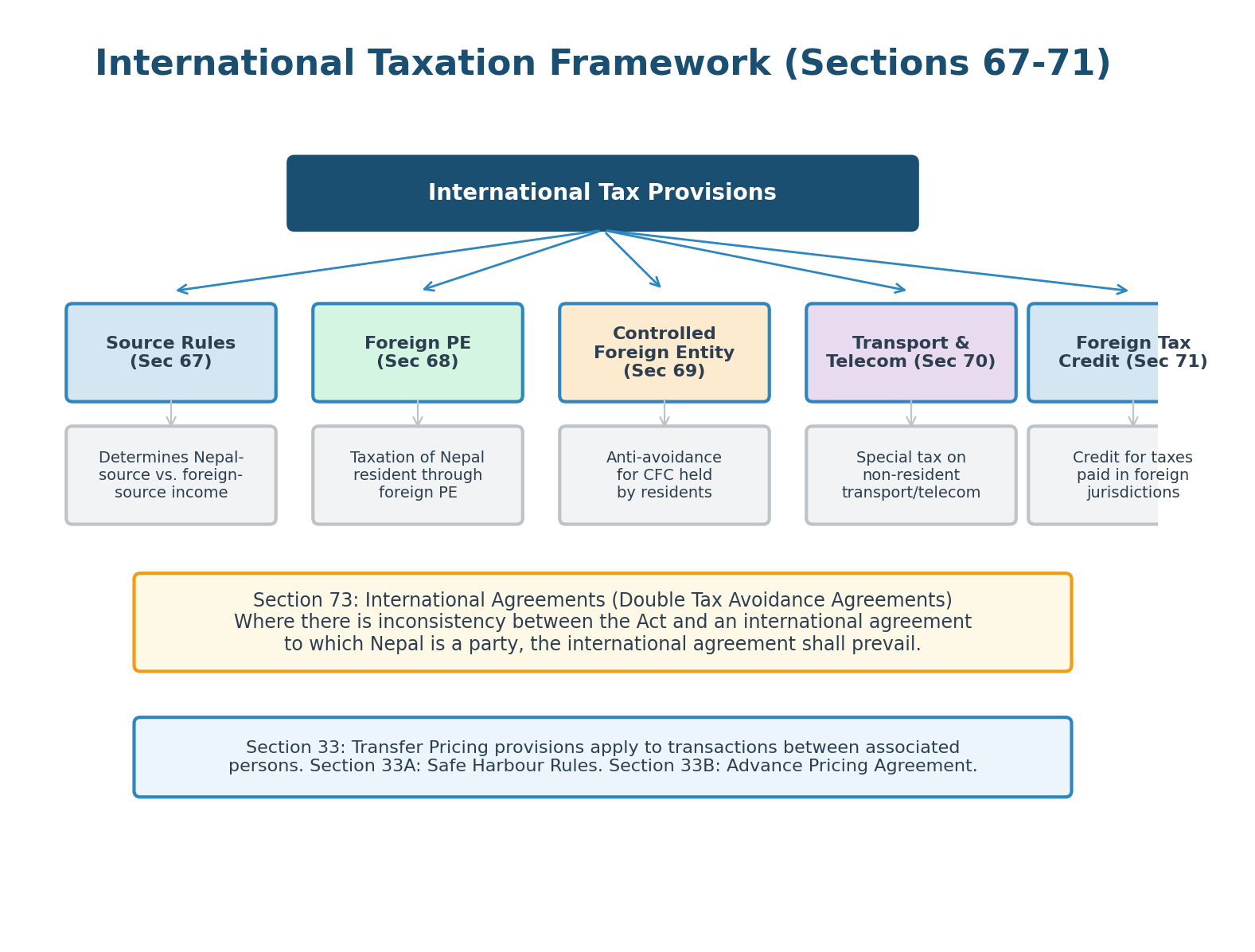
Figure: International Taxation Framework (Sections 67-71)
(1) If, in the source of income earned from any employment, business or investment of any person, the amounts mentioned in clause (a) exceed the amounts mentioned in clause (b), the amounts to the extent of such excess shall be deemed to have source in Nepal:-
(a) The amounts with source in Nepal included in computing the income,
(b) The amounts with source in Nepal deducted in computing the income.
Example 3.3.1: Suppose Ram Preet Singh, a non-resident person, ran a business selling spices at a stall rented at the Dashain fair held at Bhrikuti Mandap during income year 2080/81. He sold spices worth Rs. 10 lakhs at the fair. He incurred total expenses of Rs. 8 lakhs, comprising Rs. 7 lakhs for purchasing the spices sold and Rs. 1 lakh as stall rent. In this situation, the amount to be included in Ram Preet Singh's income is Rs. 10 lakhs, and the expenses incurred to earn such income amounting to Rs. 8 lakhs may be deducted. Since the amount to be included in Ram Preet Singh's income (Rs. 10 lakhs) exceeds the amount deductible as expenses (Rs. 8 lakhs) by Rs. 2 lakhs, those Rs. 2 lakhs are deemed to be income with a Nepal source for Ram Preet Singh.
(2) If the amounts mentioned in clause (a) exceed the amounts mentioned in clause (b) in the loss suffered from any business or investment of any person, the amounts to the extent of such excess shall be deemed to have source in Nepal:-
(a) The amounts with source in Nepal to be deducted in computing the income of the business or investment,
(b) The amounts with source in Nepal included in computing the income.
Example 3.3.2: Suppose Mohammad Hussein, a resident of Lucknow, India, took a stall at the Dashain fair held at Bhrikuti Mandap to sell goats during income year 2080/81. He incurred Rs. 5 lakhs for 100 goats brought to the stall for sale. He paid Rs. 50,000 as rent to the fair organizer for the stall. Because the climate of Lucknow and Kathmandu differed, 20 out of the goats brought from Lucknow died before they could be sold. Mohammad Hussein received income of Rs. 4 lakhs from selling the remaining 80 goats during the fair period. In this situation, the amount to be included in his income is Rs. 4 lakhs, and the deductible expenses comprising the cost of the goats and the stall rent amount to Rs. 5 lakhs 50 thousand. Since the amount deductible as expenses exceeds the amount to be included in income by Rs. 1 lakh 50 thousand, a loss has occurred. This loss of Rs. 1 lakh 50 thousand is deemed to have a Nepal source.
(3) The amounts to be included in computing the income shall be deemed to have source in Nepal in the following circumstances:-
(a) The net profits referred to in clause (c) of sub-section (2) of Section 7 or clause (b) of sub-section (2) of Section 9 to be set by subtracting the loss suffered from the disposal of the asset or liability with source in Nepal from the profit made from the disposal of the asset or liability with source in Nepal,
Section 67(3) addresses the source of gains arising from the disposal of depreciable assets used for earning income from business and investment activities of a person, and the disposal of non-business chargeable assets of a person. Section 67(3) deems income arising from the disposal of an asset or liability with a Nepal source to have a Nepal source.
Example 3.3.3: Suppose Brasil Drill Ltd. is a Brazilian company that constructs tunnels. The company obtained a contract to construct a tunnel with a Nepali company producing hydroelectric power on the Trishuli River in Nepal. To complete the tunnel construction, Brasil Drill Ltd. purchased 10 bighas of land in Muglin for Rs. 10 crores for the purpose of storing construction machinery and materials. The company also took a loan of USD 5 lakhs from GHI Bank of the United Kingdom for purchasing machinery and equipment to be used in the construction work. The company completed the tunnel construction work in income year 2080/81 and also repaid the outstanding loan of USD 5 lakhs to the UK bank in income year 2080/81. The exchange rate at the time of taking the loan was Rs. 60 per US dollar in Nepal, while the exchange rate at the time of repaying the loan in income year 2080/81 was Rs. 70 per US dollar. Since the construction work was completed, the land purchased for storing construction machinery and materials was also no longer required for the company's business use and was accordingly sold in income year 2080/81. The company received Rs. 15 crores from the sale of that land. In this situation, Brasil Drill Ltd. has a gain from the sale of land (a business asset) and a loss from the disposal of a foreign currency loan liability (a business liability).
In the above example, Brasil Drill Ltd. has a gain of Rs. 5 crores from the disposal of land. Upon disposal of the foreign currency loan liability, a payment of Rs. 3 crores 50 lakhs in Nepali rupee equivalent is required for USD 5 lakhs due to currency depreciation, whereas when the loan liability was created, it was recorded in Nepali rupees at only Rs. 3 crores. In this situation, a loss of Rs. 50 lakhs arises upon disposal of the liability. In accordance with Section 67(3) of the Act, the net gain is Rs. 4 crores 50 lakhs, arrived at by deducting the loss of Rs. 50 lakhs on the disposal of the loan (a business liability) from the gain of Rs. 5 crores on the disposal of the land (a business asset). The source of such gain of Rs. 4 crores 50 lakhs is deemed to be Nepal.
Example 3.3.4: Suppose Mr. Ricky is a resident of the Netherlands. He developed software useful for banking operations. He licensed such software to a commercial bank in Nepal for use on a royalty basis of Rs. 1 crore per annum. From the royalty payments received, he purchased shares worth Rs. 1 crore in that same bank in income year 2079/80. Mr. Ricky disposed of those shares in income year 2080/81 by selling them for Rs. 1 crore 50 lakhs, thereby realising a gain of Rs. 50 lakhs. Since Mr. Ricky is a natural person and the gain from the disposal of the shares constitutes income under Section 9(2)(b) of the Act, namely a gain from the disposal of non-business chargeable assets, the gain from the disposal of the shares is deemed to be income with a Nepal source.
(b) If a asset situated in Nepal or a liability to be borne in Nepal is included, the profits and amounts to be included in computing the income as mentioned in clause (d) of sub-section (2) of Section 7 or clause (c) of sub-section (2) of Section 9,
A person engaged in business and investment activities in Nepal holds various assets and liabilities for the purpose of earning income. Such assets and liabilities are disposed of in the course of business or investment. A gain arising upon the disposal of such assets and liabilities is deemed to have a Nepal source.
The amount to be included in respect of depreciable assets is the amount that, where a net gain arises from the disposal of some or all depreciable assets in a depreciable asset pool, is included in the profit and gain of the business in accordance with Schedule 2, Section 4. As mentioned above, where a depreciable asset is located in Nepal, the source of its income or expense is deemed to be in Nepal.
Where there are no assets remaining in a depreciable asset pool at year-end but a depreciation base remains, the remaining amount is deductible as terminal depreciation in accordance with Schedule 2, Section 4(2). Where a negative depreciation base arises regardless of whether assets remain in the pool at year-end, it indicates that income exceeding the cost of the pool has been received, and such negative amount (balancing charge) is computed in accordance with Schedule 2, Section 4(2) and included in the profit and gain of the business in accordance with Section 7(2)(d).
The following example further illustrates the above provisions.
Example 3.3.5: Suppose Brasil Drill Ltd. obtained a contract to construct a tunnel with a Nepali company producing hydroelectric power on the Trishuli River in Nepal. The tunnel construction was completed in income year 2080/81. After the tunnel construction was completed, the company sold all the machinery and equipment used in the tunnel construction in the local market for Rs. 6 crores. The machinery and equipment used in the tunnel construction were classified under Section 1(d) of Schedule 2 of the Act, and the opening depreciation base of that pool for income year 2080/81 was Rs. 5 crores. In this situation, a gain (balancing charge) of Rs. 1 crore arises from the disposal of the depreciable assets of that pool. Such gain (balancing charge) from the disposal of the assets is deemed to be a gain included in the company's income with a Nepal source.
Similarly, if the above-mentioned company received only Rs. 4 crores in total from selling all the machinery and equipment used in the tunnel construction after the construction was completed, a loss of Rs. 1 crore would arise from the disposal of the depreciable assets of that pool. In such a circumstance where the pool is dissolved, the company is entitled to deduct the loss of Rs. 1 crore arising from the disposal of the assets of that pool as an expense in that income year.
(c) Received payments with source in Nepal, subject to clauses (a) and (b).
Other payments received in connection with amounts with a Nepal source to be included in income, as referred to in clauses (a) and (b) of Section 67(3) of the Act, are also deemed to be amounts with a Nepal source to be included in income. The following example further illustrates this provision.
Example 3.3.6: Suppose Brasil Drill Ltd. obtained a contract to construct a tunnel with a Nepali company producing hydroelectric power on the Trishuli River in Nepal. The company insured the machinery used in the tunnel construction with an insurance company located in Brazil. During the tunnel construction, a machine worth Rs. 1 crore was damaged in an accident and became unusable, and the Brazilian insurance company paid compensation therefore. Accordingly, the compensation received from the Brazilian insurance company for a risk with a Nepal source is deemed to have a Nepal source.
(4) If a asset situated in Nepal or a liability to be borne in Nepal is included, the source of profit or loss made or suffered from the disposal of the asset or liability shall be deemed to have source in Nepal.
The following example further illustrates this provision.
Example 3.3.7: Suppose Kalp Lab Pvt. Ltd. is a company producing medicines in Nepal. Mr. Lee from Singapore lent Rs. 1 crore to that company in income year 2079/80 at an annual interest rate of 10 percent. The loan given to the Nepali company is an asset of Mr. Lee with a Nepal source. In income year 2080/81, Kalp Lab Pvt. Ltd.'s financial condition weakened and it decided it could not continue the pharmaceutical manufacturing business, so a decision was made to send the company into liquidation, and a liquidator was appointed to dispose and realise the assets and liabilities and carry out the liquidation. The liquidator disposed of all assets, but the proceeds were insufficient to pay all the company's liabilities. Accordingly, paying on a pro-rata basis in order of payment priority, Mr. Lee received only Rs. 50 lakhs out of the Rs. 1 crore loan he had extended. After receiving Rs. 50 lakhs as payment against the loan he had invested in Nepal, Mr. Lee's asset with a Nepal source (loan investment) is disposed of. Accordingly, the loss of Rs. 50 lakhs arising upon the disposal of the loan investment asset (in accordance with Section 37) is deemed to be a loss with a Nepal source.
A person earning income by conducting business in Nepal incurs various types of expenses. Accordingly, where a person is engaged through a head office, branch, factory, sales outlet, or construction, assembly and installation activities lasting more than 90 days, or for any similar reason, the amounts of expenses incurred in operating the business for the purpose of earning income in Nepal are deemed to have a Nepal source.
(5) If the following amounts are included in the amounts deducted in assessing the income, the source of such amounts shall be deemed to be in Nepal:-
(a) The amount that can be deducted as cost expenditure mentioned in sub-section (1) of Section 15 in respect of the properties situated in Nepal,
(b) The expenses referred to in sub-section (1) of Section 16 in respect of the properties situated in Nepal, and the expenses to the extent allowed to be deducted pursuant to Section 19, and
(c) The payments with source in Nepal, subject to clauses (a) and (b).
The following example further illustrates this provision.
Example 3.3.8: Suppose Brasil Drill Ltd. of Brazil was engaged in constructing a tunnel for the hydroelectric project on the Trishuli River. The company incurred Rs. 10 crores in construction materials for the tunnel construction in income year 2080/81. Depreciation expense on the machinery and equipment used in the construction work amounted to Rs. 1 crore. Repair and maintenance of the machinery and equipment cost Rs. 50 lakhs. Accordingly, the source of expenses such as Rs. 10 crores for consumption of construction materials, Rs. 1 crore for depreciation, and Rs. 50 lakhs for repair and maintenance is deemed to be in Nepal.
(6) The following payments shall be deemed to have source in Nepal:-
Basis 1: Payments made by a resident (Residency Based Payments) - interest, dividends, annuities, investment insurance proceeds, retirement payments and government service.
Basis 2: For payments other than those arising from the disposal of assets and liabilities, where the location of the payment base is in Nepal (Location of Payment-base) - all types of income or expense-determining payments (Sections 7, 8, 9 and 13), other than those determined on the basis of residency.
(a) Dividends paid by a resident entity,
(b) Interest paid by a resident person,
(c) Payment for natural resources made in respect of the natural resource derived from the land situated in Nepal or calculated with reference to such source,
(d) Rent paid for the use of any property situated in Nepal,
(e) Royalty received by any person for having allowed any person to use any property situated in Nepal or for accepting the right to use the property or the restriction on the use of such property,
The following example further illustrates this provision.
Example 3.3.9: Suppose a Nepali film producer authorizes a person to exhibit a film produced in Nepal. The source of the royalty received by the producer for granting such authorization is deemed to be in Nepal.
Example 3.3.10: Suppose the producer in Example 3.3.9 receives any payment from that person on the condition that the film will not be exhibited to anyone other than that person. The source of such payment is deemed to be in Nepal.
(f) Amount for the general insurance paid by any person in respect of insurance against risks in Nepal and premium paid to that person for general insurance,
The following example illustrates this provision.
Example 3.3.11: Suppose an Indian insurance company insured the risk of a factory located in Nepal. The source of the insurance premium paid by that factory to the Indian insurance company is deemed to be Nepal.
(g) Payments received by any person as follows by operating inland, sea or air transport or charter service business in Nepal, except as a result of transshipment:-
(1) The carriage of departing passengers, or
(2) The shipment of mail, livestock or other direct movable property.
Where a person operates an air service in Nepal and transports passengers and cargo, the source of the amount paid to the airline company by passengers departing from Nepal for air travel is deemed to be in Nepal. Similarly, the source of the payment received by an airline company for transporting cargo sent from Nepal is also deemed to be in Nepal. Where an export company in Nepal transports goods being exported by road to the final destination country, the source of the payment received for such transport is Nepal. Where a shipping company sends goods for export from Nepal by sea route via a land route and a port to the destination country, the source of the payment received therefor is also deemed to be in Nepal.
(h) Payments received by a person who carries on a business of dispatching information or news through means of communication such as wire, radio, optical fiber or satellite in respect of dispatch of news or information through networks established in Nepal, irrespective of whether or not such news or information is originated in Nepal
This clause specifically relates to the transmission of information and news. It is difficult to identify the origin of information or news and the person transmitting it. The transmission of such information and news involves not only the transmitter but also the participation of other persons in between. In this situation, it is difficult to ascertain the location of the transmission of information or news. Keeping this difficulty in mind, this provision of the Act deems the source of a payment made for news or information transmitted through installations located in Nepal to be in Nepal. The following example illustrates this provision.
Example 3.3.12: Suppose the Star Africa Channel, which operates in South Africa, is broadcasting a cricket match being played live in that country. The Star Africa Channel authorized Nepal's Fly Cable TV to broadcast the live cricket coverage and make it available to Nepali viewers. Fly Cable TV accordingly provided the service to its subscribers. The source of the payment made by Fly Cable TV to the Star Africa Channel, which holds the rights to broadcast the live cricket match, for the broadcast made using Fly Cable TV's installations established in Nepal, is deemed to be Nepal.
(i) Payments in the following circumstances including service charges of the kinds not mentioned in clauses (g) or (h) for doing employment or rendering service or accepting restriction in those acts:-
(1) Where the acts are carried out in Nepal irrespective of the place of payment, or
(2) Where the Government of Nepal is to make payment irrespective of the place of employment.
This provision of the Act deems the source of a payment received by a person for performing employment or providing services in Nepal to be in Nepal, regardless of where such payment is made. Similarly, where the Nepal Government makes a payment for employment, the source of such payment is deemed to be Nepal even if the employment is performed outside Nepal. The following examples illustrate this provision.
Example 3.3.13: Suppose IMGD of the Netherlands conducted a training program to build the capacity of employees working in Nepal's revenue administration. The Danish Government provided financial support to the program. The company conducted the training for employees in Nepal itself, and the service fee for providing such training was to be paid in the Netherlands. In this situation, since the training activity was conducted in Nepal, the source of the payment received by IMGD for the service fee is deemed to be in Nepal.
Example 3.3.14: The Nepal Government has opened a resident embassy in France. The Nepal Government pays remuneration to the persons employed in that embassy. Even though such persons are working in the embassy located in France, since the Nepal Government is making the payment for employment, the source of such payment is deemed to be in Nepal.
(j) Annuities, amount for investment insurance and retirement payment paid by a resident person which does not fall under clause (i), and any premium or other payment paid to the resident person in order to ensure such amounts,
The following example further illustrates this provision.
Example 3.3.15: Suppose a person retired from employment. During the period of employment, they had been contributing to the Citizens Investment Trust (a resident person). After retirement, the Citizens Investment Trust made a retirement payment to them. In this situation, the source of the retirement payment made by the Citizens Investment Trust is deemed to be in Nepal. In addition, the source of the retirement contributions made by the employer to the Citizens Investment Trust (a resident person) during the period of employment to secure the retirement payment is also deemed to be in Nepal.
(k) Gifts received in respect of a business or investment operated from the asset situated in Nepal, and
The source of gifts received in connection with a business or investment conducted from an asset located in Nepal is deemed to be Nepal regardless of where they are received. The following example further illustrates this provision.
Example 3.3.16: Suppose Fukuda & Co., a Japanese company, has an investment in a botanical garden in Kathmandu. Various types of research on plants and trees are also conducted at the botanical garden. For making a notable contribution to research on plants and trees in Nepal, Fukuda & Co. received a gift of 1 million Japanese yen in Japan from the Botanical Association of Japan. The source of such gift received in connection with the business in Nepal is deemed to be Nepal.
(l) The following payments except those mentioned in clauses (a), (b), (c), (d), (e), (f), (g), (h), (i), (j) and (k) above:-
(1) Payments made in respect of disposal of the property situated in Nepal or in respect of acquiring liability to be borne in Nepal, or
(2) Payments made in respect of activities carried out in Nepal.
Clauses (a) through (k) of Section 67(6) of the Act enumerate various types of payments with a Nepal source. In addition to the above types of payments, the source of payments for all activities (business or investment) conducted in Nepal is also deemed to be in Nepal. Similarly, the source of any payment made upon the disposal of any asset located in Nepal or upon acquiring any liability is also deemed to be in Nepal. The following example further illustrates this provision.
Example 3.3.17: Suppose Fukuda & Co., mentioned in Example 3.3.16, sold its share investment in the botanical garden to another Japanese company. The source of such shares sold by Fukuda & Co. is deemed to be Nepal, and the source of the income received from such sale, computed in accordance with Section 36, is also deemed to be Nepal.
(7) Any income, loss, amount, profit or payment other than the one deemed to have source in Nepal as mentioned in the above sub-sections shall be deemed to have foreign source, and the references to Nepal given in this Act shall be applicable as if they were used in the case of any particular foreign country for the purposes of ascertaining in which country such income, loss, amount, profit or payment has source.
Income, loss, amounts, gains and payments not mentioned in subsections (1) through (6) are deemed to have a foreign source. Such amounts deemed to have a foreign source are attributed to the source country using the same basis by which they would be deemed to be a Nepal source if they were in Nepal. For instance, just as income received from an asset located in Nepal is deemed to have a Nepal source, income received from an asset located in Japan is deemed to have a Japan source.
Section 67(1) through (6) of the Act provides for circumstances where Nepal is deemed to be the source, while all other circumstances are deemed to have a foreign source. The following example further illustrates this.
Example 3.4.1: Suppose Diwakar Thapa, a Nepali citizen, is a resident of Canada and has been conducting business there. He has earned income from business conducted in Canada and other countries other than Nepal, and the source of such income is not deemed to be Nepal.
Explanation: For the purposes of this Section,-
(a) "Asset situated in Nepal" means the land or buildings situated in Nepal and the asset other than land or building of a resident person situated in any foreign country, or if the person is associated with a controlled foreign entity pursuant to Section 69, inclusive of his interest in that entity.
Example 3.4.1a:
Suppose Durga Sapkota is a Nepali resident person who has obtained permanent residency in Canada. He also has a house and land in Canada. For the past 4 years, he has been residing in Nepal and conducting business. He also has a house, land and shares in various companies in Nepal. In addition, he has an investment in the shares of certain Canadian companies. In this situation, the house and land of Durga Sapkota in Canada are not deemed to be assets with a Nepal source, whereas his house and land in Nepal, the interest attributable to the shares in Nepali companies, and the interest attributable to the shares in Canadian companies are deemed to be assets with a Nepal source, i.e., asset situated in Nepal.
(b) "Liability to be borne in Nepal" means the liability of a resident person created from activities carried out in Nepal.
Liabilities to be borne in Nepal refers to liabilities that a resident person is required to bear. For example, liabilities payable in Nepal or abroad for goods or services purchased by a resident person, and loan amounts borrowed from Nepal or abroad, may be included. The following example further illustrates this.
Example 3.4.2: Suppose Golden Investment Inc., USA extended a loan investment of USD 1 lakh to Sunakhadi Pvt. Ltd., a resident company. The source of the interest payment (income) to be paid by Sunakhadi Pvt. Ltd. to Golden Investment Inc., USA is deemed to be Nepal.
Example 3.4.3: Suppose Diwakar Thapa, a Nepali citizen, is a resident of Canada and has been conducting business there. He took a personal loan of Rs. 1 crore from a bank in Nepal. Since he was unable to repay the loan, the bank wrote off Rs. 10 lakhs and settled his loan. Since Diwakar Thapa disposed of a liability of Rs. 1 crore located in Nepal for Rs. 90 lakhs, a saving (income) of Rs. 10 lakhs arose, and the source of such income is deemed to be Nepal.
Source of income (Sec 67): Nepal-source income/loss = Nepal-source inclusions − Nepal-source deductions (67(1)/(2)); gains/profits on disposal of asset situated in Nepal or liabilities borne in Nepal = Nepal source (67(3)/(4)/(5)).
67(6) PAYMENTS deemed Nepal source: dividends/interest paid by a resident; rent, royalty & natural-resource payments for Nepal asset; general insurance of a Nepal risk; transport/charter of passengers/cargo departing Nepal; communications via Nepal networks; payment for employment/services performed in Nepal (or paid by GoN wherever performed); annuities, investment-insurance & retirement payments by a resident; gifts re a Nepal business/investment; and any payment for disposing Nepal asset or for activities carried out in Nepal.
67(7): anything not deemed Nepal source is FOREIGN source (assigned to the foreign country by the same tests).
'Asset situated in Nepal' = Nepal land/buildings + a resident's movable asset anywhere + an interest in a Sec 69 controlled foreign entity
‘Liability to be borne in Nepal’ = liability of a resident person created from activities carried out in Nepal.
68. Foreign permanent establishments
Refer Section 2(aab) for detailed understanding of Permanent establishment.
A foreign permanent establishment is a place outside the country of residence where a non-resident person carries on business in Nepal.
For tax purposes, a foreign permanent establishment is treated as an independent entity from its parent company. Amounts invested in a permanent establishment are treated as equity of that establishment. Only expenses directly related to the establishment's business are treated as its expenses; however, indirect expenses incurred by the parent company allocated per Section 33 up to that allocation are treated as expenses of the establishment. Transactions (purchases, transfers, or payments) between the permanent establishment and the parent company or associated persons must be at arm's length, and withholding tax and other tax treatment apply to transactions with the parent company the same as to transactions with other independent parties.
(1) Notwithstanding anything contained in Section 3, any foreign permanent establishment of a non-resident person situated in Nepal shall be liable to pay tax payable on the income of such establishment, subject to other provisions of this Act.
Section 3 of the Act sets out the following bases for levying income tax: (a) a person with taxable income in any income year; (b) a foreign permanent establishment located in Nepal of a non-resident person that remits income abroad in any income year; and (c) a person who receives payments with final advance tax withholding in any income year. Income of the person under clause (a), whether sourced in Nepal, abroad, or both countries, is subject to tax, while under clauses (b) and (c) only income sourced in Nepal is subject to tax. This provision places the tax payment obligation for income from the foreign permanent establishment's Nepal operations on the foreign permanent establishment itself.
Example 14.2.5: Suppose Dare Devil Inc. from Spain is a company that provides entertainment through adventure activities. The company operates a branch in Nepal providing Sky Jump entertainment to Nepali people and foreign tourists visiting Nepal. In income year 2080/81, Dare Devil Inc.'s Nepal branch earned taxable income of Rs. 1 crore. Since Dare Devil Inc. is a foreign entity and operates in Nepal through a branch, that branch constitutes a foreign permanent establishment under the Nepal Income Tax Act. The tax obligation on taxable income in FY 2080/81 rests not with Dare Devil Inc. in Spain but with the branch in Nepal. Dare Devil Inc.'s Nepal branch must pay tax on such income at the same rate as a domestic company. In addition, the obligation to file tax on income remitted to Spain also rests with the branch office.
(2) The income of a person having ownership of a foreign permanent establishment shall be separated from the income of that establishment pursuant to Section 69.
If a foreign entity's permanent establishment in Nepal conducts taxable transactions and earns income, and a Nepali resident has an interest in that foreign entity, the proportional amount corresponding to the Nepali resident's interest must be separated from the full income of the foreign permanent establishment.
Example 14.2.6 (INCORRECT IN DIRECTIVE) : Suppose Timilaa Construction Company Pvt. Ltd., a resident company of Nepal, holds 60% of the shares in Daso Construction Company Ltd., a company incorporated in Bhutan. Since Timilaa Construction Company controls Daso Construction Company, Daso is a Controlled Foreign Entity (CFE) under Section 69 of the Income Tax Act.
During an income year, Daso Construction Company undertakes a construction contract in Bhutan and earns:
Particulars | Amount (Rs.) |
Contract Revenue | 5,00,00,000 |
Deductible Expenses | 4,00,00,000 |
Net Profit | 1,00,00,000 |
Under Section 69, Timilaa Construction Company must include in its income the portion of Daso's attributable income corresponding to its ownership interest: 1,00,00,000×60%=60,00,000
Therefore, Rs. 60 lakh shall be included in Timilaa Construction Company's income for that income year, regardless of whether any dividend has actually been distributed. After paying 25% tax on income of NPR 10 million, the remaining NPR 7.5 million when repatriated to the parent company in Bhatrun, only NPR 3 million shall be treated as income remitted abroad.
Subsequent Distribution
Assume that in a later year Daso distributes its entire after-tax profit.
If Bhutan corporate tax is 25%:
Particulars | Amount (Rs.) |
Profit before tax | 1,00,00,000 |
Tax @ 25% | 25,00,000 |
Profit after tax | 75,00,000 |
Timilaa's share of the distributable profit: 75,00,000×60%=45,00,000. Accordingly, Timilaa receives a dividend of Rs. 45 lakh.
Since Timilaa has already been taxed on the attributed income under Section 69, the dividend is dealt with under the Act's provisions preventing double taxation of previously attributed CFE income.
(3) Tax shall be imposed on the permanent establishment referred to in clause (b) of Section 3 in the income sent abroad by the foreign permanent establishment of a non-resident person situated in Nepal.
Section 3 of the Act provides for levying tax on a foreign permanent establishment located in Nepal of a non-resident person for income remitted abroad by such establishment. Section 68(1) provides that the foreign permanent establishment is taxed like a company on income from business operations. Since a permanent establishment is not registered under the Companies Act or other laws of the country, it does not distribute income as dividends, and income earned from business operations is repatriated to the home country of the parent entity. Tax is levied on such repatriated income under this section.
Example 14.2.7: Suppose Buloski Construction Company from Italy is a road construction company. It received a road construction contract in Nepal. In FY 2080/81, it completed road construction work over 9 months under the contract. Since the company was engaged for 9 months, it qualifies as a permanent establishment under Nepal's law. The company earned taxable income of Rs. 1 crore. Since the company is a foreign permanent establishment, it must pay Rs. 25 lakh as corporate income tax at 25 percent. After paying Rs. 25 lakh corporate income tax, the remaining Rs. 75 lakh remitted to the company's head office abroad is treated as income remitted abroad by the foreign permanent establishment, and tax at 5 percent under Schedule-1, Section 2(6) of the Act must be paid on such income. When remitting all Rs. 75 lakh, the 5 percent tax of Rs. 3.75 lakh must be deducted and only Rs. 71.25 lakh may be remitted.
(4) The income sent abroad in any income year by the foreign permanent establishment of a non-resident person situated in Nepal shall be equal to the amount of dividends distributed by that foreign permanent establishment in that year.
If a foreign permanent establishment of a non-resident person located in Nepal remits income earned from Nepal operations abroad to a non-resident entity, such repatriated income is treated the same as dividends paid by an associated resident entity to another non-resident entity. However, for repatriated income, tax is levied under Section 3(b) and the applicable rate is specified in Schedule-1, Section 2(6). Since the source of dividends paid by associated entities is in Nepal under Section 67(6)(a), advance tax withholding under Section 88(2)(a) applies to such dividends; but for income remitted abroad by the foreign permanent establishment, tax is levied at 5 percent under Schedule-1, Section 2(6) and the obligation rests with the foreign permanent establishment itself.
Example 14.2.8: Suppose the Indian company Kasmir Insurance Company has established a branch office in Nepal and has been conducting general insurance business in Nepal. The company earned income of Rs. 1 crore from general insurance operations in Nepal in FY 2080/81. The branch paid Rs. 30 lakh as corporate income tax at Nepal's corporate rate on that income, and of the remaining Rs. 70 lakh, Rs. 50 lakh was remitted to its head office in India. On such remitted income, the Nepal branch must file Rs. 2.5 lakh (5 percent of Rs. 50 lakh) as tax under Schedule-1, Section 2(6).
Foreign permanent establishment (Sec 68): a non-resident's place of business in Nepal, taxed as a SEPARATE resident entity. Four PE types: (1) FIXED-PLACE - branch, factory, office, mine, farm etc. (no minimum duration); (2) AGENCY - a dependent agent who habitually concludes contracts for the non-resident (an independent agent is not a PE); (3) SERVICE - own employees/representatives present 90+ days in any rolling 12-month (365-day) period; (4) CONSTRUCTION/INSTALLATION - site present 90+ continuous days.
The PE pays tax on its Nepal income at the company rate (68(1)); income then remitted abroad is a deemed dividend taxed at 5% (Schedule 1, Sec 2(6)), payable by the PE itself (68(3)/(4))
69. Controlled foreign entities
A controlled foreign entity means a non-resident entity in which a resident person has a direct interest or an indirect interest through one or more intermediary non-resident entities in any income year, and that person is associated with the entity, or if that person and their associated persons together with any other up to four resident persons are associated with such entity. In other words, a foreign company, trust, or partnership in which a Nepali resident holds more than 50 percent ownership or interest through income, capital, or voting rights is a controlled foreign entity.
Example 14.3.1: Suppose Sagarmatha Company Ltd. is a Nepali resident company. The company holds 70 percent share ownership in MountFuji Company Pvt. Ltd. in Japan. Since Nepali resident Sagarmatha Company Ltd. has a direct interest in and control over MountFuji Company Pvt. Ltd., MountFuji Company Pvt. Ltd. is a controlled foreign entity controlled by the Nepali resident.
Example 14.3.2: Suppose Koshi Company Ltd. is a Nepali resident company. The company has invested in preference shares with priority profit-sharing rights in Askari Group of Companies Pvt. Ltd. in Pakistan. The share agreement provides that 70 percent of the company's income from the preference shares belongs to Koshi Company. Since the Nepali resident has direct income control over Askari Group of Companies Pvt. Ltd., that company is a controlled foreign entity controlled by the Nepali resident.
Example 14.3.3: Suppose Mechi Company Ltd. is a Nepali resident company. The company has invested in 40 percent ordinary shares in a company in Pakistan. The class of shareholders has the right in the company's articles to appoint 4 out of 7 directors. Since the Nepali resident has direct operational control, that company is a controlled foreign entity controlled by the Nepali resident.
Example 14.3.4: Suppose MountFuji Company Pvt. Ltd. mentioned in Example 14.3.1 above is a non-resident company but is controlled by a Nepali resident. MountFuji Company Pvt. Ltd. holds 80 percent share ownership in Nippon Pvt. Ltd. in Japan. Since Nepali resident company Sagarmatha Company Ltd. indirectly controls Nippon Pvt. Ltd. through its associated entity, Nippon Pvt. Ltd. is also a controlled foreign entity. Control in Nippon Company by the Nepali resident through its associated entity amounts to 56 percent (70 percent of 80 percent), making it a controlled foreign entity.
Example 14.3.5: Suppose A, B, C, D, E, and F are Nepali residents. They each hold 10 percent ownership in ABC Company in Japan. Although they collectively hold 60 percent ownership at 10 percent each, since the company is controlled by more than 4 persons, it is not treated as a controlled foreign entity controlled by Nepali residents.
If a foreign entity in which a resident person has invested qualifies as a controlled foreign entity, such an entity is treated as a Nepali resident entity for purposes of the Income Tax Act, 2058. Income returns must be prepared according to Nepal's income year regardless of the tax year of the country where such entity is located. Business income or investment income is determined under the Income Tax Act, 2058, and income computed for Nepal's income year period is called attributed income in relation to the controlled foreign entity.
Example 14.3.6: Suppose Sagarmatha Ltd. is registered in Nepal and holds 70 percent share ownership in MountFuji Company Pvt. Ltd. in Japan. MountFuji Company Pvt. Ltd. is a controlled foreign entity of Sagarmatha Ltd. MountFuji Company earned business income of Rs. 1 crore from its business in income year 2080/81. The taxable income computed under the Income Tax Act, 2058 for Nepal's income year is the attributed income of MountFuji Company Pvt. Ltd. The income attributable to Nepali company Sagarmatha Ltd. from this entity is Rs. 70 lakh being 70 percent of the attributed income, constituting Sagarmatha Company's Japan-source income.
(1) If any entity distributes dividends of the associated income earned in any income year as a controlled foreign entity at the end of the income year, it shall be deemed to have distributed dividends in proportion to its beneficiaries, as follows:-
(a) As per the rights of the beneficiaries to the income in distributing dividends, or
(b) If the rights are not determinable in a reasonable manner, as per the method which the Department thinks proper according to the circumstance.
The Act provides for including a proportional amount based on the resident person's interest in the attributed income of a controlled foreign entity in income. Even if the controlled foreign entity has not distributed dividends to its beneficiaries, it is treated as if dividends were distributed, and the amount arising from such person's right must be included in the person's income. Since the resident person has a decisive right in the controlled foreign entity, the Act makes this special provision to prevent deferring tax obligations by not including income earned in such entities in Nepal's income.
Example 14.3.7: Suppose the directly controlled foreign entity of Nepali company Sagarmatha Ltd. is Annapurna Company Pvt. Ltd. in Japan, and the indirectly controlled foreign entity is Kanchenjunga Pvt. Ltd. In income year 2080/81, per the Income Tax Act, 2058, Annapurna Company has income of Rs. 1 crore. Similarly, Kanchenjunga Pvt. Ltd. also has income of Rs. 1 crore in that year. Since Annapurna Company and Kanchenjunga Pvt. Ltd. are controlled entities of Sagarmatha Ltd. Nepal, the income of these entities in FY 2080/81 is attributed income of Sagarmatha Nepal. Sagarmatha Nepal is treated as having received dividends as follows: since Sagarmatha holds 70 percent shares in Annapurna Company, the attributed income proportional to share ownership is Rs. 70 lakh; since Annapurna Company holds 80 percent shares in Kanchenjunga Pvt. Ltd., Sagarmatha Company's effective proportion is 56 percent (70% x 80%), so the proportional amount is Rs. 56 lakh. Nepali company Sagarmatha Ltd.'s total attributed income from directly and indirectly held controlled foreign entities: Rs. 70 lakh + Rs. 56 lakh = Rs. 1.26 crore as Japan-source income. Sagarmatha Ltd. must include Rs. 1.26 crore as income received from controlled foreign entities in its income return for FY 2080/81.
(2) Tax shall not be levied on the dividends distributed by an entity as a controlled foreign entity at the end of any income year except those distributed pursuant to sub-section (1).
Since a resident person has already included the attributed income of the controlled foreign entity proportionally in their income return for the same year, when the controlled foreign entity later distributes dividends, the resident person need not include such dividend amount in income again.
Example 14.3.8: Suppose Nepali resident company Sagarmatha Ltd. holds 70 percent shares in MountFuji Company Pvt. Ltd. registered in Japan. MountFuji Company Pvt. Ltd. distributed dividends of Rs. 50 lakh out of the FY 2079/80 attributed income of Rs. 1 crore to its beneficiaries in FY 2080/81. Sagarmatha Nepal Ltd. received Rs. 35 lakh of the distributed dividend based on its share ownership (70 percent in MountFuji Company). Since Sagarmatha Ltd. already included the amount based on its interest in the controlled foreign entity in its income return for FY 2079/80 and filed tax, in FY 2080/81 the amount received as dividends from the controlled foreign entity need not be included in income.
(3) The following shall be deemed to have occurred in respect of the dividends distributed by a controlled foreign entity pursuant to sub-section (1) to the beneficiaries associated with that entity at the time of distribution of dividends:-
(a) Having the characteristic equivalent to the type and source of the associated income of that entity, and
(b) Having distributed proportionately out of each type and source of the associated income of that entity.
Simple Explanation- Section 69(3)
When a CFE distributes dividends to its shareholders:
The dividend is treated as having the same character as the underlying income from which it was derived.
The dividend is deemed to come proportionately from all categories of the CFE's income, not from just one category chosen by the taxpayer.
Example 1
Suppose a CFE earns:
Income Type | Amount (Rs.) |
Business Income | 60 lakh |
Interest Income | 20 lakh |
Capital Gain | 20 lakh |
Total | 100 lakh |
The CFE distributes a dividend of Rs. 50 lakh.
Under Section 70(3)(b), the dividend is deemed to be distributed proportionately from each income source:
Income Type | Share | Dividend Portion |
Business Income | 60% | 30 lakh |
Interest Income | 20% | 10 lakh |
Capital Gain | 20% | 10 lakh |
Total Dividend | 100% | 50 lakh |
Effect of Clause (a)
The dividend portions retain the same character as the underlying income:
Dividend Portion | Character |
Rs. 30 lakh | Business Income |
Rs. 10 lakh | Interest Income |
Rs. 10 lakh | Capital Gain |
Thus, the shareholder is deemed to receive a dividend that consists of different income types rather than a single generic dividend.
Why is this rule needed?
Without this provision, taxpayers could argue:
"The dividend came only from income that has already been taxed or from a favorable source."
The law prevents such cherry-picking by requiring the dividend to be traced proportionately to all underlying income pools.
(4) Any tax paid by any controlled foreign entity including that deemed to have been paid pursuant to sub-section (5) or sub-section (5) of Section 52 in respect of the amounts deemed to be distributed pursuant to sub-section (3) shall be set aside for the beneficiary associated with that entity.
This provision grants the controlling resident persons of a controlled foreign entity foreign tax credit benefits. The corporate income tax paid by the controlled foreign entity in the country where it is located must be credited against the tax payable when earning corporate income. The amount equal to the tax on dividends must be given as an exemption to the beneficiary proportionally based on the dividends deemed to have been received.
Example 14.3.9: Suppose Nepali resident company Sagarmatha Ltd. holds 70 percent shares in MountFuji Company Pvt. Ltd. registered in Japan. MountFuji Company distributed dividends of Rs. 35 lakh to Sagarmatha Nepal in FY 2080/81. The company's attributed income was Rs. 1 crore and corporate tax paid for that year was Rs. 29 lakh. MountFuji Company Pvt. Ltd. is a Japan-based company and Japan's income tax law requires 10 percent advance tax withholding on dividend payments. In this case, the advance tax withheld from dividends distributed by MountFuji Company and the proportional corporate tax amount are treated as amounts eligible for the tax credit under Section 71.
(5) The tax set aside pursuant to sub-section (4) at the time of allocation shall be deemed to have been paid by the beneficiary, and the beneficiary may get facility of tax adjustment for such tax as provided for in Section 71.
For purposes of this Act, foreign income tax paid under sub-section (5) and tax filed by any person, whether by the beneficiary or the entity, is treated as filed by the entity.
(6) The amount deemed as distributed to the beneficiary pursuant to sub-section (1), at the time of distribution shall be included in the expenses for any asset or liability of the recipient beneficiary in the entity making such distribution.
The Act provides for including a proportional amount of attributed income of a controlled foreign entity in income. This creates a temporary tax difference: income is taxed before receipt, but when income is actually received, tax is not levied again. Sections 69(6) and (7) eliminate such differences by adjusting the cost base of the interest held.
Example 14.3.10: As mentioned in Example 14.3.7 above, Nepali company Sagarmatha Ltd.'s directly controlled foreign entity Annapurna Company's FY 2080/81 attributed income under Section 69(1) is Rs. 70 lakh, and the proportional amount of attributed income of the indirectly held controlled foreign entity Kanchenjunga Pvt. Ltd. included in income is Rs. 56 lakh, totalling Rs. 1.26 crore to be included in Sagarmatha Ltd.'s income. This total amount of Rs. 1.26 crore must be included as expenditure (outgoing) for the interest held in MountFuji Pvt. Ltd.
(7) The dividends distributed to the beneficiary enjoying tax exemption pursuant to sub-section (2) at the time of distribution shall be included in the income for any asset or liability of the recipient beneficiary as an interest in the entity making such distribution.
Example 14.3.11: As mentioned in Example 14.3.7 above, Sagarmatha Ltd. received Rs. 35 lakh as dividends from the controlled foreign entity MountFuji Pvt. Ltd. in FY 2080/81. Under sub-section (2), Sagarmatha Ltd. must include the Rs. 35 lakh received as income (incoming) for the asset of the related controlled foreign entity.
Reading Section 69(6) and 69(7) together
Reading Section 69(6) and 69(7) together
Situation | Tax Treatment |
Section 69(6) | Previously attributed income increases the cost base of the interest in the CFE. |
Section 69(7) | Dividends later received out of that previously attributed income reduce that cost base (or are included in income from the interest). |
The translation of Section 69(7) is somewhat awkward, but its purpose is clear: to reverse the adjustment made under Section 69(6) when the profit is actually distributed.
Example
Year 1
Nepal Co. owns 60% of Foreign Co. (CFE).
Foreign Co. earns profit = Rs. 100 lakh.
Under Section 69: Rs. 60 lakh is attributed to Nepal Co. and taxed in Nepal.
Effect of Section 69(6)
Cost of shares = Rs. 200 lakh
Add attributed income: 200+60=260lakh
Adjusted cost base = Rs. 260 lakh
Year 2
Foreign Co. distributes dividend. After foreign tax, Nepal Co. receives dividend = Rs. 45 lakh.
Since this dividend relates to income that was already attributed under Section 69, it is exempt from further taxation under Section 69(2). However, if nothing further happened, Nepal Co. would still retain the additional Rs. 60 lakh in its cost base.
That would result in a double benefit:
Income already taxed → cost base increased.
Dividend received tax-free. Cost base remains inflated.
Effect of Section 69(7)
The exempt dividend reduces the previously increased cost base.
Particulars | Rs. lakh |
Cost base after 69(6) | 260 |
Less: Exempt dividend received | 45 |
Revised cost base | 215 |
Thus, the earlier upward adjustment is gradually reversed as profits are actually distributed.
(8) For the purposes of this Act, the foreign income tax paid or foreign income tax deemed as paid by any controlled foreign entity pursuant to sub-section (5) or sub-section (5) of Section 52 shall be deemed as tax amount paid by that entity or deemed to be paid by that entity pursuant to this Act.
Explanation: For the purposes of this Section,-
(a) "Associated income" means, in computing the taxable income of any controlled foreign entity in any income year, a taxable income computed as if that entity were a resident entity.
(b) "Controlled foreign entity" means any non-resident entity in which any resident person has interest directly or indirectly through one or more interposed non-resident entities in any income year; and where that person is associated with that entity, or where any person deemed to be associated with that person and any other resident persons not exceeding four persons are associated with that entity, it includes such entity, as well.
Controlled foreign entity / CFE (Sec 69): a non-resident entity is a CFE if a resident - alone, or with associates and up to 4 other residents - controls it (over 50% of income, capital or voting rights; direct or indirect through intermediaries).
Anti-deferral: the CFE's ATTRIBUTED income (computed under Nepal rules for Nepal's income year) is deemed distributed to the resident in proportion to interest and taxed NOW, even if no actual dividend is paid (69(1)).
When the CFE later actually distributes that income, it is NOT taxed again (69(2)).
Indirect control multiplies through the chain (e.g. 70% × 80% = 56%).
NOT a CFE if controlled by more than 5 residents (e.g. 6 residents at 10% each).
Foreign corporate tax and dividend WHT paid by the CFE are creditable to the resident under Sec 71 (69(4)/(5))
70. Tax chargeable on non-resident person providing water transport, air transport or telecommunications service in Nepal
Section 67(6)(g) of the Act provides that payments received by a non-resident person from operating water transport, charter services, or air transport in Nepal constitute Nepal-source income. Similarly, Section 67(6)(h) provides that payments received by a non-resident person operating cross-border data transmission business in Nepal through telegraph, radio, optical fibre, or satellite communication constitute Nepal-source income. A special provision makes the tax rate and taxable income computation for such persons different from that for other business income. For purposes of this section, 'non-resident person' means a resident entity within a group of associated entities whose main office is outside Nepal. In this context, even if a water transport, charter service, or air service operator has established an office in Nepal or appointed an authorised sales agent, for purposes of this section they are treated as non-resident persons rather than having a Nepal permanent establishment.
(1) The taxable income of any non-resident person who operates water traveling/rafting, charter service or air transport in any income year shall consist of the amounts derived from the following acts except the amounts derived from transshipment in that year:-
(a) Carriage of passengers departing from Nepal, or
(b) Carriage of the mail, animals or goods dispatched from Nepal.
If an airline uses Nepal's airport as a transit point, payments made by transit passengers need not be included in the airline's Nepal-source income for this section's purposes. Similarly, freight received for goods transported from another country to Nepal's airport and then to another destination also need not be included. Only the amount received for transporting passengers who originate from Nepal and the amount received for transporting goods dispatched from Nepal constitute income to be included. The same applies to water transport and charter services.
Example 14.4.1: Suppose Gold Airways registered in Saudi Arabia operates air services between Kathmandu and Riyadh. The airline has opened a branch to manage air transport operations in Kathmandu. The airline's income from air service operations and other activities in Shrawan 2080 was as follows:
Item | Amount (Rs.) |
1. Amount received for passengers departing from Kathmandu | 1,00,00,000 |
2. Amount received for cargo originating from Kathmandu | 50,00,000 |
3. Amount received from passengers transiting Kathmandu from Bhutan and Lhasa | 50,00,000 |
4. Freight for cargo arriving from Bhutan and transiting Kathmandu | 50,00,000 |
5. Revenue from restaurant operated at Kathmandu airport for air travellers | 50,00,000 |
6. Revenue from ground services provided to other airlines | 25,00,000 |
Total income | 3,00,00,000 |
Includable per Section 70(1): | |
1. Passenger transport from Kathmandu | 1,00,00,000 |
2. Cargo originating from Kathmandu | 50,00,000 |
Total includable per Section 70(1) | 1,50,00,000 |
The amounts includable for Gold Airways in Shrawan per this section are as per the table above (items 1 and 2 totalling Rs. 1,50,00,000). This includable income is the taxable income of that airline per Section 70(1), and per Section 70(3) no expenses related to computing such amounts may be deducted when computing such taxable income. Tax at 5 percent per Schedule-1, Section 2, sub-section (7) applies to the taxable income computed in this manner.
In the above example, the Rs. 50,00,000 received from passengers transiting Kathmandu from Bhutan and Lhasa and the Rs. 50,00,000 freight for cargo arriving from Bhutan and transiting Kathmandu need not be included in the airline's income per this section. Similarly, Rs. 50,00,000 from the restaurant operated at Kathmandu airport for air travellers and Rs. 25,00,000 from ground services provided to other airlines must be computed as regular business income and tax paid at 25 percent on the resulting taxable income.
(2) The taxable income of any non-resident person who carries on a business of cable, radio, optical fiber or satellite communication in any income year shall consist of the amounts derived from the dispatch of news or information through any device established in Nepal, whether originated in Nepal or not.
Example 14.4.2: Suppose Super Star TV Network is a non-resident entity. The network has installed equipment in Kathmandu to broadcast all of its programmes to Nepali viewers. It transmits its programmes to Nepali TV cable operators through such installed equipment and collects a fixed amount as a toll from TV cable networks for such transmission. The amounts received by Super Star TV Network from TV cable operators must be included as income for this section's purposes. Tax at 5 percent under Schedule-1, Section 2(7) applies to the taxable income computed in this manner.
Example 14.4.3: Suppose HSBC Nepal Bank Limited is a resident bank within the HSBC banking network. The bank has connected a device at its office to transmit information to all banks in the HSBC network. Information flows to all banks in the HSBC network through such device. Since the device is connected in Nepal, the amount received or deemed received by the HSBC group is subject to tax in Nepal under Section 70(2).
(3) Tax shall be levied on the amounts to be included in the taxable income of any non-resident person pursuant to sub-section (1) or (2) at the rate specified in sub-section (7) of Section 2 of Schedule-1.
Provided that
(a) Those amounts need not to be computed in computing the tax payable in respect of any due taxable income of that person,
(b) The expenses related with the computation of those amounts shall not be allowed to be deducted in computing that due taxable income, and
(c) That person shall not be entitled to any facility of tax adjustment from the amount of tax payable by that person pursuant to this Section.
A special rate of tax applies to non-resident persons earning income from water transport, charter services, air transport, and telegraph, radio, optical fibre, or satellite communication businesses in Nepal. Tax at 5 percent under Schedule-1, Section 2(7) applies on gross income. Since expenses related to earning such income cannot be deducted, the gross income is itself the taxable income. If such a person has income beyond that included under sub-sections (1) and (2), that additional income must be computed together with other regular business income, and no expense related to sub-section (1) and (2) income may be deducted when computing other income.
Example 14.4.4: Suppose Gold Airways operates air services between Kathmandu and Riyadh. The airline has opened a branch to manage air transport operations in Kathmandu. The airline's income from air service operations and other activities in Shrawan 2080 was as follows:
1. Amount received for passengers departing from Kathmandu | Rs. 1,00,00,000 |
2. Amount for cargo originating from Kathmandu | Rs. 50,00,000 |
3. Amount received from passengers transiting Kathmandu from Bhutan and Lhasa | Rs. 50,00,000 |
4. Freight for cargo arriving from Bhutan, transiting Kathmandu, and departing from Kathmandu | Rs. 50,00,000 |
5. Revenue from restaurant operated at Kathmandu airport for air travellers | Rs. 25,00,000 |
6. Revenue from ground services provided to other airlines | Rs. 25,00,000 |
Total income | Rs. 3,00,00,000 |
Gold Airways incurred the following expenses to earn the above income | |
7. Air ticket expenses | Rs. 50,00,000 |
8. Crew hotel and food expenses | Rs. 50,00,000 |
9. Ground service operation expenses | Rs. 30,00,000 |
10. Restaurant operation expenses | Rs. 20,00,000 |
11. Expenses for passengers from Bhutan and Lhasa | Rs. 50,00,000 |
12. Re-shipping expenses for cargo arriving from Bhutan | Rs. 50,00,000 |
Total expenses | Rs. 2,50,00,000 |
Note: Gold Airways managed ground handling for its own 100 flights and another 100 flights of other airlines, totalling 200 flights in that FY.
For the above example, the income to be included for the non-resident person for Section 70 purposes, other income, and deductible expenses are as follows:
1. For Section 70 purposes, Gold Airways' Shrawan income per items (1) and (2) is Rs. 1,50,00,000 only. Tax at 5 percent per Schedule-1, Section 2, sub-section (7) amounts to Rs. 7,50,000 on such income.
2. Income per items (3) and (4) of Rs. 1,00,00,000 is not Nepal income and thus not subject to tax under the Income Tax Act, 2058.
3. Gold Airways' income per items (5) and (6) is not income per Section 70 and must be computed as regular business income and corporate tax applies at the applicable rate.
4. When computing Gold Airways' income per items (5) and (6), expenses incurred to earn that income may be deducted.
5. Among expenses, items (7), (8), and (9) - ground handling expenses for own air services - are expenses for Section 70 purposes but cannot be deducted from Section 70 income.
6. Expenses in items (11) and (12) are for income that is not subject to income tax in Nepal and thus cannot be deducted.
7. Expenses incurred to earn income per items (5) and (6) - half of ground service operation expenses Rs. 15,00,000 and restaurant operation expenses Rs. 20,00,000, totalling Rs. 35,00,000 - may be deducted.
8. Of the income per items (5) and (6) of Rs. 50,00,000, deducting expenses per point 7 of Rs. 35,00,000 leaves Rs. 15,00,000, on which corporate tax at 25 percent applies.
Example 14.4.5: Suppose Alpha Airways registered in Malaysia does not operate flights in Nepal, but through a sales agent it sold tickets and provided services to passengers travelling from Bangkok to other countries worth Rs. 5 crore in that income year. Since services were provided to passengers departing from Bangkok, the proviso of Schedule-1, Section 2(7) applies and tax at 2 percent of Rs. 5 crore amounts to Rs. 10 lakh.
Example 23.4.2: Suppose Globe Airlines is an airline company registered in Denmark. The company opened a liaison office in Nepal and also operates flights in Nepal. In fiscal year 2080/81, the company sold the following tickets in Nepal:
(1) Rs.50 crore for tickets sold to passengers departing from Nepal.
(2) Rs.10 crore for tickets sold in Nepal to passengers departing from other countries.
Although Globe Airlines has a liaison office in Nepal, it is treated as a non-resident for the income mentioned in the above example.
In this situation, income of Rs.50 crore from ticket sales to passengers departing from Nepal and income of Rs.10 crore from tickets sold in Nepal for passengers departing from other countries are treated as the taxable income of that company for the purpose of this section, and tax must be paid at rates of 5 percent and 2 percent respectively on such income.
Example 23.4.3: Suppose Globe Telecommunication Ltd. is a resident company of Singapore. That company established a Communication Hub in Nepal for the purpose of telecommunications, information exchange, and data switch. However, it has not established any office. Companies from America and Europe used the said system to perform their data switch and information exchange activities. The Singapore company received USD ten lakh in return. Under Section 70(2) of the Act, the amount received through equipment established in Nepal has its source in Nepal and such income is treated as taxable income. Accordingly, tax must be paid at the rate of five percent on such income as per Section 2(7) of Schedule 1. Such income and related expenses of that company are not treated as deductible expenses for income tax purposes.
Explanation: For the purposes of this Section, "non-resident person" means a resident entity within the group of associated entities with head offices outside Nepal.
Non-resident water/air transport & telecom (Sec 70): a non-resident operating water transport, charter or air service, or cross-border cable/radio/optical-fibre/satellite communication via equipment in Nepal, is taxed at 5% on GROSS Nepal income (Schedule 1, Sec 2(7)) - only amounts for passengers/cargo DEPARTING Nepal and for news/info transmitted through Nepal equipment count (transit passengers/cargo are excluded).
No expenses are deductible and no tax credit is allowed against this 5%; any other Nepal income (restaurant, ground services etc.) is taxed separately as ordinary business income at the company rate.
Tickets sold via an agent for travel departing another country = 2% (proviso).
'Non-resident' here includes a group entity with its head office outside Nepal even if it has a Nepal office/agent
71. Foreign tax adjustment
The Act provides that a Nepali resident person must include income earned anywhere in the world in Nepal's income and pay income tax. If a resident person earns income from business, employment, investment, or casual gains outside Nepal, they may have paid tax in that country. Since a resident person must include income earned anywhere in Nepal's income and pay tax, and tax has already been paid in the country where income outside Nepal was earned, a situation of double taxation arises. To avoid double taxation, Section 71 of the Act provides the foreign tax credit facility.
Example 14.5.1: Suppose Ms. Rameshwori Sharma is a person employed and earning income in Nepal. She works at Subhalaxmi Bank in Nepal in FY 2080/81. From Magh to Chaitra, she took three months' leave from her employing bank and worked at Maybank in Malaysia. She earned income of Rs. 3 lakh for 3 months from that bank. She filed Rs. 60,000 as income tax on Rs. 3 lakh earned, per Malaysia's income tax law. In this case, Ms. Rameshwori Sharma may claim credit for tax paid in Malaysia under Section 71 of the Act when filing tax in Nepal on her assessable income computed by including the Rs. 3 lakh income earned in Malaysia with Nepal income.
(1) Any resident person may claim for adjustment of tax for the foreign income tax paid by that person in any income year to the extent of the tax paid for the assessable foreign income of that person in that year.
(2) When computing the foreign tax adjustment claimed pursuant to sub-section (1), it shall be done as follows:-
(a) Separate computation shall be done for the assessable foreign income having source in each country, and
(b) Foreign tax adjustment claim shall not be made in respect of the assessable foreign income at the rate of tax higher than the average rate of tax of Nepal payable by that person in that year in respect of each computation.
The Act allows a resident person to claim a credit up to the tax paid on their assessable foreign income. However, to prevent full foreign tax from being credited when more than Nepal's average rate was paid abroad, a limit is imposed so that the credit does not exceed Nepal's average tax rate. Nepal's average tax rate means the rate arrived at by dividing the tax amount to be filed by a person under Section 3(a) for that year (before any foreign tax credit) by that person's taxable income for that income year, multiplied by one hundred. If a person has foreign income from more than one country, the foreign tax paid in those countries must be claimed as separate foreign tax credits by country; foreign income from various countries cannot be combined for a single credit claim.
The formula is: Average tax rate = (Total tax before foreign tax credit / Taxable income) x 100%.
Example 14.5.2: Ms. Rameshwori Sharma mentioned in Example 14.5.1 above received Rs. 8 lakh as remuneration from Subhalaxmi Bank in Nepal in FY 2080/81, of which the employing bank deposited Rs. 2 lakh into an approved retirement fund. She worked at Maybank in Malaysia from Magh to Chaitra for three months, earning Rs. 3 lakh, on which she paid Rs. 60,000 income tax per Malaysia's income tax law. Having elected single natural person for tax purposes, her computation is:
Description | Amount (Rs.) | Amount (Rs.) |
Nepal employment income | 8,00,000 | |
Malaysia employment income | 3,00,000 | |
Assessable income | 11,00,000 | |
Less: Approved retirement contribution | (2,00,000) | |
Taxable income | 9,00,000 | |
Tax: Up to Rs. 5,00,000 at 1% | 5,000 | |
Next Rs. 2,00,000 at 10% | 20,000 | |
Next Rs. 2,00,000 at 20% | 40,000 | |
Total tax | 65,000 | |
Less: Female exemption (10% of tax under Sch.1(1)(11)) | (6,500) | |
Total tax before foreign tax credit | 58,500 | |
Less: Foreign tax credit | (19,500) | |
Total tax liability | 39,000 |
Foreign Tax Credit Computation | Amount (Rs.) |
Average tax rate = (Total tax before FTC / Taxable income) x 100% = 58,500/65,000 | 6.5% |
Assessable foreign income (Malaysia) | 3,00,000 |
Tax paid in Malaysia | 60,000 |
Claimable credit (6.5% of Rs. 3,00,000) | 19,500 |
Ms. Rameshwori Sharma had Rs. 60,000 deducted as tax on her Malaysia employment income. Since Nepal's average tax rate for FY 2080/81 on her taxable income is 6.5 percent, the claimable foreign tax credit is Rs. 19,500 (6.5 percent of Rs. 3 lakh assessable foreign income from Malaysia). Even though she paid Rs. 60,000 in foreign tax, only Rs. 19,500 may be claimed as foreign tax credit.
(3) Any foreign income tax paid in respect of the assessable foreign income of any person who is not entitled to the foreign tax adjustment facility pursuant to sub-section (1) by virtue of the limit provided for in clause (b) of sub-section (2) may be dealt with as follows:-
(a) It may be carried forward in the coming year, and
(b) It shall be deemed to be paid in respect of the assessable foreign income in the future income year of the person having source in the country where such foreign income has been earned.
If a resident person has business, employment, or investment income earned outside Nepal and pays tax in that country, such tax may be credited against Nepal tax payable as foreign tax credit within Nepal's average tax rate. However, since the credit is limited to Nepal's average tax rate, a portion of the paid amount may not be creditable in the current year. If foreign tax paid cannot be fully credited, the uncredited foreign tax amount may be carried forward to future years. Such uncredited amount is treated as filed for assessable foreign income from the same source country in future income years.
Foreign tax credit (Sec 71): a resident taxed on worldwide income may credit foreign income tax paid against Nepal tax - but capped at Nepal's AVERAGE tax rate on that foreign income. Average tax rate = (total tax before FTC ÷ taxable income) × 100.
Computed SEPARATELY per country (foreign incomes from different countries cannot be combined).
Example: Rs. 60,000 paid abroad on Rs. 3 lakh, Nepal average rate 6.5% → credit limited to Rs. 19,500. EXCESS foreign tax (Rs. 40,500) is NOT lost - it is carried forward and treated as paid on future foreign income from the SAME country (71(3)).
Alternatively (71(4)) the person may forgo the credit and instead deduct the foreign tax as an expense
Example 14.5.3: Suppose Ms. Rameshwori Sharma mentioned in Example 14.5.2 has Rs. 40,500 of FY 2080/81 foreign tax (Rs. 60,000) that could not be adjusted against her FY 2080/81 income tax liability (after Rs. 19,500 was credited). The remaining Rs. 40,500 may be carried forward and adjusted against tax on her future foreign income (Malaysia income).
Example 14.5.4: Suppose Santosh Handicraft Enterprises produces and sells handicraft goods. The enterprise has sales offices in Kolkata, India and Doha, Qatar, in addition to Kathmandu, for selling its goods. In FY 2080/81, the assessable income from the enterprise's sales offices in Nepal and abroad is as follows:
In the above sales offices, Santosh Handicraft Enterprises paid foreign tax as follows:
(1) On Rs. 10,00,000 assessable income of Kolkata sales office at 30 percent: Rs. 3,00,000
(2) On Rs. 5,00,000 assessable income of Doha, Qatar sales office at 15 percent: Rs. 75,000
If Santosh Handicraft Enterprises is a natural person and opted as a couple in that FY, in FY 2080/81 the tax payable on Nepal business income and foreign income is as follows:
Description | Amount (Rs.) | Amount (Rs.) |
Kathmandu sales office | 5,00,000 | |
Kolkata (India) sales office | 10,00,000 | |
Doha (Qatar) sales office | 5,00,000 | |
Assessable income (a) | 20,00,000 | |
Taxable income (a - b - c) | 20,00,000 | |
Tax computation (couple): | ||
Up to Rs. 6,00,000 at 1% | 0 | |
Next Rs. 2,00,000 at 10% | 20,000 | |
Next Rs. 3,00,000 at 20% | 60,000 | |
Balance Rs. 9,00,000 at 30% | 2,70,000 | |
Total tax | 3,50,000 | |
Less: Foreign tax credit - India | (1,75,000) | |
Less: Foreign tax credit - Qatar | (75,000) | |
Total tax liability | 1,00,000 |
Foreign tax credit computation:
Taxable income: Rs. 20,00,000
Tax before foreign tax credit: Rs. 3,50,000
Nepal's average tax rate = (Rs. 3,50,000 / Rs. 20,00,000) x 100% = 17.5%
Country | India (Rs.) | Qatar (Rs.) |
Assessable income | 10,00,000 | 5,00,000 |
At average rate (17.5%) | 1,75,000 | 87,500 |
Tax paid in that country | 3,00,000 | 75,000 |
Claimable FTC | 1,75,000 | 75,000 |
Carry forward to next year | 1,25,000 | - |
(4) Notwithstanding anything contained in sub-section (1), any person may give up a claim for foreign tax adjustment to which that person is entitled in any income year and also claim for credit for the foreign income tax for which such adjustment facility is available in that year as an expense.
If a resident person paid tax abroad in any income year, they may opt not to credit such foreign tax against Nepal income tax and instead claim the amount of foreign tax paid as an expense deduction. In such case, such paid tax amount is treated as a claimable expense.
Example 14.5.5: Suppose Vishwarup Carpet Pvt. Ltd. is engaged in producing and selling carpets in Nepal. In FY 2079/80, the Pvt. Ltd. opened a sales office in Frankfurt, Germany, and earned assessable income of Rs. 10,00,000 from transactions through that sales office. It paid Rs. 3,50,000 as tax per Germany's income tax law on the Frankfurt sales office assessable income. The Pvt. Ltd. also earned Rs. 10,00,000 assessable income from Nepal operations. In this case, it may determine its tax liability as follows:
Description | Nepal business | Germany business |
Assessable income in Nepal | 10,00,000 | 10,00,000 |
Less: Tax paid in Germany | (3,50,000) | |
Total taxable income | 10,00,000 | 6,50,000 |
Tax payable (Nepal 20%, Germany 30% effective) | 2,00,000 | 1,62,500 |
Total tax payable in Nepal | 3,62,500 | |
In this example, the Pvt. Ltd. must pay Rs. 3,62,500 as total tax in Nepal, which includes Rs. 1,62,500 as tax on the Germany operations.
Explanation: For the purposes of this Section,-
(a) "Assessable foreign income" means the following income to be included in the assessable income earned by any resident person in any income year from any employment, business or investment:-
(1) Income earned from a foreign source, or
(2) Income of a non-resident person deemed as distributed to that resident person under Section 69 irrespective of the source.
(b) "Average rate of tax of Nepal" means the rate resulted from multiplying by one hundred the amount to be set by dividing the amount of tax required to be paid by the person referred to in clause (a) of Section 3 in that year before any foreign tax adjustment, by the taxable income of that person for that income year.
Chapter-14 Tax Administration and Authentic Documents
72. Department
(1) The Department shall be responsible for the implementation and administration of this Act.
(2) The Government of Nepal may, by a notification in the Nepal Gazette, establish large taxpayer offices, medium level taxpayer offices or inland revenue offices under the Department and prescribe their working areas, in order to render assistance in fulfilling the responsibility of the Department mentioned in sub-section (1). The offices of which working areas have been so specified shall remain as organs of the Department.
(3) The Department may have the following officers and other employees:-
(a) Director General,
(b) Deputy Director General, Chief Tax Administrator, Director, Chief Tax Officer, Tax Officer and other officers in the required number, and
(c) Other employees.
(4) The Director General may carry out the following functions, subject to the direction given by the Government of Nepal:-
(a) To exercise any of the powers conferred on the Department pursuant to this Act,
(b) To so delegate the powers referred to in clause (a) as to be exercisable by any other officer, subject to sub-sections (5) and (6), and
(c) To so specify that all or any of the powers referred to in clause (a), except the power to issue public circular pursuant to Section 75, to specify the document referred to in Section 77, to hold any reviewable decision or otherwise affect it pursuant to sub-section (5) of Section 115, to accept or reject fully or partly the matters contained in an application made by any person pursuant to sub-section (7) of Section 115, to make addition by adding offence pursuant to Section 129, or to grant authority to any officer pursuant to Section 82, may be exercised by any officer employee of the civil service.
(5) The Deputy Director General, Chief Tax Administrator, Director, Chief Tax Officer and Tax Officer who acts as the Chief of Office may carry out the following functions, subject to the direction given by the Government of Nepal or the Director General:-
(a) To exercise the powers conferred on the Department pursuant to this Act, other than the power to issue public circular pursuant to Section 75, to specify the document referred to in Section 77, to hold any reviewable decision or otherwise affect it pursuant to sub-section (5) of Section 115, to accept or reject fully or partly the matters contained in an application made by any person pursuant to sub-section (7) of Section 115, to make addition by adding offence pursuant to Section 129, and
(b) To so delegate such powers as to be exercisable by any other officer of the Department, subject to sub-section (6).
(6) Any other officer of the Department except the Director General, Deputy Director General, Chief Tax Administrator, Director, Chief Tax Officer or Tax Officer who acts as the Chief of Office may carry out the following functions:-
(a) To exercise any powers delegated to that officer out of the powers conferred on the Department, except the following powers:-
(1) To issue public circular pursuant to Section 75, to specify the document referred to in Section 77, to hold any reviewable decision or otherwise affect it pursuant to sub-section (5) of Section 115, to accept or reject fully or partly the matters contained in an application made by any person pursuant to sub-section (7) of Section 115, to make addition by adding offence pursuant to Section 129, or
(2) To grant authorization to any officer pursuant to Section 82 or issue a notice pursuant to Section 109.
(b) That officer shall not be entitled to re-delegate any power delegated to him.
Since the term 'Department' means the Inland Revenue Department as defined in the Act, the overall responsibility of administering income tax rests with the Inland Revenue Department under the Ministry of Finance, Government of Nepal. Under this Department, Large Taxpayer Offices, Medium Taxpayer Offices, Inland Revenue Offices, and Taxpayer Service Offices have been established as integral subordinate parts of the Department. Since these offices are subordinate parts and auxiliaries of the Department, even though the Act states that all matters related to income tax administration are performed by the Department, tasks performed by subordinate offices are also deemed to be performed by the Department.
Tax administration (Sec 72): the Inland Revenue Department (under the Ministry of Finance) administers the Act; Large/Medium Taxpayer Offices, Inland Revenue Offices & Taxpayer Service Offices are its sub-organs (their acts = the Department's acts).
The Director General may delegate powers to officers, EXCEPT these non-delegable DG-only powers: issuing public circulars (Sec 75), prescribing documents/formats (Sec 77), staying a reviewable decision (Sec 115(5)), accepting/rejecting an administrative-review application (Sec 115(7)), and adding/charging an offence (Sec 129)
73. International agreements
The Income Tax Act, 2058 grants the Government of Nepal the authority to enter into agreements with the governments of other countries for the avoidance of double taxation and the prevention of fiscal evasion. Due to trade between two countries, technology transfer, and capital investment by persons of one country in another, a resident of one country may have sources of income in another country, resulting in tax being levied both in the country of residence and in the country where the income arises. This creates a situation where the same income of a single person is taxed twice. To provide relief from such situations, double tax avoidance and fiscal evasion prevention agreements are concluded between different countries. Section 73 of the Act provides for agreements that cover not only the avoidance of double taxation and the prevention of fiscal evasion but also mutual assistance in tax administration.
Example 15.2.1: Assume that Dr. Rajendra Jha is a senior eye surgeon resident in Nepal. In fiscal year 2080/81, he provided services for four months as an independent professional at a hospital in Banaras, India, and received service fees of Rs. 10,00,000. The Nepal-India double tax avoidance agreement provides that income received by a person providing surgical services as an independent professional in a country where he is not a resident, for services rendered for fewer than 183 days, is not taxable in the source country. In this situation, Dr. Rajendra Jha is not required to pay income tax in India on the income received for eye surgery services. Had there been no such agreement between the Government of Nepal and the Government of India, he would have been required to pay tax in India on the income received there and also include that income in Nepal's tax base, thus creating double taxation on the same income.
Where a double tax avoidance agreement has been concluded, assistance in tax collection is also provided. A person who earns income in a country but leaves for another country without fulfilling the tax liability under that country's income tax legislation does not escape that liability.
Example 15.2.2: Assume that a person named Amir Hussain operated a hotel business in India in fiscal year 2079/80 as a resident of India. He was required to pay Rs. 10,00,000 in tax for operating the business in India. Without filing the tax return in India, he left the country and became a resident of Nepal from fiscal year 2080/81. He also operates a business as a resident of Nepal. Since the double tax avoidance and fiscal evasion prevention agreement between the Government of Nepal and the Government of India includes a provision on assistance in tax collection, if India's competent authority writes to the Director General of Nepal's Inland Revenue Department requesting collection of Amir Hussain's outstanding tax liability in India, the Director General of the Inland Revenue Department must, under this section, provide assistance in collecting that tax.
Where the competent authority of a country with which Nepal has concluded a double tax avoidance and fiscal evasion prevention agreement sends a request for tax collection, the Department must issue a written notice specifying a deadline to the Nepal-resident person who has a tax liability in the treaty country, requiring that person to deposit the amount for onward remittance to the treaty country.
(1) If any income of any person is taxable pursuant to this Act or the laws in force and the same income is also taxable in a foreign country, the Government of Nepal may conclude an international agreement with the foreign country for the avoidance of double taxation.
(2) This sub-section shall be applicable if, pursuant to any international agreement concluded with Nepal, the competent authority of the other country requests the Department to collect in Nepal the amount payable by any person who is in arrears of that amount pursuant to the taxation law of that other country.
(3) If sub-section (2) is applicable, the Department may, for the purpose of sending that amount to that competent authority, issue a notice in writing to the person who is in arrears of tax and require that person to pay such amount to the Department within the date mentioned in that notice.
(4) This sub-section shall be applicable if any international agreement contains a provision under which Nepal has to exempt income or payment or has to apply the reduced tax rate to income or payment.
The rates under a country's income tax law and the rates under the treaty may differ for certain types of income. Where the treaty rate is lower than the rate under the Act, or where the treaty provides for an exemption in the source country for a particular person's income, the treaty provisions must be followed in relation to the country with which the agreement has been concluded.
Example 15.2.3: Assume that Dr. Lee from China taught at Nepal's Bhrikuti Medical College and earned Rs. 10,00,000. The double tax avoidance agreement signed between the Government of Nepal and the Government of China provides that income earned by a professor from one country who is engaged in teaching in the other country is exempt from tax in that other country for a period of two years. Accordingly, the Act provisions do not apply in this situation; the treaty governs, meaning Dr. Lee is not required to pay tax in Nepal on the income received from Bhrikuti Medical College.
Example 15.2.4: Assume that the governments of Nepal and Qatar have concluded a double tax avoidance agreement providing that interest income earned by a resident of one country from lending in the other country is taxable at 10 percent. Nepal's Act provides that interest income received by persons other than resident natural persons is subject to 15 percent advance tax withholding, and for non-resident persons, this 15 percent withholding is the final tax. In fiscal year 2080/81, Jakir Hussain, a resident of Qatar, invested Rs. 1,00,00,000 in the Karnali Hydropower Company of Nepal and received Rs. 10,00,000 as interest income. Under Nepal's Act, tax at 15 percent amounts to Rs. 1,50,000; however, under the Nepal-Qatar agreement, only Rs. 1,00,000 (10 percent) is payable. Since a double tax avoidance agreement exists, only Rs. 1,00,000 at 10 percent is payable on Jakir Hussain's interest income.
(5) If sub-section (4) is applicable, any of the following entities shall not be entitled to enjoy tax exemption or tax deduction facility:-
(a) An entity that is considered as a resident of the other party of the agreement for purposes of the agreement, and
(b) Where fifty percent or more of the vested ownership of that entity is owned by natural persons or by entities in which no natural person has any interest and, for purposes of the agreement, those persons or entities are residents of neither the other country party to the agreement nor Nepal.
While sub-section (4) provides that treaty provisions govern where the treaty prescribes a lower tax liability than the Act, sub-section (5) provides that sub-section (4) shall not apply to certain entities. To qualify for treaty benefits, the entity must be a resident of either the contracting state or Nepal. For example, where a double tax avoidance agreement exists between Nepal and Qatar, for a Qatari company to access treaty benefits under this section, at least 50 percent of its shareholders must be persons who are residents of Qatar under Qatari tax law, or residents of Nepal. A Qatari company where 60 percent of shares are held by residents of a country other than Qatar or Nepal cannot claim the tax concession under this section.
Explanation: For the purposes of this Section, "international agreement" means any treaty or agreement containing the following provisions, concluded with any foreign government and applicable to Nepal:-
(a) To avoid double taxation and prevent fiscal evasion, or
(b) To render reciprocal administrative assistance in the implementation of tax liability.
The principal objectives of double tax avoidance agreements are:
(1) elimination of double taxation - ensuring the same income of a single person is not taxed in two countries;
(2) reduction of the tax burden - where the treaty rate is lower than the rate in the Act, the tax burden is reduced by virtue of the agreement;
(3) reduction of tax uncertainty - the tax rate is fixed according to the nature of income under the treaty, and even if the host country's income tax law is amended to prescribe a higher rate, the treaty provision prevails; and
(4) reduction of tax evasion - agreements include provisions for exchange of information relating to transactions of residents of the contracting countries.
Example 15.3.1: Assume that Mr. Peter is a resident of the United Kingdom. In fiscal year 2080/81, he earned income by working as a telephone operator at Nepal's embassy in London. Under Section 67(6)(i) of the Act, income received from the Government of Nepal constitutes Nepal-source income, and Mr. Peter's income is therefore taxable under Nepal's Act. The United Kingdom's income tax law provides that where a UK-resident person receives income from any government service, the United Kingdom taxes it. In this situation, Mr. Peter's income would be taxed in both countries. If a double tax avoidance agreement were concluded between the Government of Nepal and the Government of the United Kingdom, that agreement would clearly specify in which country government service income is taxable, providing relief from double taxation.
Example 15.3.3: Assume that Mr. Habib is a resident of Pakistan. He developed computer software for banking operations. He entered into an arrangement under which ABC Bank of Nepal may use the software exclusively for five years, with an annual royalty payment of Rs. 1,00,00,000. Nepal's Act prescribes a 15 percent tax rate on royalty payments. Since the income tax law is amended from time to time and the rate on royalties may change, Mr. Habib may continuously face uncertainty about his royalty tax rate. Since Mr. Habib is a Pakistani resident and a double tax avoidance agreement exists between Nepal and Pakistan, even if Nepal amends the Act to increase the royalty rate, the treaty rate remains effective for Mr. Habib. Under the Nepal-Pakistan double tax avoidance agreement, the royalty rate cannot exceed 15 percent.
Example 15.3.4: Assume that a company located in Mauritius is engaged in the sale of motorised vehicles and has permanent establishments in both Nepal and Kuwait. Mauritius prescribes a 20 percent tax rate on business income, Nepal prescribes a 25 percent rate, and Kuwait's rate is 15 percent. The price per vehicle sent by the Mauritius company to Nepal is Rs. 8,00,000, while the same type of vehicle is sent to Kuwait at Rs. 7,00,000. This indicates that the company has made a transfer pricing arrangement to shift value from Nepal to Mauritius. Since a double tax avoidance agreement exists between Nepal and Mauritius, Nepal's competent authority may request from Mauritius's competent authority an exchange of information regarding the prices at which the company transfers goods to its other permanent establishments. Mauritius must then provide the requested information.
Among the various published models, the OECD Model and the UN Model are the most widely used. The principal differences between the two models are as follows:
(1) the UN Model contains 29 articles while the OECD Model has 31;
(2) the OECD Model provides that a construction-related permanent establishment requires more than one year of activity, while the UN Model provides for permanent establishment status where activity exceeds six months;
(3) the UN Model explicitly provides for a service permanent establishment where services are provided for more than 183 days;
(4) the UN Model incorporates the Force of Attraction Rule in computation of permanent establishment income;
(5) the OECD Model provides that income of shipping and air transport enterprises is taxable only in the country where effective management is located, while the UN Model offers two alternatives;
(6) the OECD Model specifies dividend tax rates of 5 percent or 15 percent based on shareholding, while the UN Model does not expressly specify the rate;
(7) the OECD Model provides for a 10 percent interest rate in the source country, while the UN Model leaves it to bilateral negotiation;
(8) the OECD Model provides that royalties are taxable only in the country of residence of the recipient, while the UN Model also taxes royalties in the source country;
(9) the OECD Model removed Article 14 (Independent Personal Services) as a separate article, while the UN Model has retained it; and
(10) following the 2008 revision, the OECD Model expanded the scope of exchange of information to include banking information.
(11) The persons, taxes, definitions, country of taxation by income type, applicable rates, and other matters covered in the OECD Model and the UN Model are set out in the following articles:
Article | UN Model | OECD Model |
1 | Persons Covered | Persons Covered |
2 | Taxes Covered | Taxes Covered |
3 | General Definitions | General Definitions |
4 | Resident | Resident |
5 | Permanent Establishment | Permanent Establishment |
6 | Income from Immovable Property | Income from Immovable Property |
7 | Business Profits | Business Profits |
8 | Shipping, Inland Waterways Transport and Air Transport | Shipping, Inland Waterways Transport and Air Transport |
9 | Associated Enterprises | Associated Enterprises |
10 | Dividend | Dividend |
11 | Interest | Interest |
12 | Royalties | Royalties |
13 | Capital Gains | Capital Gains |
14 | Independent Personnel Services | Deleted |
15 | Dependent Personnel Services | Income from Employment |
16 | Director's Fees and Remuneration of Top Level Managerial Officials | Director's Fees |
17 | Artists and Sportspersons | Artists and Sportsmen |
18 | Pensions and Social Security Payments | Pensions |
19 | Government Service | Government Service |
20 | Students | Students |
21 | Other Income | Other Income |
22 | Capital | Capital |
23 | Method for Elimination of Double Taxation | Method for Elimination of Double Taxation |
24 | Non-discrimination | Non-discrimination |
25 | Mutual Agreement Procedure | Mutual Agreement Procedure |
26 | Exchange of Information | Exchange of Information |
27 | Members of Diplomatic Missions and Consular Posts | Assistance in the Collection of Taxes |
28 | Entry into Force | Members of Diplomatic Missions and Consular Posts |
29 | Termination | Territorial Extensions |
30 | - | Entry into Force |
31 | - | Termination |
The Government of Nepal has, to date, concluded double tax avoidance and fiscal evasion prevention agreements with 11 countries. In concluding these agreements, Nepal has followed the provisions of both the UN Model and the OECD Model. Nepal's first double tax avoidance and fiscal evasion prevention agreement was signed with the Government of India in 1987.
Countries with which the Government of Nepal has concluded double tax avoidance agreements:
S.N. | Country | Subject Matter |
1. | India | In respect of Income |
2. | Norway | In respect of Income and/or Capital |
3. | Thailand | In respect of Income |
4. | Sri Lanka | In respect of Income |
5. | Mauritius | In respect of Income (Removed) |
6. | Austria | In respect of Income |
7. | Pakistan | In respect of Income |
8. | China | In respect of Income |
9. | South Korea | In respect of Income |
10. | Qatar | In respect of Income |
11. | Bangladesh | In respect of Income |
Principal features of Nepal's double tax avoidance agreements:
(1) among the 11 countries, the agreement with Norway also covers capital;
(2) Nepal's agreements provide that the site of a construction, installation, or assembly project constitutes a permanent establishment;
(3) Nepal has concluded agreements providing that a permanent establishment is deemed to exist where a person provides technical, professional, or consulting services through employees or otherwise;
(4) Nepal has adopted the Force of Attraction Rule under some agreements;
(5) most of Nepal's agreements specify that income of shipping and air transport enterprises is taxable in the country of residence;
(6) Nepal has concluded agreements providing that interest paid to the government or central bank of a contracting country is not taxable in the source country;
(7) income earned by an athlete or artist is taxable in the country where the income is earned, but where payment is made from public funds, the income is not taxable in the source country;
(8) all agreements except the agreement with India include capital gains provisions;
(9) all agreements include a provision that income earned by a teacher or professor engaged in teaching in another country is exempt from tax in that other country for a specified period;
(10) all agreements provide that royalty income is taxable at a uniform rate of 15 percent in the source country;
(11) all agreements provide that tax paid in the source country may be credited against income tax payable in the country of residence, capped at the effective rate of Nepal's income tax on that income (the Ordinary Credit Method); and
(12) the Nepal-India agreement includes provisions on tax collection assistance.
Tax rates on dividend, interest, and royalty income under Nepal's double tax avoidance agreements:
S.N. | Country | Dividend Tax Rate | Interest Tax Rate | Royalty Tax Rate |
1. | India | 5%, 10% | Max 10% | Max 15% |
2. | Norway | 5%, 10%, 15% | 10%, 15% | Max 15% |
3. | Thailand | Max 15% | 10%, 15% | Max 15% |
4. | Sri Lanka | Max 15% | 10%, 15% | Max 15% |
5. | Mauritius | 5%, 10%, 15% | 10%, 15% | Max 15% |
6. | Austria | 5%, 10%, 15% | 10%, 15% | Max 15% |
7. | Pakistan | 10%, 15% | 10%, 15% | Max 15% |
8. | China | Max 10% | 10% | Max 15% |
9. | South Korea | 5%, 10%, 15% | 10% | Max 15% |
10. | Qatar | Max 10% | 10% | Max 15% |
11. | Bangladesh | 10%, 15% | 10%, 15% | Max 15% |
Note: For countries where different dividend tax rates are listed, the rate varies based on the percentage of capital investment held by the beneficial owner. However, where the dividend tax rate under Nepal's Income Tax Act is lower than the rate specified in the agreement, the lower domestic rate applies. Under current arrangements, even where a higher rate is specified in the agreement, a resident entity must withhold tax on dividends at 5 percent.
Tax Residency Certificate: To claim benefits under a double tax avoidance agreement, tax residency must be established. A person who cannot prove tax residency is not eligible to claim benefits under a double tax avoidance agreement. Where a taxpayer requests a Tax Residency Certificate under a double tax avoidance agreement, the relevant office must issue the certificate in the format prescribed in Schedule 11 of the Income Tax Regulations.
International agreements / DTAA (Sec 73): GoN may conclude double-tax-avoidance & fiscal-evasion-prevention treaties (73(1)).
Treaty OVERRIDE: where the treaty rate is lower than the Act's rate, or the treaty exempts income in the source country, the TREATY prevails (73(4)) - e.g. interest at 10% under the Nepal-Qatar treaty instead of 15% under the Act; a visiting professor exempt for 2 years.
Collection assistance (73(2)/(3)): on a treaty partner's request, the Department issues notice and collects a defaulter's foreign tax in Nepal.
Anti-treaty-shopping / LOB (73(5)): treaty benefits are DENIED to an entity not genuinely resident in a contracting state - i.e. where 50% or more of its ownership is held by persons resident in neither Nepal nor the treaty partner.
Main models: UN Model & OECD Model (Nepal uses both); Nepal has DTAAs with 11 countries (first with India, 1987)
74. Taxpayer's rights
(1) The taxpayer shall fulfill the duties referred to in this Act.
(2) In the context of paying tax pursuant to this Act, the taxpayer shall have the following rights:-
(a) The right to be treated with honour,
(b) The right to receive information on tax related matters pursuant to the laws in force,
(c) The right to have an opportunity to furnish proofs in defence on tax related matters,
(d) The right to appoint a legal practitioner or auditor for defence, and
(e) The right to have tax related secret matters inviolable except as otherwise mentioned in this Act.
Explanation: For the purposes of this Section, "taxpayer" means a person on whom tax is imposed and collected as mentioned in Section 3.
Persons with a legal obligation to pay tax under the Act, i.e., persons with taxable income, foreign permanent establishments in Nepal remitting income abroad, and persons receiving amounts subject to final withholding, have the right to receive tax-related information from the Department or the concerned office, to submit defence or evidence in tax-related matters, and to engage a lawyer or auditor for their defence in tax-related transactions or cases. Similarly, the Act guarantees that tax administration will treat taxpayers with respect, and that tax-related or other information, returns, or documents of taxpayers at the Department or the office or submitted by taxpayers to those bodies are inviolable and confidential except in prescribed circumstances.
75. Public circular
(1) In order to bring about uniformity in the implementation of this Act and simplify tax administration and give guidelines to the officers of the Department as well as the persons affected by this Act, the Department may issue written public circulars, accompanied by explanations, on the provisions made in this Act.
(1a) The interpretation made by the Department pursuant to Sub-section (1) shall be final.
(2) The Department may publish and transmit the circulars issued pursuant to sub-section (1) in the website of the Department or a newspaper of national level or other electronic means for the information of the public.
(3) The Department shall be compelled to take action according to the circular issued pursuant to sub-section (1) unless and until such circular is revoked.
In order to bring uniformity in the implementation and interpretation of this Act, to facilitate tax administration, and to provide guidance to officers of the Department as well as other persons affected by this Act, the Department may issue written public circulars with explanations of the provisions of this Act. Such issued circulars may be published and broadcast through the Department's own website, national-level newspapers, or other electronic media for the information of the general public. Employees under the Department are bound to comply with and take action in accordance with any circular issued by the Department until the Department revokes it. However, public circulars issued by the Department are not binding on stakeholders. If any person finds the provisions or interpretation made in any public circular unsatisfactory, that person must pursue available legal remedies.
76. Advance ruling
(1) If any person makes an application in writing to the Department for the removal of any confusion as to the application of this Act to any arrangement proposed or accepted by that person, the Department may issue its version by an advance ruling as prescribed, by notifying the person in writing.
(2) Notwithstanding anything contained in sub-section (1), the Department shall not be entitled to issue an advance ruling referred to in sub-section (1) on any matter of confusion that has occurred in the implementation of this Act if such matter is sub judice in the court or has already been decided by the court.
(3) If any person acts as follows prior to the issuance of an advance ruling pursuant to sub-section (1), the Department shall be compelled to implement this Act as per that ruling until the ruling issued to that person remains valid:-
(a) If the full and actual statements of the matter related to that ruling are presented to the Department, and
(b) If the arrangement corresponds to the point mentioned in the application made by that person for the ruling.
(4) If the public circular issued pursuant to Section 75 and the advance ruling issued pursuant to sub-section (1) are mutually contradictory, priority shall be given to the matters mentioned in the advance ruling in the case of the person to whom such ruling has been issued.
(5) Prior to the issuance of the advance ruling pursuant to sub-section (1), the Department may give an opportunity to the applicant to furnish further statements, if any, in person or through a representative.
(6) The Department shall be compelled to take action according to any advance ruling issued pursuant to sub-section (1) unless and until such ruling is revoked.
Rule 22(1): A person requesting an advance ruling under Section 76 of the Act must file a petition with the Department in the format prescribed by the Department.
Rule 22(2): After receiving a petition under sub-rule (1), the Department must make a decision on the matter within forty-five days.
Rule 22(3): If an advance ruling is not received from the Department within the period under sub-rule (2), the petitioner may file a petition for administrative review before the Department under Section 115 of the Act or file an appeal before the Revenue Tribunal under Section 116(4).
Rule 22(4): Before making a decision under sub-rule (2), the Department may, if it deems necessary, have the matter examined by officers and other experts.
A person seeking an advance ruling must:
(a) file a written petition with the Department in the prescribed format to resolve their doubts;
(b) present a complete and accurate description of the matter on which they have doubts;
(c) submit any incomplete information requested by the Department in time; and
(d) not seek an advance ruling in matters where a tax liability has already arisen or has already been extinguished from any action taken, or in matters that are pending before a court or have already been decided by a court.
The Department must:
(a) not issue an advance ruling if the matter is pending before a court or has already been decided by a court;
(b) give the petitioner an opportunity to appear in person or through a representative and present any incomplete information before issuing the ruling; and
(c) make a decision on the matter within forty-five days and give written notice of the decision to the concerned person.
Legal status of an advance ruling:
(a) So long as an advance ruling issued to any person remains in force or is not revoked, the Department is generally bound to implement such order in accordance with it for the person in question. However, the advance ruling is not binding on the person to whom it was not issued, and if any person finds an issued advance ruling unsatisfactory, that person may pursue available legal remedies including administrative review.
(b) If public circulars issued under Section 75 of the Act and an advance ruling issued to any person conflict with each other, the provisions mentioned in the advance ruling shall apply in the case of the person to whom the advance ruling was issued.
(c) An advance ruling applies only to the person to whom it was issued and only in the context for which it was issued. If the person or context is different, the provisions of the advance ruling do not apply.
77. Format of documents
(1) The Department may, from time to time, so specify the mode of submission and formats of necessary documents, statements including income returns, tax deduction statements and formats of records, as well as notices, information and details required under this Act and the rules framed under this Act for the effective implementation of this Act.
(2) The Department shall make available the formats referred to in sub-section (1) in the Department and in any other places specified by the Department and through any other means.
(3) The Department may so prescribe that information, return or documents to be submitted by any person to the Department shall be submitted through electronic means.
Documents and returns to be used by any person with a legal obligation to pay tax when registering, withholding advance tax, making tax payments, claiming tax credits, or filing income returns for purposes of the Act, or to be filed with the Department or the office, have been prescribed along with their formats. Under Section 77(3) of the Act, applications for Permanent Account Number, withholding tax returns, estimated tax returns, and income returns may be filed electronically.
78. Permanent account number
(1) The Department shall, subject to this Act, issue a permanent account number to any person for the purpose of identifying that person.
Provided that an entity may provide such permanent account number upon completion of the procedure under this Act upon approval from the Department. The taxpayer receiving the permanent account number issued as such shall not operate transactions of import and export until the period as prescribed by the Department.
(2) The Department may order any person to mention his or her permanent account number in any income return, statement, version or other document to be used for purposes of this Act.
(3) The Department may specify the circumstances where any person has to show or mention his or her permanent account number.
(4) Notwithstanding anything contained in sub-section (1), the person referred to in sub-section (3) shall obtain a permanent account number prior to making any transaction.
(4a) A person making transactions by obtaining a permanent account number pursuant to sub-section (4) shall update such registration details as specified by the Department in the biometric system within the prescribed period.
(5) Notwithstanding anything contained in sub-sections (1), (2), (3) or (4), no person shall be free from tax obligation for the reason that the person has not obtained a permanent account number.
Rule 23(1): Any person who has not yet obtained a Permanent Account Number and wishes to earn assessable income, or who is required to take a Permanent Account Number as prescribed by the Department, or who is required to withhold tax under Chapter 17 of the Act, must file a petition with the Department before earning such income or withholding tax.
Rule 23(2): Any other person who is not required to obtain a Permanent Account Number and has not yet obtained one may also file a petition with the Department to obtain a Permanent Account Number.
Rule 23(3): After receiving a petition under sub-rule (1) or (2), the Department shall provide the petitioner with a certificate of Permanent Account Number.
Rule 23(3A): A person who has obtained a Permanent Account Number must update the information stated in the notice published by the Department in the Department's biometric system within the period prescribed by the publication of the notice.
Rule 23(4): A taxpayer conducting business with a Permanent Account Number must issue sequential numbered invoices stating their name, address, and Permanent Account Number.
Rule 24(1): In cases where the details mentioned in the permanent account number certificate obtained by any person are altered, the person shall provide information thereof to the Department within fifteen days from the date of such alteration.
Rule 24(2): Upon receiving information pursuant to Sub-rule (1), the Department shall make necessary amendments to the permanent account number.
Rule 24A: A taxpayer shall submit the details of the bank account opened in the name of the business to the Department as determined by the Department.
Rule 25: In cases where the place of transactions of any person changes, the person shall provide information thereof to the Department.
78A. Suspension of permanent account number
(1) The Department may suspend the permanent account number in any of the following circumstances:-
(a) If the transaction is left,
(b) In the case of an entity, if it is closed, sold or transferred or such entity ceases to exist by any other reason,
(c) In the case of an natural person ownership, if such owner dies, and
(d) In the case of registration by mistake.
(2) The procedure for the suspension of the permanent account number shall be as prescribed.
Rule 23A(1): A person or entity wishing to suspend a Permanent Account Number under Section 78A(1) must file a petition with the Department within thirty days of the date on which the circumstances requiring suspension of the Permanent Account Number arose, stating the reasons.
Rule 23A(2): When filing a petition under sub-rule (1), the income return and tax up to that period must have been filed.
Rule 23A(3): After examining the petition received under sub-rule (1), if the grounds are found reasonable, the Department must, within thirty days of the date of filing the petition, notify whether the number has been suspended or, if it is not to be suspended, notify accordingly.
Rule 23B(1): If any person who has obtained a certificate of Permanent Account Number loses the Permanent Account Number certificate or it is destroyed in any way, such person must apply to the Department for a duplicate of such certificate.
Rule 23B(2): Within three days of receiving an application under sub-rule (1), the Department must provide the petitioner with a duplicate of the registration certificate of the Permanent Account Number.
79. Service of documents
(1) Any document required to be given or delivered to any person pursuant to this Act shall be deemed to have been given or delivered to that person in the following circumstances:-
(a) Where it is sent to the fax, email or such other electronic medium at the address of that person,
(b) Where it is delivered by hand to whom it has to be delivered individually or to his or her representative or staff and, in the case of an entity, to the manager or the representative or staff assigned by the manager, or
(c) Where it is sent by a registered post to the residential, office, business or other address of the person to the extent known.
(2) Any document signed, encrypted or encoded through computer technology, or written with the name and designation of the competent authority of the Department indicated therein, and issued, served or given pursuant to this Act shall be deemed to have met the formal requirements.
(3) If a document cannot be served pursuant to sub-sections (1) and (2), information thereof may be given by broadcasting or publishing a notice of the related order by radio, television or a newspaper of national circulation in the name of the concerned person. Information so given shall be deemed to have been received by the concerned person.
80. Defective documents:
(1) Any document issued under this Act shall not be deemed defective in the following circumstances:-
(a) Where it is consistent with this Act substantially, and
(b) Where the person who is addressed in the document is normally indicated in the document.
(2) If any document issued by the Department pursuant to this Act contains any error and the error does not give rise to any dispute as to the interpretation of this Act or the fact of any specific person, the Department may make amendment in the document for the purpose of rectifying such error.
Chapter-15 Records and Information Collection
81. To maintain records of documents
(1) Each person who is liable to pay tax pursuant to this Act shall, in Nepal, set up and maintain the following necessary documents, in addition to the documents required to be maintained in the format or type as prescribed by the Department, or to be certified or authenticated by audit or in any other manner:-
(a) Necessary information and documents supporting the income returns or any other documents required to be submitted including invoices to the Department pursuant to this Act,
(b) Documents assisting to assess the tax payable by that person,
(c) Documents supporting the deduction of expenses.
(2) Except as otherwise specified by the Department by issuing a notice in writing, the documents referred to in this Section shall be safely retained for five years from the date of expiration of the concerned income year.
(3) If any document referred to in sub-section (1) is not in the Nepali or English language, the Department may, by issuing a notice in writing, require the concerned person to submit the translated version of such document in the Nepali language done, at that person's own cost, by a recognized translator under the law in force.
(4) The Department may, upon prescribing the standards and procedures, may make necessary arrangements regarding maintenance through electronic means and to keep the documents required to be kept under sub-section (1) through electronic means.
(5) Notwithstanding anything contained in Sub-section (4), the Department may, by publishing a notice, require a taxpayer specified in such notice to:
(a) compulsorily issue invoices through electronic means and integrate with the Department’s Central Billing Monitoring System (CBMS); or
(b) issue electronic invoices using the billing system provided by the Department.
(6) The Department shall formulate and implement a working procedure relating to the security and reliability of the software or device for issuing invoices through electronic means.
81A. Prohibition on depositing amount for business transactions in personal bank account
No person shall deposit any amount received through cash, cheque, QR code or any other electronic means for business transactions in a personal bank account.
Any person must deposit in a bank account opened in the name of a business transaction any cash, cheque, QR code, or any amount received through any other electronic means in respect of such business transactions. Amounts related to business transactions may not be deposited in a personal bank account. Violation of this provision results in a fee of five thousand rupees or two percent of the total amount, whichever is higher, per monitoring instance under Section 119A(3) of the Act.
Rule 24A: A taxpayer shall submit the details of the bank account opened in the name of the business to the Department as determined by the Department.
82. Powers of Department to obtain information
(1) The officer of the Department may do the following in order to implement this Act:-
(a) To have full or unhindered access to any premises, places, documents or properties situated in Nepal, subject to the laws in force,
(b) To obtain any portion of or duplicate copy of the document, including an electronic copy of the documents to which there is access pursuant to clause (a),
(c) If the concerned officer thinks that the document to which there is access pursuant to clause (a) is evidence that could be necessary to assess the tax liability of any person pursuant to this Act, to take such document in that officer's custody, and
(d) If any person having access to any document, who is requested to provide a duplicate copy of such document, does not provide it, and the officer thinks that such document is kept in any property in any form, to take such property in own custody in order to have access to such document.
(2) No officer shall be entitled to exercise the powers referred to in sub-section (1) without having authority in writing from the Department. If, in entering any premise or place in exercise of the powers referred to in sub-section (1) by any officer, the possessor of such premise or place or the person having access to any concerned document or property requests to see the authority of the Department, such officer shall show such authority to them.
(3) If any officer of the Department who enters any premise or place in exercise of the powers referred to in sub-section (1) so requests, the possessor of such premise or place or the person having access to any concerned document or property shall provide all proper facilities and assistance for the effective exercise of the powers.
(4) The Department may hold in its custody the document or property taken in its custody pursuant to clause (c) or (d) of sub-section (1) until the following time:-
(a) In the case of any document taken in custody pursuant to clause (c) of sub-section (1), until the time the document is required to assess the tax liability of any person or for any other action pursuant to this Act, and
(b) In the case of any property taken in custody pursuant to clause (d) of sub-section (1), until the time when access to the document in question is gained and it is taken in custody.
(5) The person whose document is taken in custody pursuant to sub-section (4) may inspect such document and may obtain a copy of or copy down a portion of such document at that person's own cost within office hours and under supervision as prescribed by the Department.
(6) Notwithstanding any provision made on privilege or public interest in respect of having access to the documents required for the implementation of this Act, the provisions contained in this Section shall apply in that respect.
Explanation: For the purposes of this Section, "possessor" means, in respect of any premise or place, a person having ownership of that premise or place, the manager of the premise or place or any other person remaining there.
82A. Power to Obtain Information or Particulars
For the implementation of this Act, the Department may, through electronic means, obtain information or particulars relating to the financial transactions of any person residing or operating in Nepal under the prevailing laws; such person’s customers; employees; service recipients; members; or any other person who possesses facts, information, or records relating to such person.
83. Power to obtain information by notice
(1) The Department may, by giving a notice in writing, order any person with or without liability to pay tax pursuant to this Act to do as follows:-
(a) To submit any information specified in the notice within the time specified in the notice, also by preparing any document,
(b) To be present at the Department at the place and time specified in the notice before the officer of the Department for inspection on the tax related matters of that person or any other person,
(c) To submit, for the purpose of inspection, any document mentioned in the notice that is under that person's control at the time when that person is examined pursuant to clause (b).
(2) Any person who is to be examined pursuant to clause (b) of sub-section (1) shall have the right to have legal or other representation during such examination.
(3) Notwithstanding any provision made on any privilege or on public interest in respect of having access to the documents required for the implementation of this Act, the provisions contained in this Section shall apply in that respect.
84. Governmental secrecy
(1) Any officer and other employee of the Department shall maintain secrecy of all documents and information that come to that person's custody or knowledge in the course of carrying out duties pursuant to this Act.
(2) Notwithstanding anything contained in sub-section (1), any officer of the Department may disclose the document or information referred to in sub-section (1) to the following persons as follows:-
(a) To the extent that it is necessary to carry out the duty of that officer pursuant to this Act,
(b) If it is so ordered by any court or tribunal in respect of administrative review or action pursuant to this Act,
(c) Before the Minister for Finance,
(d) If it is necessary to disclose for the purposes of any other financial law,
(e) If it is necessary for any person in the service of the Government of Nepal for any acts relating to revenue or statistics, before such a person,
(f) If it is necessary in the course of carrying out duties, before the Auditor General or any person authorized by the Auditor General, or
(g) Before the competent authority of the government of any country with which the Government of Nepal has concluded an international agreement, to the extent as provided for in such agreement in that respect.
(3) Any person, court, tribunal, body or official who obtains any document or information pursuant to sub-section (2) shall keep such document or information secret except to the minimum extent required.
Rule 26(1): Any person who has paid all tax payable under the Act up to a certain date may file a petition with the Department, along with the documents mentioned in Section 96(2) of the Act, requesting a certificate thereof.
Rule 26(2): After receiving a petition under sub-rule (1), the Department must check whether the petitioner's tax calculation is arithmetically correct, and after having any tax, fees, interest, and advance withholding tax amounts remaining unpaid as per the tax return filed and deposited, on the basis of proof of tax payment, the Department must provide such person with a tax clearance certificate.
If any person with a legal obligation to pay tax under the Act requests a tax clearance certificate, and such person has filed the income return required to be filed under the Act and paid the required tax, fees, interest, and advance withholding tax amounts, a tax clearance certificate must be provided to such person. However, if it appears that any person requesting a tax clearance certificate has any outstanding returns or amounts remaining to be paid under the Act, a tax clearance certificate must not be provided to such person until the outstanding returns or tax amounts are paid. Before providing a tax clearance certificate to any person, if a revised tax assessment has been made up to the income year for which the tax clearance certificate was requested, and if an order has been given to pay additional tax under such tax assessment, and if no petition for review or appeal has been filed at any body regarding such tax assessment or a decision has already been made on such petition, the person must be made to pay the tax amount to be paid under such tax assessment. However, a tax clearance certificate must be provided on the basis of the income return filed up to the income year for which the person requested the tax clearance certificate.
Chapter-16 Payment of Tax
85. Time, place and mode of payment of tax
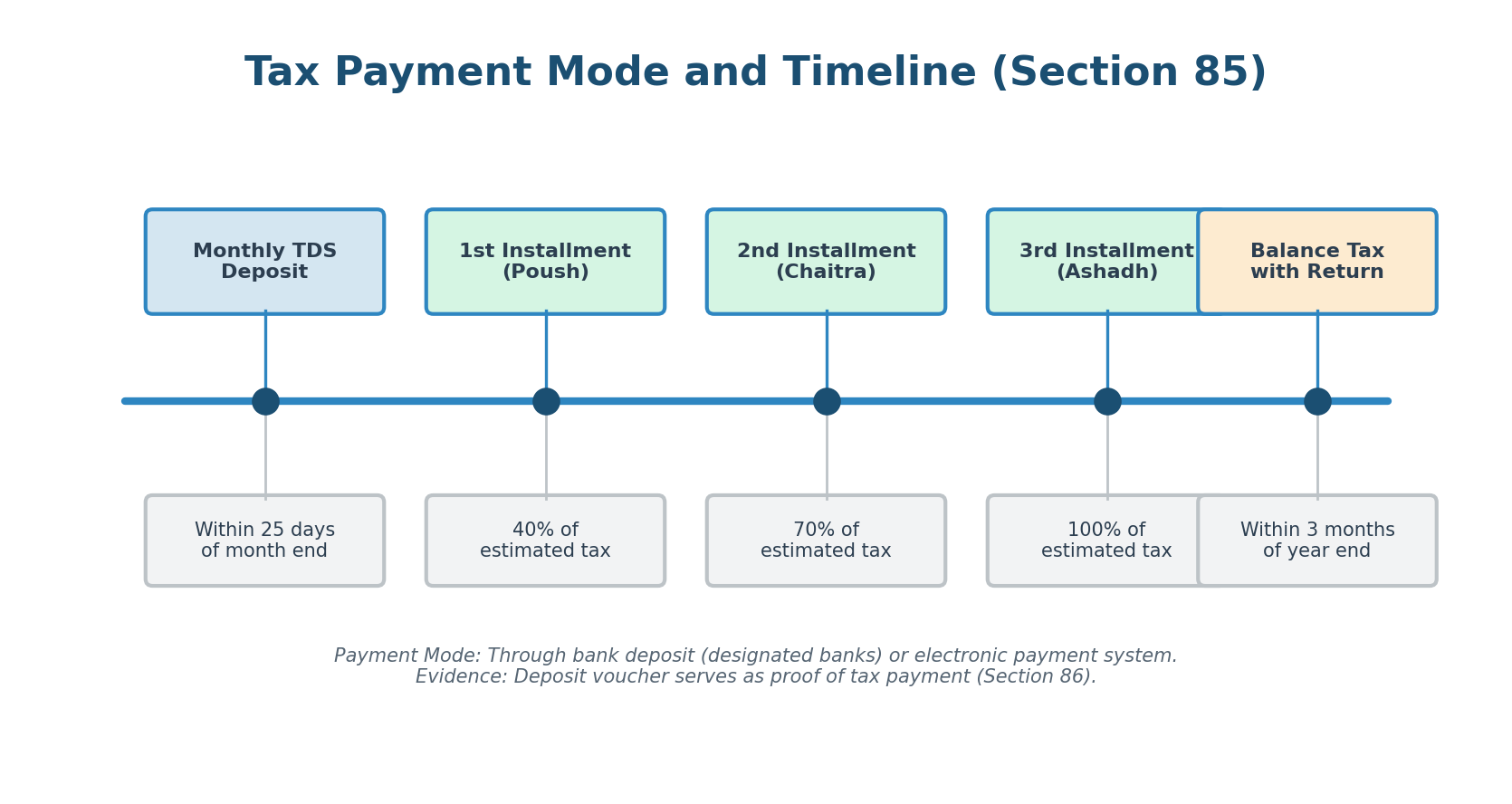
Figure: Tax Payment Mode and Timeline (Section 85)
(1) Tax required to be paid under this Act shall be paid in the place and mode as prescribed, and the Department may so prescribe that tax to be paid shall also be paid through electronic means.
Rule 29(1): A person must pay tax payable under the Act at the following places in the following manner:
(a) Where the Department has notified any person of the place for paying tax, at that same place;
(b) In other cases not covered by Clause (a), at a government-authorised bank or at the Department.
Rule 29(2): Where any person has paid tax at a government-authorised bank under Sub-rule (1), information thereof must be provided to the Department.
Rule 29(3): When paying tax under Sub-rule (1), payment may be made as follows:
(a) When making payment at the Department, by cash up to the limit prescribed by the Department, and by cheque or draft for amounts exceeding such limit; or
(b) When making payment at a government-authorised bank, by cash, cheque, draft, or electronic means.
Rule 29(4): If a cheque used to pay tax under Sub-rule (3) is dishonoured for any reason, the person who submitted such cheque must pay the Department an amount prescribed by the Department for all expenses incurred up to the payment date. When the Department prescribes such expense amount, it must include interest, fees, and fine amounts applicable on the tax up to the payment date.
Under the provisions of the Income Tax Act, the 'tax to be paid' includes the following amounts:
1. Amount to be paid per tax assessment under Section 99 by a person who has filed an income return under Section 96 of the Act: Among taxpayers required to file income returns under Section 96, if any taxpayer files an income return stating the total tax they owe for that year and the remaining tax balance to be paid for that year, such taxpayer must be deemed to have assessed their own tax for that year. The remaining tax to be paid by the person who filed the income return means the amount remaining after deducting from the total tax payable under the income return any instalment tax deposited for that year and any tax withheld when receiving payment from any other person. However, if any person does not file an income return for any income year, they must be deemed to have assessed their tax under Section 99 of the Act and to have paid the tax as per such assessment, and no tax balance is deemed outstanding for that year per their self-assessment.
2. Instalment Tax to be Paid by a Person Required to Pay Tax in Instalments: Under Section 94 of the Act, a person who earns income from business or investment in any income year must pay their estimated tax for that year in three instalments. Of the total estimated tax to be paid, 40 percent must be paid by the first instalment, 70 percent by the second instalment, and 100 percent by the third instalment. The instalment tax to be paid means the estimated tax for the instalment period minus any instalment tax already deposited for that income year in any earlier instalment before the current instalment deadline, and minus any tax withheld from payments included in computing that person's income for that year before the current instalment deadline. However, a taxpayer whose total amount for all 3 instalments is less than Rs. 7,500/- need not pay instalment tax.
3. Amount to be Paid per Revised or Deemed Tax Assessment Made by the Department or Office: Under Section 99 of the Act, the Department may revise the tax assessment made or deemed to have been made by a person within four years from the deadline for filing the income return. For taxpayers mentioned in Section 96(5) who fail to file an income return as per the Department's order, the office may conduct a deemed tax assessment. For a taxpayer who has been subjected to a revised or deemed tax assessment, an amount required to be paid as per the notice given under Section 102 of the Act is called the tax to be paid under this Act.
4. Tax Withheld from Payments or Amount Deemed to Have Been Withheld: A person or entity required to withhold tax on payments must deposit the withheld tax amount at the relevant office under Section 90. Where such amounts are paid without tax withholding by the payer or person or entity required to withhold tax, the tax is deemed to have been withheld at the time when it should have been withheld. The obligation to pay the unwithheld tax amount rests jointly with both the withholding agent and the person subject to tax withholding.
5. Amount of Advance Tax Collected or Deemed Collected: Under Section 95A of the Act, advance tax must be collected by the operator of a commodity market from persons who have earned profits and gains by trading in such market, by the entity that receives tax withholding on gains from disposal of securities of a resident entity, by the relevant Land Revenue Office that receives tax withholding on gains from disposal of house-land, house, or land, and by the relevant Customs Office on import of agricultural goods specified in the Act. Where advance tax has been collected but not deposited, the responsibility to deposit such amount rests with the person who collected it. The obligation to pay the uncollected advance tax amount rests jointly with both the person collecting and the person who should have received the tax.
6. Fees/Penalties Payable under the Act: These include:
(i) Fee under Section 117(1)(c) for not filing income return on time;
(ii) Fee under Section 117(1)(a) for not filing estimated tax return under Section 95;
(iii) Fee under Section 117(1)(b) for not filing the statement under Section 95A(9);
(iv) Fee under Section 117(3) for not filing the statement under Section 90(1);
(v) Fee under Section 117(2) for not maintaining documents required under Section 81;
(vi) Fees under Section 119A for violations related to electronic invoicing;
(vii) Fee under Section 120 for false or misleading statements;
(viii) Fee under Section 121 for encouraging tax offenses.
The fee amount to be paid as above is called the tax to be paid under this Act.
7. Interest Payable under the Act: If any person fails to pay the tax they owe within the prescribed time, interest accrues on such outstanding amount at the rate of 15 percent per year for the period between when the tax was required to be deposited and when it was actually deposited, as provided in Section 119 of the Act. Where instalment payment of arrear tax collection has been approved under Section 110A of the Act and payment is not made within the approved period, additional interest at the annual rate of 5 percent on the outstanding tax accrues under Section 119(4). Such interest is called the tax to be paid under this Act.
8. Claim and Auction Expenses: If the Department or office incurs any expense in seizing or conducting auction sale of any property of a person with tax arrears for the purpose of collecting outstanding tax, the office or Department may recover such expense from the person with tax arrears, and such amount is called the tax to be paid under this Act.
9. Fine Amount Payable under Section 129: If any person who has not paid tax, given false or misleading statements, obstructed tax administration, or failed to comply with the Act, or was an accomplice in such offenses, admits in writing to any of the offenses they have committed before the Department or office initiates court proceedings, the Department may order such person to deposit a fine amount not exceeding the total fine applicable for all offenses they admitted. The fine amount to be paid per such order is called the tax to be paid under this Act.
10. Amount to be Paid by Second or Third Parties per the Department's Order: A manager of an entity with tax arrears is responsible for paying the outstanding tax of that entity. Similarly, the Department may order a person required to pay any amount to a person with tax arrears, or an agent of a non-resident person with tax arrears, to pay the outstanding tax of the person with tax arrears up to that amount, and it becomes the duty of such person to pay the amount specified in the order. The amount that any such person mentioned above must pay under the Act or Department's order is called the tax to be paid under this Act.
(2) Tax required to be paid under this Act shall be paid at the following times, subject to sub-section (1):-
(a) In the case of one who has to withhold and pay advance tax, at the time mentioned in sub-section (4) of Section 90,
A person required to withhold and deposit tax on payments must deposit the tax amount within twenty-five days of the end of the month in which the tax is required to be withheld.
(b) In the case of one who has to pay tax in installments, at the time mentioned in sub-section (1) of Section 94,
A person required to pay in instalments must pay the first instalment of estimated tax by the end of Poush (mid-January), the second instalment by the end of Chaitra (mid-April), and the third and final instalment by the end of Ashadh (mid-July) of that income year.
(c) In the case of one who has to pay assessed tax,-
(1) On the date when the income return is to be submitted in respect of the tax assessment referred to in Section 99,
A person who self-assesses their tax must deposit the remaining unpaid tax balance after deducting the instalment tax and advance tax deposits from the total tax per the income return, along with the income return, i.e., within three months of the end of the income year.
(2) Within the time limit as specified in the tax assessment notice delivered pursuant to Section 102 in respect of tax assessed pursuant to sub-section (2) of Section 100,
Where the Department conducts a jeopardy tax assessment, the person subjected to jeopardy tax assessment must pay the outstanding tax within the deadline specified in the tax assessment notice sent under Section 102 of the Act.
(3) Within the time limit as specified in the tax assessment notice delivered pursuant to Section 102 in respect of the amended tax assessment made pursuant to Section 101,
Where the Department conducts an amended tax assessment, the person subjected to amended tax assessment must pay the outstanding tax within the deadline specified in the tax assessment notice sent under Section 102 of the Act.
(d) In respect of the amounts required to be paid to the Department as per any notice issued pursuant to sub-section (8) of Section 104, sub-section (1) of Section 109, or sub-section (1) of Section 110, on the date mentioned in the notice,
A person with tax arrears must pay the demanded amount by the date specified in the notice given under Section 104(8) of the Act regarding expenses incurred when the Department seizes or conducts auction sale of any property of that person to collect the outstanding tax. Persons required to pay amounts to persons with tax arrears under Section 109(1) and agents of non-resident persons with tax arrears under Section 110(1) must pay the required amount by the date specified in the notice issued by the Department.
(e) In respect of a liability fixed upon failure of any entity to pay tax pursuant to sub-section (2) of Section 107, at the same time when the entity is required to pay the tax,
Responsible authorised officers or managers of an entity who are responsible under Section 107(2) of the Act to pay the outstanding tax liability not paid by such entity must pay it at the same time the entity was required to pay it.
(f) In respect of the amounts required pursuant to sub-section (3) or (4) of Section 108, within seven days of the date on which the amounts are adjusted by auction sale or on which the amounts cannot be so adjusted, and
A receiver who, per the notice given by the Department under Section 108(2), sets aside an amount from the proceeds of the sale of any property of the person with tax arrears must deposit such amount within seven days of the date the receiver set aside such amount from the sale proceeds. Even if such person did not set aside any amount from the sale proceeds, the amount must be paid within seven days of the date by when it should have been set aside.
(g) In respect of the fees and interest assessed pursuant to Section 122, on the date as mentioned in the assessment notice.
Fees and interest assessed by the Department or office under Section 122 that are required to be paid must be paid within the deadline specified in the tax assessment notice sent under Section 102 of the Act or other notice.
(3) The date on which tax has to be paid shall not be affected in the following circumstances:-
(a) An action taken by the Department pursuant to Chapter-20 to recover tax, or
(b) Other action has been commenced pursuant to this Act.
Rule 30: In cases where any person is to pay due tax, interest and fee in various income years or of various sources but does not pay all amounts, the Department shall decide the matter of which income year or which source that amount is considered to belong to or is related with.
The tax to be paid under the Act and the time for payment are as summarised in the following table:
S.No. | Description of Tax or Amount | Time for Payment |
1. | Tax withheld from payments by a withholding agent, or the advance tax or the amount deemed withheld or collected even if not actually withheld or collected | Within twenty-five days of the end of the month in which tax withholding or advance tax collection is required. |
2(a) | Estimated instalment tax to be paid (first instalment / second instalment / third instalment) | By end of Poush / Chaitra / Ashadh of the income year in which instalment is due. |
2(b) | For taxpayers filing turnover-based income statement (first instalment / second instalment) | By end of Poush / Ashadh of the income year in which instalment is due. |
3. | Outstanding tax balance per income return filed under Section 96 and tax assessed under Section 99 | By the deadline for filing the income return, i.e., within three months of the end of the income year. |
4. | Tax payable per jeopardy tax assessment under Section 100(2) | Within the deadline specified in the tax assessment notice sent under Section 102 of the Act to the person subjected to jeopardy tax assessment. |
5. | Tax payable per amended tax assessment under Section 101 | Within the deadline specified in the tax assessment notice sent under Section 102 of the Act to the person subjected to amended tax assessment. |
6. | Expenses incurred when the Department seizes or conducts auction sale of property of a person with tax arrears | By the date specified in the notice given to the person with tax arrears under Section 104(8) of the Act. |
7. | Amount to be paid by a person required to pay amounts to a person with tax arrears under Section 109(1) and an agent of a non-resident person with tax arrears under Section 110(1) per the notice issued by the Department | By the date specified in the notice issued by the Department to those persons for payment. |
8. | Outstanding tax liability not paid by an entity for which one or more responsible authorised officers or managers of that entity under Section 107(2) of the Act are responsible to pay | At the same time the entity was required to pay it. |
9. | Amount set aside by a receiver from proceeds of sale of property of the person with tax arrears under Section 108(3) | Within seven days from the date the amount was set aside from the sale proceeds. |
10. | Where a receiver personally becomes responsible to pay the amount under Section 108(4) because no amount was set aside from the sale proceeds for tax | Within seven days from the date by when the amount should have been set aside from the sale proceeds. |
11. | Fees and interest assessed by the Department as per Section 122 | Within the deadline specified in the tax assessment notice or other notice sent under Section 102 of the Act to the person for whom fees and interest were assessed. |
12. | Fine amount to be paid per the order given by the Department under Section 119A | By the date specified in that order. |
Every type of amount falling within the definition of tax payable under the Act must be paid by the date and time prescribed by the Act. If any taxpayer pays the tax amount after the prescribed time, they must pay interest at the standard rate (15 percent per year) on the tax amount other than fees, interest, and fines paid late. Where any taxpayer fails to pay any amount due as tax on time, the Department may seize or conduct auction sale of any property of such taxpayer or recover from any amount the taxpayer is entitled to receive from any other person in order to collect the outstanding tax and interest accruing thereon.
86. Evidence of payable tax
The certificate signed by the officer of the Department, indicating the name, address of any person and the amount of tax required to be paid by that person, shall be an ample evidence for the amount of tax required to be paid by that person in the following actions:-
(a) Any action taken by the Department pursuant to Chapter-20 to recover tax, or
(b) Any action on any offence pursuant to Chapter-23.
Any certificate (notice or letter issued to that taxpayer or person) issued by an authorised official of the Department to a taxpayer or person, stating their name, address, and outstanding tax amount per the Department's records, constitutes the amount that such taxpayer or person must pay. An order issued under Section 90(8) or a notice issued under Sections 95(7) and 102 of the Act mentioning the outstanding tax payable by any taxpayer or person may be taken as evidence of the outstanding tax. If the taxpayer or person to whom such notice or letter was issued fails to pay the amount mentioned therein, the Department or office may initiate collection proceedings under Chapters 20 or 23 of the Act to recover such amount. To initiate such proceedings, the notice or letter issued by an authorised official of the Department to the taxpayer or person with tax arrears is considered sufficient evidence that such person or taxpayer has outstanding tax.
Chapter-17 Withholding on Payment
87. Withholding of tax by employer
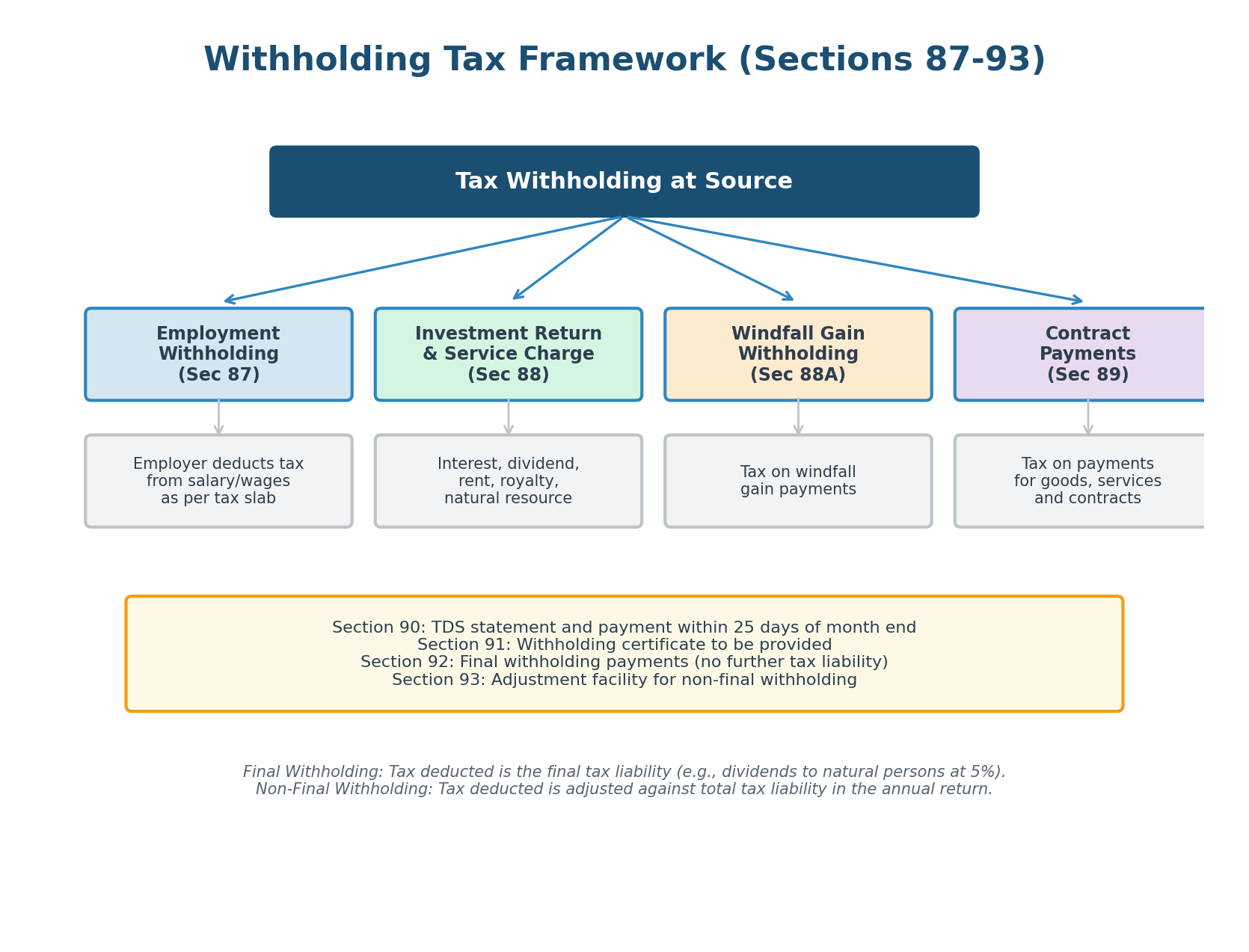
Figure: Withholding Tax Framework (Sections 87-93)
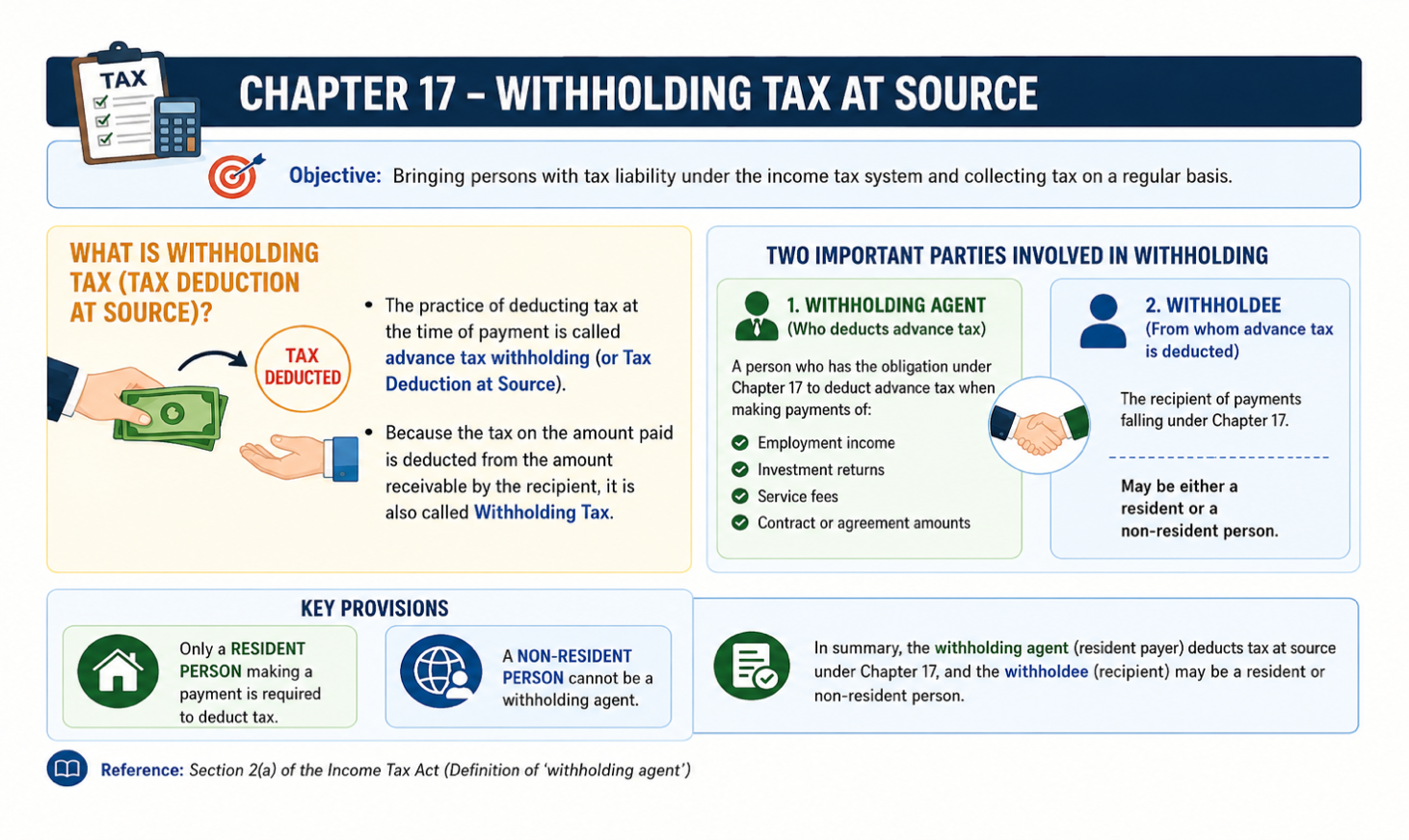
Example 16.2.1: Assume that the committee formed for burning old banknotes at Nepal Rastra Bank includes representatives from the District Treasury and the Comptroller of Financial Accounts Office. The committee provides a meeting allowance of Rs. 250 for attending each meeting. Accordingly, on the Rs. 250 meeting allowance payable to Mrs. Sunyana Swanr for attending the committee meeting, 15 percent advance tax of Rs. 37.50 must be deducted under Section 88 and the balance of Rs. 212.50 must be paid to her. Nepal Rastra Bank is the withholding agent in this transaction.
Example 16.2.2: In Example 16.2.1 above, Mrs. Sunyana Swanr, who receives Rs. 212.50 after advance tax deduction, is the withholdee.
(1) When making payment of any amount having source in Nepal that is to be included in computing the income derived by any employee or worker from employment, each resident employer shall withhold (deduct) tax at the rate referred to in Schedule-1.
Rule 31: Any employer shall, in withholding tax from employment pursuant to Sub-section (1) of Section 87 of the Act, carry out as follows:
(a) if an adjustment of tax for medical treatment is allowed pursuant to Section 51 of the Act, adjust such amount; and
(b) withhold tax on a monthly basis on pro rata of the tax payable on the annual remuneration of the employee or worker.
An employer must:
Step | Calculation / Adjustment | Reference |
1 | Estimate total annual remuneration receivable by the employee (salary, allowances, benefits, bonuses, etc.) before the first payment in the income year. Revise if circumstances change. | Section 8 |
2 | Less: Employer's contribution to an approved retirement fund eligible for deduction. | Section 63(2), Rule 21 |
3 | Less: Remote Area Allowance (if eligible). | Schedule 1, Sec. 1(5) |
4 | Less: 75% of Foreign Allowance received by Govt employees working at Nepali diplomatic missions abroad. | Schedule 1, Sec. 1(6) |
5 | Less: Disability Deduction (resident employee only). | Schedule 1, Sec. 1(10) |
6 | Less: Eligible Investment Insurance Premium. | Schedule 1, Sec. 1(12) |
7 | Less: Eligible Health Insurance Premium. | Schedule 1, Sec. 1(16) |
8 | Result = Assessable Employment Income | |
9A | For Resident Employees: Calculate annual tax using progressive rates under Schedule 1. | Schedule 1 |
9B | For Non-Resident Employees: Tax = Assessable Employment Income × 25% | Schedule 1 |
10 | Less: 10% Tax Concession for resident female employee whose income consists only of employment income. | Schedule 1, Sec. 1(11) |
11 | Less: Medical Tax Credit (if eligible). | Section 51 |
12 | Result = Net Annual Tax Liability | |
13 | Monthly Withholding Tax = Net Annual Tax Liability ÷ 12 (or actual employment months if less than 12 months). | Section 87 |
The following examples illustrate the calculation of employment income tax and the determination of monthly withholding amounts.
Example 17.11.1: Suppose Dipika is a single woman employed at Nepal Bikash Bank. She received annual salary and benefits of Rs. 12,50,000 from Nepal Bikash Bank in FY 2080/81.
Description | Amount | Amount |
Annual salary and benefits | 12,50,000 | |
Employment assessable income | 12,50,000 | |
Exempt amount | - | |
Taxable income | 12,50,000 | |
Tax calculation: | ||
On Rs. 10,00,000 at 1% (Single) | 10,000 | |
Additional Rs. 2,50,000 at 10% | 25,000 | |
Total | 35,000 | |
Less: 10% exemption for woman's employment income only | (3,500) | |
Total annual tax liability | 31,500 | |
Monthly tax to be deducted by Nepal Bikash Bank (31,500/12) | 2,625 |
Example 17.11.2: Suppose Hrekendra, a single person, joined Nepal Bikash Bank on Poush 1, 2080. He received 7 months' salary and benefits of Rs. 8,80,000 from Nepal Bikash Bank in FY 2080/81.
Description | Amount (Rs.) | Amount (Rs.) |
7 months' salary and benefits | 8,80,000 | |
Employment assessable income | 8,80,000 | |
Taxable income | 8,80,000 | |
On Rs. 8,80,000 at 1% (Single) | 8,800 | |
Total annual tax liability | 8,800 | |
Monthly tax from Poush 2080 to Ashadh 2081 (7 months) (8,800/7) | 1258 |
Additional Comprehensive Examples - Employment Income Calculation (Section 17.13)
Example 17.13.1: If salary and allowances of a Nepali citizen employee at a Nepali Embassy in France are paid by the Government of Nepal through the Nepali Embassy in France, such received income is deemed income with source in Nepal. Even though the place of payment and work is France, the source of income is deemed Nepal. However, if foreign allowance is received, up to 75% of the allowance can be claimed as deductible from taxable income as per Schedule 1, Section 1(6) of the Act.
Example 17.13.2: Suppose Gyanesh Pradhan, an employee at Bikash Bank Limited, retired on Baisakh 6, 2073. He obtained permanent residence visa for Australia on Shrawan 5, 2073 and has been residing there since. He receives a monthly pension of Rs. 40,000 in FY 2080/81. He paid a life insurance premium of Rs. 50,000 and donated Rs. 25,000 to a tax-exempt organization registered in Nepal. Since he is a non-resident person, the 25% flat rate applies. Life insurance premium cannot be deducted (must be a resident person). His tax liability must be calculated as follows:
Description | Amount (Rs.) |
Pension (Rs. 40,000 x 12) | 4,80,000 |
Dashain expense (Rs. 40,000 x 1) | 40,000 |
Assessable income | 5,20,000 |
Less: Deductions (non-resident: none applicable) | - |
Taxable income | 5,20,000 |
Tax at 25% flat rate | 1,30,000 |
Medical tax credit: not claimable (non-resident) | - |
Total tax liability | 1,30,000 |
Note: Even if a person retired from Nepal employment receives their retirement payment abroad, the source of employment remains in Nepal. If the payment recipient is a non-resident person, the exemptions available to resident persons will not apply and tax will be charged at a flat 25%.
Example 17.13.3: Suppose an employee at a company in Nepal went to Afghanistan to work from Shrawan 1, 2079 taking one year of special leave. The employee's monthly salary is USD 5,000. He entered Nepal on Bhadra 10, 2080 and rejoined the same company. Since he was not present in Nepal for more than 183 days in FY 2079/80, he is a non-resident. Since the work-related activity was done in Afghanistan (not Nepal) and payment was not from the Government of Nepal, the source of income is not Nepal. As a non-resident with no Nepal-source income, the assessable income is nil and such income is not taxable in Nepal for FY 2079/80.
Example 17.13.4 (Resident Person Having More than One Employment): Suppose a person named Bhaireja is working as a Chief Manager at a financial institution. In addition to that institution, he also teaches Accounting at a campus. He received the following income from employers in FY 2081/82:
Salary: Rs. 60,000 per month
Dashain expense: Rs. 60,000
Educational allowance: Rs. 5,000 per month
Dearness allowance: Rs. 5,000 per month
Bonus: Rs. 60,000
Salary from campus teaching: Rs. 10,000 per month
A car with driver was provided for office and personal use.
Monthly driver salary and allowances: Rs. 8,000
Average monthly petrol expense for the Chief Manager's car: Rs. 10,000, and repair expense of Rs. 25,000 was incurred for the car in FY 2081/82.
The office also provided accommodation.
The office provides telephone expense of Rs. 2,000 per month for telephone connected at his residence, of which 50% is personal telephone expense.
A security guard was provided to look after his residence and the guard was given Rs. 6,000 per month. Rs. 3,000 per month is deducted from his monthly salary for the guard.
He used a loan of Rs. 30,00,000 from the office at 5% interest throughout the year. The institution charges an average 8% interest on such loans to other borrowers.
He received one month's salary as annual leave in Mangsir 2081.
The office deducts 10% of drawn salary and adds an equal amount to deposit in the Employees Provident Fund, and he himself deposits Rs. 20,000 per month in the Citizens Investment Trust.
He donated Rs. 60,000 to a tax-exempt organization approved by the Department.
He took life insurance of Rs. 2,50,000 for himself and Rs. 1,50,000 for his wife at Nepal Insurance Company and paid premiums of Rs. 19,000 and Rs. 14,000 respectively in FY 2081/82.
He spent Rs. 20,000 on approved medical treatment at Tribhuvan University Teaching Hospital in that FY.
He chose to file as a couple for that FY.
His assessable income, taxable income must be calculated and income return filed as follows:
Description | Amount (Rs.) | Amount (Rs.) |
Salary | 7,20,000 | |
Dashain expense | 60,000 | |
Educational allowance | 60,000 | |
Dearness allowance | 60,000 | |
Bonus | 60,000 | |
Vehicle benefit (7,20,000 x 0.5) | 3,600 | |
Driver salary: not applicable | ||
Petrol expense: not applicable | ||
Repair expense: not applicable | ||
Accommodation benefit (7,20,000 x 0.5) | 14,400 | |
Telephone expense (2,000 x 12 x 50%) | 12,000 | |
Security guard benefit (6,000-3,000) x 12 | 36,000 | |
Loan benefit (8%-5%) x 30,00,000 | 90,000 | |
Annual leave salary | 60,000 | |
Retirement fund contribution | 72,000 | |
Total employment income from financial institution | 12,48,000 | |
Salary from campus teaching | 1,20,000 | |
Employment assessable income | 13,68,000 | |
Exempt amounts: | ||
Deductible retirement contribution | (3,84,000) | |
Actual contributions: | ||
Employer to Provident Fund | 72,000 | |
Employee to Provident Fund | 72,000 | |
Employee to Citizens Investment Trust (20,000 x 12) | 2,40,000 | |
Total retirement contribution | 3,84,000 | |
One-third of assessable income | 4,56,000 | |
Maximum limit | 5,00,000 | |
Adjusted taxable income (13,68,000 - 3,84,000) | 9,84,000 | |
Charitable contribution | (49,200) | |
5% of adjusted taxable income | 49,200 | |
Actual charitable contribution | 60,000 | |
Maximum limit | 1,00,000 | |
Taxable income | 9,34,800 | |
Life insurance premium deduction | (33,000) | |
Premium paid for self and wife | 33,000 | |
Maximum limit | 40,000 | |
Taxable income (for tax calculation) | 9,01,800 | |
Tax calculation: | ||
Rs. 9,01,800 (couple) at 1% - FY 2081/82 | 9,018 | |
Less: Medical expense credit | (1,500) | |
Total tax liability | 7,518 |
Bhaireja spent Rs. 20,000 on approved medical treatment, 15% of which amounts to Rs. 3,000, of which Rs. 1,500 can be claimed as tax credit this year and the remaining Rs. 1,500 can be claimed in the following year. Since he deducted his own retirement contributions and charitable contributions, and since he had two employers at the same time, he must file an income return.
Example 17.13.5/ Example 17.13.6 (Resident Person Having Business, Employment, and Investment Income): Suppose in Examples 17.13.4 and 17.13.5, Bhaireja sold listed company shares purchased on Mangsir 10, 2079 on Poush 15, 2081 and earned a profit of Rs. 2,50,000 from the sale. His assessable income, taxable income, and tax:
Description | Amount (Rs.) | Amount (Rs.) |
Business income | 2,00,000 | |
Employment income (per Example 17.13.4) | 13,68,000 | |
Investment income (non-business taxable asset disposal gain) | 2,50,000 | |
Assessable income | 18,18,000 | |
Deductible retirement contribution | (3,84,000) | |
Actual contributions (same as 17.13.4) | 3,84,000 | |
One-third of assessable income | 6,06,000 | |
Maximum limit | 5,00,000 | |
Adjusted taxable income (18,18,000 - 3,84,000) | 14,34,000 | |
Charitable contribution (5% of 14,34,000 = 71,700; actual 60,000; limit 1,00,000) | (60,000) | |
Taxable income | 13,74,000 | |
Life insurance premium (33,000; limit 40,000) | (33,000) | |
Taxable income for tax calculation | 13,41,000 | |
Tax on Rs. 10,00,000 at 1% | 10,000 | |
Tax on Rs. 91,000 at 10% (13,41,000 - 2,50,000 - 10,00,000) | 9,100 | |
Non-business taxable asset disposal gain Rs. 2,50,000 at 5% (held > 365 days) | 12,500 | |
Total tax | 31,600 | |
Less: Medical expense credit | (1,500) | |
Total tax liability | 30,100 | |
Notes: (1) Medical credit: Rs. 1,500 this year, Rs. 1,500 carries forward.
(2) Business losses cannot be offset against employment income but can be offset against investment income.
(3) Non-business taxable property disposal losses cannot be offset against business or employment income but can be carried forward indefinitely.
Example 17.13.7 (Resident Natural Person Contributing to the Social Security Fund with Additional CIT Contributions): Suppose a person named Laxmi Kumar Rijal is working as Chief Manager at a commercial bank. He received the following income from employers in FY 2080/81:
Salary: Rs. 2,00,000 per month
Dashain expense: Rs. 2,00,000
Educational allowance: Rs. 10,000 per month
Dearness allowance: Rs. 10,000 per month
Bonus: Rs. 2,00,000
A car with driver was provided for office and personal use.
Monthly driver salary and allowances: Rs. 20,000.
Average monthly petrol expense for the Chief Manager's car: Rs. 10,000, and repair expense of Rs. 40,000 was incurred in FY 2080/81.
The office also provided accommodation.
The office provides Rs. 6,000 per month for telephone connected at his residence, of which 50% is personal telephone expense.
A security guard was provided and paid Rs. 16,000 per month. Rs. 8,000 per month is deducted from his monthly salary for the guard.
He used a loan of Rs. 30,00,000 from the office at 5% interest throughout the year. The institution charges an average 8% interest on such loans to other borrowers.
He received one month's salary as annual leave in Mangsir 2080.
The office deducts 10% of drawn salary and adds an equal amount to deposit in the Contributory Social Security Fund, and he himself deposits Rs. 20,000 per month in the Citizens Investment Trust.
He took life insurance of Rs. 5,00,000 at Nepal Insurance Company and paid Rs. 30,000 premium in FY 2080/81.
He paid health insurance premium of Rs. 20,000 in that FY.
His assessable income, taxable income must be calculated and income return filed as follows:
Description | Amount (Rs.) | Amount (Rs.) |
Salary | 24,00,000 | |
Dashain expense | 2,00,000 | |
Educational allowance | 1,20,000 | |
Dearness allowance | 1,20,000 | |
Bonus | 2,00,000 | |
Vehicle benefit | 12,000 | |
Driver salary: not applicable | ||
Petrol expense: not applicable | ||
Repair expense: not applicable | ||
Accommodation benefit | 48,000 | |
Telephone expense (6,000 x 12 x 50%) | 36,000 | |
Security guard benefit (16,000-8,000) x 12 | 96,000 | |
Loan benefit (8%-5%) x 30,00,000 | 90,000 | |
Annual leave salary | 2,00,000 | |
Social Security Fund contribution | 2,40,000 | |
Employment assessable income | 37,62,000 | |
Exempt amounts: | ||
Social Security Fund contribution deductible | (5,00,000) | |
Actual contributions: | ||
Employer to Social Security Fund | 2,40,000 | |
Employee to Social Security Fund | 2,40,000 | |
Employee to Citizens Investment Trust | 2,40,000 | |
Total retirement contribution | 7,20,000 | |
One-third of assessable income | 12,54,000 | |
Maximum limit | 5,00,000 | |
Taxable income | 32,62,000 | |
Life insurance premium deduction | (30,000) | |
Premium paid for self | 30,000 | |
Maximum limit | 40,000 | |
Health insurance premium deduction | (20,000) | |
Premium for health insurance | 20,000 | |
Maximum limit | 20,000 | |
Taxable income (for tax calculation) | 32,12,000 | |
Tax calculation: | ||
Up to Rs. 10,00,000: no tax | ||
Next Rs. 5,00,000 at 10% | 50,000 | |
Next Rs. 10,00,000 at 20% | 2,00,000 | |
Next Rs. 7,12,000 at 27% | 1,92,240 | |
Total tax liability | 4,42,240 |
Note: Since Laxmi Kumar Rijal contributed to the Social Security Fund and to the Citizens Investment Trust, the maximum deductible retirement contribution is limited to Rs. 5,00,000 (or one-third of assessable income, whichever is lower), not a combination of both separately. Persons contributing to the SSF are not eligible for the 1% slab.
Example 17.13.8 (Resident Natural Person Contributing Only to the Social Security Fund): Same as Example 17.13.7 but without the additional CIT contributions. His assessable income, taxable income:
Description | Amount (Rs.) | Amount (Rs.) |
Employment assessable income (As calculated in 17.13.8) | 37,62,000 | |
SSF contribution deductible | (4,80,000) | |
Employer SSF contribution | 2,40,000 | |
Employee SSF contribution | 2,40,000 | |
Total contributions | 4,80,000 | |
One-third of assessable income | 12,54,000 | |
Maximum limit | 5,00,000 | |
Taxable income | 32,82,000 | |
Life insurance premium (30,000; limit 40,000) | (30,000) | |
Health insurance premium (20,000; limit 20,000) | (20,000) | |
Taxable income for tax calculation | 32,32,000 | |
Tax on Rs. 10,00,000: no tax (SSF contributor - no 1% slab) | 0 | |
Tax on next Rs. 5,00,000 at 10% | 50,000 | |
Tax on next Rs. 10,00,000 at 20% | 2,00,000 | |
Tax on next Rs. 7,32,000 at 27% | 1,97,640 | |
Total tax liability | 4,47,640 |
Example 16.2.4: Assume that Nepal Sewa Bank Ltd. has appointed a Chief Executive Officer with an annual gross salary of Rs. 40,00,000 on the condition that tax will not be deducted from the salary and the bank will pay the tax on his behalf. Even though the employment contract provides that tax cannot be deducted from his remuneration at source, the bank's obligation to withhold employment income tax on the CEO's employment income is not extinguished. The bank must gross up the salary treating the tax paid on the CEO's behalf as additional income calculate the total gross salary, and deduct and deposit Rs. 17,14,754 in tax as shown below:
Particulars | Amount (Rs.) |
Total employment income (gross salary) | 49,36,620 |
Up to Rs. 10,00,000 at 1% | 10000 |
Next Rs. 5,00,000 at 10% | 50000 |
Next Rs. 10,00,000 at 20% | 200000 |
Next Rs. 15,00,000 at 27% | 4,05,000 |
Balance Rs. 9,36,620 at 29% | 2,71,620 |
Total tax | 9,36,620 |
After-tax salary (net amount due to CEO) | 40,00,000 |
(2) The liability of an employer required to withhold tax pursuant to sub-section (1) shall not decrease or end by virtue of the following:-
(a) If the employer has the right or duty to deduct, hold up or subtract any other amount from the said payment, or
(b) If the income earned by the employee or worker from employment cannot be subtracted pursuant to other laws in force.
Example 16.2.3: Assume that an employee of Nepal Sewa Bank Ltd. receives a monthly salary of Rs. 50,000 in fiscal year 2080/81. The bank is required to deduct Rs. 6,000 in tax from the employee's monthly payment. In Ashadh 2081, the bank is required to deduct Rs. 48,000 from the salary in respect of an advance taken by the employee, leaving only Rs. 2,000 as net cash payment. Even though the bank may deduct Rs. 48,000 for the advance before paying salary, the bank cannot be exempted from its withholding obligation. The bank must first deduct Rs. 6,000 tax and deposit it at the relevant office, and then deduct the advance amount.
Where an employee has only one resident employer and only Nepal-source employment income with no additional claims, the tax withheld is the final tax. Such an employee need not file an income return. Employees with employment income must obtain a Personal Permanent Account Number (PAN), which must be included in the E-TDS return when depositing withheld tax.
Employer withholding (Sec 87, Rule 31): each RESIDENT employer must withhold tax from an employee's Nepal-source employment income at Schedule-1 rates, deposited by the 25th of the following month.
88. Withholding of tax in making payment for investment return and service charge
Section 88 of the Act provides the withholding provisions on investment returns and service fees. A resident person making a payment of Nepal-source interest, natural resource payments, rent, royalty, service fee, commission, sales bonus, retirement payment, or any other return must deduct tax at 15 percent of the total payment amount, subject to the specific rates specified in the provisos.
'Natural resource payment' means a payment for the right to extract water, minerals, or other living or non-living resources from the ground, or an amount computed on the basis of the quantity or value of natural resources extracted. 'Service fee' means any fee paid at market value to a person for services provided, including meeting allowances, management fees, and technical service fees. Examples of service fees include consultancy fees paid to a consultant for services rendered, and audit fees paid to an auditor for audit services. However, if an internal auditor is an employee of the payer, remuneration paid to such an auditor falls under employment income.
In the case of tax-exempt non-governmental organizations, international non-governmental organizations, or any mission, office, or other institution, when they make payments under a Local Subsidy, a Consulting Contract, or any other service-related contract for activities from which they do not receive any consideration, the following shall be followed:
(1) When payment is made as a grant (subsidy) to an organization that has submitted a tax exemption certificate, for carrying out programs in line with its objectives without expecting any consideration, tax deduction at source is not required. This means that:
The payment must be made by the payer to a tax-exempt organization.
The payer must not expect or receive any form of consideration (benefit/return) from the payment.
The nature of the payment must be that of a grant (subsidy).
The payment must be made specifically for carrying out activities aligned with the objectives of the tax-exempt organization.
Only when all these conditions are fulfilled, tax is not required to be deducted at the time of payment.
(2) Even if a tax exemption certificate is submitted, if any of the conditions mentioned in Clause (1) are not fulfilled at the time of payment, or if payment is made to an organization that has not submitted a tax exemption certificate, or to any other person, the following shall be done:
a reimbursement of expenses incurred by the payer and settled on the basis of original bills and vouchers submitted by the recipient is not subject to advance tax withholding (this is an expense of the payer, not income of the recipient);
however, when settling expense reimbursements, the payer must verify whether the counterparty has withheld tax on payments requiring withholding.
Example 16.2.7: Assume that the Department of Health Services, Government of Nepal, pays Rs. 40,000 to a private limited company for a public health awareness programme, and additionally pays Rs. 20,000 to cover airfare, hotel, and daily expenses of the company's employees. Since the travel costs incurred by the company's employees for the awareness programme are also part of the service fee, advance tax must be deducted on the total Rs. 60,000. The rate is 15 percent if the company is not VAT-registered, or 1.5 percent if VAT-registered. However, if instead of engaging the company's employees, the Department sends its own employees to conduct the programme and reimburses Rs. 20,000 to the company based on original bills and vouchers submitted by the Department's employees, no advance tax need be deducted on that reimbursement.
Example 16.2.8: Assume that for the services described in Example 16.2.7, the Department of Health Services gives a grant to a tax-exempt NGO for carrying out public health awareness work, on a bill-reimbursement basis. No advance tax is required to be deducted on such a payment under Section 88(4)(ga).
Example 16.2.9: Assume that a tax-exempt international NGO (INGO) enters into an agreement with a local Chamber of Commerce to establish a contact office at the Chamber premises for three years in order to support and coordinate the programme 'The Promotion of Local Product of the Region' in a particular district. (Assume the Chamber is registered as an NGO with local administration but has not registered as a tax-exempt organisation.) The agreed budget is as follows:
Particulars | Amount (Rs.) |
Programme coordinator (max Rs. 14,000/month, with bill to INGO) - 3 years | 5,04,000 |
Office manager (max Rs. 14,000/month, with bill to INGO) - 3 years | 5,04,000 |
Driver (max Rs. 8,000/month, with bill to INGO) - 3 years | 2,88,000 |
Office rent (2 rooms at Rs. 10,000/month, with bill to INGO) - 3 years | 3,60,000 |
Electricity and water (Rs. 1,500/month, with bill) - 3 years | 54,000 |
Office cleaning (Rs. 1,500/month, with bill) - 3 years | 54,000 |
Telephone charges (max Rs. 3,000/month, with bill) - 3 years | 1,08,000 |
Internet charges (max Rs. 1,500/month, with bill) - 3 years | 54,000 |
Tea, coffee, water (Rs. 2,700/month, with bill) - 3 years | 97,200 |
Miscellaneous (max Rs. 5,000, per INGO rules, with bill) - 3 years | 1,80,000 |
Office overhead (no bill required) - 3 years | 2,54,100 |
Total expenditure | 24,57,300 |
Chamber's in-kind contribution | 4,50,000 |
The INGO's payment obligations are as follows: For bill-based reimbursements made to the Chamber (which is not registered as a tax-exempt entity), no advance tax need be deducted on the reimbursement amounts. However, when settling accounts, the INGO must verify whether the Chamber has withheld and deposited tax on any payments it makes that are subject to withholding. For the office overhead (Rs. 2,54,100) which requires no bill, this amount is income of the Chamber (not a reimbursable expense), so the INGO must deduct advance tax when paying the Chamber, which is not registered as a tax-exempt entity.
Example 16.2.10: Assume that a tax-exempt NGO with a poverty alleviation objective receives a local subsidy from a tax-exempt INGO on a bill-reimbursement basis to conduct income-generating training, with no expectation of return (total budget Rs. 11,07,000 including office operating expenses Rs. 6,31,000 and programme expenses Rs. 4,76,000). Under this arrangement, since the INGO is paying the tax-exempt NGO to carry out activities consistent with the NGO's objectives on a bill-reimbursement basis, no advance tax need be deducted. However, when the NGO spends these funds, it must deduct tax on any payments that require withholding under the Act.
Example 16.2.11: Assume that Gaun Sewa Pariwar (an NGO) engages Harish Mathema, a Kathmandu-based consultant, for training in Nepalgunj, authorising the following expenditure (payable after submission of bills and vouchers, except for daily remuneration and allowance):
Particulars | Amount (Rs.) |
Daily remuneration (Rs. 5,000/day x 2 days) | 10,000 |
Kathmandu-Nepalgunj airfare | 9,000 |
Local travel expenses | 1,000 |
Daily allowance (TADA) | 2,000 |
Meals (max Rs. 500/day) | 1,000 |
Stationery (max Rs. 50/person) | 2,000 |
Participants' lunch (max Rs. 300/person) | 30,000 |
Hall rental | 5,000 |
Total | 60,000 |
Section 89 (contract/agreement) does not apply here as the arrangement is not for supply of goods, labour, or construction of tangible assets. Under Section 88, the amounts received by Harish Mathema as the consultant are: consultancy fee Rs. 10,000 + airfare Rs. 9,000 + local travel Rs. 1,000 + daily allowance Rs. 2,000 + meals Rs. 1,000 = Rs. 23,000. Advance tax at 15 percent = Rs. 3,450 must be deducted on Rs. 23,000. The stationery (Rs. 2,000), participants' lunch (Rs. 30,000), and hall rental (Rs. 5,000) are expenses of the NGO (not income of the consultant) incurred by the consultant on the NGO's behalf with bill-submission authority, so no advance tax need be deducted on these amounts. However, advance tax must be deducted on hall rental (as it is a withholding-applicable payment) and the hall rental provider must be required to deposit it.
Example 16.2.12: Assume that in Example 16.2.11 above, the same training work is contracted to Harish Mathema for a lump sum of Rs. 60,000 without requiring bill submission. In this case, advance tax must be deducted on the entire Rs. 60,000.
(1) When a resident person makes payment for interest, natural resource, rent, royalty, service charge, commission, sales bonus, retirement payment and any other consideration having source in Nepal, and in making payment of the amount, that person shall withhold tax at the rate of fifteen percent of the total amount of payment.
Provided that tax shall be withheld in the following payments at the following rate:-
(1) In the case of retirement payment from the Government of Nepal or contribution-based retirement payment from an approved retirement fund, at the rate of five percent on the benefit computed under clause (b) of sub-section (1) of Section 65,
'Retirement payment' for advance withholding purposes is classified as follows:
Contribution based retirement payments from the Government of Nepal or from an approved retirement fund | 5 percent on the gain computed under Section 65(1)(b) |
Retirement payments from an unapproved retirement fund | 5 percent on the gain |
Retirement payments from non contributory funds | 15 percent on the full payment |
Other retirement payments (gratuity, leave encashment, medical expenses) | 15 percent on the full payment |
Example 16.2.13: See Example 12.4.6 in Section 65
Example 16.2.14: See Example 12.4.7 in Section 65
Example 16.2.19: Assume that Hari Prasad Kafle retires from Vikashansil Bank on 1 Shrawan 2080 (joined in 2044). The bank pays him a monthly pension of Rs. 70,000 for life. He and his wife have elected couple status for FY 2080/81 and his wife has no income. His monthly tax computation is:
Particulars | Amount (Rs.) |
Annual pension income (Rs. 70,000 x 13 months) | 9,10,000 |
Less: pension income exemption (25% of Rs. 10,00,000 - first slab) | (2,50,000) |
Taxable income | 6,60,000 |
No 1% tax on amount upto 10 lakh for pension income |
Example 16.2.20: Assume the same facts as Example 16.2.19, except that his wife has Rs. 4,00,000 business income in this year. They have elected couple status for FY 2080/81. The overall tax and the pension payer's monthly withholding are computed as follows:
Overall Tax Computation (couple filing) | Amount (Rs.) |
Annual pension income | 9,10,000 |
Business income | 4,00,000 |
Total income | 13,10,000 |
Less: pension exemption (25% of Rs. 10,00,000) [1% rate not applicable] | (2,50,000) |
Taxable income | 10,60,000 |
First Rs. 10,00,000: couple exemption (no tax) | - |
Next Rs. 60,000 at 10% | 6,000 |
Total tax payable | 6,000 |
Note: The pension payer withholds tax based only on pension income, as the payer is unaware of the business income. The employee must file a return to account for total income and pay any additional tax.
(2) In a commission paid by the resident employment company to a non-resident person, at the rate of five percent,
This covers commissions paid by a resident manpower agency to its foreign-based local agent.
Example 16.2.21: Assume that Everest Manpower Company (Nepal) Pvt. Ltd. pays commission to the non-resident Everest International Manpower Incorporation, Doha, of US$100 per worker for supplying Nepali workers to Qatar. On the commission of Rs. 13,400 (assuming US$1 = Rs. 134), advance tax at 5 percent = Rs. 670 is deducted and only the balance of Rs. 12,730 is remitted. When applying exchange rates for tax deposit purposes, the NRB's selling rate for foreign currency on that date must be used.
(3) In payment of amount for lease of aircraft, at the rate of ten percent,
Example 16.2.22: Assume that Everest Airlines Corporation has leased an aircraft from a French company at US$3,000 per flight hour. In one month, the corporation operated the aircraft for 300 hours. The total lease rent is US$900,000 (300 hours x US$3,000). The corporation must deduct 10 percent advance tax of US$90,000 and remit the balance to the French company. The NRB selling rate on that date is used to determine the amount to be deposited at the relevant office.
Note: Under a financial lease arrangement, the interest component calculated under Section 32 is subject to 15 percent withholding under this section.
(4) In service charge paid to a service provider resident person registered in value added tax, or to a resident entity carrying on transactions exempt from value added tax, at the rate of one and half percent of the payment amount,
Service fees paid to VAT-registered resident service providers are subject to 1.5 percent advance tax. Service fees paid to resident entities carrying on VAT-exempt transactions are also subject to 1.5 percent.
Example 16.2.23: Rocy & Co. is a VAT-registered accounting firm. It issues an invoice of Rs. 2,26,000 (service fee Rs. 2,00,000 + VAT Rs. 26,000) to Jacky & Sons Pvt. Ltd. for consulting services. When Jacky & Sons pays, it must deduct 1.5 percent on the service fee of Rs. 2,00,000 = Rs. 3,000 advance tax and pay the balance of Rs. 2,23,000 to Rocy & Co. Rocy & Co. may claim the Rs. 3,000 withheld as advance tax credit against its total tax liability.
Example 16.2.24: D.B. Cold Store Pvt. Ltd. provides cold storage services for agricultural produce. Since cold storage for agricultural produce falls under Schedule 1 of the VAT Act (VAT-exempt), D.B. Cold Store is not VAT-registered. Prasad Fruit Processing Industry stores its fruit inventory at D.B. Cold Store and is required to pay Rs. 30,000 service fee in Asoj 2081. Prasad must deduct 1.5 percent withholding tax on the service fee payment to D.B. Cold Store.
Example 16.2.25: Assume that Khappa Cement Industry Pvt. Ltd. pays a sales commission to Ram Cement Sales Store Pvt. Ltd. for achieving a specified cement sales target. Even though Ram Cement Sales Store Pvt. Ltd. is VAT-registered, the standard 15 percent rate (not the 1.5 percent VAT-registered rate) applies under Section 88(1). This is because the amount is not a service fee for services rendered but is an incentive (sales bonus) for meeting the sales target.
(5) In rent payment made by a resident person having source in Nepal, at the rate of ten percent,
'Rent' under Section 2(af) means all payments including house rent and lease premiums for tangible property (movable or immovable). The term does not include natural resource payments or amounts received by natural persons (other than sole proprietorships) for house rent.
Example 16.2.26: Assume that Ramshri Pvt. Ltd. has agreed to pay Aadishri & Company a monthly rent of Rs. 50,000 for a building in Pokhara's New Road. Ramshri Pvt. Ltd. must deduct 10 percent advance tax = Rs. 5,000 and pay the balance of Rs. 45,000 to Aadishri & Company.
Example 16.2.27: Assume that Aadishri & Company rents furniture for one month at Rs. 25,000. On payment of Rs. 25,000 for furniture rental, 10 percent advance tax = Rs. 2,500 must be deducted and the balance Rs. 22,500 paid.
Provided that
In an amount paid to a person registered in value added tax and operating a business of providing vehicles on rent, for rent of such vehicles, one and half percent shall be withheld from such amount,
Example 16.2.28: Assume that Aadishri & Company rents a vehicle from Daman Vehicle Services Pvt. Ltd. (a VAT-registered entity) for business purposes. In Asoj 2076, the company issues an invoice of Rs. 50,000 (vehicle rental Rs. 30,000 + driver and other services Rs. 20,000 + VAT). When Aadishri pays the total amount of Rs. 50,000 (excluding VAT), it must deduct 1.5 percent = Rs. 750 advance tax and remit the balance.
Example 16.2.29: Assume that Aadishri & Company rents a vehicle owned by Daman Thapa (registered for rent) at Rs. 25,000. Advance tax at 10 percent = Rs. 2,500 must be deducted and the balance Rs. 22,500 paid to Daman Thapa.
No tax shall be withheld on an amount received by an natural person for house rent,
Example 16.2.30: Assume that Aadishri & Company has agreed to pay landlord Mr. Garibdas a monthly house rent of Rs. 50,000 for operating a business in Pokhara's New Road. When paying rent to Garibdas (an natural person), the company is not required to deduct advance tax.
Please Refer my analysis of Court Cases on Payment of Rent TDS to ward or Tax office Link
Summary- Payment of House Rent to Natural Person – TDS at ward &
Payment of House Rent to Entity – TDS at Inland Revenue Office
(6) In an amount paid as consideration distributed to an natural person by a mutual fund, at the rate of five percent,
Example 16.2.31: Golden Mutual Fund distributed a 10 percent return to its beneficiaries on 6 Poush 2076. On the portion of this return distributed to natural persons, 5 percent advance tax must be deducted. For other persons, 15 percent advance tax applies.
(7) In a payment for use of satellite, bandwidth, optical fiber, tools related to telecommunications or electricity transmission line by a resident person, at the rate of ten percent,
(8) In a payment for carriage service or in payment for renting a carrier vehicle, at the rate of two and half percent,
Provided that in an amount paid to a person registered in value added tax and operating a business of providing carriage service or renting carrier vehicles, one and half percent shall be withheld from such payment.
(9) In payment of interest for a loan received in foreign currency from a foreign bank or other financial institution by a resident bank and financial institution for investment in the sectors as specified by the Nepal Rastra Bank, at the rate of five percent,
Example 16.2.32: Assume that City Commerce and Development Bank Ltd. has taken a 5-year loan of US$1 crore at 5 percent per annum from Nippon Bank of Japan for investment in NRB-prescribed sectors. When paying interest on this loan to Nippon Bank, City Commerce and Development Bank must deduct advance tax at 5 percent on the interest payment.
(9a) In payment of interest by a hydropower project having a capacity above two hundred megawatts with reservoir and semi-reservoir for which financial closure is completed by Chaitra of 2082 (mid-April 2026), on a loan received in foreign currency from a foreign bank or other foreign financial institution, at the rate of five percent,
(10) Tax shall not be withheld on the incentives amount provided for payment made through payment card, e-money (wallet), mobile banking or similar electronic payment instruments under the prevailing law in the purchase of goods and services by a consumer,
Example 16.2.33: Assume that Aadishri & Company operates a department store. Hanumandas purchases goods of Rs. 50,000 plus Rs. 6,500 VAT using an electronic payment method. A 10 percent cash incentive of Rs. 650 is credited to his bank account. Aadishri & Company is not required to deduct withholding tax on this incentive of Rs. 650.
(11) In payment of registration charge, tuition charge and examination charge to a foreign school or university, at the rate of five percent of the paid amount,
(12) In payment of interest by a resident bank and financial institution to a life insurance company on deposits, at the rate of five percent, and
(13) In payment of royalty to a resident person for a literary work or composition, at the rate of one and half percent of the payment amount.
(2) A resident person shall, in making the following payments having source in Nepal, withhold tax at the following rate:-
(a) In a dividend payment, at the rate of five percent of the paid amount,
A company's or partnership firm's liability to pay dividends arises only after the general meeting or partners' meeting has approved the distribution. When paying dividends, whether to a resident or non-resident, 5 percent advance tax must be deducted. 'Dividend' includes both cash dividends and bonus share distributions. Under Section 53 of the Act, capitalisation of profit by an entity is treated as a distribution, and under Section 54, such distribution from a company is subject to dividend tax. Thus, bonus share distributions are also subject to dividend tax.
Example 16.2.34: Assume that the general meeting of Aadishri & Company Limited held on 28 Falgun 2081 resolves to distribute a cash dividend of Rs. 50,000 (10% of share capital) and bonus shares of Rs. 1,00,000 (20% of share capital) from the profit of FY 2080/81. The total distribution of Rs. 1,50,000 is treated as dividends. The date of the general meeting is the payment date. The company is obligated to deduct and deposit 5 percent advance tax of Rs. 7,500 on total dividends of Rs. 1,50,000.
Example 16.2.35: Assume that the partners' meeting of Aadishri & Partnership Firm held on 28 Falgun 2081 resolves to distribute Rs. 1,50,000 from FY 2080/81 profit among partners proportionate to their investment. The firm is obligated to deduct 5 percent advance tax of Rs. 7,500 on the dividend distribution of Rs. 1,50,000.
Example 16.2.36: Assume that Aadishri & Company Limited distributes watches worth Rs. 9,500 to its shareholders as dividend in lieu of cash dividend in FY 2080/81. Since this in-kind distribution to beneficiaries is treated as a dividend under Section 53, and since this is a post-withholding distribution (95% of gross), the gross dividend is Rs. 10,000 (= Rs. 9,500 / 95 x 100). The company is obligated to deposit 5 percent of Rs. 10,000 = Rs. 500.
(b) In a benefit payment of investment insurance, at the rate of five percent of the paid amount, or
'Gain' on investment insurance (life insurance or insurance with more than 5 years' risk cover) is the amount received less the total premium paid. This gain is subject to 5 percent advance tax when paid.
Example 16.2.37: Assume that Purnata has a life insurance policy with sum insured Rs. 8,00,000 at Nepal Life Insurance Corporation, paying an annual premium of Rs. 40,000. By the time the policy matures, she has paid total premiums of Rs. 6,00,000. The maturity value is Rs. 12,00,000. When paying this amount, the corporation computes gain as Rs. 6,00,000 (= Rs. 12,00,000 - Rs. 6,00,000) and deducts 5 percent advance tax of Rs. 30,000. The balance Rs. 11,70,000 is paid. Purnata need not include this amount in her other income.
Example 16.2.38: Assume that Sajag Sapkota has an accidental insurance policy from Nepal Life Insurance Corporation. In the third year of the policy, he meets with an accident and breaks his arm. The insurance company pays Rs. 50,000 as compensation. As of the payment date, he has paid Rs. 20,000 in premiums. Since such compensation is exempt from tax under Section 31 of the Act, no advance tax withholding is required under Section 88.
(c) In a benefit payment from an unapproved retirement fund, at the rate of five percent of the paid amount.
Where a payment is made from an unapproved retirement fund, the natural person (beneficiary) will have included contributions to such fund in employment income at the time of contribution and paid tax on them. When computing the gain on such a payment, the amount previously taxed (own contributions) is deducted from the retirement payment, and 5 percent tax is withheld on the balance (gain).
Example 16.2.15: Assume that Hari Prasad Kafle is an employee at Himalayan Industries. The industry annually contributed Rs. 1,00,000 to an unapproved retirement fund in his name for 7 years as a gratuity provision, and the contributions were included in his annual employment income. After retirement, the fund pays him Rs. 10,00,000. Computation: total gratuity received Rs. 10,00,000; less own contributions already taxed Rs. 7,00,000; gain Rs. 3,00,000; withholding tax at 5% on gain Rs. 15,000; net payment to employee Rs. 9,85,000.
Example 16.2.16: Assume that Hari Prasad Kafle is an employee at Vikashansil Bank. The bank has established a welfare fund to which the bank contributes annually (a non-contributory fund). Upon retirement, he receives Rs. 6,00,000 from this fund. The full Rs. 6,00,000 is subject to 15 percent withholding. Tax of Rs. 90,000 is withheld and the balance of Rs. 5,10,000 is paid.
Example 16.2.17: Assume that Hari Prasad Kafle retires from Vikashansil Bank (joined in 2059). The bank is required to pay him a lump sum gratuity of Rs. 6,00,000. Tax at 15 percent = Rs. 90,000 must be withheld and Rs. 5,10,000 paid.
Example 16.2.18: Assume that Hari Prasad Kafle retires from Vikashansil Bank (joined in 2059). The bank is required to pay him Rs. 50,000 for unused leave and Rs. 1,00,000 for unused medical entitlement. Tax at 15 percent must be withheld on each of these amounts before payment.
TDS on investment return & service charge (Sec 88): base rate = 15% on interest, natural-resource payment, rent, royalty, service charge, commission, sales bonus, retirement payment & other Nepal-source returns (88(1)).
Key special rates: GoN/approved-fund retirement-payment gain = 5%; manpower commission to a non-resident = 5%; aircraft lease = 10%; service charge to a VAT-registered / VAT-exempt resident = 1.5%; rent of Nepal property = 10% (BUT house rent to a natural person = NO TDS; VAT-registered vehicle-rental business = 1.5%); mutual-fund distribution to a natural person = 5% (others 15%); satellite/bandwidth/optical-fibre/telecom & transmission line = 10%; carriage/freight = 2.5% (1.5% if VAT-registered); interest on a foreign-currency loan from a foreign bank to a resident BFI for NRB-specified sectors = 5%; large reservoir hydropower (>200 MW) foreign-loan interest = 5%; foreign school/university registration, tuition & exam fees = 5%; bank interest to a life insurer on deposits = 5%; royalty to a resident for a literary work = 1.5%; consumer e-payment incentive = NO TDS.
88(2): dividend = 5% (incl. bonus shares); investment-insurance benefit gain = 5%; unapproved-fund benefit gain = 5%.
A sales bonus/incentive for meeting a target = 15% (not the 1.5% service rate)
(3) Notwithstanding anything contained in sub-section (1), a resident bank, financial institution, cooperative organization or any other entity issuing bonds, or a company enlisted under the prevailing law, shall, in making payment to any natural person of interest or of an amount in the form of interest as follows in consideration for deposits, bonds, debentures and government bonds, withhold tax at the rate of six percent of the total amount of payment:-
(a) Which has source in Nepal, and
(b) Which is not related with the operation of business.
Banks, financial institutions, cooperatives, debenture-issuing entities, and stock exchange-listed companies paying interest on deposits, debentures, or government bonds to any natural person must deduct 6 percent advance tax and pay the balance. For payments to entities other than natural persons, 15 percent advance tax applies.
Example 16.2.40: Assume that Himalayan Infotech Ltd. is a company listed on the Nepal Stock Exchange. The company has issued 10 percent debentures to raise capital. Dipika holds Rs. 5,00,000 of debentures; ABC & Co. holds Rs. 20,00,000. When paying interest: Dipika's interest Rs. 50,000 - deduct 6 percent = Rs. 3,000 and pay Rs. 47,000. This is a payment from which tax is withheld finally under Section 92(1)(e) and Dipika need not include it in income. ABC & Co.'s interest Rs. 2,00,000 - deduct 15 percent = Rs. 30,000 and pay Rs. 1,70,000. This is not a final withholding for ABC & Co.; Rs. 30,000 is advance tax that can be credited against total tax liability, and the full Rs. 2,00,000 is included in income.
(4) Notwithstanding anything contained in sub-sections (1), (2) and (3), this Section shall not apply to the following payments:-
(a) Any payment other than that related to the operation of business by an natural person,
Example 16.2.41: Assume that Gobind is constructing his own house and pays Rs. 20,000 per month to engineer Krishna Sharma for architectural design and construction supervision. No advance tax need be deducted on this payment. However, Krishna Sharma must include this consultancy fee in his own income.
(a1) Payment for a feature or article in a newspaper,
Example 16.2.42: Assume that Shyam is a professor. He receives Rs. 5,000 for an economics article published in a journal. The journal is not required to deduct advance tax on this payment. However, Shyam must include this amount in his income when filing his return.
(b) Interest paid to a resident bank or other resident financial institution,
Example 16.2.43: Assume that S & Company borrows Rs. 2,00,00,000 at 10 percent per annum as working capital from City Commerce and Development Bank Ltd. It pays Rs. 20,00,000 annual interest to the bank. No advance tax need be deducted on interest paid to a financial institution.
(b1) Interest paid by a cooperative bank and cooperative union or organization to each other for loan investment,
(c) Payment enjoying tax exemption or payment liable to tax withholding pursuant to Section 87,
Example 16.2.44: Assume that Poor & Support is a non-profit NGO that has obtained a tax exemption certificate from the tax office. It provides education to vulnerable rural populations using grants from donors with no expectation of return. Since grants received by this NGO are tax-exempt under Section 10(g), the donor need not deduct advance tax on the grant. However, on non-exempt amounts such as interest on deposits, advance tax must still be deducted by the payer.
(d) Inter-regional interchange charge paid to the bank issuing a credit card,
Example 16.2.45: Assume that National Bank Limited is a commercial bank operating a credit card scheme (e.g. Mastercard). The bank is required to transfer a portion of the fee charged for Mastercard usage to Mastercard International. No advance tax need be deducted on this service fee transferred to Mastercard International.
WHT exemptions (Sec 88(4)): no TDS on -
(a) inter-bank interest between resident banks/FIs;
(b) interest paid to a resident bank/FI;
(b1) interest between cooperatives on loan investment;
(c) a tax-exempt payment or a payment already subject to Sec 87 (employment) WHT;
(d) inter-regional interchange fee paid to a credit-card-issuing bank (e.g. to Mastercard International).
A tax-exempt organisation's exempt grants bear no WHT, but WHT still applies to its non-exempt income (e.g. deposit interest)
88A. Tax withholding in windfall gain
'Windfall gain' means a lottery, gift, prize, bonus, winnings, or any other gain received accidentally. Windfall gains include lottery winnings, gifts, prizes, bonuses, competition winnings, or any other amount received without certainty of receipt and without use of the recipient's labour or capital. Under Section 92(1)(i), the withholding on such windfall gains is a payment from which tax is withheld finally.
(1) Tax shall be withheld at the rate of twenty-five percent in making a payment for a windfall gain.
Example 16.2.47: Assume that Dipak Niraula wins Rs. 1,00,000 at Casino Nepal. Casino Nepal must deduct 25 percent advance tax of Rs. 25,000 and pay only Rs. 75,000. Under Section 92(1)(jha), this withholding is a payment from which tax is withheld finally.
Example 16.2.48: Assume that Dipak Kayastha purchases a lottery ticket during Dashain and wins Rs. 1,00,000. When paying the winnings, 25 percent tax of Rs. 25,000 must be deducted and only Rs. 75,000 paid. Under Section 92(1)(i), this is a payment from which tax is withheld finally.
Provided that the Government of Nepal may, by a notification in the Nepal Gazette, provide exemption from levying windfall gain tax on national and international awards for contribution made to literature, art, culture, sports, journalism, science, technology, agriculture and public administration.
(2) Notwithstanding anything contained in sub-section (1), no windfall gain tax shall be levied on a national and international award of up to five hundred thousand rupees for contribution made to literature, art, culture, sports, journalism, science, technology, agriculture and public administration.
Provided that if the award amount exceeds five hundred thousand rupees, windfall gain tax shall be levied on the amount exceeding that.
On national and international awards of up to Rs. 5,00,000 received for contributions in the fields of literature, art, culture, sports, journalism, science, technology, and public administration, no windfall gain tax is payable. If the prize amount exceeds Rs. 5,00,000, windfall gain tax is payable on the excess amount only.
Windfall gain TDS (Sec 88A): 25% final withholding (Sec 92(1)(i)) on any lottery, gift, prize, bonus or winnings received accidentally without the recipient's labour or capital.
Exception: national & international awards for contribution to literature, art, culture, sports, journalism, science, technology or public administration are exempt up to Rs. 5,00,000; only the excess over Rs. 5,00,000 is taxed
89. Tax withholding in making payment of deed or contract
(1) In making payment of a sum exceeding fifty thousand rupees for a deed or contract, a resident person shall withhold tax at the rate of one and half percent of the total amount of payment.
Example 16.2.49: Assume that ABC & Co. receives Rs. 51,000 from CBS International under a ration supply contract. Since the payment exceeds Rs. 50,000, tax must be deducted on the full payment amount. CBS International must deduct 1.5 percent = Rs. 765 and pay the balance Rs. 50,235 to ABC & Co.
(2) The amount referred to in sub-section (1) shall be fixed by also adding any other payments, if any, made by that person or the associated person of that person under the same contract to the person entitled to payment under that contract or the associated person of that person in the past ten days.
Example 16.2.50: Assume that Zenith Hotel Pvt. Ltd. has entered into an annual supply agreement with Haris Fresh House to purchase all the chicken needed by the hotel. Payments made: 2080/4/17 Rs. 5,000; 2080/4/15 Rs. 10,000; 2080/4/13 Rs. 5,000; 2080/4/12 Rs. 10,000; 2080/4/7 Rs. 25,000. All payments within the past 10 days total Rs. 55,000, which exceeds Rs. 50,000. Withholding at 1.5 percent on Rs. 55,000 = Rs. 825 must be deducted.
(3) Notwithstanding anything contained in sub-section (1), tax shall be withheld as follows from payment made by any resident person to any non-resident person under any contract:-
(a) For deed or contract, five percent,
(b) For a commission in payment of a premium to a non-resident insurance company or a premium amount received for reinsurance from a non-resident insurance company, one and half percent,
Example 16.2.51: Assume that Nepal Life Insurance Company Ltd. has entered into a reinsurance agreement with a Japanese life insurance company. In FY 2080/81, it pays Rs. 10,00,000 reinsurance premium to the Japanese company. Since the Japanese company is a non-resident insurance company, 1.5 percent = Rs. 15,000 must be deducted and the balance Rs. 9,85,000 paid.
(c) Where the Department has given that resident person a notice in writing, except as referred to in clause (a) or (b), at the rate specified in the notice.
(3a) [Omitted by the Finance Bill, 2083.]
Payments exceeding Rs. 50,00,000 made by the Government of Nepal, provincial governments, and local government bodies through consumer committees must have 1.5 percent withholding deducted.
(4) Notwithstanding anything contained in sub-section (1), this Section shall not apply to the following payments:-
(a) Any other payment to an natural person other than one operating a business, except rent paid for a land or house and fixtures and equipment installed therein having source in Nepal,
Example 16.2.52: Assume that Gobind has given a construction contract for his own house at Rs. 50 lakh to a construction company. He is not required to deduct advance tax on payments under this contract. However, the construction company must include the contract amount in its own income.
(b) Payments enjoying tax exemption or payments liable to tax withholding pursuant to Sections 87, 88 or 88A.
Example 16.2.53: Assume that Nepal Retirement Fund is an approved retirement fund. Its deposits are held at Shubha Bank Ltd. Since income of an approved retirement fund is tax-exempt, the bank need not deduct advance tax on interest paid to the fund.
Where a payment falls under both Section 87 or 88 and Section 89, the rate applicable under Section 87 or 88 prevails.
Explanation: For the purposes of this Section, "deed or contract" means a contract or agreement concluded for the supply of any goods or labor, or construction, installation or establishment of tangible property or structure, and such act as specified to be a deed or contract by the Department, and such contract or agreement also includes payment for the service related to construction, installation or establishment if such service is also covered by it.
Contract/deed TDS (Sec 89): a resident paying over Rs. 50,000 under a contract (supply of goods or labour, construction/installation of tangible property, and related services) withholds 1.5%. The Rs. 50,000 threshold AGGREGATES all payments to the payee (or associates) under the same contract within the past 10 days.
Non-resident contract payments (89(3)): 5% (contract/agreement); 1.5% (reinsurance premium/commission to a non-resident insurer); other = rate set by Department notice.
Consumer-committee work over Rs. 50 lakh = 1.5% (89(3a)).
EXEMPT (89(4)): payments to a non-business natural person (except Nepal-source rent), and payments already under Sec 87/88/88A. Where both Sec 88 and 89 could apply, the Sec 87/88 rate prevails
90. Statement and payment of tax withheld
(1) Each person who has to withhold tax shall submit to the Department a statement in such mode and format as specified by the Department within twenty-five days of the expiration of each month.
(2) The person withholding tax shall pay to the Department the amount of tax withheld or deemed to be withheld pursuant to sub-section (3), along with the statement referred to in sub-section (1), within the time-limit referred to in sub-section (1).
(3) Even though the person withholding advance tax has not withheld tax pursuant to Sections 87, 88, 88A. or 89, the tax shall be deemed to be withheld at the time when it has to be withheld.
(4) The person withholding advance tax shall pay to the Department the amount of tax withheld pursuant to Sections 87, 88, 88A. or 89 or the amount of tax deemed to have been withheld pursuant to sub-section (3); and if sub-section (5) is applicable, the person subject to advance tax withholding shall pay the tax within twenty-five days after the period referred to in sub-section (1).
(4a) Notwithstanding anything contained in sub-section (4), the person paying tax on the basis of transaction pursuant to sub-section (4a) of Section 4 of this Act shall pay the advance tax withheld under Chapter-17 at the time of payment of the installment tax.
(5) The person subject to withholding advance tax and the person withholding advance tax shall both be jointly and severally responsible to pay such tax amount to the Department in the following circumstances:-
(a) If the person withholding advance tax does not withhold tax from any payment pursuant to Sections 87, 88, 88A. or 89, and
(b) If the person withholding advance tax does not pay to the Department the amount of tax deemed to have been withheld pursuant to sub-section (3) within the date on which tax has to be paid pursuant to sub-section (4).
(6) If the person withholding advance tax withholds tax and pays it to the Department pursuant to Sections 87, 88, 88A. or 89, and the person subject to tax withholding makes any claim as to that payment subject to tax withholding, that amount shall be treated as if it were paid to the person subject to tax withholding.
(7) If the person withholding advance tax pays to the Department the amount of tax not withheld pursuant to Sections 87, 88, 88A. or 89, that person may recover the amount equal to the amount of tax so paid from the person subject to tax withholding.
(8) If the Department believes that any person has not submitted a return or paid tax required to be submitted or paid under sub-section (1) or (2), or that the circumstance referred to in sub-section (5) exists in respect of any person, it may issue an order to pay the amount not paid or the amount paid less, and the interest referred to in Section 119, as well as the charge referred to in Section 120 if advance tax has not been deducted from the payment subject to advance tax deduction.
Provided that prior to issuing such an order, a written notice shall be given to submit evidence in defence in respect of such order, within the time-limit of fifteen days, setting out an appropriate reason.
Withholding statement & payment (Sec 90): the agent files a monthly TDS statement and deposits the tax within 25 days of each month-end.
Tax is DEEMED withheld at the due time even if not actually withheld (90(3)).
The agent and the withholdee are JOINTLY and severally liable if the agent fails to withhold or deposit (90(5)).
Tax withheld and deposited is credited to the withholdee as if paid by them (90(6));
an agent who pays tax it did not withhold may recover it from the withholdee (90(7)).
The Department may order the shortfall plus Sec 119 interest and Sec 120 fees (90(8))
91. Tax withholding certificate
(1) The person withholding advance tax shall provide the tax withholding certificate, as follows, to the person subject to tax withholding at the time specified in sub-section (2):-
(a) Having been certified in accordance with the manner, if any, as prescribed by the Department,
(b) Setting out the amount of tax withheld pursuant to Sections 87, 88, 88A. or 89 and the paid amounts.
(2) The tax withholding certificate setting out the period of advance tax withholding shall be provided within twenty-five days from the date of expiration of the month in which advance tax is withheld.
(3) Notwithstanding anything contained in sub-section (1), if tax is withheld pursuant to Section 87, the tax withholding certificate shall be provided as follows:-
(a) The certificate shall be valid only for the period when the employee continues to serve in that income year.
(b) The certificate shall be provided within thirty days from the expiration of that year, or if the employee leaves employment with the person withholding advance tax in that year, within thirty days from the date of leaving employment.
92. Payment from which tax is withheld finally
(1) The following payments shall be treated as payments from which tax is withheld finally:-
(a) Dividend paid by a resident company or partnership firm,
(b) Rent paid for the land or building and fixtures and equipment appurtenant thereto having source in Nepal to an natural person other than one who is carrying on business,
(c) Profit paid by a resident person for investment insurance,
(d) Profit paid by a resident person for the interest of an unapproved retirement fund,
(e) The following interest paid by a bank, financial institution or other entity issuing bonds or a company enlisted under prevailing law or cooperative organization mentioned in sub-section (3) of Section 88:-
(1) Payment made to an natural person having source in Nepal and not related to operation of business,
(2) Payment made to an organization entitled to enjoy exemption pursuant to clause (s) of Section 2.
(f) Payment subject to tax withholding made to a non-resident person pursuant to Sections 87, 88, 88A or 89,
(g) All kinds of retirement payment, including that paid by the Government of Nepal or an approved retirement fund or unapproved retirement fund (except regularly paid pension),
(h) Meeting allowance of up to twenty thousand rupees per meeting, payment for teaching each time, payment for preparing question papers or checking answer sheets,
(i) Payment for a windfall gain,
(j) Amount of consideration distributed to natural persons from a mutual fund,
(Ja1) In the case of a resident natural person and a non-resident person who are not required to submit an income statement under Section 95A(2) and (5): gain, and payments in foreign currency as referred to in Sub-sections (6b), (6c) and (6d), and service payments as referred to in Sub-section (6e),
(Ja2) Service fees or commission paid by a resident natural person to an insurance agent,
(k) Payment for rent of a motor vehicle or carrier vehicle or carriage service of an natural person other than a private firm.
(2) If the person withholding advance tax or the person subject to tax withholding pays to the Department the amount of tax withheld from the payment from which tax is withheld finally pursuant to Sections 87, 88, 88A or 89 or the amount of tax deemed to have been withheld pursuant to sub-section (3) of Section 90, the person referred to in clause (c) of Section 3 shall be deemed to have fulfilled the tax liability.
93. Adjustment facility and inclusion of tax not to be withheld finally
(1) If any tax is withheld from any payment for the purposes of computing the amount of such payment, such tax-withheld amount shall be treated as a portion of that payment.
(2) If any tax is withheld from any payment except the payment from which tax is withheld finally, the person subject to tax withholding shall be deemed to have paid the amount of tax as follows:-
(a) The amount of tax withheld from payment pursuant to Sections 87, 88 or 89,
(b) If the person withholding advance tax or the person subject to tax withholding pays to the Department the amount referred to in sub-section (3) of Section 90 or the amount of tax deemed to have been withheld from payment, such amount.
(3) The person subject to tax withholding may make a claim for adjustment of the amount referred to in sub-section (2) only against the amount of tax payable in the income year in which that payment is made.
Creditable (non-final) WHT (Sec 93): for payments NOT subject to final withholding, the tax withheld under Sec 87/88/89 (or deemed withheld u/s 90(3)) is treated as tax PAID by the withholdee, who includes the gross payment in income and credits the WHT against that year's tax liability (93(2)).
The adjustment may be claimed only against tax payable in the income year in which the payment was made (93(3))
Chapter-18 Installment and Advance Tax
94. Payment of tax in installments
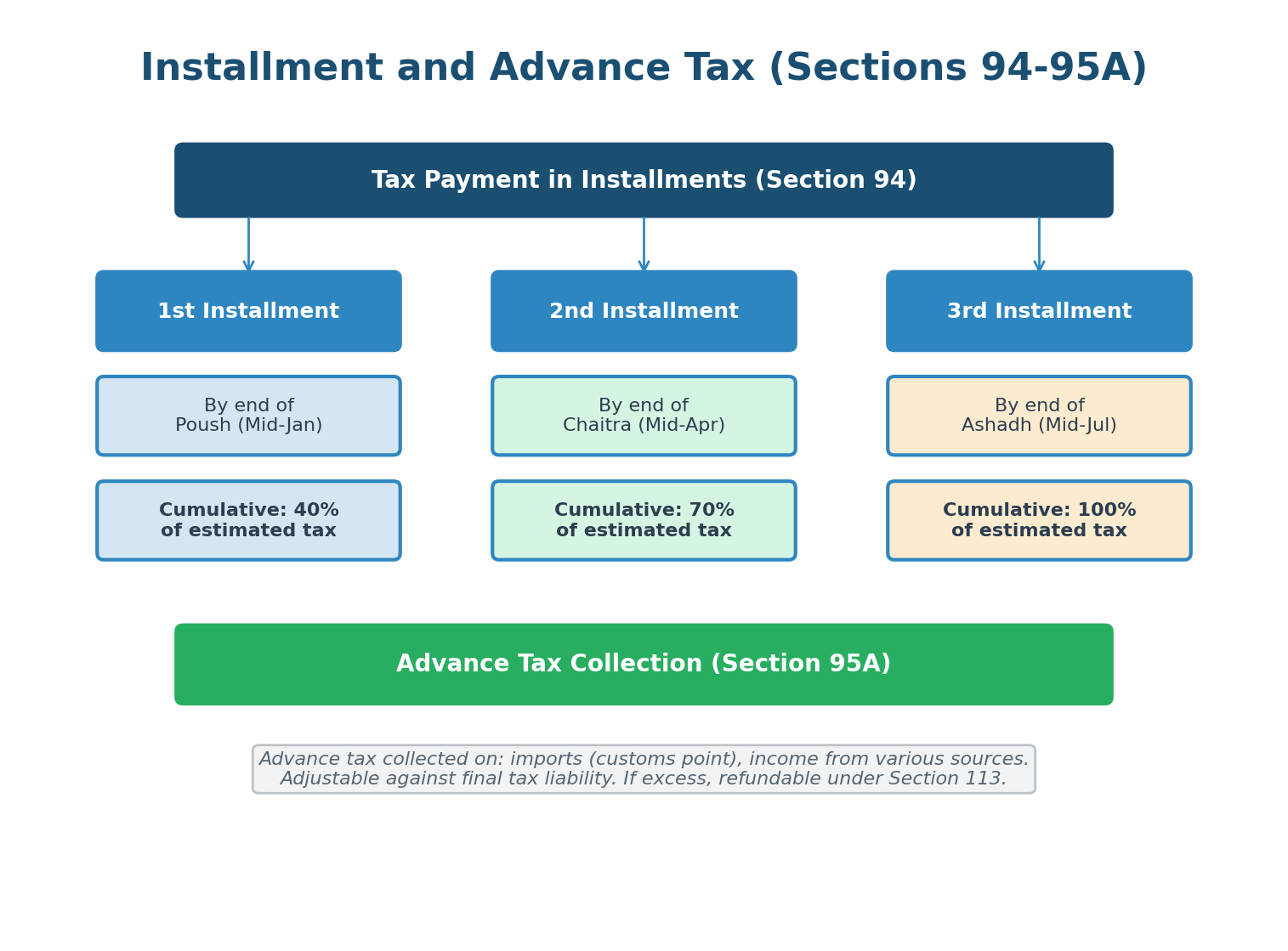
Figure: Installment and Advance Tax (Sections 94-95A)
(1) A person who has or will have assessable income from any business or investment in any income year shall pay tax in three installments as follows:-
Date on which payment is to be made | Amount to be paid |
By the end of Poush (mid-January) | Amount remaining from forty percent of the estimated tax, after deducting tax already paid |
By the end of Chaitra (mid-April) | Amount remaining from seventy percent of the estimated tax, after deducting tax already paid |
By the end of Ashad (mid-July) | Amount remaining from one hundred percent of the estimated tax, after deducting tax already paid |
Explanation: For the purposes of this sub-section,-
(a) "Estimated tax" means the estimated tax in installment computed by any person liable to pay tax in installments pursuant to Section 95 at the time when the installment tax is to be paid in any year.
(b) "Tax remaining to be paid" means the amount found to be insufficient upon subtracting the following aggregate sum from the amount as specified by the percentage for installment payment of the estimated tax in this sub-section:-
(1) The amount of tax deposited in that income year by a prior installment before the date on which the installment in question is to be paid,
Example 24.11.1: Suppose ABC Enterprises filed a return with the relevant office by the specified time that the amount required to be paid for the first installment of income year 2080/81 is 40 percent of the pre-estimated tax of Rs. 1 lakh, i.e., Rs. 40 thousand. For the second installment at end of Chaitra 2080, they must file the total 70 percent, i.e., Rs. 70 thousand, minus the Rs. 40 thousand already filed at end of Poush, leaving the balance of Rs. 30 thousand. Thus, in this example, the balance tax amount after deducting amounts already paid refers to Rs. 30 thousand.
(2) The amount of tax withheld from payments to be included in computing the income of any person in any income year pursuant to Chapter-17 before the date on which the installment in question is to be paid in that year,
Example 24.11.2: Suppose Bishal Enterprises Pvt. Ltd. rented the first floor of its building to a cooperative institution at Rs. 50 thousand per month. When the institution paid Bishal Enterprises Pvt. Ltd., it deducted Rs. 5 thousand advance tax at 10 percent and paid the balance of Rs. 45 thousand. Since such rental income is income to be included in that enterprise's income, when calculating the installment tax amount to be paid, only the balance installment tax amount after deducting source-withheld tax must be filed.
(3) If the person withholding advance tax or the person subject to tax withholding pays to the Department the amount of tax deemed to have been withheld from the payment referred to in clause (2) pursuant to sub-section (3) of Section 90 in that year, before the date on which the installment is to be paid, such amount of tax, and
Example 24.11.3: Suppose Rameshwar Panthi and Company is a legal consulting firm not registered for value added tax purposes. For legal advice provided to NB Ltd., they received Rs. 50 thousand payment on date 2080.6.27 without deducting advance tax. In this situation, even if advance tax was not deducted on the date of payment 2080.6.27, it is deemed to have been deducted. If that company filed Rs. 7,500/- (15 percent of the payment) as advance tax with the relevant office within 25 days of the end of the month in which payment was received, that company must deduct Rs. 7,500/- from the estimated tax amount to be paid at end of Poush and file the balance amount, i.e., the tax amount to be paid.
(4) The amount of tax adjustment for approved medical treatment expenses which that person may claim pursuant to Section 51 in respect of approved medical treatment expenses incurred by that person before the date on which the installment is to be paid.
Example 24.11.4: Suppose Adhikari and Co. is an auditing firm. The proprietor, Mr. Kamles, incurred Rs. 15 thousand for medical treatment up to date 2080.8.29. According to the estimated return for income year 2081/82, the installment he must pay at end of Poush is Rs. 40 thousand. If he deducts the medical tax credit amount of Rs. 1,500/- for medical expenses pursuant to Section 51 of the Act from that installment amount and files the balance Rs. 38,500/-, the obligation of paying the end-of-Poush installment tax is deemed fulfilled.
Rule 32: If the following evidence is submitted to the Department, the installment amount calculated pursuant to Section 94(1) of the Act may be reduced by the amount proven by such evidence:
(a) if advance tax has been withheld pursuant to Chapter 17, the tax withholding certificate issued pursuant to Section 91(1),
(b) if medical tax credit is claimed for medical treatment, the bill and receipt of approved medical treatment expenses incurred for medical treatment.
Example 24.11.5: Suppose a company has already paid Rs. 25,00,000/- out of the total estimated tax of Rs. 32,50,000/- to be paid in income year 2080/81 by the second installment. The third installment still remains to be paid. When that company calculates the third installment amount to be paid, or when filing the installment, it must pay only Rs. 7,50,000/- after deducting the tax amount already paid by the second installment of Rs. 25,00,000/- from the total estimated tax of Rs. 32,50,000/-. Even though the third installment amount is 30 percent of estimated tax, i.e., Rs. 9,75,000/-, since the company paid more than required by the second installment and one must not pay more than the total estimated tax as installments, that company need not pay more than Rs. 7,50,000/- for the third installment.
(1a) The person paying tax on the basis of transaction shall pay tax in two installments as follows:-
Date on which payment be made | Amount of tax to be paid |
By the end of Poush (mid-January) | Tax at the prescribed rate on the transaction up to the 20th of Poush |
By the end of Ashad (mid-July) | Tax amount to be set by subtracting the tax paid up to the end of Poush (mid-January) from the amount of tax calculated at the prescribed rate, after estimating the transaction to be carried out by the end of Ashad (mid-July) on the basis of actual transactions up to the 20th of Ashad |
(2) Notwithstanding anything contained in sub-section (1), if the total amount of installments to be paid pursuant to that sub-section is less than seven thousand five hundred rupees, the amount of such installment need not be paid.
Example 24.3.1: Suppose Ramhari Agarwal has a pan shop in Kathmandu. If the annual estimated tax amount required to be filed for transactions up to Poush 25, 2080 of income year 2080/81 is only Rs. 7,000/-, such person is not required to file installment tax amounts due by end of Poush 2080, end of Chaitra 2080, and end of Ashadh 2081.
(2a) Notwithstanding anything contained in this Section, the advance tax payable pursuant to Section 95A in respect of income from the disposal of non-business taxable assets shall not be required to be paid in installment form.
Example 24.3.3: Suppose Kamal Prasad Singh (single person) is an employee at Nepal Chemicals Pvt. Ltd. In income year 2081/82, he received Rs. 7,50,000/- salary from that company. In that year, he donated Rs. 10,000/- to a tax-exempt organization. In that year, that company deducted Rs. 70,000/- from his salary and deposited it in an approved retirement fund. Besides that, he made no contributions to any other approved retirement fund. That company paid Rs. 1,000/- for Medical Insurance and included it in his income in that year. In addition, he separately spent Rs. 2,000/- on medical treatment in that year. That company deducted and filed tax pursuant to Section 87 of the Act on the salary paid by it. In this situation, he must file an income return to claim a deduction for his charity donation and to claim Rs. 300/- (15 percent of Rs. 2,000/-) Medical Tax Credit on Rs. 2,000/- spent on medical treatment. If he did not claim a deduction for his charity donation and did not claim the additional Rs. 300/- Medical Tax Credit, he is not required to file tax installments and the return thereof.
(3) The person paying tax in installments shall be allowed to deduct the amount of tax paid in any income year by way of installments pursuant to this Section from the tax chargeable in that year.
Any person may set off the tax amount filed as installments pursuant to Section 94(1) of the Income Tax Act, 2058 and the advance tax withheld amount against the actual tax amount payable according to the income return for that income year.
Example 24.12.1: The company mentioned in Example 24.11.5 above has already paid Rs. 25,00,000/- out of the total estimated tax of Rs. 32,50,000/- to be paid in income year 2080/81 by the second installment. The third installment still remains to be paid. That company received interest due in income year 2077 Ashadh 20 and the payer withheld Rs. 1,50,000/- tax while paying that interest. When that company calculates or files the third installment, it must pay only Rs. 6,00,000/- after deducting from the total estimated tax of Rs. 32,50,000/- both the tax already paid by the second installment of Rs. 25,00,000/- and the tax withheld by the payer while paying interest of Rs. 1,50,000/-, totaling Rs. 26,50,000/-.
Installment tax (Sec 94): a person with business/investment income pays estimated tax in 3 INSTALMENTS - by end of Poush (mid-Jan) 40% cumulative, by end of Chaitra (mid-Apr) 70%, by end of Ashad (mid-Jul) 100% - each net of tax already paid (prior instalments + WHT credits + Sec 51 medical credit).
Turnover-basis taxpayers pay in 2 instalments (Poush & Ashad). No instalment is due if the total would be under Rs. 7,500 (94(2)). Advance tax on disposal of NBTA under Sec 95A is not paid in instalments (94(2a)).
Instalments paid are credited against the final tax for the year (94(3))
95. Return of estimated tax to be paid
(1) Each person who has to pay tax in installments in any income year shall submit to the Department a return, in such format and manner as may be prescribed by the Department, setting out estimates of the following amounts of that person for that year, within the date on which the first installment of tax is to be paid in that year pursuant to Section 94:-
(a) Assessable income that could be earned by that person from each source of employment, business and investment in that year, and the source of such income,
(b) Taxable income of that person that could be earned in that year and the amount of tax to be paid by the person referred to in clause (a) of Section 3, computed pursuant to Section 4 without subtracting the amount of tax adjustment for medical treatment expenses,
(c) In respect of a non-resident person's foreign permanent establishment situated in Nepal, the amount of income sent abroad by such foreign establishment in that year and the amount of tax to be paid by the person referred to in clause (b) of Section 3, computed pursuant to sub-section (5) of Section 4 in respect of that income, and
Income remitted abroad means that if any person working as a foreign permanent establishment of a non-resident person situated in Nepal earns any income that is deemed a Nepal source, after paying the tax due on such income pursuant to the Act, the remaining income sent to that non-resident person is the remitted amount. Since five percent tax applies to the income sent abroad by such person, the estimated tax for any income year of such person equals five percent of the estimated amount to be sent abroad by that person in that year.
Example 24.6.1: Suppose the branch office of American Life Insurance Company (ALICO) has received a license from the relevant authority of Nepal and is a foreign permanent establishment of a non-resident person situated in Nepal conducting business in Nepal. When that entity earns profit from investment insurance in Nepal and cannot distribute that amount itself, and sends that amount to its Parent Company, such amount is deemed to be income remitted abroad. Since five percent tax applies to the income sent abroad by such person, the estimated tax for any income year of such person equals five percent of the estimated amount to be sent abroad by that person in that year.
(d) Any other details as specified by the Department.
Rule 34: Any person required to file installments in any income year shall submit the estimated tax return pursuant to Section 95 of the Act to the Department in the form prescribed by Schedule-2.
Every person required to file installment tax must submit the estimated tax return to the relevant office by the end of Poush of the income year, i.e., by the deadline for filing the first tax installment. For the convenience of taxpayers, a provision has also been made to file such estimated tax return through electronic means. The person required to file the estimated tax return must state in the return the estimated taxable income from each income source for that year, the estimated taxable income for that year, the estimated tax on such income, and in relation to the foreign permanent establishment of a non-resident person situated in Nepal, the estimated income that such foreign establishment can remit abroad in that year and the estimated tax amount to be filed on such income. Although the deadline for filing the estimated tax return is specified as the end of Poush of the income year, for businesses registered up to Chaitra, such return must be submitted by Chaitra, and for businesses registered after that, by Ashadh.
(2) The sum total of the tax amounts mentioned in clauses (b) and (c) of sub-section (1) shall be the estimated tax payable by the person referred to in sub-section (1) in that income year.
The estimated tax required to be filed by any person required to file installment tax in any income year means the total of the estimated tax required to be filed on the estimated taxable income from any business or investment by that person in that year and the estimated tax required to be filed on the estimated income to be remitted or expected to be remitted abroad by any foreign permanent establishment of any non-resident person situated in Nepal.
Example 24.7.1: Suppose Sagarmatha Pvt. Ltd. produces and sells juice. In income year 2080/81, that company estimated earning Rs. 1 crore taxable income from its business. This company has invested Rs. 5 crores in debentures of a company in Nepal and earns Rs. 50 lakhs interest each year from that. In income year 2080/81, the total estimated tax required to be filed by this company is as follows:
Income Source | Estimated Taxable Income | Tax Rate | Estimated Tax |
Business | 1,00,00,000/- | 20 percent | 20,00,000/- |
Investment | 50,00,000/- | 25 percent | 12,50,000/- |
Total Estimated Tax | 32,50,000/- |
(3) In computing the foreign tax adjustment amount to be claimed pursuant to Section 71 in order to estimate the tax to be paid in any income year pursuant to clause (b) of sub-section (1), only the foreign tax paid by any person in that year or the foreign income tax estimated by that person as payable in that year shall be computed.
If any person required to file installment tax from any business or investment has taxable income in any income year and receives or is expected to receive any income subject to tax from a foreign source in that year, that income must also be estimated for the purpose of calculating the estimated tax for that year. Tax must be calculated on the estimated or expected foreign source income at the rate specified by Schedule-1 of the Act to arrive at the total estimated tax. However, if any tax has been paid or is to be paid abroad on the foreign source income included in the tax calculation, the paid or estimated to be paid tax amount may be deducted when calculating the estimated tax.
Example 24.8.1: In income year 2080/81 of Sagarmatha Pvt. Ltd. mentioned in Example 24.7.1, in addition to the income mentioned in that example, if Rs. 10 lakhs income is to be earned from investing Rs. 1 crore in debentures of a company in India and Rs. 1 lakh tax is to be paid in India on that income, the total estimated tax required to be filed by this company in income year 2080/81 is as follows:
Income Source | Estimated Taxable Income | Tax Rate | Estimated Tax |
Business | 1,00,00,000/- | 20 | 20,00,000/- |
Investment | 50,00,000/- | 25 | 12,50,000/- |
Foreign source investment income | 10,00,000/- | 25 | 2,50,000/- |
Total Estimated Tax | 35,00,000/- | ||
Deduct: | |||
Foreign tax payable on foreign source income | 1,00,000/- | ||
Total Estimated Tax to be Filed | 34,00,000/- |
(4) Unless any person paying installment of tax submits to the Department an amended estimate in the format referred to in sub-section (1) setting out the necessary information and the reasons for amendment, the estimate made by that person pursuant to that sub-section shall remain in force throughout the income year.
(5) Notwithstanding anything contained in sub-section (2), the amended estimate submitted by any person pursuant to sub-section (4) shall be applicable only in computing the installment of tax to be paid pursuant to Section 94 in that income year after the date of its submission to the Department.
If any person files a new estimated tax return, their previously filed estimated tax return is deemed cancelled or amended and the later return is treated as that person's estimated tax return. The new return must clearly mention the reasons for amending the previous return. However, any person's filed amended estimated tax return applies only to calculate the estimated installment tax required to be filed after they filed the amendment. According to this provision of the Act, a person who does not file an amended estimate must calculate the installments to be filed for that year based on the estimated tax return they filed.
(6) Notwithstanding anything contained in sub-sections (1) and (5), the Department may so specify that any person or class who has to pay installment of tax is not required to submit an estimate pursuant to sub-section (1).
Rule 33: For the purposes of Section 95(6) of the Act, the Department may specify the following persons as not required to file an estimated tax return pursuant to Section 95(1) of the Act:
(a) persons not required to file a return pursuant to Section 96 of the Act,
(b) persons covered by Section 4(3) of the Act, and
(c) persons mentioned in Section 4(4) of the Act.
Pursuant to the above, the following persons are not required to file their required tax amount in the form of installments:
(1) Persons including presumptive tax payers whose total tax to be paid in any income year is less than seven thousand five hundred rupees;
(2) Persons whose income received in any income year is only payments subject to final withholding tax;
(3) Persons with only employment income pursuant to Section 4(3) of the Act; and (4) Persons with only business income with turnover upto 30 lakh.
(7) Notwithstanding anything contained in sub-section (2), if any person who has to pay installment of tax does not submit an estimate in any income year pursuant to sub-section (1) or the Department is not satisfied with the submitted estimate or amended estimate, ...... the Department may do as follows:-
(a) The person referred to in clause (a) or (b) of Section 3 may make an estimate of the estimated tax to be paid by that person in that year on the basis of the tax required to be paid by that person in the last income year, and
(b) If the Department is not satisfied with the estimate prepared pursuant to clause (a), the Department shall give a written notice to the person who has to pay installment, setting out the method used in preparing the estimate and the reasons for not being satisfied with the estimate submitted by the person.
(8) If the Department gives a notice to the person who has to pay installment of tax pursuant to sub-section (7), the amount of estimated tax to be paid by that person in that year shall be the amount estimated by the Department.
If any person required to file an estimated tax return and file installment tax does not file the estimated taxable income and estimated tax for that year at the relevant office by the end of Poush of that year, the relevant office or tax officer may estimate the tax required to be filed by that person in that income year. Also, if the office is not satisfied with the estimated tax return or amended estimated tax return filed by any person, the office may amend the taxable income and estimated tax amount mentioned in the estimated tax return or amended estimated tax return filed by that person. When preparing such an estimate or amending the estimated tax return or amended estimated tax return filed by any person, the office may also take as a basis the tax filed or required to be filed by that person in the previous income year. Written information of such estimate prepared by the office or tax officer must be given to the relevant person. Such information must clearly state the basis on which the office prepared such estimate. When any person's tax estimate for any year has been prepared and written information thereof has been given to that person, the tax amount estimated by the office is the estimated tax amount that person must file in that year.
Estimated tax return (Sec 95, Rule 34): a person liable to pay tax in instalments must file an estimated-tax return (Schedule-2 form, e-filing available) by the FIRST instalment date (end of Poush) showing estimated assessable & taxable income per source, the estimated tax, and (for a non-resident's Nepal PE) income to be remitted abroad.
Estimated tax = tax on estimated taxable income + 5% on a PE's estimated remittance; foreign income is included and the estimated foreign tax credit (Sec 71) deducted.
Deadlines flex to Chaitra for businesses registered up to Chaitra, and Ashad for later registrations; a revised estimate may be filed if income changes
95A. Collection of advance tax
(1) The entity operating commodity future market service shall collect advance tax at the rate of ten percent on the profit and benefit earned by a person trading under the commodity future market from such business.
Example 24.15.1: Suppose Nepal Commodity Exchange Limited (NCEL) is a company operating Commodity Future Market services. More than 20 brokers are registered in this company, including Himal Broker Company P.Ltd. A person named Krishna Prasad made a purchase agreement for 1 kilogram of gold on date 2080.4.15 through this broker company. The international market price of 1 kg gold was Rs. 25 lakhs on that day. According to the agreement, the provision was for Krishna Prasad to sell on date 2080.6.15, i.e., 2 months later. Krishna Prasad deposited Rs. 2,50,000/- (10 percent of the market value of that gold on the agreement date) at NCEL through the broker on the agreement date. A service fee of Rs. 10,000/- was paid when making the purchase agreement. For that service fee, advance tax must be deducted at 1.5 percent pursuant to Section 88(1)(4) of the Act if registered for VAT, or at 15 percent pursuant to Section 88(1) of the Act if not registered for VAT. Suppose at the end of the agreement (date 2080.6.15), the market price of 1 kg gold was Rs. 27 lakhs. In this transaction, NCEL must collect Rs. 19 thousand advance tax (10 percent of Krishna Prasad's gain of Rs. 1 lakh 90 thousand [Rs. 27 lakhs - Rs. 25 lakhs - Rs. 10 thousand]) and file it with the relevant office.
(2) If any person other than a resident entity registered under the prevailing law carrying on transactions for the purchase and sale of securities derives benefit from the disposal of interest in any resident entity, advance tax shall be collected on such benefit computed pursuant to Section 37, as follows:-
(a) In the case of benefit derived from the disposal of interest in an entity enlisted in the Securities Board of Nepal, by the entity operating the securities exchange market, at the rate of seven and half percent of the profit amount for a resident natural person who has held the interest for more than three hundred sixty-five days, ten percent for a resident natural person who has held the interest for three hundred sixty-five days or less, ten percent of the profit for a resident entity, and twenty-five percent for others,
Example 24.15.2: Suppose resident natural person Anil has 500 ordinary shares of Standard Chartered Bank Nepal Ltd., listed on Nepal Stock Exchange Ltd., with a face value of Rs. 100/- each, purchased on date 2080.06.01. He requested a stock broker (share agent) to sell those shares. He purchased those shares at Rs. 1,000/- per share. Anil paid Rs. 4,000/- broker commission when purchasing the shares. The share agent sold those shares on date 2081.07.20 at Rs. 7,000/- per share. He paid Rs. 17,500/- as commission to the broker when selling the shares.
The gain calculation on that share sale is as follows:
Particulars | Amount |
Sale price: 500 x Rs. 7,000 | Rs. 35,00,000/- |
Cost: | |
Share value 500 x Rs. 1,000 | Rs. 5,00,000/- |
Add: Share agent commission on purchase | Rs. 4,000/- |
Add: Share agent commission on sale | Rs. 17,500/- |
Total cost | Rs. 5,21,500/- |
Gain on share sale | Rs. 29,78,500/- |
Nepal Stock Exchange Ltd. must collect Rs. 2,23,387.5/- advance tax (7.5 percent of gain from share sale) through the relevant broker and pay the balance Rs. 33,33,575/- to Anil as follows:
Particulars | Amount |
Sale price | Rs. 35,00,000/- |
Less: | |
Share agent commission on sale | Rs. 17,500/- |
Source tax amount to be withheld | Rs. 2,23,387.5/- |
Total payment | Rs. 32,59,112.5/- |
Similarly, if those shares were sold on date 2081.05.20, with ownership for less than 365 days, the gain must be calculated as follows and advance tax collected and balance paid:
Nepal Stock Exchange Ltd. must collect Rs. 2,97,850/- advance tax (10 percent of gain from share sale) through the relevant broker and pay the balance Rs. 31,84,650/- to Anil. However, if that share sale was made not by a resident natural person but by a resident entity, advance tax must be collected at 10 percent, and if made by a non-resident person, at 25 percent.
(b) In the case of benefit derived from the disposal of interest in an entity not enlisted in the Securities Board of Nepal, by the entity in which the interest has been disposed, at the rate of ten percent of the profit for a resident natural person, fifteen percent of the profit for a resident entity, and twenty-five percent for others.
Example 24.15.3: Suppose Nepal Bank Ltd. sold 2,00,000 units of shares in Purbanchal Rural Development Bank, which is not listed on Nepal Securities Board, to Shinas Company at Rs. 114/- per unit. The cost value of those shares was Rs. 100/-. In this situation, the entity conducting share registration must collect advance tax from Nepal Bank Limited as follows:
Particulars | Amount |
Sale price: 114 x 2,00,000/- | Rs. 2,28,00,000/- |
Less: Cost value 100 x 2,00,000 | Rs. 2,00,00,000/- |
Gain: | Rs. 28,00,000/- |
Advance tax must be collected at 15 percent on the gain amount of Rs. 28,00,000/- calculated pursuant to Section 37. The obligation to deduct tax on such gain belongs to Purbanchal Rural Development Bank. However, if those shares were sold by a resident natural person who is a shareholder of that entity, advance tax must be collected at 10 percent, and if sold by a non-resident person, at 25 percent.
(2a) In computing the benefit pursuant to clause (a) of sub-section (2), it shall be computed on the basis of the weighted average cost of the interest owned by that person in the entity of which the interest is to be disposed on that date.
Under this system, there is only one cost basis for any one person for any one company. If any person purchased shares of any one company at different prices, the weighted average cost for that company for that person is calculated by dividing total cost by total number of shares. The actual Weighted Average Cost is calculated on the basis of the investor's actual cost.
Example 24.15.4 (It is incorrect in the directive): Suppose the Weighted Average Cost in the following share purchase and sale situation of Yuva Prasad Subedi in ABC Company is calculated as follows:
S.N. | Particular | No. of Share | Cost per Share | Amount | Cost in Total | Balance Share | Weighted Cost per Share |
1 | IPO | 100 | 100 | 10000 | 10000 | 100 | 100 |
2 | Bonus | 50 | 100 | 5000 | 15000 | 150 | 100 |
3 | Secondary buy | 200 | 400 | 80000 | 95000 | 350 | 271 |
4 | Secondary sale | -50 | 271 | -13571 | 81429 | 300 | 271 |
5 | Secondary buy | 70 | 350 | 24500 | 105929 | 370 | 286 |
6 | Right share | 50 | 100 | 5000 | 110929 | 420 | 264 |
As mentioned above, when calculating the weighted average, capital gains tax is calculated on the basis of the actual cost of each investor.
(3) While recording the share in the Company Registrar's Office upon disposal of interest pursuant to clause (b) of sub-section (2), it shall record the same only after the submission of evidence of advance tax payment on the profit amount.
(4) ......
(5) The registering authority shall collect advance tax as follows at the time of registration on capital gain earned from the disposal of land or a private building by any natural person:-
(a) If the disposed non-business taxable asset (land and building) has been in ownership for five years or more, at the rate of seven and half percent,
(a1) In the case of a non-business taxable asset (land and building) compulsorily disposed of due to acquisition of land belonging to a natural person by the Government of Nepal, at the rate of two and one-half percent (2.5%),
Example 24.15.5: Suppose Ramesh Bagale purchased a house-land for Rs. 30 lakhs on date 2073.08.15. He sold that house-land on date 2080.07.04 for Rs. 52 lakhs. The capital gain on the house-land he sold is as follows:
Particulars | Amount |
Incoming (sale price) | Rs. 52,00,000/- |
Outgoing (expense) | Rs. 30,00,000/- |
Gain | Rs. 22,00,000/- |
Tax must be collected as advance tax by the land revenue office at 7.5% during registration when the buyer pays Ramesh Bagale. Such collected advance tax can be adjusted by Ramesh Bagale by filing an income return against his total tax liability.
Example 24.15.6: Suppose the house-land mentioned in Example 24.15.5 above was purchased by Ramesh Bagale on date 2070.04.15 (i.e., 10 years before the date of sale) and he has also been residing there continuously. Since such house-land is not considered a non-business taxable asset pursuant to Section 2(r) of the Act, advance tax (capital gains tax) need not be collected on the sale of such house-land.
Example 24.15.7: Suppose the house-land mentioned in Example 24.15.5 above was purchased by Ramesh Bagale on date 2074.04.15 and that house-land was sold on date 2080.04.20 for Rs. 9 lakhs. Since such house-land is not considered a non-business taxable asset pursuant to Section 2(r) of the Act, advance tax (capital gains tax) need not be collected on the sale of such house-land.
(b) If the disposed non-business taxable asset (land and building) has been in ownership for less than five years, at the rate of ten percent.
Example 24.15.8: Suppose Ramesh Bagale purchased a house-land for Rs. 40 lakhs on date 2076.04.15 (i.e., less than 5 years before the date of sale). He sold that house-land on date 2079.10.15 for Rs. 52 lakhs. The advance tax (capital gains tax) on that house-land he sold must be collected as follows:
Particulars | Amount |
Sale price | Rs. 52,00,000/- |
Expense | Rs. 40,00,000/- |
Gain | Rs. 12,00,000/- |
Tax of Rs. 1,20,000/- (10 percent of the calculated gain amount of Rs. 12,00,000/-) must be collected as advance tax by the land revenue office during registration when the buyer pays Ramesh Bagale. Such collected advance tax can be adjusted by Ramesh Bagale by filing an income return against his total tax liability.
(5A) Notwithstanding anything contained in Sub-section (5), where a natural person transfers, free of charge, land or a private building owned by him/her to the Government of Nepal, a Provincial Government, or a Local Level, no capital gain shall be deemed to arise from such disposal of the land or private building.
(6) If any land or building owned by any other person except as mentioned in sub-section (5) is disposed, the registering authority shall collect advance tax at the rate of one and half percent of the value of disposal at the time of registration.
(6a) A resident bank or financial institution providing the facility of foreign currency exchange to students going abroad for study, for language examination fees or standardised test fees, shall collect advance tax at the rate of fifteen percent of the amount of such examination fees at the time of providing such foreign currency exchange facility.
(6b) If a resident natural person not involved in the operation of a business receives payment in foreign currency for providing software or other similar electronic services outside Nepal, the concerned bank, financial institution or money transfer institution shall collect advance tax at the rate of five percent of the amount received at the time of making such payment.
(6c) If a resident natural person not involved in the operation of a business receives payment in foreign currency for personally providing consultancy services outside Nepal, the concerned bank, financial institution or money transfer institution shall collect advance tax at the rate of five percent of the amount received at the time of making such payment.
(6d) If a resident natural person not involved in the operation of a business receives payment in foreign currency for uploading audio-visual content on social networks, the concerned bank, financial institution or money transfer institution shall collect advance tax at the rate of five percent of the amount received at the time of making such payment.
(6e) A resident electronic commerce operator (e-commerce operator) shall collect advance tax at the rate of one percent at the time of making payment of the amount for the sale of goods, services or goods and services to a person providing goods, services or goods and services through its platform.
(6f) A resident ride-sharing service operator shall collect final tax at the rate of one percent (1%) on the amount paid for services to a natural person providing services through the operator’s platform.
(7) ......
(8) Even though the person or entity responsible for collecting advance tax pursuant to sub-sections (1), (2), (5), (6), (6a), (6b), (6c), (6d) and (6e) does not collect it, the tax shall be deemed to have been collected at the time required for such collection.
(9) The person responsible for collecting advance tax shall submit details to the Department in the mode and format prescribed by the Department within twenty-five days of the expiration of each month.
(10) The amount collected as advance tax or the amount deemed to have been collected pursuant to sub-section (8) shall be paid to the Department within the time-limit mentioned in sub-section (9), together with the details referred to in sub-section (9).
(11) The person required to deposit advance tax and the person responsible for collecting advance tax shall both be jointly and severally responsible for depositing such amount in the Department in the following circumstances:-
(a) If the person responsible for collecting advance tax does not collect the tax, and
(b) If the person responsible for collecting advance tax does not deposit the amount deemed to have been collected pursuant to sub-section (8) in the Department pursuant to sub-section (10).
(12) The person required to deposit advance tax pursuant to sub-section (11) shall deposit such tax within twenty-five days of the expiration of the date referred to in sub-section (9).
(13) If the person responsible for collecting advance tax deposits in the Department the advance tax not collected, pursuant to sub-section (10), that person may recover the amount equal to the tax so deposited from the person required to deposit such tax.
(14) The person required to deposit tax shall be allowed to deduct the advance tax deposited pursuant to this Section from the annual tax liability.
(15) If the Department is satisfied that the person responsible for collecting and depositing advance tax pursuant to this Section has not collected, deposited, or has deposited short, or has not deposited within the prescribed time, it may issue an order to deposit the amount not deposited or short-deposited together with the interest referred to in Section 119 and, in the case of failure to collect advance tax, the charge referred to in Section 120.
Provided that prior to issuing such an order, a written notice shall be given setting out an appropriate reason, with a time-limit of fifteen days to submit evidence in defence in respect of such order.
Advance-tax collection on disposal & receipts (Sec 95A):
Sub-section | Transaction / Income Type | Person Responsible to Collect Advance Tax | Rate of Advance Tax |
95(1) | Profit and benefit earned from commodity future market transactions | Entity operating commodity future market service | 10% of profit |
95(2)(a) | Gain from disposal of interest in a listed entity (holding period > 365 days) | Entity operating securities exchange | 5% of profit (Resident Natural Person) |
95(2)(a) | Gain from disposal of interest in a listed entity (holding period ≤ 365 days) | Entity operating securities exchange | 7.5% of profit (Resident Natural Person) |
95(2)(a) | Gain from disposal of interest in a listed entity | Entity operating securities exchange | 10% of profit (Resident Entity) |
95(2)(a) | Gain from disposal of interest in a listed entity | Entity operating securities exchange | 25% of profit (Others) |
95(2)(b) | Gain from disposal of interest in an unlisted entity | Entity whose interest is disposed | 10% of profit (Resident NP) |
95(2)(b) | Gain from disposal of interest in an unlisted entity | Entity whose interest is disposed | 15% of profit (Resident Entity) |
95(2)(b) | Gain from disposal of interest in an unlisted entity | Entity whose interest is disposed | 25% of profit (Others) |
95(5)(a) | Capital gain on disposal of non-business land/building held for 5 years or more | Land Revenue Office | 5% of capital gain |
95(5)(b) | Capital gain on disposal of non-business land/building held for less than 5 years | Land Revenue Office | 7.5% of capital gain |
95(6) | Disposal of land/building by persons other than those covered under subsection (5) | Land Revenue Office | 1.5% of disposal value |
95(6a) | Foreign currency exchange for study-abroad language or standardized test fees | Resident Bank or Financial Institution | 15% of examination fee amount |
95(6b) | Foreign currency income from software or similar electronic services provided outside Nepal by a resident natural person not carrying on business | Bank, Financial Institution or Money Transfer Institution | 5% of amount received |
95(6c) | Foreign currency income from personal consultancy services provided outside Nepal by a resident natural person not carrying on business | Bank, Financial Institution or Money Transfer Institution | 5% of amount received |
95(6d) | Foreign currency income from uploading audio-visual content on social networks by a resident natural person not carrying on business | Bank, Financial Institution or Money Transfer Institution | 5% of amount received |
95(6e) | Payment for sale of goods/services through an e-commerce platform | Resident E-commerce Operator | 1% of payment amount made to seller/service provider |
95(6f) | Payment for services to a natural person providing services through operator’s platform | Resident ride-sharing service operator | 1% of payment amount made |
Chapter-19 Income Return and Assessment of Tax
96. Income return
(1) Each person shall, within three months of the expiration of an income year, and subject to Sections 97, 98 and 100, submit the income return of that year in the place specified by the Department.
Analyzing the above provisions of the Act, except for persons exempted from filing income returns as specified in Section 97 of the Act, every person must file an income return for that income year within three months of the end of the income year. Any person engaged in any economic activity that generates taxable income within Nepal, and any resident person engaged in any economic activity that generates taxable income anywhere in the world, must file an income return.
Among persons engaged in any economic activity that generates taxable income, a person who has no taxable income in any income year, i.e., has incurred a loss from such activity or has income only up to the amount where no tax is payable, although such a person need not pay tax, does not fall within the definition of persons not required to pay tax. Therefore, such persons must still file an income return even if they have no taxable income in any year.
A person with a tax filing obligation must generally file an income return for any income year within 3 months of the end of that fiscal year. If that day falls on a public holiday, the first working day the office opens shall be treated as the extended deadline. Under Section 98 of the Act, any person required to file an income return who submits a written application to the Department with an appropriate reason within the deadline for filing such return may have the deadline for filing extended once or repeatedly up to a maximum of three months.
(2) The income return referred to in sub-section (1) shall be as follows:-
(a) It shall be prepared in the manner and format specified by the Department, setting out the following matters:-
(1) Assessable income earned by that person from each employment, business or investment in that year and the source of such income,
(2) Taxable income of that person in that year and the tax imposable on the person referred to in clause (a) of Section 3 in respect of that income,
(3) Income sent abroad in that income year by a non-resident person's foreign permanent establishment situated in Nepal and the tax imposable on that income,
(4) ......,
(5) ......,
(6) Such other information and details as specified by the Department.
(b) The income return shall be signed by that person or manager, declaring that it is true and complete, and
Except for persons paying presumptive tax, professional natural persons, and persons with annual turnover of less than Rs. 1 crore from business and employment, the income returns filed by other persons must be certified by an auditor authorised to conduct audits by the Institute of Chartered Accountants of Nepal.
Example 25.2.1: Suppose Bhairav Singh Kaptan's sole proprietorship firm has annual turnover of Rs. 29 lakhs and annual profit of Rs. 2,78,000/-. He has filed the income return as a presumptive taxpayer. His income return need not be certified by an auditor.
Example 25.2.2: Suppose Dr. Bhairavlal Joshi is a physician at Nirmalaya Hospital. He received Rs. 6 lakhs from that employment this year. He also has a private clinic. The turnover of that clinic this year was Rs. 54 lakhs. Therefore, his total turnover from employment and business became Rs. 60 lakhs. Even though the total annual employment and business income of a professional natural person is Rs. 60 lakhs, his income return need not be certified by an auditor. If the total turnover had exceeded Rs. 1 crore, the income return for such turnover and the attached documents would have needed to be certified by an auditor.
Example 25.2.3: Suppose Man Bahadur Limbu is engaged in the purchase and sale of land. In income year 2080/81, his turnover was Rs. 93,50,000/-. Since the turnover did not exceed Rs. 1 crore, his income return need not be certified by an auditor. If the total turnover had exceeded Rs. 1 crore, the income return for such turnover and the attached documents would have needed to be certified by an auditor. However, if registered as a company, the financial statement must be audited under the Companies Act, 2063.
Auditor certification of return (Sec 96(2)): NOT required for - presumptive taxpayers, professional natural persons (doctors, lawyers, engineers, auditors) with income up to Rs. 30 lakh, and persons with annual business + employment turnover under Rs. 1 crore. All OTHER persons/entities must have the return and financial statements certified by an ICAN-licensed auditor. A company's accounts must still be audited under the Companies Act, 2063 regardless. A return not signed & sealed by the taxpayer (or authorised manager) is invalid.
(c) The following matters shall be accompanied with the income return:-
(1) ......,
(2) Any details made available to that person pursuant to sub-section (4),
(3) ......,
(3a) If a choice has been made pursuant to sub-section (4b) of Section 4, information thereof, and
(4) Such other information and details as specified by the Department.
(3) If any person, except in the capacity of an employee, prepares or assists in preparing the income return of any other person or the documents or details to be accompanied with the income return, in lieu of any payment, such person shall certify the following matters:-
(a) Having examined the documents maintained by the other person pursuant to Section 81, and
(b) Having the circumstances in question actually reflected in the details or information.
(4) If the person required to certify the return pursuant to sub-section (3) refuses to certify, information setting out the reasons for such refusal shall be given in writing to the person whose income return was to be certified.
A person who receives any consideration or service fee, other than as an employee, and prepares or assists in preparing the income return of a person required to file an income return, or any statements and documents to be attached with such income return, and who certifies the information stated in such income return, is called a tax auditor. In this context, an accounting professional who has obtained permission to audit from the Institute of Chartered Accountants of Nepal is treated as a tax auditor for the purposes of the Act. However, persons paying presumptive tax, professionals such as doctors, lawyers, engineers, and accountants with employment and business income (profit and gain) up to Rs. 30 lakhs, and persons with annual turnover (total income) from business and employment up to Rs. 1 crore need not have their income returns certified by a tax auditor. A tax auditor assisting someone in preparing and certifying the income return must fulfill the following obligations:
1. The income return must be prepared in the prescribed format and the statements and documents required to be attached must be attached. The statement must ascertain the assets, liabilities, income, expenses, and taxable income of the taxpayer.
2. The books of account and documents kept by the taxpayer under the Act must be examined.
3. The tax audit report must certify that the taxpayer's documents have been examined and that the income return reflects the taxpayer's income, expenses, and profit and loss.
4. The income return prepared or assisted in preparing must be signed, sealed, and certified.
5. If any tax auditor is unable to certify as per points 3 and 4 above, such auditor must state in writing the reasons why they cannot certify and inform the relevant taxpayer in writing.
(5) In the following circumstances, the Department may require any person to submit the income return of an income year or any part of an income year within the time-limit mentioned in the written notice given to such person, subject to Section 100, prior to the due time-limit for submission of the income return of the income year pursuant to sub-section (1):-
(a) If that person becomes bankrupt, insolvent or is dissolved,
(b) If that person is to leave Nepal for an uncertain period of time,
(c) If that person is leaving the act being carried out in Nepal for any reason, or
(d) If the Department otherwise thinks it proper.
Although every person must generally file an income return within three months of the end of the income year, if any person becomes insolvent, goes into receivership, becomes indebted, is dissolved, is about to leave Nepal permanently or for an indefinite period, or is about to stop any business or economic activity being conducted in Nepal, the Department may give a written order and notice to such person to file an income return for any income year or any part or period of the income year before the end of that income year. A person who receives such a notice must file the income return for the income year or period mentioned in the notice within the time stated in that notice. If a person who has received such an order does not file the income return within the time stated in the notice, the Department may conduct a deemed assessment under Section 100 of the Act for the purpose of determining the tax payable for the period mentioned in the notice.
(6) If any person wishes to amend the income return submitted to the Department within the time-limit, that person may amend the income return within thirty days of the date of its submission in accordance with the process specified by the Department.
Under the above provisions of the Act, an income return filed within the deadline means the period under Section 96(1) and, where extension has been granted, the period under Sections 98(1) and (2) of the Income Tax Act, 2058. Accordingly, only the income return filed within such deadline and the related schedules can be amended. Once a financial statement certified by an auditor and the taxpayer themselves has been submitted, the financial statement cannot be amended under this provision. For presumptive and turnover-based taxpayers for whom it is not mandatory to submit financial statements, if the turnover differs from what was shown in the income return, such taxpayers may amend the income return filed within the prescribed deadline if they wish under this provision.
Example 25.4.1: Suppose Kalpabriksha Pvt. Ltd. took a three-month extension under Section 96 in Ashwin 2081 to file the income return for income year 2080/81. That company filed the income return on Poush 20, 2081. If any error is found in the filed income return by Magh 20, 2081, since that date falls within thirty days of filing, the income return can be amended up to that date.
Example 25.4.2: Suppose ABC and Company Pvt. Ltd. filed the income return for income year 2080/81 on 2081/06/25. When filing the income return, the interest expenses paid for this year as per the profit and loss account were Rs. 10 lakhs, but in Schedule 5 the amount was omitted from the expense side, and the total sales in the profit and loss account and financial statement were Rs. 1,00,00,000/- (Rs. 1 crore) but in Schedule 5 it was incorrectly recorded as Rs. 10,00,00,000/- (Rs. 10 crore). Since there was an error in Schedule 5, the company submitted an application with reasons to amend the income return within 30 days from the date of filing, and the office, after review, has provision to amend such income return.
Where the ownership of any entity changes under Section 57 of the Act, the part before and the part after the change of ownership in the income year of the change must be treated as separate income years. Where parts need to be treated as separate income years, the date on which ownership changes is the date of change, and the period before and after that date must self-assess tax separately and file separate income returns. Within three months of the date of ownership change, the income return must be filed.
For example, if the ownership of any entity changes on date 2081/1/5, for the purpose of Section 57, the part of that entity before the change of ownership, i.e., from date 2080/4/1 to date 2081/1/5, is one income year and the income return for that income year must be filed by date 2081/4/4 without extension. Similarly, the part after the change of ownership, i.e., from date 2081/1/6 to date 2081/3/32, is another income year, and the deadline for the income return for that subsequent income year without extension is by the end of Ashwin 2081.
Income return (Sec 96): every person must file an income return within 3 MONTHS of the income-year end (by end of Ashwin), at the place specified by the Department. Even a person with a loss or income below the taxable threshold must file (no taxable income ≠ exempt from filing); lacking a PAN does not excuse filing or liability.
The return states assessable income per source, taxable income & tax, any PE remittance, WHT/instalment credits and tax payable.
97. Submission of income return not required
(1) Notwithstanding anything contained in Section 96, the following persons shall not be required to submit an income statement (tax return):
(a) A person who is not liable to pay tax and falls within the category of persons referred to in Section 3(a) during that income year.
(b) A person referred to in Section 3(c) during that income year.
(c) A resident natural person to whom Section 4(3) applies during that income year.
(d) In the case of a natural person other than a sole proprietorship owner of a vehicle who pays tax pursuant to Schedule 1, Section 1, Sub-section (13), such natural person.
(e) A person specified by the Department.
Provided that, the Department may, by written order or public notice, require such person to submit an income statement.
A natural person who earns income by transacting non-business taxable assets, i.e., land and house-land and interest (shares) in any entity, and has only such income and does not want to file an income return need not submit a return. However, under the proviso to Section 97(2), if a natural person has income exceeding Rs. 40 lakhs in any income year, an income return must be filed under Section 96 of the Act.
(2) Notwithstanding anything contained in sub-section (1), an natural person having income of more than forty lakh rupees in any income year shall submit the income return pursuant to Section 96 of this Act.
Notwithstanding the above exemptions, where a natural person has income exceeding Rs. 40 lakhs in any income year, an income return must be filed. Persons with only employment income from Nepal source, persons receiving only payments subject to final withholding tax, and natural persons who are owners of rented passenger vehicles, if they earn income exceeding Rs. 40 lakhs in any income year, must file an income return prescribed by the Department under Section 96 of the Act.
(3) The natural person required to submit the return pursuant to sub-section (2) shall include in the return, in addition to the income required to be included, the income gained from the business concession benefit referred to in clause (d) of Section 5, sub-section (3) of Section 7, clause (a) of sub-section (3) of Section 8, clause (a) of sub-section (3) of Section 9 and Section 11.
Provided that it shall not be mandatory to include retirement payment, meeting allowance and interest income.
(4) From the income computed pursuant to sub-section (3), the income referred to in clause (c) of Section 3 and the income exempted from tax under Section 11 of this Act shall be deducted.
Provided that it need not be deducted where retirement payment, meeting allowance and interest income have not been included.
(5) The format of the income returns to be submitted pursuant to sub-section (2) shall be as specified by the ...... Department.
No income return required (Sec 97): the following need NOT file (unless the Department orders) - (a) a person with NO taxable income (but a person with a LOSS or income below the threshold MUST still file);
(b) a person whose income is ONLY final-WHT payments;
(c) a resident natural person meeting all Sec 4(3) conditions (Nepal employment income only, one resident employer at a time, no extra retirement/donation claims);
(c1) a resident with only Sec 95A(6b)/(6c)/(6d) forex income;
(d) a natural-person owner (not a firm) of a rented passenger vehicle paying tax under Sch 1, Sec 1(13);
(e) a natural person with only NBTA-disposal income who chooses not to file.
EXCEPTION (97(2)): ANY natural person with income over Rs. 40 lakh in the year MUST file
98. Extension of time-limit for submission of income return
(1) If any person who has to submit an income return pursuant to Section 96 makes an application in writing to the Department within the time-limit for the submission of such return for an extension of the time-limit, the Department may extend the time-limit for submission of the income return if there is a reasonable cause. Information of the decision made by the Department on the application for the extension of time-limit shall be given in writing to the applicant.
(2) For the purpose of submitting the income return pursuant to sub-section (1), the Department may extend the time-limit, at one time or on several occasions, for a period not exceeding three months in total.
Extension (Sec 98): on a written application with reason filed within the deadline, the Department may extend, once or repeatedly, by up to a maximum of 3 months total. If the due date falls on a public holiday, the next working day applies
99. Assessment of tax
(1) If any person has submitted the income return of any income year, setting out the following amounts, on the date of submission of the return, the tax of the income return shall be deemed to have been assessed:-
(a) The amount of tax mentioned in the income return payable by the person mentioned in clauses (a) and (b) of Section 3 in that income year, and
(b) The amount of tax mentioned in the income return remaining due and payable in that year.
Example 26.2.1: Suppose Ram Prasad operates 'Ram Galla Bhandar' as a sole proprietorship doing wholesale rice business. His turnover in income year 2080/81 was Rs. 2 crores. Of the turnover amount for this year, he sold rice worth Rs. 50 lakhs to the Nepal Food Corporation, and that corporation withheld Rs. 75 thousand as advance tax in Magh 2080. He paid Rs. 10 thousand at Bir Hospital for approved medical treatment expenses in that year. According to his calculations, his taxable income after all allowable deductions was Rs. 20 lakhs for that year. He paid Rs. 60 thousand as installment tax in Poush 2080. He filed his income return in Bhadra 2081. In this year, he and his wife chose the couple option. The total tax he must pay and the balance tax remaining are as follows:
Particulars | Amount |
Taxable income | Rs. 20,00,000/- |
Less: | |
Tax-free limit for sole proprietorship | Rs. 10,00,000/- |
Taxable income | Rs. 10,00,000/- |
Tax on first Rs. 5,00,000/- at 10 percent | Rs. 50,000/- |
Tax on next Rs. 5,00,000/- at 20 percent | Rs. 1,00,000/- |
Total tax payable | Rs. 1,50,000/- |
Less: | |
Medical tax credit for approved medical treatment | Rs. 1,500/- |
Installment tax paid | Rs. 60,000/- |
Advance tax withheld | Rs. 75,000/- |
Total filed medical tax credit & Advance tax | Rs. 1,36,500/- |
Balance tax payable remaining | Rs. 13,500/- |
(2) If any person does not submit the income return of any income year, tax shall be deemed to have been assessed as follows on the due date for submission of the income return until the return is submitted:-
(a) The tax payable by that person in that year shall be deemed to equal the sum of any tax withheld from amounts received pursuant to Chapter-17 and any amount paid by that person in installments for that year pursuant to Chapter-18, and
(b) No tax shall be deemed due and payable pursuant to tax assessment.
If a person required to file an income tax return fails to do so within the prescribed deadline, the person is deemed to have made a self-assessment on the return filing due date. The deemed tax liability is equal to the installment tax paid under Section 94 together with any non-final withholding taxes deducted from payments included in the person's income. Where advance tax or installment tax has been paid, such amount is deemed to be the assessed tax liability and no balance tax remains payable. Even where no advance tax or installment tax has been paid, a deemed assessment still arises with a nil tax liability. Since a deemed assessment is considered to have been made under Section 99(2), the tax authority cannot issue an amended assessment merely because the taxpayer failed to file a return. If the taxpayer subsequently files the return after the due date, the deemed assessment is automatically nullified. However, where the tax authority has already issued an amended assessment before the late return is filed, that amended assessment remains effective. The late-filed return may then be treated as a notice for further amendment of the assessment if required; otherwise, the existing amended assessment becomes final.
Example 26.2.2: Hari Mishra does wholesale chowmein business as an agent. His turnover in income year 2080/81 was Rs. 2 crores. For significantly conducting that year's transactions, the manufacturer gave him a sales bonus of Rs. 2 lakhs and withheld Rs. 30 thousand advance tax from that amount and filed it. He paid Rs. 1 lakh as installment tax in Poush 2080. He had not filed an income return for that year by Ashwin 2081 and had not obtained an extension of the income return filing deadline. In this situation, his tax assessment for income year 2080/81 is deemed done at end of Ashwin 2081, and the total tax he must pay and balance tax remaining are as follows:
Particulars | Amount |
Installment tax filed | Rs. 1,00,000/- |
Advance tax withheld | Rs. 30,000/- |
Total | Rs. 1,30,000/- |
Tax he must pay | Rs. 1,30,000/- |
Balance tax remaining | Rs. 0/- |
Since Hari Mishra did not file an income return, it is deemed that at the deadline for filing the income return (end of Ashwin 2080/81), tax of Rs. 1,30,000/- filed by him or on his behalf by others is the tax assessment, and pursuant to that tax assessment he has no remaining tax for 2080/81.
Example 26.2.3: Suppose Hari Mishra's turnover and income are the same as mentioned in Example 26.2.2. He obtained a deadline extension until end of Mangsir 2081 to file the income return for income year 2080/81. However, he did not file the income return by end of Mangsir 2081 either. Even in this situation, Hari Mishra's tax assessment for income year 2080/81 is deemed done at the deadline for filing his income return, i.e., end of Ashwin 2081, with tax of Rs. 1,30,000/- filed by him or on his behalf by others, and pursuant to that tax assessment, he has no remaining tax for income year 2080/81. Similarly, even though Hari Mishra obtained a deadline extension, until the return is filed or until the Department makes an amended tax assessment, the tax assessment as above at end of Ashwin 2081 is deemed done.
Example 26.2.4: Suppose Hari Mishra's turnover in income year 2080/81 is the same as mentioned in Example 26.2.3, but there was no sales bonus income and advance tax withheld amount. Similarly, he did not file any amount as installment tax for that year. He did not file an income return for income year 2080/81 by end of Ashwin 2081 and did not obtain an extension either. Even in such a situation, Hari Mishra's tax assessment for income year 2080/81 is deemed done at the deadline for filing the income return, i.e., end of Ashwin 2081. Since no tax was filed by him or by anyone else on his behalf for this income year, it is deemed that the tax assessment is done showing no tax required for this income year, i.e., a zero-amount tax assessment is done. Similarly, pursuant to that tax assessment, he also has no remaining balance tax for income year 2080/81.
For any person covered by Section 96(5) of the Act, i.e., a person who is insolvent, in bankruptcy proceedings, drowning in debt, dissolved, planning to leave Nepal permanently or for an indefinite period, or planning to cease any business or economic transactions operating in Nepal, if the office gives a written order or notice to file an income return for any income year or any portion or period of that income year before the filing deadline, and such person does not file the income return for the income year or period mentioned in that notice within the time mentioned in that notice, the above provision does not apply. If a person who received such an order does not file the income return for the income year or period mentioned in the office's order within the time mentioned in that notice, that person is not deemed to have done the tax assessment for the period mentioned in that notice. In such a situation, the office must make a jeopardy tax assessment pursuant to Section 100 of the Act to determine the tax that person must pay for the period mentioned in that notice.
Self-assessment (Sec 99): filing an income return within the deadline (or extended deadline) = the tax is DEEMED assessed on the filing date, as stated in the return - no separate departmental order is needed. 'Tax payable' = taxable income × Schedule-1 rates + any interest/penalty; 'balance tax remaining' = that total minus instalment tax, WHT credits, self-paid advance tax, foreign tax credit and medical credit.
Deemed assessment (Sec 99(2)): if a person does NOT file by the deadline, tax is DEEMED assessed at the deadline = the sum of instalment tax + creditable WHT already paid (so no balance remains; zero if nothing was paid). Filing later nullifies this deemed assessment (unless the Department already made an amended assessment).
JEOPARDY assessment (Sec 100): where a person is insolvent, dissolving, leaving Nepal or ceasing business and has not self-assessed/filed after the Department's Sec 96(5) notice, the Department assesses the tax itself on available information, giving at least 7 days to show cause. A jeopardy assessment can be made only before the self-assessment period lapses; after that, only an amended assessment is possible
100. Jeopardy assessment of tax
(1) Section 99 shall be applicable if the income return of any income year or any part of an income year has to be submitted pursuant to sub-section (5) of Section 96.
(2) Notwithstanding anything contained in sub-section (1), in the circumstance mentioned in sub-section (5) of Section 96, the Department may, based on the amounts mentioned in sub-clauses (1), (2) and (3) of clause (a) of sub-section (2) of Section 96, assess the tax of that person for any income year or for the part of such year in a justifiable manner.
(3) The following provisions shall apply if tax is assessed pursuant to sub-section (1) or (2):-
(a) A person whose tax is assessed for the whole income year shall not be required to submit the income return referred to in sub-section (1) of Section 96 for that income year, or
(b) A person whose tax is assessed for a portion of any income year shall be required to submit the income return referred to in sub-section (1) of Section 96 for that income year.
(4) The amount of tax paid as per the assessment of tax for a portion of any income year may be adjusted against the tax chargeable as per the assessment of tax for the whole year.
(5) In assessing the tax pursuant to this Section, the Department shall give a time-limit of seven days for the submission of proof and evidence in defence.
Jeopardy assessment refers to the tax assessment done by the Department to determine the tax that a person must pay, where there is a risk that such a person may not pay the required tax due to being insolvent, drowning in debt, dissolved, planning to leave Nepal permanently or for an indefinite period, or planning to cease any business or economic transactions operating in Nepal, or where the Department considers it otherwise appropriate, and that person has not self-assessed the tax and has not filed the income return even as per the Department's notice.
Any person covered by Section 96(5) of the Act who has not determined and paid their tax liability may have their jeopardy tax assessment made by the Department before the deadline for filing the income return for any income year, covering that income year or any portion or period of that year. For this, the Department may give a written order or notice pursuant to Section 83 of the Act to such person asking them to file the returns and information needed for tax assessment. If the Department gives such a notice to any person, that person must file the returns for the income year or period and information as requested in the notice within the time specified in that notice. The Department may make a jeopardy tax assessment for that income year or portion of the income year based on that notice and other information available to it. However, after the period for self-assessment for the relevant income year has passed, jeopardy assessment cannot be made, but an amended tax assessment can be made.
Example 26.3.1: Information reached the Department on date 2081.3.1 that Kamleshi had made documents showing a sale of land worth Rs. 3 crores for Rs. 1 crore on date 2081.2.1. She had not paid advance tax (capital gains tax) during registration at the land revenue office for that Rs. 1 crore either. The Department also received information that she was leaving Nepal to go abroad. In such a situation, the Department may have tax assessed through the following methods:
(a) Pursuant to Section 100(1), require her to file an income return and make a tax assessment pursuant to Section 99, and make an amended tax assessment pursuant to Section 101 for that income return.
(b) Make a jeopardy tax assessment under Section 100(2); in such a case, a period of at least seven days must be given for the concerned person to submit cause and evidence.
(c) Pursuant to Section 95(7), estimate the advance payment for persons who did not file an estimated return and request the installment amount.
101. Amended tax assessment
(1) The Department may make an amended tax assessment in order to adjust, on reasonable grounds, the tax liability of a person whose tax has been assessed pursuant to Section 99 or 100, in accordance with the purposes of this Act.
The Department may issue an amended tax assessment under Section 101 for taxpayers whose self-assessment or deemed assessment was made under Section 99 or whose jeopardy assessment was made under Section 100, where the original assessment is found to be unsatisfactory or results in an under-assessment of tax. An amended assessment must be based on reasonable grounds and evidence, with the objective of correctly determining the taxpayer's actual tax liability rather than imposing additional tax arbitrarily. The tax officer must establish sufficient evidence before amending an assessment. Grounds for amendment include omission of taxable income, deduction of non-allowable or excess expenses, incorrect computation of tax, penalty or interest, or wrongful claim of tax credits. Where such errors are identified through a tax audit, examination, or other reliable information, the Department may amend the tax liability. These provisions apply equally to taxpayers who filed returns, those subject to deemed assessments for non-filing, and those assessed through jeopardy assessments.
(2) If the Department considers it proper to re-amend the amended tax assessment made pursuant to sub-section (1), it may amend it for any number of times on reasonable grounds.
If any error occurred in an amended tax assessment due to lack or insufficiency of notice or evidence at the time of making that amended tax assessment, the amended tax assessment may be re-amended only for the purpose of adjusting the tax liability on a reasonable basis, i.e., correctly determining that person's tax liability. Without evidence or basis proving that any person's amended tax assessment is erroneous or shows less tax assessment, the Department cannot amend any person's amended tax assessment.
(3) The Department shall complete the assessment of tax pursuant to sub-section (1) or (2) within three years from the following date:-
(a) If tax is assessed pursuant to Section 99, the due date for the submission of income return,
When the Department must amend the tax assessment of any person who filed or did not file an income return for any income year pursuant to Section 96 of the Act, where the tax assessment was done pursuant to Section 99(1) by filing an income return by the filing deadline, or is deemed done pursuant to Section 99(2) even without filing an income return, such amendment must be completed within three years from the deadline for filing the income return for any income year (i.e., the end of Ashwin of the income year following the income year for which the income return is filed). For this purpose, even for persons who obtained a deadline extension, the three-year period is calculated without counting the extended period.
Example 26.6.1: Suppose the following persons filed their income return for income year 2080/81 as follows:
Hari Prasad filed the income return for income year 2080/81 by end of Ashwin 2081.
Dinesh Kumari obtained a deadline extension until Mangsir 30, 2081 to file the income return for income year 2080/81 and filed the income return on that date.
Gobind Prasad filed the income return for income year 2080/81 on Poush 20, 2081 but had not obtained a deadline extension for filing the return.
Hemant Kumari filed the income return for income year 2080/81 on Chaitra 2, 2081. She had obtained a deadline extension until end of Poush 2081 for filing that return.
Manoj Kumari did not file an income return for income year 2080/81.
Whether the above persons filed their income return for income year 2080/81 on time, filed it within the extended deadline, did not file on time, did not file within the extended deadline, or did not file at all - for all these persons, the deadline for filing or required to file the income return for income year 2080/81 is end of Ashwin 2081.
The Department must complete the amended tax assessment or re-amended tax assessment by end of Ashwin 2084.
Example 26.6.2: Suppose 50 percent ownership of Neptune International Pvt. Ltd. changed on date 2080.11.10. That entity had not filed an ownership change return pursuant to Section 57 of the Act, and filed a consolidated income return for income year 2080/81 on Bhadra 5, 2081. Since the ownership of that entity changed on date 2080.11.10, for the purposes of Section 57 of the Act, the portion before the ownership change, i.e., the period from 2080.4.1 to 2080.11.10, is one income year, and the income return for that income year must be filed by 2081.2.10 if no deadline extension is obtained. And the portion after the ownership change, i.e., from 2080.11.11 to end of Ashadh 2081, is another income year, and the income return for that later income year must be filed by end of Ashwin 2081. In this situation, the Department must complete the amended tax assessment or re-amended tax assessment for the pre-ownership change income year by 2084.2.10 and for the post-ownership change income year by end of Ashwin 2084.
(b) If tax is assessed pursuant to sub-section (2) of Section 100, the date on which the tax assessment notice is given to the person whose tax is assessed pursuant to Section 102,
The Department may also amend or re-amend the jeopardy tax assessment of any person made pursuant to Section 100(2) of the Act. When amending or re-amending the jeopardy tax assessment of a person for whom jeopardy assessment was made, it must be completed within three years from the date the notice of jeopardy tax assessment was given to that person pursuant to Section 102.
Example 26.6.3: Suppose Meg Jackson is a British citizen who has been operating a business in Nepal for the past ten years. Due to family reasons, he had to return to Britain, so he closed his business in Nepal in Poush 2076. From some source, the Department received information about this person and issued him a notice on Magh 2, 2080 to file an income return for the period from Shrawan 2080 to Poush 2080 by end of Magh 2080. However, he disregarded that notice and did not file the income return. On the basis of evidence and information immediately available to the office, a jeopardy tax assessment was made on Falgun 15, 2080 establishing a tax liability of Rs. 10 lakhs for his income year 2080/81 for the period from Shrawan to Poush, and the notice of jeopardy tax assessment was served to him on Falgun 20, 2080 pursuant to Section 102. In this situation, the amendment or re-amendment of the jeopardy tax assessment made by the office for that period must be completed within three years of the date Falgun 20, 2080, i.e., by Falgun 20, 2083.
(c) If tax is assessed pursuant to sub-section (1) or (2), the date mentioned in clause (a) or (b) related with the previous tax assessment that has been amended pursuant to sub-section (1).
Explanation (Section 101(3c)): When the Department has already amended a tax assessment once under Section 101, and later wants to amend it again, the 4-year limitation period does not restart from the date of the first amendment. Instead, it is counted from the original assessment date referred to in clauses (a) or (b).
(4) Notwithstanding anything contained in sub-section (3), if the tax of any person has been assessed in a wrong manner due to fraud, the Department may amend such tax assessment at any time. Such amendment shall be completed within one year of receipt of information that details have been given or tax assessed fraudulently.
Where a taxpayer has made a fraudulent tax assessment, the normal three-year limitation period for issuing an amended assessment does not apply. Instead, the Department may amend or further amend the assessment at any time, provided it completes the amendment within one year from the date it receives information or evidence of the fraud. Fraud includes intentionally or maliciously making false statements, omitting material facts in returns, records or documents, submitting forged documents, or using any other fraudulent means to reduce tax liability. Upon obtaining evidence that a taxpayer has understated tax through such fraudulent conduct, the Department must amend or re-amend the tax assessment for the relevant income year within one year of receiving the information, irrespective of when the original assessment was made.
(5) Notwithstanding anything contained in sub-section (3), if the tax assessment is amended or the assessed tax is reduced by the Revenue Tribunal or other competent courts, the Department shall not be able to amend such tax assessment to that extent.
Provided that if an order has been issued to re-examine the matter, it shall not be deemed to bar the making of an amendment.
Where the Revenue Tribunal, an authorized officer, or a court orders the Department to re-amend an amended tax assessment, the Department must comply with the order. If the order specifies the amendments to be made, they must be implemented accordingly. If the order merely directs a re-hearing, the Department must reassess the tax after conducting the re-hearing based on the facts established. A taxpayer dissatisfied with a jeopardy assessment, amended assessment, or re-amended assessment may seek an administrative review by the Director General. If dissatisfied with the review decision, or if no decision is made within 60 days, the taxpayer may appeal to the Revenue Tribunal, and thereafter, with leave, to the Supreme Court. Where a final decision of the Revenue Tribunal or court requires amendment or re-amendment of a tax assessment, the Department may make such amendment at any time, notwithstanding the normal limitation period, but it must complete the amendment within one year of receiving the final decision.
(6) In making an amendment to the tax assessment pursuant to this Section, the Department shall give that person a written notice clearly setting out the grounds for such amendment and a time-limit of fifteen days for the submission of proof and evidence in defence on such tax assessment.
Before amending a jeopardy assessment, tax assessment, or amended tax assessment under Section 101(1), the Department must issue a written notice to the taxpayer stating the basis and reasons for the proposed amendment. The same requirement applies where a re-amendment is made pursuant to an order of the Director General, the Revenue Tribunal, or any court. The notice must clearly specify the reasons for the amendment, the revised taxable income, the total tax, penalty and interest payable, and the resulting balance tax liability. The taxpayer must be given an opportunity to present explanations, evidence, or objections within 7 days in the case of a jeopardy assessment and 15 days in the case of an amended assessment, with the response period calculated from the date the notice is received.
Amended assessment (Sec 101): the Department may amend a Sec 99 or 100 assessment on reasonable grounds where under-assessment is proven (income omitted, excess/disallowed expenses, wrong tax/interest, wrongful credit), and may re-amend any number of times (101(2)).
TIME BAR (101(3)): complete within 4 YEARS of the return deadline (Sec 99) or the Sec 102 notice date (jeopardy) - any deadline extension is NOT counted in the 4 years.
EXCEPTIONS: fraud/false statement → amend ANY TIME, within 1 year of discovering it (101(4)); where a court/Revenue Tribunal has reduced the assessment, the Department cannot re-amend to that extent (101(5)) unless a re-hearing is ordered (then within 1 year of the decision). The Department must give 15 days' notice (7 days for jeopardy) stating the grounds before amending
101A. Tax assessment on property of undisclosed source
(1) If a reference is received by the Department on the assessment of tax in relation to any person's property of undisclosed source pursuant to Section 28 of the Asset (Money Laundering) Prevention Act, 2064 (2008), the Department shall, subject to that Section, examine whether or not a tax-related offence has been committed.
(2) If no tax-related offence is found upon examination pursuant to sub-section (1), income tax shall be recovered from that person at the maximum tax rate applicable to the income of that year.
Undisclosed-property assessment (Sec 101A): on a money-laundering reference under the Asset (Money Laundering) Prevention Act, 2064, the Department checks for a tax offence; if NONE is found, it recovers income tax at the MAXIMUM rate applicable that year on the undisclosed-source property.
102. Tax assessment notice
The Department shall give the person whose tax has been assessed a written notice of the tax assessment made pursuant to sub-section (2) of Section 100 or Section 101, setting out the following matters:-
(a) The assessed tax payable and due and payable by the person mentioned in clauses (a) and (b) of Section 3 for the income year or period related to the tax assessment,
(b) The method of computation of tax in the tax assessment mentioned in clause (a),
(c) The reason why the Department has to assess the tax,
(d) The time for payment of the assessed tax due and payable, and
(e) The time, place and mode for making a petition if not satisfied with the tax assessment.
Until the person whose tax assessment was made receives the notice of tax assessment, such tax assessment does not have legal validity and the person whose tax assessment was made is not obliged to pay the tax liability created by that tax assessment.
Assessment notice (Sec 102): a jeopardy/amended/re-amended assessment is NOT legally valid and creates NO payment obligation until the written notice is served - stating the assessed & payable tax, the computation method, the reason for assessing, the payment deadline, and the time/place/manner of appeal
Chapter-20 Collection, Remission and Refund of Tax
103. Security for tax payable by withholding
(1) The tax required to be withheld by a person who has to withhold advance tax pursuant to Chapter-17 shall be given preference over any payment to be made by the order of a court or as per any other law or in any other manner.
Example 28.2.1: Suppose Annapurna Company is required to pay Rs. 1,00,000 for purchases, Rs. 50,000 as bank interest, and Rs. 10,000 as tax withheld in Kartik of 2080, on the 15th day of Mansir 2080. However, on that day only Rs. 1,00,000 is available for payment. In this situation, since the withheld tax is deemed to be held in trust for the Government of Nepal, the company must first pay the Rs. 10,000 withheld in Kartik 2080. The company may not pay any other obligation until that tax has been paid.
(2) The following provisions shall apply in respect of the tax withheld by a person who has to withhold advance tax pursuant to Chapter-17:-
(a) The tax withheld by such person as well as the property, if any, received for such tax shall be deemed to have been held for the Government of Nepal,
If any person withholds tax from any payment under Chapter 17, the withheld amount is deemed to be automatically held in trust for the Government of Nepal. Similarly, if any person receives any property as consideration for tax required to be withheld from any payment, such property together with the tax is deemed to be automatically held in trust for the Government of Nepal. The government's right and claim over that tax amount vests from the moment of withholding. If more tax was withheld than required, the person from whom tax was withheld may claim a refund of the excess.
Example 28.2.3: Suppose Annapurna Company in Mansir 2080 withheld Rs. 15,000 from a fee of Rs. 1,00,000 payable to Chandani and Company for audit services and paid the balance of Rs. 85,000. Chandani and Company, being registered for Value Added Tax (VAT), claimed that only Rs. 1,500 should have been withheld and sought a refund of the excess Rs. 13,500. If the person from whom tax was withheld claims that more tax was withheld than required, and if the amount has not yet been deposited as revenue, the excess must be refunded. If it has already been deposited, Chandani and Company may either offset the excess against its tax liability for that year or claim a refund from the Department.
Example 28.2.4: Suppose Annapurna Company in Mansir 2080 had a service fee payment of Rs. 1,00,000 due to N. Company. N. Company had already received Rs. 1,00,000 in advance and Annapurna Company paid the full amount without making any tax deduction. Annapurna Company requested N. Company to return the Rs. 15,000 that should have been withheld. N. Company, unable to pay cash, proposed instead to transfer a debenture of Rs. 15,000 in another company's name to Annapurna Company, and Annapurna Company agreed. In this situation, the debenture received in Annapurna Company's name is deemed to be held in trust for the Government of Nepal until the tax withheld from N. Company is deposited. Therefore Annapurna Company cannot transfer the right to that debenture to anyone at any time.
(b) The amount of tax so withheld shall not be attached to the loan or liability of such person, and
No person with the withholding obligation may set off the withheld tax amount, or the amount of tax required to be withheld, against their own debts or liabilities. A person cannot refuse to withhold tax on a payment to another merely because that other person owes them money. Similarly, the withheld or required-to-be-withheld tax cannot be shown as a payable liability and its payment deferred.
(c) If the person withholding advance tax becomes bankrupt or is dissolved, the amount of tax so withheld shall not be treated as a part of the assets so dissolved or become bankrupt; and in making distribution upon such dissolution or bankruptcy, the Department shall have the first lien over the tax withheld or over such property.
Security for withheld tax (Sec 103): tax withheld (or required to be withheld) under Chapter 17 is held IN TRUST for the Government from the moment of withholding, and must be paid in PRIORITY over every other obligation - even a court-ordered payment or a bank loan. The agent cannot set it off against its own debts/liabilities (103(2)(b)); on the agent's insolvency/dissolution the withheld tax is NOT part of the estate and the Department has the FIRST lien over it (103(2)(c)). Excess wrongly withheld is refundable to (or set off by) the withholdee
104. Lien over property
(1) Notwithstanding anything contained in the laws in force, if any person does not pay tax on the due date for payment of tax, the lien of the Government of Nepal shall be deemed to have been created over the property of the person who is in arrear of tax.
Under this provision, where a person has tax arrears, the Government of Nepal may acquire a statutory claim over that person's property. The claim extends to immovable property owned by the taxpayer and to movable property in the possession of the taxpayer, an associated person, or any other person in which the taxpayer has a legal interest. Such property may include business assets, depreciable assets, or non-business taxable property. Once the government's claim is validly established, the property is treated as being subject to the Government's claim and cannot be transferred or otherwise disposed of. However, the claim does not arise automatically merely because tax arrears exist; it arises only after the Department has complied with the procedures and requirements prescribed under the Act.
(2) When claiming the property over which the lien is created pursuant to sub-section (1), the Department shall give that person a written notice setting out the following matters:-
(a) Description of the property claimed,
(b) Limit of the claim referred to in sub-section (3),
(c) Tax related to the claim, and
(d) Other matters, if any.
The description of the claimed property means, for land, land and buildings, or a building, the location, area, plot number and the name and address of the owner. For other tangible property such as machinery, equipment, business stock, goods, cash or valuables, it means the location, type and quantity. The limit of the claim means the total amount of outstanding tax, interest payable under Section 119, and the costs of making the claim and conducting the auction sale. If the proceeds exceed that amount, the excess must be returned to the person. The tax related to the claim means the tax liability that gave rise to the claim, including the year for which the outstanding tax is owed and how the tax liability arose.
(3) When making a claim over property pursuant to sub-section (2), the claim shall be created only to the extent of the tax due and payable by such person, the interest payable in respect of such tax pursuant to Section 119 and the expenses incurred in auction sale.
When claiming any property of a person with tax arrears, the Department must give that person written notice specifying the limit of the claim. The limit of the claim means the total amount the Department may collect due to the person's tax arrears: outstanding tax, interest for late payment under Sections 118 and 119, and the costs of making the claim and auctioning the property. From the proceeds of any claimed property, the Department's rights extend only up to that calculated amount; any remainder must be returned to the person.
(4) The claim made pursuant to sub-section (2) shall not take effect unless and until the following matters take place:-
(a) In respect of a building and land, until the Department gives information to have the claim registered pursuant to sub-section (6),
(b) In respect of other tangible property, until the Department takes possession of such property pursuant to sub-section (3) of Section 105, and
(c) In any other circumstances whatsoever, until the notice referred to in sub-section (2) is given to the person who is in arrear of tax.
For the Department's claim to have legal effect over any property of a person with tax arrears, the Department must fulfil the following conditions: (a) For land, land and buildings, or a building, the Department must give information to the relevant land revenue office and cause the property to be frozen; this is called registering the claim. On receiving such written instructions, the land revenue office must freeze the property so that the owner cannot sell or transfer it. (b) For other tangible or movable property, the Department must take possession of such property after giving the person written notice of the claim.
(5) If the person in arrear of tax pays to the Department all the amounts referred to in sub-section (3) and covered by the claim made pursuant to sub-section (2), the property so claimed shall be released.
The Act provides that if a person with tax arrears files the outstanding amount, property that has been frozen or claimed must be returned. If the person pays the amount specified in the notice, the Department must release the claimed, possessed or frozen property. If the property is land, land and buildings, or a building, the Department must write to the relevant land revenue office to release it. For any other property, the Department must itself release it or hand it back to the person.
(6) If the Department makes a claim over any land or building pursuant to sub-section (2), information shall be given to the concerned Land Revenue Office; and that Office shall withhold such land or building so that it cannot be sold and disposed of or ownership transferred to any person.
If the Department needs to claim and enforce its right over land, land and buildings, or a building owned by a person with tax arrears, it must provide written information to the relevant land revenue office specifying the address, area and owner's name and address of the property and requesting it be frozen. On receiving such written instructions, the land revenue office must freeze the property so that the owner cannot sell or transfer it. Until the Department provides written instructions to freeze such property or registers its claim, the Department's claim or right over such property is not deemed to have arisen.
(7) If the claim over land and building has to be released pursuant to sub-section (5), the Department shall give information thereof to the Land Revenue Office. Upon receipt of such information, the Land Revenue Office shall release the withheld land and building.
(8) The Department shall promptly give the person in arrear of tax a notice setting out the following matters in respect of the expenses to be charged pursuant to sub-section (3):-
(a) The expenses incurred by the Department for the claim on the property of the person in arrear of tax and for the auction sale thereof, prior to giving such notice, and
(b) The date on which the person in arrear of tax shall pay such expenses to the Department.
The costs of making the claim and conducting the auction sale means the costs incurred or to be incurred by the Department in establishing, maintaining or releasing a claim, or taking possession of, maintaining and auctioning the claimed property. The Department must give the relevant person prompt notice of such costs, clearly stating the total amount and the date by which it must be paid.
Explanation: For the purposes of this Section, "expenses incurred for claim and auction sale" means the following expenses incurred or to be incurred by the Department:-
(a) The expenses incurred or to be incurred by the Department in creating or releasing the claim over the property pursuant to this Section, or
(b) The expenses incurred or to be incurred by the Department pursuant to Section 105 in possessing, holding and auctioning the claimed property.
105. Auction sale of claimed property
(1) The Department shall give the person in arrear of tax a notice on auctioning the claimed property held by the person in arrear of tax.
Before the Department auctions claimed property, it must give the person written notice specifying the property to be auctioned, the manner and time of the auction or sale, and the manner and location of taking possession of movable property. Such notice may be included in or given separately from the claim notice.
(2) The notice given pursuant to sub-section (1) may be included in or attached to the notice given pursuant to sub-section (2) of Section 104. Such notice shall clearly set out the following matters and be given to the person in arrear of tax:-
(a) The claimed property and the mode and time for its auction or sale, and
(b) In respect of tangible property, the mode and place of possessing the property by the Department.
(3) After the Department has given the notice referred to in sub-section (1) or (2) to the person in arrear of tax, it may do as follows:-
(a) Take possession of the tangible property mentioned in the notice at any time,
(b) For the purpose of taking possession of the tangible property, enter any premises mentioned in the notice referred to in sub-section (1) at any time, and
(c) In respect of tangible property except land or building, keep such properties at such place as thought proper by the Department, at the expense of the person in arrear of tax.
For the Department's claim over property to have legal force, it must give the person written notice of the claim. After giving such notice, the Department has the authority to take possession, enter any premises at any time, and cause movable property to be placed at any location it deems appropriate at the person's expense.
(4) If the Department has given the notice referred to in sub-section (1) to the person in arrear of tax, it may, at the following times, publicly auction such claimed property or sell, dispose of or use such property in such manner as thought proper:-
(a) If the claimed property is land or building, after thirty days from the date of possession of such property pursuant to sub-section (3),
(b) If the claimed property is a perishable tangible property, after one day from the date of possession pursuant to sub-section (3),
(c) If the claimed property is a tangible property except those mentioned in clause (a) or (b), after ten days from the date of possession pursuant to sub-section (3), and
(d) If the claimed property is any other kind of property, after ten days from the date of possession of such property pursuant to sub-section (3).
Rule 35(1): The Department shall, taking into account the nature of the property and the appropriate place for its sale, determine the location for the auction sale.
Rule 35(2): The Department shall conduct the auction sale of the possessed property subject to Section 105(4) of the Act as follows:
(a) publish a notice of the auction sale for at least ten days in at least one local newspaper in the area mentioned in sub-rule (1), if possible; but this provision does not apply to perishable or easily destroyed property;
(b) determine the market value of the property in the presence of the representative of the local government authority (municipality or rural municipality) of the area mentioned in sub-rule (1) and a representative of the nearest government office.
Rule 35(3): The auction shall be conducted in the presence of a representative of the local government authority nearest to the area mentioned in sub-rule (1), and the property shall not be sold unless a bidder offers a price at least equal to the market value determined under sub-rule (2)(b).
Rule 35(4): If the property fails to attract a bid at or above the market value, a second auction shall be held after publishing a seven-day notice pursuant to sub-rule (2)(a).
Rule 35(5): If the second auction also fails to attract a bid at or above the market value, a third auction shall be held after publishing a three-day notice pursuant to sub-rule (2)(a), and the property may then be sold at whatever price it fetches.
Rule 35(6): The Department shall issue a bill of transfer to the person who purchases the property at the auction.
Even after the Department has claimed, frozen or taken possession of property, if the person fails to file the outstanding tax, the Department may sell or dispose of such property. The procedure for auction sale is as follows:
(a) Determining the auction sale location: Before auctioning any claimed or possessed property, the Department must first determine the auction location appropriate to the nature of the property.
(b) Determining the value: Before auctioning, the Department must determine the minimum value of the property in the presence of the representative of the local government authority of the auction location and the representative of the nearest government office.
(c) Determining the time: Land or land and buildings must be auctioned thirty days after possession; other movable property ten days after possession; perishable movable property one day after possession.
(d) Publishing the auction sale notice: The Department must publish a notice clearly stating the type of property, auction location and date in one or more national or local newspapers for at least ten days before the date of the auction, except for perishable property.
(e) Selling the claimed property: In an open auction, the auction must be conducted in the presence of a representative of the local government authority. If no bidder offers at or above the minimum value, a second auction must be held after a seven-day notice; if the second auction also fails, a third auction is held after a three-day notice and the property may be sold at whatever price it fetches.
(f) Issuing a bill of transfer: The Department must issue a bill of transfer to the person who purchases the property at auction; if the auctioned property is land or a building, the Department must inform the relevant land revenue office to transfer ownership to the buyer's name.
(5) From the proceeds derived from the auction sale pursuant to sub-section (4), the expenses incurred in making the claim and auctioning the property shall first be deducted. After such expenses are deducted, the payable tax and the interest payable on the tax pursuant to Section 119 shall be deducted; and if any amount then remains, such amount shall be refunded to the person in arrear of tax.
The Department must use the auction or sale proceeds to settle the person's tax arrears. First, all costs of claiming and auctioning the property must be settled. The remaining amount must then be used to settle the outstanding tax and interest due under Section 119 up to the date of settlement. After settling the outstanding tax, interest and all costs, if any amount remains from the proceeds, it must be returned to the relevant person.
(6) After the proceeds derived from the auction sale have been adjusted pursuant to sub-section (5), the Department shall give the person in arrear of tax a written notice setting out the process of adjustment.
(7) If, in adjusting the proceeds derived from the auction sale by following the process referred to in sub-section (5), the proceeds are not sufficient to fully pay the amounts for the expenses, tax and interest mentioned in that sub-section, the Department shall re-institute action to recover the shortfall amount pursuant to Section 104, 111 or this Section.
If the auction proceeds are insufficient to settle all costs, outstanding tax and interest, the Department must proceed as follows:
(1) If the person has other assets or property besides the auctioned property, the Department must establish a fresh claim over such property pursuant to Sections 104 and 105 and initiate fresh auction sale proceedings;
(2) If the person has no other assets or property besides the auctioned property, the Department must file a lawsuit against that person at the relevant district court pursuant to Section 111 to recover the tax arrears.
Explanation: For the purposes of this Section,-
(a) "Claimed property" means the property of the person in arrear of tax mentioned in sub-section (2) of Section 103 or sub-section (2) of Section 104.
(b) "Expenses incurred in making claim and auction sale" means the expenses incurred in making claim and auction sale pursuant to Section 104.
(c) "Person in arrear of tax" includes the person withholding advance tax mentioned in Sections 103 and 104.
Lien & auction for tax arrears (Sec 104-105): unpaid tax by the due date creates a Government LIEN over the defaulter's property. The Department serves notice describing the property and the claim limit = outstanding tax + Sec 119 interest + claim/auction costs. The lien takes effect only on registration with the Land Revenue Office (land/building), taking possession (movable property), or service of notice (other) - and is released on full payment.
AUCTION (Sec 105, Rule 35): after notice and possession, property is auctioned - land after 30 days, perishables after 1 day, other property after 10 days; minimum price = market value set with a local-government representative; if unsold, a 2nd auction after 7 days' notice, then a 3rd after 3 days' notice at WHATEVER price it fetches. Proceeds: first costs, then tax + Sec 119 interest, surplus refunded; any shortfall pursued afresh under Sec 104/105/111
106. Prevention from leaving Nepal
(1) If any person does not pay tax within the time-limit due for the payment of tax, the Department may, by giving written notice to the concerned office of the Government of Nepal, issue an order to prevent such person from leaving the country for a period not exceeding 72 hours from the date of expiration of the time of issue of the notice to such person to pay tax.
If a person with tax arrears persistently avoids paying outstanding tax, or the Department deems it necessary, the Department may prohibit that person from travelling abroad for up to 72 hours. The Department must give written notice to the Ministry of Home Affairs, the Department of Immigration and border security agencies to prevent the person from leaving the country. Upon receiving such a request, the Ministry of Home Affairs must confiscate that person's passport, and the Department of Immigration and border security agencies must prevent travel.
(2) If it is required to extend the period mentioned in sub-section (1), the Department shall obtain prior leave of the concerned High Court.
For a prohibition on travel beyond 72 hours, prior approval must be obtained from the relevant High Court before extending the restriction period.
(3) If the person referred to in sub-section (1) pays tax or the Department considers that such person has made a satisfactory arrangement for payment of tax, it may withdraw such order by giving notice to the concerned office pursuant to sub-section (1).
Travel ban (Sec 106): the Department may bar a tax defaulter from leaving Nepal for up to 72 HOURS (passport confiscated via Home Ministry/Immigration); any longer needs prior HIGH COURT approval; lifted on payment or satisfactory arrangement (Sec 106).
107. Officer employees of entity to be held responsible
(1) If any entity does not observe anything required to be observed under this Act, each person who acts as the officer of that entity at that time shall be responsible therefor.
(2) If any entity does not pay tax on the due date for payment of tax, all officers who are incumbent in that entity at the time or were incumbent until six months prior shall be jointly and severally liable to pay that tax.
If any entity with a tax payment obligation fails to file the required tax within the prescribed time, the obligation to file such tax rests with the authorized officials of that entity. An entity means a partnership, trust or company, rural municipality, municipality or district coordination committee, the Government of Nepal, any foreign government or an authority or local government thereof, or any public organization established by a treaty or a foreign permanent establishment. Generally, the manager or a person of equivalent status currently working in, or who has worked in the last six months in, any entity with outstanding tax must file that tax. These officials are jointly and severally liable.
(3) Notwithstanding anything contained in sub-sections (1) and (2), those sub-sections shall not apply in the following circumstances:-
(a) Where the entity has committed such offence without the knowledge or consent of such person, and
(b) Where that person has, in order to avoid such offence, observed or exercised the same care, effort and skill which a reasonable person would observe or exercise in similar circumstances.
(4) If any person pays the tax required to be paid pursuant to sub-section (2), that person may do as follows:-
(a) Recover from that entity the amount so paid, and
(b) For the purposes of clause (a), hold under own control the property including the moneys of that entity which is in that person's possession or which may come under that person's possession, to the extent not exceeding the amount so paid.
(5) If any person holds any property under own control pursuant to clause (b) of sub-section (4), the entity or any other person shall not be entitled to make any claim against such person.
If an authorized official files outstanding tax on behalf of the entity, that official may recover from the entity the amount so filed. If recovery is not possible, the official may retain in their possession any cash or other property of the entity currently in or likely to come into their possession. No entity or other person may claim against such an authorized official over property so retained. The official may also recover from such retained property an amount equal to the tax they paid on behalf of the entity.
Explanation: For the purposes of this Section, "officer of any entity" means the manager of that entity or any person who acts in that capacity.
Officer liability (Sec 107): an entity's officers (manager or equivalent) - those in office at the time OR within the prior 6 months - are JOINTLY and severally liable for the entity's unpaid tax. EXCEPTION: an officer is not liable if the default occurred without their knowledge or consent AND they exercised the care, effort and skill a reasonable person would in the circumstances
108. Recovery of tax from recipient
(1) Each recipient shall give notice of the matter to the Department in writing within fifteen days of the date of appointment to the post of recipient or the date of having possession of the property situated in Nepal, whichever is earlier.
As soon as the Department receives information that a person with tax arrears has a receiver or that a receiver has been appointed, it must give the receiver written notice to pay or file the outstanding tax. Until the Department gives such written notice, the receiver is not obligated to file the outstanding tax.
(2) The Department shall give the recipient a written notice of the amount to be paid by the person in arrear of tax.
(3) On receipt of the notice referred to in sub-section (2), the recipient shall do as follows:-
(a) Set aside the amount notified by the Department under sub-section (2), after making payment of the loan, if any, which is preferential to the tax payable pursuant to sub-section (2) subject to clause (c) of sub-section (2) of Section 103, from the proceeds of the sale of the required portion of the property which has come under possession of the recipient, and
(b) Pay to the Department the amount so set aside for the tax liability of the person in arrear of tax.
(4) To the extent that no amount has been set aside by the recipient pursuant to sub-section (3), it shall be the personal liability of the recipient to pay to the Department the amount equal to the tax liability payable by such person in arrear of tax.
Provided that the recipient may recover from the person in arrear of tax the amount of tax so paid.
A receiver of a person with tax arrears must fulfil the following duties:
(a) Every receiver must give the Department written information of their appointment or role;
(b) such information must be given within ten days from the earlier of the date of appointment or the date of taking possession of any property in Nepal;
(c) if the Department gives the receiver written notice to pay or file the outstanding tax, the receiver must sell the necessary portion of the property in their possession and separately set aside the amount notified by the Department;
(d) the receiver must file the set-aside amount with the Department on behalf of the person with tax arrears;
(e) if any receiver fails to set aside any amount for the purpose of filing the outstanding tax, the receiver shall have personal liability to file that tax; however, if any receiver files the outstanding tax of a person with tax arrears pursuant to this legal provision, the receiver may recover from that person an amount equal to the tax so filed.
Explanation: For the purposes of this Section,-
(a) "Recipient" means any of the following persons:-
(1) A liquidator,
(2) A person appointed from outside or by a court as a recipient in respect of any property or entity,
(3) A person possessing property by mortgage,
(4) An heir apparent, administrator or manager of the property belonging to a deceased natural person, or
(5) A person looking after the affairs of an incapacitated natural person.
(b) "Person in arrear of tax" means the person whose property has come under the possession of the recipient.
109. Recovery of tax from the person liable to pay amount
(1) If a person in arrear of tax does not pay tax within the due date for payment of tax, the Department may, by giving a notice in writing, order any of the following payers to pay to the Department the amount to the extent of the tax payable on behalf of the person in arrear of tax, within the date mentioned in that notice:-
(a) The person who has to pay an amount to the person in arrear of tax,
(b) The person who holds money for or on behalf of the person in arrear of tax,
(c) The person who holds money on behalf of any third person in a manner to pay it to the person in arrear of tax, or
(d) The person who has received authority from a third party to pay the amount to the person in arrear of tax.
If the Department needs to collect outstanding tax from a person who owes money to a person with tax arrears, it may give written notice ordering that person to file an amount up to the outstanding tax with the Department within the specified date. Until the Department issues such an order, that person is not obligated to file the outstanding tax.
(2) The Department shall give a copy of the notice given to the payer pursuant to sub-section (1) to the person in arrear of tax.
(3) Notwithstanding anything contained in sub-section (1), the date mentioned in the notice referred to in that sub-section shall not be earlier than the dates mentioned in clauses (a) and (b):-
(a) The date on which the amount has to be paid to the person in arrear of tax or the date on which such amount has been held on behalf of that person, and
(b) The date on which the notice has been given pursuant to sub-section (2).
(4) The amount paid by the payer pursuant to sub-section (1) shall be deemed as paid to the person in arrear of tax. The person in arrear of tax or any other person shall not be allowed to claim such amount against the payer.
110. Recovery of tax from the agent of a non-resident person
(1) If a non-resident person in arrear of tax does not pay tax within the due date for payment of tax, the Department may, by giving a written notice, order any person in possession of any property owned by such non-resident person in arrear of tax to pay tax, on behalf of the person in arrear of tax, from the amount equivalent to the market value of that property, in respect of the tax liability of the third person, in a sum not exceeding the amount of tax payable by such person in arrear of tax, within the date mentioned in the notice.
If a non-resident person with outstanding arrears has any agent in Nepal, the Department may give that agent written notice ordering them to file, within the specified date, an amount up to the outstanding tax on behalf of the non-resident person. For this purpose, an agent of a non-resident person in Nepal means any person who holds any property owned by that non-resident person in their possession. Until the Department issues such an order, the agent is not obligated to file the outstanding tax.
(2) If any person pays the amount of tax as per the order referred to in sub-section (1), that person may do as follows:-
(a) Recover the amount of such payment from the person in arrear of tax, and
(b) For the purposes of clause (a), take under own control any property whatsoever, including the money belonging to the person in arrear of tax which is or would come in that person's possession, in a sum not exceeding the amount so paid.
(3) If any person takes possession of any property pursuant to clause (b) of sub-section (2), the person in arrear of tax or any other person shall not be allowed to make any claim against such person.
If any Nepal-based agent files the outstanding tax of a non-resident person pursuant to the Department's order, that agent has the following special rights: (a) the right to recover from the non-resident person the amount equal to the tax so filed; (b) the right to retain in their control, from among the non-resident person's property, any property currently in or likely to come into their possession, up to the amount so paid; and (c) if any person retains any property of a non-resident person pursuant to the above, the non-resident person with tax arrears or any other person shall not have any claim over such property.
Recovery from third parties (Sec 108-110): the Department can collect a defaulter's tax from others on written notice. RECEIVER/liquidator (Sec 108) - a liquidator, court-appointed receiver, mortgagee in possession, or administrator/heir of a deceased or incapacitated person must notify the Department within 15 days, set aside the noticed amount from sale proceeds (after any prior-ranking secured loan) and pay it; failing to set aside = personal liability. PERSON OWING MONEY to the defaulter (Sec 109) - a debtor, or anyone holding/authorised to pay money to the defaulter, must pay it to the Department up to the arrears (the notice date cannot precede when the money falls due). NON-RESIDENT's AGENT (Sec 110) - a person holding a non-resident defaulter's property pays from its market value. In each case the payer is treated as having paid the defaulter and may recover from / retain the defaulter's property; no claim lies against the payer
110A. Recovery of arrear tax in installments
If, prior to the institution of a case pursuant to Section 111, any person makes a written request to pay the arrear amount in installments, the tax officer may give approval to pay in installments, giving a reasonable time-limit.
Upon receiving such a petition, the Department may, considering the outstanding amount and the person's financial condition, permit that person to file the outstanding tax within a reasonable monthly period. If the Department grants such permission, it cannot file a lawsuit until the approved period expires. However, if the person fails to pay within such period, the Department is free to take action pursuant to Chapter 20.
110B. Responsibility of tax payment of joint venture
The persons involved in a joint venture shall be jointly or severally responsible for payment of the tax obligation of the joint venture in which they are involved.
No partner can claim that it was another partner who did it, or that they knew nothing about it, and attempt to escape liability.
110C. Person receiving real consideration to be responsible for payment of tax
If it is proved that the person receiving the real consideration of a business is different from the person registered for business, the person receiving such consideration shall be responsible for payment of tax of such business.
If it is proved that the person who actually receives the benefits of a business is different from the person in whose name the business is registered, the obligation to pay the tax of such business shall rest with the person actually receiving such benefits.
Arrears instalments, JV & real-beneficiary liability (Sec 110A-110C): 110A - before a Sec 111 lawsuit, a defaulter may apply in writing to pay arrears in monthly instalments; if the Department approves a reasonable period it cannot sue until that period lapses (but may act on default). 110B - partners in a JOINT VENTURE are JOINTLY and severally liable for the JV's tax; a partner cannot escape by blaming another or pleading ignorance. 110C - if the person actually RECEIVING the real consideration/benefit of a business differs from the registered owner, the real beneficiary is liable for that business's tax
111. Institution of case on failure to pay tax
The Department may file a case in the concerned District Court for the recovery of tax from the person who does not pay tax within the due time-limit for payment of tax.
Generally, the outstanding tax must be collected from any property of the person with tax arrears over which no other person has a prior claim. If the outstanding tax cannot be collected from the person's property, and if that person is an entity, the Department must seek collection from authorised officials of that entity, from the receiver, from a person who owes money to the person with tax arrears, and if the person is a non-resident, from that person's agent. Even where collection through these methods fails, a lawsuit must still be filed against the person with tax arrears pursuant to this section.
112. Remission
(1) If the tax payable by any person cannot be recovered, the Government of Nepal may remit such tax in full or in part.
(2) Notwithstanding anything contained in sub-section (1), the Government of Nepal may remit, in full or in part, the fee or interest imposed pursuant to Chapter-22.
The government periodically reviews tax arrears and forms high-level arrears screening committees or commissions to identify arrears to be remitted and to recommend remission, and remits such arrears based on the recommendations. If the government or such committees request any information or details regarding the person with tax arrears, the outstanding amount, and whether the arrears are collectible or not, the Department and relevant offices have the duty to provide such information.
Recovery suit & remission (Sec 111-112): Sec 111 - if tax is unpaid by the deadline, the Department files a recovery suit in the relevant DISTRICT COURT. Recovery is sought first from the defaulter's own (unencumbered) property, then (for an entity) from officers, the receiver, debtors of the defaulter, and a non-resident's agent - but a suit must still be filed even if those fail. Sec 112 - the Government of Nepal may REMIT uncollectible tax, and any fee or interest under Chapter 22, fully or partly; high-level arrears-screening committees review and recommend remission, and offices must supply requested arrears information
113. Tax refund and adjustment of amount
(1) If any person has paid tax exceeding the tax liability payable by that person, the Department may give direction to subtract the excess amount of tax paid from the amount of tax payable by that person pursuant to this Act. The Department shall refund the excess amount resulting from such subtraction to the concerned person.
In any one or more of the following circumstances, the tax filed by any person for any income year may exceed the tax required to be filed for that year:
(a) If tax was withheld on a payment that should not have been subject to withholding, or if tax was withheld at a higher rate: If tax was withheld and deposited on a payment received by any person in any income year that should not have been subject to withholding, or if tax was withheld at a rate higher than the prescribed rate, the tax filed by that person may exceed the tax required to be filed.
Example 28.15.1: Suppose Uttam Prasad is an accountant registered for Value Added Tax (VAT). He earned Rs. 5,00,000 from such profession in income year 2080/81, and all payors withheld tax at 15 percent instead of the correct 1.5 percent. In this situation, the tax withheld and deposited may exceed the tax he is required to pay per his assessment, and he may claim a refund of the excess withheld amount.
(b) If tax has been withheld from a tax-exempt person: If tax is withheld and deposited from a payment received by a tax-exempt person in any income year for an activity consistent with their purpose, and if that person has no taxable income, the tax filed will exceed the required tax.
Example 28.15.2: Suppose Skill Development Centre is a non-governmental organisation with tax exemption for providing skill-based training. In income year 2080/81, this organisation conducted a skill-based training pursuant to the request of the Ministry of Finance and consistent with its own purpose. For this, when the Ministry of Finance paid Rs. 2,00,000 pursuant to the agreement, it withheld Rs. 30,000 as tax and deposited it. Since this organisation did not engage in any activity contrary to its purpose in this income year and did not earn any taxable income, it is deemed to have filed Rs. 30,000 in excess tax and may claim a refund.
(c) If the estimated tax paid in instalments exceeds the tax payable under the assessment: If the estimated tax paid in instalments by any person exceeds the tax payable under the assessment, the tax filed exceeds the required tax.
Example 28.15.3: Suppose N.N. Company estimated its income for income year 2080/81 at Rs. 3 crore and filed estimated tax of Rs. 75,00,000 in instalments. However, when the company prepared its tax assessment, the tax payable came to only Rs. 50,00,000. In this situation, since the tax filed exceeds the required tax, it may claim a refund of the excess amount.
(d) If any person filed tax pursuant to an estimated, amended or re-assessed tax determination but is found not to owe such tax: If the Department issued an amended or re-assessed tax determination ordering a person to pay tax, penalty or interest, and that person filed all or part of such ordered amount, and if the Department or any court determines that all or part of such ordered amount is not owed by that person, the amount filed minus the amount found to be owed becomes excess tax.
Example 28.15.4: Suppose N.N. Company filed Rs. 50,00,000 as tax for income year 2080/81 in its tax assessment. The office issued an amended tax assessment ordering an additional Rs. 12,00,000 as tax, penalty and interest. The company, not agreeing with the decision, filed one-quarter, Rs. 3,00,000, and submitted a petition for administrative review to the Department. The Department determined that only Rs. 2,00,000 of the additional tax ordered by the office needed to be paid. From the Rs. 3,00,000 filed, subtracting the Rs. 2,00,000 determined to be payable, the remaining amount is excess tax filed by the company, and it may claim a refund of that excess.
(e) If any person mistakenly files tax: If any person, whether or not they have a tax payment obligation, mistakenly files an amount as tax when they have no obligation to do so, that person is deemed to have filed excess tax.
The tax paid by any person means the total of: tax withheld and deposited when receiving payments; tax paid in instalments; tax, penalty and interest paid when submitting an income return or at any other time; and tax, penalty and interest paid pursuant to an estimated, amended or re-assessed tax determination.
Example 28.15.5: Suppose Ram Narayan operates a medicine business from his own home. He had a turnover of Rs. 5 crore in income year 2080/81, estimated a tax liability of Rs. 5 lakh on the income earned and filed an income return, and paid Rs. 5 lakh as instalment tax. He supplied medicine worth Rs. 1 crore to a hospital, and the hospital withheld Rs. 1,50,000 as tax and deposited it. He also had interest income from an insurance company on which Rs. 5,000 was withheld. Ram Narayan opted for couple status that year. Total tax filed by Ram Narayan: instalment tax Rs. 5,00,000 + tax withheld by the hospital Rs. 1,50,000 + tax withheld on bank interest Rs. 5,000 = Total tax filed Rs. 6,55,000.
(2) If the tax in relation to which any person has paid interest pursuant to Section 119 is not required to be paid, the Department shall refund such interest to that person.
If any person has filed more tax than required and has outstanding tax under the Act, the Department may direct that person to offset the excess filed tax against any other tax payable or outstanding under the Act. Such a direction may be given by the Department at the request of that person or on its own initiative.
Example 28.15.7: Suppose N.N. Company filed Rs. 50,00,000 as tax for income year 2080/81 in its tax assessment. The office issued an amended tax assessment ordering an additional Rs. 12,00,000 as tax, penalty and interest. The company filed one-quarter, Rs. 3,00,000, and submitted a petition for administrative review. The Department determined that only Rs. 2,00,000 of the additional tax needed to be paid. From the Rs. 3,00,000 filed, subtracting the Rs. 2,00,000 determined to be payable, the remaining balance is excess tax. The company submitted an application for a refund of Rs. 1,00,000. However, the company has outstanding tax of Rs. 1,00,000 from the amended tax assessment for income year 2079/80. In this situation, the Department may direct the company to offset the Rs. 1,00,000 excess filed in income year 2080/81 against the outstanding tax of income year 2079/80.
(3) If any person makes an application to the Department, as prescribed, for the refund of the amount pursuant to sub-section (1), the Department shall refund such amount within sixty days of the date on which the application was made.
Rule 36: When claiming a refund pursuant to Section 113(3) of the Act, an application must be submitted to the Department along with documents substantiating that the claimed amount was filed in excess and any other documents required by the Department, in the form prescribed by the Department.
(4) The person who makes an application pursuant to sub-section (3) shall do so within five years from the latest of the following dates. If an application is not made within that time-limit, the amount referred to in sub-section (1) shall not be refunded:-
(a) The date of expiration of the income year to which the excess payment relates,
(b) The date on which the excess amount is paid, or
(c) The date on which the case is decided.
Example 28.15.9: Suppose N.N. Company filed Rs. 50,00,000 as tax for income year 2079/80. The office, on date 2081.4.10, made an amended tax assessment ordering an additional Rs. 12,00,000 as tax, penalty and interest. The company filed one-quarter, Rs. 3,00,000, and submitted a petition for administrative review. The Department, on date 2081.7.5, determined that only Rs. 2,00,000 needed to be paid. From the Rs. 3,00,000 filed, subtracting Rs. 2,00,000, the remaining amount is excess tax. The company has no outstanding tax. In this situation, the company may submit an application for the refund of Rs. 1,00,000 by date 2083.7.4.
Example 28.15.10 (Incorrect in directive) : Suppose Skill Development Centre is a non-governmental organisation with tax exemption for providing skill-based training. In income year 2080/81, this organisation conducted a training pursuant to the request of the Ministry of Finance and consistent with its own purpose. For this, on date 2080.8.10, when the Ministry of Finance paid Rs. 2,00,000 pursuant to the agreement, it withheld Rs. 30,000 as tax and deposited it. Since this organisation did not engage in any activity contrary to its purpose in this income year and did not earn any taxable income. Pursuant to Section 102(4), the organisation must submit its refund application within two years from the latest of:
the expiration of Income Year 2080/81,
the date the excess tax was paid (2080.8.10), or
the date on which the case is decided, if applicable.
As there was no later decision, the relevant date is the expiration of the income year, and the refund application should be filed within two years from that date.
(5) The Department shall give a written notice of the decision made by it on the application made pursuant to sub-section (3).
The procedure for income tax refunds pursuant to Section 113 of the Income Tax Act, 2058 has been simplified as follows:
(1) If any person has paid tax in excess of their tax liability, the excess amount shall first be offset against any other outstanding tax; any remaining amount shall be refunded;
(2) The format for a refund application shall be as per Schedule 12;
(3) The application must be submitted at the relevant office in the prescribed format with documents substantiating the excess and any other documents required by the Department;
(4) After receiving a refund application, the relevant office must conduct a full tax audit or TDS audit only as needed, make a decision on the income tax refund, and write to the Department requesting release of the amount;
(5) The office's decision must include the taxpayer's name, PAN, address, date of application, amount claimed, confirmation the application was submitted within the deadline, date of approval of the tax audit report, confirmation the taxpayer has no tax arrears, total tax filed and total tax payable for the relevant income year, and the excess amount filed; (
6) Excess income tax must be refunded within 60 days from the date of receipt of the application.
(6) When refunding any amount of tax to any person by virtue of the order of a court or any other reason, the Department shall pay to such person interest at the normal rate for the following period:-
(a) If such tax refund is related to the excess tax adjustment available to any person in any income year pursuant to Section 93, 94 or 100, the period between the due date for submission of the income return pursuant to Section 96 and the date of tax refund, and
(b) In any other case, the period between the date of payment by such person of the refundable tax and the date of tax refund.
When refunding excess tax filed by any person, interest at the general interest rate, i.e., 15 percent per annum, must also be paid regardless of the reason for which the excess tax is refunded. Interest for the following periods must be paid:
(a) If the tax amount to be refunded is related to tax withheld in any income year, interest must be paid for the period from the due date for submitting the income return for that income year to the date of the refund.
(b) If the tax amount to be refunded is instalment tax paid under Section 94, interest must be paid for the period from the due date for submitting the income return for that income year to the date of the refund.
(c) If the tax amount to be refunded is tax filed pursuant to an estimated tax assessment made by the Department under Section 100, interest must be paid for the period from the due date for submitting the income return for that income year to the date of the refund.
Example 28.15.11: Suppose Ram Narayan operates a medicine business. He supplied medicine worth Rs. 1 crore to a hospital, and on date 2080.10.5 the hospital withheld Rs. 1,50,000 as tax and deposited it. The income return for Ram Narayan for that year was not subject to an amended assessment. From the tax filed, Rs. 1,50,000 is found to be excess. Ram Narayan submitted an application for refund on date 2082.5.4. If a refund decision is made, interest at 15 percent per annum must also be paid for the period from date 2081.7.1 (the due date for filing the income return) to the date of the refund.
Example 28.15.12: Suppose N.N. Company estimated its income at Rs. 3 crore for income year 2079/80 and filed estimated tax of Rs. 75,00,000 in instalments. Rs. 30 lakh as the first installment in Poush end of 2079, Rs. 25 lakh as the second installment in Chaitra end of 2079,The third instalment of Rs. 20 lakh was paid on Ashadh 20, 2080. However, the tax payable came to only Rs. 50,00,000 and the office's amended tax assessment determined an additional tax liability of Rs. 5 lakh. The company did not submit any petition and has no outstanding tax. The Rs. 20 lakh paid on Ashadh 20, 2080 is excess tax. The company submitted an application for refund on Baisakh 19, 2081. If it is determined that the amount is to be refunded, interest at 15 percent per annum must also be paid on the Rs. 20 lakh from Kartik 1, 2080 to the date of the refund.
Example 28.15.13: Suppose Ram Narayan is an agent of a foreign company. He had a turnover of Rs. 5 crore up to Mansir month of income year 2079/80. He closed his business on the 5th of Poush 2079 without reporting this to the office or filing any tax. The office made an estimated tax assessment of Rs. 5 lakh on date Chaitra 2, 2079. He filed the tax per the assessment but appealed to the Department. The Department, on date 2080.6.6, determined that only Rs. 2 lakh needed to be paid. From the tax filed, Rs. 3,00,000 is excess tax. Ram Narayan submitted an application for refund on date 2081.10.4. If a refund decision is made, interest at 15 percent per annum must also be paid for the period from date 2080.7.1 to the date of the refund.
(7) Tax deduction that can be claimed pursuant to Section 51 or 71 in any year shall not be adjusted, and such tax deduction shall not be adjusted in amounts or refunded pursuant to this sub-section.
Provided that the tax deduction adjustment may be made in that year in accordance with the provisions of sub-section (2) of Section 4, sub-section (4) of Section 51 and sub-section (3) of Section 71.
When calculating excess tax filed by any person, the tax credit claimable for approved medical treatment expenses of a natural person and any foreign tax of any person are not included. Therefore, if the tax credit claimable for approved medical treatment expenses, i.e., Rs. 1,500, cannot be offset against the tax payable in any income year, or if the foreign tax of any person is filed in excess in any year, such amounts cannot be offset against any other income tax payable by that person or claimed as a refund. However, the tax credit settlement for that year may be carried out pursuant to Section 4(2), Section 51(4) and Section 71(3).
Tax refund & adjustment (Sec 113): excess tax arises where - (a) tax was wrongly withheld or withheld at too high a rate (e.g. 15% instead of 1.5%); (b) tax was withheld from a tax-exempt person with no taxable income; (c) instalment tax exceeds the assessed tax; (d) an amended/re-assessed amount is later reduced by the Department or a court; (e) tax was paid by mistake with no obligation. The Department first SETS OFF the excess against any other outstanding tax (on request or on its own), then REFUNDS the balance within 60 DAYS of a complete application. Interest paid under Sec 119 on tax later found not due is also refunded (113(2)).
The refund application must be filed within 2 YEARS of the LATEST of: the income-year end, the date of the excess payment, or the date the case was decided - otherwise no refund
Chapter-21 Review and Appeal
114. Decisions subject to administrative review and procedures
(1) For the purposes of this Act, the following decisions may be subject to administrative review:-
(a) Advance ruling issued by the Department pursuant to Section 76,
(a1) Decision or order made pursuant to sub-section (8) of Section 90,
(b) Estimate made by the Department on, or decision made by it to estimate, the estimated tax payable by any person pursuant to sub-section (7) of Section 95,
(c) Decision made by the Department to order any person to submit the income return pursuant to sub-section (5) of Section 96 or Section 97,
(d) Decision made by the Department on any application made by any person for the extension of the time-limit for submission of the income return pursuant to Section 98,
(e) Assessment of tax payable by any person for any income year pursuant to Section 100 or 101, or assessment of auction expenses referred to in sub-section (5) of Section 105, or assessment of fees and interest payable by any person pursuant to Section 122,
(f) Notice given by the Department requiring any recipient to set aside amounts receivable pursuant to sub-section (2) of Section 108,
(g) Decision made by the Department to order any person holding moneys payable to the person in arrear of tax to pay the same to the Department pursuant to sub-section (1) of Section 109,
(h) Decision made by the Department to order any person to pay tax of any person due and payable on behalf of a non-resident person pursuant to sub-section (1) of Section 110,
(i) Decision made by the Department on any application made by any person for the refund of tax pursuant to sub-section (5) of Section 113, and
(j) Decision made by the Department on any application made by any person for the extension of the time-limit for filing a complaint pursuant to sub-section (3) of Section 115.
The process of examining orders or decisions made by the tax officer or the Department from an administrative standpoint and checking whether they are in accordance with the law is called administrative review. Based on such examination, where such decisions are found not to be in accordance with the law, such decisions or orders are reversed. When a lower officer has made a procedural or computational error, or an error due to negligence or lack of competence, the higher authority (the Director General) corrects it. This arrangement has been made so that, with the entire Inland Revenue Department acting as one integrated body, the taxpayer may as far as possible be provided a fair decision conveniently and promptly.
(2) Even if decision has been made by the Department on the matters mentioned in clauses (d), (i) and (j) of sub-section (1), if the Department does not give notice of the decision to the applicant within thirty days after the making of the application pursuant to Section 98, sub-section (3) of Section 113 or sub-section (3) of Section 115, the decision may be subject to administrative review as if it were a decision to reject the application.
Under Section 114(2) of the Act, administrative review petitions may also be filed against the following decisions:
(1) If a person has filed a petition requesting an extension of the deadline for filing an income return under Section 98 and the Department fails to give notice of the extension within 30 days of receipt of the petition, the petitioner may treat the petition as rejected, i.e., treat it as a decision of non-extension, and file an administrative review petition against such decision of non-extension.
(2) If a person has filed a petition for a tax refund under Section 113 and the Department fails to give notice of the decision on the petition within 30 days of filing the petition, the petitioner may treat the Department as having made a decision rejecting the petition and file an administrative review petition against such decision.
(3) If a person has filed a petition under Section 115(3) for an extension of the deadline for administrative review, and the Department fails to give notice of whether the extension was granted within 30 days of receipt of the petition, the petitioner may treat the petition as having been rejected by decision and file an administrative review petition against such decision.
(3) If the applicant does receive a notice of decision within the time-limit referred to in sub-section (2) and registers information thereof with the Department, the decision made by the Department to reject the application mentioned in that sub-section and notice thereof shall be deemed to have been served on that person on that date.
There is a difficulty in calculating the deadline for filing an administrative review petition. In all three situations under Section 114(2), the fact that the petitioner's demand has been rejected by the Department has neither been communicated to the petitioner nor is there any basis for the petitioner to know. Section 114(3) provides the solution: the petitioner shall be deemed to have received notice of the decision when the following two conditions are both met: (1) if the Department fails to give notice of the decision to the petitioner within the deadline of 30 days, and (2) on the date when the petitioner registers their information with the Department in that regard. That date shall be treated as the date on which a decision on the administrative review was made and notice of such decision was received by or given to the petitioner.
Administrative review decisions (Sec 114): the Director General re-examining whether an officer's/Department's decision is lawful, and reversing it if not.
Reviewable decisions include: advance rulings (Sec 76), WHT orders (90(8)), estimated-tax estimates (95(7)), orders to file a return (96(5)/97), refusal to extend return time (98), jeopardy/amended assessments (100/101), auction-cost & fee/interest assessments (105(5)/122), third-party set-aside/payment orders (108/109/110), refund decisions (113(5)), and time-extension decisions (115(3)).
114(2): if the Department does NOT decide an extension (98), refund (113) or review-extension (115(3)) application within 30 days, it is DEEMED rejected and itself becomes reviewable
115. Application for administrative review
(1) A person who is not satisfied with any decision subject to administrative review referred to in Section 114 may make an application to the Department against the decision within thirty days of the date of receipt of notice of that decision.
The following procedure must be completed to file a petition with the Department for administrative review:
(1) A petition must be filed only against decisions that are subject to administrative review under Section 114, if the petitioner is not satisfied with them.
(2) The petition must be filed within 30 days of receiving notice of such decision. If the deadline for filing the petition has expired for any reason, a petition requesting an extension of the deadline may be filed within seven days of the expiry of the deadline.
(3) The Department must examine a petition filed for extension of the deadline, and upon finding reasonable cause, may grant an extension of up to thirty days from the date of expiry of the deadline. The notice of such extension must be given in writing to the petitioner.
(4) There is no obligation to grant an extension. The Department may refuse to grant an extension if the reason is not found reasonable, but must give written notice to that effect to the petitioner.
(5) The petition may be written in the customary general format and must clearly state what provision of which law was violated by the decision in question, how and to what extent the petitioner was aggrieved, as well as the grounds and reasons for the review.
(6) The person adversely affected or aggrieved by the decision has the right to file an administrative review petition personally or through an authorised representative or attorney.
(7) An administrative review may be filed through an agent, provided a document showing the appointment of an agent in a legally valid manner is attached.
(8) For administrative review, it is mandatory that the petitioner has paid the full amount of undisputed tax and that the receipt showing payment of one-fourth of the disputed tax amount is attached to the petition. Otherwise, the administrative review proceedings cannot take place.
(9) Evidence supporting the claim should be attached to the petition.
(2) The application to be made pursuant to sub-section (1) shall clearly set out the reasons and grounds for such review.
(3) If the time-limit for making an application pursuant to sub-section (1) expires and any person makes an application for an extension of the time-limit within seven days from the date of expiration, the Department may do as follows:-
(a) Extend the time-limit for a period not exceeding thirty days from the date of expiration of the time-limit for making the application pursuant to sub-section (1), where there is a reasonable cause, and
(b) Give the applicant a written notice of the decision made by the Department on the application.
If the Department grants an extension, written notice must be given to the petitioner. The decision on the extension must be made within 7 days of the petition for extension being received. If a decision of non-extension is made, it may itself be subject to administrative review under Section 114(2).
(4) The making of an application pursuant to sub-section (1) shall not be deemed to affect the implementation of the decision mentioned in sub-section (1) of Section 114.
Generally, the filing of an administrative review petition does not in itself prevent the implementation of the disputed decision. The filing of a petition for administrative review shall not be deemed to affect the implementation of the decision mentioned in Section 114(1).
(5) Notwithstanding anything contained in sub-section (4), the Department may postpone or otherwise affect the decision made pursuant to sub-section (1) of Section 114 pending the settlement of the application made by any person pursuant to sub-section (1).
(6) A person who makes an application pursuant to sub-section (1) shall pay the total amount of undisputed tax and one-fourth of the disputed tax out of the assessed tax amount.
(7) The Department may do as follows on an application made by any person pursuant to sub-section (1):-
(a) Accept or reject, fully or partly, the matters mentioned in the application, and
(b) Give the applicant a written notice of the decision on the application.
If the petition filed by the petitioner is found to be reasonable, the Department may wholly or partly reverse the decisions made against the petitioner. Similarly, if not found reasonable, the Department may make a decision not to accept the petitioner's demand. Whatever decision is made during the administrative review, the Department must give written notice thereof to the petitioner.
(8) If the Department fails to give the applicant notice of a decision on the application within sixty days of the date on which the application was made pursuant to sub-section (1), the applicant may make an appeal to the Revenue Tribunal pursuant to Section 116.
The Department must complete the examination of the petition for administrative review, make a decision within 60 days of the date of filing, and communicate the decision to the petitioner. If the Department fails to give notice of the decision within that period, the petitioner may inform the Department in writing to the effect that they consider the Department to have made a decision on their petition, and may treat the petition as having been rejected. For that purpose, the date on which the petitioner registers such information shall be deemed to be the date on which a decision on the administrative review was made and notice of such decision was received or given to the petitioner.
(9) If an appeal is made pursuant to sub-section (8), such person shall give written information to the Department, enclosing a copy of the appeal, within fifteen days of the date on which the appeal was filed.
If an appeal to the Revenue Tribunal is filed on the basis of the Department's deemed rejection under Section 115(8), it is mandatory for the petitioner to register written information with the Department about what the petitioner considers to have been decided, within fifteen days of filing the appeal, attaching a copy of the appeal letter.
Application for administrative review (Sec 115): file with the Department within 30 DAYS of receiving notice of the decision, stating the grounds. If the deadline lapses, apply within 7 days for an extension of up to 30 more days (reasonable cause; decided within 7 days).
MANDATORY DEPOSIT (115(6)): pay 100% of the UNDISPUTED tax PLUS 25% of the DISPUTED tax - otherwise the review cannot proceed.
Filing does not stay the decision (115(4)), though the Department may stay it (115(5)).
The Department decides within 60 DAYS and notifies in writing; if it does NOT decide within 60 days, the applicant may treat it as rejected and appeal to the Revenue Tribunal (115(8))
116. Appeal to the Revenue Tribunal
(1) A person who is not satisfied with any decision made by the Department pursuant to Section 115 may make an appeal to the Revenue Tribunal under the Revenue Tribunal Act, 2031 (1974).
Under Section 116 of the Act, an appeal to the Revenue Tribunal lies against the following decisions:
(1) a decision made by the Department under Section 115 on a petition filed for administrative review; and
(2) if the decision that may be subject to administrative review under Section 114(1) has been made by the Director General himself, such decision made by the Director General.
The right to appeal is governed by law. Through appeal, it is examined whether the decision made by the lower officer or body is just and lawful, and if found to be contrary to justice and law, such decision is reversed. The procedure for filing appeals and the authority to make decisions on appeals are governed by the Revenue Tribunal Act, 2031 and the Revenue Tribunal Rules, 2030.
(2) A person who makes an appeal pursuant to sub-section (1) shall register a copy of the appeal with the Department within fifteen days of the date of filing the appeal.
This registration requirement ensures the Department is informed of the appeal and can participate as the respondent in the Revenue Tribunal proceedings.
(3) The making of an appeal pursuant to sub-section (1) shall not be deemed to affect the implementation of the decision mentioned in sub-section (1) of Section 114.
Generally, according to accepted principles of justice, when an appeal is filed, the lower decision cannot be implemented. However, Section 116(3) of the Income Tax Act, 2058 states that filing of an appeal shall not be deemed to affect the implementation of the decision mentioned in Section 114(1) that may be subject to administrative review. Therefore, a decision against which an appeal has been filed can be implemented. However, if the Revenue Tribunal or court has issued an immediate stay order, the Department's decision shall be stayed (remain in abeyance) in accordance with such order.
(4) Notwithstanding anything contained in sub-section (1) of Section 114, if the Director General has made a decision subject to administrative review as mentioned in that sub-section, an appeal may be made to the Revenue Tribunal.
(5) Upon filing an appeal to the Revenue Tribunal pursuant to sub-section (1), the undisputed amount of the assessed tax shall be submitted and fifty percent of the disputed tax amount, charge and fine, or a bank guarantee of such amount, shall be provided.
(6) In computing the deposit amount or bank guarantee pursuant to sub-section (5), the twenty-five percent of the tax amount submitted to the Department for administrative review shall also be included.
(7) The bank voucher deposited in the deposit account at the Office of the Comptroller and Accountant General in the name of the concerned office pursuant to sub-section (5), or the bank guarantee letter equal to such amount, shall be submitted together with the appeal.
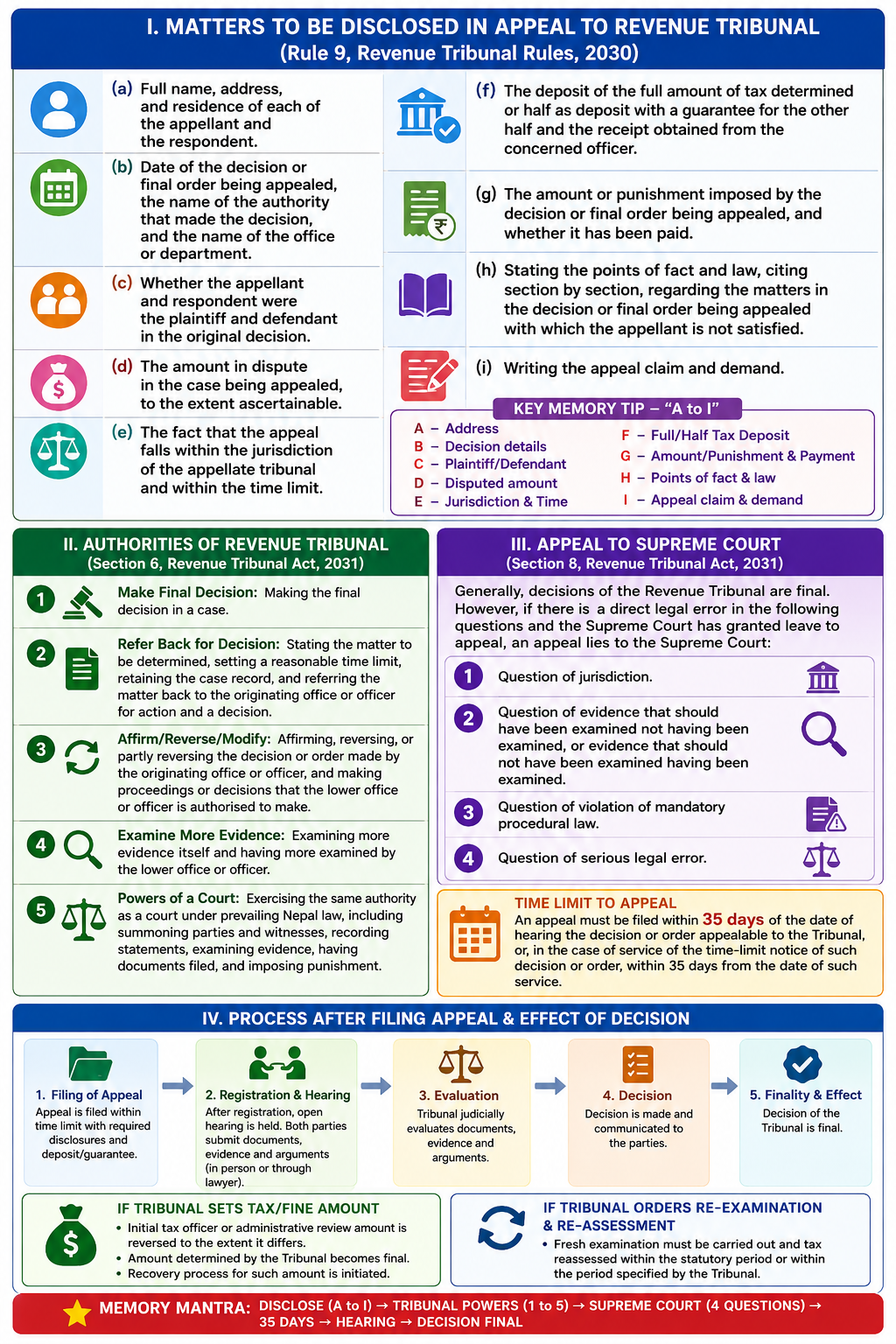
Appeal to the Revenue Tribunal (Sec 116): a person dissatisfied with the Department's Sec 115 decision may appeal to the Revenue Tribunal (under the Revenue Tribunal Act, 2031) within 35 DAYS of the decision/notice, and must register a copy with the Department within 15 days of filing.
MANDATORY DEPOSIT (116(5)): 100% of the undisputed tax PLUS 50% of the disputed tax, fees & penalties (cash or bank guarantee) - the 25% already deposited for administrative review counts toward this 50% (116(6)), so only the balance is needed.
Filing does not stay the decision unless the Tribunal/court orders a stay.
Where the Director General personally made the original decision, the appeal goes DIRECTLY to the Tribunal, skipping administrative review (116(4)).
Chapter-22 Fees and Interest
117. Fees to be charged in event of failure to maintain documents or to submit return or income return
(1) If any person does not submit the following details, the following charge shall be imposed on that person:-
(a) If the return of any income year has not been submitted pursuant to sub-section (1) of Section 95, five thousand rupees or 0.01 percent of the assessable income amount mentioned in the return, whichever is higher,
Section 95(1) of the Act requires a person who has to pay installment tax to file an estimated return stating the estimated installment amount payable by the due date for that year's installment, in the format and manner prescribed. A person who fails to file such a return shall be liable to a fee of five thousand rupees per return or 0.01 percent of the assessable income shown in the income return, whichever is higher.
Example 29.2.1: Suppose that in income year 2080/81, a person's estimated tax liability based on estimated income is Rs. 10,000. Such person must file the relevant return with the concerned office by end of Poush 2080 under the provisions of Section 95 of the Act. If such person fails to file such return by that date, the person must pay a fee of Rs. 5,000. If the assessable income of such person is Rs. 6 crores, a fee of Rs. 6,000 shall be payable. Such fee must also be paid by a person who pays the tax amount but fails to file the return.
(b) If any person required to collect advance tax has not submitted the details pursuant to sub-section (9) of Section 95A, such person shall be imposed a charge of one and half percent per year of the amount of advance tax to be collected, for each month and portion of the month, from the date required to make submission until the date of actual submission,
As per Section 95A(9) of the Act, every person required to collect advance tax has a legal obligation to submit the advance tax collection return in the format and manner prescribed by the Department within 25 days of the end of each month. A fee shall be levied on those who fail to fulfil this obligation. Such person is liable to a fee at the rate of 1.5 percent per year of the amount required to be collected, from the due date of the return to the date the return is filed. Such fee applies to each month or part of a month.
(c) If the income return of any income year is not submitted pursuant to sub-section (1) of Section 96, for the person mentioned in sub-section (4) of Section 4, an amount at the rate of one thousand two hundred rupees per return and one hundred rupees per month for a period of less than one year; and for other persons, an amount at the rate of 0.1 percent per year of the assessable income computed without deducting any amount that can be deducted and by including any amount that has to be included, or one thousand two hundred rupees per return and one hundred rupees per month for a period of less than one year, whichever is higher, and
Every person with taxable income must file an income return as per Section 96(1) with the concerned office within 3 months of the end of the income year, or within the extended period if granted. A person who fails to file such a return shall be liable to fees under Section 117(1)(c). Such fees, for persons covered under Section 4(4) (persons required to pay presumptive lump-sum tax), shall be twelve hundred rupees per return and, for periods of less than one year, an amount at the rate of one hundred rupees per month. For any other person, a fee equal to the higher of: 0.1 percent per year of the assessable income for that income year calculated without deducting deductible amounts and including amounts required to be included, or twelve hundred rupees per return and, for a period of less than one year, an amount at the rate of one hundred rupees per month, shall be levied.
Example 29.2.2: Suppose Gaurav and Sons Pvt. Ltd. received an extension under Section 98 until end of Poush 2081 to file its income return for FY 2080/81. Despite the extension, the company failed to file the return within the extended period and filed its income return at the income tax office only on Magh 9, 2081. For that year, the amount to be included in income under Section 7 of the Act was Rs. 50 lakhs, and the claimable deduction was Rs. 40 lakhs. The fee payable by the said company under Section 117(1)(c) of the Act shall be calculated as follows:
Amount to be included in income: Rs. 50,00,000
Deductions: Not claimable (not to be deducted)
Assessable income for the purpose of Section 117(1)(c): Rs. 50,00,000
Period of fee liability (from Kartik 2081 to Magh 2081): 4 months
Fee under Section 117(1)(c):
Rs. 50,00,000 x 0.1% / 12 x 4 = Rs. 1,667
Since Gaurav and Sons Pvt. Ltd. received an extension until end of Poush 2081 for filing the income return, and if the return had been filed within that extended deadline, the fee under Section 117(1)(c) would not have been applicable. However, since the return was not filed within the extended deadline, the fee under Section 117(1)(c) of the Act applies from the deadline for filing the return under Section 96(1), i.e., from the three-month deadline after the end of the income year (from Kartik month).
(d) If the income return of any income year is not submitted pursuant to sub-section (2) of Section 97, an amount at the rate of 0.1 percent per year of the assessable income after deducting the income subject to final withholding tax, or one thousand two hundred rupees per return and one hundred rupees per month for a period of less than one year, whichever is higher.
For Natural Person with income over 40 lakh
(2) If any person does not maintain the documents required to be maintained in any income year pursuant to Section 81, a charge of 0.1 percent per year of the assessable income computed without deducting any deductible amount and by including any includable amount, or one thousand rupees, whichever is higher, shall be imposed on such person for each month and portion of the month.
As per Section 81 of the Act, every person with a tax liability must maintain for 5 years from the date of the relevant income year documents of the kind prescribed by the Department, including auditor-certified reports, income returns, and documents supporting tax determination and expense deductions. Failure to maintain such documents results in a fee equal to the higher of 0.1 percent of the assessable income for that income year calculated without deductions and with all required inclusions, or Rs. 1,000.
Example 29.2.3: Suppose Old Company Private Ltd. sold goods worth Rs. 40 lakhs in income year 2080/81. The total expenses for that year were Rs. 30 lakhs. The company did not maintain documents substantiating the expenses. In this situation, since the company failed to maintain documents as required under Section 81, the fee under Section 117(2) shall be calculated as follows:
(1) Assessable income for this purpose: Rs. 40 lakhs;
(2) Amount at 0.1 percent of assessable income: Rs. 4,000;
(3) Minimum fee: Rs. 1,000.
In this situation, the company must pay a fee of Rs. 4,000.
(3) If any person withholding tax does not submit the return referred to in sub-section (1) of Section 90, a charge of two and half percent per year of the amount of tax to be withheld shall be imposed on such person for each month and portion of the month from the due date for submission of the return until the date on which such return is submitted.
As per Section 90(1) of the Act, every person required to withhold tax has a legal obligation to submit the withholding tax return in the format and manner prescribed by the Department within 25 days of the end of each month. A fee shall be levied on those who fail to fulfil this obligation. Such person is liable to a fee at the rate of 2.5 percent per year of the amount required to be withheld, calculated from the due date of the return to the date the return is filed. Such fee applies to each month or part of a month.
Example 29.2.4: Suppose Jivandhara Ltd. withheld Rs. 20,000 in tax during payments in Shrawan 2080. The entity paid the said tax within Bhadra 25, 2080, but filed the return only on Asoj 3, 2080. In this situation, the following fee must be paid under Section 117(3) of the Act: Amount of tax withheld in Shrawan 2080: Rs. 20,000. Due date for filing withholding tax return: Bhadra 25, 2080. Date the withholding tax return was filed: Asoj 3, 2080. Period of fee liability under Section 117(3): 2 months. Fee under Section 117(3): Rs. 20,000 x 2.5% / 12 x 2 = Rs. 83.33.
Fees for non-submission (Sec 117): (1)(a) estimated-tax return (Sec 95) not filed = Rs. 5,000 or 0.01% of assessable income, whichever higher;
(1)(b) advance-tax-collection statement (95A(9)) not filed = 1.5% p.a. (per month) of the advance tax;
(1)(c) income return (Sec 96) not filed = for presumptive Sec 4(4) persons Rs. 1,200/return + Rs. 100/month, for others the HIGHER of 0.1% p.a. of assessable income (computed without deductions) or Rs. 1,200/return + Rs. 100/month;
(1)(d) Income return not filed by natural person with transaction over 40 lakh = higher of 0.1% p.a. of assessable income (excluding final-WHT income) or Rs. 1,200 + Rs. 100/month;
(2) documents not kept (Sec 81, 5-year retention) = higher of 0.1% p.a. of assessable income or Rs. 1,000, per month;
(3) WHT return (Sec 90) not filed = 2.5% p.a. (per month) of the tax to be withheld. A part of a month counts as a full month
118. Interest to be charged where person paying in installments makes lesser payment than estimated tax
(1) If, with respect to the amount of installment tax to be paid by any person in any income year under Section 94, the amount mentioned in clause (b) exceeds the amount mentioned in clause (a), interest shall be charged on such excess amount pursuant to sub-section (2):-
(a) Amount of each installment paid by such person in any income year, and
(b) The estimated amount or revised estimate amount, if correct; and, if not correct, ninety percent of the tax amount to be submitted as installment for each installment period in that income year by the person mentioned in clauses (a) and (b) of Section 3.
(2) The person referred to in sub-section (1) shall be charged interest at the general rate of interest for each month and portion of the month from the due date for payment of the installment of that year for the following period:-
(a) In the case of a person whose tax is assessed pursuant to sub-section (1) of Section 99, until the due date for submission of the income return, and
(b) In the case of a person for whom the revised tax has been assessed by the Department for the first time under Section 101 as not having been assessed pursuant to sub-section (1) of Section 99, until the date of submission of notice of such amended tax assessment under Section 102.
Explanation: For the purposes of this Section, "amount to be submitted as installment" means the installment amount computed pursuant to sub-section (5) of Section 95 for those who have not submitted a revised estimate after submitting an initial estimate, for those who have not submitted an estimate and the Department has estimated pursuant to sub-section (7) of Section 95, and for those who have submitted a revised estimate and where the Department has estimated being not satisfied with the estimate or revised estimate pursuant to sub-section (7) of Section 95.
Persons required to pay tax pursuant to clauses (a) and (b) of Section 3 of the Act must file and pay tax in the form of installments based on the estimated tax return filed. Since the estimated return must be filed by end of Poush, considering the situation where the person cannot fully estimate turnover and income accurately at that time, the Act also provides that if the installment filed is up to 90 percent of the actual tax liability, no interest will be charged.
Example 24.14.1: Nepal Bikas Company filed a return at end of Poush 2080 showing estimated tax of Rs. 50,00,000/- for income year 2080/81. Based on that estimated return, the company filed Rs. 22,00,000/- by end of Poush, Rs. 17,00,000/- by end of Chaitra, and Rs. 17,00,000/- by end of Ashadh, totaling Rs. 56,00,000/- in installments. At the end of the income year, the company's actual tax liability based on income turned out to be Rs. 60,00,000/-. In this situation, there is a difference of Rs. 10,00,000/- between the estimated tax and the actual tax payable. Section 118(1) of the Income Tax Act, 2058 provides that if 90 percent of actual tax liability has been paid, no interest applies, and since Nepal Bikas Company's paid installments exceeded Rs. 54,00,000/- (90 percent of Rs. 60,00,000/-), that company does not need to pay interest pursuant to Section 118 of the Act.
Example 24.14.2: The actual tax liability at the end of the income year of Nepal Bikas Company mentioned in Example 24.14.1 turned out to be Rs. 80,00,000/-. The installment tax paid by that company of Rs. 50,00,000/- based on the estimated tax return was less than Rs. 72,00,000/- (90 percent of actual tax liability Rs. 80,00,000/-), so in this situation Nepal Bikas Company must file interest calculated as follows pursuant to Section 118(2) of the Act:
Particulars | First installment (40%) | Second installment (70%) | Third installment (100%) |
Installment amount (A) | 32,00,000/- | 56,00,000/- | 80,00,000/- |
Amount subject to interest | 22,00,000/- | 39,00,000/- | 56,00,000/- |
Interest basis (90% of A) | 28,80,000/- | 50,40,000/- | 72,00,000/- |
Total interest amount | 6,80,000/- | 11,40,000/- | 16,00,000/- |
If a person pays less than 90 percent of the installment amount due in any income year, interest at the normal rate, i.e., 15 percent per annum, shall be charged on such shortfall. For the purpose of calculating interest, when computing the period, a full month is counted as one month and a period less than one month is also counted as one month.
Interest rate and period:
(a) A person who does not pay the installment amount shall be charged interest at the normal interest rate, i.e., 15 percent per annum, from the due date of the installment to the date of filing the income return under Section 99(1) through self-assessment, i.e., three months after the end of the income year, on the balance unpaid tax amount.
(b) A person who is required to pay the installment amount but has not filed the income return through self-assessment under Section 99(1), resulting in the Department making a first revised assessment under Section 101, shall be charged interest at the normal rate of 15 percent from the due date of the installment to the date of service of notice of such revised assessment.
Example 29.3.1: Suppose Gaurav and Sons Pvt. Ltd. filed its income return for income year 2080/81 on Magh 9, 2081. For that year, the company's taxable income was Rs. 10 lakhs and the tax liability under self-assessment was Rs. 2 lakhs 50 thousand. The company paid Rs. 50 thousand within Poush 2080, an additional Rs. 50 thousand in Chaitra, and a further Rs. 90 thousand by end of Ashadh 2081, making a total of Rs. 1 lakh 90 thousand by the end of that income year. Additionally, the company paid a further Rs. 60 thousand on Shrawan 13, 2081. The interest under Section 118(1) and (2) of the Act shall be calculated as follows:
First installment at 40% | Second installment at 70% | Third installment at 100% | |
Installment amount | Rs. 1,00,000/- | Rs. 1,75,000/- | Rs. 2,50,000/- |
Amount paid - 118(1)(a) | Rs. 50,000/- | Rs. 1,00,000/- | Rs. 1,90,000/- |
Minimum payable - 118(1)(b) | Rs. 90,000/- | Rs. 1,57,500/- | Rs. 2,25,000/- |
Amount subject to interest | Rs. 40,000/- | Rs. 57,500/- | Rs. 35,000/- |
Months subject to interest | 3 | 3 | 1 |
Interest amount | Rs. 1,500/- | Rs. 2,156.25 | Rs. 437.50 |
Total interest under Section 118: Rs. 4,093.75
Interest on instalment shortfall (Sec 118): if a person pays less than 90% of the instalment tax due under Sec 94, interest at the general rate (15% p.a.) is charged on the shortfall, for each month (part-month counts as full). The benchmark per instalment = 90% of (40% / 70% / 100% cumulative) of the FINAL actual tax. If total instalments reach 90% of the actual tax, NO interest applies (a margin for estimation error). Interest runs from each instalment's due date to the self-assessment return date (Sec 99) or, where the Department first assesses under Sec 101, to the Sec 102 notice date
119. Interest to be charged if tax is not paid
(1) If any person does not pay tax on the prescribed due date for payment of tax, that person shall be charged interest at the general rate of interest for each month and portion of the month, on the amount remaining due and payable, for the entire period during which tax is so due and payable.
Under Section 119(1), if a person with a legal obligation to pay tax fails to pay the tax by the determined date prescribed by law for paying tax, interest at the normal rate shall be charged on the outstanding balance for each month and part of a month during which it remains unpaid. The tax amount is confirmed in two ways:
(a) through tax assessment, where the amount remaining after adjusting credits including withheld tax is the tax amount payable; and
(b) through statutory deduction, where the law finalises the taxable income as an absolute matter, for example Section 92 which lists payments subject to final withholding tax.
Example 29.3.2: Suppose Gaurav and Sons Pvt. Ltd. filed its income return for income year 2080/81 on Magh 9, 2081. For that year, the company's taxable income was Rs. 10 lakhs and the tax liability under self-assessment was Rs. 2 lakhs 50 thousand. The company paid Rs. 50 thousand within Poush 2080, an additional Rs. 50 thousand in Chaitra, and a further Rs. 90 thousand by end of Ashadh 2081, making a total of Rs. 1 lakh 90 thousand by the end of that income year. The company paid the remaining Rs. 60 thousand along with the income return. The interest under Sections 118 and 119 of the Act shall be calculated as follows:
First installment at 40% | Second installment at 70% | Third installment at 100% | |
Installment amount | Rs. 1,00,000/- | Rs. 1,75,000/- | Rs. 2,50,000/- |
Amount paid - 118(1)(a) | Rs. 50,000/- | Rs. 1,00,000/- | Rs. 1,90,000/- |
Minimum payable - 118(1)(b) | Rs. 90,000/- | Rs. 1,57,500/- | Rs. 2,25,000/- |
Amount subject to interest | Rs. 40,000/- | Rs. 57,500/- | Rs. 35,000/- |
Months subject to interest | 3 | 3 | 3 |
Interest amount | Rs. 1,500/- | Rs. 2,156.25 | Rs. 1,312.50 |
Total interest under Section 118: Rs. 4,968.75
Particulars | Amount |
Amount payable by end of Ashwin 2081 | Rs. 2,50,000/- |
Amount paid by end of Ashwin 2081 | Rs. 1,90,000/- |
Balance remaining to be filed | Rs. 60,000/- |
Date income return was filed | Magh 9, 2081 |
Months subject to interest | 4 |
Total interest under Section 119 | Rs. 3,000/- |
(2) For the purpose of computing the interest to be charged pursuant to sub-section (1), interest shall not be exempted for the extended time-limit given pursuant to Section 98.
Under Section 119, a person with a legal obligation to pay tax must pay the tax within the period that begins when the obligation arises. That is, interest is charged from the day after the expiry of the three-month period following the end of the income year until the date the tax is paid. Under the provision of Section 119(2), even if a person has received an extension for filing the income return under Section 98, interest shall also be payable for such extended period.
(3) The person responsible for collecting advance tax who has not complied with sub-section (8) of Section 95A, or the person withholding tax who has not complied with sub-section (4) of Section 90, shall not be allowed to recover the interest payable by that person from the person required to make advance tax payment or the person subject to tax withholding.
A withholding agent with the obligation to withhold tax under Chapter 17 of the Act must pay the withheld amount within 25 days of the end of each month, as per Section 90(4). If such person fails to pay the amount within the deadline, interest at 15 percent shall be charged for the late period. The withholding agent cannot recover the interest for such period from the person from whom tax is withheld.
(4) If tax is not paid within the time-limit given pursuant to Section 110A, such person shall be liable to pay an additional interest of five percent per annum on the outstanding tax.
In a situation where the agent of a non-resident person with tax arrears has agreed to pay such arrears in instalments within a specified time limit under Section 110A, if such person fails to clear the arrears within the time limit specified in the agreement, in addition to the interest under Section 119, an additional five percent interest per annum must also be paid.
Interest on unpaid tax (Sec 119): tax not paid by its due date bears interest at the general rate (15% p.a.) on the outstanding balance, for each month (part-month = full month) it remains unpaid. Applies both to assessed tax (the balance after WHT/instalment/other credits) and to statutorily-fixed tax such as final withholding under Sec 92.
Sec 118 interest (instalment shortfall) and Sec 119 interest (late payment) can both apply in the same year for different periods
119A. Charge to be imposed
(1) A taxpayer who issues electronic invoices pursuant to Section 81(4) shall be liable to:
(a) a penalty of NPR 500,000 (Five Hundred Thousand) if software capable of deleting or modifying data is used; and
(b) a penalty of NPR 100,000 (One Hundred Thousand) if the other requirements of that section are not complied with.
(2) If a person who manufactures, installs or operates software or a device for issuing electronic invoices pursuant to sub-section (4) of Section 81 does not comply with the working procedure issued by the Department, a charge of five hundred thousand rupees shall be imposed.
A fee of five lakh rupees shall be levied if a person manufacturing, installing, or operating electronic invoice software or equipment fails to comply with the guidelines issued by the Department.
(3) If Section 81A is violated, a charge of five thousand rupees or two percent of the total amount, whichever is higher, shall be imposed for each instance of monitoring.
For depositing business transaction amounts into personal accounts in violation of Section 81A, a fee equal to the higher of five thousand rupees or two percent of the total amount shall be levied per monitoring instance.
(4) Except as otherwise provided in this Act, a charge of five thousand to twenty-five thousand rupees shall be imposed on a person who does not comply with any provision of this Act or the Rules framed under this Act.
Section 119A is the residuary provision of the fee-related provisions in the Act. Except as otherwise provided in the Income Tax Act and for other matters mentioned therein, a fee ranging from five thousand rupees to twenty-five thousand rupees shall be levied on a person who fails to comply with any provision of this Act or the rules made thereunder.
Additional charges (Sec 119A): Rs. 5,00,000 if a taxpayer issuing electronic invoices (whether or not approved under Sec 81(4)) uses software capable of deleting or altering data (119A(1)); Rs. 5,00,000 if a maker/installer/operator of e-invoicing software or devices ignores the Department's procedure (119A(2)); for depositing business receipts into a personal account in breach of Sec 81A, the higher of Rs. 5,000 or 2% of the amount, per monitoring instance (119A(3)); and a residuary charge of Rs. 5,000 to Rs. 25,000 for any other non-compliance with the Act or Rules not otherwise penalised (119A(4))
120. Charge to be imposed on the person who submits a false or misleading statement
If any person submits to the Department a false or misleading statement on any matter, or the information mentioned in the statement becomes misleading as a result of concealing or removing information of any matter or thing required to be submitted, the following charge shall be imposed on such person:-
(a) If it has become false or misleading not knowingly or recklessly but by mistake, fifty percent of the amount of tax less resulted therefrom.
If a return or information filed by any taxpayer with the Department or office is found to be false or misleading by mistake and not due to intentional or careless action, a fee of fifty percent of the resulting tax underpayment shall be levied.
(b) If it has become false or misleading knowingly or recklessly, one hundred percent of the amount of tax less resulted therefrom.
If it occurred due to deliberate or careless action, one hundred percent of the amount of tax underpaid as a result thereof shall be levied as a fee.
Example 29.2.5: Suppose ABC Company filed its income return for income year 2080/81 at the tax office. Based on the income return submitted by the company, Jiwan Rai filed a written complaint with the Director General of the Department that the company had concealed income, as Rs. 10 lakhs received as insurance claims were not included in the return. Upon investigation by the office, based on evidence, a revised tax assessment was made and a tax amount of Rs. 2 lakhs 50 thousand was established on the concealed income at the rate of 25 percent. Since the company intentionally concealed income, a fee of Rs. 2 lakhs 50 thousand shall be levied under Section 120(b) of the Act.
Explanation: For the purposes of this Section, "statement submitted to the Department" means any statement submitted in writing to the Department or to the officer authorized by the Department in the course of performing duties pursuant to this Act, and includes the following:-
(a) Application, notice, description, complaint, deposition, or other document submitted, prepared, given or furnished pursuant to this Act,
(b) Document submitted to the Department or any officer of the Department except under this Act,
(c) Reply to any question asked by the Department or any officer to any person, or
(d) Information given by any person who has reasonable knowledge of the matter to be informed, to the Department or any officer through any other person.
Fee for false/misleading statement & abetment (Sec 120): where a person files a false or misleading statement (or one made misleading by omitting/removing information) that understates tax - fee = 50% of the tax shortfall if it happened by MISTAKE (not knowing or reckless); 100% of the shortfall if done KNOWINGLY or recklessly (Sec 120). 'Statement to the Department' covers any application, return, notice, complaint, document or answer given under (or even outside) the Act.
121. Charge to be imposed on accomplice
An accomplice who knowingly or recklessly aids, abets or advises any offender referred to in this Act in committing any offence mentioned in this Act shall be charged a sum equal to one hundred percent of the tax less paid by such person.
Example 29.2.7: In the context of the company mentioned in Example 29.2.5 above, consultant Avishwasi Kapoor provided written advice to credit the Rs. 10 lakhs received as insurance claims to the personal account of the director instead of including it in the company's financial statement, and this was established as having been credited to the director's personal account. Therefore, consultant Avishwasi Kapoor is considered an abettor under this section and shall be liable to a fee of Rs. 2 lakhs 50 thousand.
Sec 121: an ACCOMPLICE who knowingly/recklessly aids, abets or advises the offender is charged 100% of the tax that person underpaid. These fees are civil and do not bar the criminal proceedings in Chapter 23
122. Assessment of fee and interest
(1) The Department shall assess the fee and interest required to be paid by any person pursuant to this Chapter.
The authority to determine fees and interest rests with the Department. The Department may determine fees and interest for failure to comply with or violation of the law requiring maintenance of documents or submission of returns or income returns.
(2) In computing the liability for fee and interest chargeable where any particular act has not been performed or chargeable in respect of any statement pursuant to this Chapter, it shall be computed separately in the case of each Section of this Chapter.
That is, the fees or interest applicable under each section must be computed separately and the amount of fees or interest must be arrived at for each applicable section. Where more than one section applies for fees and interest, the determination must be made separately under each section.
(3) The fee and interest chargeable pursuant to this Section shall be added to any other tax, if any, payable pursuant to this Act; and mere payment of such fee and interest shall not be deemed to release any person from the liability related to criminal proceedings mentioned in Chapter-23.
(4) If the fee and interest have been assessed pursuant to this Section, the Department shall give that person a written notice of the assessment setting out the following matters. Such notice may be attached to and sent along with the notice issued pursuant to Section 102:-
(a) The reasons why the Department has to assess the fee and interest,
(b) The amount of fee and interest payable,
(c) The method by which the amount has been computed, and
(d) The time, place and mode for making a complaint against the assessment.
The determination notice may be sent separately or may be sent attached to the notice sent under Section 102. Since fees and interest are generally computed along with the tax assessment, it is more convenient and practical to send it with the Section 102 notice.
(5) It shall be as follows in assessing the fee and interest pursuant to this Section:-
(a) The matters contained in sub-section (1), sub-section (2), clause (b) of sub-section (3), sub-sections (4) and (5) of Section 101 shall also apply in assessing the fee and interest pursuant to this Section, and
(b) The matters contained in clauses (b) and (c) of sub-section (3), sub-sections (4) and (5) of Section 101, and Section 102 shall also apply in the case of sub-section (4) of this Section.
When determining fees and interest, the matters written in Section 101(1), (2), (3)(b), (4) and (5) shall also apply. Similarly, the matters written in Section 101(3)(b), (c), (4), (5), and Section 102 shall also apply for the notice sent after the determination of fees and interest under this section. The Department has authority to make an amended or re-amended assessment of fees and interest in the same manner as for an amended tax assessment, subject to the same time limits.
Chapter-23 Offences and Punishment
123. Punishment to one who does not pay tax
A person who does not pay tax by the due date for payment of tax without any reasonable cause shall be punished with a fine of a sum from five thousand rupees to thirty thousand rupees, or with imprisonment for a term from one month to three months, or with both punishments.
124. Punishment to one who submits a false or misleading statement
If any information or statement submitted by any person to the Department is false or misleading because of submission with intention or recklessness, or that information becomes misleading since such person has not mentioned or has removed information of any particular matter or thing from the statement, such person shall be punished with a fine of a sum from forty thousand rupees to one hundred sixty thousand rupees, or with imprisonment for a term from six months to two years, or with both punishments.
Explanation: For the purposes of this Section, "any information or statement submitted to the Department" means any statement submitted in writing to the Department or the officer authorized by the Department in the course of complying with the obligation under this Act, and includes the following:-
(a) Application, notice, details, complaint, statement, or other documents deposited, prepared, given or submitted pursuant to this Act,
(b) Document submitted to the Department or any officer of the Department,
(c) Answers to questions asked by the Department or any officer to any person, or
(d) Information provided by any person who has reasonable knowledge of the matter to the Department or any officer through any other person.
125. Punishment to one who obstructs or unduly influences tax administration
(1) Any person who commits the following acts shall be punished with a fine of a sum from five thousand rupees to twenty thousand rupees, or with imprisonment for a term from one month to three months, or with both punishments:-
(a) Obstructing the officer of the Department in the course of carrying out duties pursuant to this Act,
(b) Not acting as per the notice referred to in Section 83, or
(c) Obstructing in any other manner the implementation of this Act.
(2) Any person who attempts to commit any act referred to in sub-section (1) shall be punished with half the punishment mentioned in that sub-section.
126. Punishment in the event of commission of offence by a person with or without authority
(1) Any authorized person who violates Section 84 shall be punished with a fine of a sum not exceeding eighty thousand rupees, or with imprisonment for a term not exceeding one year, or with both punishments.
(2) If any person who is not authorized under this Act collects tax or any other amount in the name of tax or attempts to collect the same, such person shall be punished with a fine of a sum from eighty thousand rupees to two hundred forty thousand rupees, or with imprisonment for a term from one year to three years, or with both punishments.
Offences & punishment (Chapter 23): criminal sanctions (fine and/or imprisonment) on top of any tax, fee and interest.
Sec 123 non-payment without reasonable cause = fine Rs. 5,000-30,000 and/or 1-3 months' imprisonment.
Sec 124 intentional/reckless false or misleading statement = fine Rs. 40,000-1,60,000 and/or 6 months-2 years.
Sec 125 obstructing a tax officer / ignoring a Sec 83 notice / otherwise obstructing the Act = fine Rs. 5,000-20,000 and/or 1-3 months (an ATTEMPT = half the punishment).
Sec 126 breach of Sec 84 confidentiality by an authorised person = up to Rs. 80,000 and/or up to 1 year; UNAUTHORISED collection of tax (or attempt) = fine Rs. 80,000-2,40,000 and/or 1-3 years
127. Punishment to accomplice
Any person who intentionally aids or abets or advises any other person to commit any offence under this Act, or certifies a false financial or tax account, or gives wrong advice, shall be punished with half the punishment imposed on the offender.
Provided that if such an accomplice is a governmental employee, that person shall be liable to punishment equal to the punishment imposed on the offender.
128. Punishment to one who does not observe the Act
Except as otherwise provided for in this Act, any person who does not observe any provision of this Act or the rules framed under this Act shall be punished with a fine of a sum from five thousand rupees to thirty thousand rupees.
Section 128 provides for punishment of a general nature. This section applies to matters for which specific punishment has not been explicitly prescribed. Where matters defined as offenses in the Income Tax Act have specific punishments as mentioned above, those punishments apply. For violations of the Income Tax Act or the rules made thereunder that are not otherwise addressed, a fine of five thousand rupees to thirty thousand rupees shall apply.
129. Power of Department to issue order to pay fine amount
(1) Notwithstanding anything contained elsewhere in this Chapter, if any person admits in writing, before the commencement of court proceedings, that that person has committed any one or more offences mentioned in this Chapter, except the offence mentioned in Section 126, the Department may order such a person to pay the amount of fine not exceeding the amount of fine imposable for the commission of such one or more offences.
(2) In making the order referred to in sub-section (1), the Department shall set out in such order the offence committed, the amount of fine to be paid and the date for payment of the fine amount.
(3) The order made by the Department pursuant to this Section shall be final and no appeal may be made against it.
Section 129 grants special authority to the Department regarding the collection of penalty amounts. Generally, penalty amounts cannot be collected until an offense is established and the penalty determined by the District Court. However, the Department may collect penalty amounts if, before court proceedings commence, the concerned person admits in writing to having committed offenses other than those under Section 126. The Department may collect the penalty only to the extent admitted by the concerned person, for one or more offenses. The penalty amount to be collected is subject to the upper limit of the penalty for that particular offense. The order to pay the penalty must be in writing, and such order must specify the offense, the penalty amount payable, and the date for payment. The order issued by the Department to collect the penalty is final, and no appeal lies against such order.
The determination and collection of fees and interest is done by the Department as per Section 122, whereas the authority to impose penalties is vested in the District Court under Section 131. The Department may not impose penalties except in the circumstances provided for in Section 129. If any person is subject to fees, interest, and penalties under the Income Tax Act, all of them may be imposed on such person. Fees and interest may be levied by the Department, but penalties are imposed only after the offense is established by the District Court. Payment of fees and interest does not exempt a person from penalties relating to criminal liability for offenses committed.
Accomplice, general & admitted-offence penalties (Sec 127-129):
Sec 127 - an accomplice who aids, abets, advises, certifies false accounts or gives wrong advice = HALF the offender's punishment (but a GOVERNMENT EMPLOYEE accomplice = the FULL punishment).
Sec 128 - any contravention of the Act/Rules with no specific punishment = fine Rs. 5,000-30,000 (residuary).
Sec 129 - if a person ADMITS an offence in writing before court proceedings begin (any offence except Sec 126 unauthorised collection), the Department may order payment of a fine up to the maximum for that offence; the order states the offence, fine & due date and is FINAL with no appeal. Otherwise penalties (unlike fees/interest, which the Department assesses) are imposed only by the District Court (Sec 131)
130. Government of Nepal to be plaintiff
Cases under this Chapter shall be state cases with the Government of Nepal as plaintiff.
131. Investigation and filing of cases
(1) The prescribed officer shall investigate cases related to offences punishable under this Chapter, and the case shall be filed in the concerned District Court within thirty-five days of the completion of such investigation.
(2) In conducting investigation pursuant to sub-section (1), the investigating officer shall seek advice and opinion of the government attorney.
The following procedure must be followed for investigating offenses and filing cases under Sections 130 and 131:
(1) For offenses under Chapter 23 of the Income Tax Act, the Department must file a case with the concerned District Court for punishment. In such cases filed, the Government of Nepal is the plaintiff as per Section 130.
(2) The investigation of punishable offenses is conducted by an officer designated by the Department.
(3) The case must be filed with the concerned District Court within thirty-five days from the date of completion of the investigation.
(4) The investigating officer must seek the opinion and advice of the government attorney during the investigation.
Rule 37: The officer designated by the Department shall investigate cases relating to offences punishable pursuant to Chapter-23 of the Act.
Chapter-24 Miscellaneous
132. Power to obtain expert's service
The Government of Nepal or the Department may obtain the service of the concerned expert for acts related to tax auditing; and the provision on governmental secrecy mentioned in Section 84 shall also apply to such expert.
133. Departmental action to be taken
If the liability of a taxpayer increases or decreases because of a tax assessment made with recklessness, the Director General may institute departmental action to punish the concerned officer who has made such tax assessment or has not made the amended tax assessment within the time-limit referred to in sub-section (3) of Section 101, in accordance with the law in force relating to the service conditions of that officer.
The Director General may initiate departmental proceedings against such officer for punishment pursuant to the prevailing law governing the officer's terms of service, i.e., the Civil Service Act and Regulations.
134. Identity card of officer
Each officer shall hold the identity card as prescribed and shall show such identity card to anyone who requests to see it in the course of carrying out duties.
Rule 28: Identity card of officer: The format of an officer's identity card shall be as per Schedule 1 of the Income Tax Regulations, 2059.
Every officer of the Department must carry an identity card in the format prescribed by Rule 28 of the Income Tax Regulations, 2059.
135. Powers of a court of law to be vested
For the purposes of this Act, the Department shall have the powers vested in a court under the law in force in the matters of summoning the presence of the concerned person, recording of statements, examining evidence and compelling production of documents.
136. Not to be responsible for an act done in good faith
Notwithstanding anything contained elsewhere in this Act, no officer shall be personally responsible for any act done in good faith in carrying out duties.
Provision has been made that no officer shall be personally liable for any action taken in good faith in the course of making a tax assessment or performing duties. Notwithstanding anything written in other sections of this Act, such as Section 133 and Section 126(1), if an officer has acted in good faith, that officer shall not be personally liable.
136A. Provision for prize and informant's expenses
(1) A person who provides information along with evidence that any person has evaded, or attempted to evade, all or any portion of the tax liability may be awarded a prize equal to twenty percent of the tax amount assessed on the basis of the evidence submitted by that person, from the amount of tax recovered on the basis of such information, upon the decision of the Director General.
(2) If there are more than one person entitled to the prize pursuant to sub-section (1), the prize amount shall be provided on a pro rata basis.
(3) Notwithstanding anything contained in sub-section (1), a person who gives information on revenue leakage may be provided immediately with informant's expenses of up to ten thousand rupees, pursuant to the procedures specified by the Department, on the basis of the truthfulness of the information provided.
(4) The name, surname and address of the person providing information pursuant to sub-sections (1) and (3) shall be kept confidential.
Example 32.3.1: Suppose ABC Company has submitted its income return for income year 2080/81 to the relevant office. On the basis that ABC Company submitted its income return without including in its income the sum of Rs. 10,00,000 received as an insurance claim, Deshbhakta Nepal provided written information to the Director General of the Department that the company had concealed income. Based on investigation by the office, a tax assessment was made and collected on the basis of evidence: tax at the rate of 25 percent amounting to Rs. 2,50,000; penalty under Section 120(b) of the Act amounting to Rs. 2,50,000; and interest under Section 119 amounting to Rs. 20,000, totalling Rs. 5,20,000. In this situation, the Director General may decide to award Deshbhakta Nepal a reward equal to 20 percent of the tax collected, i.e., Rs. 1,04,000.
Informant reward (Sec 136A): a person who supplies information WITH evidence that someone evaded (or attempted to evade) tax may be awarded 20% of the tax actually assessed and collected on the basis of that evidence, by the Director General's decision; if several informants qualify, the reward is shared pro rata. A revenue-leakage informant may also receive up to Rs. 10,000 immediately. The informant's name, surname and address are kept confidential
137. Power of the Government of Nepal to give order or direction
The Government of Nepal may give necessary order or direction to the Department in order to make tax administration effective.
It is the Department's duty to comply with such directions. Such directions must be received through the Ministry of Finance, which is the ministry to which the Department is accountable.
138. Power to frame rules
The Government of Nepal may frame necessary rules in order to carry out the objectives of this Act.
Provision has been made for the Government of Nepal to make and issue the necessary regulations in the course of implementing the Act. Accordingly, the Income Tax Regulations, 2059 have been made and issued. Subject to the Income Tax Regulations, 2059 issued pursuant to Section 138 of the Act, the Department may also make and issue directives, provided they are not inconsistent with the Act and the Regulations. The Income Tax Directive, 2066 is a directive issued by the Department pursuant to this provision. To the extent that a directive issued by the Department is inconsistent with the Act and the Regulations, it shall automatically become inoperative. Any departmental public circular inconsistent with such a directive shall also become inoperative. The interpretations and examples contained in a directive shall have the same status as a public circular. It is the duty of every taxpayer to comply with it and the responsibility of the Department to implement it.
The Government of Nepal may, by publishing a notice in the Nepal Gazette, make necessary additions, deductions or amendments to any Schedule of the Act other than Schedule 1 (tax rates). No amendments or additions may be made to any other Schedule without publishing a notice in the Gazette.
Notwithstanding anything in the prevailing law, no act other than the annual Finance Act, which amends the Income Tax Act to impose, assess, increase, decrease, exempt or remit tax, may make any amendment, change or other provision regarding the tax provisions of this Act. Amendments to the Income Tax Act, 2058 can only be made: (1) through the Finance Act; (2) through an Act specifically made to amend the Income Tax Act, 2058; or (3) through a Some Nepal Laws Amendment Act. This is intended to enhance the stability and predictability of income tax provisions and provides an opportunity for all stakeholders to understand Nepal's income tax system through a single codified Act.
Rule-making & amendment of the Act (Sec 138): GoN may frame Rules to implement the Act (the Income Tax Rules, 2059); the Department may issue Directives & public circulars consistent with the Act/Rules (the Income Tax Directive). GoN may amend Schedules OTHER than Schedule 1 by Nepal Gazette notice.
Crucially, the Act's TAX provisions can be amended ONLY through
(1) the annual Finance Act,
(2) an Act made specifically to amend the Income Tax Act, or
(3) a Some Nepal Laws Amendment Act - giving the income-tax system stability and predictability.
1. In respect of a natural person
(1) Subject to sub-sections (2), (4) and (4a) of this Schedule, tax shall be levied on the taxable income of a resident natural person in any income year at the following rates:-
(a) If taxable income from employment is up to ten lakh rupees, at the rate of one percent,
Provided that for a taxpayer registered as a sole proprietorship firm, no tax pursuant to this clause shall be levied on income from pension, pension fund and the income of a natural person contributing to a contribution-based social security fund.
(b) If taxable income exceeds ten lakh rupees but does not exceed fifteen lakh rupees, ten thousand rupees on taxable income up to ten lakh rupees pursuant to clause (a), and ten percent on taxable income exceeding ten lakh rupees,
(c) If taxable income exceeds fifteen lakh rupees but does not exceed twenty five lakh rupees, sixty thousand rupees on taxable income up to fifteen lakh rupees pursuant to clause (b), and twenty percent on taxable income exceeding fifteen lakh rupees,
(d) If taxable income exceeds twenty five lakh rupees but does not exceed forty lakh rupees, two lakh sixty thousand rupees on taxable income up to twenty five lakh rupees pursuant to clause (c), and twenty seven percent on taxable income exceeding twenty five lakh rupees, and
(e) If taxable income exceeds forty lakh rupees, an additional tax at the rate of two percentage on the rate prescribed in clause (d) shall be levied on the amount of taxable income exceeding forty lakh rupees.
Income Slab- Individual | Rate |
First Rs. 1,000,000 | 1% |
Next Rs. 500,000 (1,000,001–1,500,000) | 10% |
Next Rs. 1,000,000 (1,500,001–2,500,000) | 20% |
Next Rs. 1,500,000 (2,500,001–4,000,000) | 27% |
Above Rs. 4,000,000 | 29% |
(2) [Removed by the Finance Act, 2083. The rates under Sub-section (1) now apply to both a resident natural person and a resident couple.]
(3) The provision of sub-section (4) shall apply in the following circumstances:-
(a) In the case of a resident natural person or a resident couple, where income exceeds NPR 1,000,000 in any income year, and
(b) Where the net profit derived from the disposal of non-business taxable assets is included in the income and taxable income computation of such natural person or couple.
(4) Subject to sub-section (3), tax shall be levied on the following persons as follows:-
(a) Tax shall be levied at the rate specified in sub-section (1) or (2) of this Schedule on such natural person or couple, treating only the higher of the following amounts as the taxable income:-
(1) The amount resulting from subtracting the amount of such profit from the total taxable income of such natural person or couple, and
(2) Ten lakhs rupees in the case of a natural person, or a couple.
(b) Tax shall be levied on the remaining amount of such taxable income at the rate of ten percent.
Provided that
(1) If the disposed non-business taxable asset (land and building) has been in ownership for five years or more, tax shall be levied at the rate of seven and half percent,
(2) If the disposed non-business taxable asset (land and building) has been in ownership for less than five years, tax shall be levied at the rate of ten percent, and
(3) In the case of profit derived from the disposal of interest held for more than three hundred sixty-five days in an entity listed on the Securities Board of Nepal, tax shall be levied at the rate of seven and half percent, and in the case of interest held for three hundred sixty-five days or less, at the rate of ten percent.
Schedule 1 Section 4 Explanation
Total taxable income = Rs. 1,200,000
Included capital gain = Rs. 300,000
Taxable income excluding gain: Rs. 1,200,000 − Rs. 300,000 = Rs. 900,000
Compare with threshold
For an individual, compare:
Option | Amount |
Taxable income excluding gain | Rs. 900,000 |
Threshold | Rs. 1,000,000 |
Higher amount = Rs. 1,000,000
This Rs. 1,000,000 is taxed under the normal individual tax slabs.
Remaining amount: Rs. 1,200,000 − Rs. 1,000,000 = Rs. 200,000. This Rs. 200,000 (the gain) is taxed at the special rate.
(4a) Notwithstanding anything contained elsewhere in this Section, tax shall be levied at the rate of five percent on the income of a resident natural person not involved in the operation of a business, received pursuant to sub-sections (6b), (6c) and (6d) of Section 95A of the Act.
Sub-section | Nature of Service | Recipient | Rate of Advance Tax |
6(b) | Software services or other similar electronic services provided outside Nepal | Resident natural person not engaged in business | 5% of amount received |
6(c) | Consultancy services personally provided outside Nepal | Resident natural person not engaged in business | 5% of amount received |
6(d) | Income from uploading audio-visual content on social networks | Resident natural person not engaged in business | 5% of amount received |
(5) In computing the tax pursuant to this Section, the remote area allowance as prescribed of a natural person working in a remote area as specified by the Government of Nepal, up to a maximum of fifty thousand rupees, shall be deducted from the taxable income and the tax shall be computed only on the remaining amount.
Rule 38: For purposes of Sub-section (5) of Section 1 of Schedule-1 of the Act, the amount for remote allowances to be added to the threshold of non-taxable amount of any person shall be as follows: (a) Fifty Thousand Rupees in the areas of category 'a'; (b) Forty Thousand Rupees in the areas of category 'b'; (c) Thirty Thousand Rupees in the areas of category 'c'; (d) Twenty Thousand Rupees in the areas of category 'd'; (e) Ten Thousand Rupees in the areas of category 'e'.
Directive Annexure 3: Provisions relating to remote areas
The classification of remote areas is as follows.
1. Areas falling under Category "A"
(1) Manang District (2) Kalikot District (3) Mugu District (4) Dolpa District (5) Humla District (6) Bajura District
2. Areas falling under Category "B"
(a) Dhungesangu, Olangchunggola of Taplejung District and the VDCs falling under it
(b) The following Village Development Committees of Sankhuwasabha District:
1. Chepuwa 2. Hedangna 3. Kimathanka 4. Syaksila 5. Waling 6. Simajor
(c) The following Village Development Committees of Solukhumbu District:
1. Khumjung 2. Namche 3. Chaurikharka
(d) Gogar Village Development Committee of Dolakha District
(e) Timure Village Development Committee of Rasuwa District
(f) The following Village Development Committees of Gorkha District:
1. Sirdibas 2. Prok 3. Lho 4. Keraja 5. Chhekampar 6. Manbu
(g) The following Village Development Committees of Baglung District:
1. Bonga 2. Nisi 3. Hukam 4. Ramma 5. Mekot 6. Takwachi
(h) Mustang District
(i) Jumla District
(j) Bajhang District
(k) The part of Khaptad Herbal Garden of Doti District above 900 feet altitude
(l) Darchula District
3. Areas falling under Category "C"
(a) Rukum District
(b) Jajarkot District
(c) Dailekh District
(d) Achham District
4. Areas falling under Category "D"
(a) Village Development Committees of Taplejung District other than those falling under Category "B"
(b) Bhojpur District
(c) Terhathum District
(d) Village Development Committees of Sankhuwasabha District other than those falling under Category "B"
(e) Khotang District
(f) Okhaldhunga District
(g) Village Development Committees of Solukhumbu District other than those falling under Category "B"
(h) The following Village Development Committees of Dhading District:
1. Budhathum 2. Lapa 3. Fulkharka 4. Rigaun 5. Salyankot 6. Salyantar
(i) The following Village Development Committees of Sindhupalchok District:
1. Baramchi 2. Baruwa 3. Mautada 4. Birta Golde 5. Gunsa 6. Guwa 7. Kiul 8. Listikot 9. Mahankal 10. Pagtag 11. Fulping Kati 12. Dhagpalkot 13. Tisun Thagal Tinas Dhyagal
(j) The following Village Development Committees of Lamjung District:
1. Bahundanda Mahendrodaya 2. Shrikali Katadhi 3. Thulibesi Patango 4. Thakan Falikadevi
(k) Myagdi District
(l) Rolpa District
(m) Salyan District
(n) Pyuthan District
(o) Areas of Doti District other than those falling under Category "B"
(p) Dadeldhura District (q) Baitadi District
5. Areas falling under Category "E"
(a) Panchthar District
(b) Dhankuta District
(c) Ramechhap District
(d) Dolakha District
(e) Village Development Committees of Rasuwa District other than those falling under Category "B"
(f) Village Development Committees of Sindhupalchok District other than those falling under Category "D"
(g) Village Development Committees of Dhading District other than those falling under Category "D"
(h) Village Development Committees of Lamjung District other than those falling under Category "D"
(i) Village Development Committees of Gorkha District other than those falling under Category "B"
(j) Gulmi District (k) Arghakhanchi District (l) Parbat District
(m) Village Development Committees of Baglung District other than those falling under Category "B"
Category of Area | Additional Non-Taxable Amount (Rs.) |
Category 'A' | 50,000 |
Category 'B' | 40,000 |
Category 'C' | 30,000 |
Category 'D' | 20,000 |
Category 'E' | 10,000 |
Example 11.4.1: Suppose Shyam Mahato (single individual) is an employee at the Dailekh branch of Bikas Bank Limited. In FY 2080/81, his monthly salary and allowances total Rs. 60,000. He received Rs. 50,000 as Dashain allowance and Rs. 50,000 as bonus in that year. The bank contributed a total of Rs. 60,000 to the provident fund (approved retirement fund) by adding that amount to his income and deducting the same from his remuneration. His taxable income and tax for the year shall be as follows:
Heading | Tax Rate | Amount (Rs.) |
Salary and allowances | 720,000 | |
Dashain allowance | 50,000 | |
Bonus | 50,000 | |
Provident fund addition | 60,000 | |
Total assessable income | 880,000 | |
Less: Investment in approved retirement fund | 120,000 | |
Taxable income | 760,000 | |
Less from taxable income: remote area concession (Category 'Ga') | 30,000 | |
Net taxable income | 730,000 | |
First slab up to Rs. 500,000 (tax nil for sole proprietorship registrants, pension income earners, pension fund, and contribution-based SSF contributors) | 1% | 5,000 |
Second slab next Rs. 200,000 | 10% | 20,000 |
Third slab next Rs. 300,000 (on Rs. 30,000) | 20% | 6,000 |
Total tax payable | 31,000 |
Since this concession based on remote area is available only to natural persons, employees, business persons, and investors working in remote areas are entitled to this concession. However, a person with a permanent residence in a remote area but working in another area shall not receive this concession solely on account of permanent residence.
(6) Seventy-five percent of the foreign allowance of an employee working in a diplomatic mission of Nepal situated abroad shall be deducted from the taxable income and the tax shall be computed only on the remaining amount pursuant to this Section.
Example 11.4.2: Suppose the Government of Nepal deputed employee Shyam Mahato to work at the Nepali Embassy in the United States of America. In FY 2080/81, the employee's monthly salary is Rs. 65,000. He received Rs. 65,000 as Dashain allowance in that year. The Government of Nepal provided a foreign allowance of Rs. 60,000 per month. The Government of Nepal contributed a total of Rs. 78,000 to the provident fund (approved retirement fund) by adding that amount to his income and deducting the same from his remuneration. The employee opted as a single individual for that year. His taxable income and tax for the year shall be as follows:
Heading | Tax Rate | Amount (Rs.) |
Salary and allowances (12 x Rs. 65,000) | 780,000 | |
Dashain allowance | 65,000 | |
Foreign allowance (12 x Rs. 60,000) | 720,000 | |
Provident fund addition | 78,000 | |
Total assessable income | 1,643,000 | |
Less: Investment in approved retirement fund | 156,000 | |
Taxable income | 1,487,000 | |
Less from taxable income: 75% of foreign allowance | 540,000 | |
Net taxable income | 947,000 | |
First slab up to Rs. 500,000 | 1% | 5,000 |
Second slab next Rs. 200,000 | 10% | 20,000 |
Third slab next Rs. 300,000 (on Rs. 247,000) | 20% | 49,400 |
Fourth slab next Rs. 2,000,000 onwards | 30% | |
Total tax payable | 74,400 |
(7) The tax amount pursuant to sub-section (4) of Section 4 of the Act shall be as follows:-
(a) For a natural person carrying on business in a Metropolitan or Sub-metropolitan Municipality area, seven thousand five hundred rupees,
(b) For a natural person carrying on business in a Municipality area, four thousand rupees, and
(c) For a natural person carrying on business in areas other than those mentioned in clauses (a) and (b), two thousand five hundred rupees.
(8) Tax shall be levied at the rate of twenty-five percent on the taxable income of a non-resident natural person in any income year.
(9) ......
(9a) Notwithstanding anything contained elsewhere in this section, where a resident natural person has retirement income, for such individual or couple, twenty-five percent (25%) of the amount referred to in clause (a) of sub-section (1) for a natural person, or clause (a) of sub-section (2) for a couple, shall be deducted from taxable income, and tax under this section shall be computed on the remaining amount.
Provided that the amount so deducted shall not exceed the prescribed limit.
Rule 39: The amount to be deducted pursuant to Sub-section (9A) of Section 1 of Schedule-1 of the Act shall not be more than the pension income.
Example 11.4.3 Suppose Shyam Mahato is an employee at the Dailekh branch of Bikas Bank Limited. In FY 2080/81, his monthly salary and allowances total Rs. 50,000. He received Rs. 40,000 as Dashain allowance and Rs. 1,00,000 as bonus. The bank contributed Rs. 30,000 to the provident fund (approved retirement fund) by adding that amount to his income and deducting the same from his remuneration. In addition to the remuneration from the bank, he also received pension income of Rs. 4,50,000 from the Government of Nepal in that year. He opted as a couple for that year. His taxable income and tax shall be as follows:
Heading | Tax Rate | Amount (Rs.) |
Salary and allowances | 600,000 | |
Dashain allowance | 40,000 | |
Bonus | 100,000 | |
Provident fund addition | 30,000 | |
Pension income | 450,000 | |
Total assessable income | 1,220,000 | |
Less: Investment in approved retirement fund | 60,000 | |
Taxable income | 1,160,000 | |
Less from taxable income: | ||
Remote area concession (Category 'Ga') | 30,000 | |
Pension exemption (25% of Rs. 600,000) | 150,000 | |
Net taxable income | 980,000 | |
First slab (pension income earner, tax nil) up to Rs. 600,000: Rs. 300,000 (being Rs. 450,000 - Rs. 150,000) | 1% | 3,000 |
Second slab next Rs. 200,000 | 10% | 20,000 |
Third slab next Rs. 300,000 (on Rs. 180,000) | 20% | 36,000 |
Total tax | 59,000 |
Pension income is retirement payment for past employment. Pension income must be included in employment income as per Section 8(2)(f) of the Act. Tax calculated on taxable pension income as per Schedule 1 must be deducted at source as per Section 87. In calculating taxable pension income, the following deductions are available:
(1) Pension deduction: individual natural persons may deduct 25% of Rs. 5,00,000 (i.e., Rs. 1,25,000) and couples may deduct 25% of Rs. 6,00,000 (i.e., Rs. 1,50,000) from pension income.
(2) Disability benefit: a disabled individual natural person may deduct 50% of Rs. 5,00,000 (i.e., Rs. 2,50,000) and a disabled couple may deduct 50% of Rs. 6,00,000 (i.e., Rs. 3,00,000).
(3) Life insurance premium: actual annual premium paid or Rs. 40,000, whichever is lower, can be deducted from taxable income.
(4) Remote area benefit: applicable to pensioners residing in designated remote areas.
Example 17.12.1 Suppose Bhai Raja Nepali is a retired disabled government employee. He currently lives in Dailekh, a 'C' class remote district. He received the following income in FY 2081/82: Monthly pension Rs. 65,000; life insurance premium Rs. 10,000; private building insurance premium Rs. 10,000; approved medical treatment expenses Rs. 20,000. He chose couple status for that FY. His assessable income, taxable income, and tax must be calculated as follows:
Description | Amount (Rs.) | Amount (Rs.) |
Annual pension | 7,80,000 | |
Total | 7,80,000 | |
Remote area benefit (C class) | 30,000 | |
Pension deduction (25% of Rs. 6,00,000 couple) | 1,50,000 | |
Disability benefit (50% of Rs. 6,00,000) | 3,00,000 | |
Life insurance premium | 10,000 | |
Private building insurance premium | 5,000 | |
Deductible from taxable income | (4,95,000) | |
Taxable income (for tax calculation) | 2,85,000 | |
Tax calculation - up to Rs. 6,00,000: no tax | 0 |
Bhai Raja Nepali spent Rs. 20,000 on approved medical treatment, and 15% of that amounts to Rs. 3,000. Since there is no tax liability for this year, such amount can be claimed in the following year.
Example 17.12.2 Suppose Dipika Basnet is a single retired woman who retired from Nepal Bikash Bank service. She currently lives in Hankuta, an 'E' class remote district. She received the following income from Nepal Bikash Bank in FY 2081/82: Annual pension Rs. 4,20,000; Dashain allowance Rs. 35,000; previous year's increased pension payment Rs. 40,000. Her assessable income, taxable income calculation:
Description | Amount (Rs.) | Amount (Rs.) |
Pension income | 4,20,000 | |
Dashain allowance | 35,000 | |
Previous year increased pension payment | 40,000 | |
Employment assessable income | 4,95,000 | |
Remote area benefit (E class) | 10,000 | |
Pension deduction (25% of Rs. 5,00,000 individual) | 1,25,000 | |
Deductible from taxable income | (1,35,000) | |
Taxable income (for tax calculation) | 3,60,000 | |
Tax calculation - taxable income less than Rs. 5,00,000: no tax | 0 |
(10) Notwithstanding anything contained elsewhere in this section, where a resident natural person is a person with disability, for such individual or couple, an additional amount equal to fifty percent (50%) of the amount referred to in clause (a) of sub-section (1) for a natural person, or clause (a) of sub-section (2) for a couple, shall be deducted from taxable income, and tax under this section shall be computed on the remaining amount.
Refer Example 17.12.1
(11) Notwithstanding anything contained elsewhere in this Section, if any resident natural person is a woman earning remuneration income only, ten percent rebate shall be given on the amount of tax payable by such natural person.
Example 11.4.5: Suppose Sushri Shashikala Rai is an employee at the Achham branch of Nepal Bank Limited. In FY 2081/82, her monthly salary and allowances total Rs. 60,000. She received Rs. 50,000 as Dashain allowance and Rs. 40,000 as bonus in that year. The bank contributed Rs. 30,000 to the provident fund (approved retirement fund) by adding that amount to her income and deducting the same from her remuneration. Her taxable income and tax for the year shall be as follows:
Heading | Tax Rate | Amount (Rs.) |
Salary and allowances | 720,000 | |
Dashain allowance | 50,000 | |
Bonus | 40,000 | |
Provident fund addition | 30,000 | |
Total assessable income | 840,000 | |
Less: Investment in approved retirement fund | 60,000 | |
Taxable income | 780,000 | |
Less from taxable income: remote area concession (Category 'Ga') | 30,000 | |
Net taxable income | 750,000 | |
First slab up to Rs. 500,000 (tax nil for sole proprietorship, pension income, pension fund, SSF contributors) | 1% | 5,000 (note: second slab portion below) |
Second slab next Rs. 200,000 | 10% | 15,000 (note: below) |
Third slab next Rs. 300,000 (on Rs. 50,000) | 20% | 10,000 |
Total tax before exemption | 30,000 | |
Less: 10% exemption for salaried woman | 3,000 | |
Net tax payable | 27,000 |
(12) Notwithstanding anything contained elsewhere in this Section, if any resident natural person has made an investment insurance with a resident insurance company, the annual premium paid for such insurance or forty thousand rupees, whichever is lower, shall be deducted from the taxable income, and the tax pursuant to this Section shall be computed only on the remaining amount.
Example 11.4.6: Suppose Shyam Mahato mentioned in Example 11.4.4 above has taken out life insurance and paid an insurance premium of Rs. 45,000 and Health insurance Premium of Rs. 25,000 in that year. Also, the Person has paid home insurance premium of Rs. 10000. His taxable income and tax for the year shall be as follows
Heading | Tax Rate | Amount (Rs.) |
Salary and allowances | 600,000 | |
Dashain allowance | 40,000 | |
Bonus | 100,000 | |
Provident fund addition | 30,000 | |
Pension income | 450,000 | |
Total assessable income | 1,220,000 | |
Less: Investment in approved retirement fund | 60,000 | |
Taxable income | 1,160,000 | |
Less from taxable income: | ||
Remote area concession (Category 'Ga') | 30,000 | |
Pension exemption 25% of Rs. 600,000 | 150,000 | |
Disability concession (50% of first slab Rs. 600,000) | 300,000 | |
Investment insurance premium Rs. 45,000 - maximum Rs. 40,000 | 40,000 | |
Health Insurance Premium Rs. 25,000 - maximum Rs. 20,000 | 20,000 | |
Home Insurance Premium Rs. 10,000 - maximum Rs. 5,000 | 5,000 | |
Net taxable income | 615,000 | |
First slab up to Rs. 600,000: Rs. 300,000 | 1% | 3,000 |
Second slab next Rs. 200,000 (on Rs. 15,000) | 10% | 1,500 |
Total tax | 4,500 |
(13) Notwithstanding anything contained elsewhere in this Section, the following annual income tax shall be collected at the time of registration or renewal of a vehicle from the owner of vehicles on hire through the Traffic Management Office:-
Type of Vehicle | Annual Tax per Vehicle (Rs.) |
(1) Car, Jeep, Van, Micro-bus | |
(a) Up to 1300 c.c. | 6,500 |
(b) 1301 to 2000 c.c. | 7,000 |
(c) 2001 to 2900 c.c. | 7,500 |
(d) 2901 to 4000 c.c. | 9,500 |
(e) 4001 c.c. and above | 11,000 |
(2) Mini-truck, Mini-bus, Water Tanker | 9,500 |
(3) Mini Tipper | 11,000 |
(4) Truck, Bus | 12,500 |
(5) Dozer, Excavator, Loader, Roller, Crane and similar machinery equipment | 17,500 |
(6) Oil Tanker, Gas Bullet, Tipper | 17,500 |
(7) Tractor | 3,500 |
(8) Power Tiller | 3,000 |
(9) Auto Rickshaw, Three-Wheeler, Tempo | 3,500 |
(10) Electric Vehicle | |
(a) Up to 50 kilowatt | 4,000 |
(b) 50 kilowatt to 125 kilowatt | 5,000 |
(c) 125 kilowatt to 200 kilowatt | 7,500 |
(d) Above 200 kilowatt | 9,500 |
(11) E-Rickshaw | 3,500 |
(12) Two Wheelers | 3,000 |
(14) ......
(15) ......
(16) Notwithstanding anything contained elsewhere in this Section, if any resident natural person has made a health insurance with a resident insurance company, the annual premium paid for such insurance or twenty thousand rupees, whichever is lower, shall be deducted from the taxable income, and the tax pursuant to this Section shall be computed only on the remaining amount.
See Example 11.4.6
(16a) Notwithstanding anything contained elsewhere in this Section, if any resident natural person has made an insurance of a private building under own ownership with a resident insurance company, the annual premium paid for such insurance or ten thousand rupees, whichever is lower, shall be deducted from the taxable income, and the tax pursuant to this Section shall be computed only on the remaining amount.
See Example 11.4.6
(16b) Notwithstanding anything contained elsewhere in this Section, where a resident natural person has made payment of tuition fees to a resident person for the education of his or her descendant, an amount equal to twenty-five percent of the annual tuition fee paid or twenty-five thousand rupees, whichever is lower, shall be deducted from the taxable income.
(17) In computing the tax on the turnover amount pursuant to sub-section (4a) of Section 4 of the Act, the tax applicable to transactions up to thirty lakh rupees shall be the tax pursuant to sub-section (4) of Section 4 of the Act; and for the turnover amount exceeding that, the tax shall be levied at the following rates:-
(a) For a person carrying on trade in goods by adding up to three percent commission or value, including gas and cigarettes, at the rate of 0.25 percent on the turnover amount exceeding thirty lakh rupees up to fifty lakh rupees, and 0.3 percent on the turnover amount exceeding fifty lakh rupees up to one crore rupees,
(b) For a person carrying on a business other than that mentioned in clause (a), at the rate of one percent on the turnover amount exceeding thirty lakh rupees up to fifty lakh rupees, and 0.8 percent on the turnover amount exceeding fifty lakh rupees up to one crore rupees, and
(c) For a person carrying on a service business, at the rate of two percent of the turnover amount.
2. In respect of an entity
(1) Subject to sub-sections (2), (3), (5) and (7) of this Section, tax shall be levied on the taxable income of any entity in any income year at the rate of twenty-five percent.
(2) In any income year, tax shall be levied on the taxable income of any bank, financial institution, general insurance business, entity carrying on financial transactions, or entity engaged in telecommunications and internet services, money transfer, capital market business, securities business, merchant banking business, commodity future market, securities and commodity brokerage business, or in the business of cigarettes, bidi, cigar, chewing tobacco, khaini, gutkha, paan masala, liquor or beer, or carrying on petroleum operations pursuant to the Nepal Petroleum Act, 2040, at the rate of thirty percent.
Explanation: For the purposes of petroleum operations, "taxable income" means the taxable income determined in accordance with the procedure specified in the petroleum agreement and pursuant to this Act and the Rules framed under this Act.
(3) If a cooperative institution registered pursuant to the Cooperative Act, 2074 carries on transactions other than transactions exempt from tax, tax shall be levied at the following rates:-
(a) If operating within the area of a Municipality, at the rate of five percent,
(b) If operating within the area of a Sub-metropolitan Municipality, at the rate of seven percent, and
(c) If operating within the area of a Metropolitan Municipality, at the rate of ten percent.
Provided that in the case of a cooperative institution carrying on savings and credit transactions, tax shall be levied at the following rates:-
(1) If operating within the area of a Municipality, at the rate of ten percent,
(2) If operating within the area of a Sub-metropolitan Municipality, at the rate of fifteen percent, and
(3) If operating within the area of a Metropolitan Municipality, at the rate of twenty percent.
(3a) ......
(3b) Tax shall be levied on the taxable income of a school or college registered and operated under a public trust at the rate of twenty percent.
(4) ......
(5) Tax shall be levied on the taxable income of the trust receiving or managing the property of any deceased resident person or the trust of an incapacitated resident natural person in any income year, treating such trust as a resident natural person, pursuant to sub-sections (1) and (4) of Section 1 of this Schedule.
Although a trust is an entity, since the purpose of the trust mentioned in this subsection is to manage the property of a natural person (deceased or incapacitated resident natural person), tax rates applicable to natural persons apply to the income of such trust. Such a trust is treated as a single person and taxed as per Subsections (1) and (4) of Section 1.
(6) Tax shall be levied at the rate of five percent on the income remitted abroad by the foreign permanent establishment of a non-resident person situated in Nepal in any income year.
(7) Tax shall be levied at the rate of five percent on the taxable income of a non-resident person in respect of the income mentioned in Section 70 of the Act in any income year.
Provided that in the case of a non-resident person providing water transport, air transport or telecommunications services without departing from Nepal to any other foreign country, tax shall be levied at the rate of two percent.
The tax rate provisions for entities, including exemptions on business income under Section 11 of the Income Tax Act, 2058, are clarified in the following table:
Section | Business / Entity Description / Income Situation | Tax Rate |
Schedule 1, Section 2(1) | Entities conducting general business | 25% |
Schedule 1, Section 2(2) | Banks, financial institutions, general insurance business, financial transaction entities, telecommunications and internet services, money transfer, foreign exchange, securities business, merchant banking, commodity futures, brokerage, cigarettes, alcohol, beer, or petroleum work | 30% |
Schedule 1, Section 2(3) | Cooperative institutions (non-exempt business): Municipality area / Sub-metropolitan city / Metropolitan city. Savings and credit cooperatives: Municipality area / Sub-metropolitan city / Metropolitan city | 5%/7%/ 10%. 10%/15%/20% |
Schedule 1, Section 2(3b) | Schools and colleges registered and operated under a public guthi | 20% |
Schedule 1, Section 2(6) | Income remitted abroad by foreign permanent establishment in Nepal | 5% |
Schedule 1, Section 2(7) | Taxable income of non-resident persons (Section 70). Non-residents providing water transport, air transport, or telecom services not departing from Nepal to foreign country | 5%. 2% |
1. Classification and grouping of depreciable property
(1) Depreciable property shall be classified as follows:-
Class | Description of Property |
A | Buildings, structures and other similar constructions of a permanent nature. |
B | Computers, data processing equipment, furniture, fixtures and office equipment. |
C | Automobiles, buses and mini-buses. |
D | Construction and mining equipment and other depreciable assets not included elsewhere, including under sub-section (3) of Section 17, sub-section (3) of Section 18 and sub-section (3) of this Schedule. |
E | Intangible assets other than those mentioned in Class D. |
(2) Any person shall, at the time when any depreciable property used for earning income from a business or investment comes into ownership or is first used in any income year, place it in the following groups; and such groups shall be deemed to be the groups of depreciable property of that person in that year:-
(a) Depreciable property of Class A, B, C or D under the same class as other property of the same class already under ownership or use of that person shall be placed in the same group as such other property, and
(b) In respect of depreciable property of Class E, even if the properties are of the same class, they shall be placed in separate groups.
(3) The cost incurred for the extraction of natural resources, mining operations and development related thereto, in the course of earning income from business, shall be treated as the cost of acquiring property for the business related to such income.
2. Depreciation expenses
(1) Any person may, in any income year, deduct expenses equal to the depreciation of the property in each group computed pursuant to sub-sections (2) and (6) of this Section for the groups of depreciable property of that person.
(2) Any person shall compute the depreciation deduction of property in a group in any income year using the following formula: A x B
where "A" denotes the depreciation base amount of the property group at the end of that income year, and "B" denotes the depreciation rate applicable to that group pursuant to Section 3 of this Schedule.
(3) The depreciation base amount of the depreciable property of Class A, B, C or D at the end of any income year shall be computed by subtracting the amount of clause (c) from the sum of the amounts of clauses (a) and (b):
Provided that the amount after such subtraction shall not be less than zero:-
(a) The amount remaining after deducting the depreciation expenses computed pursuant to sub-sections (2) and (6) for that group from the depreciation base amount of that group at the end of the previous year,
(b) The cost added to the depreciation base amount of that group in that income year for the property added to that group during that income year, pursuant to sub-section (5) of this Schedule, and
(c) Any amount received from the disposal of any property of that group in that year.
(4) The depreciation base amount of each depreciable property of Class E at the end of any income year shall be the sum total of the following amounts:-
(a) Depreciation base amount of depreciable property in the group at the end of the previous income year, and
(b) The cost added pursuant to sub-section (5) for the property in the group in that income year.
(5) The cost incurred for any depreciable property included in any group of depreciable property of any person shall be added to the depreciation base amount of the relevant group as follows:-
(a) At the later of: the time of placement in the group pursuant to Section 1 of this Schedule, or the time at which cost for acquiring that property is incurred - whichever comes later, by computing the first value using the following formula and adding it:- A/3 x B
For the purposes of this clause,
"A" shall have the following value for the following periods:-
(i) For the period from the beginning of the income year to the end of Poush (mid-January): three,
(ii) For the period between Magh and the end of Chaitra (mid-January to mid-April): two, and
(iii) For the period from Baisakh to the end of the income year (mid-April to mid-July): one.
"B" denotes the cost amount.
(b) The remaining portion of the cost shall be added in the income year following the income year in which the first portion was added, provided that the group has not been dissolved in the intervening period pursuant to sub-section (2) of Section 4 of this Schedule.
(6) If, after deducting the depreciation expenses computed pursuant to sub-section (2) of this Section from the depreciation base amount of the property of Class A, B, C or D groups, the remaining amount is less than two thousand rupees, the entire remaining amount shall be computed as additional depreciation expenses.
3. Rate of depreciation
(1) Subject to sub-section (2), the applicable depreciation rate for each group mentioned in sub-section (2) of Section 2 of this Schedule shall be as follows:-
Class | Rate |
A | 5 percent |
B | 25 percent |
C | 20 percent |
D | 15 percent |
E | Rate (in percent) computed by dividing the cost of the property at the time of purchase by the useful life of the property, rounded off to the nearest half year |
(2) The projects mentioned in sub-section (2) of Section 19 of the Act, and the entities mentioned in sub-sections (2b), (3c) and (3t) of Section 11 of the Act, shall be entitled to an additional one-third of the depreciation rate applicable to the depreciable property of Classes A, B, C and D mentioned in sub-section (1) of this Schedule.
(3) Any person may, in a single year, claim as depreciation expenses fifty percent of the capital amount invested in property required for the production of energy from renewable sources for own business use.
(4) If any person keeps a fiscal printer and cash machine and issues bills and invoices thereon, the entire cost incurred on such printer and cash machine may be claimed as depreciation expenses in that year.
4. Disposal of depreciable property
(1) In computing the income from the disposal of depreciable property used in the business or investment of any person in any income year, if the amount in clause (a) exceeds the amount in clause (b), the excess shall be included in that income:-
(a) Income received in that year from the disposal of depreciable property of any person in Class A, B, C or D groups, and
(b) The depreciation base amount of that group at the end of that year computed pursuant to sub-section (3) of Section 2 of this Schedule without including the income from disposal.
(2) If any person disposes of all the property in a group of depreciable property before the end of any income year, the group shall be deemed to have been dissolved, and it shall be as follows:-
(a) If the depreciation deduction amount computed by the following formula for the property in the group of depreciable property exceeds the depreciation base amount of the group, that person shall be deemed to have received the amount of such excess for that year:- A - B
or
(b) If the amount computed by the following formula for the property in the group of depreciable property exceeds the depreciation base amount of the group, that person shall be entitled to remission of such excess cost amount for that year: B - A
Explanation: For the purposes of this Section,-
(1) "A" means the incomings received or to be received by any person from the disposal of such property in that year.
(2) "B" means the sum total of the amounts of sub-clauses (i), (ii) and (iii):-
(i) The declining balance value of the group in that year,
(ii) The outgoings for property in the group added to the depreciation base amount of the group in that year, and
(iii) The outgoings to be added to the depreciation base amount of the group in the following year pursuant to sub-section (5) of Section 2 of this Schedule.
(3) For the purposes of this Schedule, the declining balance value of a group of depreciable property in any income year means:-
(a) In the case of Class A, B, C or D, the amount remaining after deducting any depreciation computed pursuant to sub-sections (2) and (6) of Section 2 of this Schedule for that year from the depreciation base amount of that group at the end of the previous income year, and
(b) In the case of Class E, the amount remaining after deducting all past-year expenses allowed to be deducted pursuant to sub-section (1) of Section 2 of this Schedule from the depreciation base amount of that group at the end of the previous income year.
Schedule 2 - depreciation mechanics & special rates (Sec 19):
Pools - Classes A-D group all assets of the same class together; each Class E intangible is a SEPARATE pool.
Depreciation = year-end pool base × rate, where base = prior-year base + additions − disposal proceeds (never below zero).
Additions enter at A/3 × cost (A = 3 if acquired Shrawan-Poush, 2 if Magh-Chaitra, 1 if Baisakh-Ashad); the remaining cost is added the next year.
Rates: A 5%, B 25%, C 20%, D 15%, E = cost ÷ useful life.
ACCELERATED (3(2)): Sec 19(2) BOT/power projects and Sec 11(2b)/(3c)/(3t) entities (special industry, IT/industrial parks) get an extra one-third of the A-D rate.
SPECIAL one-year write-offs: 50% of the cost of renewable-energy plant for own business use (3(3)); 100% of the cost of a fiscal printer / cash machine that issues bills (3(4)).
If a pool's balance falls below Rs. 2,000 after depreciation, the entire remainder is written off that year (2(6))