
Overview
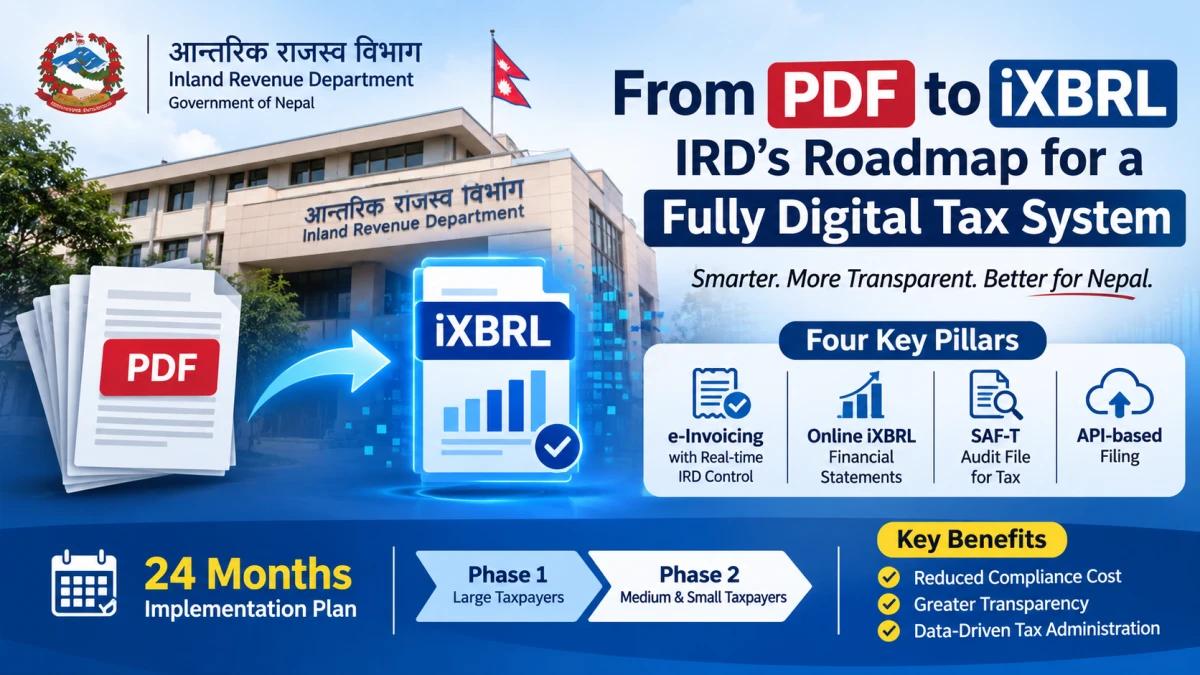
The Inland Revenue Department (IRD), Nepal has received the report of the PDF Format to XBRL System Transformation Study Committee, which recommends moving audited financial statements and tax filings from PDF documents to a machine-readable iXBRL reporting system. The report was submitted to IRD Director General Dr. Bhishma Kumar Bhusal, and IRD announced it through a press release dated 2083/07/18 (BS).
The report sets out a clear roadmap to:
Replace paper-based statements, multiple annexes and fragmented PDF-based reports.
Build an automated, transparent and machine-readable digital tax system aligned with international standards.
Complete implementation within 24 months, in two phases.
About the Study Committee
Particular | Details |
|---|---|
Committee name | PDF Format to XBRL System Transformation Study Committee |
Coordinator | Deputy Director General Mr. Janakraj Sharma |
Formed by | Secretary-level decision dated 2083/05/08 (BS) |
Members | IRD Deputy Directors General and Directors, plus two expert representatives from the Institute of Chartered Accountants of Nepal (ICAN) |
Policy link | Item 3 of IRD's 28-point transformation action plan on tax reform: risk-based tax audit and investigation using AI and data analytics |
Benchmarks studied | International practices, OECD standards, IMF and World Bank guidance, and the tax systems of Norway and other countries |
The Four Fundamental Pillars
The committee recommended four pillars to fully digitalize Nepal's tax system.
Pillar | What is proposed | Expected result |
|---|---|---|
1. Structured e-Invoicing | Upgrade the existing Central Billing Monitoring System (CBMS) and introduce e-billing with real-time IRD control or authentication. Integrate it with the Vehicle Consignment Tracking System (VCTS). | Lower risk of fake tax invoices, greater business transparency and easier tracking of goods movement. |
2. Online iXBRL financial statements | Make it mandatory to file audited annual financial statements online in iXBRL format, following the National Taxonomy to be prepared in line with NFRS by the Accounting Standards Board (ASB). | Statements become machine-readable, enabling automatic risk identification by business sector and data analytics, instead of manual review. |
3. Standard Audit File for Tax (SAF-T) | Require prescribed audit data and books of accounts to be provided on demand in a standard SAF-T format. | More objective and automated tax audits and investigations, uniform Charts of Accounts and multidimensional analysis. |
4. API-based filing | Develop an open and secure Application Programming Interface (API) so returns can be filed directly from the taxpayer portal and commercial accounting software. | System-to-system filing, with less manual entry and fewer errors. |
Implementation Roadmap: 24 Months, Two Phases
The committee also stressed the need to broadly simplify income returns, tax returns, annex forms and related procedures as part of modernizing tax administration.
Phase | Key activities |
|---|---|
Phase 1 | Form a Steering Committee; establish the legal basis; build staff capacity; develop IT systems; build the tax taxonomy; conduct risk-based audits of large taxpayers; and strengthen the capacity of stakeholders. |
Phase 2 | Extend the system progressively to medium and small taxpayers, moving fully to faceless and contactless tax administration. |
Expected Benefits
IRD expects the transformation to deliver the following:
Lower compliance cost for taxpayers.
Control of revenue leakage and development of an error-free revenue system.
End to dual bookkeeping, as the same structured data feeds both financial reporting and tax filing.
Less time spent uploading returns and financial statements to the Integrated Tax System.
Better server storage efficiency compared with storing large PDF files.
Automated, multidimensional analysis, enabling risk identification and better-quality tax audits.
Greater transparency, impartiality and public trust in tax administration.
For successful implementation, IRD plans continuous coordination and capacity-building programs with accounting professionals, ICAN, software developers, the private sector and other stakeholders.
What This Means for Businesses and Professionals
The proposals are recommendations at this stage; detailed rules, the legal framework and the National Taxonomy are still to be issued. Even so, the direction is clear, and early preparation will ease the transition.
Stakeholder | Likely impact | Suggested preparation |
|---|---|---|
Businesses and taxpayers | Financial data will be read and analyzed by IRD systems automatically, so inconsistencies between books, invoices and returns will surface faster. | Clean up the chart of accounts, reconcile VAT, TDS and income tax records with the books, and confirm that billing software can integrate with CBMS. |
Auditors | Audited financial statements will need to be tagged in iXBRL using the National Taxonomy, adding a new reporting step to audit engagements. | Build familiarity with iXBRL tagging and NFRS-based taxonomies, and plan for review of tagged data. |
Finance and accounts teams | SAF-T and API-based filing will require structured, system-generated data rather than manually prepared schedules. | Review accounting software capability for SAF-T export and API connectivity, and strengthen data quality controls. |
Software vendors | Accounting and billing software will need to support e-invoicing, iXBRL, SAF-T and API filing. | Monitor IRD technical specifications and plan product updates in advance. |
Large taxpayers should expect to be covered first under Phase 1, while medium and small taxpayers will follow in Phase 2.
Conclusion
The move from PDF to iXBRL marks a significant step in Nepal's shift toward data-driven, risk-based and faceless tax administration. Businesses, auditors and finance teams that begin aligning their systems and records now will be better placed to comply smoothly once IRD issues the detailed requirements. We will continue to monitor developments and share updates as further guidance is released.
Source: Press release of the Inland Revenue Department dated 2083/07/18.
This article is for general information only and does not constitute professional advice. Please consult a qualified tax advisor for guidance specific to your situation.