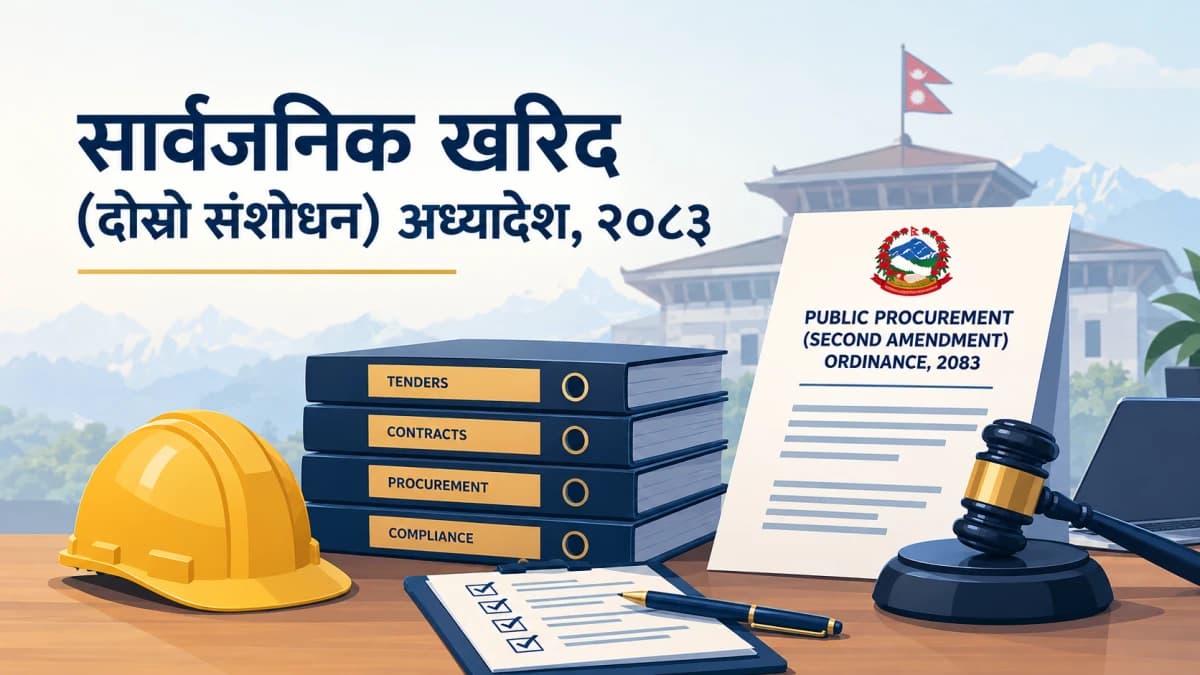
सार्वजनिक खरिद (दोस्रो संशोधन) अध्यादेश, २०८३
Introduction
On 17 Baisakh 2083 (30 April 2026), the Ministry of Law, Justice and Parliamentary Affairs published Ordinance No. 02 of 2083 in Part 2 of the Nepal Gazette (Volume 76, Extraordinary Issue 4). The Public Procurement (Second Amendment) Ordinance, 2083 was promulgated by the President on the recommendation of the Council of Ministers under Article 114(1) of the Constitution of Nepal, because the Federal Parliament was not in session. It amends 31 provisions of the Public Procurement Act, 2063 and takes effect immediately.
For contractors, suppliers, consultants and the finance and audit teams of public bodies, this is a substantial rewrite of how public tenders are designed, evaluated and administered.
Background and legal context
The Public Procurement Act, 2063 (the principal Act) governs how public bodies in Nepal buy goods, construction works and services. The ordinance route allows urgent amendments while Parliament is not sitting. The Gazette preamble records that an immediate amendment was necessary and that the Federal Parliament was not in session. The text of the ordinance is set out in 31 numbered sections, each amending or inserting a provision in the principal Act.
Main provisions and changes
1. New and revised definitions (Section 2)
Public projects are now included alongside government bodies and offices in the definition of a public body.
"Goods" is redefined to cover movable and immovable, living and non-living, tangible and intangible items, together with incidental services connected with supply.
"Other services" now expressly lists vehicle and equipment hire, transport, repair and maintenance, advertising, security, cleaning, air tickets, and infrastructure management, operation and repair, while continuing to exclude consulting services.
A new definition of "domestic goods" covers goods produced with domestic labour and raw materials, or from imported raw materials where domestic labour, raw materials and materials contribute at least 30 percent of value added. Goods imported from abroad and merely branded in Nepal are not domestic goods.
2. Procurement methods and bidder qualification (Sections 3 to 6)
A reverse auction method is added to the list of procurement methods. It lets a public body treat its cost estimate as a ceiling and select the bidder offering the lowest bid, subject to a defined bidding period.
Public bodies may not procure by splitting a requirement into large packages or small pieces in a way that restricts competition.
Qualification criteria may cover professional and technical capacity, equipment, past performance, bid capacity, after-sales service, spare parts, legal capacity, financial resources and penalties for professional misconduct.
Where two or more firms merge before bidding, the qualifications of the pre-merger firms count towards the merged entity.
Single-envelope bidding applies where qualification is not required or construction value is below a prescribed figure. Two-envelope bidding (separate technical and financial proposals) applies to construction above the prescribed value. Joint venture members bear joint and several liability and responsibility cannot be passed to one member.
3. Shorter notice periods and electronic procurement (Sections 7 and 14)
The ordinance shortens several minimum notice periods. The notice does not restate the categories of procurement to which each period applies, and those categories have not been independently verified here.
Provision of the Act | Previous minimum | New minimum |
Section 14(4), first period | 30 days | 21 days |
Section 14(4), second period | 45 days | 30 days |
Section 14(4A), first period | 15 days | 7 days |
Section 14(4A), second period | 21 days | 15 days |
Section 14(4B) | 7 days | 3 days |
Section 40(3), sealed quotation notice | 15 days | 7 days |
Where bids or prequalification are invited through the electronic procurement system, notices need not be published in any other medium. Where they are not, the notice must appear on the website of the Public Procurement Monitoring Office and of the public body, and on the information portal. Under the new section 14(12), the Government of Nepal may call bids with a seven day period in special circumstances. Public bodies must give priority to domestic goods and state this in the bidding documents (section 14(8A)).
4. Evaluation, negotiation and award (Sections 8 to 13)
Technical and financial proposals are to be evaluated strictly on the criteria stated in the bidding documents. In two-envelope bidding, the technical envelope is opened first and only substantially responsive bidders have their financial proposals evaluated.
If a bid is more than 30 percent below the approved cost estimate, the committee must request a rate analysis and compare it with prevailing norms and rates. A bid that shows no basis for performing the work at its quoted rates is removed from evaluation, and the reasoning must be disclosed in the evaluation report.
Where the lowest substantially responsive bid is materially above the approved estimate, the public body may negotiate a lump sum percentage discount to bring the price within the estimate. Specifications and quality may not be reduced as part of such negotiation.
Tied lowest bids are resolved by lottery.
For consultancy selection, where the top proposal is materially above the estimate and budget, the next ranked proposer can be selected without cancelling the whole procurement if its price is not materially above the estimate and budget.
5. New institutional and special arrangements (Sections 15 to 19, 26, 27 and 29)
Government e-marketplace (new section 41A): goods and services listed on a marketplace prepared by the Public Procurement Monitoring Office may be bought directly up to a prescribed amount. Producers, suppliers and service providers must publish their details and prices on it.
Special procurement (new section 42A): fertilizer, medicine, information technology and items notified by the Government of Nepal follow a government approved procedure covering cost estimates, price escalation, bidder eligibility, bid security, bid documents and contract terms.
Land purchase for commercial or business purposes (new section 43A) may follow a prescribed procedure, while land acquisition for public purposes remains under the prevailing land acquisition law.
User committees and beneficiary groups (section 44) may execute construction works meeting prescribed conditions, such as no need for complex technical capacity, local resource use and local employment, and may set up training centres and small enterprises.
Incentives and awards (new sections 61B and 62A): employees and construction entrepreneurs who complete procurement or works with quality and within the planned time may receive incentives, awards or certificates as prescribed.
Government Procurement Service Office (new section 66A): a service office is established under the Office of the Prime Minister and Council of Ministers to help selected public bodies choose suppliers and buy goods.
6. Contract administration (Sections 20 to 25 and 28 to 31)
Topic | Change |
Mobilization advance (s. 52A) | Up to 20 percent of contract value against an advance bank guarantee, after the public body obtains the main activities and procurement work plan. |
Variation orders (s. 54) | Up to 5 percent by the head of the gazetted third class office or equivalent; up to 10 percent by the head of a second class office; up to 15 percent by the head of a first class office; above 15 percent by the departmental head. |
Termination (s. 59(8)) | Performance security is forfeited. The public body may recover additional completion cost from the defaulting contractor as government arrears and need not re-invite bids. |
Disputes (new s. 58A) | Public infrastructure construction cannot be stopped because of a dispute between the parties. |
Review Committee (s. 50) | Public bodies must implement Review Committee decisions. If not, the aggrieved bidder may apply to the Committee, which can write to the competent authority for departmental action. |
Monitoring (s. 61A) | Officials who fail to act on listed procurement defaults face departmental action under prevailing law. |
Federal structure (s. 74(4)) | The Federal Government may prescribe that provincial and local bodies carry out functions assigned to federal bodies. |
The ordinance also lets public bodies undertake certain work by direct departmental force account (section 45), allows air service licensees to buy or lease aircraft and aviation equipment, and lets infrastructure companies buy construction materials and rent machinery under the Act (section 67).
Practical implications
Bidders. Shorter notice windows mean bid preparation time is tighter. Domestic goods now attract a statutory preference, so documenting domestic value addition of at least 30 percent will matter.
Public bodies and auditors. The rate analysis requirement for abnormally low bids and the reverse auction method change how price competition is managed and evidenced in the audit file.
Finance professionals. Accountants advising contractors should review contract templates for the advance payment limit, variation order approval levels and the cost recovery rule on termination.
Pending rules. Many operational details are left to rules or prescribed procedures. Practical application will depend on the Public Procurement Rules and guidance issued under the amended Act.
Effective date and transitional arrangements
The ordinance was published and certified on 17 Baisakh 2083 and, under section 1(2), commences immediately. The ordinance contains no separate transitional or savings provision. Procurement proceedings already under way when it came into force should be reviewed against the amended text. Its continued force depends on how the ordinance is dealt with by the Federal Parliament, which has not been verified for this article.
Conclusion
The Second Amendment Ordinance modernises the Public Procurement Act, 2063 in several directions at once: electronic and marketplace purchasing, shorter timelines, stricter evaluation of low bids, preference for domestic goods and clearer contract administration rules. Businesses that sell to the public sector should update their bidding checklists now and monitor the accompanying rules.
Official sources and references
Nepal Gazette, Part 2, Volume 76, Extraordinary Issue 4, dated 2083-01-17, Ordinance No. 02 of 2083 (original notice): http://rajpatra.dop.gov.np/welcome/book/?ref=26311
Official listing of Gazette notices (Ari), 2083: http://rajpatra.dop.gov.np/welcome/list_by_type/0/2083
Public Procurement Monitoring Office: https://www.ppmo.gov.np
Nepal Law Commission (legislation database): https://www.lawcommission.gov.np
Disclaimer
This article is intended for general informational and educational purposes and should not be treated as a substitute for advice based on the specific facts and applicable law.
FAQs
• Q: When did the ordinance take effect? A: Section 1(2) provides that it commences immediately. It was published and certified on 17 Baisakh 2083 (30 April 2026).
• Q: What is a domestic good under the ordinance? A: Goods produced with domestic labour and raw materials, or from imported raw materials where domestic labour, raw materials and materials contribute at least 30 percent of value added. Imported goods merely branded in Nepal do not qualify.
• Q: How much mobilization advance can a public body give? A: Up to 20 percent of the contract amount against an advance bank guarantee, under new section 52A.
• Q: Does the ordinance shorten bid notice periods? A: Yes. Section 14 and section 40(3) minimum periods are reduced, for example 30 days to 21 days and 7 days to 3 days in the respective sub-sections.