सहकारी (पहिलो संशोधन) अध्यादेश, २०८३
Nepal Gazette, Part 2, Vol. 76, Extraordinary Issue 3, Baisakh 17, 2083 (Ordinance No. 1 of 2083)
Introduction
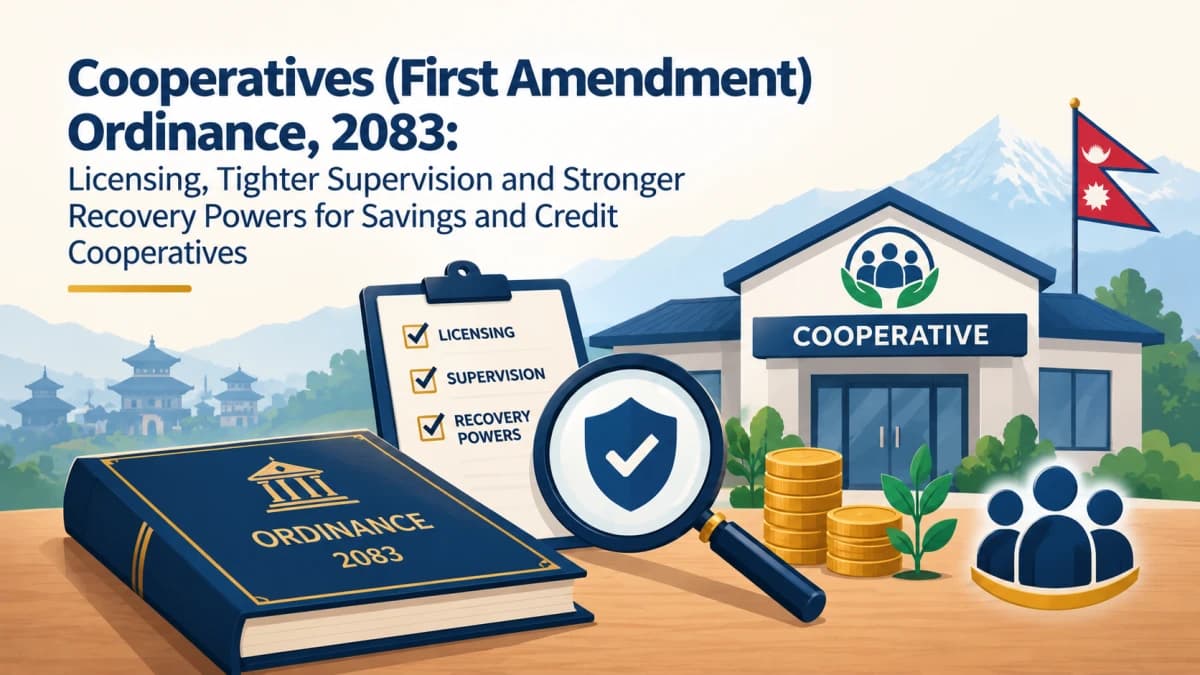
On Baisakh 17, 2083 (April 30, 2026), the Ministry of Law, Justice and Parliamentary Affairs published the Cooperatives (First Amendment) Ordinance, 2083 in an extraordinary issue of the Nepal Gazette. The President promulgated it on the recommendation of the Council of Ministers under Article 114(1) of the Constitution, because Parliament was not in session. It amends the Cooperatives Act, 2074 in 33 numbered provisions.
The Ordinance matters to members and depositors of savings and credit cooperatives, to directors and managers, to auditors, and to lenders and regulators. Its core theme is to place cooperatives whose main business is savings and credit under a licensing and supervision regime run by the Authority, and to widen the powers available when such a cooperative runs into trouble.
Background and Legal Context
The Cooperatives Act, 2074 governs formation, registration, management, savings and credit mobilisation, problem-ridden cooperatives, offences and penalties. Before this amendment, the Act spoke of a National Cooperative Development Board in several places. Press reports on the ordinance issued on December 29, 2024 (Poush 14, 2081) state that it created a National Cooperative Regulatory Authority to regulate cooperatives carrying on savings and credit business and repealed the National Cooperative Development Board Act, 2049. The present Ordinance replaces the Board with the Authority throughout the Act and gives the Authority the lead role over savings and credit cooperatives. The Authority's own governing instrument was not reviewed for this article, and the Ordinance pages read do not define the term.
Main Provisions and Changes
1. New and revised definitions (section 2)
Licence. The Ordinance adds a definition of licence, meaning the operating licence granted under the new section 16A.
Main business threshold. The definition of main business in section 2(ज) now requires a share of at least fifty percent, in place of thirty percent in the Act as published, of savings liabilities and of member purchase or sales transactions.
Savings and credit main-business cooperative. A savings and credit main-business cooperative is one where total savings collected, or total loans outstanding, exceed fifty percent of total assets or total liabilities shown in its balance sheet. Any cooperative holding total savings or total loans above Rs 25 crore is also covered.
Family and relative. "Family" is redefined in detail (spouse, children, adopted children, parents, step-mother, and dependent siblings, with grandparents and in-laws added for the relevant member). For a problem-ridden cooperative, a family member who has apparently separated by dividing shares is still counted as family. A new definition of "relative" covers uncles, aunts, nephews, nieces, in-laws and other listed relations, and extends to employees of the cooperative.
Registrar. "Registrar" now includes the officer who performs the registrar's functions under provincial and local cooperative laws.
2. Registration, licensing and entry rules (sections 14, 16A and 50)
Prior approval. A savings and credit cooperative must attach the Authority's prior approval to its registration application, and a cooperative bank must attach Nepal Rastra Bank's (amended section 14(3)).
Operating licence. New section 16A requires savings and credit main-business cooperatives to hold an operating licence from the Authority. Cooperatives already registered must obtain it within one year of commencement. The licence is renewed annually, and fees, procedure and criteria will be prescribed.
Suspension. The Authority may suspend a licence if the cooperative breaches the Act, rules or directives, acts against members' interests, or fails to submit the financial and business details required by the Authority. A suspended cooperative cannot carry on business for the suspension period.
Unions barred from savings and credit. New section 50(9) bars cooperative unions (sangh) from savings and credit business. Unions that were already doing so must close that business within three years of commencement.
3. Operating limits and financial discipline
Section | Change |
32(1) proviso | Time limit changed from one year to two years. |
50(5) | Total interest charged by a cooperative may not exceed the principal sum, in addition to the existing bar on charging interest on capitalised interest. |
68 (new sub-section 4) | Where a retrospective restatement under the applicable accounting standards raises profit, the reserve fund must also be adjusted to that extent. |
125(1)(छ) | Dividend ceiling relevant to the fine provision reduced from eighteen percent to fifteen percent of share capital. The fine under section 125 can reach Rs 5 lakh. |
4. Supervision, inspection and information (sections 73, 81, 95, 97, 101, 150, 150A and 151)
Monitoring system. New section 97 requires savings and credit main-business cooperatives to adopt the monitoring system prescribed by the Authority. The Authority supervises on that basis and may take help from Nepal Rastra Bank and other bodies.
Account audit. The Authority may audit the accounts of these cooperatives despite anything else in section 95.
Credit information. The Authority must coordinate with the Credit Information Centre for savings and credit cooperatives, and the Department for other cooperatives (section 81(5)).
Deposit protection. These cooperatives must take secure membership of the Deposit and Credit Protection Fund under prevailing law, prepare updated details of protected savings and loans, and provide them to the Authority and the Department (section 101).
Reports and directions. Cooperatives must file reports within the time set by the Authority. The Authority may study them, issue directions, order intensive monitoring or special inspection, and recommend further investigation and action to the relevant body (section 150A). It may also issue directives and procedures for its own work (section 151(1ख)).
Provincial and local cooperatives. Provincial and local government cooperatives are governed by their own laws, provided these do not conflict with federal law (section 150(10)).
5. Problem-ridden cooperatives and recovery of savings (sections 103G to 115)
Early freezing and travel ban. Before recommending that a cooperative be declared problem-ridden, the Registrar or the Authority must freeze movable and immovable property, business, bank accounts and shares, and place loan promissory notes and electronic records under control, for directors, borrowing members, managers, responsible employees, account supervision committee members, loan sub-committee members and others who appear involved in losses or misuse. A travel ban abroad is also required (section 104(1ख)).
Recovery steps and composition changes. Amended section 103J lists steps for cases where savers are not repaid: facilitating recovery of the cooperative's loans, ordering refund of savings within a set period, seeking police assistance, freezing property held by directors, employees and related persons who do not comply and imposing travel bans, and, where refund still fails, sending a complaint to the police to treat the matter as an offence. Section 103G adds the Department's Registrar as a member and the Authority's Executive Director as member-secretary of the body it describes. The headings of sections 103G and 103J were not available in the Act copy reviewed, so readers should read them in the current consolidated Act.
Revolving Relief Fund. The Government may set up a revolving relief fund to refund savings quickly to members of problem-ridden cooperatives who claim under section 112क. It is funded by government contributions, repayments from the cooperative and other sources, kept in a separate account at an A-class commercial bank, is not frozen at the year end, and may be spent only for refunds under section 108(1)(क) (new section 108ख).
Government funding for asset management. The Government may provide the cash needed to manage the assets of a problem-ridden cooperative if it cannot be recovered at once from those assets (section 110).
Wider reach and priorities. Section 106 widens the committee's powers to cover directors, former directors, committee office-bearers, managers, employees and their families or relatives. Section 108(1)(ग) adds payment to persons who paid advance sums for business with the problem-ridden cooperative. Section 115 keeps existing freezes and bars auctions or transfers of the property of cooperatives under double freezes.
6. Institutional changes
References to the National Cooperative Development Board are replaced with the Authority in sections 25, 51, 70, 103, 129 and 135. Section 149 is replaced so that the Government of Nepal may make rules and the Authority may make regulations with Government approval. Section 70 places the cooperative promotion fund under the Department, and section 73 requires the Registrar to update the share-member and share-amount record every year.
Practical Implications
Cooperatives. Each savings and credit main-business cooperative should check whether it meets the new fifty percent or Rs 25 crore tests, apply for the licence within one year and budget for annual renewal fees.
Directors and managers. Boards should review loan pricing against the principal limit, dividend proposals against the fifteen percent ceiling, and family and relative lending exposures against the wider definitions.
Members and depositors. The Ordinance aims to make recovery of savings faster, through freezes, travel bans and the relief fund. The notice does not promise that any member will be repaid in full.
Accountants and auditors. Accountants and auditors should note the reserve-fund adjustment on retrospective restatements, the Authority's audit power and the extra reporting duties.
Unions. Cooperative unions doing savings and credit business face a three-year wind-down.
Effective Date and Transitional Arrangements
Section 1(2) states that the Ordinance comes into force immediately. The Gazette is dated Baisakh 17, 2083 (April 30, 2026) and the authentication date shown is also Baisakh 17, 2083. Transitional periods are built in: one year to obtain a licence under section 16A(2) and three years for unions to close savings and credit business under section 50(9). Under Article 114 of the Constitution an ordinance is temporary and must be placed before Parliament. The Gazette notice does not state what has happened since, so readers should confirm whether it has been replaced by an Act before relying on it.
Conclusion
The Ordinance moves savings and credit cooperatives from a lightly supervised model to one built on licensing, monitoring and quick intervention. For cooperatives, the main tasks are to secure the licence in time and to tighten governance. For members, the changes may improve the chances of orderly recovery if a cooperative fails.
Official Sources and References
Nepal Gazette, Part 2, Vol. 76, Extraordinary Issue 3, Baisakh 17, 2083, Cooperatives (First Amendment) Ordinance, 2083: Original Gazette notice (Department of Printing)
Cooperatives Act, 2074 (reference copy of the Law Commission text): Cooperatives Act, 2074
Press report on the December 2024 cooperatives ordinance and the Authority (background only): Kantipur report
Disclaimer
This article is intended for general informational and educational purposes and should not be treated as a substitute for advice based on the specific facts and applicable law.
FAQs
Q. Which cooperatives need the new operating licence?
Savings and credit main-business cooperatives (section 16A). Existing ones must apply within one year of commencement, and the licence is renewed annually.
Q. What is the new dividend ceiling?
A. Section 125(1)(छ) now refers to fifteen percent of share capital instead of eighteen percent.
Q. Can cooperative unions run savings and credit business?
No. Under new section 50(9), unions must close that business within three years of commencement.
Q. When did the Ordinance take effect?
Immediately, with the Gazette dated Baisakh 17, 2083 (April 30, 2026).